What a Difference Six Months Makes – International Media Discuss Kim Jong-Un Meeting With Xi Jinping…


It was only six months ago when the international media and U.S. left-wing pundits were proclaiming how we were on the cusp of thermonuclear war with North Korea.  As outlined HERE there was almost no-one paying attention to the approach taken by President Donald Trump to creating the “Magnanimous Panda” outcome.

Well, today those same media are reporting on North Korean leader Kim Jong-Un meeting with Chinese President Xi Jinping and committing to a denuclearized Korean peninsular:

SEOUL, March 28 (Yonhap) — North Korean leader Kim Jong-un has visited China at the invitation of President Xi Jinping and reaffirmed his commitment to denuclearization during their first summit, the two countries’ media said Wednesday.

The North’s leader made an “unofficial” visit to China from Sunday to Wednesday, accompanied by his wife Ri Sol-ju and key officials, including de facto No. 2 figure Choe Ryong-hae, according to the North’s state-run radio.

It was Kim’s first foreign trip since he took office in late 2011.  The summit came as Kim plans to meet the leaders of South Korea and the United States in the coming months. (read more)

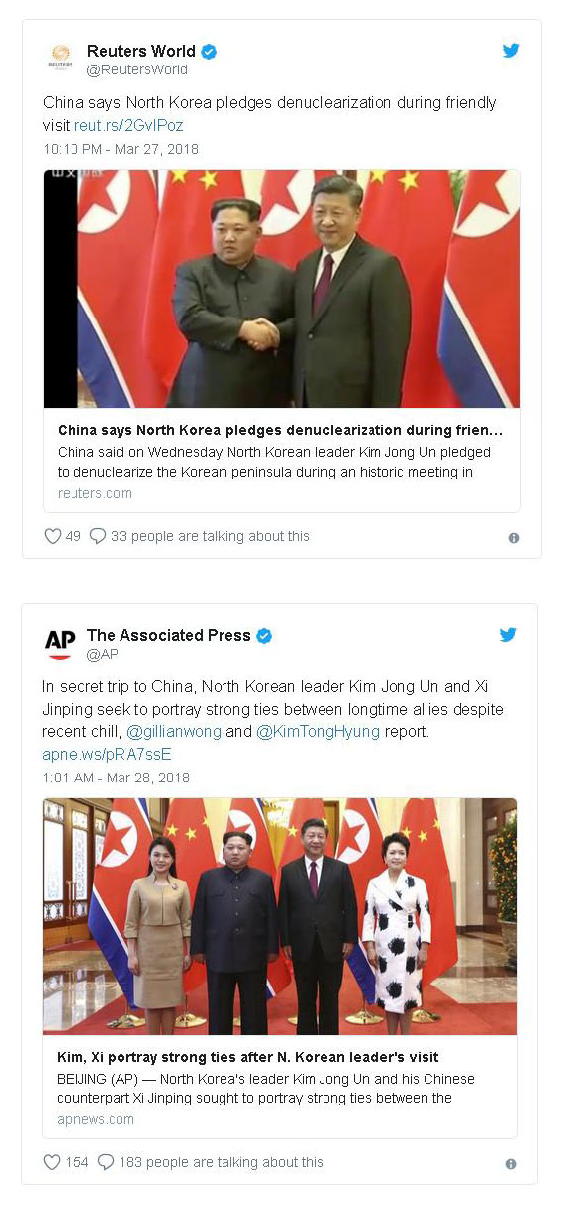
Well, well, well,…. doesn’t this look like the “Magnanimous Panda” outcome previously discussed?

August 2017 […] The end result will be Kim Jong-un giving up his nuclear ambitions for good; a group of nations promising economic assistance (size TBD), and some official enterprise of ASEAN partners enters as an agency to oversee nuclear compliance under carefully negotiated terms. Big Panda (Xi Jinping) promises the world to be the magnanimous insurance policy therein. Everything between now and that outcome is optically chaff and countermeasures.  SEE HERE and HERE

Funny how that works?...

“complicated business folks,…. complicated business”..

…. And likely no-one in media will ever recognize exactly how it all came together.

August 29th, 2017

August 30th, 2017

China’s objective is conquest.  China’s tool for conquest is economics.  President Trump’s entire geopolitical strategy, using economics in a similar way, is an existential threat to China’s endeavor.  Communist Beijing calls the proverbial DPRK shots.

President Trump is putting on a MASSIVE economic squeeze.

♦Squeeze #1. Trump and Mnuchin just sanctioned Venezuela and cut off their access to expanded state owned oil revenue.  Venezuela now needs more money.  China and Russia are already leveraged to the gills in Venezuela and hold 49% of Citgo as collateral for loans outstanding.  Now China and Russia will need to loan more, directly.

♦Squeeze #2.  China’s geopolitical ally, Russia, is already squeezed with losses in energy revenue because of President Trump’s approach toward oil, LNG and coal.  Trump, through allies including Saudi Arabia, EU, France (North Africa energy), and domestic production has driven down energy prices. Meanwhile Russia is bleeding out financially in Syria.  Iran is the financial reserve, but they too are energy price dependent.

♦Squeeze #3. Trump and Tillerson just put Pakistan on notice they need to get involved in bringing their enabled tribal “extremists” (Taliban) to the table in Afghanistan.  Pakistan’s primary investor and economic partner is China.  If U.S. pulls or reduces financial support to pressure Pakistan toward a political solution in Afghanistan, China has to fill void.

♦Squeeze #4. China’s primary economic threat (competition) is next door in India.  President Trump has just embraced India as leverage over China in trade and pledged ongoing favorable trade deals.  The play is MFN (Most Favored Nation) trade status might flip from China to India.  That’s a big play.

♦Squeeze #5.  President Trump has launched a USTR Section 301 Trade Investigation into China’s theft of intellectual property.  This encompasses every U.S. entity that does manufacturing business with China, particularly aeronautics and technology, and also reaches into the financial services sector.

♦Squeeze #6.  President Trump, Secretary Ross, Secretary Mnuchin and USTR Robert Lighthizer are renegotiating NAFTA.  One of the primary objectives of team U.S.A. is to close the 3rd party loopholes, including dumping and origination, that China uses to gain backdoor access to the U.S. market and avoid trade/tariff restrictions. [China sends parts to Mexico and Canada for assembly and then back-door entry into the U.S. via NAFTA.]

♦Squeeze #7. President Trump has been open, visible and vocal about his intention to shift to bilateral trade renegotiation with China and Southeast Asia immediately after Team U.S.A. conclude with NAFTA renegotiation.

♦Squeeze #8.  President Trump has positioned ASEAN (Association of Southeast Asian Nations) as trade benefactors for assistance with North Korea. The relationship between ASEAN nations and the Trump administration is very strong, and getting stronger. Which leads to…

♦Squeeze #9.  President Trump has formed an economic and national security alliance with Shinzo Abe of Japan.   It is not accidental that North Korea’s Kim Jong-un fired his missile over the Northern part of Japan.  Quite simply, Beijing told him to.

Add all of this up and you can see the cumulative impact of President Trump’s geopolitical economic strategy toward China.  The best part of all of it – is the likelihood China never saw it, meaning the sum totality of “all of it”, coming.

Six Months Later – This week:  •India announces $500 billion investment in U.S. steelworks.  •USTR finalizes section 301 report on Chinese trade practices.  •The U.S. and South Korea sign historic renegotiated “KORUS” trade deal.  •President Trump handing out Steel and Aluminum tariff exemption cards…..  And, oh yeah, North Korea tells China it agrees to a full reversal of nuclear ambitions.

Funny that.


KORUS Details Emerging – South Korea Agrees to 30% Reduction in Steel, Accepts Doubling of U.S. Autos, Accepts 20 Year Extension on Truck Tariff…


The actual announcement of KORUS (“KOR”+”U.S.”), the renegotiated U.S. and South Korea trade deal, has yet to be made by U.S. Trade Representative Robert Lighthizer, Commerce Secretary Wilbur Ross and U.S. President Donald Trump.  However, more details are surfacing inside KORUS media leaks.  Fantastic job by Lighthizer!

TOP LINES:

  • U.S. Gains twice as many exported vehicles into S-Korea (50k per manufacturer, per year).  [No word on possible Kia / Hyundai tariff or quota – RE: “unlikely”]
  • South Korea drops ridiculous customs inspection barriers. [Trade trickery ploy]
  • U.S. retains 25% Tariff on S-Korea pickup trucks with extension for 20 years.
  • South Korea gets two year exemption from a 25% U.S. steel tariff, but must drop steel export level to 70% of prior two years shipments. (A controlled reduction of 30%).

(Via AP) The new deal doubles — to 50,000 — the cars each U.S. automaker can export annually to South Korea, reduces bureaucratic barriers to American products and extends a 25 percent U.S. tariff on South Korean pickup trucks by 20 years, through 2041.

South Korea escapes America’s new 25 percent tariff on imported steel — but must accept quotas on steel exports equal to 70 percent of its average annual shipments to the United States between 2015 and 2017.

The officials spoke on condition of anonymity in order to discuss the policy ahead of an official announcement.

The United States this month began imposing the steel tariffs, saying imports jeopardized U.S. national security. But it has been suspending the duties on allies like the European Union, Canada and Mexico.

The U.S. Treasury Department is also in talks on a deal to prevent Seoul from deliberately pushing its currency lower to give South Korean exporters a competitive advantage. A formal agreement on currency would be unprecedented — but it wouldn’t have teeth, because it would include no enforcement mechanism.

The U.S. trade deficit in goods with South Korea — nearly $23 billion last year — widened after the original pact took effect in 2012, one reason Trump has denounced it. Trade in autos has been especially lopsided: South Korea last year exported to the United States 929,000 passenger vehicles worth $15.7 billion. By contrast, the U.S. shipped to South Korea fewer than 53,000 autos, worth just $1.5 billion, according to the U.S. Commerce Department.

The United States says South Korea has used non-tariff barriers, such as rigorous customs inspections, to block U.S. products.

Trump’s complaints about South Korean trade practices have caused friction between the two allies at a crucial time, as he prepares for a meeting with North Korea’s reclusive leader, Kim Jong Un.

Unions at South Korea’s two-largest automakers, Hyundai Motor Co. and Kia Motors Corp., have already blasted the new agreement for blocking access to the fast-growing U.S. pickup truck market. “It is a humiliating deal that accepts Trump’s strategy to preemptively block South Korean pickup trucks,” Hyundai Motor Company’s labor union said in a statement.  (read more)

Commerce Secretary Wilbur Ross Talks KORUS, Tariffs, China, EU, NAFTA and Census With Maria Bartiromo…


Commerce Secretary Wilbur Ross appears on Fox Business News for an extensive interview with Maria Bartiromo.  The interview covers a wide spectrum of important topics attached to the U.S. economy and ongoing trade deals.  Two great video segments for the interview will get you up to speed on ongoing initiatives:

♦Segment #1 outlines the upcoming announcement of KORUS, the South Korea and U.S. trade deal.  Additionally, Secretary Ross discusses the steel and aluminum tariffs and how they enmesh in the larger objective of the ongoing trade negotiations with China:

.

♦Segment #2 outlines more on the aluminum and steel tariffs; ongoing trade talks with Europe; efforts to renegotiate NAFTA, and the possibility of a deal being reached; Saudi Arabian investment in the U.S. and the Commerce Department plans to bring back a citizenship question in the 2020 Census.

.

Worth noting the reaction to Maria Bartiromo at 02:45 of the video centered around the question of the “lefty winning in Mexico“, etc. It would appear, based on hidden grinning, the trade team is anticipating a socialist victory in the Mexican election which would likely end up with Mexico wanting to cancel NAFTA due to loggerheads with the U.S.

It is additionally likely Canada’s Chrystina Freeland would lose her NAFTA cohort Mexican Foreign Minister Ildefonso Guajardo. Through seven rounds of NAFTA talks Freeland and Guarjardo have tag-teamed against Ambassador Robert Lighthizer (U.S.).

National Trade Council Director Peter Navarro Discusses Ongoing Trade Initiatives…


National Trade Council Director Peter Navarro appeared on CNBC, prior to today’s massive U.S. stock market increase, to discuss ongoing trade initiatives.

U.S.T.R. Robert Lighthizer is currently conducting simultaneous bilateral trade negotiations with South Korea, Philippines, Vietnam, Australia, China (way-points), Japan, Mexico/Canada (NAFTA) and the European Union.

India Invests $500 Million In Two U.S. Steel Operations…


The passage of the defense spending portion of the Omnibus bill ultimately means there will be increased demand for U.S. steel and aluminum within new defense equipment. The contracts within the procurement process will predictably require the use of U.S. parts.

Add the increase in defense spending with the pending global tariffs on steel imports, and the environment is created for foreign investment in domestic steel and metal manufacturing…. Then add into the mix the geopolitical economic relationship developed between India’s Prime Minister Modi and President Trump… And you discover the backdrop for this announcement from India owned JSW Steel:

(Reuters) – India’s JSW Steel Ltd said on Monday it would spend $500 million to build out its U.S. operations in Texas, amid heightened global trade tensions following U.S President Donald Trump’s decision to pursue steep import tariffs.

The company has signed an agreement with the Texas governor’s office, under which the governor has approved a grant worth $3.4 million to the company’s unit, the steelmaker said in a statement here.

The unit, JSW USA, sells high-quality carbon plates to the energy, petrochemicals, defense and other heavy equipment industries.

The company will use $150 million of the funds to improve and modernize its plant in Baytown, Texas, while the rest will fund a new facility, it said.  (read more)

.

Remember, a key part of MAGAnomics is changing the investment dynamic where the ‘best play’ is to invest in the U.S.

The entire landscape of modern geopolitics is an assembly of various nations specifically focused on their economic interests.  Fundamentally, the economics of a nation is the cornerstone for their ability to hold, advance, influence and present their ideology.

Without the underlying economic capability to provide sustainability and stability, the nation, any nation, cannot maintain itself regardless of the underlying political outlook.  In short, as the old verse presents: “money makes the world go ’round“.  Everything boiled down to it’s essential core – is about economics.

The shock to the system of modern multinational financial interests was created by an earthquake known as Trump; which created a seismic shift via the 2016 U.S. presidential election outcome.

The tectonic political and economic shift was so unsettling to the global elites -who created a decades-long system of global financial interests- they have been thrashing around desperate to regain footing ever since.

All modern political alliances are based on this economic reality, and every single action taken by every member within each grouping is based on their affiliated and interconnected self-interest in the underlying economic equation.

At first, every nation positioned themselves to push-back against a realignment in geopolitical power based on the nationalistic economic shifting created by U.S. President Donald J. Trump.  However, as time progresses, and the clear strategy of President Trump begins to take shape, allies and adversaries have begun to accept that POTUS Trump is not going to retreat.  Access to a $20 trillion U.S. market is the biggest economic leverage in the world.

It doesn’t matter which continent you point to. If you pull back to the larger view and overlay the economic maneuvering you will find the reason behind the strategic relationship always revolves around economics.  War or peace, it’s all about the economics within the equation.

If you scale market economies on a linear continuum according to freedom (size of government in their economic market), and line up the individual nations as flags according to their political outlook on the same linear scale, you will quickly see how the groups cluster in both political ideology and similar economics. [Big government communist nations cluster together; big government socialist nations cluster together; and smaller government fair markets cluster together.] It has always been thus.

The scale of market freedom, in direct proportion to the wealth of the individual within each nation, is the one constant in an ever changing universe.

This is the essential issue with global trade agreements which seek to enjoin free/fair market nations within larger trade deals that also encompass more socialistic political forms of governance. It simply doesn’t work. Generally speaking the free/fair market nations get screwed because they are forced to acquiesce to the insufferable dictates -and rules- of the big government institutional nations. (TTIP and TPP examples)

President Trump has assembled economic SME’s (Subject Matter Experts)to deal with this geopolitical dynamic.  Each person specifically skilled to navigate this complex network of internal interests.  Treasury Secretary Steven Mnuchin, Commerce Secretary Wilbur Ross, Trade Rep. Robert Lighthizer, AG Secretary Sonny Perdue, Energy Secretary Rick Perry, and more recently Trade Adviser Peter Navarro.

Each cabinet member has a role within the larger dynamic that is a policy of economic patriotism benefiting the U.S.A.

New trade deals are being negotiated; NAFTA (Canada and Mexico), Vietnam, South Korea, Australia, ASEAN nations, and then China and the EU [with U.K. coming as soon as Brexit negotiations are complete].

All of the currently visible political alliances, like those witnessed within the G20, are based on their positioning for these upcoming trade deals.  Every supportive or antagonistic expression by each of these nation states is directly tied to their positioning for trade leverage and negotiation with the U.S.

The MSM will sell visible and spoken differences of opinion, differences of political ideologies, and newly formed alliances around a narrative of nations being anti-Trump.  The media like to focus on the cult of personality to create their discussion segments; but that’s nowhere near the full measure of what’s behind international alliances. The actual motives are the underlying economic determinations within each nation.

It has been so long since U.S. economic power was used to the benefit of the U.S., there’s an entire generation that has no concept of this underlying reasoning for national friendliness, or lack thereof, toward each other.  We have given away so much national economic wealth many people have forgotten how to accumulate or compete for it.

The ‘We-Are-The-World‘ type leftist globalism (fair share economics) has been pushed for so long, that many people have completely forgotten what it looks like when nations look out for their own unique economic best interests, and actually strive to achieve them.

Heck, many younger Americans may never have seen the competition at all.

Economic competition, territorial economics, is what drives each nation to excel and innovate.  The unexpected aspect, buried by almost all media, is how President Trump is empowering all nations to reevaluate their trade status by confronting a global trade system that was diminishing sovereignty.

And the WINNING is the best part of M.A.G.A !

“KORUS”

KORUS Trade Deal – No Steel Tariffs For South Korea In Exchange for 50,000 Exports per U.S. Automaker…


Perhaps as early as this week we should anticipate hearing about completion a significant trade agreement with South Korea.  The deal is known as “KORUS” (KOR+U.S.), and has been in negotiations for over a year.

Part of the recent agreement within the auto-sector of the deal, between Moon Jae-in and President Donald Trump, via Lighthizer and Ross, is an exemption of U.S. steel tariffs for South Korea in exchange for a doubling of U.S. auto exports; from 25,000 to 50,000 American made cars, per U.S. automaker, per year.  (link)

The results within KORUS exhibit the intended outcome of the global tariff proposal from President Trump as leverage to enhance the administration policy of reciprocity.  The world is taking notice, and China is now beginning to signal their understanding of President Trump leading the international discussion of reciprocal trade.

The unspoken background is that all nations, who have acquiesced to the overwhelming demands of China’s trade position, are now beginning to reassess the value of President Trump confronting the equation head-on.  Ultimately it is beginning to sink-in that all nations can benefit from correcting a trade imbalance within their own position.  In essence, U.S. President Trump is moving the entire global trade dynamic.

The timing for a U.S. leveraged KORUS deal could not be better.  On the geopolitical stage President Trump, through his sheer will, has thrown open the doors to a denuclearized Korean peninsular and is about to engage in direct discussions with North Korean leader Kim Jong-un.

The ramifications for peace on the Korean peninsular, and the economic outcomes therein, are seismic for South East Asia.  Thus we see today stunning reports of Kim Jong-un heading to Beijing for discussions of unknown substance.

There is no doubt both Kim Jong-un (DPRK) and Chinese President/Chairman Xi Jinping must engage in talks about the ramifications.  China has long used the DPRK as a proxy province for their own geopolitical strategy against the U.S. and western interests.

POTUS Trump using economic leverage to break down the walls of totalitarian regimes is a stunning position for two nations (China and DPRK) who must have thought such an action would be unconscionable a mere eighteen months ago.

Incredible times of jaw-dropping consequence.  Because, ‘His Excellency’ Trump.

The Era of the Economic Titan is Back!

PS. A U.S./South Korea trade deal enhances the backdrop, and leverage, of U.S. position toward NAFTA. Canada and Mexico have aligned with the TPP multilateral trade deal.  POTUS Trump is negotiating bi-lateral deals with nations within TPP (Japan, Australia, Vietnam, South Korea all ongoing).

Sunday Talks: Insufferable Wall Street Mouthpiece, Chris Wallace -vs- Treasury Secretary Mnuchin…


Oh, here we go. Fox News owner Rupert Murdoch has a decades-earned nickname, “Mr. Wall Street”, Chris Wallace is the insufferable media mouthpiece for the financial interests of the guy who signs the front of his paycheck.  This is Wall Street -vs- Main Street.

.

When Main Street economic principles are applied Wall Street will initially lose. There’s no way for this not to happen. Most of Wall Street is built on the Multinational platform of economic globalism. Weaken the grip of the multinational corporations and financial interests on the U.S. economy and Wall Street will drop… this is not difficult to predict. This is also necessary.

U.S. stocks, centered around U.S. domestic companies, will go up. U.S. stocks, centered around multinational companies -invested heavily overseas, and dependent on exploitation of the U.S. trade deficit- will go down.

As Secretary Wilbur Ross, U.S.T.R. Robert Lighthizer and U.S. President Trump have previously affirmed, they are going to restore the U.S. manufacturing base or lose office trying.

Additionally, the U.S. GDP is measured by deducting the value of imports from the value of everything produced domestically.  Therefore, initially as the economy expands, and as more Americans have more money to buy more stuff, lots of the things they buy will come from overseas.  This increase in purchasing of imports drives down the GDP despite the overall economic activity expanding.

I hope everyone has been prepared with prior information on how the economic system works so we can understand this weird and predictable dynamic.  Increased consumer spending can actually drive down the GDP if the stuff we are buying is imported.

Sunday Talks: National Trade Council Director Peter Navarro Discusses Confronting China…


National Trade Council Director Peter Navarro appears on Fox News with Maria Bartiromo for a discussion of ongoing trade initiatives.

Keep in mind, while simultaneously confronting China head-on, USTR Lighthizer has current trade deals, centered around reciprocity, being negotiated with: NAFTA [Mexico and Canada (round #7)], the EU, South Korea (almost done), Vietnam, Philippines, Malaysia, Australia and Japan (almost done).

.

A rolling stone gathers no moss.

Sunday Talks: Maria Bartiromo Interviews Devin Nunes…


Maria Bartiromo has an interview with Devin Nunes encompassing multiple topics from China and Trade to the FBI/DOJ investigation.

.

HPSCI recommendations below:

https://www.scribd.com/embeds/374810422/content?start_page=1&view_mode=&access_key=key-GIc3EXLab0ZWrW92UfKg

Important Context: Understanding The Eagle, Panda and Red Dragon…


Nuance and subtlety is everything in China.  Culturally harsh tones are seen as a sign of weakness and considered intensely impolite in public displays between officials; especially within approved and released statements by officials representing the government.

There is no doubt in my mind that President Trump has a very well thought out long-term strategy regarding China.  President Trump takes strategic messaging toward the people of china very importantly.  President Trump has, very publicly, complimented the friendship he feels toward President Xi Jinping; and praises Chairman Xi for his character, strength and purposeful leadership.

To build upon that projected and strategic message – President Trump seeded the background by appointing Ambassador Terry Branstad, a 30-year personal friend of President Xi Jinping.

To enhance and amplify the message – and broadcast cultural respect – U.S. President Trump used Mar-a-Lago as the venue for their visit, not the White House.  And President Trump’s beautiful granddaughter, Arabella, sweetly serenaded the Chinese First Family twice in Mandarin Chinese song showing the utmost respect for the guests and later for the hosts.

Why the constant warm messaging?

What is the purpose?

What does all this have to do with a trade confrontation?

Historic Chinese geopolitical policy, vis-a-vis their totalitarian control over political sentiment (action) and diplomacy through silence, is evident in the strategic use of the space between carefully chosen words, not just the words themselves.

Each time China takes aggressive action (red dragon) China projects a panda face through silence and non-response to opinion of that action;…. and the action continues. The red dragon has a tendency to say one necessary thing publicly, while manipulating another necessary thing privately.  The Art of War.

President Trump is the first U.S. President to understand how the red dragon hides behind the panda mask.

It is specifically because he understands that Panda is a mask that President Trump messages warmth toward the Chinese people, and pours vociferous praise upon Xi Jinping, while simultaneously confronting the geopolitical doctrine of the Xi regime.

In essence Trump is mirroring the behavior of China while confronting their economic duplicity.

China has no cultural or political space between peace and war; they are a historic nation based on two points of polarity.  They see peace and war as coexisting with each other.

China accepts and believes opposite or contrary forces may actually be complementary, interconnected, and interdependent in the natural world, and they may give rise to each other as they interrelate to one another.  Flowing between these polar states is a natural dynamic to be used -with serious contemplation- in advancing objectives as needed.

Peace or war. Win or lose. Yin and Yang. Culturally there is no middle position in dealings with China; they are not constitutionally capable of understanding or valuing the western philosophy of mutual benefit where concession of terms gains a larger outcome.  If it does not benefit China, it is not done. The outlook is simply, a polarity of peace or war.  In politics or economics the same perspective is true.  It is a zero-sum outlook.

Therefore, when you see China publicly use strong language – it indicates a level of internal disposition beyond the defined western angst.  Big Panda becomes Red Dragon; there is no mid-status or evolutionary phase.  Every American associated with investment, economics and China would be well advised to put their business affairs in order accordingly.

President Trump will not back down from his position; the U.S. holds all of the leverage and the issue must be addressed.  President Trump has waiting three decades for this moment.  This President and his team are entirely prepared for this.

We are finally confronting the geopolitical Red Dragon, China!

The Olive branch and arrows denote the power of peace and war. The symbol in any figure’s right hand has more significance than one in its left hand. Also important is the direction faced by the symbols central figure. The emphasis on the eagles stare signifies the preferred disposition. An eagle holding an arrow also symbolizes the war for freedom, and its use is commonly referred to the liberation fight of righteous people from abusive influence. The eagle on the original seal created for the Office of the President showed the gaze upon the arrows.

The Eagle and the Arrow – An Aesop’s Fable

An Eagle was soaring through the air. Suddenly it heard the whizz of an Arrow, and felt the dart pierce its breast. Slowly it fluttered down to earth. Its lifeblood pouring out. Looking at the Arrow with which it had been shot, the Eagle realized that the deadly shaft had been feathered with one of its own plumes.

Moral: We often give our enemies the means for our own destruction.