Posted originally on CTH on March 13, 2026 | Sundance |
‘Trump, you magnificent bastard, I read your book!’
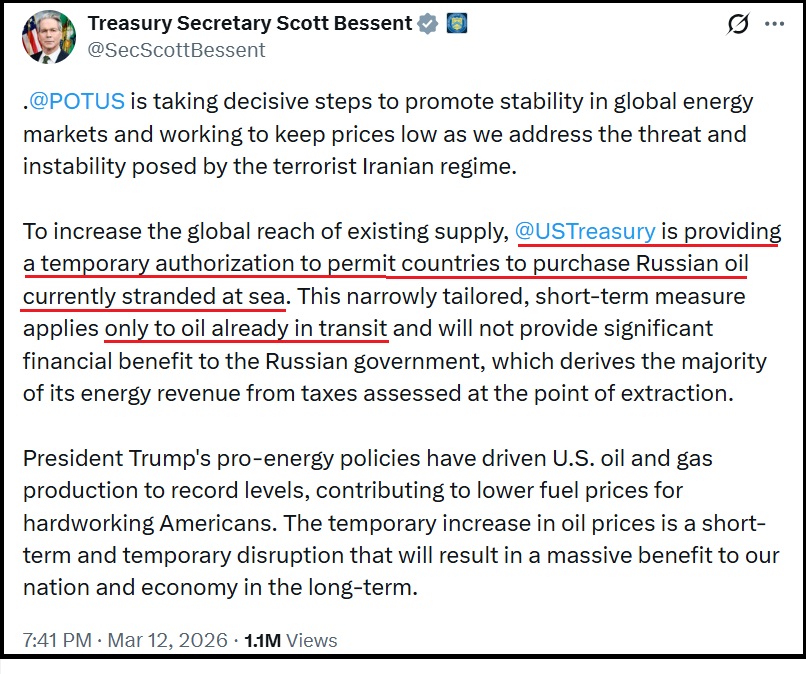
President Trump and Treasury Secretary Scott Bessent are facing mounting criticism for creating a window for Russia to sell oil and gas to the global market via “narrowly tailored, short-term” sanction relief. However, few people are putting the issue into context, and the background here is exceptionally interesting.
According to the terms announced by Secretary Bessent, the license to sell applies solely to Russian crude or petroleum products loaded onto vessels as of March 12 and is valid through midnight Washington time on April 11. [Treasury Notice Here – OFAC Technical Details Here]
The sanction relief license to sell will be done in globally recognized petrodollars and applies only to preexisting oil and petroleum products that are already in transit at sea. However, here’s where it gets very interesting and the ramifications are significant.
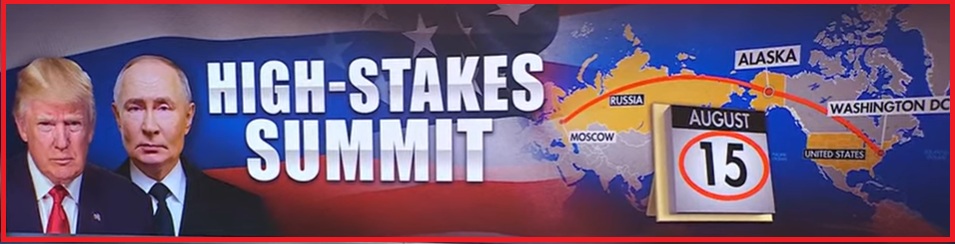
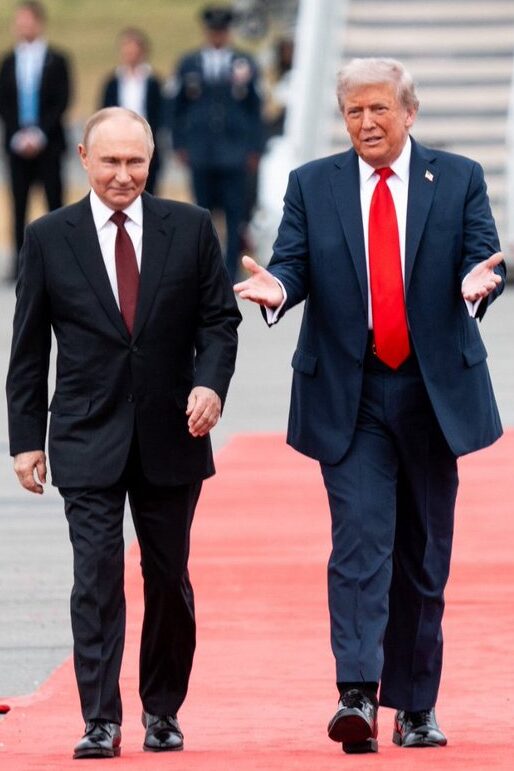
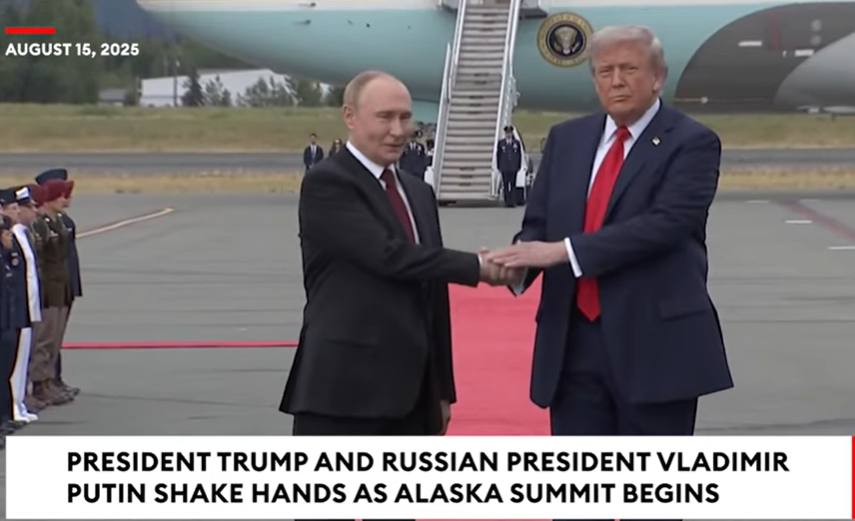
Immediately following the Alaska summit between Russian President Vladimir Putin and President Trump, Russia restarted Arctic-2 LNG terminals and began increasing oil production for storage on ‘floating platforms.’ President Trump met with Putin on August 15, 2025, and the curious increase in Russian production began on August 18, 2025.
In the past six months Russia has been pumping sanctioned oil and gas and storing it on ships and mobile sea platforms, seemingly (at the time) with no customers. Suddenly, against the background of the Iran conflict, all of that previously stored ‘on the water‘ production, now worth double, is authorized for global sale (in petrodollars).
Either Russian President Putin is the luckiest guy in the world, or Russia knew something.
In 2025 what Russia did following the Alaska summit did not make sense; now it does and the ramifications are stunning.
President Trump was looking for a way to organize a strategic partnership with Russia on the issue of energy production but was hampered by the preexisting sanction regime and strong opposition from domestic and international politics.
The ‘coincidental’ timing’ of Trump meeting with Putin and then subsequently Russia producing massive amounts of oil and gas for storage on the water suddenly starts to take on an entirely new light. Did Putin know something was coming, something that would eventually make the Russian over production and ‘on the sea’ storage worth billions.
The implications here are quite remarkable; however, they simultaneously explain most of the behaviors since the Iran confrontation began.
Media reports highlight that Vladimir Putin was asked about a previous joint agreement for military support between Iran and Russia and why Russia did not respond when Iran was attacked. Foreknowledge would explain that reaction.
Additionally, the Russian Federation president never responded to the Trump operation to take down Venezuelan dictator Maduro and seize control over Venezuela’s oil production.
If there was some discussion inferring that a ‘limited sanction relief’ protocol might be possible, that would explain why Russia began storing oil and gas at sea.
This fact pattern would also indicate that President Trump’s decision toward Iran was made at least six months ago, with a set of geopolitical events planned between the Alaska summit and the eventual confrontation with Iran.
TIMELINE: Trump and Putin meet. Three days later Russia begins pumping oil/gas and storing it at sea. President Trump then triggers the Venezuela western hemisphere security operation; Russia stays silent. President Trump then triggers the confrontation with Iran; Russia rejects involvement. And then two weeks after the Iran confrontation begins, Trump removes sanctions on Russian oil/gas “in transit” at sea.
Suddenly all of the Russian produced and stored product ‘on the water’ has greater value and new customers.
Just a coincidence? No way.
The United States needs the oil/gas market stability that Russia can provide.
Venezuela was/is to Trump as Ukraine was/is to Putin.
Posted originally on CTH on March 12, 2026 | Sundance
It is transparently obvious now that Canada is going to rely on UniParty (Corporate) opposition to President Trump in the dissolution of the USMCA (CUSMA) in favor of two distinctly different bilateral trade agreements; one with Canada and one with Mexico.
A bilateral trade negotiation between the United States and Canada would be devastating to the interests of the Canadian government. Particularly after the Venezuela operation and new strategic relationship with the United States, Canada has almost zero points of leverage to negotiate anything similar to their current exploitative trade position.
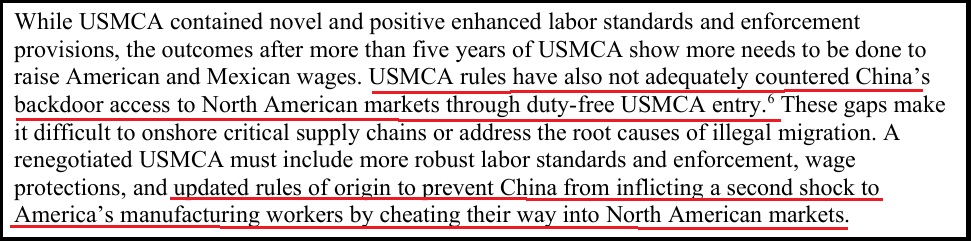
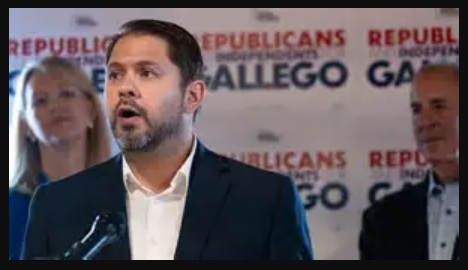
Canada is going to rely on congress to stop Trump from forcing reciprocity in the bilateral discussions. However, as a positive indicator that President Trump will factually have congressional support for the elimination of the USMCA, Democrat Senator Ruben Gallego has written a letter to President Trump requesting a comprehensive review. [LETTER HERE]
This is a key Senate democrat who notes the problem. One of Gallego’s top points of concern is the loophole that Canada uses to assemble Chinese component parts into finished goods for tariff free distribution into the United States.
Ever since President Trump won the 2024 election, Mexico has been taking proactive independent action to block Chinese component goods. But Canada has done the opposite and begun to enhance their trade relationship with China to take even more Chinese component and finished goods.
Gallego writes to U.S. Trade Representative Jamieson Greer from the position of wanting to increase wages and enhance jobs in both Mexico and the USA, growing both economies. However, Gallego’s advocacy simultaneously bolsters why the USMCA should be dissolved and also puts Canada at a distinct disadvantage.
MEXICO – Mexico’s President Claudia Sheinbaum told reporters during her morning news briefing on Wednesday that her U.S. counterpart, Donald Trump, is open to doing away with the U.S.-Mexico-Canada trade agreement (USMCA) and replace it with individual trade deals with each country.
[…] “There might be revisions that create bilateral deals instead of involving the three countries because some things are more important between Mexico and the United Sates or between Canada and the United States,” said Sheinbaum. “Not everything has to be trilateral.”
Mexico’s president said the subject was brought up by Trump during a Tuesday phone conversation. […] According to Sheinbaum, her country is ready to consider possible changes. (read more)
Just like the original NAFTA dissolution, if Senate democrats agree the USMCA is structurally flawed then Canada will lose its only hope to retain the trilateral agreement.
It appears that some Senate democrats like Gallego recognize this issue and support the need for exceptional change.
There is a significant difference between Mexico and Canada as it pertains to trade. Two distinctly different bilateral trade agreements would be the best outcome for the USA.
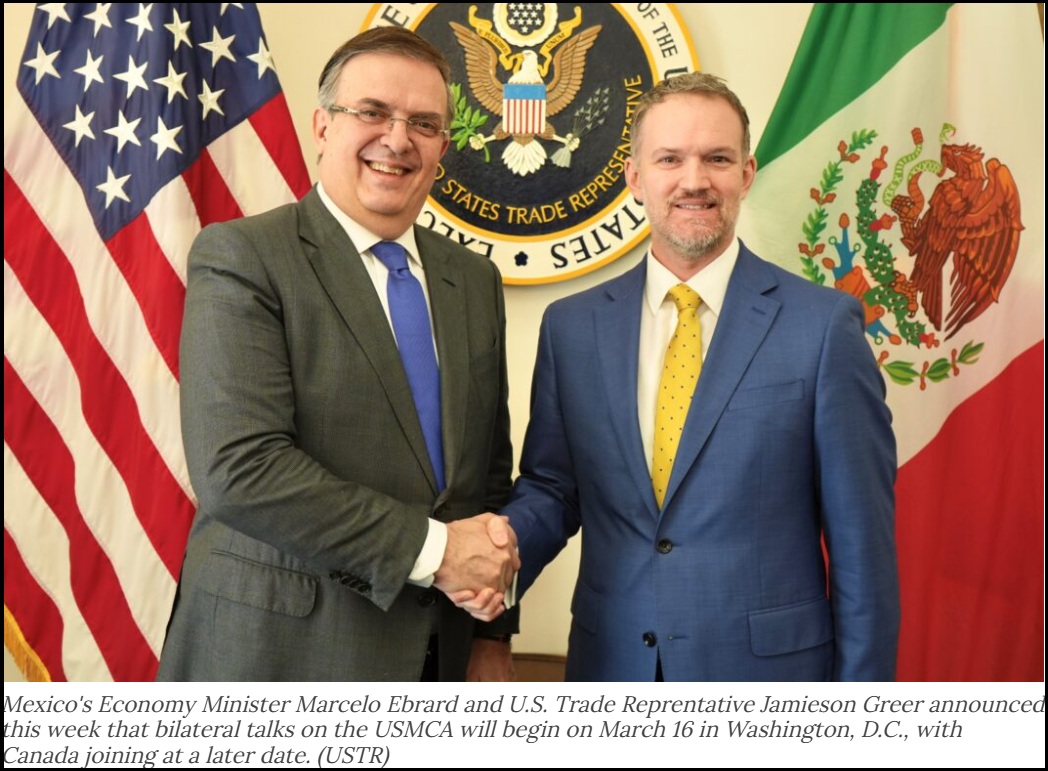
Team Mexico have already been holding bilateral discussions with USTR Jamieson Greer, and I suspect the broad outlines of a free trade agreement between the U.S and Mexico have already been agreed.
While Mexico has been working diligently for 16 months to get into alignment with the USA on a new free trade agreement, Canada has been doing everything possible to retain their “elbows up” position in opposition to the USA. This will not work out well for Canada.
“The key thing that has struck me, and I think it has struck all Canadians, is so many of these guys in the Trump administration, frankly, they just hate Canada,” said Brian Clow, former Prime Minister Justin Trudeau’s deputy chief of staff who led Canada-U.S. affairs. {source}
Posted originally on CTH on March 12, 2026 | Sundance
The fact that Team Russia and Team USA would be discussing a strategic economic alliance on the issue of energy is not a surprise to those who watched both President Putin and President Trump outline that same content discussion in Alaska last August. However, given the current conflict with Iran and the escalating oil price issue, Russia and the USA discussing Russian oil capacity and U.S. sanctions therein takes on a new angle.
It has been obvious that domestic U.S. politics, in combination with the Russia-Ukraine war, has impeded President Trump from organizing a strategic reset with Russia pulling away from historic conflicts. However, CTH is also clear-eyed on the longer-term ramifications for Eastern Europe when contrast with Putin’s ambitions to fix what he perceives as prior Russian Federation mistakes regarding the West (more on that at the end).
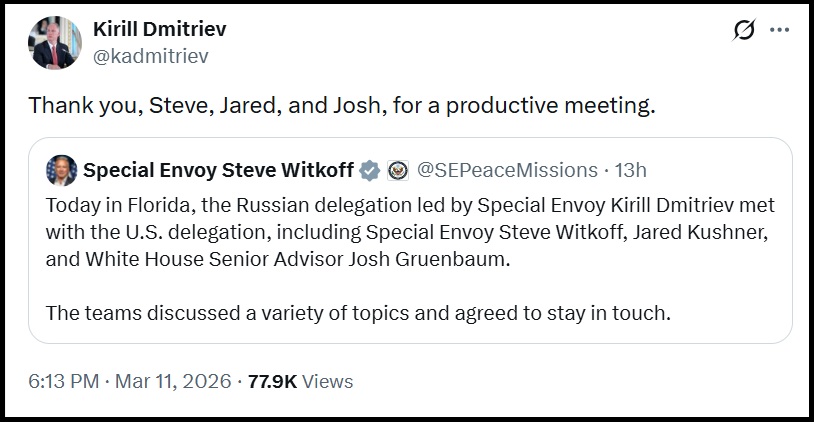
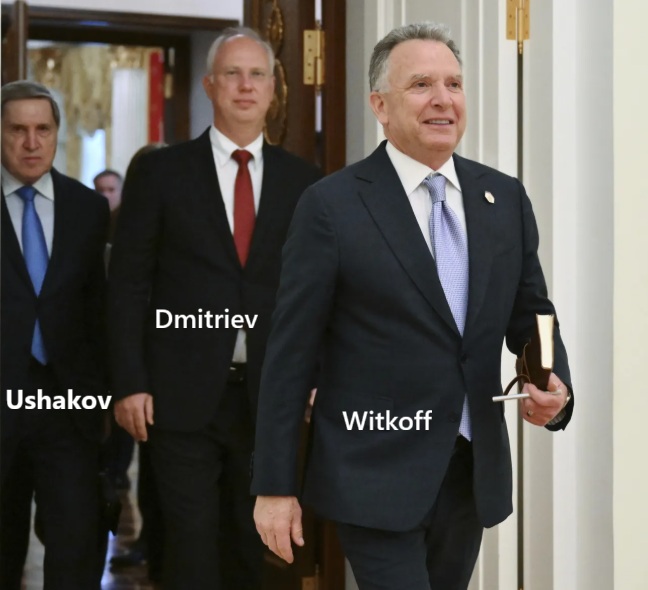
As noted in social media exchanges from Witkoff and Dmitriev, the discussion was productive.
All indications of this meeting give the appearance of less focus on progress in the Ukraine-Russia conflict, and a higher focus on current economic conditions -created by the Iran conflict- that could be enhanced with cooperation between the U.S. and Russia. {GO DEEP BACKGROUND}
According to Kirill Dmitriev, Russian special presidential envoy for investment and economic cooperation with foreign countries and director general of the Russian Direct Investment Fund (RDIF), relayed through the Russian News Agency (TASS), “he visited the US upon orders from Russian President Vladimir Putin, taking part in a meeting of the heads of a working group on economic cooperation between the two countries.”
According to the envoy, the meeting addressed both promising projects that can help restore Russia-US relations and the current crisis on global energy markets.
The US is becoming increasingly aware of the role of Russian oil and gas in ensuing the stability of the world economy, as well as of the [in]effectiveness of sanctions against Russia, Dmitriev said after the meeting. (source)
“We discussed promising projects that could contribute to the restoration of Russian-American relations and the current crisis on global energy markets,” Dmitriev also wrote in a Telegram post.
“Today, many countries, primarily the United States, are beginning to better understand the key, systemic role of Russian oil and gas in ensuring the stability of the global economy, as well as the ineffectiveness and destructive nature of sanctions against Russia.”
With the strong likelihood that Russia’s restart of their flagship LNG terminal Arctic-2 was directly related to the August summit in Alaska {SEE HERE}, there is already a baseline established for strategic cooperation.
President Trump would have no problem with Russia introducing millions of barrels of oil into the global market given the issues created by conflict in/around the Strait of Hormuz. However, obviously the issues for streamlined Russia oil exports surround (1) preexisting sanctions, (2) domestic U.S. anti-Russia politics and (3) the political and economic position of the anti-Russia European Commission leadership.
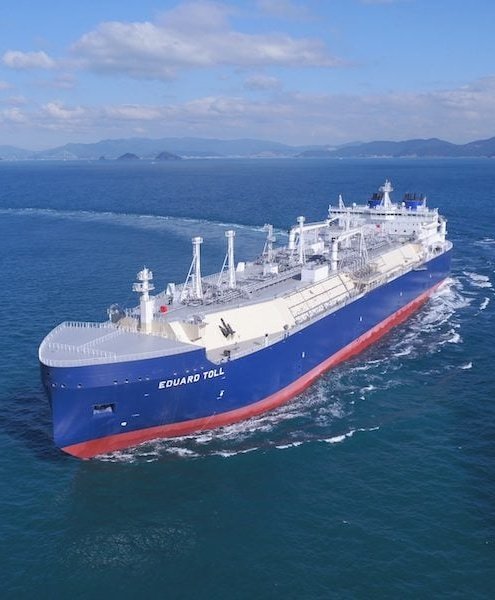
As we previously outlined with the Liquified Natural Gas (LNG) benefit, Russia previously extracted, liquified and pumped massive amounts of LNG into floating storage platforms from Arctic-2. Those LNG supplies doubled and tripled in value in a few days once Qatar shut down their production facilities and are now being sold to various Asian countries.
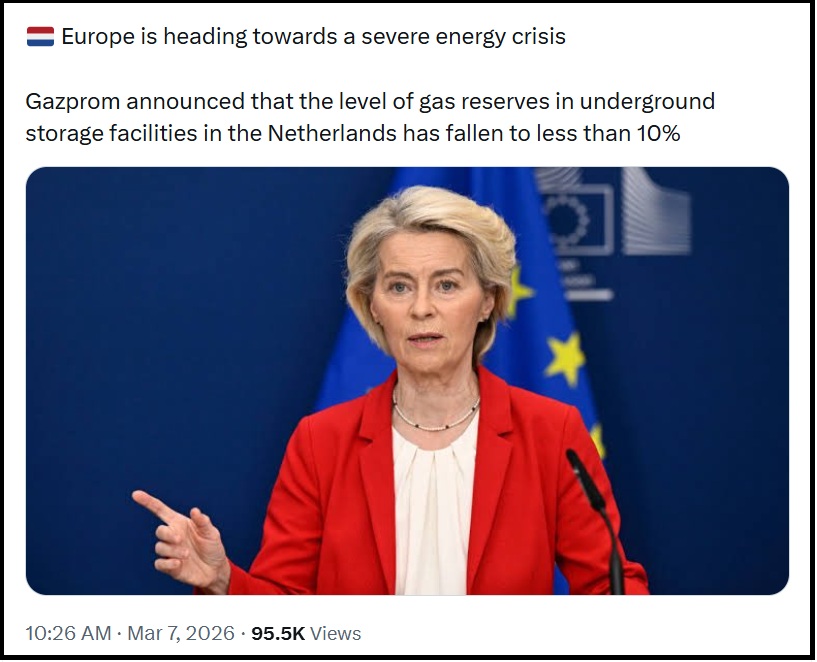
Europe has a massive energy problem with severely low LNG storage rates and now a shortage of oil, with EU gasoline prices rising much higher & faster than the rest of the world. Europe is facing a severe energy crisis overall and now their preexisting economic troubles are being amplified.
More than ever Europe needs the Russian oil/gas, but ridged ideologues will never compromise on their anti-Russia position. They have even steeper sanctions against Russian oil/gas scheduled to trigger at the end of this month.
It will be interesting to see how President Trump navigates the potential benefit from Russian energy products into the global market against the backdrop of all the geopolitical angst and political opposition against Russia.
…. AND that brings me to a point of discussion that I’ve had with a few dialed-in people.
When you look at the long term, and when you overlay the mindset of Russian President Vladimir Putin, almost everyone in Russia/Eastern Europe who evaluates the future can see the potential for Putin to exploit the EU’s self-created economic vulnerabilities for his own expansionist objectives.
Yes, some elements of the U.S. banter about further Russian expansion are not propaganda. Most of it is, but there is an element to the future forecast -beyond the Ukraine conflict- that could see Russia in a much stronger position, and the EU in a position of significant weakness.
The MAGA-minded European and Russian people, the ones who have strong wisdom on the issues, can all see a specific set of dominos falling that could place Putin in a position to recapture the remaining pro-Russian geographies in Europe back into an expanded Russian Federation.
Given the highly unstable mindset and friction points within European leadership, that would be a very bad combination to contemplate.
A strategic USA reset with the Russian Federation is a reasonable and pragmatic goal. There is no reason for America and Russia to be in conflict or opposition and pulling Russia away from a relationship with China has massive benefits for both countries.
The Russian people are not affectionate toward China at all, not even a little bit. In reality, China is a necessary ally for Russia but not a choice they would select if other options were available and variables were changed. The Russian people are exceptionally independent, incredibly strong and brutally proud; however, they are also more Western-minded (European, without self-flagellation) than Eastern-minded (Asian).
Here’s where/why Trump is being careful and pragmatic. President Trump doesn’t want to see an outcome where Russia is eventually stronger than Europe. There’s not enough frictionless history between the USA and Russia to trust Putin when he says the Federation has no plan to expand into Europe.
The USA can/should be strategic allies with Russia. However, it would be much better if a strong Europe existed at the same time. Hence, Vice President Vance and Secretary of State Rubio continuing to emphasize that Europe needs to stop cowering in politically correct wokeness. The EU is destroying itself at the same time Russia is getting stronger.
.
Last point, the Lyndon LaRouche team, Promethean Action PAC, are very happy with the ongoing fracture of the USA away from the UK/EU group. However, be cautious around Political Action Committees who say, “President Trump needs people to understand what he is doing” and we are here as his official policy interpreters.
Remember, President Trump doesn’t need policy interpreters.
Posted originally on CTH on March 10, 2026 | Sundance
The origin of this issue goes back to 2021 and the relaunch of the Build Back Better European green energy program to fight the non-existent climate change problem. We have been highlighting the consequences within the EU auto sector.
We noted in October of last year, the EU’s mandated fines against auto manufacturers who do not hit their production goals for electric vehicle sales began in 2025. EU automakers unable to meet the regulatory compliance goal began purchasing carbon credits to avoid stiff EU fines. Many of those carbon credits were purchased from Chinese EV automakers, who then turned around and started using the extra EU revenue to discount Chinese cars sold in Europe.
At the same time as Chinese autos hit record highs in Europe, EU car sales are flat or declining. Now, Volkswagen is announcing they lost half their profits in one year and will be cutting 50,000 jobs in the next four years.
(MSM – Europe) – Volkswagen just revealed its operating profit sank like a stone last year, dropping by more than half as tariffs, Chinese competition, and shifting strategies took a serious bite out of the bottom line. And that performance now has the VW Group’s execs reaching for the cost-cutting scissors, including plans to shed 50,000 jobs by the end of the decade.
The German automaker reported an operating profit of €8.9 billion ($10.3 bn at current rates) for 2025. That’s down a hefty 53 percent from the year before and well below what analysts were expecting. Revenue, meanwhile, barely moved, slipping only slightly to around €322 billion ($374 bn). (read more)
This was very predictable. In essence, EU car companies buy Chinese car company carbon credits, to avoid the EU fines. The Chinese car companies then use the carbon credit revenue to subsidize lower priced Chinese EVs to the European car market, thereby undercutting the European EV car companies.
The EU tariff applied to gasoline powered cars or hybrids from China is 10%. That tariff is not enough to stop the imports. The Chinese hybrid autos are substantially less than European car brands, and there’s no financial incentive for China to build auto plants in the EU zone especially when you consider the EU is subsidizing those cars by purchasing carbon credits.
When analyzed from a cost and consequence, the entire EU dynamic toward car companies is a little funny. However, for Germany this is a serious issue, and with the German industrial economy already stagnant – every impact to their auto industry only makes the situation worse.
When you overlay the big picture of their expensive “green energy” costs, the EU find themselves in an unescapable downward spiral. Quite literally, all commonsense seems to have been lost in their green energy chase.
By focusing on energy targets, specifically by trying to force production of European electric vehicles that are not favored by European car purchasers, the EU is shrinking their economy to the benefit of Beijing exploitation.
German Chancellor Friedrich Merz recently travelled to China for a discussion with Chairman Xi Jinping. Chancellor Merz returned to German with a stark message about how the nation needed to quickly get productive in order to meet the far superior work ethic he saw in China.
At the same time, the EU has destroyed its energy sector by chasing windmills and solar farms instead of maintaining the much cheaper coal and gas alternatives. Overall, Europe has made a series of really bad decisions, but those consequences will surface the hardest within the largest industrial economy, Germany.
Posted originally on Mar 9, 2026 by Martin Armstrong |
The latest diplomatic explosion between Hungary and Ukraine did not come out of nowhere. Hungarian authorities recently detained seven Ukrainian nationals traveling through the country in armored vehicles carrying enormous quantities of cash and gold, reportedly tens of millions of dollars and kilograms of bullion. Kyiv immediately accused Hungary of “state banditism” and hostage-taking, while Budapest launched a money-laundering investigation and announced the individuals who they deem a “Ukrainian gold convoy” would be expelled.
But this incident cannot be understood without the broader economic conflict unfolding between the two countries. It is highly suspicious that these workers were traveling with 40 million in USD, 35 million euros in cash, and 9 kilos of gold. If it were nationals from any other nation then money laundering would not be deemed hostage taking. For Hungary, this is about energy and the oil lifeline that keeps Hungary’s economy running. Hungary and Slovakia rely heavily on crude delivered through the Druzhba pipeline network, one of the main arteries carrying Russian oil into Central Europe. That pipeline has been offline since late January after infrastructure damage in Ukraine halted deliveries, leaving the two countries facing supply shortages and rising economic pressure.
Political statements from Hungarian officials this morning show that the detention of seven Ukrainian citizens in Budapest was part of Hungary’s blackmail and electoral campaign.
Orban's list of demands for Ukraine this morning was particularly telling. This is what typically…
Budapest has repeatedly accused Kyiv of deliberately delaying repairs and effectively imposing an oil blockade. Prime Minister Viktor Orbán has openly declared that Hungary will use political and financial pressure to force Ukraine to reopen the pipeline and restore energy flows to Hungarian refineries.
From Hungary’s perspective, the situation is absurd. The European Union demands sanctions against Russia while simultaneously expecting smaller Central European economies to cripple their own energy systems. Hungary was granted exemptions to continue importing Russian oil precisely because its refining infrastructure and geography make sudden alternatives extremely difficult.
When Ukraine halted the pipeline, Hungary and Slovakia responded by suspending diesel exports to Ukraine and threatening broader retaliatory measures, including blocking EU funding packages for Kyiv.
This is where the story becomes politically explosive. The EU leadership and Western media continue to frame the conflict purely through the lens of the war with Russia. But Hungary is looking at it through a far more practical lens: national survival. Hungary was forced to block the 90 billion euro package to Ukraine. Why would a nation agree to provide unconditional funds for a hostile country that is threatening its economy?
“We hope that a certain person in the European Union will not block the €90 billion, or the first tranche from the €90 billion, and our defenders will have weapons. Otherwise, we will give that person’s address to our Armed Forces, to our boys, so they can call him on the phone and speak to him in their own language,” Zelensky said, threatening to provide troops Orban’s number.
“If Ukraine blackmails Hungary, it cannot expect pro-Ukraine decisions in Brussels. Until order is restored, we will use every tool available. We have already stopped fuel deliveries, and we will continue applying pressure until oil supplies resume,” said Orban in a Kossuth interview on March 6. Hungary is giving Ukraine until today “to visit and assess the current state of the Druzhba oil pipeline together with representatives of the MOL group (Hungary’s oil company — ed)” or resume oil transit.
Energy is the foundation of every modern economy. Shut down oil flows, and you are not merely making a geopolitical statement — you are threatening industry, transportation, and the entire domestic energy market. The next step will be crucial. Will Brussells side with Hungary or continue to disregard a member state in favor of propping up Ukraine? This is one of the countless reasons why the European Union is doomed. There is no union, there is no loyalty. The unelected bureaucrats in Brussels are only concerned with beating the drums of war to buy time from the inevitable crash and burn.
Posted originally on CTH on March 8, 2026 | Sundance
Almost all of the corporate news programs today are carbon copies of the same tired talking points, driving home the reality that mainstream U.S. media are concentric circles of the same news feed. Essentially, media reports reporting on media reports, of other organized media reports.
No one seems to be asking any of the core operational and policy questions that can cut to the heart of the matter. ie., “you are doing XXX, what is the intent of this action/policy move, and can you describe in actionable terms what benefit the American people can expect as a result of the anticipated outcome”? Instead, the questions are all hindsight and reactionary. Frankly, the repetition is mind-numbing.
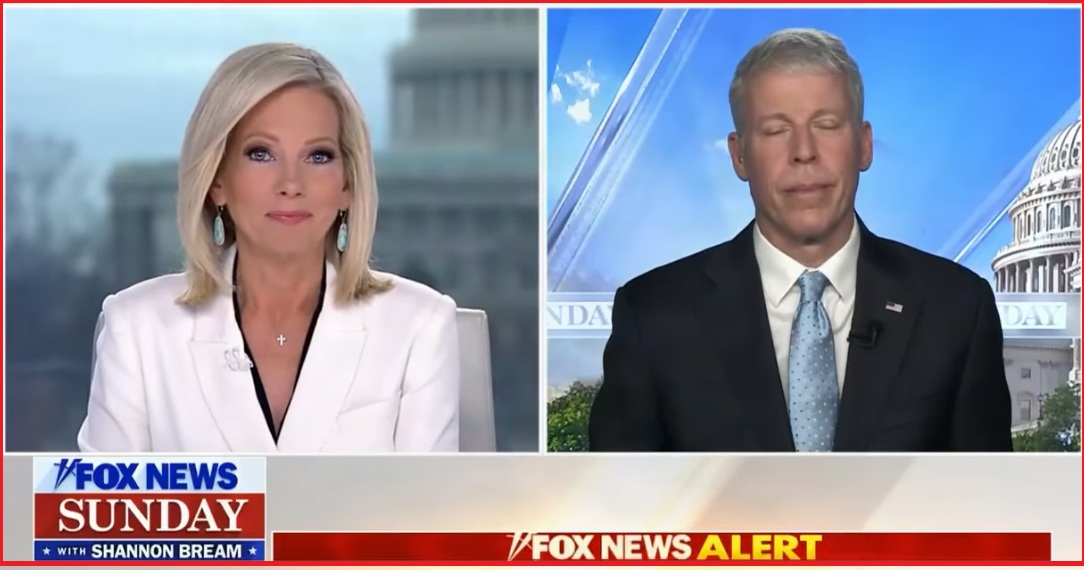
In this Fox interview, Secretary of Energy Chris Wright answers some of the same questions from the CBS interview, sans the arrogant and condescending tone during the questioning. WATCH:
Posted originally on CTH on March 8, 2026 | Sundance
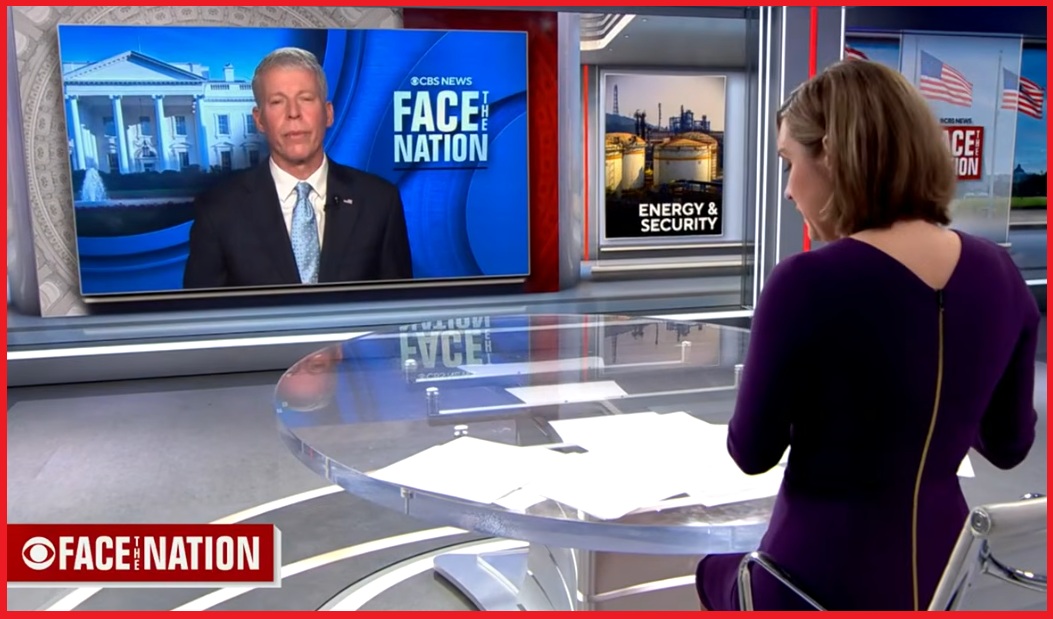
Energy Secretary Chris Wright appears on Face the Nation to push back against the narrative engineering of CBS’s Margaret Brennan. The video and transcript are below.
[Transcript] – MARGARET BRENNAN: We turn now to Energy Secretary Chris Wright, who joins us this morning from Denver. Good morning to you.
SECRETARY OF ENERGY CHRIS WRIGHT: Thanks for having me Margaret.
MARGARET BRENNAN: So 50,000 U.S. troops deployed, six Americans that we know of so far killed in action, civilians stranded. We look at our polling, Mr. Secretary, and we see that this is an unpopular war among the majority of Americans. More than half of them, 56% disapprove. When you speak to energy executives about the scope and duration of American involvement, what do you tell them? How long?
SEC. WRIGHT: I tell them that for 47 years, Iran is warg- waged war against the United States, and they’ve- throughout that 47 years, they’ve tried to undermine the energy development and energy infrastructure of all their neighbors, as they’re doing right now, and it’s time to put it to an end. So yes, we have a, we have a temporary period of elevated energy prices, but it will not be long. In the worst case, this is weeks, this is not months, and it leads to a much better place. It leads to an Iran that’s defanged, that can’t threaten its neighbors, can’t threaten American soldiers and can’t continue to drive up energy prices by making a mess of the Middle East. They can move to commerce, not conflict.
MARGARET BRENNAN: Well, but you have the moment we are in right now, and as you know, gasoline prices up 14% in the past week. According to AAA, reports the national average is $3.45. We’ve seen oil prices spike. How high do you think oil and gas are going to go?
SEC. WRIGHT: They shouldn’t go much higher than they are here because the world is very well supplied with oil. There’s no energy shortage at all in the Western Hemisphere.
MARGARET BRENNAN: Right.
SEC. WRIGHT: The United States is a net exporter of oil, a large net exporter of natural gas. But refineries in Asia and Europe are seeing an interruption from the normal crude flows. But there is massive energy stores around the world. What you’re seeing is emotional reactions and fear that this is a long term war. This is not a long term war–
MARGARET BRENNAN: –But–
SEC. WRIGHT: –It’s a temporary movement.
MARGARET BRENNAN: Sorry, go ahead, temporary movement.
SEC. WRIGHT: No, I’m saying look, we’ve seen previous administration have done everything they could. They begged, bartered and bribed the Iranian government to stop its nefarious activity, stop its murderous behavior, and it simply hasn’t worked, and now, they’re, they’re expanding missile and drone program that are rapidly growing to protect their desire to build a nuclear weapon. We’re going to cross the threshold where we can’t put them back in the box. Now is the time to end their risk to America and the world.
MARGARET BRENNAN: But as you know, when I ask you about energy prices, this is not a supply problem. You said there’s plenty of supply. The head of the International Energy Agency said, lot of oil, logistics are the problem. It’s dislocation. It’s a serious problem. So what he’s referring to there is being able to actually move it around. I know you said there’s, there’s one vessel that’s gone through the Strait of Hormuz. 20 million barrels per day typically go through it. When do you get back to that level?
SEC. WRIGHT: Oh, I think it will be relatively soon. Of course, I don’t know exactly. All of our military assets right now are focused on ending Iran’s ability to kill their neighbors, threaten American soldiers and threaten ship traffic in the Strait of Hormuz, but that’s going swimmingly well. Their missile launches are down 90%, the drone launches are down over 80% I think in the relatively near term, you’re going to see their capacity so low that we’ll see more normal ship traffic return to the Strait of Hormuz.
MARGARET BRENNAN: So you don’t think Navy escorts of vessels are necessary?
SEC WRIGHT: They might be. They might be. The U.S. is here to do everything we can to keep world oil markets supplied. Yes, if they have some residual–
MARGARET BRENNAN: –When will you make that decision?
SEC. WRIGHT: We’re, we’re in engagement right now with people that want to get tankers moving out of the Gulf. And so, yes, there could be there- early tankers probably will involve some direct protection by the U.S. military, but most important is to defang their ability to threaten these ships.
MARGARET BRENNAN: So the president had said he was open to tapping the American stockpile of oil, the Strategic Petroleum Reserve, but I saw you on other networks this morning, kind of throwing cold water on the idea. You referred to it as depleted. Are you saying America doesn’t have adequate stockpiles?
SEC. WRIGHT: No. America still has over 400 million barrels of oil in our strategic petroleum reserve, and, of course, robust production. We’re, we’re, more than happy to use that if it’s needed. But as you said earlier, it’s a logistics issue. Where do they need oil? They need oil at refineries in Europe and in Asia. And that’s why we took a very pragmatic step. There’s over 100 million barrels of floating Russian crude waiting in line to deliver to China. That’s going to be sold, it’s going to be refined, but that could be one or two months from now. So in a pragmatic way, with no change in U.S. policy towards Russia, we told the Indians, bring that into your refineries. You know, if you, if you’re feeling a shortage of crude, prices are being bid up, draw down that Russian crude stocks that are sitting right offshore.
MARGARET BRENNAN: Yeah. So on that point, the U.S. has temporarily suspended some sanctions to make that Russian oil, you say was already going to be sold anyway, make it available. But doesn’t Russia still financially benefit from that? Why isn’t the U.S. seizing those Russian tankers if they are our adversary?
SEC. WRIGHT: Because right now, because right now, we’re worried about Iran and fixing a 47-year problem there, and we’re worried about American consumers. We want to stop the rise in–
MARGARET BRENNAN: –Russia was helping Iran–
SEC. WRIGHT: –gasoline and diesel prices. Well, there’s been rumors of that. We don’t know if that’s true or not. Certainly, they’ve gotten a strong message from us. But this is oil already on the ocean–
MARGARET BRENNAN: –These Iranian drones have Russian parts in them. The Russians have been buying Iranian drones. That is very well documented, and CBS has confirmed and reported that there was sharing of intelligence. Russia providing intel to target Americans. So how is Russia not part of this?
SEC. WRIGHT: Look, Russia, Russia is expert at causing trouble around the world, so I’m not saying they’re not. I’m saying I don’t- if they’re helping Iran, it’s not working very well, but we’re not helping Russia by just accelerating the sale of their oil to stop the rise of energy prices and keep European and Asian refineries in oil. We’re just doing pragmatic things to get through a short period that will bring in an era of even lower energy prices because a major energy producing region of the world, the Middle East, will no longer have a strong, powerful Iran that can threaten their neighbors, that can threaten the United States of America and was not far away from a nuclear bomb. That’s an–
MARGARET BRENNAN: –How much–
SEC. WRIGHT: –unacceptable scenario. That’s the risk to energy prices was not doing anything.
MARGARET BRENNAN: So when the Qataris say you could see $150 barrel in oil, that’s something America could stomach? President Trump wouldn’t say, I’m done with this war because I can’t stand the political pressure and the American people saying I don’t like what I’m paying at the pump?
SEC. WRIGHT: No, the president’s going to continue to stay focused on ending a 47-year conflict, stay focused on growing the global energy supply. This is actually part of that effort. It does involve a temporary impediment to energy production, but on the other side, it will allow much more energy production and much lower energy prices. But this is not a long term conflict. Most presidents have just thought, they’ll kick the can down the road. The risk is simply too great to kick that increasingly dangerous can down the road.
MARGARET BRENNAN: Yeah.
SEC. WRIGHT: President Trump’s bold leadership is enough’s enough. We’re going to put it to an end.
MARGARET BRENNAN: I want to ask you about Venezuela. The U.S. deposed Maduro. He’s sitting in a prison. Just this past week, though, we had the interior secretary visiting Venezuela and sitting across from Maduro’s Chief thug, Diosdado Cabello. This is someone who has a $25 million bounty on his head. He ran the prisons, he ran the militias. He was treated as a counterpart to an American official. Is this the same playbook the Trump administration is going to run in Iran, that you will deal with the same regime you’ve been telling me is terrible to deal with for 47 years?
SEC. WRIGHT: We don’t know what the regime will be in place at the, at the end of this conflict, but we do know that regime will not have a massive weapons arsenal, that that regime will no longer be a massive threat to Americans and to the Middle East and to global oil supplies. President Trump is using bold leadership. We can’t change the world at a blink of an eye, but we can steer it in massively positive directions, and yes, Venezuela is a great example of that. Crime in the nearby Trinidad and Tobago has plummeted already from our actions in Venezuela, and President Trump’s insistence that he’s going to work with that our neighbors to reduce drug trafficking in the Western Hemisphere. Leadership takes- involves risks, but if you want to drive improvement, you’ve got to be confident, you’ve got to have the right agenda, and you’ve got to have the courage to do it. This president does.
MARGARET BRENNAN: Energy Secretary Wright, thank you for your time this morning. Face the Nation will be back in a minute. Stay with us.
Posted originally on CTH on March 7, 2026 | Sundance
When President Donald Trump and President Vladimir Putin met in Alaska on August 15, 2025, the focus of the geopolitical world was on discussions surrounding Ukraine. Unfortunately, it didn’t take long, merely a few hours, for both the U.S. and Russia to say that no progress was made. However, also noted at the time was both the USA and Russia saying sideline discussions took place surrounding the possibility for a strategic relationship surrounding energy development.
What follows below is a review of the current energy dynamic, specifically surrounding LNG, against the backdrop of the Iran war with a hindsight review of that previous discussion between Putin and Trump.
What most people are missing in their current analysis was something that took place immediately following that Alaska summit six months ago. Something that did not make any sense until now. {GO DEEP PART I HERE}
It absolutely did not make sense that Russia would start producing even more LNG considering the previously imposed western sanctions against them, and the fact that Russia was already overproducing LNG. As noted by analysts at the time:
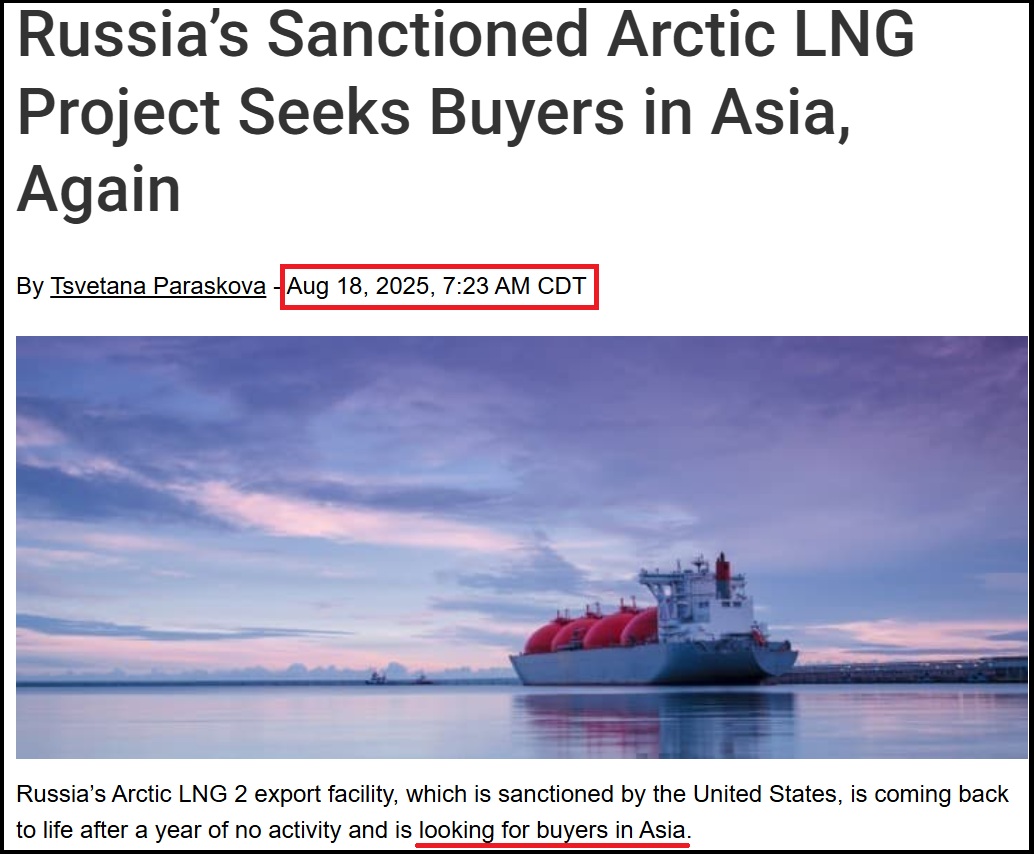
AUGUST 18, 2025 – Russia’s Arctic LNG 2 export facility, which is sanctioned by the United States, is coming back to life after a year of no activity and is looking for buyers in Asia.
[…] The U.S. and EU sanctions on Russia’s Arctic LNG 2, which was billed as Russia’s flagship LNG project, have effectively frozen the start-up of the export facility in the Gydan Peninsula.
[…] Last year, Russia started shipping LNG from its flagship Arctic LNG 2 project—but not to customers. The shipments were made from the Arctic project to floating storage units either in Russia or in European waters, as potential customers were unwilling to buy the sanctioned LNG. {SOURCE}
In August of 2025, Russia was essentially producing more LNG than they could sell into the available market. Russia was storing the overproduction from Arctic-1 on floating storage units and slowly selling to countries that did not align with the sanctions, specifically China and some Asian buyers. Then suddenly, after the Trump summit, Russia decides to bring Arctic-2 online and produce even more LNG. You can see how this did not make sense.
If they could not even sell all the Arctic-1 LNG output, then why would Russia bring Arctic-2 LNG production online?
That was six months ago.
Suddenly, with the war in Iran being triggered, and with Qatar almost immediately announcing they were shutting down all LNG production, there are dozens of new markets for liquified natural gas. And that current LNG is now worth 50% more than it was when Russia inextricably decided to start producing and storing it.
Apply some hindsight to this timeline. Did Russia know or discover something in August of 2025 that the world would not discover until six months later?
Russia’s behavior in increasing LNG production, then storing that LNG in strategic venues, during a time when there was no reasonable incentive to trigger an LNG output increase, would seem to answer that question in the affirmative.
One thing is certain, all of that previously produced LNG is now worth double what it was when Russia created it, and now the global market is scrambling to get it.
Here is where it gets really interesting….
In October 2025, do you remember me asking why President Trump decided to fly East, to go West to the ASEAN summit in Asia? It just didn’t make sense.
Previously in 2017 when President Trump went to the ASEAN summit, he flew West; Airforce One refueled in Guam. This time in 2025, a few weeks after the meeting with President Putin in Alaska, President Trump flew East, to go West.
Where did he refuel?
That’s correct. President Trump refueled in Qatar, and during the ‘unexpected’ stop he met, yet again, with Qatari leadership.
♦ In May 2025 President Trump traveled to Qatar and had numerous and lengthy conversations, signing multiple strategic defense and trade deals. ♦ In August 2025, President Trump meets with Vladimir Putin, who then begins ramping up production of LNG. ♦ In October 2025, President Trump travels back to Qatar for a curious and unexpected visit.
Less than 36 hours after President Trump began “Operation Epic Fury” Qatar announces they are halting the production of LNG, and as a consequence the price of LNG jumped and a massive supply shift in global trade was created.
The Financial Times – […] The global battle for gas is underway, with Europe on the front lines. Since Wednesday, March 4, at least four liquefied natural gas (LNG) tankers – factory ships with large, refrigerated tanks used to transport LNG over long distances – suddenly changed course. Initially headed for France, Belgium or Spain from Africa and the United States, they rerouted for Asia, according to data from the maritime analytics company Kpler. (read more)
MOSCOW, March 4 (Reuters) – Russia could halt gas supplies to Europe right now amid a spike in energy prices triggered by the Iran crisis, President Vladimir Putin warned on Wednesday, linking the possible decision to the European Union wanting to ban purchases of Russian gas and liquefied natural gas. (read more)
MOSCOW, March 6 (Reuters)– “Our companies are considering opportunities, without waiting for further restrictions from Europe, to conclude new long-term contracts with our partners and redirect some of the gas from Europe to other countries, including India, Thailand, the Philippines and the People’s Republic of China,” Russian Deputy Prime Minister Alexander Novak said.
Six months ago, following a summit in Alaska with President Trump, President Vladimir Putin began producing and storing LNG at a scale and capacity that did not make sense. Six months later, the now massive Russian inventory is worth twice as much as it was, AND the number of global buyers for the Russian LNG has exploded.
Meanwhile, “while China would suffer from oil outages, a Middle East crisis with disproportionate LNG outages might benefit the PRC. Natural gas accounts for a relatively small share of China’s primary energy consumption, the country enjoys substantial domestic production, and it can tap pipeline imports from Russia, Central Asia, and Myanmar. Significantly, many of the PRC’s competitors or rivals—the European Union, Japan, South Korea, and Taiwan—are substantially or even wholly reliant on LNG imports for their natural gas consumption. Dutch TTF natural gas prices are up more than 50 percent against last Friday’s close, fueling concerns of an energy-induced inflationary spike.”
Where is President Trump scheduled to go next?
WASHINGTON/BEIJING, March 3 (Reuters) – The U.S. military campaign against Iran has put Chinese leader Xi Jinping on the back foot ahead of an expected summit with U.S. President Donald Trump, who for the second time in as many months has turned America’s military against one of Beijing’s close partners.
Trump is set to arrive in Beijing at the end of March following the U.S. capture of Venezuelan President Nicolas Maduro in a risky Caracas raid in January and the U.S.-Israeli air war that on Saturday killed Iran’s Supreme Leader Ayatollah Ali Khamenei, the former leaders of two countries that have been major oil suppliers for China.
[…] Xi now faces the awkward prospect of feting Trump on the world stage or backing out of the proposed March 31 to April 2 meeting. Beijing has yet to confirm the summit dates. (read more)
Posted originally on CTH on March 7, 2026 | Sundance
We like the deep weeds, most do not. The geopolitical ramifications of the U.S. confrontation with Iran are vast and complicated; however, to encapsulate one of the most interesting dynamics consider this ‘tldr’ statement to open the discussion with your friends: Right now, Russia is like Amazon during COVID-19.
What follows is not me saying President Trump and President Putin are holding nightly conversations, discussing steps or details, or even obliquely coordinating measures as Trump eliminates the generational threat posed by Iran.
However, I am saying that given the nature of all contact and communication between Trump and Putin, including extensive contacts by their representative emissaries, both Putin and Trump are well aware of each downstream effect from the Iranian confrontation.
Two days after the U.S./Israel began Operation Epic Fury, President Vladimir Putin said Russia should consider shutting down oil and liquified natural gas (LNG) shipments to the EU in advance of the previously scheduled April deadline date when the EU would stop purchases.
♦ First, remember ‘force majeure’ contract nullification is in place for every producer, supplier and transporter in the middle east. Second, with shipments from the Gulf of Oman greatly reduced, LNG prices along with oil prices are increasing rapidly. The result – ships filled with oil and LNG currently on the water are diverting in real time as international bidding for the content of the ships take place.
If Putin stops selling LNG to Europe, and Europe cannot get LNG from the Gulf of Oman, and China/Asia are LNG dependent (not exporting), then where is Europe going to get the LNG to replace what Russia will no longer provide?
Answer: The United States, and to a lesser extent, Norway.
[SIDENOTE: now does President Trump continuously smacking Great Britain about shutting down their North Sea oil and gas operations take on context? Geopolitical foresight? I digress. END SIDENOTE]
The European Commission’s decision to phase out and ultimately stop purchasing Russian oil/gas was made in 2025 prior to the Iran conflict triggering. Europe’s replacement plan included increased LNG purchases from the U.S., Norway and middle east; the latter supply option is now void.
Europe’s decision to stop buying oil/gas from Russia puts them in a very precarious position. The supply option for Europe is suddenly very limited, and Putin’s statement about stopping the flow early was obviously made with this understanding in mind.
Answer: The United States, and to a lesser extent, Norway.
[SIDENOTE: now does President Trump continuously smacking Great Britain about shutting down their North Sea oil and gas operations take on context? Geopolitical foresight? I digress. END SIDENOTE]
The European Commission’s decision to phase out and ultimately stop purchasing Russian oil/gas was made in 2025 prior to the Iran conflict triggering. Europe’s replacement plan included increased LNG purchases from the U.S., Norway and middle east; the latter supply option is now void.
Europe’s decision to stop buying oil/gas from Russia puts them in a very precarious position. The supply option for Europe is suddenly very limited, and Putin’s statement about stopping the flow early was obviously made with this understanding in mind.
[Go back to the sidenote above. Without question President Trump already knew that an LNG supply restriction from the middle east would disproportionately hurt Europe. Both President Trump and President Putin would understand this geopolitically obvious fact/reality.]
If Europe now has to purchase more LNG from America (at higher prices) President Trump’s leverage over Europe increases. If both oil and LNG prices increase substantially, the price of oil/LNG currently on the water increases.
[SIDENOTE #2 – Previously the EU confiscated their holdings of the Russian Sovereign Wealth Fund, value €210 billion held in Euroclear and another €50 billion from other G-7 countries; total €260 billion. From those seized assets the EU created a €90 billion loan scheme to Ukraine with no repayment mechanism, because the EU predicts Russia will be forced to pay reparations for war and the negotiated settlement will deduct the €90 billion loan scheme from the balance.
Hungary, a Trump ally, is currently blocking the transfer of funds; but this payment scheme -created by the EU holding the assets- underpins why the EU will not permit the conflict to end without their approval. END SIDENOTE]
♦ To increase distribution of oil/gas “currently on the water” President Trump and Secretary Bessent have dropped the sanctions against Russian oil and LNG. India and Southeast Asia, not coincidentally both with new U.S. free trade agreements, are suddenly bidding customers for previously sanctioned oil/gas.
Here it is important to note that ‘sanctioned’ oil and gas sales were done in the transactional currencies of the selling and buying country (see BRICS). However non-sanctioned oil/gas, traditional OPEC market oil/gas products, are bought and sold using petrodollars. If Russia is suddenly allowed to sell to OPEC market customers, then petrodollars will likely back the transaction. Who wins, Putin (higher prices) & Trump (leverage and petrodollar). Who loses, the EU.
Now, you know how much I love timelines to explain things…. So consider:
On August 15, 2025, Vladimir Putin and President Trump met in Alaska. One of the key points that followed the meeting was both Trump and Putin discussing a realignment of strategic interests surrounding energy development.
On August 18, 2025, three days after the Alaska meeting:
Two days ago, Treasury Secretary Scott Bessent announced the easing of sanctions against Russian oil/LNG exports, specifically toward Asia in order to relieve some of the global supply constraints. {SOURCE} Yesterday, Moscow announced the redirection of Russian oil/LNG exports to Asia {SOURCE}.
“Our companies are considering opportunities, without waiting for further restrictions from Europe, to conclude new long-term contracts with our partners and redirect some of the gas from Europe to other countries, including India, Thailand, the Philippines and the People’s Republic of China,” Russian Deputy Prime Minister Alexander Novak said.
♦ Before February 28, European Title Transfer Facility (TTF) liquified natural gas traded around 35 euros per megawatt hour. As of March 6, TTF settled at 52.81 euros, a 50 percent monthly surge in the value of LNG to Europe.
Asian Japan Korea Marker (JKM) spot cargoes, the benchmark LNG price assessment, are trading above $20 per million BTU, with Bangladesh paying $28.28 for emergency deliveries.
The difference between Russia selling LNG to hostile Europe or selling Russian LNG to friendly Asia at post gulf crisis premiums is the widest it has been since the post pandemic (2022) ‘Build Back Better” energy crisis.
Russia supplied 13.8 million tonnes of LNG to Europe in 2025. The EU is phasing Russian gas out: short-term contracts banned beginning in April, full LNG ban by year end 2025, pipeline gas fully banned by 2027.
Russia is not fighting the EU bans; Russia is finding new customers at higher prices. Every tonne Russia redirects to Asia before the EU ban was scheduled to begin creates a potential long-term contract at a premium price with a buyer who will not legislate Russia out of the relationship.
Qatar and all shippers and suppliers declared force majeure after Iranian drones struck Ras Laffan facility on March 2, 2026. Approximately 20% of global LNG went offline. Asian buyers are now bidding against Europe for every tanker “on the water.” Russia has a lot of supply on the water and the ability to put a lot more into the market quickly.
Hormuz is closed, at least temporarily, through forced reinsurance withdrawal triggered by the U.K (Lloyds insurance market). And Russia, the one major energy exporter whose supply chains run through neither the Gulf nor the Strait, is the only non-western producer that can deliver to Asia without navigating a war zone.
Right now, Russia is to energy supplies for Asian customers as Amazon was to U.S. consumers during COVID. Both selling to an isolated and captive customer base, who were regulated out of options.
SUMMARY:
(1) Upon reelection President Trump told all U.S. energy providers to “drill baby drill” and maximize energy production. Trump then deregulated the industry for maximum efficiency: Secretaries Burgum (Interior), Wright (Energy) and Zeldin (EPA).
(2) Trump then meets with Putin in Alaska Aug 15, 2025. Three days later, Aug 18, 2025, Putin restarts Russia’s flagship Arctic project, the LNG export facility via the Northern Route to Asia.
(3) President Trump then signs contracts with Finland for the urgent start of Arctic icebreaking ship manufacturing in the USA and emphasizes the prior conversation about taking over Greenland which infuriates the Danes and EU.
(4) President Trump then triggers the Venezuela operation, captures Nicholas Maduro and -in addition to other benefits- forms a new strategic oil development relationship with the interim Venezuela government. Russia stays silent.
(5) President Trump then triggers Operation Epic Fury against Iran; completely changing the geopolitical landscape that surrounds energy partnerships. Energy flows through the Gulf of Oman are impacted.
(6) President Trump then removes specific sanctions against Russia permitting Russian oil and LNG to be sold (in petrodollars) into the Asian market. Meanwhile, the European Union is forced to increase LNG purchases from the United States.
Sure, it could all be just coincidence… or not. One thing is certain, the FIVE-EYES opposition do not think all of this downstream benefit that flows to Russia and the USA is coincidental. The FIVE-EYES opposition see all of this as a strategic realignment between the USA and Russia, and they are going to do everything in their power to stop it.
Now does this sudden news story make sense?
You see that "WP" on the end of it? That's Washington Post.
WaPo is the outlet for the direct CIA shaping narratives. There is usually no truth to the statements as narrated.
The CIA, like the other members of the 5 eyes, wants maximum conflict with Russia at all times. https://t.co/kjiTTlar6A
(Reuters) – “Russia is ready to divert oil to India to offset Middle East supply disruptions, with about 9.5 million barrels of Russian crude in vessels near Indian waters and able to arrive within weeks, an industry source with direct knowledge told Reuters. The source declined to say where the non‑Russian fleet cargoes were originally headed but said they could deliver to India within weeks, giving refiners rapid relief.”
The U.S. and Israel have been targeting deep underground missile sites within Iran, with strong success. Iranian counterstrikes, missile & drone launches are down 80 to 90 percent according to Pentagon officials.
Additionally, the Israeli military has reported they dismantled an underground bunker system in Tehran used by regime leadership. Originally the bunker was used by slain Supreme Leader Ayatollah Ali Khamenei underneath the leadership compound in central Tehran. The bunker was targeted by 50 Israeli fighter jets and subsequently destroyed.
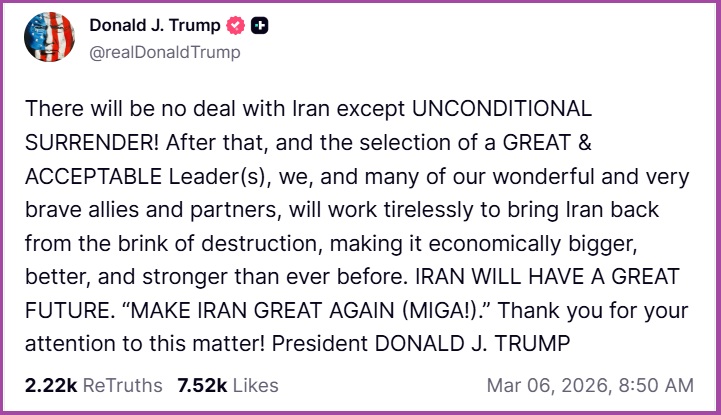
President Trump announced via Truth Social that he will not seek any terms with Iran other than unconditional surrender.
Meanwhile, in a somewhat predictable move, Treasury Secretary Scott Bessent has announced the U.S. will lift some sanctions on Russian oil exports in order to mitigate shortfalls. India will be permitted to purchase additional Russian oil for use in their refineries. The gasoline end products will then be sold into the market.
BESSENT: “President Trump’s energy agenda has resulted in oil and gas production reaching the highest levels ever recorded.
To enable oil to keep flowing into the global market, the Treasury Department is issuing a temporary 30-day waiver to allow Indian refiners to purchase Russian oil. This deliberately short-term measure will not provide significant financial benefit to the Russian government as it only authorizes transactions involving oil already stranded at sea.
India is an essential partner of the United States, and we fully anticipate that New Delhi will ramp up purchases of U.S. oil. This stop-gap measure will alleviate pressure caused by Iran’s attempt to take global energy hostage. (more)
Strategically, it has always appeared that President Trump wanted to remove the sanctions against Russia as part of a negotiated peace deal with Ukraine. However, the intransigence of Ukraine and the EU had blocked that move. I would anticipate at some date the U.S. will use the opportunity of global need as a justification to permit more Russian oil to be sold into Western markets.
This approach will not make Ukraine or the EU happy; however, it could be structured to put petrodollars back in control of Russian oil sales. That approach would further weaken China and the BRICS assembly who have been purchasing energy products in domestic exchange currencies.
The U.S., Venezuela and Russia could increase output and replace the missing oil production from the middle east region. This would stabilize markets. Although, the politics of that approach would face stiff opposition.
What seems very likely is that Bessent, Rubio and Trump have a plan. If there’s one person in U.S. politics who understands how to use oil to financially mitigate any geopolitical impacts, it’s President Trump.
Keep an eye on Russia. Ignore the western media narratives and look for direct source information on Russian oil activity.
I have created this site to help people have fun in the kitchen. I write about enjoying life both in and out of my kitchen. Life is short! Make the most of it and enjoy!
This is a library of News Events not reported by the Main Stream Media documenting & connecting the dots on How the Obama Marxist Liberal agenda is destroying America