Short-term v Long-term Forecasting Earthquakes


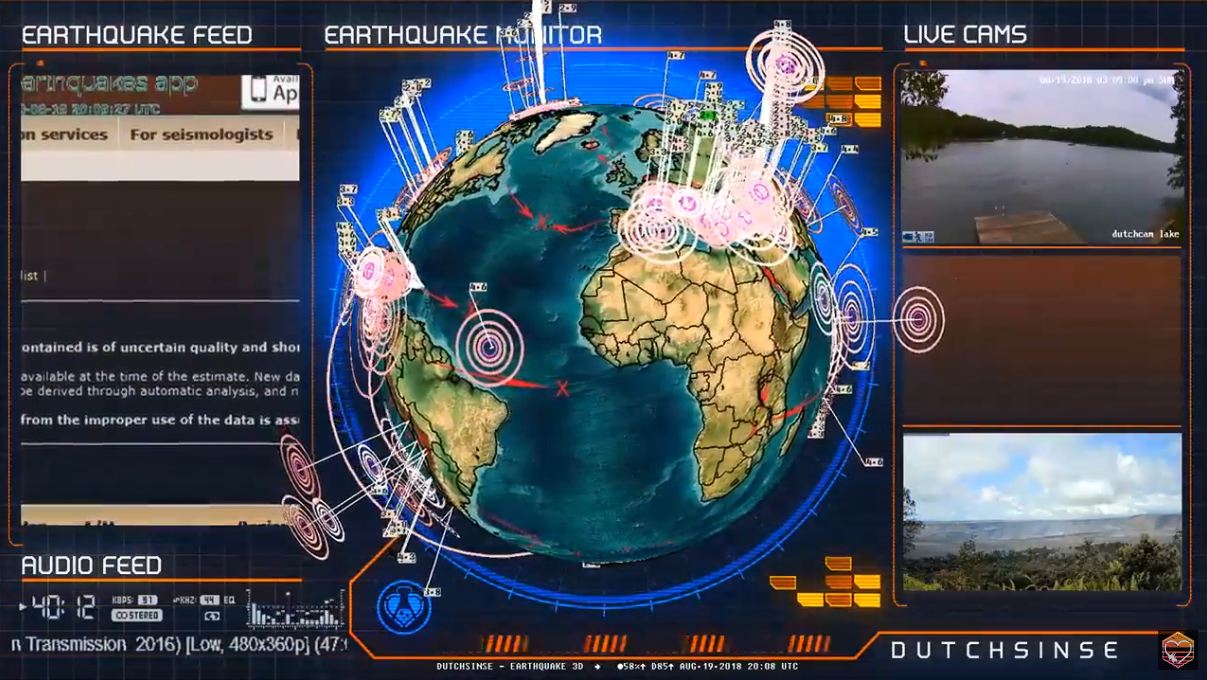
There is a site that is doing short-term Earthquake forecasts who has a very good track record known as Dutchsinse. He has a very good track record for forecasting events near-term. Of course, this is still not mainstream. It is very strange when people can improve on forecasting they are just ignored. Our models are not designed to give a specific target for an earthquake on a daily basis. We have plotted the long-term historical records and correlate that with the global economy.

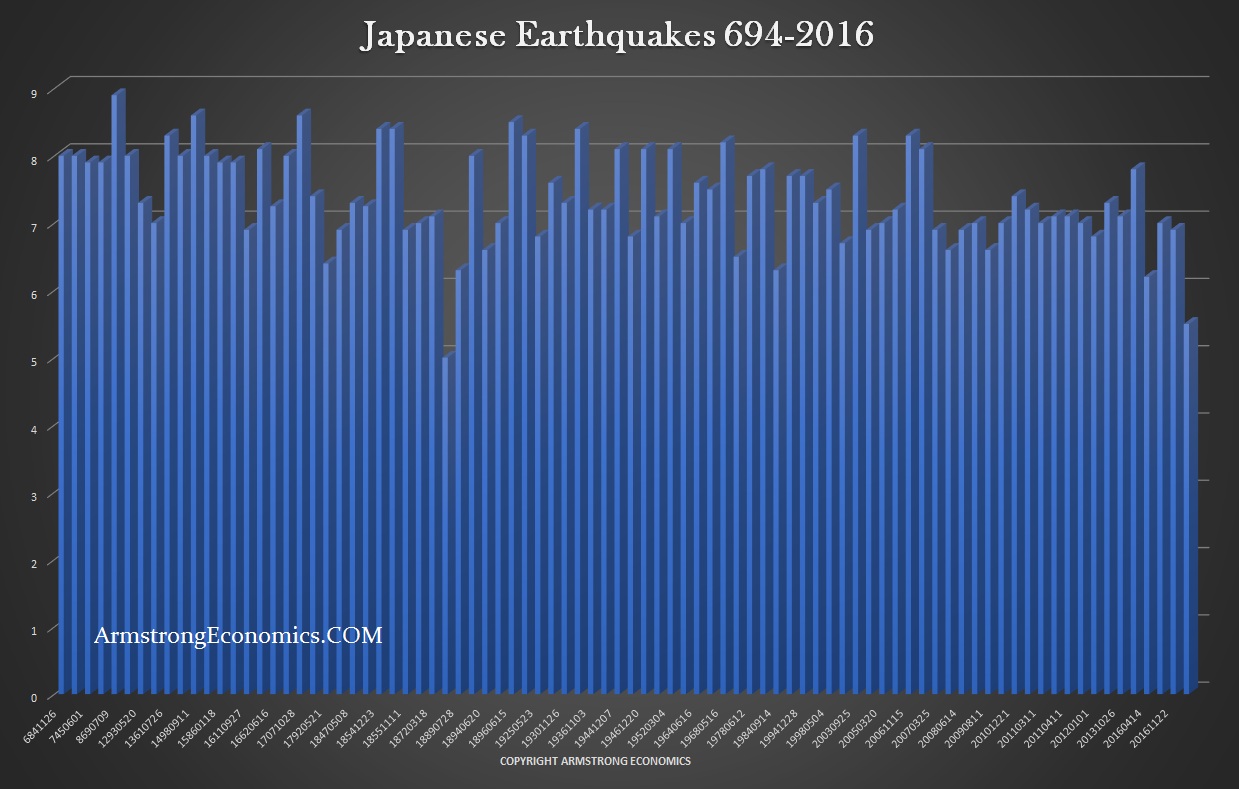
There are countless earthquakes every day.  We do not seek to duplicate what Dutchsinse provides. We are more concerned with targeting important events that will alter the economic trends either short or long-term. Here is our database on Japan. These are the earthquakes back to 694AD. In this case, there have been 86 important quakes for Japan. This is the entire country and not just Tokyo which has been destroyed three times – the last being 1923.

We identify periods where activity should appear even years in advance. This is completely different from short-term forecasting specific targets as has been the case with Dutchsinse. There are numerous quakes around the world every day. Most people will never feel them. Some will run deep and others shallow. Some will produce tsunami events that can be catastrophic as was the case in the 1923 Tokyo event.

Our models are more focused on the correlation with other events. Obviously, a 1923 style earthquake and tsunami in Tokyo today would impact the global economy as Japan is the third largest economy and debt market. The ripple effect in global markets, both currency, and equity would be very significant as well as the debt markets. Here we strive for long-term forecasts to provide institutions time to shift portfolios that could never be accomplished in 24 hours or less.

Second Earthquake in One Day Hits Lombok, Indonesia


Another earthquake hit now in Indonesia but this was a 6.9 and much shallower. It has resulted in a landslide from Mount Rinjani after another earthquake hits Lombok. It really would be nice if we simply realize that everything is connected cyclically. We have now had two quakes hit the very first day our computer projected a correlation would intensify in August. There are studies that need to be done and knock off the political BS that supports research like Global Warming that produces taxes and divert it to something more practical that can actually save lives now.

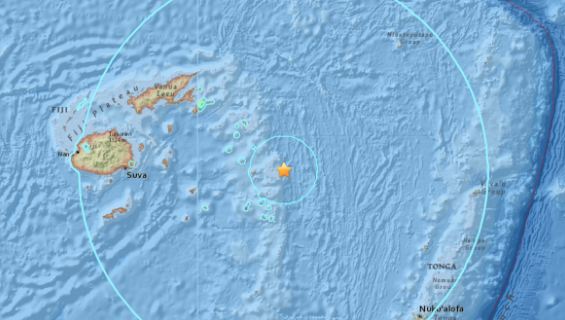
Fiji Earthquake 8.2 – More to Come?


COMMENT: Ok, this time you were wrong. A major earthquake hit Fiji on the 19th, not the 20th and CNN reported it 3 hours ago which followed your post 8 hours ago. Your slipping!

Cheers

Keep up the great work

PF

REPLY: Well, I never bothered to try to hone in on earthquakes to the day. It was a deep quake at 8.2. Such deep quakes can later trigger more shallow quakes of similar magnitude days or weeks later. But in reality, this week began today the 19th. I am a trader so I label the weeks with the first trading day being Monday 20th. Yet, what I do find most interesting is how everything seems to be correlated together be it nature or markets. I am still trying to figure that one out. I put all of this together because it became clear from ancient times onward, that natural disasters had profound economic impacts.


It was the great fire of Rome that necessitated the creation of money. Nero was the first to slightly debase the silver denarius reducing the silver content from 97.5% to 93.5%. He needed more money to pay for the reconstruction of Rome and his new palace.

When Pompei was destroyed by the eruption of Vesuvius, once again we see that money was needed for the relief effort. Titus was forced to reduce the silver content from Nero’s level of 93.5% to 92.5%. Of course, the San Francisco Earthquake of 1906 contributed to the Panic of 1907 and the regional capital flow crisis that eventually led to the creation of the Federal Reserve with branches throughout the nation.

You cannot forecast the economy and markets without taking into account all factors and that includes NATURE!

Earthquake & Volcanoes for August/September 2018


QUESTION: Mr. Armstrong; In Singapore who warned that there would be continued volcanic activity in the Pacific and that the peak in 2018 appeared to be coming into play August/September. Is that timing still on track?

GH

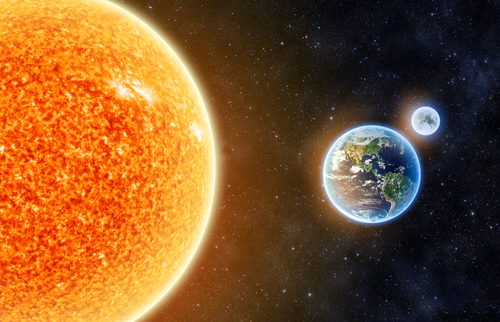
ANSWER: Yes. That seems to actually begin this coming week 8/20 and goes into the week of 09/10. This is just a cyclical period but it is not catastrophic so no need to run and hide under the desk. This is a trend that should continue for several years. However, we are entering a period where we can see an increase in activity cyclically speaking. It is just that 2018 was the beginning and we have seen quite a few volcanoes erupted so far this year. It tends to correlate with the downturn in the energy output of the sun

Immortality: Breakthrough Reverses Aging


Published on Aug 16, 2018

Scientists may have found a recipe for immortality, but if you live long will you prosper? What would you do with an extra 300 years? Bill Whittle hosts Scott Ott and Stephen Green to explore the benefits of virtual eternal life, and the hazards. ‘Right Angle’ is brought to you by the members at http://BillWhittle.com Subscribe and become a patron producer spreading the message of liberty around the world, in an entertaining way. Other topics on this week’s Right Angle include Omarosa’s new Trump book and why journalists treat it as fact, what killed off Homo erectus, and a look at “How we’re doing” as a country. Members get an extra episode each week, plus a Backstage video pass to our pre-production meeting. Bill Whittle, Stephen Green and Scott Ott have produced a three-man news commentary and humor show for about nine years, every week. Your topic ideas always welcome in the comments at http://BillWhittle.com Follow the Right Angle Facebook page: https://www.facebook.com/RightAngleTV/ Join the Right Angle MeWe group: https://mewe.com/join/right_angle

Amazing videos of tornadoes and the Destruction that they do


This is a series of videos clips pieced into one short movie that is the best I have ever seen showing the destruction that tornadoes can cause.


Horrific Bridge Collapse in Genoa, Italy – Dozens Killed During Massive Structural Failure…


The images are jaw-dropping.  Dozens of vehicles plunged well over a hundred feet when a massive section of an elevated/suspension bridge collapsed in Genoa, Italy.  The death toll continues to grow (currently 35); and incredibly there were/are actual survivors being pulled from vehicles.  The bridge was built in 1967, and there was a very bad storm at the time of the collapse. An eye witness stated he saw a direct lightning strike on the support tower just prior to the moment of failure.

(Via Daily Mail) At least 35 people have been killed ‘including a baby’ and dozens more are feared dead after a huge 260ft section of a highway bridge collapsed during a fierce storm in the Italian city of Genoa.

Cars fell hundreds of feet along with tonnes of twisted steel and concrete debris into a river, railroad tracks and an industrial zone below when the Morandi bridge gave way at 11.30am local time.

Officials fear ‘dozens’ are dead in what is being described as ‘an immense tragedy.’ There are reports that a baby is among the victims and that two people died in their homes when the giant structure collapsed.

Amid ‘apocalyptic’ scenes, up to 35 cars and three heavy trucks cascaded into the valley below as they were making their way over the bridge.

One witness said he saw the 50-year-old structure ‘wobbling’ minutes before it gave way and another said they saw it being struck by lightning just before it crumbled. (read more)

Complexity & Quantum Computing


QUESTION: Do you think that quantum computing will really change the world and is it feasible in our lifetime?

FD

REPLY: Quantum Computing is the first real change in computer science. Traditional computers encode information in bits which are essentially magnets that store a charge and that created the binary code of 1 and 0. Therefore, 8 magnets form a bit and thus the letter A would be 01000001. You can store the entire alphabet in these bits.

Quantum computers, on the other hand, work entirely different. They are based on qubits, which operate according to two key principles of quantum physics: superposition and entanglement. The superposition means that each qubit can represent both a 1 and a 0 at the same time. Entanglement means that qubits in a superposition can be correlated with each other, which means that whether the state of one is actually a 1 or a 0 can depends entirely upon the state of another. Using these two principles, qubits can act in a more complex yet sophisticated manner. This enables quantum computers to function in ways that allow them to solve difficult problems that are inflexible or difficult utilizing today’s computers.

Whether it is actually possible to solve is one of the greatest mysteries of life and not fully recognizable just yet. There are experiments being conducted to see if they can solve problems that would be impossible with standard coding. Will they change the world? It is possible, but not yet. Socrates was designed with standard computer binary structures. However, in order to work out some of the most difficult complex structures, it required creating a derivative of this principle of superposition and entanglement but artificially creating this quantum structure.

For example, this is a photo of a giant honey mushroom, located in Oregon, which is 2400 years old. It is actually all connected by a root system that stretches 3 miles.  This is the LARGEST living organism on the planet. On the surface, you would assume they are all separate and individual. However, they are all connected and form part of the same organism. It is this same complex structure that connects all of us. Although we are independent on one level, we react and respond also collectively — the panic herd syndrome. Any attempt to forecast a single economy fails because it excludes the trends in all others.

Complexity is fascinating. It is all about how we approach it

Thailand: Four Boys Rescued in Part 1 Of Treacherous Operation Racing Against Time and Rain…


Four of the twelve Thai schoolboys were rescued by divers in part one of an exhaustive international effort. The remaining boys will have to wait until oxygen tanks are replaced and equipment resupplied along the underwater system for the next attempt.

According to local officials it is expected to take at least 10 hours to re-stage the rescue equipment before attempting round #2 of the rescue. Each rescue team takes another 6 hours to navigate and guide the boys through a 4,000 meter long underwater labyrinth. There are more than 90 divers working on the rescue mission including 50 international divers from around the world.

CHIANG RAI, Thailand (Reuters) – Four of 12 Thai schoolboys were rescued from a flooded cave on Sunday in a daring and dangerous operation to save the children and their soccer coach who have been trapped underground for more than two weeks.

The operation to rescue the remaining eight boys – some as young as 11 and weak swimmers – and the coach was called off at nightfall until Monday to give the divers time to replenish oxygen supplies and ensure all preparations were complete.

Thirteen foreign divers and five members of Thailand’s elite navy SEAL unit guided the boys to safety through narrow, submerged passageways that claimed the life of a former Thai navy diver on Friday.

“Today was the best day, the best situation in terms of the weather, the health of the boys, our water management for our rescue effort,” the head of the rescue operation, Narongsak Osottanakorn, told a news conference.

“Today we managed to rescue and send back four children to Chiang Rai Prachanukrua Hospital safely.”

The rescuers needed at least 10 hours to prepare for their next operation, involving about 90 divers in total, 50 of them from foreign countries, he said.

A helicopter flew the four boys to the nearby city of Chiang Rai, where they were taken by ambulance to the hospital. (read more)

Pictorial graphic of the challenge AVAILABLE HERE

US East Coast Risk of Tsunami & Earthquakes that Threaten NYC


QUESTION:  Hey Marty,
Thanks for all your insight the last few years on what the models are projecting for volcanic & seismic activity. As usual, you’re on the money. The forecast of events laying out to 2032 is really starting to add up in their interconnectivity. God help us all.
My question is regarding the mid-Atlantic ridge and the US East Coast continental shelf faults. We all know you chose Tampa over the Florida Atlantic Coast; should we be concerned about tsunamis & seismic activity along the eastern seaboard?

As always, thanks for everything you do. You’re my hero.
Cheers,

DP
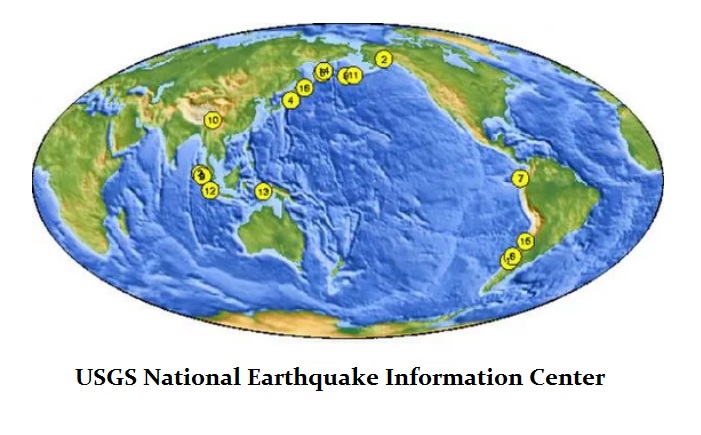
ANSWER: That is actually a very good question. The 10 Biggest Earthquakes in History have ALL taken place around the Pacific Rim of Fire – not in the Atlantic. Ideally, the next big one is interestingly due in 2021. The modern big quakes around the Pacific Rim have been:

  • 1906 — San Francisco, California, Magnitude: 8. About 3,000 people died from the earthquake, on the San Andreas Fault, and resulting fire.
  • 1923 — Tokyo, Japan, Magnitude: 7.9. One of the world’s most destructive earthquakes, more than 142,000 people died from collapsing buildings and the resulting firestorm. The quake also resulted in enormous tsunami waves.
  • 1960 — Chile, Magnitude: 9.5. The largest earthquake ever recorded, the 1960 quake in Chile killed more than 1,600 people, with many of the deaths resulting from tsunamis. Waves reached 38 feet (11.5 meters) and carried debris as far as 2 miles (3.2 kilometers) inland.
  • 1970 — Peru, Magnitude: 7.9. Approximately 66,000 people died, many from collapsed buildings and a post-earthquake avalanche.
  • 2004 — Indonesia, Magnitude: 9.1. The third largest earthquake in the world in this century, the quake killed more than 227,000 people. Powerful tsunami waves crisscrossed the Indian Ocean and ravaged 12 Asian countries.
  • 2011 — Japan, Magnitude: 9.0

When we turn to the Atlantic, there is a different problem altogether. I remember experiencing my first earthquake when I was probably the 4.5 quake of May 12, 1964, that hit Lancaster, Pa. I woke up and first though boy that was a loud train. Then I realized I did not live near a train track. When I came down in the morning the press was all talking about the earthquake that hit the area outside of Philadelphia. That was not in the ocean.
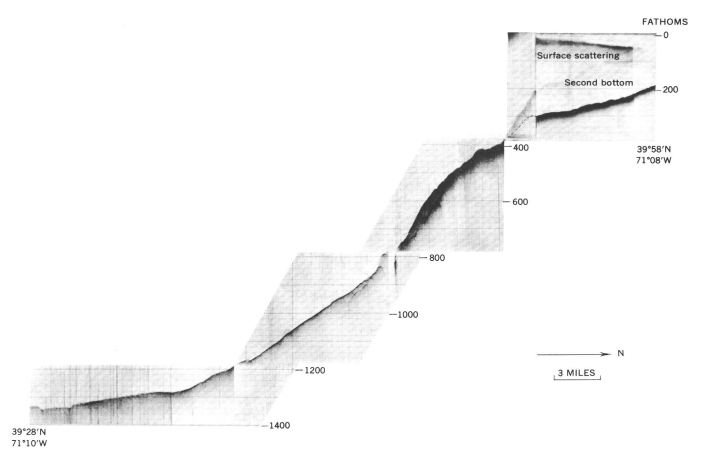
What we must understand about the Mid-Atlantic Ridge is that there may be a greater risk of tsunami events than major earthquakes. The continental slope is the topographic boundary between the continent and the ocean basin. It is a complex feature. What people do not generally understand is that relatively minor earthquakes can set off a tsunami. The greater risks are in the north from Newfound down to just below New Jersey. A relatively minor offshore earthquake of magnitude 4.5 or above could cause submarine avalanches that then generate tsunami events with waves higher than 26 feet (8 meters). The underwater canyons and bays could focus these waves and make them even much larger all from minor events.

Back in 1929, there was a 7.2-magnitude earthquake off the southern coast of Newfoundland that caused a large underwater landslide. It was that landslide that created a large wave that rushed ashore and killed some 28 people on the island. However, the waves were at first about 26 feet high until they reached the narrow inlets. This compressed all the energy causing the tsunami to grow to 43 feet (13 m). That was absolutely devastating.

There is evidence that at least a 12-foot tsunami wave hit Manhattan around 300BC. Geological experts reported that this ancient tsunami dumped sediment, shells and marine fossils across the region inland that date back to 300BC. Tsunami waves are rare events in the Atlantic. One theory is that a New York tsunami may have been triggered by an asteroid. However, no crater has ever been discovered. It is far more likely that an earthquake simply triggered an avalanche.
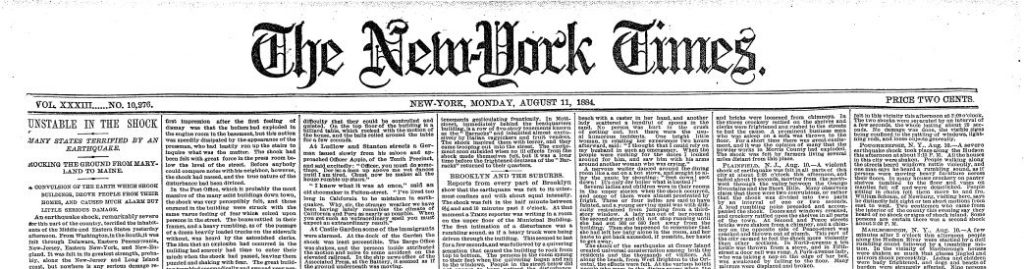

Historically, New York City has been hit by large earthquakes over the 5 scale about once a century. There was a 5.2-magnitude quake that shook New York City back in 1737 and another of the same severity hit on August 10th, 1884 with tremors being felt from Maine to Virginia. I have been in New York City for at least two earthquakes that I remember. They were minor but enough that you felt them. One I recall was in 1981 and one around 2002. The biggest hit on an 18-year cycle in 2010, but that was only a 3.2 measurement. There is a small fault that runs down 125th Street. That is the one that produced the tremors of 1981. It is also believed that this is the source of the big one that hit in 1737. Curiously, the next big one is due in 2031. That could reach a 7.2 level or so.

If you look at NYC closing, you will notice that the skyscrapers are clustered. This seems to be the most overlooked aspect of New York City with people assuming that it’s just all about Wall Street. Not True! Skyscrapers clearly dominate the Manhattan skyline, but they are actually clustered in two distinct areas. Downtown is home to the Financial District. Midtown includes the Empire State Building, Chrysler Building, Park Avenue and Times Square. The reason is the surface bedrock over much of New York City provides solid anchorage to support the high buildings. Although there are two areas of this strong bedrock at or close to the surface, there is a valley in between where the building heights are noticeably lower.

In fact, the entire region south of 30th Street is where the bedrock begins to drop down and by the time your reach Washington Square, it is well below the surface. In reality, Manhattan has a valley in the center between midtown and Wall Street that would be underwater if it were not filled in with debris from various periods which may include the ancient tsunami. That is why there are no skyscrapers between the two regions.

Manhattan has NUMEROUS faults running through it and there as frequent earthquake activity on them. However, this activity is very small so people do not notice. However, there may be a risk of a larger scale earthquake that we are unable to define lacking the data before 1700. Still, New York City metropolitan is ranked as moderate on the risk scale. However, because of the density and the age of many buildings constructed of brick, a moderate earthquake would have considerable consequences in terms of public safety and economic impact more so than many other places. A 5.0-magnitude earthquake today like that of 1884 or 1737, would be far more significant given the density and construction concerns.

Therefore, the risk of an offshore earthquake that causes an avalanche on the ridge would produce a tsunami. On the other hand, there are earthquake faults in Manhattan that are numerous and the density combined with poor construction from brick increase the risk to Manhattan with just a 5+ earthquake.