Posted originally on CTH on February 21, 2026 | Sundance
Tucker Carlson interviews U.S. Ambassador to Israel Mike Huckabee against the background of a potential U.S. military operation against Iran. Apparently, Carlson and Huckabee had some public disagreements on the subject of Israel, and this interview came about as Ambassador Huckabee invited Carlson for an interview.
The interview is filled with uncomfortable friction as Carlson asks many questions that come from ongoing reviews of the files of Jeffrey Epstein. Mr Carlson confronts Ambassador Huckabee with his personal opinion that the U.S. Ambassador works for Israel and not the best interests of the United States.
Posted originally on CTH on February 19, 2026 | Sundance
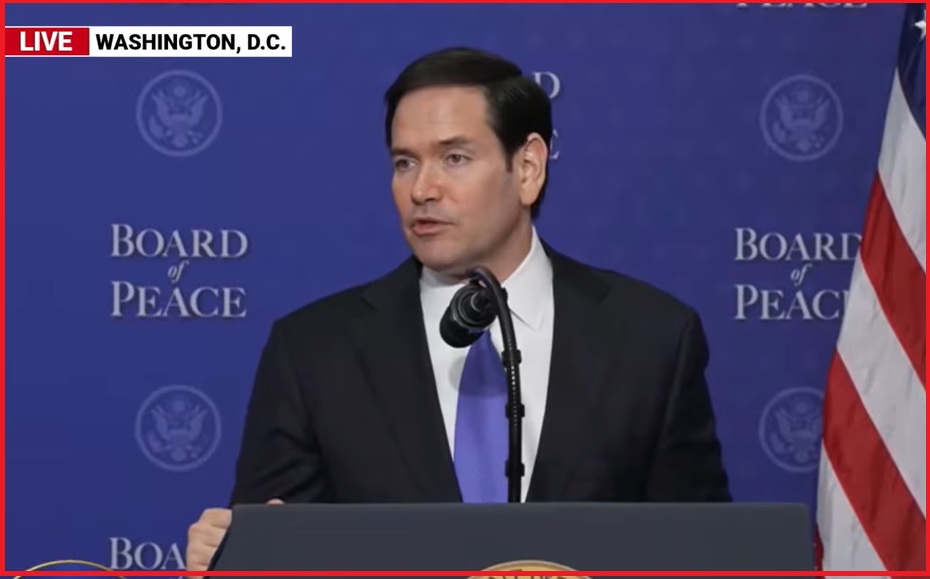
As the inaugural meeting of the Global Board of Peace gets underway, Vice President JD Vance, Secretary of State Marco Rubio and Special Envoy Steve Witkoff delivered speeches at the beginning of the Board of Peace session in Washington DC. WATCH:
Posted originally on CTH on February 19, 2026 | Sundance
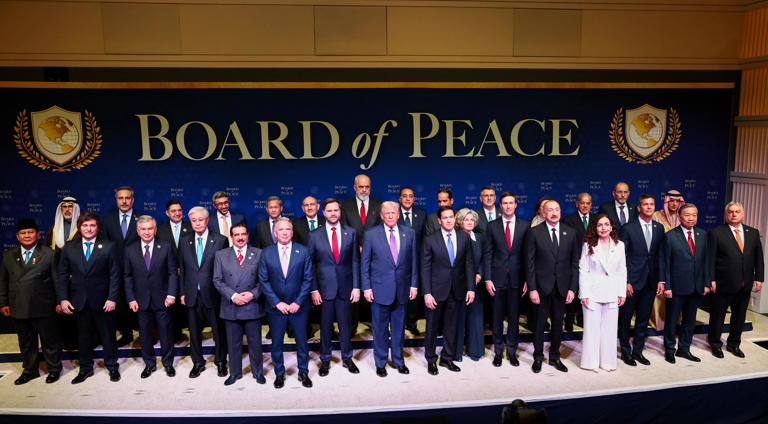
President Trump invited global leaders to Washington DC to participate in the inaugural meeting of the Board of Peace. U.S President Donald Trump, U.S. Vice President JD Vance, U.S. Secretary of State Marco Rubio, Special Envoy Steve Witkoff and Jared Kushner all delivered remarks during the event.
Participating countries include Albania, Argentina, Armenia, Azerbaijan, Belarus, Bulgaria, Cambodia, El Salvador, Hungary, Indonesia, Kazakhstan, Kosovo, Mongolia, Pakistan, Paraguay, Uzbekistan, Vietnam, Israel, Saudi Arabia, Egypt, Qatar, Bahrain, Jordan, Kuwait, Morocco, Turkey and the United Arab Emirates.
The Vatican and Pope Leo rejected an invitation to participate, concerned the Global Board of Peace may overshadow the United Nations, and that would not be acceptable to the Catholic Church or the European Union. Full video of the event below:
Posted originally on CTH on February 16, 2026 | Sundance
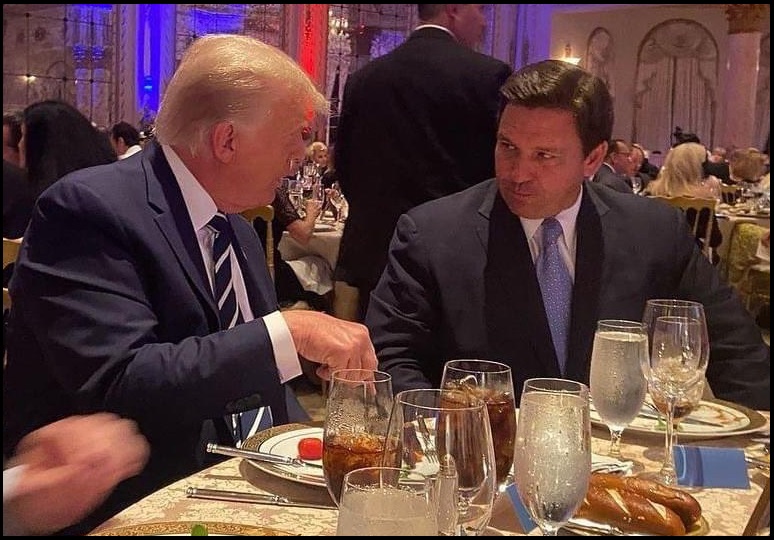
An interesting thing happened last weekend, President Trump went golfing with Florida Governor Ron DeSantis. {SOURCE} Simultaneously, President Trump released the following statement from his Truth Social account.
(Via Truth Social) – “The Board of Peace has unlimited potential. Last October, I released a Plan for the permanent end to the Conflict in Gaza, and our Vision was unanimously adopted by the United Nations Security Council. Shortly thereafter, we facilitated Humanitarian Aid at record speed and secured the release of every living and deceased Hostage.
Just last month, two dozen distinguished Founding Members joined me in Davos, Switzerland, to celebrate its official formation, and present a bold Vision for the Civilians in Gaza, and then, ultimately, far beyond Gaza — WORLD PEACE!
On February 19th, 2026, I will again be joined by Board of Peace Members at the Donald J. Trump Institute of Peace in Washington, D.C., where we will announce that Member States have pledged more than $5 BILLION DOLLARS toward the Gaza Humanitarian and Reconstruction efforts and have committed thousands of personnel to the International Stabilization Force and Local Police to maintain Security and Peace for Gazans.
Very importantly, Hamas must uphold its commitment to Full and Immediate Demilitarization. The Board of Peace will prove to be the most consequential International Body in History, and it is my honor to serve as its Chairman.” PRESIDENT DONALD J. TRUMP
I said a few weeks ago that I would not be surprised to see President Trump announce the appointment of Ron DeSantis to be the Chief Executive Officer of the Board of Peace. DeSantis’ executive experience in combination with his relationship with Israel functionally makes him a good fit. Just a guess.
DeSantis is a political animal without much of a career path that does not lean heavily on his governorship. Ron and Casey DeSantis are the republican equivalent of Bill and Hillary.
DeSantis will need a job after his term expires this year. The traditional path would be to take a job as the CEO within a major company, make money then launch for the 2028 campaign later in 2027.
You know the IC narrative is falling apart quickly when even the New York Times paints the background as gossip.
Within the New York Times reporting we discover more of the underlying context for the NSA intercept.
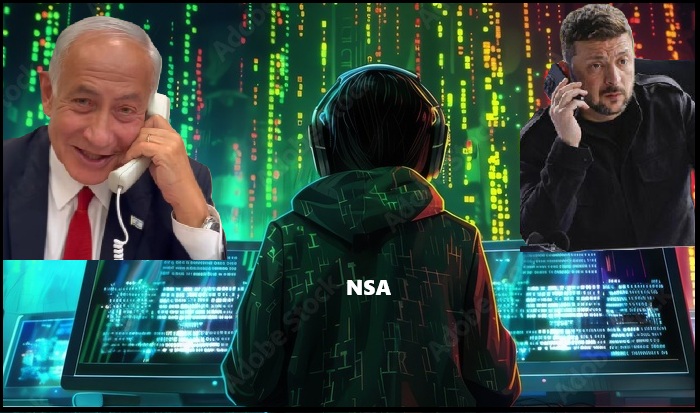
According to the Times, the NSA intercept was of “two foreign nationals” discussing an American person with some relationship to President Trump. The underlying concern was about the conversation they intercepted.
Just pulling out the pertinent:
“a whistle-blower report about an intelligence intercept of a call between two foreign nationals discussing a person close to President Trump” … “It is not clear what country the two foreign nationals were from, but the discussion involved Iran.” … “The identity of the person close to Mr. Trump could not be immediately determined.”
[…] “One official said there was no other intelligence that led officials to think the two officials had been speaking truthfully. Some intelligence analysts concluded the two foreign nationals were either gossiping or deliberately spreading misinformation. As a result of those doubts, Ms. Gabbard moved to restrict the report’s visibility. She also provided the information to Susie Wiles, the White House chief of staff, according to people briefed on the events.
The acting intelligence community’s inspector general [a Biden appointee] cleared Ms. Gabbard of wrongdoing after she responded to questions about her actions.” {source}
Summary: The NSA intercepted two foreign nationals talking about Iran and gossiping about someone close to Trump. The NSA snooper documented the conversation. Intel analysts concluded the two foreign nationals were just gossiping. DNI Gabbard did not put credibility on the issue, but to be safe informed Susie Wiles of the intercept. That’s it.
The NSA snooper then got big mad about the intelligence analysis of the conversation labeling it as gossip and took out their frustration by blaming Tulsi Gabbard for dismissing it.
Posted originally on Feb 1, 2026 by Martin Armstrong |
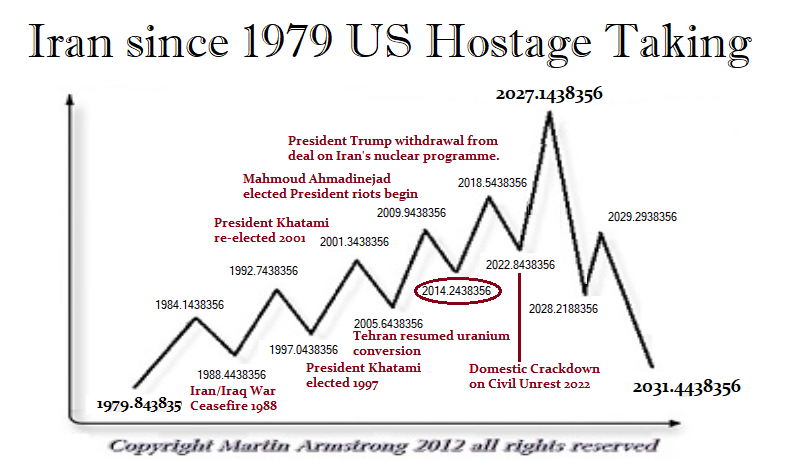
QUESTION: Do you still see the risk of a Middle East War by 2027?
HF
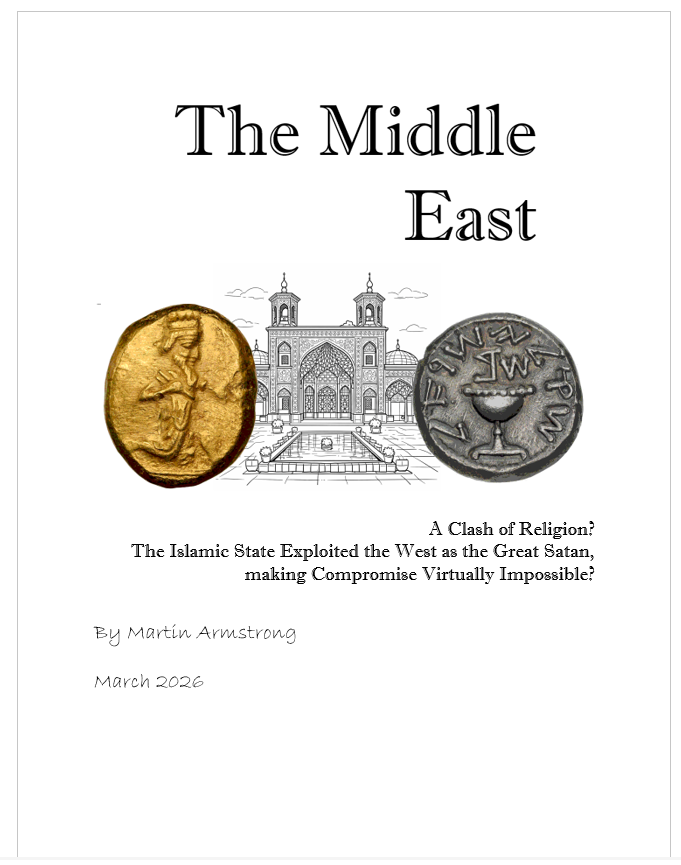
ANSWER: Unfortunately, yes. I will do a Report on the Middle East for 2026.
The Paradox of a Regime That Can’t Afford Peace
Let me start with the question everyone’s asking wrong: “Will Iran start another war with Israel?”
Wrong question. The right question is: Can Iran’s regime survive WITHOUT war?
The answer is no. And understanding why reveals everything about what’s coming in 2026 and beyond. Iran is facing its worst domestic crisis since the 1979 Revolution. As we have witnessed, starting December 28, 2025—just six months after the war—massive protests erupted across all 31 provinces. What began as economic demonstrations over hyperinflation and currency collapse rapidly evolved into demands for wholesale regime change. This isn’t like 2009’s Green Movement or 2022’s protests after Mahsa Amini’s death. This is different.
The economic devastation from sanctions, war damage, and decades of mismanagement has severed the social contract even with traditional regime supporters—the Bazaaris (merchant class) who helped bring Khomeini to power in 1979. When you lose the Bazaar, you’ve lost Iran. The shopkeepers shuttering stores in Tehran’s Grand Bazaar aren’t revolutionaries—they’re businessmen who can no longer operate because inflation destroyed the currency and the economy is broken. By early January 2026, Iranian police detained over 21,000 suspects during the unrest, including 260 accused of spying and 172 for illegal filming. Several Kurdish men were executed publicly for alleged collaboration with Israel.
Think about that. The regime is executing people for “collaboration” while simultaneously trying to rebuild military capabilities to fight Israel again. That’s not the behavior of a confident government. That’s desperation.
Why War Becomes Necessary
From a cyclical perspective, Iran’s regime is trapped between two lethal forces:
External Pressure:
Nuclear program set back 1-2 years (rebuilding frantically) Proxy network (Hezbollah, Hamas, Syria) decimated Direct military confrontation exposed defensive weaknesses U.S. and Israel signaling willingness to strike again in 2026 Regional Arab states increasingly skeptical of Iran as stabilizing force
Internal Collapse:
Hyperinflation destroying purchasing power Water scarcity creating agricultural crisis Youth unemployment astronomical Brain drain of educated class Massive protests demanding regime change Even security forces expressing financial desperation (viral videos of police officers describing severe hardship)
Posted originally on CTH on January 19, 2026 | Sundance
My message is simple: Relax and watch him work folks. I didn’t just spend three months in the region for nothing.
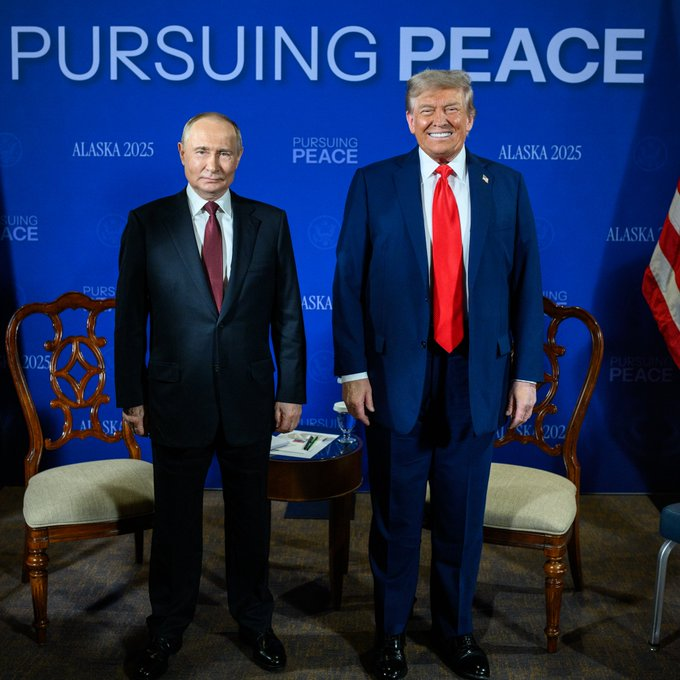
Media has just discovered that U.S. President Donald Trump has invited Russian Federation Vladimir Putin and Belarusian President Alexander Lukashenko to join the ‘Gaza Board of Peace.’ The United Nations Assembly is going bananas.
In one of the most beautiful and strategic constructs of international maneuvering in our lifetime, Chairman of the Board and U.S. President Donald Trump has just constructed a geopolitical pathway for the Russian Federation to rejoin the world and establish a respectful global governance assembly based on pragmatic, humanitarian and sovereign interests.
Simultaneously, President Donald J. Trump has just nulled the globalist United Nations Assembly by framing a new global vision; an actionable international construct, based on the same reciprocity, non-interventionist and sovereign nation worldview.
Chairman/President Trump is using the most complex, conflicted and multidimensional landscape to assemble a synergy of perspective.
The visionary map is in his head, and it is a beautiful thing to see materialize.
(VIA MSM) – Russian President Vladimir Putin has been invited to join US President Donald Trump’s “Board of Peace,” the committee that will oversee the reconstruction of Gaza, his spokesman said on Monday.
Speaking to reporters during a regular media briefing, Dmitry Peskov said: “President Putin also received through diplomatic channels an invitation to join this Board of Peace.”
He said the Kremlin is now reviewing the invitation and “hoping to get more details from the US side.”
CNN has asked the White House for a comment.
Later on Monday, the Belarusian Foreign Ministry said President Alexander Lukashenko also received an invitation to join the board.
The ministry’s press service said Minsk “highly appreciates that the American side sees Belarus – and this is clearly stated in the text of the address – as a country ready to take on the noble responsibility of building a lasting peace and leading by example, investing in a secure and prosperous future for future generations.”
Lukashenko is Putin’s closest ally and has been described as Europe’s last dictator.
The establishment of the board, chaired by Trump, is a key step in the United Nations-backed American plan to demilitarize and rebuild Gaza, which was ravaged by two years of war between Israel and the Hamas militant group.
Ireland’s Minister for Foreign Affairs Helen McEntee issued a statement on Sunday warning that the body proposed by Trump “would have a mandate wider than the implementation of the Gaza Peace Plan.”
“The United Nations has a unique mandate to maintain international peace and security, and the legitimacy to bring nations together to find common solutions to shared challenges. While it may be imperfect, the UN and the primacy of international law is more important now than ever,” she said in a statement. (read more)
The United Nations Assembly are not happy.
Those who constructed the United Nations are not happy.
President Trump calls the Gaza Board of Peace, “the Greatest and Most Prestigious Board ever assembled” for a reason. However, he is not describing the board simply for who assembles around the table, but rather for the actionable intent created by the assembly itself.
For this intention Gaza -the place- represents a tool, an example, a useful geographical means to an end, a proving ground for the impossible.
When people think of Trump, they think big, bold and unique. This perspective carries with it, both big support and big opposition. But even those scaled perspectives are not quite grasping the scope of what he is prepared to accomplish.
Posted originally on CTH on January 18, 2026 | Sundance
Last week President Donald Trump officially announced the members of the Gaza Board of Peace; an organization headed by President Trump and tasked to oversee the second phase of his plan to end the Israeli conflict in Gaza, specifically the reconstruction and disarmament of Gaza and Hamas respectively. [SEE HERE]
The members of the “Board of Peace,” chaired by Trump himself, includes Secretary of State Marco Rubio; Emissary Steve Witkoff; Jared Kushner; former British Prime Minister Tony Blair; an American-Jewish billionaire named Mark Rowan; World Bank President Ajay Banga; and Deputy National Security Advisor of the United States, Robert Gabriel. President/Chairman Donald Trump has also appointed Aryeh Lightstone and Josh Gruenbaum as senior advisors to the Board of Peace.
At the same time, President Trump announced another executive body that would operate under the Peace Council to assist with the facilitation of a new Palestinian government, the “Gaza Executive Board.” This structure is intended to manage day to day events on the ground instead of a Hamas loyalist govt. The appointees to the executive board have upset the Netanyahu government of Israel.
According to the White House announcement, the Gaza Executive Board will include: Witkoff; Kushner; Turkish Foreign Minister Hakan Fidan; senior Qatari official Ali al-Thawadi; Egyptian intelligence chief Hassan Rashad; Tony Blair; billionaire Mark Rowan; UAE Minister Reem Al Hashimi; former Bulgarian Foreign and Defense Minister Nickolay Mladenov, who also served as the UN envoy for the Middle East peace process; U.N Representative Sigrid Kagg, and Israeli-Cypriot businessman Yakir Gabbay, who specializes in real estate, technology and international investments.
Additionally, to establish security, preserve peace, and establish a durable terror-free environment, Major General Jasper Jeffers has been appointed Commander of the International Stabilization Force (ISF), where he will lead security operations, support comprehensive demilitarization, and enable the safe delivery of humanitarian aid and reconstruction materials. [link]
According to Israeli media Netanyahu is not happy, and planning to protest the Turkish, Qatari and UAE appointments to Marco Rubio (not Trump):
“A very unusual statement by the prime minister against the US president, following the publication of the members of the “Executive Committee for Gaza” – which includes, among other things, the Turkish foreign minister and a senior Qatari official. “The announcement of the panel was not coordinated with Israel and is contrary to its policy,” the Prime Minister’s Office said.
“The announcement of the composition of Gaza’s Executive Committee, which is subordinate to the peace conference, was not coordinated with Israel and is contrary to its policy,” the Prime Minister’s Office said, adding that “the prime minister has instructed Foreign Minister Gideon Sa’ar to contact US Secretary of State Marco Rubio on this matter.” (more)
Within the appointments for the executive board, the use of Turkey, Qatar and UAE officials for the governance and reconstruction of Gaza explains the recent parsing of the Muslim Brotherhood chapters as terrorist enablers. When Secretary Rubio made the terrorist designation announcement, the Turkish and Qatari Muslim Brotherhood chapters were notably absent. With the Gaza initiative ongoing, now we see coordinated pragmatism at work.
Rubio chose to focus on Egypt, Jordan and Lebanon to target the Muslim Brotherhood. As we noted, “The Egyptian Muslim Brotherhood were chased out of the country by President Abdel Fattah al-Sisi over a decade ago. The Jordanian chapter is similarly aligned and was previously targeted by King Abdullah. The Lebanese faction is not as well known, but their support for Hamas is well understood.” {Go Deep}
A few things are obvious.
First, President Trump and Secretary Rubio knew in advance they were going to need the strong influences of Qatar and Turkey if they were going to stabilize the interim Gaza reconstruction governing system. Secondly, both Trump and Rubio knew Israeli Prime Minister Benjamin Netanyahu wouldn’t like that; however, pragmatically Trump and Rubio are doing what is in the best interest of the region as a whole, not being narrowly focused on Israel. Additionally, these appointments have upset the Israel-first influencer group in the U.S.
President Trump is restructuring mid-east stability without the need for direct U.S. intervention. Instead, under President Trump’s approach conflict resolution is the responsibility of the regional stakeholders with strong support from President Trump. It is a similar outlook conveyed to Europe about needing to be responsible for their own defense and security solutions while the USA role is supportive in nature.
In this approach the sharp tendrils of U.S. influence start to be untangled, and the national security focus returns to the USA domestically. Mutually beneficial national sovereignty replaces toxic and unending globalist intervention. This is a similar worldview that President Trump also takes toward trade agreements.
Multilateral trade agreements like the Transpacific Trade Partnership (TPP) or the Transatlantic Trade and Investment Partnership (TTIP), or even the NAFTA/USMCA trade agreement are rejected in favor of direct bilateral free trade agreements with individual nations.
In Trump’s trade policy the multilateral deals are dissolved, while the bilateral deals are affirmed. The same outlook holds true for massive institutional agreements that end up with large entanglements often carrying disproportionate costs and disparate benefits. Like NATO, the USA usually ends up with the largest price tag and least benefit from the agreement.
Is NATO/Europe going to fight China over Taiwan? Of course not. If they were, Canada wouldn’t be making deals with Beijing, and Europe would not be allowing China to purchase stakeholder interests in the European car market. The same pragmatic and reasonable outlook applies right now toward how the EU has responded to the Russia/Ukraine conflict; only “willing” if the USA puts our blood and treasure on the line.
This nationalistic outlook is honestly encapsulated in this recent soundbite from President Trump when asked about Canadian Prime Minister Mark Carney making a trade agreement with China. President Trump genuinely doesn’t care. WATCH:
Canada can make whatever deal they want with China; however, that doesn’t mean it will work out well for Canada when the USMCA is dissolved and a new bilateral trade deal between the USA and Canada is renegotiated. Factually, it means Canada will end up in a worse economic place, just look at the history of countries that hugged Big Panda. It is their own independent right to be blind to the risk.
Despite all the warnings from President Trump, Europe became dependent on Russia for low-cost energy; how’d that work out for them? Germany now seriously regrets their green energy approach, but there’s nothing President Trump can do to stop multinational assemblies from being collectively stupid; the only thing he can do is mitigate any collateral damage to the USA.
Instead of European leaders calling President Trump every time Turkish President Recep Erdogan does something against their interests, eventually the group will learn how to engage him individually. In a world of bilateral respect, the lessons from Trump could even have the downstream effect of training the EU to drop their obsession with Russia-bad everything.
The Ukraine conflict could end when Europe finally realizes it’s much easier to turn on a Nordstream gas valve than it is to rebuild 30 German nuclear power plants. President Trump’s refusal to commit U.S. troops to Zelenskyy’s security guarantee will hopefully hasten that conversation.
The same pragmatic realism applies to Greenland. Europe will never respond to any increase in strategic threat presented by China or Russia in the Arctic, and the U.S. will shoulder all the costs if that risk were to materialize. Strategic pragmatism combined with economic realism is why President Trump is focused on the security of the North American continent.
Lastly, there is a segment of MAGA that is angered by President Trump’s interim and necessary approach to removing our foreign policy entanglements in both the European and Mideast continents. Those who are short-sighted don’t see how President Trump is strategically and factually withdrawing U.S. policy from a world of enmeshed dependencies, because in reality charity –along with security– begins at home.
Thankfully, the former Lyndon LaRouche assembly from Promethean Action have begun to recalibrate their British-centric focus, and they’ve started to look at Trump policy beyond the ramifications to London and through the more accurate prism of Trump’s global pragmatism. President Donald Trump isn’t trying to unilaterally destroy British imperialism, not directly. Instead, that old, stuffy and elitist collapse is a consequence of reestablishing independent sovereignty.
Smile, live your very best life and watch it all unfold. After all, Davos is going to be a must-watch event next week.
Posted originally on Jan 7, 2026 by Martin Armstrong |
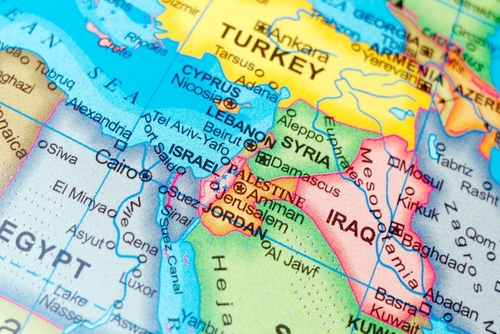
Syria has agreed to create an intelligence network with the United States and Israel. Syrian President Ahmed al-Sharaa, a former Sunni jihadist and known terrorist, became a CIA asset after he was captured while fighting for Al Qaeda in Iraq. I explained on numerous occasions that he was compromised and installed into his position by the CIA; Syria’s new alignment with Israel should not come as a shock.
Steve Witkoff, Jared Kushner, and Tom Barrack represented the US envoy for Syria during the Israel-Syria meeting in Paris this week. Washington reported that the meeting went as intended, with Israel and Syria agreeing to a “fusion mechanism” by which they will share intelligence, diplomatic engagement, military de-escalation, and commercial issues.
For decades, Syria and Israel have technically been at war. That hostility has been useful politically for both sides. It justified military budgets, internal repression, and foreign alliances. This development reiterates what the computer has warned: the Middle East is fragmenting into blocs, and the old Cold War alignments are collapsing.
Reports have emerged that Iranian officials are seeking to assassinate al-Sharaa. Al-Assad’s former military intelligence chief, Major General Kamal Hassan, is building a militia among Syria’s Alawite minority community, according to a December 2025 Reuters report. The ousted dictator’s billionaire cousin, Rami Makhlouf, has been financing Hassan’s efforts. Feared special forces commander Suhail al-Hassan, known as “The Tiger,” has been recruiting thousands of men to oppose al-Assad and retake control.
Syria is no longer beholden to Iran as its new financiers are from the West. Russia is no longer policing the region and the US has a stronghold over Syria. This alignment is temporary and a precursor to a larger regional conflict on the horizon.
I have created this site to help people have fun in the kitchen. I write about enjoying life both in and out of my kitchen. Life is short! Make the most of it and enjoy!
This is a library of News Events not reported by the Main Stream Media documenting & connecting the dots on How the Obama Marxist Liberal agenda is destroying America







 Centinel2012