Posted originally on CTH on March 13, 2026 | Sundance
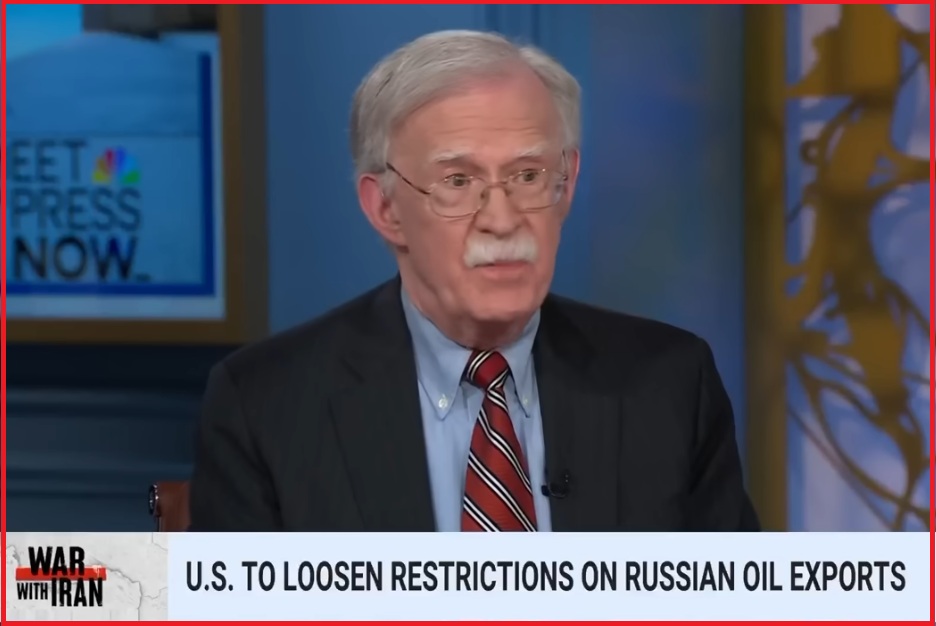
While under federal indictment for improper retention, holding and releasing classified intelligence, John Bolton appears on NBC News to complain about how President Trump is conducting the war against Iran.
It is hilarious to see Bolton pontificate, with all the customary arrogant self-assurances, that President Trump did not plan for a scenario where the oil flows through the Strait of Hormuz would be disrupted, while simultaneously proclaiming President Trump is giving Russian President Vladimir Putin a gift with the lifting of oil/gas sanctions to support the global market.
His insufferable ignorance is laughable. John Bolton just cannot hear himself. Trump didn’t plan for the oil shortage, but Trump lifted Russian oil sanctions. Say that again slowly John, while looking in the mirror. Trump didn’t plan for an oil shortage, but Trump planned to lift Russian oil sanctions. Slow it down and repeat as needed, until the ah-ha moment sinks in.
Consider that President Trump did actually plan for the Strait of Hormuz to be closed; perhaps even planned for a long time for the issue {GO DEEP}. And planned, well in advance, for an offset to deliver massive amounts of oil even with the Strait of Hormuz closed.
Give his narrow and stale globalist mind a little longer than normal to see the strategy; give him quiet time in a room with no windows to contemplate the outcomes he is witnessing; and we might even sell tickets to see the moment his ancient neocon brain explodes.
Posted originally on CTH on March 13, 2026 | Sundance |
‘Trump, you magnificent bastard, I read your book!’
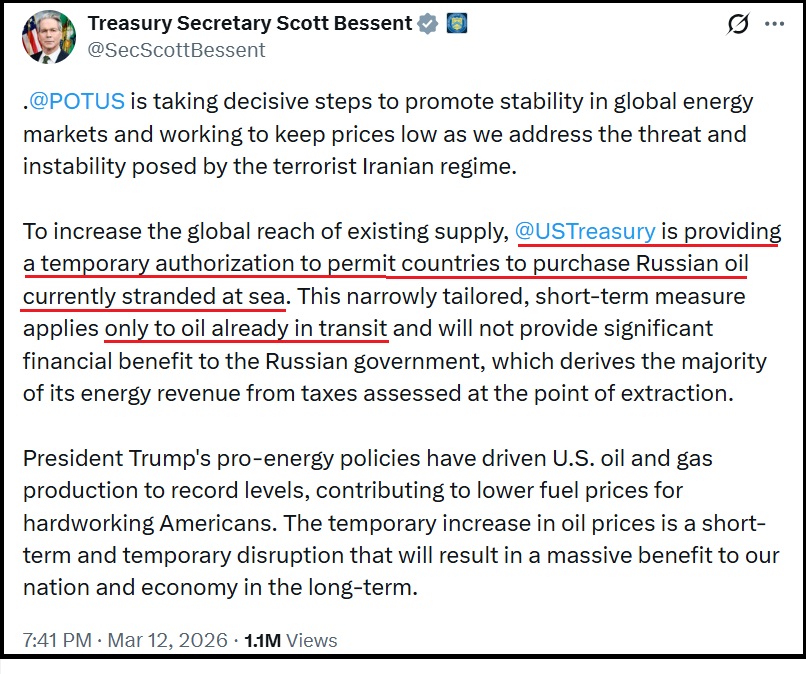
President Trump and Treasury Secretary Scott Bessent are facing mounting criticism for creating a window for Russia to sell oil and gas to the global market via “narrowly tailored, short-term” sanction relief. However, few people are putting the issue into context, and the background here is exceptionally interesting.
According to the terms announced by Secretary Bessent, the license to sell applies solely to Russian crude or petroleum products loaded onto vessels as of March 12 and is valid through midnight Washington time on April 11. [Treasury Notice Here – OFAC Technical Details Here]
The sanction relief license to sell will be done in globally recognized petrodollars and applies only to preexisting oil and petroleum products that are already in transit at sea. However, here’s where it gets very interesting and the ramifications are significant.
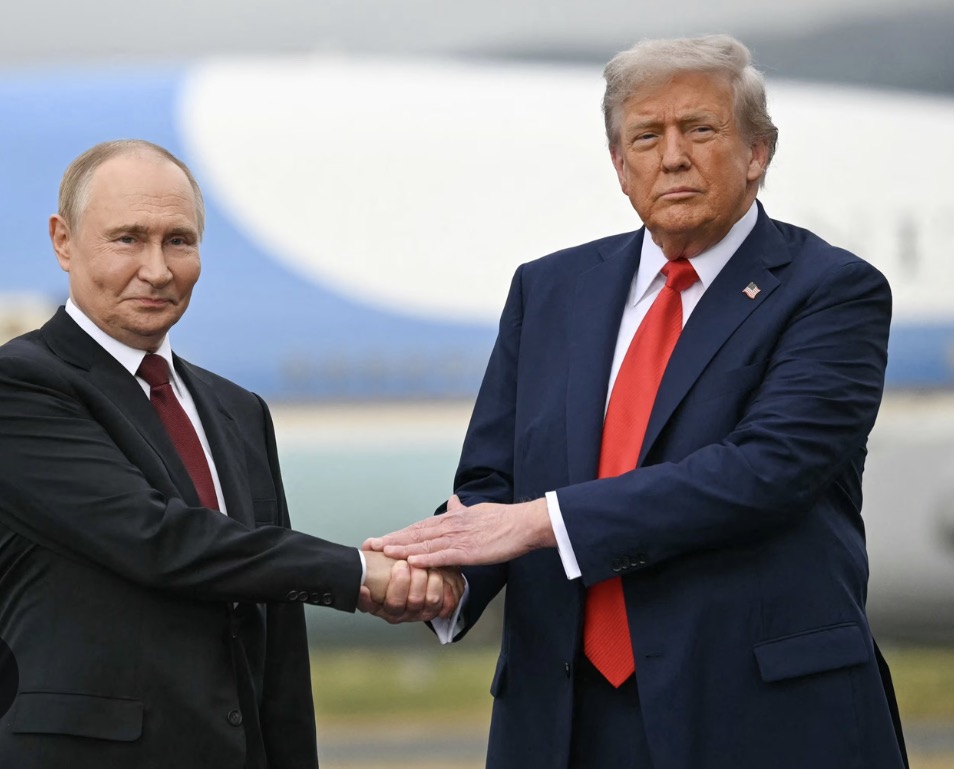
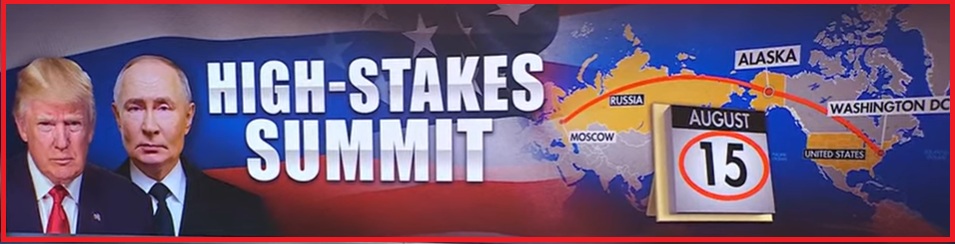
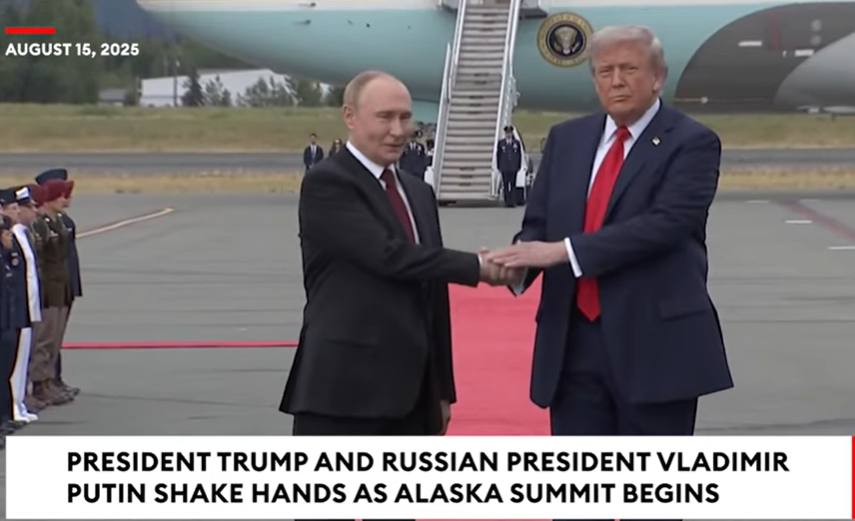
Immediately following the Alaska summit between Russian President Vladimir Putin and President Trump, Russia restarted Arctic-2 LNG terminals and began increasing oil production for storage on ‘floating platforms.’ President Trump met with Putin on August 15, 2025, and the curious increase in Russian production began on August 18, 2025.
In the past six months Russia has been pumping sanctioned oil and gas and storing it on ships and mobile sea platforms, seemingly (at the time) with no customers. Suddenly, against the background of the Iran conflict, all of that previously stored ‘on the water‘ production, now worth double, is authorized for global sale (in petrodollars).
Either Russian President Putin is the luckiest guy in the world, or Russia knew something.
In 2025 what Russia did following the Alaska summit did not make sense; now it does and the ramifications are stunning.
President Trump was looking for a way to organize a strategic partnership with Russia on the issue of energy production but was hampered by the preexisting sanction regime and strong opposition from domestic and international politics.
The ‘coincidental’ timing’ of Trump meeting with Putin and then subsequently Russia producing massive amounts of oil and gas for storage on the water suddenly starts to take on an entirely new light. Did Putin know something was coming, something that would eventually make the Russian over production and ‘on the sea’ storage worth billions.
The implications here are quite remarkable; however, they simultaneously explain most of the behaviors since the Iran confrontation began.
Media reports highlight that Vladimir Putin was asked about a previous joint agreement for military support between Iran and Russia and why Russia did not respond when Iran was attacked. Foreknowledge would explain that reaction.
Additionally, the Russian Federation president never responded to the Trump operation to take down Venezuelan dictator Maduro and seize control over Venezuela’s oil production.
If there was some discussion inferring that a ‘limited sanction relief’ protocol might be possible, that would explain why Russia began storing oil and gas at sea.
This fact pattern would also indicate that President Trump’s decision toward Iran was made at least six months ago, with a set of geopolitical events planned between the Alaska summit and the eventual confrontation with Iran.
TIMELINE: Trump and Putin meet. Three days later Russia begins pumping oil/gas and storing it at sea. President Trump then triggers the Venezuela western hemisphere security operation; Russia stays silent. President Trump then triggers the confrontation with Iran; Russia rejects involvement. And then two weeks after the Iran confrontation begins, Trump removes sanctions on Russian oil/gas “in transit” at sea.
Suddenly all of the Russian produced and stored product ‘on the water’ has greater value and new customers.
Just a coincidence? No way.
The United States needs the oil/gas market stability that Russia can provide.
Venezuela was/is to Trump as Ukraine was/is to Putin.
Posted originally on CTH on March 12, 2026 | Sundance
The fact that Team Russia and Team USA would be discussing a strategic economic alliance on the issue of energy is not a surprise to those who watched both President Putin and President Trump outline that same content discussion in Alaska last August. However, given the current conflict with Iran and the escalating oil price issue, Russia and the USA discussing Russian oil capacity and U.S. sanctions therein takes on a new angle.
It has been obvious that domestic U.S. politics, in combination with the Russia-Ukraine war, has impeded President Trump from organizing a strategic reset with Russia pulling away from historic conflicts. However, CTH is also clear-eyed on the longer-term ramifications for Eastern Europe when contrast with Putin’s ambitions to fix what he perceives as prior Russian Federation mistakes regarding the West (more on that at the end).
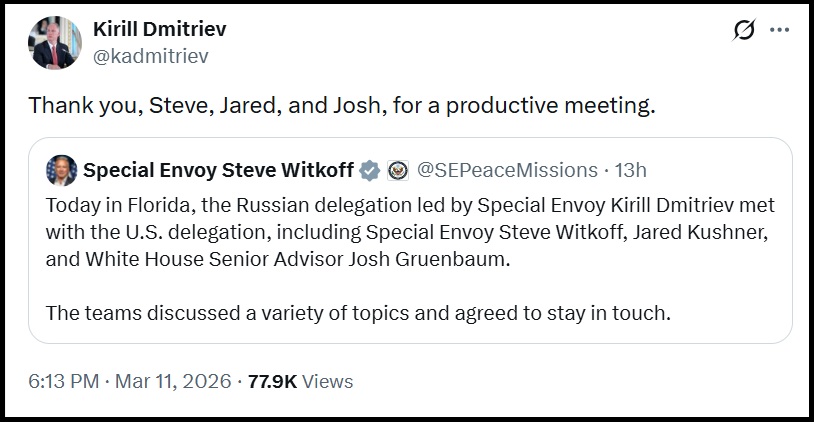
As noted in social media exchanges from Witkoff and Dmitriev, the discussion was productive.
All indications of this meeting give the appearance of less focus on progress in the Ukraine-Russia conflict, and a higher focus on current economic conditions -created by the Iran conflict- that could be enhanced with cooperation between the U.S. and Russia. {GO DEEP BACKGROUND}
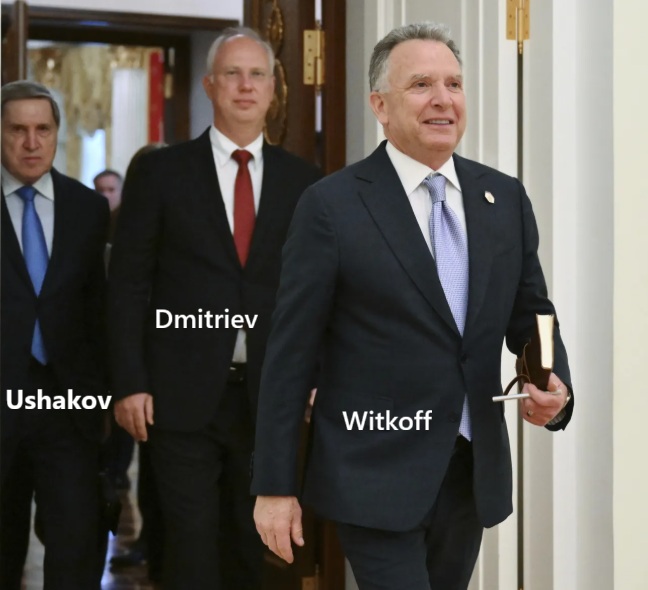
According to Kirill Dmitriev, Russian special presidential envoy for investment and economic cooperation with foreign countries and director general of the Russian Direct Investment Fund (RDIF), relayed through the Russian News Agency (TASS), “he visited the US upon orders from Russian President Vladimir Putin, taking part in a meeting of the heads of a working group on economic cooperation between the two countries.”
According to the envoy, the meeting addressed both promising projects that can help restore Russia-US relations and the current crisis on global energy markets.
The US is becoming increasingly aware of the role of Russian oil and gas in ensuing the stability of the world economy, as well as of the [in]effectiveness of sanctions against Russia, Dmitriev said after the meeting. (source)
“We discussed promising projects that could contribute to the restoration of Russian-American relations and the current crisis on global energy markets,” Dmitriev also wrote in a Telegram post.
“Today, many countries, primarily the United States, are beginning to better understand the key, systemic role of Russian oil and gas in ensuring the stability of the global economy, as well as the ineffectiveness and destructive nature of sanctions against Russia.”
With the strong likelihood that Russia’s restart of their flagship LNG terminal Arctic-2 was directly related to the August summit in Alaska {SEE HERE}, there is already a baseline established for strategic cooperation.
President Trump would have no problem with Russia introducing millions of barrels of oil into the global market given the issues created by conflict in/around the Strait of Hormuz. However, obviously the issues for streamlined Russia oil exports surround (1) preexisting sanctions, (2) domestic U.S. anti-Russia politics and (3) the political and economic position of the anti-Russia European Commission leadership.
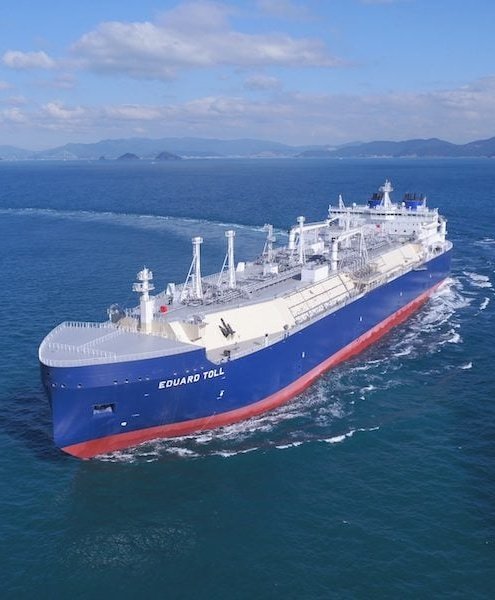
As we previously outlined with the Liquified Natural Gas (LNG) benefit, Russia previously extracted, liquified and pumped massive amounts of LNG into floating storage platforms from Arctic-2. Those LNG supplies doubled and tripled in value in a few days once Qatar shut down their production facilities and are now being sold to various Asian countries.
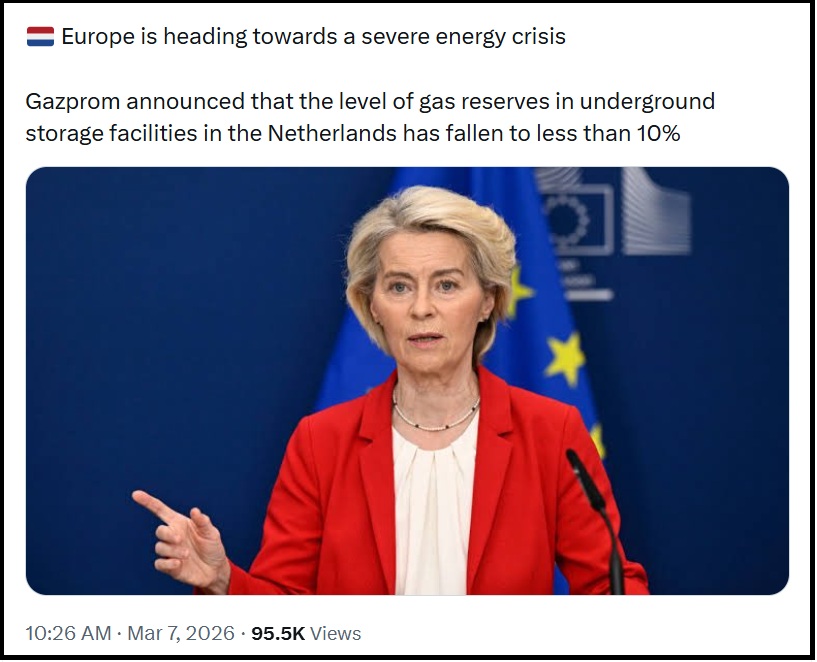
Europe has a massive energy problem with severely low LNG storage rates and now a shortage of oil, with EU gasoline prices rising much higher & faster than the rest of the world. Europe is facing a severe energy crisis overall and now their preexisting economic troubles are being amplified.
More than ever Europe needs the Russian oil/gas, but ridged ideologues will never compromise on their anti-Russia position. They have even steeper sanctions against Russian oil/gas scheduled to trigger at the end of this month.
It will be interesting to see how President Trump navigates the potential benefit from Russian energy products into the global market against the backdrop of all the geopolitical angst and political opposition against Russia.
…. AND that brings me to a point of discussion that I’ve had with a few dialed-in people.
When you look at the long term, and when you overlay the mindset of Russian President Vladimir Putin, almost everyone in Russia/Eastern Europe who evaluates the future can see the potential for Putin to exploit the EU’s self-created economic vulnerabilities for his own expansionist objectives.
Yes, some elements of the U.S. banter about further Russian expansion are not propaganda. Most of it is, but there is an element to the future forecast -beyond the Ukraine conflict- that could see Russia in a much stronger position, and the EU in a position of significant weakness.
The MAGA-minded European and Russian people, the ones who have strong wisdom on the issues, can all see a specific set of dominos falling that could place Putin in a position to recapture the remaining pro-Russian geographies in Europe back into an expanded Russian Federation.
Given the highly unstable mindset and friction points within European leadership, that would be a very bad combination to contemplate.
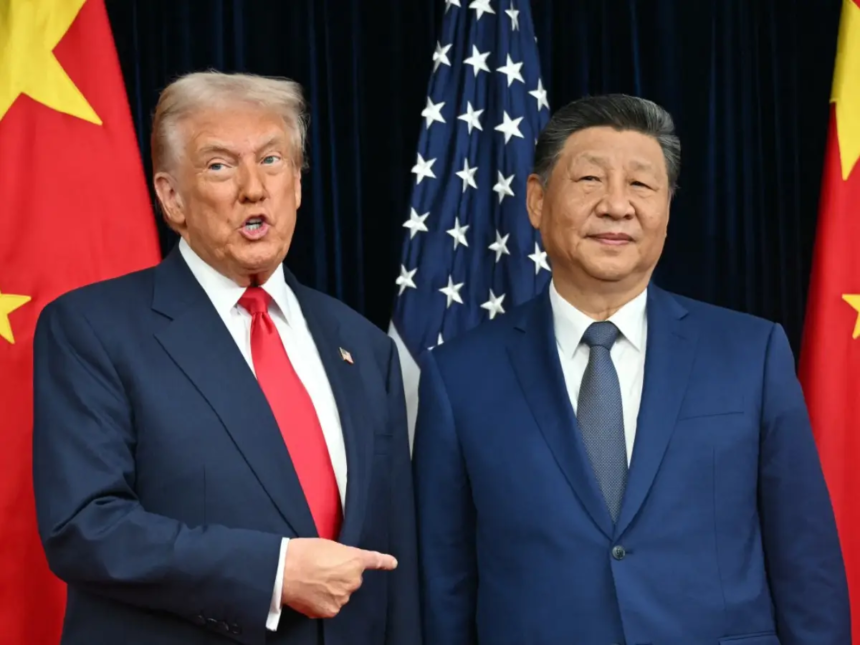
A strategic USA reset with the Russian Federation is a reasonable and pragmatic goal. There is no reason for America and Russia to be in conflict or opposition and pulling Russia away from a relationship with China has massive benefits for both countries.
The Russian people are not affectionate toward China at all, not even a little bit. In reality, China is a necessary ally for Russia but not a choice they would select if other options were available and variables were changed. The Russian people are exceptionally independent, incredibly strong and brutally proud; however, they are also more Western-minded (European, without self-flagellation) than Eastern-minded (Asian).
Here’s where/why Trump is being careful and pragmatic. President Trump doesn’t want to see an outcome where Russia is eventually stronger than Europe. There’s not enough frictionless history between the USA and Russia to trust Putin when he says the Federation has no plan to expand into Europe.
The USA can/should be strategic allies with Russia. However, it would be much better if a strong Europe existed at the same time. Hence, Vice President Vance and Secretary of State Rubio continuing to emphasize that Europe needs to stop cowering in politically correct wokeness. The EU is destroying itself at the same time Russia is getting stronger.
.
Last point, the Lyndon LaRouche team, Promethean Action PAC, are very happy with the ongoing fracture of the USA away from the UK/EU group. However, be cautious around Political Action Committees who say, “President Trump needs people to understand what he is doing” and we are here as his official policy interpreters.
Remember, President Trump doesn’t need policy interpreters.
Posted originally on CTH on March 7, 2026 | Sundance
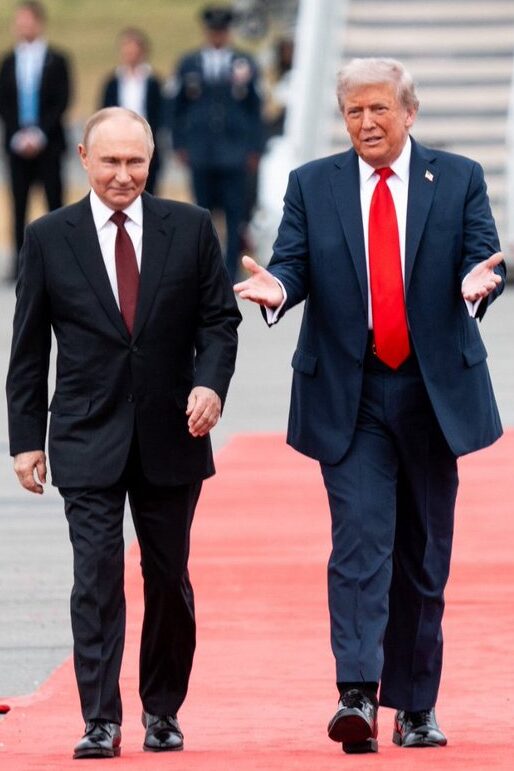
When President Donald Trump and President Vladimir Putin met in Alaska on August 15, 2025, the focus of the geopolitical world was on discussions surrounding Ukraine. Unfortunately, it didn’t take long, merely a few hours, for both the U.S. and Russia to say that no progress was made. However, also noted at the time was both the USA and Russia saying sideline discussions took place surrounding the possibility for a strategic relationship surrounding energy development.
What follows below is a review of the current energy dynamic, specifically surrounding LNG, against the backdrop of the Iran war with a hindsight review of that previous discussion between Putin and Trump.
What most people are missing in their current analysis was something that took place immediately following that Alaska summit six months ago. Something that did not make any sense until now. {GO DEEP PART I HERE}
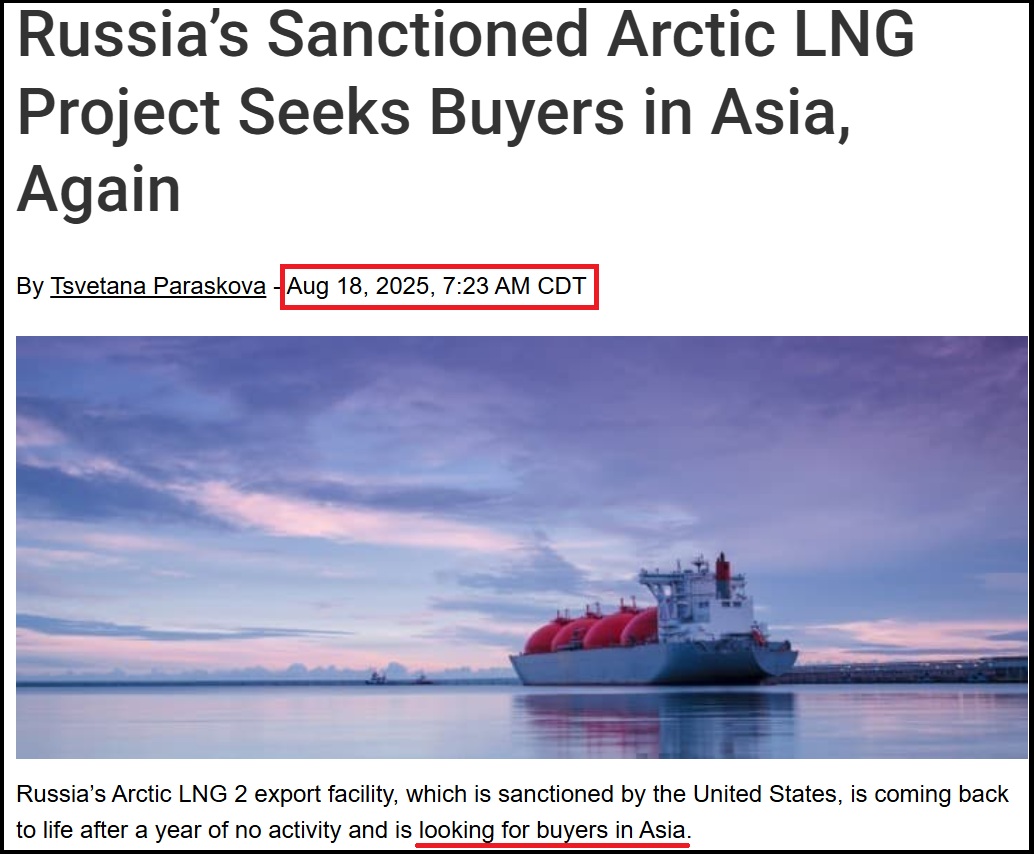
It absolutely did not make sense that Russia would start producing even more LNG considering the previously imposed western sanctions against them, and the fact that Russia was already overproducing LNG. As noted by analysts at the time:
AUGUST 18, 2025 – Russia’s Arctic LNG 2 export facility, which is sanctioned by the United States, is coming back to life after a year of no activity and is looking for buyers in Asia.
[…] The U.S. and EU sanctions on Russia’s Arctic LNG 2, which was billed as Russia’s flagship LNG project, have effectively frozen the start-up of the export facility in the Gydan Peninsula.
[…] Last year, Russia started shipping LNG from its flagship Arctic LNG 2 project—but not to customers. The shipments were made from the Arctic project to floating storage units either in Russia or in European waters, as potential customers were unwilling to buy the sanctioned LNG. {SOURCE}
In August of 2025, Russia was essentially producing more LNG than they could sell into the available market. Russia was storing the overproduction from Arctic-1 on floating storage units and slowly selling to countries that did not align with the sanctions, specifically China and some Asian buyers. Then suddenly, after the Trump summit, Russia decides to bring Arctic-2 online and produce even more LNG. You can see how this did not make sense.
If they could not even sell all the Arctic-1 LNG output, then why would Russia bring Arctic-2 LNG production online?
That was six months ago.
Suddenly, with the war in Iran being triggered, and with Qatar almost immediately announcing they were shutting down all LNG production, there are dozens of new markets for liquified natural gas. And that current LNG is now worth 50% more than it was when Russia inextricably decided to start producing and storing it.
Apply some hindsight to this timeline. Did Russia know or discover something in August of 2025 that the world would not discover until six months later?
Russia’s behavior in increasing LNG production, then storing that LNG in strategic venues, during a time when there was no reasonable incentive to trigger an LNG output increase, would seem to answer that question in the affirmative.
One thing is certain, all of that previously produced LNG is now worth double what it was when Russia created it, and now the global market is scrambling to get it.
Here is where it gets really interesting….
In October 2025, do you remember me asking why President Trump decided to fly East, to go West to the ASEAN summit in Asia? It just didn’t make sense.
Previously in 2017 when President Trump went to the ASEAN summit, he flew West; Airforce One refueled in Guam. This time in 2025, a few weeks after the meeting with President Putin in Alaska, President Trump flew East, to go West.
Where did he refuel?
That’s correct. President Trump refueled in Qatar, and during the ‘unexpected’ stop he met, yet again, with Qatari leadership.
♦ In May 2025 President Trump traveled to Qatar and had numerous and lengthy conversations, signing multiple strategic defense and trade deals. ♦ In August 2025, President Trump meets with Vladimir Putin, who then begins ramping up production of LNG. ♦ In October 2025, President Trump travels back to Qatar for a curious and unexpected visit.
Less than 36 hours after President Trump began “Operation Epic Fury” Qatar announces they are halting the production of LNG, and as a consequence the price of LNG jumped and a massive supply shift in global trade was created.
The Financial Times – […] The global battle for gas is underway, with Europe on the front lines. Since Wednesday, March 4, at least four liquefied natural gas (LNG) tankers – factory ships with large, refrigerated tanks used to transport LNG over long distances – suddenly changed course. Initially headed for France, Belgium or Spain from Africa and the United States, they rerouted for Asia, according to data from the maritime analytics company Kpler. (read more)
MOSCOW, March 4 (Reuters) – Russia could halt gas supplies to Europe right now amid a spike in energy prices triggered by the Iran crisis, President Vladimir Putin warned on Wednesday, linking the possible decision to the European Union wanting to ban purchases of Russian gas and liquefied natural gas. (read more)
MOSCOW, March 6 (Reuters)– “Our companies are considering opportunities, without waiting for further restrictions from Europe, to conclude new long-term contracts with our partners and redirect some of the gas from Europe to other countries, including India, Thailand, the Philippines and the People’s Republic of China,” Russian Deputy Prime Minister Alexander Novak said.
Six months ago, following a summit in Alaska with President Trump, President Vladimir Putin began producing and storing LNG at a scale and capacity that did not make sense. Six months later, the now massive Russian inventory is worth twice as much as it was, AND the number of global buyers for the Russian LNG has exploded.
Meanwhile, “while China would suffer from oil outages, a Middle East crisis with disproportionate LNG outages might benefit the PRC. Natural gas accounts for a relatively small share of China’s primary energy consumption, the country enjoys substantial domestic production, and it can tap pipeline imports from Russia, Central Asia, and Myanmar. Significantly, many of the PRC’s competitors or rivals—the European Union, Japan, South Korea, and Taiwan—are substantially or even wholly reliant on LNG imports for their natural gas consumption. Dutch TTF natural gas prices are up more than 50 percent against last Friday’s close, fueling concerns of an energy-induced inflationary spike.”
Where is President Trump scheduled to go next?
WASHINGTON/BEIJING, March 3 (Reuters) – The U.S. military campaign against Iran has put Chinese leader Xi Jinping on the back foot ahead of an expected summit with U.S. President Donald Trump, who for the second time in as many months has turned America’s military against one of Beijing’s close partners.
Trump is set to arrive in Beijing at the end of March following the U.S. capture of Venezuelan President Nicolas Maduro in a risky Caracas raid in January and the U.S.-Israeli air war that on Saturday killed Iran’s Supreme Leader Ayatollah Ali Khamenei, the former leaders of two countries that have been major oil suppliers for China.
[…] Xi now faces the awkward prospect of feting Trump on the world stage or backing out of the proposed March 31 to April 2 meeting. Beijing has yet to confirm the summit dates. (read more)
Posted originally on CTH on March 7, 2026 | Sundance
We like the deep weeds, most do not. The geopolitical ramifications of the U.S. confrontation with Iran are vast and complicated; however, to encapsulate one of the most interesting dynamics consider this ‘tldr’ statement to open the discussion with your friends: Right now, Russia is like Amazon during COVID-19.
What follows is not me saying President Trump and President Putin are holding nightly conversations, discussing steps or details, or even obliquely coordinating measures as Trump eliminates the generational threat posed by Iran.
However, I am saying that given the nature of all contact and communication between Trump and Putin, including extensive contacts by their representative emissaries, both Putin and Trump are well aware of each downstream effect from the Iranian confrontation.
Two days after the U.S./Israel began Operation Epic Fury, President Vladimir Putin said Russia should consider shutting down oil and liquified natural gas (LNG) shipments to the EU in advance of the previously scheduled April deadline date when the EU would stop purchases.
♦ First, remember ‘force majeure’ contract nullification is in place for every producer, supplier and transporter in the middle east. Second, with shipments from the Gulf of Oman greatly reduced, LNG prices along with oil prices are increasing rapidly. The result – ships filled with oil and LNG currently on the water are diverting in real time as international bidding for the content of the ships take place.
If Putin stops selling LNG to Europe, and Europe cannot get LNG from the Gulf of Oman, and China/Asia are LNG dependent (not exporting), then where is Europe going to get the LNG to replace what Russia will no longer provide?
Answer: The United States, and to a lesser extent, Norway.
[SIDENOTE: now does President Trump continuously smacking Great Britain about shutting down their North Sea oil and gas operations take on context? Geopolitical foresight? I digress. END SIDENOTE]
The European Commission’s decision to phase out and ultimately stop purchasing Russian oil/gas was made in 2025 prior to the Iran conflict triggering. Europe’s replacement plan included increased LNG purchases from the U.S., Norway and middle east; the latter supply option is now void.
Europe’s decision to stop buying oil/gas from Russia puts them in a very precarious position. The supply option for Europe is suddenly very limited, and Putin’s statement about stopping the flow early was obviously made with this understanding in mind.
Answer: The United States, and to a lesser extent, Norway.
[SIDENOTE: now does President Trump continuously smacking Great Britain about shutting down their North Sea oil and gas operations take on context? Geopolitical foresight? I digress. END SIDENOTE]
The European Commission’s decision to phase out and ultimately stop purchasing Russian oil/gas was made in 2025 prior to the Iran conflict triggering. Europe’s replacement plan included increased LNG purchases from the U.S., Norway and middle east; the latter supply option is now void.
Europe’s decision to stop buying oil/gas from Russia puts them in a very precarious position. The supply option for Europe is suddenly very limited, and Putin’s statement about stopping the flow early was obviously made with this understanding in mind.
[Go back to the sidenote above. Without question President Trump already knew that an LNG supply restriction from the middle east would disproportionately hurt Europe. Both President Trump and President Putin would understand this geopolitically obvious fact/reality.]
If Europe now has to purchase more LNG from America (at higher prices) President Trump’s leverage over Europe increases. If both oil and LNG prices increase substantially, the price of oil/LNG currently on the water increases.
[SIDENOTE #2 – Previously the EU confiscated their holdings of the Russian Sovereign Wealth Fund, value €210 billion held in Euroclear and another €50 billion from other G-7 countries; total €260 billion. From those seized assets the EU created a €90 billion loan scheme to Ukraine with no repayment mechanism, because the EU predicts Russia will be forced to pay reparations for war and the negotiated settlement will deduct the €90 billion loan scheme from the balance.
Hungary, a Trump ally, is currently blocking the transfer of funds; but this payment scheme -created by the EU holding the assets- underpins why the EU will not permit the conflict to end without their approval. END SIDENOTE]
♦ To increase distribution of oil/gas “currently on the water” President Trump and Secretary Bessent have dropped the sanctions against Russian oil and LNG. India and Southeast Asia, not coincidentally both with new U.S. free trade agreements, are suddenly bidding customers for previously sanctioned oil/gas.
Here it is important to note that ‘sanctioned’ oil and gas sales were done in the transactional currencies of the selling and buying country (see BRICS). However non-sanctioned oil/gas, traditional OPEC market oil/gas products, are bought and sold using petrodollars. If Russia is suddenly allowed to sell to OPEC market customers, then petrodollars will likely back the transaction. Who wins, Putin (higher prices) & Trump (leverage and petrodollar). Who loses, the EU.
Now, you know how much I love timelines to explain things…. So consider:
On August 15, 2025, Vladimir Putin and President Trump met in Alaska. One of the key points that followed the meeting was both Trump and Putin discussing a realignment of strategic interests surrounding energy development.
On August 18, 2025, three days after the Alaska meeting:
Two days ago, Treasury Secretary Scott Bessent announced the easing of sanctions against Russian oil/LNG exports, specifically toward Asia in order to relieve some of the global supply constraints. {SOURCE} Yesterday, Moscow announced the redirection of Russian oil/LNG exports to Asia {SOURCE}.
“Our companies are considering opportunities, without waiting for further restrictions from Europe, to conclude new long-term contracts with our partners and redirect some of the gas from Europe to other countries, including India, Thailand, the Philippines and the People’s Republic of China,” Russian Deputy Prime Minister Alexander Novak said.
♦ Before February 28, European Title Transfer Facility (TTF) liquified natural gas traded around 35 euros per megawatt hour. As of March 6, TTF settled at 52.81 euros, a 50 percent monthly surge in the value of LNG to Europe.
Asian Japan Korea Marker (JKM) spot cargoes, the benchmark LNG price assessment, are trading above $20 per million BTU, with Bangladesh paying $28.28 for emergency deliveries.
The difference between Russia selling LNG to hostile Europe or selling Russian LNG to friendly Asia at post gulf crisis premiums is the widest it has been since the post pandemic (2022) ‘Build Back Better” energy crisis.
Russia supplied 13.8 million tonnes of LNG to Europe in 2025. The EU is phasing Russian gas out: short-term contracts banned beginning in April, full LNG ban by year end 2025, pipeline gas fully banned by 2027.
Russia is not fighting the EU bans; Russia is finding new customers at higher prices. Every tonne Russia redirects to Asia before the EU ban was scheduled to begin creates a potential long-term contract at a premium price with a buyer who will not legislate Russia out of the relationship.
Qatar and all shippers and suppliers declared force majeure after Iranian drones struck Ras Laffan facility on March 2, 2026. Approximately 20% of global LNG went offline. Asian buyers are now bidding against Europe for every tanker “on the water.” Russia has a lot of supply on the water and the ability to put a lot more into the market quickly.
Hormuz is closed, at least temporarily, through forced reinsurance withdrawal triggered by the U.K (Lloyds insurance market). And Russia, the one major energy exporter whose supply chains run through neither the Gulf nor the Strait, is the only non-western producer that can deliver to Asia without navigating a war zone.
Right now, Russia is to energy supplies for Asian customers as Amazon was to U.S. consumers during COVID. Both selling to an isolated and captive customer base, who were regulated out of options.
SUMMARY:
(1) Upon reelection President Trump told all U.S. energy providers to “drill baby drill” and maximize energy production. Trump then deregulated the industry for maximum efficiency: Secretaries Burgum (Interior), Wright (Energy) and Zeldin (EPA).
(2) Trump then meets with Putin in Alaska Aug 15, 2025. Three days later, Aug 18, 2025, Putin restarts Russia’s flagship Arctic project, the LNG export facility via the Northern Route to Asia.
(3) President Trump then signs contracts with Finland for the urgent start of Arctic icebreaking ship manufacturing in the USA and emphasizes the prior conversation about taking over Greenland which infuriates the Danes and EU.
(4) President Trump then triggers the Venezuela operation, captures Nicholas Maduro and -in addition to other benefits- forms a new strategic oil development relationship with the interim Venezuela government. Russia stays silent.
(5) President Trump then triggers Operation Epic Fury against Iran; completely changing the geopolitical landscape that surrounds energy partnerships. Energy flows through the Gulf of Oman are impacted.
(6) President Trump then removes specific sanctions against Russia permitting Russian oil and LNG to be sold (in petrodollars) into the Asian market. Meanwhile, the European Union is forced to increase LNG purchases from the United States.
Sure, it could all be just coincidence… or not. One thing is certain, the FIVE-EYES opposition do not think all of this downstream benefit that flows to Russia and the USA is coincidental. The FIVE-EYES opposition see all of this as a strategic realignment between the USA and Russia, and they are going to do everything in their power to stop it.
Now does this sudden news story make sense?
You see that "WP" on the end of it? That's Washington Post.
WaPo is the outlet for the direct CIA shaping narratives. There is usually no truth to the statements as narrated.
The CIA, like the other members of the 5 eyes, wants maximum conflict with Russia at all times. https://t.co/kjiTTlar6A
(Reuters) – “Russia is ready to divert oil to India to offset Middle East supply disruptions, with about 9.5 million barrels of Russian crude in vessels near Indian waters and able to arrive within weeks, an industry source with direct knowledge told Reuters. The source declined to say where the non‑Russian fleet cargoes were originally headed but said they could deliver to India within weeks, giving refiners rapid relief.”
Posted originally on CTH on March 6, 2026 | Sundance
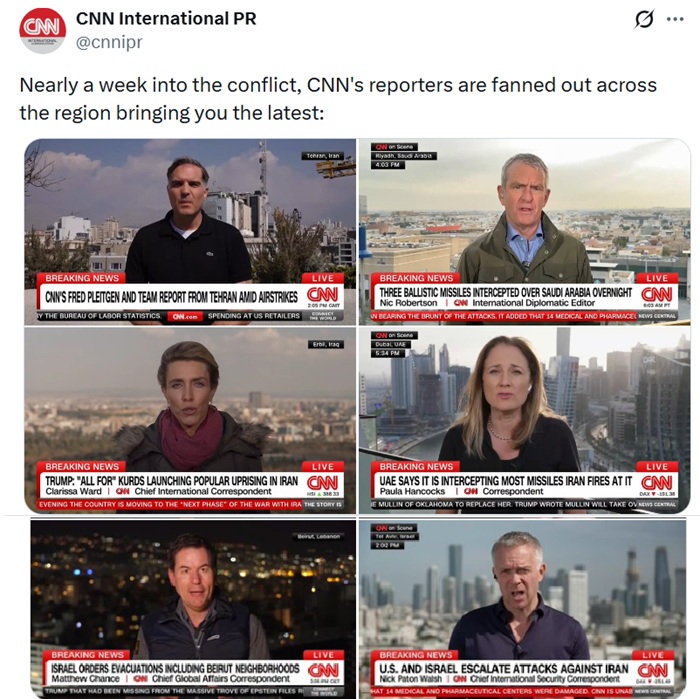
CNN is bragging about the teams they have on the ground in Iran and around the war zone to provide coverage for Operation Epic Fury. [SOURCE] Which again, brings up an interesting contrast that seemingly flew under the radar from past events.
As we noted in the beginning of the Russian war in Ukraine, where was the media for that one? Where was this CNN coverage for the war in Ukraine? The Ukraine war was the only war in modern history with ZERO mainstream media reports complete with helmets, flak jackets and play-by-play reporting of every moment within the conflict. Why?
The answer is not necessarily complicated. The Ukraine war was a war of narratives. Yes, there was actual fighting, but the physical conflict itself was not in alignment with the narrative the media intended to create from it. The reality within Ukraine did not fit in the pert chart and the visuals would not ever have supported the claims.
Ukraine was/is the COVID-19 of wars. A western intelligence operation using the geography of Ukraine to push an agenda in alignment with western interests. It would not and does not serve the interests of truth and transparency for media to report from inside a battlespace that might contradict their claims. Hence, we labeled it “World War Reddit,” and it remains that way through today.
Volodymyr Zelenskyy was installed by the same interests who triggered the conflict. As an outcome, the media participation was limited to column inches, punditry reports, claims and scripted presentations that worked alongside Zelenskyy, the actor, traveling all around the world promoting the conflict and raising money.
The physical battlespace was far less valuable than the EU/NATO and Intelligence Community narratives needed to maintain it. As soon as everyone started making money from the screenplay, maintaining ticket sales was prioritized over the performance itself. Criticism and critiques can be completely avoided by keeping the curtain down and just narrating what’s going on behind it.
That system of deception continues through today. Strange that everyone just accepted it.
The U.S. and Israel have been targeting deep underground missile sites within Iran, with strong success. Iranian counterstrikes, missile & drone launches are down 80 to 90 percent according to Pentagon officials.
Additionally, the Israeli military has reported they dismantled an underground bunker system in Tehran used by regime leadership. Originally the bunker was used by slain Supreme Leader Ayatollah Ali Khamenei underneath the leadership compound in central Tehran. The bunker was targeted by 50 Israeli fighter jets and subsequently destroyed.
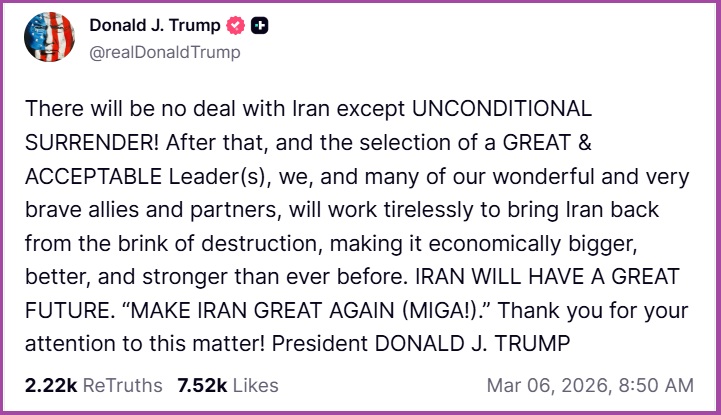
President Trump announced via Truth Social that he will not seek any terms with Iran other than unconditional surrender.
Meanwhile, in a somewhat predictable move, Treasury Secretary Scott Bessent has announced the U.S. will lift some sanctions on Russian oil exports in order to mitigate shortfalls. India will be permitted to purchase additional Russian oil for use in their refineries. The gasoline end products will then be sold into the market.
BESSENT: “President Trump’s energy agenda has resulted in oil and gas production reaching the highest levels ever recorded.
To enable oil to keep flowing into the global market, the Treasury Department is issuing a temporary 30-day waiver to allow Indian refiners to purchase Russian oil. This deliberately short-term measure will not provide significant financial benefit to the Russian government as it only authorizes transactions involving oil already stranded at sea.
India is an essential partner of the United States, and we fully anticipate that New Delhi will ramp up purchases of U.S. oil. This stop-gap measure will alleviate pressure caused by Iran’s attempt to take global energy hostage. (more)
Strategically, it has always appeared that President Trump wanted to remove the sanctions against Russia as part of a negotiated peace deal with Ukraine. However, the intransigence of Ukraine and the EU had blocked that move. I would anticipate at some date the U.S. will use the opportunity of global need as a justification to permit more Russian oil to be sold into Western markets.
This approach will not make Ukraine or the EU happy; however, it could be structured to put petrodollars back in control of Russian oil sales. That approach would further weaken China and the BRICS assembly who have been purchasing energy products in domestic exchange currencies.
The U.S., Venezuela and Russia could increase output and replace the missing oil production from the middle east region. This would stabilize markets. Although, the politics of that approach would face stiff opposition.
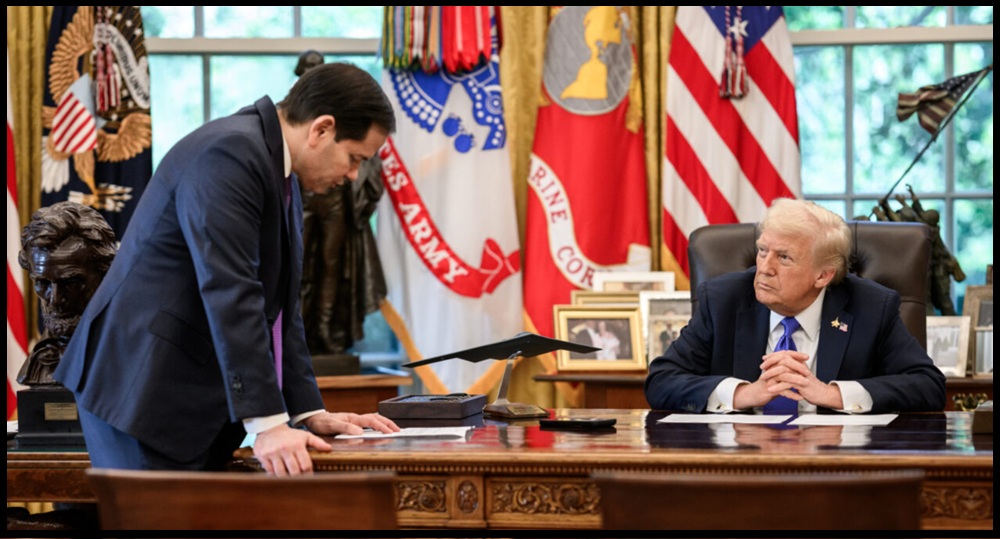
What seems very likely is that Bessent, Rubio and Trump have a plan. If there’s one person in U.S. politics who understands how to use oil to financially mitigate any geopolitical impacts, it’s President Trump.
Keep an eye on Russia. Ignore the western media narratives and look for direct source information on Russian oil activity.
Posted originally on CTH on March 3, 2026 | Sundance
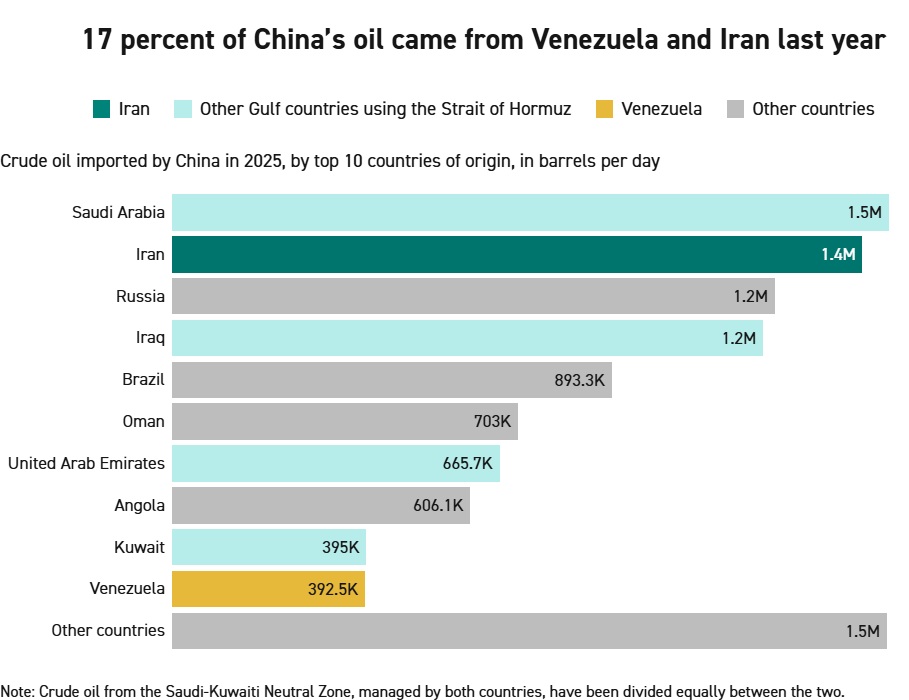
♦ First blow, the Trump tariffs hit Beijing hardest. ♦ Second blow, the Beijing tentacle on the Panama Canal is severed. ♦ Third blow, global tariff threats changed the risk dynamic for southeast Asia countries who acted as transnational shippers for China. ♦ Fourth blow, cheap sanctioned oil from Venezuela was cut-off. ♦ Now, the fifth blow; cheap, sanctioned Iranian oil is disrupted.
As noted by Politico: Following USA military strikes, “ships have begun to avoid the Strait of Hormuz off the coast of Iran — a critical shipping lane for Gulf nations to export oil to Asia. China in 2025 received about half of its imported oil from the six Gulf countries that rely on the strait. Other large crude oil producers in the region — including Saudi Arabia, Iraq and the United Arab Emirates — transport almost all their crude exports through the geographic bottleneck.”
It’s not just a factor of oil flow, but also the price that China will ultimately end up having to pay. Beijing was buying oil from Venezuela, Iran and Russia at steep discounts because their purchases were skirting western sanctions.
With Iranian oil production now no longer a market option, China will seek to replace their needs with more Russian alternative. However, that diversion means the oil India was purchasing from Russia will come at a higher price, and the refined final product that was exported by India will arrive to the European Union carrying an additional cost.
Simultaneously, Vladimir Putin was asked about Russia’s lack of military support to Iran in response to the U.S. military action, to wit the Russian president noted the technical terms of their joint military agreements did not include Russia’s immediate involvement. In shorthand, Russia is busy and is not getting involved.
Russia was/is partially dependent on receiving military supplies from Iran in exchange for oil transfers. The military component is reported to include drones from Iran for use in the Ukraine conflict. Now that exchange profile is shuttered.
Taking Iran’s malign influence off the geopolitical chessboard is beginning to surface in major challenges to the BRICS assembly (Brazil, Russia, India, China, South Africa). Russia, China and India are impacted directly.
The BRICS nations were skirting western oil sanctions by trading the commodity outside the petrodollar structure. However, President Trump now controls the flow of oil from Venezuela, and his administration controls the currency in which it is sold.
With Iranian oil removed from the non-petro supply chain, the only remaining non-petro oil producer is Russia – who is simultaneously hit with a loss in military hardware support. China may end up as a larger oil customer to Russia, but at what price and in what payment structure.
With global oil supplies in a state of flux, and with the USA in control of the oil flow from Venezuela, North America is certainly in the best position for minimal energy disruption.
Asia is heavily dependent on oil flows through the Strait of Hormuz, and the majority of Europe has already shut themselves off from Russian oil production, putting themselves in a position of dependency to the global markets. The short-term ramifications of this oil disruption hit China, Southeast Asia, Japan and Europe particularly hard.
“OPEC+ countries affirmed on Sunday that they would boost oil production starting in April by 206,000 barrels daily — a modest increase intended to dampen the war’s effect on prices down the road. The majority of the increase would come from Saudi Arabia and Russia.” {SOURCE}
All of a sudden, this happens: Zelenskyy not to be trusted?
“Ukraine is under pressure to let the EU inspect a damaged pipeline carrying Russian oil to Hungary and Slovakia, as the two pro-Kremlin countries accuse Kyiv of overstating the impact of an attack by Moscow — despite what Ukrainian officials say is evidence of extensive destruction,” the report said.
According to five diplomats and EU officials who spoke to the FT, even pro‑Ukrainian governments within the European Union and the European Commission have also asked Ukraine to permit a delegation to inspect the pipeline. Two sources told the newspaper that European Commission President Ursula von der Leyen requested access for EU experts during her visit to Kyiv on Feb. 24, the fourth anniversary of Russia’s full-scale invasion. The request, according to the sources, was refused.
As tensions escalated, the EU’s ambassador to Ukraine, Katarina Mathernova, reportedly asked through the presidential office for permission to inspect the damaged pipeline herself or to allow visits by other EU diplomats. Those requests were denied for security reasons, the sources said.” (link)
Posted originally on CTH on March 3, 2026 | Sundance
Consider the severe economic body blows to China in the past 14 months.
♦ First blow, the Trump tariffs hit Beijing hardest. ♦ Second blow, the Beijing tentacle on the Panama Canal is severed. ♦ Third blow, global tariff threats changed the risk dynamic for southeast Asia countries who acted as transnational shippers for China. ♦ Fourth blow, cheap sanctioned oil from Venezuela was cut-off. ♦ Now, the fifth blow; cheap, sanctioned Iranian oil is disrupted.
As noted by Politico: Following USA military strikes, “ships have begun to avoid the Strait of Hormuz off the coast of Iran — a critical shipping lane for Gulf nations to export oil to Asia. China in 2025 received about half of its imported oil from the six Gulf countries that rely on the strait. Other large crude oil producers in the region — including Saudi Arabia, Iraq and the United Arab Emirates — transport almost all their crude exports through the geographic bottleneck.”
It’s not just a factor of oil flow, but also the price that China will ultimately end up having to pay. Beijing was buying oil from Venezuela, Iran and Russia at steep discounts because their purchases were skirting western sanctions.
With Iranian oil production now no longer a market option, China will seek to replace their needs with more Russian alternative. However, that diversion means the oil India was purchasing from Russia will come at a higher price, and the refined final product that was exported by India will arrive to the European Union carrying an additional cost.
Simultaneously, Vladimir Putin was asked about Russia’s lack of military support to Iran in response to the U.S. military action, to wit the Russian president noted the technical terms of their joint military agreements did not include Russia’s immediate involvement. In shorthand, Russia is busy and is not getting involved.
Russia was/is partially dependent on receiving military supplies from Iran in exchange for oil transfers. The military component is reported to include drones from Iran for use in the Ukraine conflict. Now that exchange profile is shuttered.
Taking Iran’s malign influence off the geopolitical chessboard is beginning to surface in major challenges to the BRICS assembly (Brazil, Russia, India, China, South Africa). Russia, China and India are impacted directly.
The BRICS nations were skirting western oil sanctions by trading the commodity outside the petrodollar structure. However, President Trump now controls the flow of oil from Venezuela, and his administration controls the currency in which it is sold.
With Iranian oil removed from the non-petro supply chain, the only remaining non-petro oil producer is Russia – who is simultaneously hit with a loss in military hardware support. China may end up as a larger oil customer to Russia, but at what price and in what payment structure.
With global oil supplies in a state of flux, and with the USA in control of the oil flow from Venezuela, North America is certainly in the best position for minimal energy disruption.
Asia is heavily dependent on oil flows through the Strait of Hormuz, and the majority of Europe has already shut themselves off from Russian oil production, putting themselves in a position of dependency to the global markets. The short-term ramifications of this oil disruption hit China, Southeast Asia, Japan and Europe particularly hard.
“OPEC+ countries affirmed on Sunday that they would boost oil production starting in April by 206,000 barrels daily — a modest increase intended to dampen the war’s effect on prices down the road. The majority of the increase would come from Saudi Arabia and Russia.” {SOURCE}
All of a sudden, this happens: Zelenskyy not to be trusted?
“Ukraine is under pressure to let the EU inspect a damaged pipeline carrying Russian oil to Hungary and Slovakia, as the two pro-Kremlin countries accuse Kyiv of overstating the impact of an attack by Moscow — despite what Ukrainian officials say is evidence of extensive destruction,” the report said.
According to five diplomats and EU officials who spoke to the FT, even pro‑Ukrainian governments within the European Union and the European Commission have also asked Ukraine to permit a delegation to inspect the pipeline. Two sources told the newspaper that European Commission President Ursula von der Leyen requested access for EU experts during her visit to Kyiv on Feb. 24, the fourth anniversary of Russia’s full-scale invasion. The request, according to the sources, was refused.
As tensions escalated, the EU’s ambassador to Ukraine, Katarina Mathernova, reportedly asked through the presidential office for permission to inspect the damaged pipeline herself or to allow visits by other EU diplomats. Those requests were denied for security reasons, the sources said.” (link)
Posted originally on CTH on February 24, 2026 | Sundance
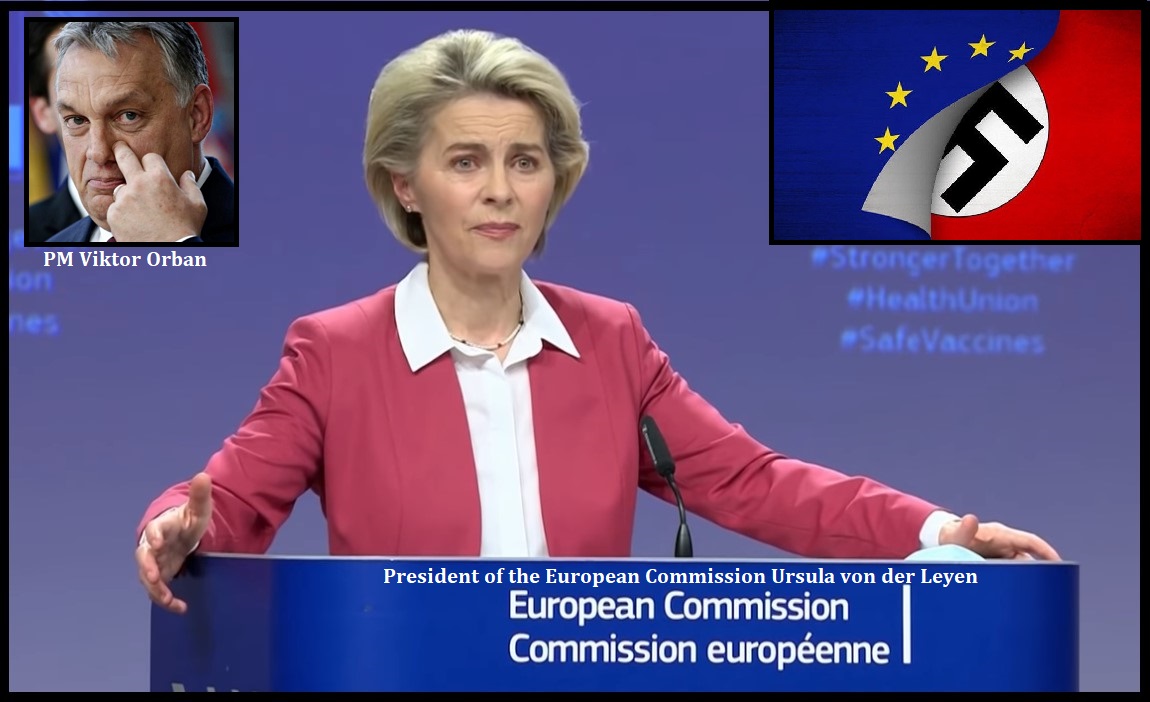
I guess we can put this in the open admission file surrounding the all-out effort by the European Union to defeat Hungarian Prime Minister Viktor Orban.
According to a leaked document received by Reuters, the European Union is scheduled to permanently ban all EU nations from importing Russian oil. They have scheduled the ban to trigger on April 15th, three days after the Hungarian election.
BRUSSELS, Feb 24 (Reuters) – The European Commission will submit a legal proposal to permanently ban Russian oil imports on April 15, three days after Hungary’s parliamentary election, according to EU officials and a document seen by Reuters.
Two EU officials told Reuters the timing was designed to prevent the oil ban becoming a major factor in Hungary’s election campaign. Hungary and Slovakia, still reliant on Russian oil imports, are strongly opposed to any ban.
In the April 12 election, Hungarian Prime Minister Viktor Orban and his nationalist Fidesz party are facing the biggest challenge to their hold on power in 16 years.
The EU has already imposed sanctions on imports of seaborne Russian oil. But it wants to enshrine a full phase-out of Russian oil in legislation that would remain in place, even if a peace deal in the Ukraine war led to the EU lifting sanctions.
The Commission plans to propose the Russian oil ban on April 15, according to a draft agenda seen by Reuters.
Asked about the matter, a Commission spokesperson told Reuters the EU executive’s agendas were provisional and that it did not have a confirmed timeline for submitting the proposal. (read more)
I have created this site to help people have fun in the kitchen. I write about enjoying life both in and out of my kitchen. Life is short! Make the most of it and enjoy!
This is a library of News Events not reported by the Main Stream Media documenting & connecting the dots on How the Obama Marxist Liberal agenda is destroying America






 Centinel2012