The agenda is for money as it always is!


The Agenda Behind Global Warming

NOAA-L_satellite_tilted_in_Vandenberg_AFB_clean_room

There are those who claim that the UN is behind the global warming scam to create a one-world government. If we turn it down a notch and follow the money, we find a bogus agenda to raise taxes substantially in the name of the environment. I have reported that NOAA, the agency responsible for collecting this data, has refused to reveal their data. NOAA has been caught manipulating the data and changing history all to set the agenda for a massive tax increase. Every real scientific investigation disproves global warming and shows that we are heading into a cooling phase.

In this context, it is interesting to note that an important meteorological satellite (NOAA 16) reportedly broke apart on November 25. The Joint Space Operations Center (JSpOC) of the American forces noticed at 15:41 ET “an unknown number of related objects” that circled the suddenly destroyed NOAA 16 satellite.

According to the report, there was no collision. Now, they are claiming that the questionable satellite responsible for the data collection has broken apart due to a defective battery. This is perfect timing, just like the 9/11 attack on the Pentagon to kill the investigation into $2 trillion missing from the defense budget or the attack on WTC7, which was not even hit, but magically collapsed with all our evidence documenting every bank manipulation from when it began. This convenient destruction of the satellite will prevent anyone from investigating the global warming data manipulation that is being used to massively increase your taxes in the years ahead. Eliminating cash and moving the election ensures that everyone will pay for the real crisis — the sovereign debt crisis & the collapse of socialism.

This weather satellite was brought into orbit in 2000 and should operate for at least many years. The NOAA used the satellite in June 2014 until they then replaced it because of a “critical anomaly” decommissioned.

This year, however, the satellite blew up with another satellite: the satellite number 13 of the weather satellite program of the U.S. Armed Forces Defense Meteorological Satellite Program (DMSP). There also, they claimed that the explosion destroying the weather satellite was due to a faulty battery.

Is this just a coincidence, or is this part of the agenda?

Obama’s Goal Is To “Force” You To Cut Back Your Modest Lifetstyle


The Republicans want the Climate treaty as much as Obama does they will do exactly like they did with the Iran treaty and turn it to a 2/3 vote to stop rather than a 2/3 vote to pass.

Tony Heller's avatarReal Climate Science

2015-12-12-02-49-42

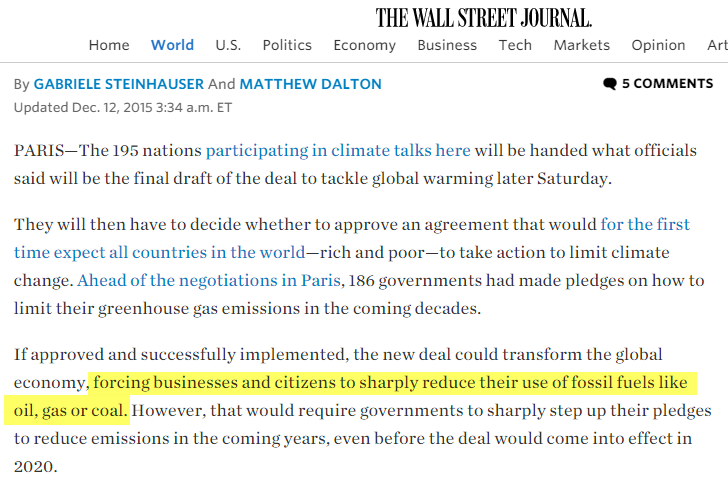
Final Draft of Global Climate Change Deal Is Complete – WSJ

The US Constitution makes it abundantly clear that Obama does not have the authority to enslave the American people with his climate insanity.

[The President] shall have Power, by and with the Advice and Consent of the Senate, to make Treaties, provided two thirds of the Senators present concur…

Thomas Jefferson explained that the Article II treaty procedure is not necessary when there is no long-term commitment:

It is desirable, in many instances, to exchange mutual advantages by Legislative Acts rather than by treaty: because the former, though understood to be in consideration of each other, and therefore greatly respected, yet when they become too inconvenient, can be dropped at the will of either party: whereas stipulations by treaty are forever irrevocable but by joint consent….[4]

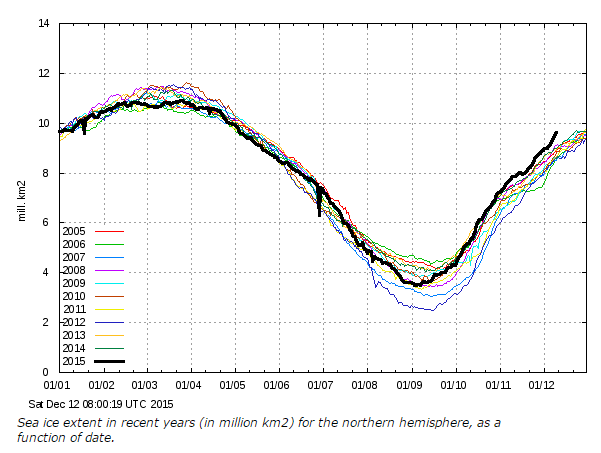
Meanwhile, unprecedented ice growth continues in the Arctic

2015-12-12-03-34-57Ocean and Ice Services…

View original post 12 more words

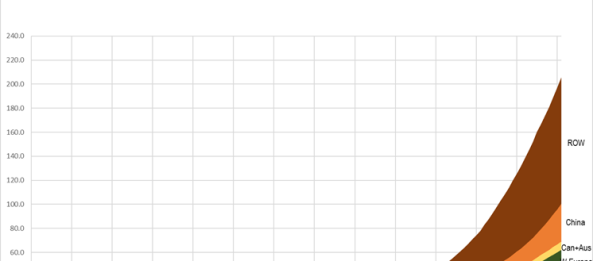
Attribution of Surplus CO2 in the Atmosphere


COP21 is only about taxes and the redistribution of wealth: the politicians have bamboozled some “scientists” into actually being that this is a real problem and the drive to get their hands on more and more money feeds the system. Its a political problem more than a science problem. But I guess we are stuck with it for now and just have to wait until nature proves them wrong.

Man Made Climate change is a 100% total scam!


The Climate Change/Global Warming Crowd Paid to Produce Bullshit

GlobalWarming-Propaganda

Government is always about money — just show me the money. It is a shame that we have to deal with such corruption in academia. They can do as they like because they know students will get loans that they can never pay off so they teach nonsense and tell people they cannot find a job without their piece of paper. But then they have to be retrained anyway or they end up in a field other than what they have a degree in. So you can get a degree in basket weaving and find a job.

This same crew is putting out total bullshit about climate change when in fact they have ZERO analysis prior to 1900 to prove anything remotely close to what they claim. But as long as they can bullshit the people, they get the grants from the government to end up raising our taxes. This is just economic treason and the people are ALWAYS the target.

Calif-DroughtMoS2 Template Master US Weather CoolingIceCores1

Now three leading experts have all jumped ship, coming out to state that climate change is just propaganda. MIT climate scientist Dr. Richard Lindzen, Princeton physicist Dr. Will Happer, and Greenpeace Co-Founder Dr. Patrick Moore all have stated publicly this is pure political propaganda. This is simply a tax agenda and not science. I have yet to see any long-term analysis to support their arguments. It is pure bullshit. Please explain all the historical data that shows it has been hotter and colder than before the Industrial Age.

Now they argue, for our own benefit, that government should tax sugar at a global G20 level. This is really getting out of hand.

Massive Data Manipulation by NASA and NOAA


UNFCCC COP 21 starts on November 30, 2015 in Paris France with additional security including no demonstrations at the conference as a result of the November 13 Jihadist attacks that killed 130 and injured 368. For the past 10 months I and others have predicted that NOAA and NASS would make October 2015 the hottest month ever and just as predicted they have published October’s temperature and it is the hottest ever. However to get there they did have to change past temperatures to make then colder.

For example in the LOTI report issued by NASA on April 2010 the following temperature anomalies were reported in their January 1880 to April 2010 LOTI listing.

March    2002 102

January 2007 108

March    2010 106

Then, only a few days ago in the current report for October 2015 the following temperature anomalies were reported in their January 1880 to October 2015 LOTI listing.

March    2002  91

January 2007  97

March    2010  92

October 2015 104

So we can see that by changing the past we can make October 2015 the hottest moth ever recorded by NASA.

George Orwell, “Who controls the past controls the future. Who controls the present controls the past.”

Analysis of Global Temperature Trends, October, 2015 What’s really going on with the Climate?


The analysis and plots shown here are based on the following: first NASA-GISS temperature anomalies (converted to degrees Celsius so non-scientists will understand the plots) as shown in their table LOTI, second James E. Hansen’s Scenario B data, which is the very core of the IPCC Global Climate models (GCM’s) and which was based on a CO2 sensitivity value of 3.0O Celsius, lastly, a plot based on an alternative climate model designated ‘PCM’ and based on a sensitively value of 0.65O Celsius.

An explanation of the alternative model designated, PCM, is in order since many have interpreted this PCM model as a statistical least squares projection of some kind. Nothing could be further from the truth. A decade ago when I started this work the first thing I did was look at geological temperature changes since it is well known that the climate is not a constant; I learned that in my undergrad geology and climatology courses in 1964.

The following observations give a starting point to any serious study. First, there is a clear movement in global temperatures with a 1,000 some year cycle going back at least 3,000 to 4,000 years; probably because of the apsidal precession of about 21,000 years for a complete cycle. However about every 10,000 years the seasons are reversed making the winter colder and the summer warmer in the northern hemisphere. 10,000 years from now the seasons will be reversed. Secondly, there are also 60 to 70 year cycles in the Pacific and the Atlantic oceans that are well documented. Lastly we also know that there are greenhouse gases such as carbon dioxide. The National Academy of Sciences (NAS) estimated that carbon dioxide had a doubling rate of 3.0O Celsius plus or minus 1.5O Celsius in 1979.

The core problem with the current climate change theory is that the IPCC still uses the NAS 3.0O Celsius as the sensitivity value of carbon dioxide and a number in that range is required to make the IPCC GCM’s work. The problem with using this value is it leaves no room for other factors and hence the need of the infamous hockey stick plots of the IPCC from Mann, Bradley & Hughes in 1999. The PCM model is based on a much lower value for carbon dioxide consistent with current research. This places the value between 0.65O and 1.5O Celsius per doubling of carbon dioxide. If the long and short movement in temperatures and a lower value for carbon dioxide are properly analyzed and combined a plot that matched historical and current (non manipulated) NASA temperature estimates very well can be constructed. This is not curve fitting.

The PCM model is such a construct and it is not based on statistical analyses of raw data. It is based on creating curves that match observations (which is real science) and those observations appear to be related to the movement of water in the world’s oceans. The movements of ocean currents are well documented in the literature. All that was done here was properly combine the separate variables into one curve which had not been previously done, to my knowledge. Since this combined curve is an excellent predictor of global temperatures unlike the IPCC GCM’s, it appears to reflect reality a bit better than the convoluted IPCC GCM’s, which after the past 19 years of no statistical warming have been shown to be in error.

Now, to smooth out highly erratic monthly variations a 12 month running average is used in all the plots. This information will be shown in four tables and updated each month as the new data comes in about the middle of the month. Since no model or simulation that cannot reasonably predict that which it was design to do is worth anything the information presented here definitively proves that NASA, NOAA and the IPCC just don’t have a clue.

Note, starting in late 20014 and continuing to the present NASA has made major changes to the way they calculate the values used in their table LOTI. These changes have significantly increased the apparent global temperatures (political reasons) and these changes are not supported by satellite data; so they are probably not real. For example in the report issued in April 2010 the following temperatures were reported March 2002 102, January 2007 108 and March 2010 106. The current report October 2015 shows March 2002 91, January 2007 97 and March 2010 92 and October 2015 as 104; which makes October 2015 the hotest ever . This paper uses the questionable NASA data since it is all that is available at this time. Prior to this “change” the PCM plot showed almost no error for NASA data as can be seen in the plots posted here last year.
2015-10

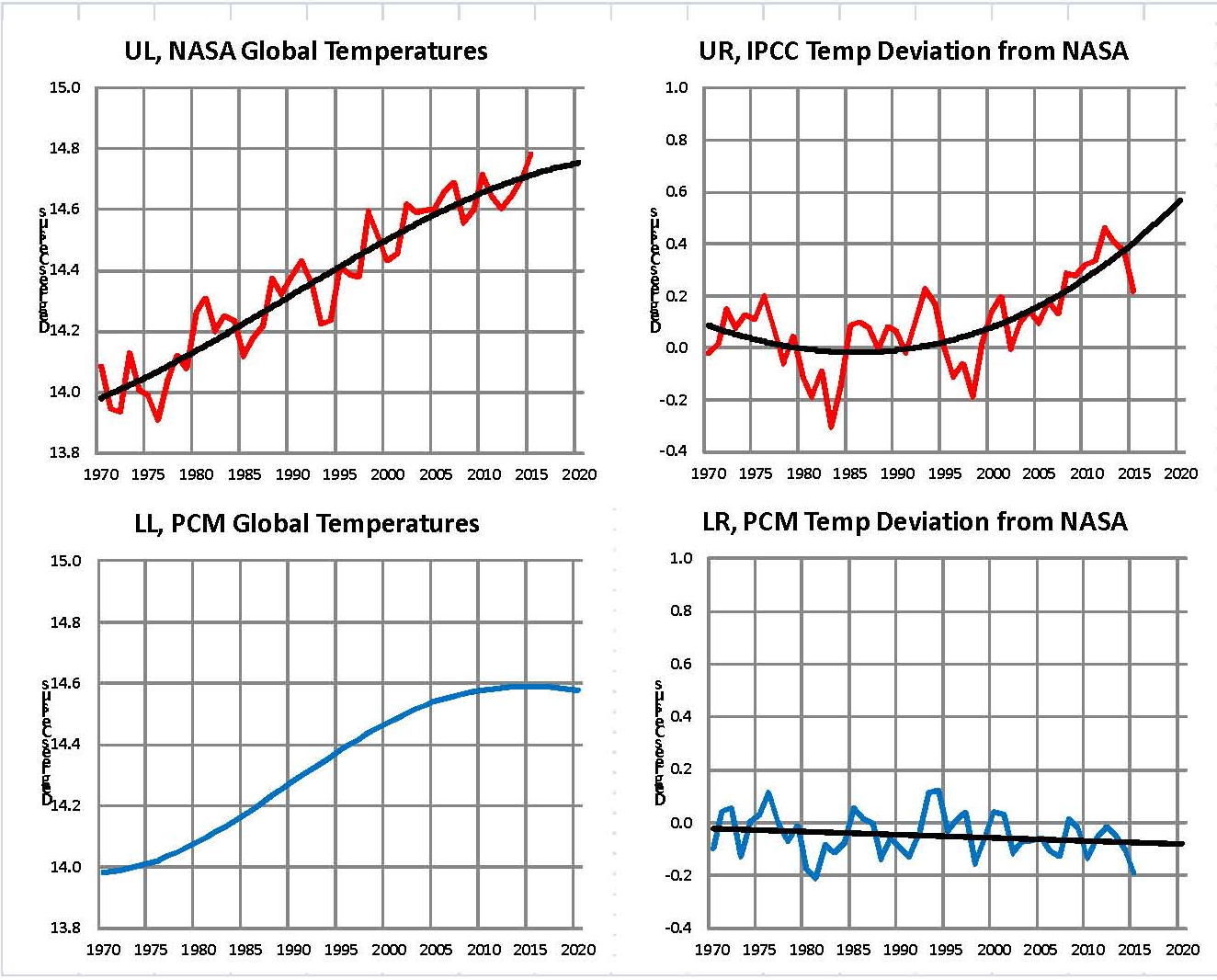
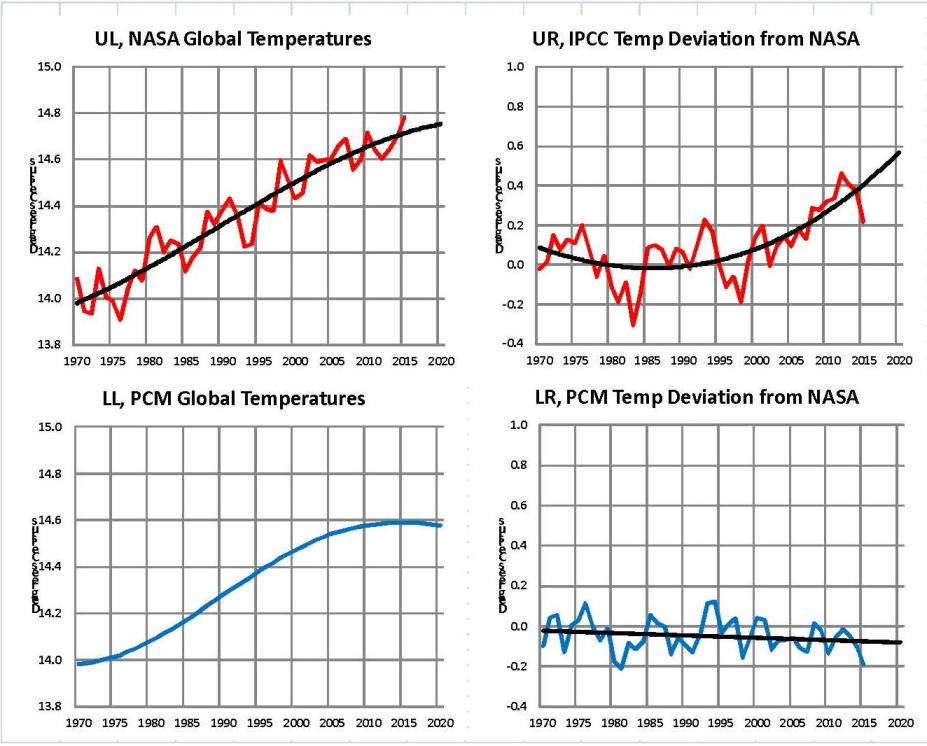
The first plot, UL is a plot of the NASA temperature anomaly converted to degrees Celsius and shown in red with a black trend line added. There has been a very clear reversal in the upward movement of global temperatures since about 2001 and neither the UN IPCC nor anyone else has an explanation for this 13 years later. Since CO2 has continued to increase at what could be argued an increasing rate, this raises serious doubts about the logic programmed into all the IPCC global climate models.

The next plot UR, also in red, shows the IPCC estimates of what the Global temperature should be, based on Hansen’s Scenario B, with the NASA actual temperatures’ subtracted from them. Therefore this plot represents a deviation from what the Climate “believers” KNOW what the temperature should be; with a positive value indicating the IPCC values are higher than actual and a negative value indicating the IPCC values are lower than actual, as measured by NASA. A black trend line is added and we can clearly see that the deviation from expected is increasing at an increasing rate. This makes sense since the IPCC models project increased temperatures based primarily on the increasing level of CO2 in the earth’s atmosphere. Unfortunately, for them, the actual temperatures from NASA are trending down (even as they try to hide the down ward movement with data manipulation) since other factors are in play, therefore each year the gap between them widens. Since we have 13 years of observations’ showing this pattern it becomes hard to justify a continuing belief in the IPCC climate models, there is obviously something very wrong here.

The next plot LL shown in blue is based on the equations in the PCM climate model described in previous papers and posts here and since it is generated by “equations” a trend line is not needed. As can be seen the PCM, LL, and the NASA, UL, trend plots are very similar the reason being that in the PCM model, there is a 68.2 year cycle that moves the trend line up and then down a total of 0.30O Celsius (currently negative .0070O Celsius per year); and we are now in the downward portion of that trend which will continue until around 2035. This short cycle is clearly observed in the raw NASA data in the LOTI table going back to 1868. Then there is a long trend, 1052.6 years with an up and down of 1.36O Celsius (currently plus .0029O Celsius per year) also observed in the NASA data. Lastly, there is CO2 adding about .005O Celsius per year so they basically wash out, which matches the current holding pattern we are experiencing. However within a few years the increasing downward trend of the short cycle will overpower the other two and we will see drop of about .002O Celsius per year and that will be increasing until till around 2025 or so. After about 2035 the short cycle will have bottomed and turn up and all three will be on the upswing again. These are all round numbers shown here as representative values.

The last plot LR in blue uses the same logic as used in the UR plot, here we use the PCM estimates of what the Global temperature should be with the NASA actual temperatures’ subtracted from them. A positive value indicates the PCM values are higher than actual and a negative value indicates the PCM values are lower than expected. A black trend line was added and it clearly shows that the PCM model is tracking the NASA actual values very closely. In, fact since 1970 the PCM model has rarely been off by more than +/- 0.1 degrees Celsius and has an average trend of almost zero error, while the IPCC models are erratic and are now approaching an error rate of +0.5O above expected.

Note: Since I first started posting this monthly analysis a year and a half ago NOAA and NASA were directed make the global temperatures fit the political narrative that the planet was over heating and something drastic need to be done right now. The problem was as shown in this analysis the “real” world temperatures were not at the level that the IPCC GCM’s said they should be. Major adjustments to the data have been made that give the illusion that temperatures are going up even though they are not. However, as this analysis shows even with the manipulation that has destroyed all credibility from NOAA and NASA they cannot get the global temperatures even close to what their false theory claims they should be.

In summary, the IPCC models were designed before a true picture of the world’s climate was understood. During the 1980’s and 1990’s CO2 levels were going up and the world temperature was also going up so there appeared to be correlation and causation. The mistake that was made was looking at only a ~20 year period when the real variations in climate move in much longer cycles. Those other cycles can be observed in the NASA data but they were ignored for some reason. By ignoring those trends and focusing only on CO2 the models will be unable to correctly plot global temperatures until they are fixed.

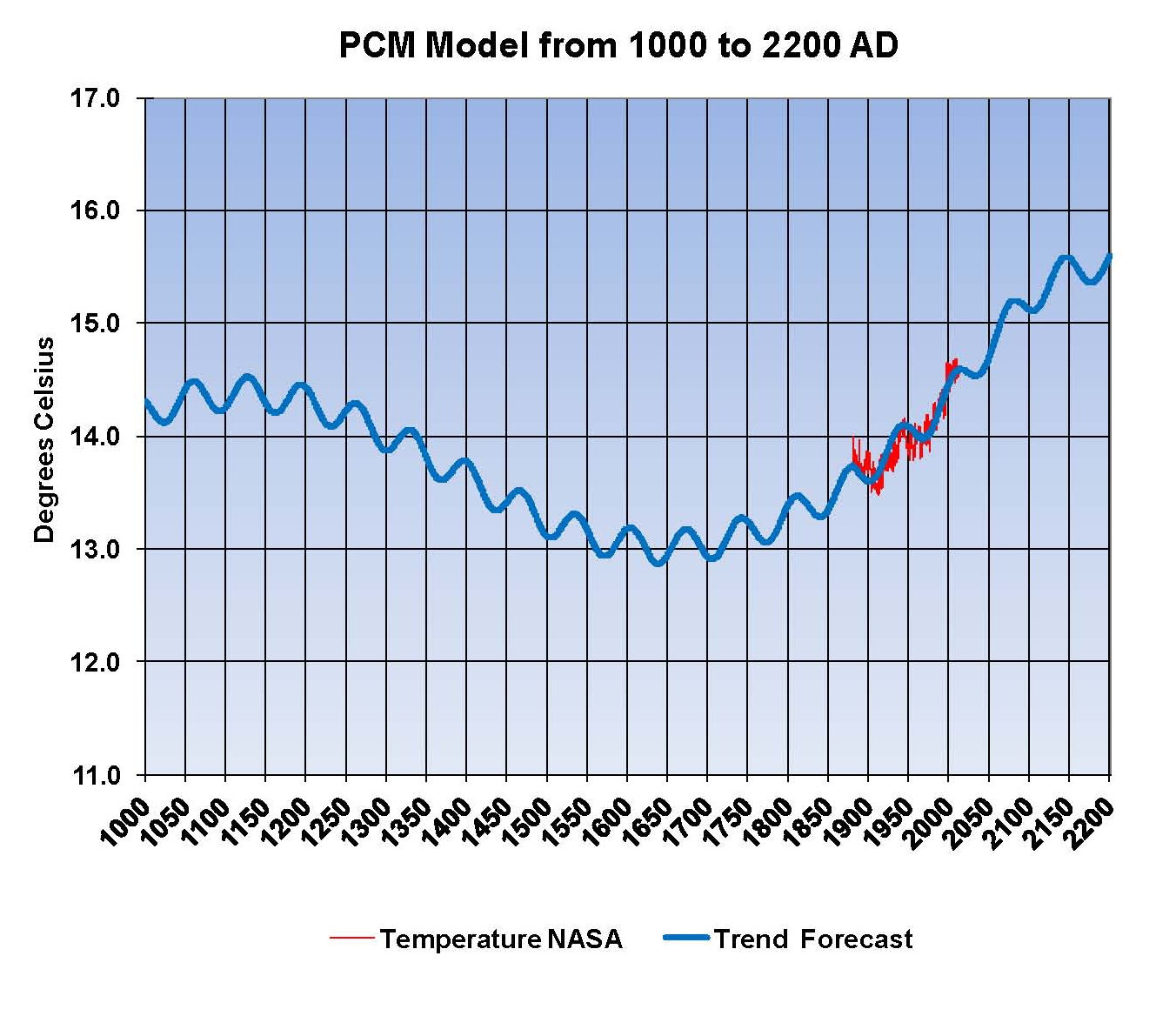
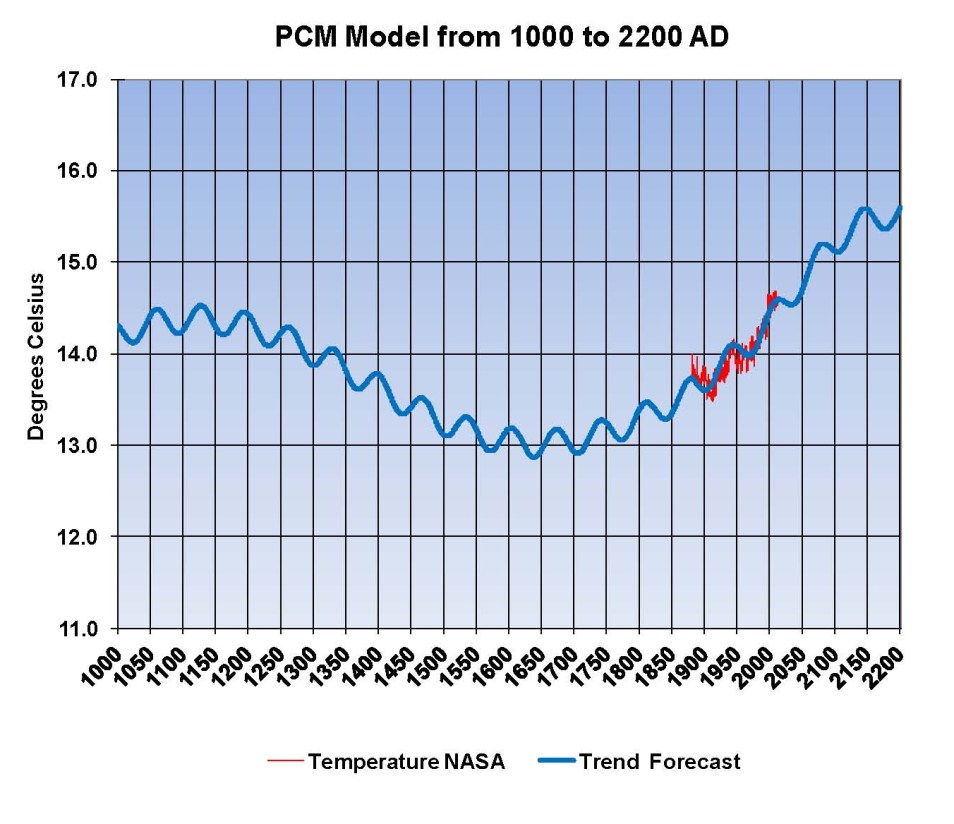
Lastly, the next chart shows what a plot of the PCM model would look like from the year 1000 to the year 2300. The plot matches reasonably well with history and fits the current NASA-GISS table LOTI date very closely, despite homogenization. I understand that this model is not based on physics but it is also not curve fitting. It’s based on observed reoccurring patterns in the climate. These patterns can be modeled and when they are, you get a plot that works better than any of the IPCC’s GCM’s. If the conditions that create these patterns do not change and CO2 continues to increase to 800 ppm or even 1000 ppm than this model will work into the foreseeable future. 150 years from now global temperatures will peak at around 15.5 to 15.7 degrees C and then will be on the downside of the long cycle for the next 500 years. The overall effect of CO2 reaching levels of 1000 ppm or even higher will be between 1.0 and 1.5 degrees C which is about the same as that of the long cycle.

Carbon Dioxide is not capable of doing what Hansen and Gore claim!
000 2015-03 b

The purpose of this post is to make people aware of the errors inherent in the IPCC models so that they can be corrected.

The Obama administration’s “need” for a binding UN climate treaty with mandated CO2 reductions in Europe and America means there will be such a resolution presented at the COP12 conference in Paris in December. To support this NASA will be forced to show ever increasing global temperatures for the rest of 2015 that will make less and less sense based on observations and satellite data which will all be dismissed or ignored.

Sir Karl Raimund Popper (28 July 1902 – 17 September 1994) was an Austrian and British philosopher and a professor at the London School of Economics. He is considered one of the most influential philosophers for science of the 20th century, and he also wrote extensively on social and political philosophy. The following quotes of his apply to this subject.

If we are uncritical we shall always find what we want: we shall look for, and find, confirmations, and we shall look away from, and not see, whatever might be dangerous to our pet theories.

Whenever a theory appears to you as the only possible one, take this as a sign that you have neither understood the theory nor the problem which it was intended to solve.

… (S)cience is one of the very few human activities — perhaps the only one — in which errors are systematically criticized and fairly often, in time, corrected.

97% Of Climate Scientists Base Their Research On Fraudulent Data From NASA And NOAA


Have no doubt that this is true! This is the result of a corr put federal government that controls the science though federal funding. The only way to stop the corruption of science is to stop the federal funding. Those pigs that the feed at the trough obey the dictates of the farmer, until he takes them to the slaughterhouse.

Tony Heller's avatarReal Climate Science

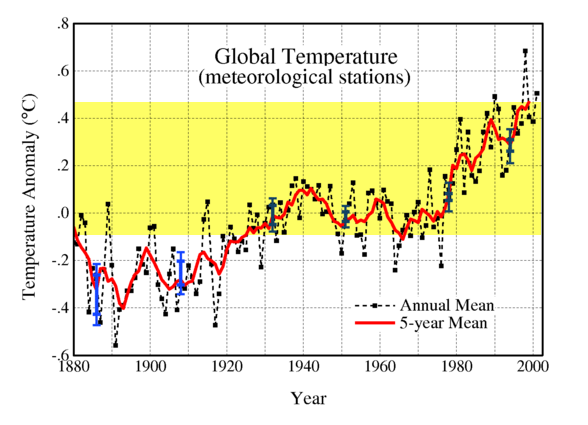
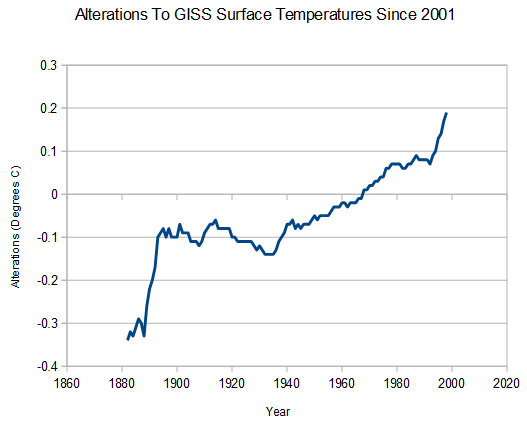
In 2001, NASA showed just under 0.6C warming from 1880 to 1999

2015-11-09-02-39-22Fig.A.ps

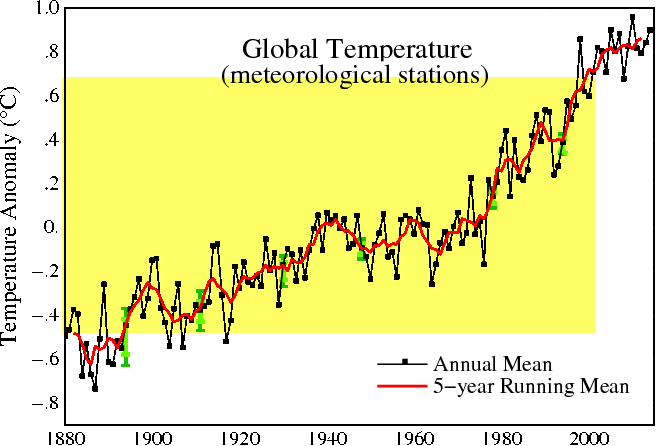
Now they show just under 1.2C warming during that same interval.

Fig.A (2)

Fig.A.gif

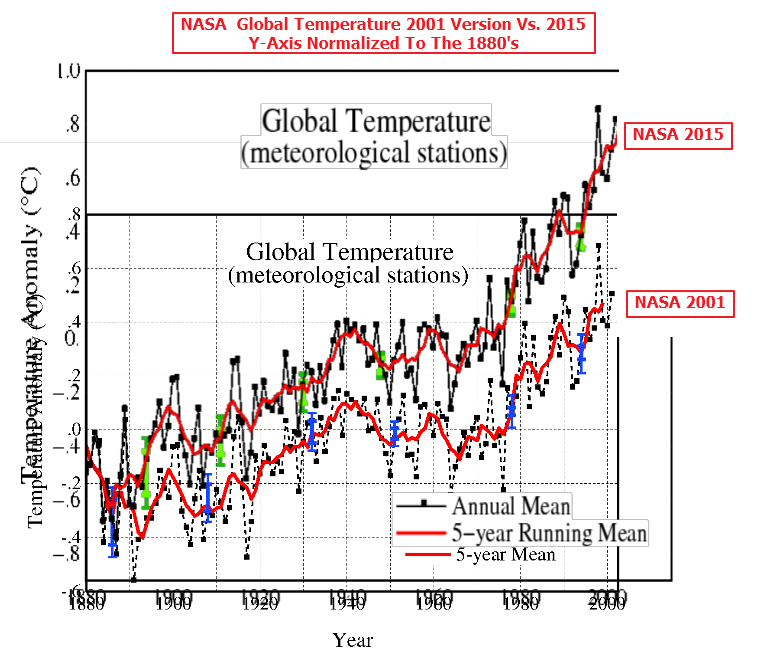
The next graph overlays the two above at the same scale, with the Y-axis normalized to the 1880’s. It shows the dramatic alterations NASA has made over the past 15 years, in an attempt to hide the failure of global warming theory.

2015-11-09-02-27-39

Note above that they have altered the data far outside of their own blue and green error bars. A smoking gun of scientific malfeasance. The graph below shows the magnitude of their post-2001 data tampering.

2015-11-09-03-11-39

2001 version : FigA.txt
2015 version: Fig.A.txt

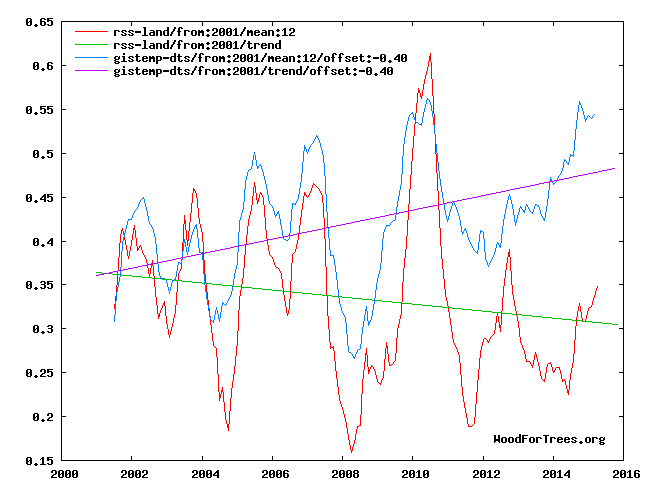
But their fraud is much worse than it seems. Since 2001 they have continued cheating, and have created a completely fake warming trend – during a time when the satellites showed that the planet was cooling.

2015-11-09-02-52-49

Wood for Trees: Interactive Graphs

NASA land…

View original post 31 more words

1971 Stunner : NASA And NCAR Knew That Catastrophic Global Warming Was A Farce


NASA uses a 3.0 degree Celsius sensitivity value which was required to make the anthropocentric theory work. Most current research has that value at under 1.0 degree Celsius and at those lower values there is no problem .

Tony Heller's avatarReal Climate Science

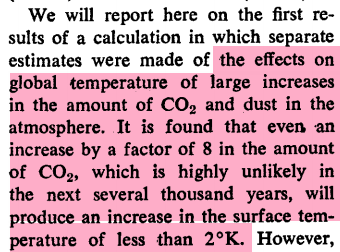
In 1971, NASA and NCAR’s top climatologists knew that even a massive increase in atmospheric CO2 would produce less than 2 degrees warming. The entire basis of the catastrophic global warming scam has been known to be a fraud from day one.

2015-11-07-12-30-092015-11-07-12-30-39

http://vademecum.brandenberger.eu/pdf/klima/rasool_schneider_1971.pdf failed to load

This is consistent with what radiative transfer models and satellite temperatures show. Without NASA and NOAA data tampering, the entire scam would have collapsed a decade ago.

h/t to Marc Morano

View original post

How Much CO2 Do Windmills Really Save?


We need more of these kinds of analysis to show that just like E-85 fuel the results are not what they are supposed to be; they never are when government is involved.

The Enforce-ability of the Climate Treaty from COP21


Can the Paris text guarantee compliance?

Re-Posted from deconstructionparis

Published on: September 2, 2015

Section K of the Paris text, ‘facilitating implementation and compliance’,  discusses measures to ensure that Parties stick to the commitments they agreed upon in the previous sections.

This section is brief, underdeveloped and appears to be one of the more contentious parts of the text. Some parties even consider section K “premature to discuss”; which is unfortunate as compliance mechanisms are going to be an integral part of achieving the UNFCCC’s goal of stabilizing greenhouse gas emission levels.

The importance of compliance mechanisms in International Environmental Law

Whether the final Paris agreement has any legal force is dependent on effective compliance mechanisms. This is because “legal force” is a variable concept at international law. For example, while a legal norm is considered ‘binding’ when it creates a legal obligation, this is distinct from legal enforcability. A norm is only ‘enforcable’ if it is backed by procedural mechanisms to incentivise parties to act in the prescribed manner. These incentives can be reputational or material, implicit or explicit, and include measures such as transparency, facilitation, compliance and enforcement.

It is currently undecided whether the Paris agreement will be “protocol, another legal instrument, or an agreed outcome with legal force.” While there is an intuitive desire for the agreement to be ‘hard’ (binding legal obligations; tightly worded) rather than ‘soft’ law (merely providing guidance), it is possible to have a hard legal instrument which lacks enforceability – and vice versa. As such, regardless of the format it eventually takes, the Paris agreement’s overall effectiveness (at practically achieving its goal) will rely on procedural mechanisms to incentivise compliance.

Some compliance mechansims are considered more suitable for environmental agreements than others. Enforcement mechanisms such arbitral tribunals, sanctions and other coercive measures are not often used in this context. Since international environmental agreements involve a collaborative approach to a long-term problem, punishing non-compliance can remove incentives for further participation, and thus ultimately prove counterproductive.

Measures to incentivise, assist and restore compliance are considered more effective for environmental agreements. Examples include reporting and monitoring systems to provide transparency and ‘early warnings’ for non-compliance; a regular Conference of Parties (COP) process to provide a forum to discuss evolving norms; capacity-building measures such as financial and technical assistance; diplomatic pressure (‘naming and shaming’); or non-compliance procedures (expert bodies to respond with non-punitive recommendations).

Existing Compliance Mechanisms

A compliance mechanism has already been established under the UNFCCC, in the form of the Kyoto Protocol’s Compliance Committee. The Kyoto Protocol covers emission reductions targets between 2008-2012 and 2012-2020 and is the predecessor to the upcoming Paris agreements.  The Kyoto Compliance Committee consists of an independent team of experts who monitor and control the procedure surrounding the Protocol’s Parties emission reduction commitments. Parties can also report each other – and themselves – to the Committee in cases of potential non-compliance. The Committee has a facilitative branch and an enforcement branch to respond appropriately to these situations. The approach is quasi-judicial but its consequences are not punitive.  The facilitative branch provides advice, assistance to Parties in order to promote compliance, and further provides an early warning of potential non-compliance. The enforcement branch decides whether developed nations (which are labelled “Annex I” Parties in the Kyoto Protocol) are meeting their reporting and reduction requirements, and determines whether to apply adjustments the assigned targets. The enforcement branch recommends actions against Parties when they fail to make progress towards their commitments.

The UNFCCC website advertises the Compliance Committee as one of “the most comprehensive and rigorous systems of compliance for a multilateral environmental agreement.” Nonetheless, it has not been entirely successful. Canada’s withdrawal from the Kyoto Protocol in 2014 is perhaps the best demonstration of the difficulties of enforcing compliance in an inherently voluntary international law system. Even a combination of hard and soft law, balanced to incentivise long-term collective action, will be rendered ineffective if a Party does not want to participate.

So what are the compliance mechanisms suggested in the Paris Text?

All three options suggested are essentially expansions to the pre-existing Compliance Committee, adapted to the Paris modality of differentiated commitments.

Enforcement and Facilitation

Kyoto’s commitments – and consequently, compliance measures – only extended to Annex I (developed) nations. Paris, in contrast, takes a universal “Nationally Determined Contribution” approach to commitments. Accordingly, Parties have suggested that Section K extends the Compliance Committee’s facilitative branch to developing nations, in order to provide the necessary resources (ie financial, technological, and capacity-building) for poorer nations to meet their requirements. Whether the enforcement branch is extended to all nations or remains for developed parties only is undecided, with both options still on the table.

Various different options suggest extending the Compliance COmmittee, but none of them develop the idea much further. Specifics of representation, committee membership rules, and decision-making processes are undecided. One option suggests leaving any elaboration beyond the suggested structure for future COP decisions; another leaves it to the first session of the governing body (where they will decide on an “indicative” list of consequences for different causes, types, degrees and frequency of non-compliance).

Regarding the substantive scope of the compliance arrangements (i.e. when the enforcement or facilitation measures are triggered), some parties suggest that the committee bear responsibility for enforcing commitments made across all sections of the text while others suggest that their jurisdiction be limited only to specified sections (such as [D] Mitigation and [I] Transparency) while excluding others (such as [E] adaptation).

Section K of the text requires considerable development and clarification ahead of COP21 in Paris. Extending the Kyoto Compliance Committee will not alone be enough to ensure compliance with the Paris agreements. Specific, tailored mechanisms with a clear substantive scope are needed.

A Climate Justice Tribunal?

While the above are options are consistent with the established preventative, non-political, non-judicial modalities, a contrasting option has been inserted at the end of the section K: a ‘Climate Justice Tribunal.’ This body would be independent from the Compliance Committee; and would be established to “oversee, control and sanction the fulfilment of and compliance with the obligations … under this agreement.”

The Climate Justice Tribunal was a suggested by the Bolivian government. The concept was developed at the World People’s Conference on Climate Change and the Rights of Mother Earth (WPCCC) hosted by Bolivia in 2010. The WPCCC was instigated by developing nations, indigenous peoples and civil society groups frustrated with the lack of commitments made at  Copenhagen (COP 15) in 2009.  As well as the call for a Climate Justice Tribunal, the WPCCC also resulted in a ‘Universal Declaration of the Rights of Mother Earth’ and a call for a ‘World People’s Referendum on Climate Change.’

Clearly, its inclusion in the Paris text represents a broader voice and movement among (but not necessarily limited to) the global south community, for increased climate action and accountability from wealthy industrialised nations. It is also a considerable deviation from the mainstream negotiated decisions under the UNFCCC; as well as traditional approaches to compliance in international environmental law. Whether these outspoken minority groups have the political weight to realistically achieve this outcome remains to be seen.

Conclusion:

Section K is one of the most important sections relative to its inconclusiveness. Finding the correct combination of hard and soft law compliance mechanisms will be crucial to incentivise ongoing commitment cycles without discouraging participation. A Climate Justice Tribunal represents an idealized way to ensure nations honour their commitments; but it is difficult to imagine nations voluntarily signing up to its jurisdiction. A strengthened Compliance Committee seems to be the likely outcome of Section K, but its specific mechanisms (and how it relates to nations at different levels of development) still needs further clarification.

Simon Hillier and Thomas Stuart | Image by Brian Turner