Is CNN Creating a Civil War?


COMMENT: From Europe, we are looking at your CNN and it really has become just propaganda and fake news. I was not a fan of Trump, but I have to say, he has done a great job probably better than any world leader. He has revised trade and has turned North Korea while your unemployment is now below 4% at 1960s level and you have a GDP growth of 4% while we have unemployment still in the 60% level among the youth and economic growth is at best 2.4%. It is hard to see why CNN turns everything negative.

HD

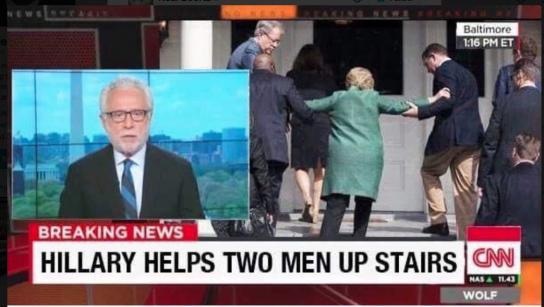
REPLY: It is really becoming blatant. This is one joke image going around, but it clearly demonstrates the point. America’s GDP growth is 4.1%, which is about twice that of Europe. Trump’s hardline threats of tariffs have yielded the first real new fair trade deal with the European Union. North Korea is actually returning the remains of our fallen American soldiers which have made a huge difference to many families.

The immigration issue where families were being separated was portrayed as if it was something brand new under Trump. CNN never bothered to report this was a policy that predated Trump and that Obama deported more people than any other president in history. They intentionally ignored the immigration issue under Obama and only used it against Trump demonstrating how corrupt CNN has become acting as only a political propaganda network. The damage CNN is doing to the country and the world is beyond description. My greatest concern is they are fueling a Civil War and what comes AFTER Trump? The people will NOT be satisfied with a career politician any longer. We are witnessing the Trump Revolution around the world and even within the Democrats.

Trump should stop the verbal assault on the press and reinstate the Fairness Doctrine and FORCE the press to present both sides and ned this reign of propaganda.

However, the owner of CNN, Time Warner, the Chairman and CEO Jeff Bewkes came out and stated PUBLICLY that Trump does not pose a grave threat to free speech, but rather it was the Democrats. Speaking at Business Insider’s Ignitiion, Bewkes made it very clear that the Democratic Party’s commitment to campaign finance reform was a threat to free speech. He pointed out that Hillary Clinton said she would push for a constitutional amendment to overturn Citizens United, the Supreme Court decision that lifted restrictions on political spending by corporations and interest groups. She wanted to reduce free speech that was being funded against the Democrats.

Reuters: Multinational Car Manufacturers Assemble To Coordinate Strategy Against U.S. President Trump…


Interestingly Reuters uses the narrative from an anonymous Canadian “official” to frame an article about how global car manufacturers are coming together next week in Geneva to coordinate their strategy against the United States and President Trump.

Just let that part sink in for a moment…

Behind that context we can clearly see: 1) the economic importance of the Auto industry to the countries that are assembling; 2) their multinational corporate interest in retaining unlimited access to the U.S. market; and 3) the absolute need of all assembling corporations to find a way to keep their investments in NAFTA’s fatal flaw viable.

Who is gathering?  Canada, Mexico, the EU (ie. Germany), Japan and South Korea.

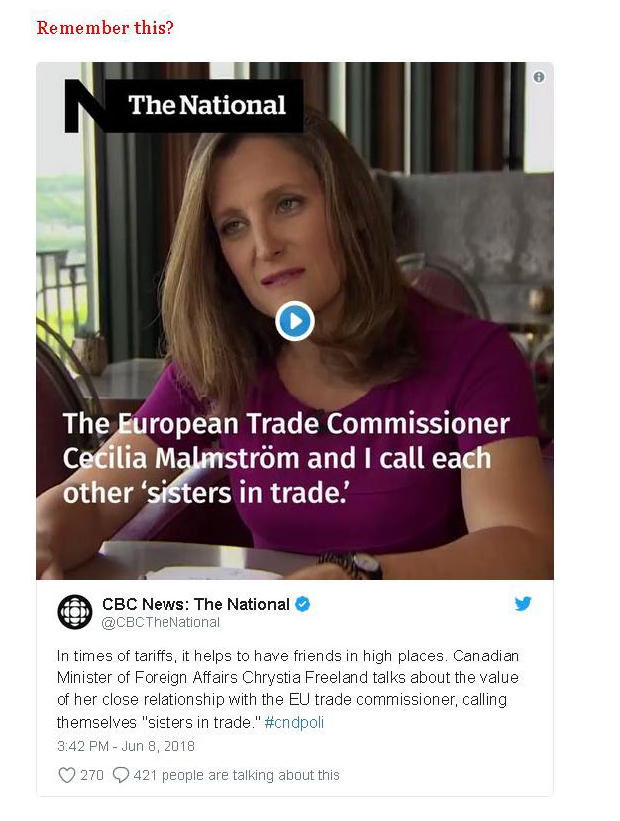
Where are they going?  To visit Geneva, Switzerland.  Why Geneva? Because that way China can attend (see Volvo/Sweden) without being on the official roster.  ::nudge, nudge:: ::wink, wink::  ::say-no-more Panda boy, say-no-more::  Additionally, Cecelia Malmström (EU Trade Minister), is the person Canada is relying upon to cover their anti-Trump position:

MEXICO CITY/OTTAWA (Reuters) – Canada, the European Union, Japan, Mexico and South Korea will meet in Geneva next week to discuss how to respond to threats by U.S. President Donald Trump to impose tariffs on U.S. imports of autos and car parts, officials familiar with the talks said.

The Trump administration has come under heavy criticism from automakers, foreign governments and others as it considers tariffs of up to 25 percent, a levy critics warn will hike vehicle costs, hurting auto sales and global industry jobs.

Several auto manufacturing powers have been talking to each other in recent days about their fears and a possible coordinated response to Trump’s “Section 232” investigation, which he ordered on May 23, into whether auto imports are a threat to U.S. security, sources say.

The probe could be completed within weeks, although similar ones ordered last year that led to tariffs of 25 percent on steel and 10 percent on aluminum took about 10 months. The Commerce Department has 270 days to offer recommendations to the president after such a probe starts. He then has 90 days to act upon them.

It was not immediately clear what kind of response the countries could be looking at, although Canada, the EU and Mexico retaliated with their own tariffs after Trump imposed levies on steel and aluminum imports in March. Another option is to fight the United States at the World Trade Organization (WTO).

Deputy ministers will gather in Geneva on July 31 to hear each other’s views, a Canadian official and a Mexican official told Reuters, asking to not be named because they were not authorized to talk to the media.

“The meeting is meant to bring together major auto producing nations so we can discuss our concerns over the U.S. Department of Commerce’s Section 232 investigation of automobiles and parts,” said the Canadian government official. (read more)

Here’s where I will repeat the funniest aspect that seems continually missed by all of the international smart-set:

President Trump doesn’t care !

President Trump doesn’t care what the opinion of the Auto industry is.

President Trump is not beholden to the interests of the corporate auto industry.

President Trump doesn’t give a flip about what international leaders gather to discuss.

President Trump will do what is in the best interests of the United States and the workers within it. Period; end-of-story.  Done.

It is in the corporate and financial interests of the multinationals to retain their open-ended tariff-free access to the U.S. market by exploiting the back-door of NAFTA.  The multinational corporations have invested hundreds of billions on the supply chain and manufacturing system all using this NAFTA loophole. They have also paid hundreds-of-millions for the political policy of multiple world leaders, all to support and retain their interests therein.

Guess what?

President Trump doesn’t care.

If it is not in the best interests of the U.S., it simply will not be allowed.

The multinational corporate leaders can assemble and strategize until they are blue-in-the-face.  It matters not.

Seriously.  They might just as easily attend a Swiss pancake tossing contest.  POTUS Trump doesn’t care.  Eventually they are going to have to ask, beg, plead and grovel to retain their position.   When they accept the one constant in an ever changing universe, and finally realize the question is not “if” they will lose, but rather “how much”, then, and only then, will POTUS Trump enter the room with his golden tickets.

To get golden ticket access to the U.S. market, those multinationals are going to have to agree to President Trump’s terms.  Trump doesn’t care about their feelings; Trump doesn’t give a flip about their statements; Trump has one prism to consider any deal, negotiation or result: is it better for the United States of America?

If not, go spit.

That’s it.

Now, go make him a sandwich…

.

The July 20th conversation with President Trump touched on the state of the U.S. economy; America’s trade reset; the timing of the trade reset juxtaposed against the current value of the U.S. stock market; the president’s news-making remarks about the Federal Reserve’s ongoing interest-rate hikes; and pragmatic insight behind the meeting with Vladimir Putin. Watch it, you’ll see:

.

Wilbur Ross outlines the policy:

White House Economic Advisor Kevin Hassett Discusses Details Within GDP Release…


The head of the White House Council of Economic Advisers, Kevin Hassett shares his perspective on the 4.1 percent GDP growth, and the ongoing MAGAnomic America-First initiatives.   Hassett rightly points out that finished good domestic inventories dropped as an outcome of consumer purchasing outpacing manufacturing.  As more manufacturing comes on-line, the production capacity expansion leads to more GDP growth.

Remember, one of the unique attributes of the U.S. economy, thanks to the foresight of industrial titans who built it, is our internal consumption.  We are not only the worlds’ largest economy, we are the biggest self-sustaining economy in the history of the world; a massively consequential strategic advantage. Our leverage comes from nations needing access to our market; the U.S. does not necessarily need access to theirs. Therefore POTUS Trump can dictate the terms.

Two Important Words From Granite City Illinois: “We’re Back”…


Last week President Trump went to Granite City, Illinois, to celebrate the re-opening of a U.S. Steelworks manufacturing facility.

If you ever had any question about how important President Trump’s Main Street economic and manufacturing policies are to U.S. workers, well, just watch this interview with a formerly laid-off Granite City steelworker.  [Dusty Keyboard Alert]:

.

“We’re back”

That’s the heartbeat of America right there!

President Trump Weekly Address July 27, 2018…


President Trump delivers a weekly address for W/E July 27th, 2018. The primary topic of immigration enforcement and support for Immigration and Customs Enforcement (ICE) is the message:

Jim Jordan Discusses His #MAGA Run for Speaker of The House…


Ohio Representative Jim Jordan appears on Sean Hannity to discuss the reason he is running for Speaker of The House.

Make SoH Great Again

.

Representative Jordan was also on Fox News Morning show for an expanded discussion. See below:

The Fundamentals of MAGAnomics….


Against the backdrop of MAGAnomic success, many people (some young some old) are beginning to engage in questions of decades-old economic assumptions.  Consider me thrilled at the possibility of a generational economic awakening.

Toward that end, here’s another repost from 2016 to gain understanding of the fundamentals behind President Trump’s MAGAnomic policies.  God Bless Main Street!

NOVEMBER 2016 – As we all begin to filter the impact of a historic Donald Trump victory, perhaps it is important to remind ourselves what should be the primary filter for perspective..

…the economics.

trump-hat-1

For the first time in many decades the chief executive of the United States will walk into office concerned about the long-term financial stability of the United States.  For the first time ever, a titan of American Main Street is going to be in the oval office. Do not downplay the significance of this aspect. Money makes the world go ’round.

Every single global leader and politician is reviewing the U.S. election through their own domestic financial prisms. Rule #1 – Everything is about the money. Rule #2 – Everything is about the money. Rule #3 – when pondering any information broadcast by corporate media about a global Trump effect, refer back to the prior two rules.

Donald Trump is 100% pure MAIN STREET, never doubt that. Trump’s macro economic DNA outlook is compromised of American business interests at a micro-cellular level. Senate Leader Mitch McConnell et al will be dispatched immediately if he attempts to bring his big Wall Street/K-Street lobbying friends into the Trump economic equation.

For the sake of brevity, we’re going to accept that most readers here are familiar with who funds and directs Mitt Romney, Paul Ryan, Jeb Bush, John McCain, Mitch McConnell, and in larger more consequential measures – the DC UniParty legislative team in charge of U.S. Policy, ie. Wall street.

During the January 2016 South Carolina debate, and in response to Trump pointing out a necessary shift in trade position (a shift to put American interests first – a shift to stop the dependency on cheap import goods – a shift to use China’s dependency on access to our market to OUR advantage), Jeb Bush came back with an example of Boeing manufacturing.

trump west virginiajeb bush what

Donald Trump, responded to Jeb’s Boeing example, and pointed out China is forcing Boeing to open a manufacturing plant in China. As would be typical from a candidate who is unfamiliar and poorly briefed on the issue, Jeb Bush looked back incredulously and said:

“C’mon man”…

There we saw it.

Right there was the disconnect.

However, almost everyone missed it.

There, in that exact moment, was the spotlight upon all that is wrong with a professional political class; globalists dependent on Wall Street best interest for their talking points.

Donald Trump was 100% correct.

But the issue is bigger.

Not only is China demanding Boeing open a plant in China, the intent of such a plant provides an opportunity to explain why Trump, and his approach, is vitally important – and time is wasting.

China is refusing to trade with (buy) Boeing products if the company does not move. Why? It’s not about putting Chinese people to work, it’s about China importing their research and development, Boeing’s production secrets, into their country so they can learn, steal and begin to manufacture their own airliners.

This is just how China works.

In time, Comac, a state-owned, Shanghai-based aerospace company will then use the production secrets they have stolen, produce their own airliners, kick out Boeing, undercut the market, and sell cheaper manufactured airplanes to the global economy.

Boeing, the great American company that Jeb Bush thinks they are, becomes yet another notch on the Asian market belt.

All of those Boeing workers, those high-wage industrial skill jobs that support the American middle class, yeah – those jobs lost. And the cycle continues.

Of course Wall Street will be invested in the cheaper Chinese aerospace manufacturing company Comac, as it emerges as a manufacturing power.

This reality within this story is a peek into the future of the fundamental disconnect between Wall Street (grows again) and Main Street (lost jobs/wages). The reality within this example is exactly what has taken place over the past three decades.

Wall Street entities like Goldman Sachs will be fine. Ted and Heidi Cruz will be fine; Jeb Bush, Marco Rubio, Nikki Haley, Carly Fiorina, Mitt Romney, John Kasich will also be fine – it’s middle America who suffers.

The economic consequence, yet again, creates disparity between those insulated by Wall Street and the rest of the U.S. This is how our current oligarchy is growing out of control.

And so they, as professional politicians, will propose solutions – their solutions. However, their solutions are actually the preferred solutions of their campaign contributors, ie. Wall Street. The same Wall Street that funds lobbyists, like the U.S. Chamber of Commerce, to set the economic legislative priorities of congress.

Meanwhile the non-import market, your visit to the grocery store, food, energy etc. sees prices increasing. This is what happens when a production economy becomes a service economy.

trump hard hat

In 1984 a name brand polo shirt would cost around $45, a really good 26″ TV around $600 to $1,000, a decent couch $1500, and a pair of name brand sneakers around $100. However, eggs (.49), milk ($1.79 gal), and store bread (2 loaves for $1).

Electric bill $100, water bill $20, phone bill $50.

In 2016 an imported name brand polo costs around $20, a really good 42″ TV $300 to $400, a couch for $500 and a pair of sneakers $50 – All imported, all Asian, all about half of of what they cost in 1984.

However, eggs ($1.99), Milk ($4.50+), and store bread ($2+ each). All domestic products and all double or triple 1984. Electric bill $250, Water bill $100, phone bill $100+. Again domestic consumables, again double, triple or even more.

egg prices

We consume and spend more on domestic goods such as food, energy, fuel, than we do purchasing imported durable goods. As a consequence, depending on lifestyle, the net out-of-pocket is essentially the same to a little more.

However, the income opportunity, the jobs, the good paying jobs, well, those are gone because the durables are no longer part of the domestic production.

To keep the unemployed pitchforks at bay, government policy (now directed by Wall Street globalists and multinational corporations) subsidize the income gap. Ergo EBT, WIC and food stamp assistance necessarily increasing.

The pitchforks are dropped, but economic independence turns to dependence. With government policy adjusted accordingly – deficits necessarily explode. Stopping those deficits would require an actual budget. There hasn’t been a federal budget since ’07…. “Omnibus”,… Sound familiar?

Yes, under Donald Trump’s proposal the cost of “durable” goods -at least those we import- will increase. Your iPhone might cost $800 instead of $600. However, the North Carolina apparel, clothing and furniture manufacturing market will have an opportunity to revitalize – and with it, jobs, people as the tailors and the custom wood furniture makers would have opportunity to thrive again with their creations.

There’s going to be a period of pain as U.S. manufacturing finds it’s footing and begins to restart. However, in the longer term, it’s a shift from “dependency” to “independence”.

Those who were fully matriculated independent adults prior to 1984 know exactly what needs to be done.

Freedom is dependent upon it.

reagan trump 2ben shapiro

Meanwhile, Ben Shapiro was born in 1984 and necessarily views the world through the cost of his next iPhone. Another Wall Street supporter, Ted Cruz, was thirteen.

On Social Security – Unlike many candidates Donald Trump is NOT calling for rapid or wholesale changes to the current Social Security program; and there’s a very good reason why he’s the only candidate not proposing wholesale changes.

With the single caveat of “high income retirees” (over $250k annually), which Trump is open to negotiating on, candidate Trump does not consider these programs as “entitlements”. The American people pay into them, and the federal government has an obligation to fulfill the promises made upon collection.

To fully understand how Donald Trump views the solvency of Social Security, you must again understand his economic model and how it outlines growth.

The issue with Social Security, as viewed by Trump, is more of an issue with receipts and expenditures. If the aggregate U.S. economy is growing by a factor larger than the distribution needed to fulfill its entitlement obligations then no wholesale change on expenditure is needed. The focus needs to be on continued and successful economic growth.

trump hard hatWhat you will find in all of Donald Trump’s positions, is a paradigm shift he necessarily understands must take place in order to accomplish the long-term goals for the U.S. citizen as it relates to “entitlements” or “structural benefits”.

All other candidates are beginning their policy proposals with a fundamentally divergent perception of the U.S. economy. They are working with, and retaining the outlook of, a U.S. economy based on “services”; a service-based economic model.

While this economic path has been created by decades old U.S. policy, and is ultimately the only historical economic path now taught in school, Trump intends to change the course entirely.

Because so many shifts -policy nudges- have taken place in the past several decades, few academics and even fewer MSM observers, are able to understand how to get off this path and chart a better course.

Candidate Trump is proposing less dependence on foreign companies for cheap goods, (the cornerstone of a service economy) and a return to a more balanced U.S. larger economic model where the manufacturing and production base can be re-established and competitive based on American entrepreneurship and innovation.

The key words in the prior statement are “dependence” and “balanced”. When a nation has an industrial manufacturing balance within the GDP there is far less dependence on the economic activity in global markets. In essence the U.S. can sustain itself, absorb global economic fluctuations and expand itself or contract itself depending on the free market.

When there is no balance, there is no longer a free market. The free market is sacrificed in favor of dependency, whether it’s foreign oil or foreign manufacturing, the dependency outcome is essentially the same. Without balance there is an inherent loss of economic independence, and a consequential increase in economic risk.

No other economy in the world innovates like the U.S.A. Donald Trump sees this as a key advantage across all industry – including manufacturing and technology.

The benefit of cheap overseas labor, which is considered a global market disadvantage for the U.S., is offset by utilizing innovation and energy independence.

The third highest variable cost of goods beyond raw materials first, labor second, is energy. If the U.S. energy sector is unleashed -and fully developed- the manufacturing price of any given product will allow for global trade competition even with higher U.S. wage prices.

In addition the U.S. has a key strategic advantage with raw manufacturing materials such as: iron ore, coal, steel, precious metals and vast mineral assets which are needed in most new modern era manufacturing. Trump proposes we stop selling these valuable national assets to countries we compete against – they belong to the American people, they should be used for the benefit of American citizens. Period.

EXAMPLE: Currently China buys and recycles our heavy (steel) and light (aluminum) metal products (for pennies on the original manufacturing dollar) and then uses those metals to reproduce manufactured goods for sale back to the U.S. – Donald Trump is proposing we do the manufacturing ourselves with the utilization of our own resources; and we use the leverage from any sales of these raw materials in our international trade agreements.

When you combine FULL resource development (in a modern era) with with the removal of over-burdensome regulatory and compliance systems, necessarily filled with enormous bureaucratic costs, Donald Trump proposes we can lower the cost of production and be globally competitive. In essence, Trump changes the economic paradigm, and we no longer become a dependent nation relying on a service driven economy.

The cornerstone to the success of this economic turnaround is the keen capability of the U.S. worker to innovate on their own platforms. Americans, more than any country in the world, just know how to get things accomplished. Independence and self-sufficiency is part of the DNA of the larger American workforce.

In addition, an unquantifiable benefit comes from investment, where the smart money play -to get increased return on investment- becomes putting capital INTO the U.S. economy, instead of purchasing foreign stocks.

With all of the above opportunities in mind, this is how we get on the pathway to rebuilding our national infrastructure. The demand for labor increases, and as a consequence so too does the U.S. wage rate which has been stagnant (or non-existent) for the past three decades.

As the wage rate increases, and as the economy expands, the governmental dependency model is reshaped and simultaneously receipts to the U.S. treasury improve.

More money into the U.S Treasury and less dependence on welfare/social service programs have a combined exponential impact. You gain a dollar, and have no need to spend a dollar – the saved sum is doubled. That is how the SSI and safety net programs are saved under President Trump.

When you elevate your economic thinking you begin to see that all of the “entitlements” or expenditures become more affordable with an economy that is fully functional.

As the GDP of the U.S. expands, so does our ability to meet the growing need of the retiring U.S. worker. We stop thinking about how to best divide a limited economic pie, and begin thinking about how many more economic pies we can create.

Simply put, we begin to….

…..Make America Great Again !

trump west virginia

trump hard hat 2

Authors note as shared in 2016: If I absolutely did not believe this economic model was doable, I would never expand the concept and place advocacy upon it. I am an absolute believer that we can, as a nation, reignite a solid manufacturing base and generate an expanding middle class.

Yes, in the short term durable goods may cost more, that’s to be expected. However, these are durable goods, not disposable goods. As consumers we may have to spend a little more on maintenance and repair to offset an increase in durable goods, but that’s a small price to pay to make the U.S. manufacturing base great again.

~ Sundance

NEC Chairman Larry Kudlow Discusses Sustainability of U.S. Economic Growth…


National Economic Council Chairman Larry Kudlow appeared on Fox News to discuss the latest GDP figures from the Bureau of Economic Analysis (BEA).

Keep in mind when contemplating ‘sustainable growth’, all of the current underlying economic activity is during the phase of transition between Wall Street policy (last 30 years) and Main Street policy (Trump).  We are in the space between the two economic approaches; two engines – SEE HERE.

.

How will we know when the two economic engines have crossed paths?  There is an easy answer:  Under MAGAnomic Main Street policies inflation is disconnected from FED monetary policy.  In the real economy inflation is connected to wage rates.  When inflation and wage rates reach growth equity (over two quarters), that’s when the Main Street economic engine will have caught and passed Wall Street. We’re close.  Watch.

President Trump Delivers Remarks on The Economy….


Earlier today President Trump, Vice-President Pence and NEC Chairman Larry Kudlow delivered remarks on the economy from the South Lawn of the White House:

.

[Transcript] South Lawn – 9:43 A.M. EDT – THE PRESIDENT: Good morning. Moments ago, the numbers for America’s economic growth — or GDP — were just released. And I am thrilled to announce that, in the second quarter of this year, the United States economy grew at the amazing rate of 4.1 percent. We’re on track to hit the highest annual average growth rate in over 13 years. And I will say this right now, and I’ll say it strongly: As the trade deals come in one by one, we’re going to go a lot higher than these numbers. And these are great numbers.

During each of the two previous administrations, we averaged just over 1.8 percent GDP growth. By contrast, we are now on track to hit an average GDP annual growth of over 3 percent, and it could be substantially over 3 percent. Each point, by the way, means approximately $3 trillion and 10 million jobs. Think of that. Each point — you go up one point — that doesn’t sound like much; it’s a lot. It’s $3 trillion and it’s 10 million jobs.

If economic growth continues at this pace, the United States economy will double in size more than 10 years faster than it would have under either President Bush or President Obama.

Perhaps one of the biggest wins in the report, and it is indeed a big one, is that the trade deficit — very dear to my heart, because we’ve been ripped off by the world — has dropped by more than $50 billion. $52 billion, to be exact. It’s dropped by more than fifty. Think of that. The trade deficit has dropped by more than $50 billion. And that’s added — and adding — one point to GDP. That’s a tremendous drop. We haven’t had a drop like that in long time. You’ll have to go back a long time before you find it.

By increasing growth to 3 percent over the next 10 years, that would mean 12 million new American jobs and $10 trillion of new American wealth, at least. And that’s not including the fact that, since I was elected, we’ve created approximately $7 trillion of new wealth.

The year before I came into office, private business investment grew at only 1.8 percent. Last year, it jumped to 6.3 percent. That was my first full year; we had to do a lot of things to get it to grow. And this year, it’s growing at 9.4 percent. So that’s a very tremendous increase. There hasn’t been an increase like that in many, many years — decades.

And I think the most important thing — and Larry Kudlow just confirmed to me, along with Kevin Hassett — that these numbers are very, very sustainable. This isn’t a one-time shot. I happen to think we’re going to do extraordinarily well in our next report, next quarter. I think it’s going to be outstanding. I won’t go too strong, because then if it’s not quite as good, you’ll not let me forget it. But I think the numbers are going to be outstanding.

We’ve accomplished an economic turnaround of historic proportions. When I came into office, 1.5 million fewer prime-age Americans were working than eight years before. We had lost almost 200,000 manufacturing jobs under the previous administration. And you all know, they say, “Well, you have to lose manufacturing jobs. It will get worse and worse. Manufacturing jobs are obsolete.” No, they’re not obsolete; they’re the greatest jobs we have.

More than 10 million additional Americans had been added to food stamps, past years. But we’ve turned it all around. Once again, we are the economic envy of the entire world. When I meet the leaders of countries, the first thing they say invariably is, “Mr. President, so nice to meet you. Congratulations on your economy. You’re leading the entire world.” They say it almost each and every time.

America is being respected again, and America is winning again, because we are finally putting America first.

Everywhere we look, we are seeing the effects of the American economic miracle. We have added 3.7 million new jobs since the election — a number that is unthinkable, if you go back to the campaign. Nobody would have said it, nobody would have even, in an optimistic way, projected it.

We are in the midst of the longest positive job-growth streak in history. New unemployment claims have recently achieved their lowest level in almost half a century. The African American unemployment rate has achieved the lowest level in recorded history. African American unemployment is the best it’s ever been in the history of our country. The Hispanic unemployment rate has reached the lowest level, likewise, in history. The Asian unemployment rate has recently reached the lowest level, again likewise, in history. Women unemployment rate recently reached the lowest level in 65 years. And soon that will be in history. Give it another two or three weeks.

Veterans’ unemployment is at its lowest level in 18 years. And that number is rapidly going up, on top of which we just received and won from Congress, Choice, where veterans can go out and see a doctor if they can’t get service, the service that they deserve.

Unemployment for disabled Americans has hit a record low. Lowest in history. More than 3.5 million Americans have been lifted off food stamps — something that you haven’t seen in decades. 3.5 million Americans have been lifted off food stamps. That’s because they’re able to go out and get a job. And they’re going to love their jobs.

Ninety-five percent of American manufacturers are optimistic about their company’s outlook. And that’s the highest level, also, in history. And that’s an old survey. Been around a long time.

Manufacturing wages are expected to rise at the fastest rate in over 17 years. Business and consumer confidence has reached historic highs.

So far this year, American exports are up nearly 20 percent. I’ve only been here a little more than a year and a half. Over the same period, in the year before I took office, we’ve become a net exporter of natural gas for the first time since 1957. We’ve gotten rid of tremendous amounts of regulations, which allows us to do things. And we still have tremendous regulations on clean air, clean water, the environment. It’s very important to me, very important to everybody. But we had unnecessary regulations that were hurting our economy and hurting our country.

We have eliminated a record number of job-killing regulations. And with the help of Republicans in Congress, we passed — without one Democrat vote — the biggest tax cuts and reform in our history. And, as you know, the Democrats want to end that and raise everybody’s taxes. That will be a disaster for our economy.

As a result, more than 6 million Americans are now enjoying new bonuses, better jobs, and far bigger paychecks. Yet every single Democrat voted against the tax cuts — every single one; we didn’t get one vote. They voted against working families, they voted against small businesses. Not good.

In the first three months after tax cuts, over $300 billion poured back into the United States from overseas. We think it’s going to be, in the end, when completed, over $4 trillion will be back into our country. Apple alone is bringing in $230 billion. And they’re building new plants. They’re building a magnificent campus. They’re going to be spending their money very wisely, but they’re spending it in our country, not in some other country. That was made possible by the new tax cut and reform plan.

At the same time, we are finally cracking down on decades of abusive foreign trade practice. We were abused by companies. We were abused by the companies within countries. But in particular, we were abused by countries themselves, including allies. Abused like no nation has ever been abused on trade before. Because we had nobody watching. They stole our jobs and they plundered our wealth. But that ended.

Yesterday, I was at Granite City Steel in Illinois. It was an incredible sight. We had an audience of steel workers, some of the roughest, toughest people you’ve ever seen. And half of them had tears coming down their face. I don’t know if these people ever cried before in their life, to be honest. Half of them had tears coming down because we opened a tremendous United States Steel plant. They’re opening up seven other plants. And the steel industry is back. They’re open for business. And we need the steel industry. And the tariffs did it.

And nobody mentions the fact that these plants are creating tremendous numbers of jobs — tremendous. And billions of dollars are pouring into the United States coffers. Billions of dollars. But we’re getting jobs. We’re getting money coming in. We’re respected. And, eventually, the steel prices will really start to go down, because all of these new plants are going to be competing against each other. But we won’t have foreign countries dumping — that’s the word they use, “dumping” — steel all over the place and destroying our factories, destroying our plants, destroying our companies, and destroying our jobs.

Since I was elected, we’ve added 400,000 new manufacturing jobs. Remember, that was the obsolete deal. Obsolete. I used to say, “Why is it obsolete? We have to make things.” Manufacturing jobs are among our best jobs — and we’re just getting started.

We’ve also liberated millions of Americans from the crushing burdens of Obamacare. The cruel individual mandate penalty is gone. That’s where you pay a lot of money for the privilege of not having to buy bad healthcare and pay for it. It’s gone. Nobody thought we could get rid of it. That was the most unpopular provision, by far, probably on anything, but certainly in Obamacare. And Obamacare is now on its last legs, fortunately.

And through Associated Health Plans, we’re giving Americans the ability — just opened — millions of people going to be signing up. Millions and millions. We’re giving Americans the ability to join together to purchase much better and more affordable healthcare and health insurance, including bidding across state lines. So all of the insurance companies are going wild. They want to get it. You’re going to have great healthcare at a much lower price. It will cost the United States nothing. Nothing. Think of that. Will cost us nothing. And that’s Secretary Acosta — Secretary Azar is coming out with another healthcare plan somewhat different. Result the same. Much less expensive healthcare at a much lower price. It will cost our country nothing. We’re finally taking care of our people.

Finally, there’s another matter that’s of profound importance to me. And I wish to discuss it right now, before we leave, because there’s nothing like what we’ve been working on. So important for the lives of not only Americans, but lives all over the world.

At this moment, a plane is carrying the remains of some great fallen heroes from America, back from the Korean War. They’re coming back to the United States. Mike Pence, our wonderful Vice President, will be there to greet the families and the remains. And I want to thank Chairman Kim for keeping his word. We have many others coming. But I want to thank Chairman Kim in front of the media for fulfilling a promise that he made to me. And I’m sure that he will continue to fulfill that promise as they search and search and search.

These incredible American heroes will soon lay at rest on sacred American soil. Even during the campaign, people would come up to me — it’s a long time ago — many decades ago. Oftentimes they were older. In some cases, they were younger. Great-grandfathers. My great-grandfather, my grandfather, my father — they asked if I could do something about it. I’d look at them, I’d say, “We don’t get along too well with that country.” They said, “Whatever you can do.” And it’s something that was very important to me. Many people have asked that.

I’ve asked the Vice President and others to just pay a special tribute — and they will do that. So we honor the sacred memory of every incredible American patriot who fought and died in that war.

In everything we do, in every action we take, we are fighting for loyal, hardworking, patriotic citizens of our blessed nation. We’re making our country great again. We’re respected again all over the world. Our military will soon be stronger than it’s ever been, by far. That in itself will produce thousands and thousands of jobs. Nobody makes equipment like we do — nobody — whether it’s planes or missiles, or any form of military equipment. We make the best in the world, by far.

We’re making it possible for our allies to buy that equipment quickly, where they don’t have to wait for two-year approvals, and more. We’re doing great. And I’m very honored to see that 4.1 number. Perhaps I’m even more honored to see that deficit shrink — the trade deficit shrink so much.

With that, I’d like to ask Kevin Hassett, Chairman of the Council of Economic Advisers, and my very good friend, Larry Kudlow, if they could both step forward and say a few words.

Thank you all very much. It’s a great day. (Applause.)

HASSETT: Thank you very much, Mr. President. And thank you for your leadership and for the faith that you put in me when you offered me this job. And thank you for standing up for our veterans. My father and my uncle both fought in the Korean War, and you just can’t imagine how much it means to those veterans that you didn’t forget their comrades.

You know, as an economist, it’s my duty, sir, to remind that we should not make too much of one number, right? How often do we hear economists say that? But when I think back to the first time I met with you in the Oval, and we talked about your vision about how to make America great again, you might recall that, in the end, I agreed, yeah, that stuff really ought to work.

And the fact is that if we look at the data today, that we can see the proof of the pudding that the President’s policies are working. And it’s not just in the top line, but it’s in the details.

So the President said that if we deregulate the economy and have a tax reform, that there will be a capital spending boom because the factories will come back to America. If you look at the data, then the factories are booming again.

The President said that if we emphasize energy production here in the U.S., that we could become a dominant energy economy, even an energy exporter. Well, if you look at the data today, one of the reasons why the data is so strong is that drilling and mining activities skyrocketed in an almost unprecedented way.

And finally — and this is the thing that at times, sir, you’ve kind of looked at me and smiled about whether I really agree with you. You said that you would bring the trade deficit down — and you have. The $50 billion reduction in the trade deficit proves that if you stand up for America’s workers and let our allies know that deals that aren’t reciprocal are unacceptable, that you can make a lot of progress.

And so thank you very much for your leadership, sir, and for your faith in me. Thank you.

THE PRESIDENT: Thank you, Kevin. Great job. Thank you. (Applause.)

KUDLOW: Thank you, sir. Thank you, sir. It’s a little warm out here, so I’ll be as quick as I can. I want to reiterate what the President said and my pal, Kevin Hassett.

Look, we’ve had a pro-growth agenda. It has been in place for a short while. It is already beginning to work. Low tax rates. Rollback of regulations. Unleashing energy. And trade reform to fix a broken world trading system.

I just want to note in the numbers — and this is becoming a trend — business investment is booming. Nine to ten percent growth in the first half of this year. I believe that’s going to continue. Why do I talk about business investment? Well, that’s the key to productivity, which is the key to growth, which is the key to rising real wages and very strong jobs.

A point that Kevin and I made during the campaign a million times and we continue to make it: These tax cuts, particularly on the business and investment side, are going to be boosting wages, livelihoods, and jobs, for middle-American, ordinary, working folks. And it’s starting to take effect.

And that’s why I agree with the President, this is a boom that will be sustainable. Frankly, as far as the eye can see, this is no one-shot effort.

So that’s me. Thank you, sir. Appreciate it very much.

THE PRESIDENT: Thank you, Larry. (Applause.) Thank you very much, everybody. Thank you.

END – 10:03 A.M. EDT

BEA Estimates Quarter 2 GDP Growth 4.1%, Q1 Revised Upward 2.2% – Growth in Exports, U.S. Investment…


MAGAnomics

The Bureau of Economic Analysis (BEA) has released the second quarter estimate in GDP growth at 4.1%, the highest rate of growth since 2014.  Here’s the non-spin review along with an embed copy of the actual report [full pdf below] to include all tables:

Gross domestic product (GDP) is the value of the goods and services produced by the nation’s economy less the value of the goods and services used up in production. GDP is also equal to the sum of personal consumption expenditures, gross private domestic investment; the net result of exports of goods and services, and government consumption expenditures and gross investment.

Along with the first estimate of Q2 GDP Growth at 4.1% (exceptionally strong), the BEA increased the Q1 growth rate to 2.2% (previously 2%).

Growth in U.S. exported goods was massive at 13.3% [Table 1, line 17] That is HUGE.
Growth in U.S. imported goods was very small at 1.0% [Table 1, Line 20] That is great.

The combination of massive increases in exports, and minimal growth in imports, led to a net increase in overall GDP from exports of 1.06%. [Table 2, line 45] Let that sink in.

WE DID NOT DEDUCT from GDP growth due to the net result of imports/exports. We actually exported more goods than we imported.

Additionally, financial media are trying to downplay the exceptional results by saying business bought material in advance of tariffs. This is FALSE. This is not even remotely true.

Net domestic inventories DROPPED by $6 billion. [Page 22, Table 3a, Line 40] There was no inventory buildup. Exactly the opposite is true. Inventories are lower/depleted…. this means future growth is forecast; ie. replenishment needed.

Current-dollar GDP increased 7.4 percent, or $361.5 billion, in the second quarter to a level of $20.4 trillion. In the first quarter, current-dollar GDP increased 4.3 percent, or $209.2 billion (table 1 and table 3A).

This means our overall U.S. economy is now EXCEEDING $20 TRILLION !!

Cue the Magic Wand !!

https://www.scribd.com/embeds/384838487/content?start_page=1&view_mode=&access_key=key-IFpIQXUY4qnUPax9zamN

.