It is more than likely President Trump and Commerce Secretary Wilbur Ross knew this was in the making several months ago. In hindsight it now appears Germany presented a false proposal to U.S. Ambassador Richard Grenell intentionally to poke him in the eye.
Germany has sealed the fate of their auto-industry with a multi-company agreement to manufacture vehicles in China and share all their intellectual processes therein.
FRANKFURT (Reuters) – German companies signed a series of agreements with Chinese partners at a meeting of Chancellor Angela Merkel and Prime Minister Li Keqiang in Berlin on Monday, according to a document seen by Reuters. Following are details of them:
♦BASF signed a Memorandum of Understanding (MoU) with China’s Guangdong Province to look at building a highly-integrated chemical production site there, BASF said.
♦[…] BMW and its joint venture partner Brilliance Automotive Group Holdings (1114.HK) have agreed to expand production capacity at BMW Brilliance Automotive’s two sites in China to a total of 520,000 BMW brand vehicles in 2019, BMW said. In addition, it said the two companies had agreed that the all-electric BMW iX3 would be exported from China to other markets.
♦[…] Bosch and Chinese electric vehicle startup NIO agreed to cooperate on sensor technology, automated driving, electric motor controls and intelligent transport systems.
♦[…] Volkswagen said its Spanish brand SEAT would return to the Chinese market in 2020/21 as part of an agreement with China’s Anhui Jianghuai Automobile Group (JAC) (600418.SS) to develop electric vehicles. VW, SEAT and JAC will jointly set up a new research and development center in China to develop electric cars as well as technologies for connectivity and autonomous driving, it said. (read more)
On its face this seems like a poor decision on the part of Germany, however within multinational trade constructs the alignments are a heavy blend of the political and the financial. Germany is aligning their interests ideologically with China and as a consequence they will likely see ZERO benefit in any trade negotiation with the U.S.
Chancellor Merkel is taking a gamble here, because China is aligning with Iran in the energy sector; and as an extended consequence Merkel’s auto industry will likely face 20% import tariffs from the U.S.
Chinese built BMWs will likely not hold much appeal in the U.S; and the structure of this German-China deal has downstream ramifications making the U.S. exit from NAFTA more urgent; thereby cutting off the workaround the EU -specifically BMW- was counting on from the new Mexican auto plant set to begin production next year.
Immediately following the 2016 election (December), President Trump warned BMW (and others) about opening a manufacturing plant in Mexico; Trump suggested such a decision might backfire. BMW ignored the warning and contracted with Mexico for an auto plant with intentions to use NAFTA to bring the completed cars to market.
The plant is anticipated to be operational in 2019; however, it is now increasingly likely that NAFTA will be dissolved and President Trump is threatening a 20% auto-tariff to any imported cars.
BMW was planning on using the NAFTA loophole to assemble EU auto parts in Mexico for duty-free transport into the U.S. However, now there’s a likelihood the BMW sedans planned to be built in Mexico could be subject to U.S. tariffs and they cannot gain benefit from the NAFTA loophole.
BMW builds SUVs in Spartanburg, South Carolina. The reason they build them there is due to a 25% pre-Trump existing tariff on imported SUV’s. It looks like BMW made a bad decision to build an car plant in Mexico; although their position as expressed within the Reuters article fails to mention this aspect at all. Obviously they don’t mention the 2016 warning from President-Elect Trump either.
The alliances will not end well for the EU. This is a perfect opportunity for President Trump to push a bilateral trade deal with the U.K…. but British political leadership is too stupid to see the opportunity.
President Donald Trump used twitter today to begin a process. [BACKSTORY HERE] This is another example of using brutal honesty in digestible doses to change the reference points of most international observers. Few have any real understanding of the dynamic between the U.S. and North Korea vis-a-vis China.
This tweet is serious business. It is fired directly into the heart of Beijing. It is the mother of all truth bombs, and it takes away the ability of Chairman Xi to act in sunlight.
“Subtle” like a brick through a window. [Backstory available here.] President Trump is removing the Panda mask to reveal the authentic nature of Chairman Xi Jinping. Simultaneously Trump is trying to rescue Kim Jong-un from the clutches of the Red dragon behind the mask.
Watch Steven Mnuchin to see if enhanced treasury sanctions resurface now.
Secretary of State Mike Pompeo, Japanese Foreign Minister Taro Kono, and South Korean Foreign Minister Kang Kyung-wha hold a joint press conference following a trilateral debriefing of ongoing negotiations with the U.S. and North Korea.
[Transcript] FOREIGN MINISTER KONO: Thank you. It is my glad pleasure to welcome Secretary Mike Pompeo and Minister Kang Kyung-wha to Tokyo for this trilateral foreign ministers’ meeting. The last time we gathered in Seoul was less than a month ago, immediately after U.S.-North Korea summit in Singapore. The timing and the frequency of the meeting have enabled smooth and effective trilateral coordination; its outcome could then be fed into the process between the U.S. and North Korea.
The responsibility Secretary Pompeo assumed after the summit in Singapore is very significant, and Minister Kang and I stand hand-in-hand with Secretary Pompeo to support him all the way till the end.
I would also like to pay tribute to the earnest effort by Minister Kang to serve as a bridge between U.S. and North Korea. Her effort has paved the way for the subsequent summit in Singapore.
Today, we were able to reaffirm our unwavering commitment to continue strengthening of our trilateral cooperation towards the common goal of North Korea’s complete, verifiable, and irreversible dismantlement of all weapons of mass destruction and ballistic missiles of all ranges.
We have also had in-depth discussion on how we can cooperate to urge North Korea to take concrete actions towards the full implementation of relevant United Nations Security Council resolutions, and we confirmed that security assurance will be provided to North Korea, as agreed in the summit in Singapore.
At the same time, we have reaffirmed that international community will continue to fully implement relevant UN Security Council resolutions in order to materialize CVID. Japan continues to seek normalize its relations with North Korea in accordance with Pyongyang Declaration through comprehensively resolving outstanding issues of concern such as nuclear missile and abductions issue, as well as through the settlement of the unfortunate past.
We wish to initiate a new start for our relations with North Korea. Japan is determined to continue playing a major role in realizing peace and stability in Northeast Asia in close coordination with United States and ROK. In this regard, I am very much looking forward to continue working closely with both Secretary Pompeo and Minister Kang in coming month.
Thank you very much.
MODERATOR: Thank you very much. Now let us invite Secretary Mike Pompeo. Secretary, please.
SECRETARY POMPEO: Thank you. It’s an honor to be here on my first trip to Tokyo as the Secretary of State for the United States of America, and I am thrilled to be here. Thank you, Foreign Minister Kono, for hosting me. Foreign Minister Kang, thank you so much for all the help you have provided me in the days since the Singapore summit.
Before I talk about North Korea, I want to say that we are closely following the news of the flooding and landslides that are hitting western Japan. The United States expresses its deep condolences to the families of those who died, and we send our thoughts and prayers to the families who are injured or missing. To our Japanese friends, the American people stand with you as you recover from this tragedy.
As we build on the momentum of President Trump and Chairman Kim Jong-un’s historic summit, the United States, the Republic of Korea, and Japan continue to strengthen our trilateral cooperation to achieve the goals set out in Singapore. To that very end, today’s meeting was a top priority after my talks in North Korea these past days.
Over two days, my team and I met with Vice Minister Chairman Kim Jong-ul – chul – Kim Yong-chul and his colleagues. We had good-faith, productive conversations which will continue in the days and weeks ahead. In the meantime, sanctions remain in place, and we will continue to enforce them with great vigor.
During the visit, we intended to build upon the agreements made by President Trump and Chairman Kim, and we made progress. But first let me make clear North Korea reaffirmed its commitment to complete denuclearization. We had detailed and substantive discussions about the next steps towards a fully verified and complete denuclearization.
In addition, North Korea agreed to meet in mid-July in Panmunjom to discuss the repatriation of remains of our American service members. North Korea also reaffirmed its earlier commitment to destroy its missile engine test site, which will make the region and the world safer. We also established a working-level team that will carry out the day-to-day work of our two sides.
Yep, the road ahead will be difficult and challenging, and we know critics will try to minimize the work that we’ve achieved. But our allies, like the Republic of Korea and Japan, President Trump and I believe that peace is worth the effort. And that’s something that we all want. As allies we share and are committed to the same goal – the fully verified, final denuclearization of North Korea, as agreed to by Chairman Kim Jong-un.
As President Trump has said, there is no limit to what North Korea can achieve if it gives up its nuclear weapons. Should the DPRK follow through on its commitments, we look forward to eventually helping North Korea obtain prosperity and earn the respect of the world; however, North Korea will first have to fulfill its commitments to denuclearize. Sanctions will remain in place until final, fully verified denuclearization, as agreed to by Chairman Kim, occurs. Multiple UN Security Council resolutions unanimously passed require all nations to fully enforce those sanctions. Our three countries will continue to be vocal in reminding each country of its obligations to do so.
And so while we are encouraged by the progress of these talks, progress alone does not justify the relaxation of the existing sanctions regime. There is also no change to our ironclad commitment to the defense of our allies, the Republic of Korea and Japan. The security of our allies is integral to our American security. The United States looks forward to continuing our close coordination with Japan and South Korea as we achieve the successful implementation of the agreement that was achieved at the Singapore summit.
Thank you.
MODERATOR: Thank you very much. Lastly, let us invite Minister Kang Kyung-wha. Minister, please.
FOREIGN MINISTER KANG: Thank you very much. Welcome, ladies and gentlemen of the press. It is indeed a distinct honor for me to be here with Secretary of State Mr. Mike Pompeo and my Japanese counterpart, Foreign Minister Taro Kono, here in Tokyo so soon after Secretary Pompeo’s third visit to Pyongyang.
But first of all, let me also reiterate the sentiment expressed by Secretary Pompeo about the terrible losses caused by the torrential rain and flooding in western Japan. Our thoughts are very much with the families and communities affected by this climactic event, and we wish them, the government, swift recovery and our greatest sympathies to the families affected.
Secretary Pompeo’s visit to Pyongyang, his third one, this visit having taken place in follow-up to the historic U.S.-North Korea summit, has been a productive starting point for implementing the agreements reached between President Trump and Chairman Kim in Singapore. Today’s meeting among the three of us underscores the unwavering commitment on the part of our three countries to achieve the shared goal of complete denuclearization and the establishment of lasting peace and – on the Korean Peninsula.
First and foremost, I would like to express my deepest gratitude and admiration to Secretary Pompeo for his tireless efforts to advance the dialogue with North Korea with a great deal of patient and deep commitment to turning this historic opportunity into reality of a nuclear-free, peaceful Korean Peninsula.
At today’s meeting, Secretary Pompeo explained to us in detail the results of his visit to North Korea and gave us a good sense of the work going forward, including the meeting scheduled at Panmunjom on July 12th regarding the return of the POW/MIA remains, but for further consultations to be had with North Korea going forward.
In the two rounds of the inter-Korean summits and last month’s U.S.-North Korea summit, the three leaders clearly set the direction towards our shared goal, and Secretary Pompeo’s visit to Pyongyang this time has taken the first steps in that direction. And we expect there to be – these to be followed up by further constructive and productive negotiations between the U.S. and North Korea, and the Republic of Korea stands ready to provide whatever assistance is needed to move the dialogue along.
The Security Council sanctions, as we have agreed in our trilateral meeting, will remain in place and faithfully implemented until we are assured of complete denuclearization by North Korea. North Korea’s denuclearization and provision of security guarantees and economic development that it desires must move together in our joint efforts to chart a brighter future towards lasting peace and prosperity on the Korean Peninsula and indeed beyond in this region.
This was the blueprint set forth in President Moon’s speech in Berlin a year ago, as well as the vision that President Trump and Chairman Kim agreed to in Singapore. And therefore, it is thus in the interest of all that we move forward expeditiously in this endeavor.
We have also confirmed once again that the ROK-U.S. alliance is firm and strong and will remain so during this process of North Korea’s denuclearization. We have made it clear that decisions to suspend certain parts of the ROK-U.S. joint military exercises, including the UFG, has been taken jointly with the aim of encouraging North Korea to actively and expeditiously engage in the denuclearization process, and that our combined defense posture will remain ironclad. Our two countries will continue to maintain watertight coordination in any and all issues related to the ROK-U.S. alliance.
In closing, may I once thank again my counterparts, Minister Kono and Secretary Pompeo, for the show of solidarity that our three countries have maintained as we have and will continue to engage on the issue of North Korea’s complete denuclearization and lasting peace on the Korean Peninsula.
Thank you very much.
MODERATOR: Thank you very much. Now we would like to move on to the Q&A session. Those who wish to make – ask a question, please raise your hand. Upon my appointing, please move to the nearest microphone and identify yourself with your name and media outlet.
Please kindly be advised to make your questions succinct. Now the floor is open. The lady in the front seat.
QUESTION: Thank you. This is Ryo Kiyomiya from Asahi Shimbun, Japanese newspaper company. I have two questions. First, I would like to ask each of you, recently the U.S. defines its goal as final, fully verified denuclearization of North Korea instead of CVID – complete, verifiable, and irreversible denuclearization. It seems softer than CVID. My question is: Will the U.S., Japan, and South Korea continue to work towards CVID of North Korea? And what do you think is the difference between CVID and final, fully verified denuclearization?
And my second question is about the abduction issue of the Japanese. Secretary Pompeo, you said you raised the abduction issue of the Japanese during your visit to North Korea. We would like to know the detail and response from North Korea. Secretary and Minister Kang, how will the U.S. and South Korea work with Japan on this abduction issue?
(Via interpreter) And my question is to Minister Kono regarding the Japanese policy on countering or reacting to these issues. Thank you.
FOREIGN MINISTER KONO: (Via interpreter) First, I would like to respond to your question. With respect to related resolutions of the Security Council, it clearly stipulates that North Korea must dismantle in a method – complete and verifiable, irreversible method dismantle the WMD as well as the ballistic missiles. So it is clearly stipulated that CVID is demanded in the resolutions.
As far as we are concerned, we would like to continue to work toward North Korea so that North Korea would completely implement the Security Council’s resolution. We are completely in agreement on that.
In terms of the international community, we are in agreement. For me, see, instead of CVID denuclearization of Korean Peninsula, sometimes I refer to this phrase. But even in doing so, what I mean is to look toward the dismantlement of all weapons of mass destruction and ballistic missiles of all ranges, at least as Security Council stipulates certain goals. And that should be solidly implemented by North Korea, and we have to demand North Korea to do that. We have – we are unchanged in that goal. So the words may be different and there is no much – not much significance in the different phrases and words that we may use.
Now on the question of abduction, from Secretary Pompeo this time around the issue was raised, and I’d like to thank him for raising the issue at the meeting. Regarding the reaction from North Korea, I will refrain from making any comment.
As far as Japan is concerned, the U.S. and North Korean negotiations should advance furthermore, and we’d like to work in tandem with the international community so that Security Council resolution-based sanction can be solidly implemented regarding North Korea.
Thank you.
FOREIGN MINISTER KANG: Yes. Should I go?
SECRETARY POMPEO: Yes, sure. Go ahead.
FOREIGN MINISTER KANG: Well, I think our goal remains complete denuclearization, and I think the FFVD, as used by Secretary Pompeo, isn’t any softer in stating our shared goal of complete denuclearization. Obviously, terms have historical context, and this has been somewhat difficult for North Korea to signed onto in written form, but we are assured that Mr. Pompeo’s engagement with the North Koreans have been very, very clear on what complete denuclearization means and how to get from here to complete denuclearization, which means the complete dismantlement of the weapons, the materials, the facilities, the plans. This is a very clearly-set goal for North Korea, and we expect them to deliver on this commitment to complete denuclearization.
On the abduction issue, yes, my president has also raised this in two rounds of discussions with Chairman Kim, and we urge them to engage in bilateral discussions with Japan on this issue. After all, it’s a bilateral issue. We also have a couple of our nationals detained in North Korea, so it’s an issue that concerns us as well.
Thank you.
SECRETARY POMPEO: I think my two colleagues answered your first question very clearly. There is no difference. But most importantly is what the North Koreans understand. We had lengthy discussions about the scope of what complete denuclearization means over the past two days. They acknowledge that this is broad; this is, as my two colleagues have said, from weapons systems to fissile material to the production facilities, enrichment facilities, across the range of weapons and missiles. It’s a broad definition of denuclearization. The North Koreans understand that and have not challenged that.
Second, they also understand that denuclearization makes no sense absent verification, and they acknowledge that as well. There will be a verification connected to the complete denuclearization. It’s what President Trump and Chairman Kim both agreed to. And so folks can try and parse words should they choose to do so. What’s most important is what the North Koreans understand and the demands that the world is making of North Korea, and there can be – it’s unmistakable, the scope of what denuclearization means to the North Koreans. I’ve been very clear with them.
Second, I did raise the issue of the abduction of Japanese. I’ve done it at each conversation I’ve had with my North Korean counterparts, whether it was on my first two trips with Chairman Kim or on this trip with Kim Yong-chul. I’ve raised it repeatedly. I won’t go into any of the details about particular parts of that element of our discussion. Know that it is important to the United States; it’s part of our discussions each and every time we interact with our North Korean counterparts.
MODERATOR: Second question. Gentleman in front of the microphone, please.
QUESTION: Hi, Mr. Secretary. Thank you very much for hosting this. I’m David Clark from Agence France-Presse, AFP. Following your talks yesterday, Mr. Secretary, the North Koreans issued a statement in which they described your demands as gangster-like and insisted that there be a series of political and economic concessions hand-in-hand with the progress towards denuclearization. You have said that maximum pressure will continue until this denuclearization, as you define it, is complete.
Is there any scope for concessions en route, or will they simply have to accept denuclearization before you can move towards sanctions relief and political settlement of the Korean War and so forth, the other demands that they have? Thank you.
SECRETARY POMPEO: So —
QUESTION: Oh, and given what they’ve said, how can you continue to say that you believe they are negotiating in good faith?
SECRETARY POMPEO: Because they were. And they did. It’s pretty simple. So look, people are going to make certain comments after meetings. If I paid attention to what the press said, I’d go nuts, and I refuse to do that. I am determined to achieve the commitment that President Trump made, and I am counting on Chairman Kim to be determined to follow through on the commitment that he made. And so if those requests were gangster-like, they are – the world is a gangster, because there was a unanimous decision at the UN Security Council about what needs to be achieved.
The second point, as we move forward, we have been very clear there were three parts of the agreement in the Singapore summit. There were the establishment of peaceful relations between the countries, increased security assurances to North Korea and its people, and finally, denuclearization. Each of those needs to be conducted in parallel. We need to work on those efforts simultaneously. And so it is absolutely the case that there are places where there will be things that take place along the way that help achieve the security assurances that the North Koreans need and improvement in the peaceful relations between our two countries during the time that denuclearization is taking place.
But the economic sanctions are a different kettle of fish altogether. The economic sanctions and the continued enforcement – so the world will see continued enforcement actions by the United States in the days and weeks ahead, and I’m counting on those other countries that are with me here today and others around the world to continue to enforce these sanctions as well. The enforcement of those sanctions will continue until denuclearization is complete.
MODERATOR: Due to the time constraint, I would like to make the next question the last one. Madam, please.
QUESTION: (Via interpreter) Hello, I am Yoon Seol-Young from JoongAng Daily, JTBC. Secretary Pompeo, you mentioned how you saw many progress in almost all central issues, however North Korea stated that the United States had unilateral position and it expressed regrets for that. Secretary Pompeo, you highlighted FFVD, so I would like to know what reaction North Korea showed to this.
And we believe that there were also other discussions. So regarding declaration of North Korea’s nuclear missile facilities and stockpiles and also timeline to denuclearization, how much achievement have you achieved?
And finally, you did not meet Chairman Kim Jong-un this time around. Is there any particular reason for that?
SECRETARY POMPEO: With respect to progress, you again referred to the statements after the event. I was there for the event. I know actually what precisely took place. When we spoke to them about the scope of denuclearization, they did not push back. It wasn’t my language; it was the language of Chairman Kim. He committed to complete denuclearization.
The commitment that Chairman Kim made is important and powerful, and I am convinced that he understands the commitment he made, and I am hopeful that we will find a path forward to achieve that commitment that Chairman Kim himself made personally to President Trump and then to world in the signed agreement between our two leaders.
With respect to timeline, we talked about timeline a great deal during our conversations. There’s still much work to do to establish what the precise timeline for the various events will be, and we talked about it in the context of the continued commitment of North Korea to destroy their missile engine test site, a commitment that they reaffirmed yesterday and told us that it would happen at a time that was important. And we told them important would be soon, and I am hopeful that that will take place soon. It will be an important event along the step towards denuclearization. It will be a good step towards fulfilling their goal.
And then your final question was about the fact that I did not meet with Chairman Kim Jong-un on this trip. It was never anticipated that I would meet with him. We went there to work with Kim Yong-chul and our two teams to work together over the course of two days. We did just that.
MODERATOR: This concludes the joint press conference. Thank you very much.
British officials are desperate to keep Nigel Farage and President Trump separate during the state visit next Thursday and Friday. [::snicker::… you know what that means… nudge, nudge… wink, wink… say-no-more, say no more] Mr. Nigel Farage discusses the current U.K. climate that awaits President Trump.
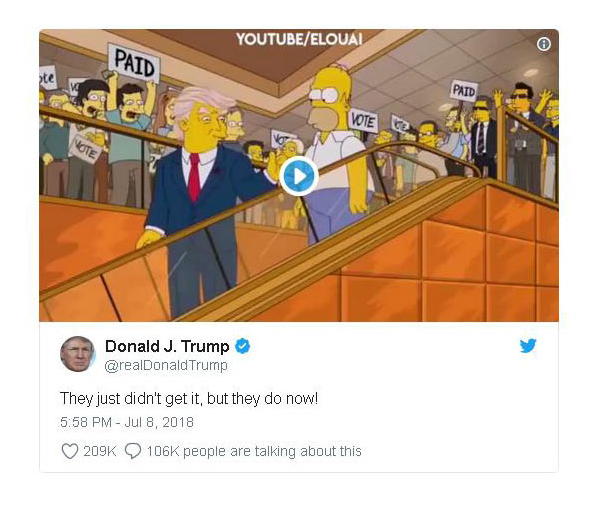
One of the funniest damn tweets in the history of twitter!!
Oh, it continues…. When in the course of corrupt events it becomes necessary for one president to confront the political bands which have connected politicians to each other; and to assume among the powers of the earth, the separate and equal station to which national laws and common sense entitles them, a decent respect to the intellect of voters requires that he should declare the cause which impels him to the confrontation:
President Trump heads to Europe on Tuesday for a series of meetings in several EU nations. On Wednesday and Thursday (11th/12th) the NATO summit. On Thursday and Friday (12th/13th) a U.K. Visit. Saturday and Sunday (14th/15th) a visit to Scotland; and Monday the 16th a summit with Russia’s Vladimir Putin in Helsinki Finland.
The EU and U.S. media are one-upping themselves every few hours with apoplectic proclamations about horrible Trump and the high-minded need to save the angelic NATO mission of unbridled altruism; a liberally canonized Saint Merkel of Deutschland; as well as Londonistan’s Queen Elizabeth and Prime Minister Theresa May, from the horrors of a swaggering U.S. vulgarian… Cue the audio visual:
.
Seriously, after a while all of these faux-intellectuals begin to sound like Charlie Brown’s teacher. “The louder they spoke of their honor, the faster we counted the spoons“…
One of the strongest ASEAN geopolitical alliances exists between the U.S. and Japan. President Trump and Prime Minister Shinzo Abe are not only good friends, but also work well together toward regional goals for a denuclearized Korean peninsula.
Additionally, the U.S-Japan alliance is bolstered by a respectful economic partnership; and the appearance of Secretary Pompeo arriving in Japan to brief Prime Minister Abe on his discussions with the DPRK also highlights the importance of the relationship.
On Tuesday June 12th, 2018, South Carolina MAGA congressional candidate Katie Arrington defeated incumbent Mark Sanford. On Friday night June 22nd, Mrs Arrington survived a deadly head-on collision in her vehicle; sustaining serious injuries and requiring multiple surgeries. On July 1st, Katie Arrington sent thanks and prayers from her hospital recovery room.
Incredibly, yesterday candidate Katie Arrington held a news conference in Charleston, her first public appearance since she was critically injured in the auto accident. She was discharged from the hospital following brief remarks to the media, and will continue her recovery at home. Many prayers answered.
White House Office of Trade and Manufacturing Policy Director Peter Navarro appeared on Fox Business last night to outline the U.S. position in the ongoing trade reset against communist China. Almost all of the financial media and economic punditry are intentionally obfuscating the underlying nature of China’s economic model.
China is a communist central government controlled economic system. Free-market principles do not apply when dealing with China; therefore trade strategies based on ‘free markets’ cannot succeed against the centralized planning of a communist regime.
Secretary of State Mike Pompeo visited North Korea amid the backdrop of the U.S. -vs- China trade confrontation. The geopolitical economic issues form the structural disconnect between the ongoing U.S. negotiations and the responses from China through their proxy province in North Korea.
Secretary Pompeo debriefs the media shortly before departing the DPRK; and expresses a generally positive disposition about the ongoing talks:
.
However, unnamed officials, likely elements within the central North Korean government who are control agents for Beijing, send a more confrontational message at the conclusion of the meetings:
(AP) North Korea says high-level talks with a U.S. delegation led by Secretary of State Mike Pompeo were “regrettable” and has accused Washington of trying to unilaterally pressure the country into abandoning its nukes.
The statement by an unnamed North Korean Foreign Ministry spokesman on Saturday came hours after Pompeo concluded two days of talks with North Korean officials led by Kim Yong Chol.
The statement says that the United States betrayed the spirit of last month’s summit between President Donald Trump and North Korean leader Kim Jong Un by making unilateral demands on “CVID,” or the complete, verifiable and irreversible denuclearization of North Korea.
It says the outcome of the follow-up talks was “very concerning” because it has led to a “dangerous phase that might rattle our willingness for denuclearization that had been firm.” (AP Link 9:55pm)
How do these different takeaways reconcile?
Keep in mind that Secretary Pompeo was not permitted to meet with Kim Jong-un. If our ongoing thesis is accurate it is likely Red Dragon (Chairman Xi) is positioning the DPRK for maximum trade and economic leverage. It would be against Chinese Chairman Xi Jinping’s interests for Pompeo and Kim Jong-un to have a public display of agreement.
Until there is an empirical or factual reason to counter what seems like an obvious geopolitical strategy, we should consider all events through the prism that the primary leadership within the DPRK, the officials controlling Kim, are under the control of China.
The trade confrontation is China’s biggest geopolitical risk. The primary weapon China holds toward demanding terms from the U.S. would be their ability to change the dynamic in North Korea at any given moment. From this frame-of-reference things begin to make more sense.
On the surface it appears the U.S. is negotiating terms for a denuclearized North Korea; however, under the surface the bigger issue is the ongoing economic confrontation between the U.S. and China. The DPRK is Red Dragon leverage.
[…] Consider that Chairman Kim was/is likely put into power not as a linear out-cropping of his familial relationship, but more as a strategy of ongoing Chinese duplicity. Kim Jong-un was seen as easier to control. Consider the possibility that all of the DPRK officials who carry out the objectives of the ruling North Korean government are factually operating according to the dictates of the hidden Chinese authority.
Within this dynamic Chairman Kim received the scorn of the international community; but was -in reality- merely a figurehead, a false panda face – hiding the true authority behind all of the DPRK policy, and a designed strategy constructed by China.
Consider that by confronting the economic interests of China, President Trump fractured the decades-long ruse, and is now positioned to expose the nature of the Chinese ruling authority within North Korea. This becomes a stunning paradigm shift; a reality that few could possibly fathom, unless you consider the cunning of Beijing.
Under this scenario, it is adverse to the interest of China for a united, open and democratic Korean peninsula where the North and South are together again. It would be particularly adverse to Xi’s interests if the U.S., Japan and a united Korea formed any substantive international alliance.
The best play for China would be to control the outcomes of any unification and position China as the control agent for any united Korea. This would be critically important if, as I am now increasingly confident, North Korea was/is actually a proxy province of China and has been for decades under the complete -albeit hidden- rule of the Chinese authority.
Under this scenario, Chairman Xi has to play a very careful game of geopolitical cunning; and if at any moment he sees Chairman Kim accepting the rescue of President Trump, Xi will likely move to eliminate Kim and defend his interests quickly.
Imagine the internal stress upon the young Kim Jong-un who has been forced to ride this dragon for almost a decade, and knows his government is not actually his government but rather a governing body with all officials reporting to Beijing.
Imagine you are the next-door-neighbor to an abused child who lives inside the palace of the abuser. The abuse has been psychological and manipulative upon this child for decades. How do you rescue him? Additionally, how do you rescue him when the ultimate abuser is the king of all communities, governments, political and legal systems in/around the palace?… and only you know the nature of the dynamic…. (link)
If our overall operating thesis is correct, these are very dangerous times. Communist China will not give up on a decades-long grand design for economic conquest. President Trump is confronting that Chinese strategy head-on.
The DPRK officials under the influence of Beijing will use their North Korean position to assist the ruling members of Chairman Xi Jinping.
These are tenuous times, and unfortunately the vast majority of the U.S. media are cheering for President Trump to fail.
I have created this site to help people have fun in the kitchen. I write about enjoying life both in and out of my kitchen. Life is short! Make the most of it and enjoy!
This is a library of News Events not reported by the Main Stream Media documenting & connecting the dots on How the Obama Marxist Liberal agenda is destroying America




 Centinel2012