
April 23, 2020
Earlier today New York Governor Andrew Cuomo released initial data from 3,000 people tested for COVID-19 antibodies throughout the state. Interestingly, though not surprisingly, the field tests were conducted on the general public who were visiting retail supermarkets and box stores (WalMart, Target, Costco, etc.). The resulting data falls directly in line with previous CTH analysis of human interface.
The preliminary New York results show a state-wide infection rate of 13.9 percent within the sample. Which would extend to 2.7 million people state-wide. With that infection rate, the mortality rate from the infection would drop to 0.5 percent.
The samples show an infection rate in New York City is 21.2 percent. [WATCH]
(VIA CBS) – New York’s first survey of coronavirus antibodies shows that 13.9% of those tested in the state had coronavirus antibodies in their system, meaning they have contracted and recovered from the virus, New York Governor Andrew Cuomo said Thursday. That suggests that 2.7 million people have been infected statewide.
The survey was taken from a sample size of about 3,000 people found outside their homes, shopping at essential businesses, such as grocery stores, which remain open. Results show antibodies in 12% of women and 15.9% of men, but a disproportionate rate of antibodies in black and Latino New Yorkers.(more)


(Reuters) “If the infection rate is 13.9 percent, then it changes the theories of what the death rate is if you get infected,” Cuomo told a daily briefing.
The survey targeted people who were out shopping, but not working, meaning they were not essential workers like grocery clerks or bus drivers but were more likely to test positive for antibodies than someone isolated at home, Cuomo said. (read more)
The direct result of this survey is that 14 percent of people in New York who interacted with retail supermarket cashiers were previously infected with the Coronavirus; or carried the coronavirus antibodies…
REPEATING – There are few high-traffic businesses more densely populated than grocery stores. In fact, within the U.S. economy retail supermarkets have the highest foot traffic of any business sector in the entire economy; that’s just an empirical fact…. and the coronavirus impact increased that foot traffic by an average of 40 percent. Now, stop and think about this logically & apply a large dose of common sense. Think about human-to-human interface.

♦First, with approximately 90 percent of the total U.S. population penetrating through grocery outlets; and with 100% of that massive number of consumers going through checkout lanes; if the COVID-19 viral strain was as significant as claimed by the worst-case data, then supermarket cashiers would have been the highest exposed profession of U.S. workers in the entire nation. There wouldn’t even be a close second place.
Considering that metric; and considering the overall population penetration & density within the business operation; there has not been an employee-based business disruption due to the coronavirus. Put another way: the coronavirus has not stopped the function of the highest human interface occupation in the entire U.S. economy.
♦Secondly, think about the businesses that are closed; perhaps think about your job that may have been shut down…. now frame your risk based on the supermarket example as highest human interface and highest population penetration in any business field.
If the #1 at risk industry has operated, essentially without disruption and with almost zero substantive mitigation, while carrying the largest population exposure rate, then all other less-exposed business operations would have significantly less operational risk.
Why would anyone be concerned about opening their business?
If you take the factual outcome of the retail food industry as a measure, it would follow that other than a few proximity businesses which may need prudent modifications or remain temporarily closed (ex. modified airplane seating, concerts, stadiums or capacity seating venues etc), then all other businesses should immediately resume operations.
No other business segment within the economy is as exposed to the population as the retail food business; and yet supermarkets operated without issue.
So why shouldn’t all businesses immediately get back to work?
Perhaps a few initial modifications might be needed; but not much, and not for long.
Think about it….


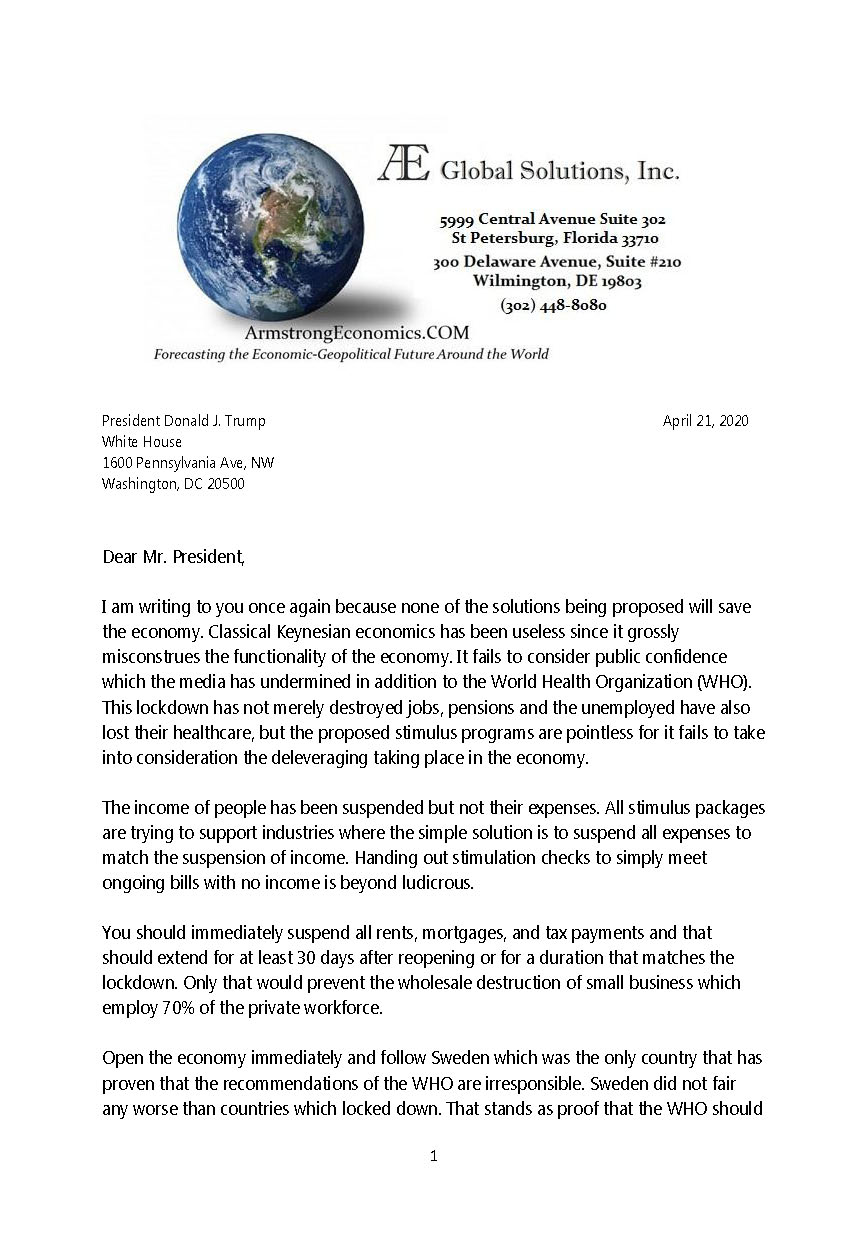
 Re-posted from the Conservative Tree House By
  “On this International Mother Earth Day,” United Nations Secretary General Antonio Guterres proclaimed, “all eyes are on the COVID-19 pandemic – the biggest test the world has faced since the Second World War.” He issued this proclamation under the banner “Climate Action” in an attempt to link the devastating health and economic crisis wrought by the coronavirus pandemic to the UN’s radical climate change agenda. “We must act decisively to protect our planet from both the coronavirus and the existential threat of climate disruption. The current crisis is an unprecedented wake-up call.”
 By labeling many private sector workers as “non-essential” during the COVID-19 crisis, government again needlessly insults regular Americans.
 When I think of the vaunted World Health Organization, under the guidance of the onetime big tooth on the crushing cog of the cruel Marxist dictatorship which used to run Ethiopia, erstwhile kidnapper and that great and good healer, good old Doctor Tedros Adhanom-Ghebreyesus PhD, I am reminded of the old vaudeville act of
 In the end it won’t be “mitigation” and computer models that will save humanity from the deadly pandemic known as the Coronavirus—but the amount of time it took to release homebound citizens from stay-at-home government dictates.


 Centinel2012