Earlier today Secretary of State Mike Pompeo and Secretary of Treasury Steven Mnuchin held a press conference in the White House to announce new sanctions against Iran. The secretaries also took questions from the press pool. [Video and Transcript Below]
.
[Transcript] – SECRETARY MNUCHIN: Good morning, everybody. Thank you for being here today. I’d just like to make a brief comment before we talk about Iran sanctions. I’m sure everybody saw that the DOW hit 29,000. The President’s economic plans are clearly working. We’re looking forward to the China signing, USMCA, and a very strong economy this year.
As previously announced by the President, we are announcing additional sanctions against the Iranian regime as a result of the attack on U.S. and allied troops.
First, the President is issuing an executive order authorizing the imposition of additional sanctions against any individual owning, operating, trading with, or assisting sectors of the Iranian economy, including construction, manufacturing, textiles, and mining. And let me be clear: These will be both primary and secondary sanctions. The EO also allows us to designate other sectors in the future as Secretary Pompeo and me think is appropriate.
Second, we are announcing 17 specific sanctions against Iran’s largest steel and iron manufacturers, three Seychelles-based entities, and a vessel involved in the transfer of products. As a result of these actions, we will cut off billions of dollars of support to the Iranian regime, and we will continue our enforcement of other entities.
Third, we are taking action against eight senior Iranian officials who advanced the regime’s destabilizing activity and were involved in Tuesday’s ballistic missile strike. Secretary Pompeo will comment more on this.
Today’s sanctions are part of our commitment to stop the Iranian regime’s global terrorist activities. The President has been very clear: We will continue to apply economic sanctions until Iran stops its terrorist activities and commit that it will never have nuclear weapons.
I’ll now turn it over to Secretary Pompeo.
SECRETARY POMPEO: Thank you, Steven. Good morning, everyone.
Today, President Trump is delivering on the pledge that he made the day after Iran attacked American forces in Iraq: There will be a series of new sanctions.
Secretary Mnuchin just mentioned eight senior Iranian officials that are responsible for the regime’s violence, both at home and abroad. We’re striking at the heart of the Islamic Republic’s inner security apparatus. These sanctions targets include the Secretary of the Supreme National Council and the Commander of the Basij Forces; that’s the regime’s brute squad, which has, in the last few months, killed approximately 1,500 Iranians who were simply demanding freedom.
Our action targets other senior leaders close to the Ayatollah. They’ve carried out his terrorist plots in destabilizing campaigns across the Middle East and around the world. They’ve employed soldiers across the region’s battlefields. They’ve trained militias in Iraq, Syria, and elsewhere in the arts of domestic repression.
Today, they’re accountable for murder and mayhem. The goal of our campaign is to deny the regime the resources to conduct its destructive foreign policy. We want Iran to simply behave like a normal nation. We believe the sanctions that we impose today further that strategic objective.
Our campaign is composed of diplomatic, economic components that have deprived the regime of billions in revenue the regime has used to fuel death and destruction across the Middle East and all across the world.
Sadly, the previous administration had opened up revenue streams for Iran. But under our administration, oil revenues are down by 80 percent and Iran cannot access roughly 90 percent of its foreign currency reserves. And not even two weeks ago, President Rouhani of Iran admitted that our sanctions have cost Iran over $200 billion in lost foreign income and investment. As long as Iran’s outlaw ways continue, we will continue to impose sanctions.
Finally, I want to reiterate President Trump’s concern for Americans and dual national citizens detained inside of Iran. Iran knows these individuals have committed no crime. They know the charges against them are fake. And we will do all that we can to get each of them returned home safely to their families.
With that, we’ll take just a few questions.
Yes, ma’am.
Q Mr. Secretary, the administration said this strike was based on an imminent threat, but this morning you said we didn’t know precisely when and we didn’t know precisely where. That’s not the definition of “imminent.” The President has also suggested that there was some sort of attack being planned against an embassy, perhaps several embassies.
Can you clarify? Did you have specific information about an imminent threat, and did it have anything to do with our embassies?
SECRETARY POMPEO: We had specific information on an imminent threat, and those threats included attacks on U.S. embassies. Period. Full stop.
Q So you were mistaken when you said you didn’t know precisely when and you didn’t know precisely where?
SECRETARY POMPEO: Nope. Completely true. Those are completely consistent thoughts. I don’t know exactly which minute. We don’t know exactly which day it would’ve been executed. But it was very clear: Qasem Soleimani himself was plotting a broad, large-scale attack against American interests. And those attacks were imminent.
Q Against an embassy?
SECRETARY POMPEO: Against American facilities, including American embassies, military bases. American facilities throughout the region.
Q Mr. Secretary —
SECRETARY POMPEO: Yes, sir. John?
Q Mr. Secretary, in the initial hours after the missile attacks on Al-Asad, in Erbil, it was believed that Iran may have taken steps to avoid U.S. casualties. But then, the Chairman of the Joint Chiefs, Mark Milley, came out, the Secretary of Defense came out, other officials came out to say, “No, these missiles were intended to kill Americans.”
If it was Iran’s intent to kill Americans, does that not deserve some sort of response? I mean, if somebody takes a shot at you and they don’t hit you simply because you duck, does that mean that they weren’t trying to kill you?
SECRETARY POMPEO: So, look, I’ll defer to the Department of Defense on the details, but there’s no doubt in my judgment, as I observed the Iranian activity in the region that night, they had the full intention of carrying — killing U.S. forces, whether that was our military folks or diplomatic folks who were in the region. And I am confident that the response the President has taken is appropriate.
The President said we don’t want war; we want Iran to behave like a normal nation. The reason that the Secretary of Treasury and I are here this morning is to continue this campaign — our strategic effort to get Iran to behave in a way that doesn’t continue their 40-year-long effort to terrorize the world.
Q Mr. Secretary and Secretary Pompeo, do you believe that the Iranians shot down the Ukrainian International Airways [sic] plane? And if the Iranians shot that plane down, will there be consequences?
SECRETARY POMPEO: We do believe that it’s likely that that plane was shot down by an Iranian missile. We’re going to let the investigation play out before we make a final determination. It’s important that we get to the bottom of it.
I’ve been on the phone — I was on the phone with President Zelensky. Just before I came here, I was on the phone with my Canadian counterpart. They’re working to get their resources on the ground to conduct that thorough investigation. We’ll learn more about what happened to that aircraft. And when we get the results of that investigation, I am confident we and the world will take appropriate actions in response.
SECRETARY MNUCHIN: And let me just —
Q Will you allow the NTSB to work with the Iranians?
SECRETARY MNUCHIN: Yeah, I was just going to comment on that. The Treasury will issue waivers for anybody, whether it’s Americans or others, that can help facilitate the investigation.
Q The last time that you both joined us in this room, it was back in September and you were announcing additional sanctions, including on the Quds Force. And, Secretary Mnuchin, at that point you said, “I think we’ve done more sanctions on Iran than anybody, and it’s absolutely working.”
Since then, we’ve seen an escalation in violence from Iran: shooting down the drone, attacking the embassy, a contractor who was killed, U.S. troops that were wounded. How are sanctions keeping the United States — economic sanctions keeping the United States and United States’ interests more secure?
SECRETARY MNUCHIN: I think we have 100 percent confidence, and we are consistent in our view that the economic sanctions are working; that if we didn’t have these sanctions in place, literally Iran would have tens of billions of dollars. They would be using that for terrorist activities throughout the region and to enable them to do more bad things. And there’s no question, by cutting off the economics to the region, we are having an impact.
And as the President has said, the fact that the Obama administration turned over $150 billion to the regime, we think we wouldn’t be in this situation had that not been the case.
SECRETARY POMPEO: May I just add, it’s important to keep in mind what’s taking place in Iran today. This country has never been in the place that it is today. Big, challenging problems. Their budget — they’re going to fail by tens of billions of dollars of achieving their revenue for this year. They’ve got real challenges, and figuring out how to make difficult decisions: Do you underwrite Hezbollah? Do you pick Hamas? Do you underwrite the Shia militias in Iraq? Or do you allow your people to have the opportunity to live the life they want and grow your economy? Those are the difficult choices that the regime is facing.
And you can see the protests — protests that we expect will continue — that we’ll demand from the Iranian regime that they begin to treat the Iranian people in the way that they so richly deserve. And this administration will continue to support those efforts as well.
SECRETARY MNUCHIN: In the back.
Q Thank you, Mr. Secretary. You mentioned secondary sanctions here. What is your message to our European allies who continue to do business with the Iranians? And then, specifically, if you can, will this impact the INSTEX barter mechanism, which was set up by a number of European countries to avoid U.S. sanctions and continue to do business without using the U.S. dollar?
SECRETARY MNUCHIN: Sure. Thank you. I think those are both very important questions.
So let me first comment on INSTEX. I don’t believe there’s been any INSTEX transactions. As we’ve made clear, we are working on a Swiss channel that we have approved for humanitarian transactions. We’ll continue to allow humanitarian transactions. We’ve warned INSTEX and others that they will most likely be subject to secondary sanctions, depending on how they use that. So that’s absolutely the case.
As it relates to the Europeans, both the Secretary and I have spoken to our counterparts in Europe several times over the last few days. We’ve emphasized the impact and the issue of — Iran has announced that they are no longer part of the JCPOA. And we’ve had very direct conversations with our counterparts about that.
Q Secretary Pompeo, what is your definition of “imminent”?
SECRETARY POMPEO: This was going to happen, and American lives were at risk. And we would have been culpably negligent. As the Chairman of the Joint Chiefs of Staff said, we would have been culpably negligent had we not recommended to the President that he take this action at Qasem Soleimani. He made the right call, and America is safer as a result of that.
Q But then why has there been these — Secretary Pompeo, why have there been these shifting definitions —
(Cross-talk.)
Q Thank you. Thank you, sir.
SECRETARY MNUCHIN: Go — go ahead. We’re going to —
Q — shifting explanations of the intelligence?
SECRETARY MNUCHIN: We’re going to try to do one question for everybody, just —
Q Were they trying to hit Iranian troops — was Iran trying to hit our troops or not?
SECRETARY MNUCHIN: — so that as many people can get questions. So I don’t mean to cut you off, but we’re trying to — go ahead.
Q I mean, let me defer to my colleague — but, sir, six months ago, Secretary Pompeo, the President said that U.S. intelligence agencies had been running amok. He spent most of the past three years he’s been in office denigrating and attacking the intelligence community and disputing findings, whether it’s on Russia or North Korea, or really any area that contradicts things that he has said publicly.
Why then should Americans suddenly believe your assertions that you had good intelligence on this when the head of the Executive Branch has been casting aspersions on the intelligence community for most of his time in office?
SECRETARY POMPEO: Look, I served as the CIA Director for the first year and a half of this administration. I watched the President rely on the work that the intelligence community did for the entire time I served as the head of the Central Intelligence Agency. I watched him rely on the capable men and women who are delivering exquisite information to the Executive Branch. I watched the President have confidence in that information.
We all challenge their work. We have to make sure we get it right. The intelligence community is not flawless. We — we get it wrong. In this case, the intelligence community got it fundamentally right. Even the reflections we’ve seen after the after-effect, after the strike that Qasem Soleimani took, has demonstrated that we were quite right. There was an imminent attack. There was active plotting. And we took an action that we thought was likely to create less risk for the American people, and I’m confident that we did that.
SECRETARY MNUCHIN: Go ahead, in the back. In the back.
Q Thank you. This question is for Secretary Pompeo. There are reports that the Iraqi Prime Minister has asked you to start negotiating some withdrawal of U.S. troops from Iraq immediately. Is that the case? Can you comment on that?
SECRETARY POMPEO: Yeah, he didn’t quite characterize the conversation correctly. But to the larger, more important point, we are happy to continue the conversation with the Iraqis about what the right structure is. Our mission set there is very clear: We’ve been there to perform a training mission to help the Iraqi security forces be successful and to continue the campaign against ISIS, the counter-Daesh campaign.
We’re going to continue that mission. But as the — as times change and we get to a place where we can deliver upon what I believe and the President believes is our right structure, with fewer resources dedicated to that mission, we will do so.
We also have today a NATO team that’s here at the State Department working to develop a plan, which will get burden-sharing right in the region, as well, so that we can continue the important missions to protect and defend and keep the American people safe while reducing our cost, our resources, and our burden, and the risk to our soldiers and sailors who are in the region.
Q Secretary Pompeo, if I can — here, today, at the podium, you said that the imminent threat was a threat to U.S. embassies. You didn’t know precisely when or where. Last night, the President said it was a threat to embassies, including to our Baghdad embassy.
Why can you say that here, and the President could say it at a rally in Toledo, but no one said it to lawmakers behind closed doors in a classified setting, as multiple senators have since said?
SECRETARY POMPEO: We did.
Q You said —
SECRETARY POMPEO: Yes.
Q So the senators are lying when they say that (inaudible) imminent threat was a threat?
SECRETARY POMPEO: We told them about the imminent threat. All of the intelligence that we’ve briefed, that you’ve heard today, I assure you, in an unclassified setting, we provide in the classified setting as well.
Q To be clear, you told them that embassies were the — were to be targeted? That was the imminent threat?
SECRETARY POMPEO: I’m not going to talk about the details of what we shared in a classified setting. But make no mistake about it: Those leaders, those members of Congress who want to go access this same intelligence, can see that very same intelligence that will reflect what I described to you and what the President said last night, as well.
Q Is that threat now gone with Soleimani gone?
SECRETARY POMPEO: Threats are never gone. Uh, right? It’s always — a lot of danger in the world.
Q The next general will pick it up?
SECRETARY POMPEO: Always — always a lot of danger in the world, throughout the region. Nobody believed that a single mission, in any respect, took down the risk of terror — terror from al Qaeda, terror from ISIS, terror from al-Shabaab. No — no one believes that. The President doesn’t.
Look at the list though; look at the achievements in the administration. We took away the caliphate in its entirety. We took down Hamza bin Laden. We took down al-Baghdadi. We took down Qasem Soleimani. This is a list that has reduced the capacity for terrorists around the world to perform the functions that put American men and women and the homeland at risk. We’re very proud of what we accomplished. We’re going to stay the course.
SECRETARY MNUCHIN: Why don’t we take one more over there? Yes. Thank you.
Q I’m curious —
SECRETARY MNUCHIN: No, no. Next to you. Right there. Yes.
Q Me?
SECRETARY MNUCHIN: Yes.
Q Thank you. Secretary Mnuchin, this is a question for you too about the China trade deal. So the Chinese side is going to be here next Wednesday to sign the phase one part of that deal. But China is also a big importer of Iranian oil and Iranian minerals, and that’s a big part of their economy as well. So how do you balance the two? And are you concerned about the Iran issue coming up in either the signing of the phase one deal or the negotiation for the phase two deal?
SECRTEARY MNUCHIN: Well, let me just comment: I had no idea you’d ask that question, but that’s a good last question to end on.
So let me first say that we are looking forward to the Chinese delegation coming next week. Phase one is very significant. It includes very significant components of changes to technology issues, intellectual property issues, and $50 billion of purchases for our farmers.
I would comment: I don’t agree with your comment that China is a big buyer of oil. The China state companies are not buying oil from Iran. And I would just say we are having conversations with China, as well with any other counterparty on sanctions evasion.
UPDATE: TRUMP REASSURES AMERICA HE IS NOT STARTING WAR WITH IRAN AND DE-ESCALATES AS IRAN STANDS DOWN. TRUMP SIGNALS FURTHER SANCTIONS AND NATO ENGAGEMENT.
It’s difficult to draw a cartoon while events are rapidly changing, so this cartoon came to mind. As I penned this I learned a jet crashed outside of Tehran, killing a great many people.
Was it accidentally shot down or targeted intentionally by Iran?
UPDATE: Reports indicate Iranian officials informed the Iraqi government before the attack that they were launching missiles at US bases, and the Iraqis informed US officials to prepare for attack. Conclusion is this attack was meant for Tehran to save face.
Even through Iran is ruled by religious lunatics, they must have some sanity left, because they made it clear they do not a full-blown war with the United States. Let’s hope the president shows restraint and avoids a full war with the Persian nation. We would defeat Iran, but at the cost of many lives on both sides.
It’s time to stop the tit-for-tat game and get out of the Middle East entirely. Iraq wants us to go. We supposedly brought Democracy there, so let’s respect their vote and get out. That probably won’t happen. The neocon deep state swamp, the globalists, Saudi Arabia, Israel, and our military industrial complex want Iran taken out. Trump has done a good job of avoiding war with Iran and I’ve praised him for it. Iran is foolishly playing into their hands by escalating the situation. Did they overreach to save face?
We don’t need another never-ending war. Trump promised to get us out of the useless wars in the Middle East and Afghanistan. It’s time for him to deliver on his promise.
Tonight President Trump heads to Toledo, OH for a massive Keep America Great rally at the Huntington Center. President Trump is expected to speak at 7:00pm ET.
Following remarks during the National Environmental Policy Act event at the White House, President Trump held a press conference with media: [Transcript Below]
[Transcript] THE PRESIDENT – We’ll take a few questions. Please.
Q Mr. President, you mentioned the Chinese trade deal that you’re working on; you’re going to be signing, next week, phase one. Can you give us a sense of phase two —
THE PRESIDENT: Yeah.
Q — what you hope to accomplish there? And will you be travelling to Beijing for that?
THE PRESIDENT: Well, phase one is a big, big number. It’s a big percentage of the deal. Some would say half, some would say a little less, or a little more than half. But it’s a tremendous percentage. It’s pretty much all for the farmers — also, bankers. We also have regulations for a lot of different — a lot of things are covered that people are going to be very surprised to see, but it’s a big chunk of it.
And we’ll start right away negotiating phase two. It’ll take a little time. I think I might want to wait to finish it until after the election, because by doing that I think we can actually make a little bit better deal — maybe a lot better deal.
But phase one was — is a phenomenal deal. Could be up to $50 billion in farm product. So that’s something that — the most they ever did was $16 billion. So they go from $16 billion to up to $50 billion. So that’s numerous times more than they were buying in the past. It’s going to have a huge impact. And I see farm prices are going way up. I see corn is just — had some big increases over the last little while. Cattle has been doing really well. And the farmers liked me anyway. That’s what I like about the farmers. (Laughter.)
But you know what I did do — and you know this better than anybody — I got — I was able — they were targeted by China. You know — look, China is negotiating. I don’t blame them. But they were targeted. They say, “You know, the farmers like Trump so we’ll target the farmers.” And they did. And the first year was $12 billion, and I took $12 billion and I asked Sonny Perdue, Secretary of Agriculture, “What do you think, Sonny?” He said, “It’s $12 billion.” And I think that would’ve caused tremendous consternation. And they were hit for $12 billion, and I took $12 billion out of the tariffs.
We had tens of billions of dollars left over; I gave it to the farmers. The next year it was $16 billion. I took $16 billion out of the tariffs; I gave it to the farmers. So the farmers did pretty well, and now they’re doing great. And the prices are going up very substantially, and China is kicking in. China has already started to buy. Japan — the deal is done. They have been buying. It’s a $40 billion deal.
But the big question I have is whether or not the farmers will be able to supply that much. Because it’s much more than — it’s the biggest contract ever signed. So I think it’ll be great for the farmers, but also great for regulatory, great for banks. You know that. Great for finance companies. Really, a lot.
Then we’re going to covering the opening of China and various other things in phase two.
Q And on impeachment, sir, would you support a deal for witnesses if that included testimony from Adam Schiff and Hunter Biden?
THE PRESIDENT: Well, I’m going to leave it to the Senate, but I’d like to hear the whistleblower. I’d like to hear Shifty Schiff. I’d like to hear Hunter Biden and Joe Biden. You know. How does Hunter Biden, with no experience whatsoever — would anybody up — Sean, would you like the Hunter Biden job? He has no experience, making no money, and then all of a sudden, see, he’s making millions and millions of dollars. You’d take that. Would you leave the union for that? I think so.
MR. MCGARVEY: Uh, I’m not sure, Mr. President. (Laughter.)
THE PRESIDENT: I know so, but I’m not going to tell.
No, no I’d like to hear from Hunter Biden. I’d like to hear from — he’s a corrupt politician, Adam Schiff. He’s corrupt. He gave a sentence. You know, he never knew I was going to release the transcript. He gave a sentence that he made up. He made it up. And it was not the — it was not what was said in the conversation. That’s why I released the transcript; got approval from Ukraine. We released the exact transcript, and it turned out to be totally different.
These are corrupt politicians. The whole thing is a hoax. But I would like to hear Hunter Biden, Joe Biden, Adam “Shifty” Schiff, and some others — the informer that never showed up. You know, once I released the transcript, you know what happened. The informer — he never showed up.
And the second whistleblower — Jon, whatever happened to the second whistleblower? The second whistleblower disappeared. There probably was none or maybe we know who the second whistleblower was. Maybe we do. But he never showed up. All of a sudden, they don’t talk, because they were really unexpectedly met with the actual conversation, the exact conversation.
So yeah, if we do that, I would like to have those people, plus others, testify. Because it’s the greatest hoax ever perpetrated on the United States government. This has gone on since the day I came down the escalator. This isn’t just here; this isn’t just the Ukraine hoax. This is the witch hunt. This is the whole thing with Russia that turned out to be a total fabricated plot. The ones who are guilty are the Democrats, the DNC, and all of the dirty cops that were involved that we caught.
Yeah.
Q Mr. President, I’m sure you saw Mike Lee’s comments. Did your national security team really say that it would be wrong for Congress to debate military action on Iran?
THE PRESIDENT: So here’s what happened on that: I had calls from numerous senators and numerous congressmen and women, saying it was the greatest presentation they’ve ever had.
Mike and Rand Paul disagreed because they want information that, honestly, I think is very hard to get. It’s okay if the military wants to give it, but they didn’t want to give it. And it really had to do with sources and information that we had that really should remain at a very high level.
Could we individually maybe give one or two of them some information? Possibly, if we can do that. I get along great with Mike Lee. I’ve never seen him like that. But other people have called and they’ve said it was the best presentation they’ve ever seen.
And let me tell you what was the best, forget about presentation: the result. We killed a man who killed many, many Americans and many, many people — thousands and thousands of people.
And when I go over to Walter Reed and I meet these young, incredible folks — mostly, it just seems mostly men, but also women — where their legs are gone, their arms are gone. In some cases, both the legs and the arms are gone, and the face and the body is badly damaged. And frankly, five years ago, they couldn’t have lived. And today, they can live because of the wonders of medicine and the wonders of Walter Reed and the people that, over there — what — the job they do, the medical doctors.
But I will say this: We caught a total monster, and we took him out. And that should have happened a long time ago. We did it because they were looking to blow up our embassy. We also did it for other reasons that were very obvious. Somebody died — one of our military people died. People were badly wounded just a week before. And we did it. And we had a shot at him, and I took it, and that shot was pinpoint accurate. And that was the end of a monster.
Then — and that was — really, that was the second attack. It was not — we didn’t start it. They started it by killing one of our people and wounding badly other of our people. So that you call “retribution.”
Ukraine — if you look at what happened with Ukraine, that’s a hoax. Well, this is a hoax, too. Iran went in, and they hit us with missiles. Shouldn’t have done that, but they hit us. Fortunately for them, nobody was hurt, nobody was killed. Nothing happened. They landed — and very little damage even, to the base. They landed.
But we had a chance to take out a monster; we took him out. And it should have been done a long time ago.
Q But would you go to Congress to take further military action against Iran? Would you seek congressional approval?
THE PRESIDENT: It would all depend on the circumstance. I don’t have to, and you shouldn’t have to be able — because you have to make split-second decisions sometimes. Sometimes, you have to move very, very quickly, Jon. But in certain cases, I wouldn’t even mind doing it.
What — you know what I — what bothers me? When I see a Nancy Pelosi trying to defend this monster from Iran, who has killed so many people, who has so badly — I mean, so many people are walking around now without legs and without arms. Because he was the big roadside bomb guy. He was the one who would send them to Afghanistan. He would send him to Iraq. He was big. That was his favorite thing. He thought it was wonderful. He doesn’t think it’s wonderful anymore.
When Nancy Pelosi and the Democrats want to defend him, I think that’s a very bad thing for this country. I think that’s a big losing argument, politically, too. Yeah.
Q So anyway, outside the JCPOA and also with total sanctions implemented, what’s left if Iran —
THE PRESIDENT: Well, just so you understand, on JCPOA: It’s close to expiring. In other words, if I didn’t terminate it, it expires in a very short period of time.
One of the problems, of which there was many — $150 billion, $1.8 billion in cash — all of that money — and then that money was used for terror. Because if you look at Iran, it wasn’t so bad until they got all that money. They used that money for terror. That’s when it became really bad. You just take a look. I mean, it really got bad when they had $150 billion, $1.8 billion in cash.
The JP- — the agreement — I always call it the Iran nuclear deal that didn’t work. The Iran deal, it was just something that it was — is no — is no good for our country. It expires in a short time. That means they would be on their path to nuclear weapons. And for me, it’s about nuclear weapons, more than anything else. Iran cannot have a nuclear weapon. Iran will never have a nuclear weapon. They understand that. We have told them very strongly.
Iran now is not wealthy like it was when President Obama handed them $150 billion. They’re a much different country. We’ll see whether or not they want to negotiate.
Maybe they want to wait until after the election and negotiate with a weak Democrat — somebody like a Biden, or a Pocahontas, or [DEL: Buttitieg :DEL] [Buttigieg] or one of these characters. Okay? Maybe they want to wait. But I think they’re probably well off doing it now. Because if you look at the polls, and if look at what’s going on, we’re doing very well.
They’re losing a tremendous amount. They’re getting hurt very badly by the sanctions. It all can end very quickly. But as to whether or not they want, that’s up to them; not up to me. It’s totally up to them.
They can straighten out their country. Iran, right now, is a mess. They can straighten out the economics of their country very, very quickly. Let’s see whether or not they negotiate.
Q (Inaudible) these sanctions — when should we expect to see sanctions on Iran following the attack?
THE PRESIDENT: Immediately.
Q Tomorrow? This week?
THE PRESIDENT: It’s already been done. Yeah. We’ve — we’ve increased them. They were very severe, but now it’s increased substantially. I just approved it a little while ago with Treasury.
Q And who will they be against and what sort of sanctions —
THE PRESIDENT: Well, you’ll see. I mean, we’ll put out a minor announcement. It’s actually a major event.
It’s like this. This is, to me, a major event. And so far, I haven’t — had no — I haven’t had — no questions on the fact that we can build a highway in, you know, a small fraction of the time, that we can build all of these beautiful bridges that we want to build but they can’t get approvals. I’ve had no questions on that.
Are you shocked, Sean, when you hear that?
MR. MCGARVEY: No, Mr. President. (Laughter.)
THE PRESIDENT: I mean, honestly, they — they should be having some questions. Okay. Yeah. Jon, go ahead.
Q Mr. President, the plane that went down —
THE PRESIDENT: Yeah.
Q — coming from Iran —
THE PRESIDENT: It’s terrible.
Q — what do you think happened to that plane?
THE PRESIDENT: Well, I have my suspicions.
Q What are those suspicions?
THE PRESIDENT: It was very — I don’t want to say that because other people have those suspicions also.
It’s a tragic thing, when I see that. It’s a tragic thing, because somebody could have made a mistake on the other side. Could have — could have made a mistake. It was flying —
Q The air defense systems?
THE PRESIDENT: It was — it was flying in — not our system, no. It has nothing to do with us. It was flying in a pretty rough neighborhood, and somebody could have made a mistake. Some people say it was mechanical. I personally — I don’t think that’s even a question, personally. So we’ll see what happens.
Q Do you think Iran shot it down by accident?
THE PRESIDENT: I don’t know. I really don’t know. I don’t want to get — that’s up to them. At some point, they’ll release the black box. Ideally, they’d get it to Boeing. But if they gave it to France or if they gave it to some other country, that would be okay, too. I think, you know, ideally, that will be released.
I have a feeling that it’s just some very terrible — something very terrible happened. Very devastating.
Q Mr. President —
THE PRESIDENT: Yeah.
Q The situation in Venezuela has not gone as smoothly as some people would, likely even yourself, have hoped. What are you prepared to do differently —
THE PRESIDENT: Well, I never thought it would go smoothly. Venezuela hasn’t gone smoothly since it became a socialist or worse-than-that country. So I never expected anything to go smoothly.
We’ll see what happens with Venezuela. They’re doing poorly. I mean, there’s a great case — when I say this country will never be a socialist nation, there’s a great case. It was a wealthy country 15 years ago, 20 years ago. That was like, a really wealthy country. And now they don’t have water. They don’t have food. We’re supplying a lot of food. We’re supplying a lot of water.
So, no, it takes a period of time. It’s been — you know, I’ve only been here a relatively short period of time. We’ll see what happens.
Q Are you prepared to do anything else — change the strategy?
THE PRESIDENT: Well, I’m not going to say that. No, I have — we have a good strategy. But we’re taking care of people. We’re helping people. Colombia is helping a lot of people. Some of the nation’s surrounding are helping people.
But we’re — I think we’re doing a good job. They have a system that, right now, is very broken. We’ll see what happens. Stay tuned.
Q Mr. President, you said Iran was trying to blow up the embassy in Baghdad. Can you provide more details on what that plot was?
THE PRESIDENT: No, I think it was obvious. If you look at the protests — and this was the anti-Benghazi. This was — Benghazi was a disaster. They showed up a long time after it took place. They saw burning embers from days before.
I said, “Get out today, immediately.” They were saying, “We think we can have them tomorrow.” I said, “Nope. They got to go right now.” And they were on their way very quickly. And they got there almost — I mean, they got there quickly.
They could have done that with Benghazi too, by the way. Same — same thing. Had they gotten there — had they done what I did, you wouldn’t have had — you wouldn’t know the name “Benghazi.” It would not be a very famous name. Now it’s a very famous name.
This was the anti-Benghazi. We got the Apaches there very quickly. They were doing the flares. People didn’t know what was happening. But if you look at those protesters, they were rough warriors. They weren’t protesters; they were Iranian-backed. Some were from Iraq, but they were Iranian-backed. Absolutely.
And they were looking to do damage. And they were breaking the windows. And, you know, those are very structurally strong windows, as you know, and they were almost through. And had they gotten through, I believe we would have either had a hostage situation, or we would have had a — worse, we would have had a lot of people killed.
Those people were going to do very serious harm. They were soldiers; they were warriors. And we stopped it. We stopped it. That was a totally organized plot. And you know who organized it. That man right now is not around any longer. Okay? And he had more than that particular embassy in mind.
Q Mr. President, do you —
THE PRESIDENT: Please.
Q Do you have a problem John Bolton testifying in the Senate trial?
THE PRESIDENT: Always got along with him. He didn’t get along with some of our people. But that’s really going to be up to the Senate. It’s really — it’s al- —
Q But you wouldn’t stop it?
THE PRESIDENT: It’s always up. I don’t stop it, no. But he would — it would be — no, I — I do have to — I’d have to ask the lawyers because we do have to — to me, for the future, we have to protect presidential privilege. When we start allowing national security advisors to just go up and say whatever they want to say, we can’t do that. So we have to protect presidential privilege for me, but for future Presidents. That’s very important.
I would have no problem, other than we have to protect — we have to be able to protect. People can’t go up and say whatever my thoughts are, whatever your thoughts are about us, countries, views. You don’t want that to be out. So we have to protect presidential privilege. Yeah.
Q So, Mr. President, you said yesterday you want NATO to do more. Could you be a little more — could you provide a little more information —
THE PRESIDENT: I did. I spoke —
Q — on what you wanted (inaudible) —
THE PRESIDENT: Right. I spoke to —
Q Have you gotten any indication from them that they might do more?
THE PRESIDENT: Yeah. I spoke to them yesterday. I spoke to the Secretary General yesterday, and we had a great conversation. He was very — I think he was actually excited by it.
And I actually had a name — “NATO,” right? And then you have “M.E.” — Middle East. You’ll call it “NATOME.” I said, “What a beautiful name.” NATOME. I’m good at names, right? “USMCA.” Like the song, “YMCA.” (Laughter.) Everybody — nobody could remember “USMCA.” I said, “Think of the song, ‘YMCA.’” Now everybody says it. They don’t remember the previous name of the bad deal, okay — commonly known as “NAFTA.”
No, if you add the words — if you add the two words “Middle East” at the end of it. Because that’s a big problem. That’s a big source of problems. And NATOME — doesn’t that work beautifully, Jon? Think of that: NATO plus ME. And he’s not — obviously, he’s not getting it. He’s not smiling. He used to smile. Before Iran, he was smiling. Now, he’s not smiling. So —
Q Mr. President, (inaudible) —
THE PRESIDENT: You know what I’m talking about.
Q Mr. President, more NATO personnel in the region — is that what you’re —
THE PRESIDENT: Yeah. As opposed to us, to be honest with you. Because this is an international problem, and we can come home — or largely come home — and use NATO. This is an international problem.
We caught ISIS. We did Europe a big favor. We got 100 percent of the caliphate. We have — thousands and thousands of ISIS fighters are killed, and thousands and thousands — tens of thousands are in prison right now. And Europe doesn’t want them. It’s not right. They want to go to France. They want to go to Germany. They want to go to UK. They want to go to these countries where they came from. That’s where they — that’s their home. The U.S. is not their home.
They want to go — it’s not fair that we’re holding these people and that other countries aren’t taking, because we’re bearing the cost.
So I think that NATO should be expanded and we should include the Middle East. Absolutely. And we pay for a big percentage of NATO.
And by the way, if you look at and speak to Secretary General Stoltenberg — who’s doing a terrific job, by the way — he will tell you that I raised $130 billion more than they were getting. It was going down from past administrations every single year. It was down to a very low number. I came in. I said, “You got to pay, folks. You got to pay. We’re working with you. We’re protecting you. We’re a part of this. You got to pay.” We don’t want to be the fools, like we have been for so many years.
So we raised $130 billion almost immediately. We had a meeting with all of the countries. I said, “You got to pay.” I mean, I can imagine they don’t like me as much as Obama and other people. But they got to pay. We’re protecting; you got to pay. We got $130 billion more — more. Not $130 [billion]; $130 [billion] more.
In fact, my biggest fan in the whole world is Secretary General Stoltenberg, because he can’t believe it. And now he just announced $530 billion we’ve gotten under my watch. And so we’re in great shape with — with that whole situation. And I think NATO should be helping us now with the Middle East. Having an international flavor there is good. Plus, you had a deal signed with many of these countries that are in NATO. So — you know, the economic deal with Iran.
So I have actually — I have actually said that I think the scope of NATO should be increased and they should be looking for ISIS. We’ll help. But right now, the burden is on us, and that’s not been fair. But we’ve done a great job with ISIS. When I came in three years ago, ISIS was all over the place. It was a disaster. And now ISIS is — the caliphate — 100 percent of the caliphate is gone. A hundred percent. And we have tens of thousands of prisoners. Well, we have them in prison. But they should be taken, and Europe should be helping with that burden. But I like the idea of NATO expanding their views.
Q How much of your own money are you prepared to spend on your reelection?
Q Since the environment is part of the issue we’re talking about today —
THE PRESIDENT: Say it?
Q Since the environment is something that is on the table here today, what is your position on global warming? Do you think it’s a hoax? Do you think that something needs to be done?
THE PRESIDENT: No, no, not at all. Nothing is a hoax. Nothing is a hoax about that. It’s a very serious subject. I want clean air. I want clear water. I want the cleanest air with the cleanest water.
The environment is very important to me. Somebody wrote a book that I’m an environmentalist — it actually called “The Environmentalist” — actually, before I did this. But they wrote a book; I’d like to get it. I have it in the other office. I’ll bring it to my next news conference, perhaps. I’m sure you’ll be thrilled to see it. I’m sure you’ll report all about it.
But, no, I’m a big believer in that word: the environment. I’m a big believer. But I want clean air. I want clean water. And I also want jobs, though. I don’t want to close up our industry because somebody said, you know, “You have to go with wind,” or “You have to go with something else” that’s not going to be able to have the capacity to do what we have to do.
We have the best employment numbers we’ve ever had. We have the best unemployment numbers we’ve ever had. So that’s very important.
All right, one more.
Q How much of your own money are you prepared to spend on your reelection?
THE PRESIDENT: I literally haven’t even thought about it. I spent a lot on the first one, and I said — I did the primaries, and obviously that came out to be very successful. And I have not thought about it.
I will say this: Because of the impeachment hoax, we’re taking in numbers that nobody ever expected. You saw the kind of numbers we’re reporting. We’re blowing everybody away. We’ve never — nobody has ever taken in the money that we’re taking in from the public. And it’s good because it’s an investment they’re making. They’re making that investment. It’s better than the big donors. We’re taking in — we’re taking in numbers that nobody has ever seen before, frankly. And it’s a great thing.
Q You (inaudible) a lot of voters in 2016 by saying that you wouldn’t take donor money, that you would be —
THE PRESIDENT: Well, I don’t know — I put in a lot.
Q — independent, and therefore you wouldn’t be bought by the donors.
THE PRESIDENT: You know the number that I put in? Do you know the number I invested — I put in for the primaries and for the first election? What? Do you know that number?
Q I don’t have the total —
THE PRESIDENT: It’s a big number. And I, to this day, say, “I wonder if it mattered,” because I never noticed myself getting any credit for that. I did; I spent a lot of my own money. You know, tens of millions of dollars, times a lot. But I spent a lot of my own money.
And I always asked the question. I said, “I wonder if it was necessary.” Because I don’t think anybody even knew that I was spending it. I’d mention it every once in a while, but I don’t — for instance, I give up my salary. It’s $450,000 — approximately $450,000 — presidential salary. I give it up. It goes to — usually, I give it to drugs. I give some to Elaine, sometimes, for transportation.
But every quarter — I think it’s paid on a quarterly basis — I give up 100 percent of my salary that I make as President. I don’t think anybody has written that story. You guys don’t want to write that kind of a story, but that’s okay with me.
Listen, I’m going to Ohio — some of you are coming with me — and we look forward to it.
I want to congratulate all of you because I think this is going to make a tremendous difference in your unions and in your — for your workers and for your investments and for everything. This is going to be a fantastic thing. We’ll bring numbers down from 20 years to less than 2. We’ll bring them down from 10 years. I really think that you’ll hit much less than two, even for major projects.
And I want to thank everybody for being here. It’s a great honor. Thank you very much. Thank you. Thank you. Thank you very much. (Applause.)
Today, President Donald J. Trump delivered remarks on the latest step his Administration is taking to reverse burdensome regulations. The executive is modernizing the National Environmental Policy Act (NEPA) regulations to promote more efficient, effective, and timely NEPA reviews of infrastructure projects that will increase our Nation’s economic competitiveness and improve the quality of life of our citizens.
NEPA regulations have not been comprehensively updated in over 40 years. Today’s action will establish time limits of 2 years for completion of environmental impact statements and one year for completion of environmental assessments.
[Video Below – Transcript ADDED]
.
[Transcript] – THE PRESIDENT: Good morning, everyone.
PARTICIPANTS: Good morning.
THE PRESIDENT: Today, we’re taking another historic step in our campaign to slash job-killing regulations and improve the quality of life for all of our citizens.
In the past, many America’s — of America’s most critical infrastructure projects have been tied up and bogged down by an outrageously slow and burdensome federal approval process. And I’ve been talking about it for a long time — where it takes many, many years to get something built — get something built — done in any way. The builders are not happy. Nobody is happy. It takes 20 years. It takes 30 years. It take numbers that nobody would even believe.
These endless delays waste money, keep projects from breaking ground, and deny jobs to our nation’s incredible workers.
From day one, my administration has made fixing this regulatory nightmare a top priority. And we want to build new roads, bridges, tunnels, highways bigger, better, faster, and we want to build them at less cost.
That is why, for the first time in over 40 years, today we are issuing a proposed new rule under the National Environmental Policy Act to completely overhaul the dysfunctional bureaucratic system that has created these massive obstructions. Now, we’re going to have very strong regulation, but it’s going to go very quickly. And if it doesn’t pass, it’s going to not pass quickly. It doesn’t have to take 10 years or much longer than that.
These proposed reforms will reduce traffic in our cities, connect our rural communities, and get Americans where they need to go more quickly and more safely.
We’re pleased to be joined by Secretary David Bernhardt, Secretary Elaine Chao, Administrator Andrew Wheeler, and Council on Environmental Quality Chairwoman Mary Neumayr. They’ve done a fantastic job on this.
Also with us are representatives of the American workers from across the country, including President of the North America’s Building Trades Unions, Sean McGarvey; President of the National Cattlemen’s Beef Association, Jennifer Houston; President of the American Trucking Associations, Chris Spear; and many other leaders of labor and industry.
America is a nation of builders. It took four years to build the Golden Gate Bridge, five years to build the Hoover Dam, and less than one year — can you believe that? — to build the Empire State Building. Yet today, it can take more than 10 years just to get a permit to build a simple road — just a very simple road. And usually, you’re not even able to get the permit. It’s unusual when you get it. It’s big government at its absolute worst, and other countries look at us and they can’t believe it.
For example, in North Carolina, it took 25 years to begin construction of the Marc Basnight Bridge. In Alaska, improvements on a 15-mile stretch of Sterling Highway — the only road connecting local communities to the rest of the state, and a very dangerous area — it’s been delayed for over 15 years, but we’re getting it started. In Washington State, it took two decades to finish environmental reviews for the runway at the Seattle-Tacoma International Airport. Think of that. It takes decades.
The United States will not be able to compete and prosper in the 21st century if we continue to allow a broken and outdated bureaucratic system hold us back from building what we need: the roads, the airports, the schools, everything.
Right now, it takes over seven years, and oftentimes much longer — and seven years is like record time — to complete approvals for a simple highway — the simplest of them. With today’s proposed reforms, we will reduce that number by more than 70 percent.
We’ll cut the federal permitting timeline for major projects down to two years. And ideally, we’re going to try and get even less than that. So you’ll be — instead of 21, 22, 25, 8, 9, 12, 15 — we’re going to get it down to 2 years and maybe less, with strong regulation, especially environmental and safety regulation. But we’ll get it down to a very low number. And we’re going to do it fast. We’re doing it with a rule change that just is being signed.
In the past, those seeking infrastructure permits have had to go to numerous federal departments all over — numerous. And numerous means many, many. Sometimes you get the same exact change, but you had to get them from different departments. So you would go to these federal departments and agencies requesting approval from countless governmental bureaucrats, each of whom was empowered to hold up the process and leave urgently needed projects in limbo, and for the most part they wouldn’t get built. If they did get built, it would take so many years and cost many times more.
But our new One Federal Decision policy — it’s called “One Federal Decision” — requires agencies to work closely together to promptly deliver one decision. Yes. The entire process will be completed; the entire federal government approval process will be done.
We’re also cutting red tape by allowing federal departments to increase the use of documentation prepared by state, tribal, and local governments. This is just common sense and there’s no need to do all of the duplicate work. There’s so much duplication. You’d go for a permit. You’d have to go for another permit. They were all — they would turn out to be all the same permits; you’re just going to different agencies to get the same approval.
At the same time, we’re maintaining America’s world-class standards of environmental protection. We have some of the cleanest air and cleanest water on Earth. And for our country, the air is, right now, cleaner than it’s been in 40 years. I guess you go before that, there was a lot less activity. So we’re competing — I would imagine, 200 years ago, it was great. (Laughter.) Five hundred years ago, before we got here, it must have been really nice, right? (Laughter.) But in the last 40 years, it’s the cleanest right now.
By streamlining infrastructure approvals, we’ll further expand America’s unprecedented economic boom. And that’s what we have: we have an economic boom.
We’ve created 7 million jobs, including over 700,000 construction jobs. Unemployment has reached the lowest rate in over 51 years.
After years of stagnation, real wages have increased nearly 10 percent for low-income workers — the biggest beneficiaries. Our regulation cuts are giving the average American household an extra $3,000 per year. And if you look at the tax cuts and all of the other cuts, it’s close to $10,000 a year — with all of the cuts that we’re getting. And that’s for an average median-income family — $10,000.
You know, I’ve talked about past administrations — the one was $475, and the other one was $975 — the last two, $975. And we’re $10,000, and the number is actually higher that — than that, if you include certain regulations that we got cut. So that’s an amazing thing, and that’s one of the reasons consumers are doing so well and leading us so strongly in this boom that we’re in.
But this is just the beginning. We’ll not stop until our nation’s gleaming new infrastructure has made America the envy of the world again. It used to be the envy of the world, and now we’re like a third-world country. It’s really sad. You get approval — they even get financing for jobs, and then they can’t build them for 15 years, and then it ends up costing five times more than it was supposed to cost.
So I’d now — now like to ask Chairwoman Mary Neumayr to say a few words. And we’re going to have another couple of speakers, and then we’ll take some questions. Go ahead. Thank you. Thank you. Come on over here, Mary. (Applause.)
CHAIRMAN NEUMAYR: Thank you, Mr. President. President Trump promised a more efficient permitting process so that Americans receive timely decisions on permits for vital infrastructure projects affecting their everyday lives.
Today, we are proposing the first comprehensive update to the National Environmental Policy Act regulations since they were issued over 40 years ago.
Over the past three years, the White House Council on Environmental Quality has been working closely with federal agencies and their leadership, including the leaders here today, to improve the implementation of NEPA for the American people.
NEPA requires federal agencies to assess the environmental impacts of proposed major federal actions, including the issuance of federal permits and other approvals, as well as when providing federal funding.
NEPA affects communities and the quality of life of Americans across the nation — from the construction of roads, bridges, airports, and harbors; to water infrastructure; agriculture, forest, land, and fisheries management activities; and environmental restoration.
The goal of NEPA is to ensure well-informed decision-making. But the process can be unnecessarily complex, burdensome, and protracted. A lengthy process can delay or even derail important projects to modernize our nation’s infrastructure, manage our federal lands and waters, and restore our environment.
The Council on Environmental Quality has found that the average time for federal agencies to complete Environmental Impact Statements is four and half years. Further, for highway projects, it takes over seven years on average, and many projects have taken a decade or more to complete the environmental review process.
These delays deprive hardworking Americans of the benefits of modernized roads and bridges that allow them to more safely and quickly get to work and get home to their families.
NEPA is the most litigated area of environmental law. Delays due to lengthy reviews and lawsuits increase costs for project applicants, states, tribes, localities, and taxpayers. These delays deter investments, and these delays make our country less economically competitive.
Today’s proposal would modernize the environmental review process. The proposed rule would make commonsense changes to establish a presumptive two-year time limit for Environmental Impact Statements; require federal agencies to request information from applicants and the public earlier in the process; increase coordination by agencies to reduce delays; avoid duplication by facilitating use of documents required by other statutes or prepared by state, tribal, or local agencies; and ensure that the regulations reflect current, modern technologies.
The proposed rule would provide for a faster process while ensuring that agencies analyze and consider the environmental impacts of proposed actions and reasonable alternatives to address significant impacts.
It’s important to note that the proposal would reform the process of gathering information on environmental effects, but would not change any substantive environmental law or regulation, such as the Clean Air Act, the Clean Water Act, and the Endangered Species Act.
Nothing in the proposal would eliminate the protections that Congress has enacted to safeguard our environment and the American people.
Today’s proposal has undergone extensive interagency review and the Council on Environmental Quality has carefully considered thousands of public comments.
Under the President’s leadership, the administration is committed to ensuring that we are good stewards of our environment while supporting American prosperity.
As we move forward with this proposed rule, we will remain focused on improving the environmental review and permitting process while ensuring a safe, healthy, and productive environment for current and future generations of Americans.
Mr. President, thank you for your leadership and support.
THE PRESIDENT: Thank you very much. I appreciate it. Thank you. (Applause.) Thanks, Mary. Thanks a lot.
And if I could, Secretary Chao? Secretary Chao. Thank you. Please.
SECRETARY CHAO: Thank you, sir. Good morning. We are delighted to be here because today is indeed very historic. Today’s action is really needed. Our nation’s infrastructure is in danger of deterioration and it needs to be repaired and rebuilt. And as you have heard from the President and also from the Director of CEQ, the time that it is required to rebuild a new project is now unsustainable. Our nation needs, our infrastructure needs to be addressed.
We all care about the environment. What we are talking about are cumbersome, unnecessary, overly burdensome, duplicative, and outdated regulations. Many of these regulations have not been updated, modernized, in decades. What we’re seeking is commonsense solutions.
As I repeat again: We all care about the environment. What we need to give, as regulators, is certainty to the regulated community, so that if a project were not to go forward, they deserve a quick no. Right now, we string along so many people who are waiting decades for answers from the federal government. And again, that is not responsible governing.
So today is historic. This NPRM will solicit comments, remarks, so it will be an open process. And what we are hoping to do is to address the infrastructure needs of our country as the President has said on so many occasions. And then of course, we want to see new projects be constructed and new jobs being created.
Thank you, Mr. President.
THE PRESIDENT: Thank you, Elaine. Thank you. (Applause.) Thank you, Elaine. I want to also thank Elaine for doing a great job. She’s doing a fantastic job.
Secretary Bernhardt, please?
SECRETARY BERNHARDT: Mr. President, thank you for the introduction and for the honor of being here today. I am thrilled.
For those of you that don’t practice in this area, let me tell you: This is a really, really big proposal. This proposal affects virtually every significant decision made by the federal government that affects the environment. And I believe it will be the most significant deregulatory proposal you ultimately implement.
THE PRESIDENT: Wow. Big statement. (Laughter.)
SECRETARY BERNHARDT: Well, the reality — you know, here’s the bottom line: You have been crystal clear since the day you arrived here that you wanted to have a commonsense approach to ensuring that the government made better decisions for the people. And what you see here today are the people. And the reality is that the NEPA law serves an incredibly noble purpose.
At the heart of the law, it establishes and ensures that we, as government decision makers, think about the consequences of our action before we make them, that we consider alternatives to our action, and that we receive the participation of the public before we make the action. And everything in this rule does precisely that, sir.
But, when I arrived at the Department of the Interior, it took, on average, the Bureau of Land Management five years to complete and environmental review document. We now are doing those in an average of 1.2 years.
And the consequences are far reaching. For example, the quicker we can do our environmental reviews for Indian schools means the sooner students can have safer schools to go to school in. The quicker we can improve and enhance our visitor’s centers and National Parks means the sooner people can enjoy those parks.
We even have the same process here for NEPA, as utilized when we’re thinking about good things to do for wildlife. And the longer it takes to implement those conservation actions, the more delayed those are.
Our firefighters depend on the speed of environmental review to do our treatments in the forest. Our ranchers, which are here, depend on the speed of our environmental review to know whether or not they’re going to have grazing opportunities next year. Our farmers need to know that they can depend on our decisions, so that they can know that our water operations are likely to be consistent and secure. And what you’re doing here is a very big thing.
We have — in the last 40 years, we’ve gone backwards. And your actions are changing that, and it’s a big step forward. So thank you. And thank you, Mary. (Applause.)
THE PRESIDENT: Please, Andrew Wheeler — where is Andrew? Come on, Andrew.
ADMINISTRATOR WHEELER: Thank you, Mr. President. I’m pleased to be here today to celebrate yet another promise this President has fulfilled: to update the NEPA regulations.
This year marks the 50th anniversary of both the EPA and the NEPA law. A lot has changed over the last 50 years, and we have made tremendous progress in protecting both the environment and growing our economy. From 1970 to 2018, the emissions of the six criteria air pollutants have decreased by 74 percent, and all six have gone down during the Trump administration. Likewise, on the water side: In 1970, over 40 percent of our nation’s drinking water systems failed to meet the EPA standards.
Today, over 92 percent of all water systems meet the EPA standards every single day. And at the same time, our economy has grown by 275 percent, with record-breaking growth over the last three years.
All of our major environmental statutes have been updated over the last 50 years, and the regulations under those statutes multiple times. The NEPA regulations should have been updated and modernized decades ago. It is long overdue. We have had incredible advancements in environmental protection, and the NEPA process has not kept up to date.
It is important to remember that NEPA is mostly about process. Today’s changes will have no impact on the important safeguards of our nation’s environmental statutes, such as the Clean Air Act, the Clean Water Act, or the Superfund process.
The NEPA process today is too bureaucratic and burdensome, and has delayed important environmental projects. The permitting process for a new drinking water plant, flood control project, or waster facility can take years, if not decades. The NEPA process today is more about preparing documents for litigation and protecting the environment. NEPA established a simple but important principle: that the federal government consider the impact of its actions on the environment before committing resources.
The NEPA process has lost sight of that goal. Over the years, step after step has been added to the NEPA process, creating a Frankenstein of a regulatory regime. Today’s proposal would empower lead agencies to make executive decisions when more than one agency is involved in the process, and will streamline the permitting process without compromising environmental protections.
This streamlined approach to NEPA will free up countless career employees to focus more of their time protecting the environment instead of protecting the jobs of attorneys who sue to stop each and every project. NEPA was not meant to be a welfare program for trial attorneys.
I want to congratulate the President for his leadership and the Council on Environmental Quality and our sister agencies who put so much time into this proposal. This proposal is yet another bold step this administration is taking to modernize the federal bureaucracy and our permitting programs for the benefit of all Americans. Thank you, Mr. President. (Applause.)
THE PRESIDENT: Great job. Thank you.
Sean? Please. Sean McGarvey.
MR. MCGARVEY: Thank you, Mr. President. Sean McGarvey, president of North America’s Building Trades. We are fully supportive of the President’s initiative when it comes to NEPA and permitting reform. Few people in this country understand the archaic nature of our system the way the President does, based on his background where we partnered with him for years to try to build buildings and infrastructure in the United States.
This proposal does nothing to take away from the protections for our citizens, for our taxpayers, for our workers, or for our environment.
So on behalf of our membership, we’re fully supportive and look forward to the opportunities for thousands — hundreds of thousands of millions of people to go to work in the construction industry once these reforms are fully in place. Thank you, Mr. President. (Applause.)
THE PRESIDENT: Thank you very much. Would you like to say something?
MS. HOUSTON: Thank you, Mr. President. America’s cattlemen and women are subject to NEPA review on a regular basis, whether renewing their grazing permits, applying for USDA program, or improving their rangeland. And although well-intentioned, it’s become mired in a complex web of litigation and complexity and delay.
So these reforms are very exciting. They will streamline the process, reduce duplication, allow more local control, and let our cattlemen and our beef producers going back to doing what they do best, and that’s raise high-quality beef to feed the world.
On behalf of the National Cattlemen’s Beef Association and the Public Lands Council, thank you, Mr. President, Secretary Bernhardt, Secretary Chao, Chairman Neumayr. We appreciate all your work and all your, really, remembering the cattlemen, cattlewomen in rural America and everything you do. Thank you. (Applause.)
THE PRESIDENT: Thank you very much. Thank you very much.
And for the cattlemen and cattlewomen, we’re signing, as you know, a very big deal, among many other things, with China —
MS. HOUSTON: Yes, sir.
THE PRESIDENT: — probably January 15th. And we just signed a $40 billion deal with Japan. That’s already kicked in. You see that.
MS. HOUSTON: Yes, sir.
THE PRESIDENT: We did South Korea. We have others that we’ve done and some that we’re doing. We have tremendous trade deals being made. MS. HOUSTON: I appreciate iAnd they’re actually good deals for our country instead of bad deals for our country.
MS. HOUSTON: Wonderful.
THE PRESIDENT: So it’s been good.
I’m going to Ohio in a little while. We have crowds of people that for, two and a half, three days, have been standing out in the cold. I don’t know how they do it. They’re strong people. But they’ve been out there, and it’s pretty much zero degrees. And it’s a great state. And we have a tremendous crowd, so I look forward to that. I’ll be leaving in a little while.
But we’ll take a few questions. Please.
Q Mr. President, you mentioned the Chinese trade deal that you’re working on; you’re going to be signing, next week, phase one. Can you give us a sense of phase two —
THE PRESIDENT: Yeah.
Q — what you hope to accomplish there? And will you be travelling to Beijing for that?
THE PRESIDENT: Well, phase one is a big, big number. It’s a big percentage of the deal. Some would say half, some would say a little less, or a little more than half. But it’s a tremendous percentage. It’s pretty much all for the farmers — also, bankers. We also have regulations for a lot of different — a lot of things are covered that people are going to be very surprised to see, but it’s a big chunk of it.
And we’ll start right away negotiating phase two. It’ll take a little time. I think I might want to wait to finish it until after the election, because by doing that I think we can actually make a little bit better deal — maybe a lot better deal.
But phase one was — is a phenomenal deal. Could be up to $50 billion in farm product. So that’s something that — the most they ever did was $16 billion. So they go from $16 billion to up to $50 billion. So that’s numerous times more than they were buying in the past. It’s going to have a huge impact. And I see farm prices are going way up. I see corn is just — had some big increases over the last little while. Cattle has been doing really well. And the farmers liked me anyway. That’s what I like about the farmers. (Laughter.)
But you know what I did do — and you know this better than anybody — I got — I was able — they were targeted by China. You know — look, China is negotiating. I don’t blame them. But they were targeted. They say, “You know, the farmers like Trump so we’ll target the farmers.” And they did. And the first year was $12 billion, and I took $12 billion and I asked Sonny Perdue, Secretary of Agriculture, “What do you think, Sonny?” He said, “It’s $12 billion.” And I think that would’ve caused tremendous consternation. And they were hit for $12 billion, and I took $12 billion out of the tariffs.
We had tens of billions of dollars left over; I gave it to the farmers. The next year it was $16 billion. I took $16 billion out of the tariffs; I gave it to the farmers. So the farmers did pretty well, and now they’re doing great. And the prices are going up very substantially, and China is kicking in. China has already started to buy. Japan — the deal is done. They have been buying. It’s a $40 billion deal.
But the big question I have is whether or not the farmers will be able to supply that much. Because it’s much more than — it’s the biggest contract ever signed. So I think it’ll be great for the farmers, but also great for regulatory, great for banks. You know that. Great for finance companies. Really, a lot.
Then we’re going to covering the opening of China and various other things in phase two.
Q And on impeachment, sir, would you support a deal for witnesses if that included testimony from Adam Schiff and Hunter Biden?
THE PRESIDENT: Well, I’m going to leave it to the Senate, but I’d like to hear the whistleblower. I’d like to hear Shifty Schiff. I’d like to hear Hunter Biden and Joe Biden. You know. How does Hunter Biden, with no experience whatsoever — would anybody up — Sean, would you like the Hunter Biden job? He has no experience, making no money, and then all of a sudden, see, he’s making millions and millions of dollars. You’d take that. Would you leave the union for that? I think so.
MR. MCGARVEY: Uh, I’m not sure, Mr. President. (Laughter.)
THE PRESIDENT: I know so, but I’m not going to tell.
No, no I’d like to hear from Hunter Biden. I’d like to hear from — he’s a corrupt politician, Adam Schiff. He’s corrupt. He gave a sentence. You know, he never knew I was going to release the transcript. He gave a sentence that he made up. He made it up. And it was not the — it was not what was said in the conversation. That’s why I released the transcript; got approval from Ukraine. We released the exact transcript, and it turned out to be totally different.
These are corrupt politicians. The whole thing is a hoax. But I would like to hear Hunter Biden, Joe Biden, Adam “Shifty” Schiff, and some others — the informer that never showed up. You know, once I released the transcript, you know what happened. The informer — he never showed up.
And the second whistleblower — Jon, whatever happened to the second whistleblower? The second whistleblower disappeared. There probably was none or maybe we know who the second whistleblower was. Maybe we do. But he never showed up. All of a sudden, they don’t talk, because they were really unexpectedly met with the actual conversation, the exact conversation.
So yeah, if we do that, I would like to have those people, plus others, testify. Because it’s the greatest hoax ever perpetrated on the United States government. This has gone on since the day I came down the escalator. This isn’t just here; this isn’t just the Ukraine hoax. This is the witch hunt. This is the whole thing with Russia that turned out to be a total fabricated plot. The ones who are guilty are the Democrats, the DNC, and all of the dirty cops that were involved that we caught.
Yeah.
Q Mr. President, I’m sure you saw Mike Lee’s comments. Did your national security team really say that it would be wrong for Congress to debate military action on Iran?
THE PRESIDENT: So here’s what happened on that: I had calls from numerous senators and numerous congressmen and women, saying it was the greatest presentation they’ve ever had.
Mike and Rand Paul disagreed because they want information that, honestly, I think is very hard to get. It’s okay if the military wants to give it, but they didn’t want to give it. And it really had to do with sources and information that we had that really should remain at a very high level.
Could we individually maybe give one or two of them some information? Possibly, if we can do that. I get along great with Mike Lee. I’ve never seen him like that. But other people have called and they’ve said it was the best presentation they’ve ever seen.
And let me tell you what was the best, forget about presentation: the result. We killed a man who killed many, many Americans and many, many people — thousands and thousands of people.
And when I go over to Walter Reed and I meet these young, incredible folks — mostly, it just seems mostly men, but also women — where their legs are gone, their arms are gone. In some cases, both the legs and the arms are gone, and the face and the body is badly damaged. And frankly, five years ago, they couldn’t have lived. And today, they can live because of the wonders of medicine and the wonders of Walter Reed and the people that, over there — what — the job they do, the medical doctors.
But I will say this: We caught a total monster, and we took him out. And that should have happened a long time ago. We did it because they were looking to blow up our embassy. We also did it for other reasons that were very obvious. Somebody died — one of our military people died. People were badly wounded just a week before. And we did it. And we had a shot at him, and I took it, and that shot was pinpoint accurate. And that was the end of a monster.
Then — and that was — really, that was the second attack. It was not — we didn’t start it. They started it by killing one of our people and wounding badly other of our people. So that you call “retribution.”
Ukraine — if you look at what happened with Ukraine, that’s a hoax. Well, this is a hoax, too. Iran went in, and they hit us with missiles. Shouldn’t have done that, but they hit us. Fortunately for them, nobody was hurt, nobody was killed. Nothing happened. They landed — and very little damage even, to the base. They landed.
But we had a chance to take out a monster; we took him out. And it should have been done a long time ago.
Q But would you go to Congress to take further military action against Iran? Would you seek congressional approval?
THE PRESIDENT: It would all depend on the circumstance. I don’t have to, and you shouldn’t have to be able — because you have to make split-second decisions sometimes. Sometimes, you have to move very, very quickly, Jon. But in certain cases, I wouldn’t even mind doing it.
What — you know what I — what bothers me? When I see a Nancy Pelosi trying to defend this monster from Iran, who has killed so many people, who has so badly — I mean, so many people are walking around now without legs and without arms. Because he was the big roadside bomb guy. He was the one who would send them to Afghanistan. He would send him to Iraq. He was big. That was his favorite thing. He thought it was wonderful. He doesn’t think it’s wonderful anymore.
When Nancy Pelosi and the Democrats want to defend him, I think that’s a very bad thing for this country. I think that’s a big losing argument, politically, too. Yeah.
Q So anyway, outside the JCPOA and also with total sanctions implemented, what’s left if Iran —
THE PRESIDENT: Well, just so you understand, on JCPOA: It’s close to expiring. In other words, if I didn’t terminate it, it expires in a very short period of time.
One of the problems, of which there was many — $150 billion, $1.8 billion in cash — all of that money — and then that money was used for terror. Because if you look at Iran, it wasn’t so bad until they got all that money. They used that money for terror. That’s when it became really bad. You just take a look. I mean, it really got bad when they had $150 billion, $1.8 billion in cash.
The JP- — the agreement — I always call it the Iran nuclear deal that didn’t work. The Iran deal, it was just something that it was — is no — is no good for our country. It expires in a short time. That means they would be on their path to nuclear weapons. And for me, it’s about nuclear weapons, more than anything else. Iran cannot have a nuclear weapon. Iran will never have a nuclear weapon. They understand that. We have told them very strongly.
Iran now is not wealthy like it was when President Obama handed them $150 billion. They’re a much different country. We’ll see whether or not they want to negotiate.
Maybe they want to wait until after the election and negotiate with a weak Democrat — somebody like a Biden, or a Pocahontas, or [DEL: Buttitieg :DEL] [Buttigieg] or one of these characters. Okay? Maybe they want to wait. But I think they’re probably well off doing it now. Because if you look at the polls, and if look at what’s going on, we’re doing very well.
They’re losing a tremendous amount. They’re getting hurt very badly by the sanctions. It all can end very quickly. But as to whether or not they want, that’s up to them; not up to me. It’s totally up to them.
They can straighten out their country. Iran, right now, is a mess. They can straighten out the economics of their country very, very quickly. Let’s see whether or not they negotiate.
Q (Inaudible) these sanctions — when should we expect to see sanctions on Iran following the attack?
THE PRESIDENT: Immediately.
Q Tomorrow? This week?
THE PRESIDENT: It’s already been done. Yeah. We’ve — we’ve increased them. They were very severe, but now it’s increased substantially. I just approved it a little while ago with Treasury.
Q And who will they be against and what sort of sanctions —
THE PRESIDENT: Well, you’ll see. I mean, we’ll put out a minor announcement. It’s actually a major event.
It’s like this. This is, to me, a major event. And so far, I haven’t — had no — I haven’t had — no questions on the fact that we can build a highway in, you know, a small fraction of the time, that we can build all of these beautiful bridges that we want to build but they can’t get approvals. I’ve had no questions on that.
Are you shocked, Sean, when you hear that?
MR. MCGARVEY: No, Mr. President. (Laughter.)
THE PRESIDENT: I mean, honestly, they — they should be having some questions. Okay. Yeah. Jon, go ahead.
Q Mr. President, the plane that went down —
THE PRESIDENT: Yeah.
Q — coming from Iran —
THE PRESIDENT: It’s terrible.
Q — what do you think happened to that plane?
THE PRESIDENT: Well, I have my suspicions.
Q What are those suspicions?
THE PRESIDENT: It was very — I don’t want to say that because other people have those suspicions also.
It’s a tragic thing, when I see that. It’s a tragic thing, because somebody could have made a mistake on the other side. Could have — could have made a mistake. It was flying —
Q The air defense systems?
THE PRESIDENT: It was — it was flying in — not our system, no. It has nothing to do with us. It was flying in a pretty rough neighborhood, and somebody could have made a mistake. Some people say it was mechanical. I personally — I don’t think that’s even a question, personally. So we’ll see what happens.
Q Do you think Iran shot it down by accident?
THE PRESIDENT: I don’t know. I really don’t know. I don’t want to get — that’s up to them. At some point, they’ll release the black box. Ideally, they’d get it to Boeing. But if they gave it to France or if they gave it to some other country, that would be okay, too. I think, you know, ideally, that will be released.
I have a feeling that it’s just some very terrible — something very terrible happened. Very devastating.
Q Mr. President —
THE PRESIDENT: Yeah.
Q The situation in Venezuela has not gone as smoothly as some people would, likely even yourself, have hoped. What are you prepared to do differently —
THE PRESIDENT: Well, I never thought it would go smoothly. Venezuela hasn’t gone smoothly since it became a socialist or worse-than-that country. So I never expected anything to go smoothly.
We’ll see what happens with Venezuela. They’re doing poorly. I mean, there’s a great case — when I say this country will never be a socialist nation, there’s a great case. It was a wealthy country 15 years ago, 20 years ago. That was like, a really wealthy country. And now they don’t have water. They don’t have food. We’re supplying a lot of food. We’re supplying a lot of water.
So, no, it takes a period of time. It’s been — you know, I’ve only been here a relatively short period of time. We’ll see what happens.
Q Are you prepared to do anything else — change the strategy?
THE PRESIDENT: Well, I’m not going to say that. No, I have — we have a good strategy. But we’re taking care of people. We’re helping people. Colombia is helping a lot of people. Some of the nation’s surrounding are helping people.
But we’re — I think we’re doing a good job. They have a system that, right now, is very broken. We’ll see what happens. Stay tuned.
Q Mr. President, you said Iran was trying to blow up the embassy in Baghdad. Can you provide more details on what that plot was?
THE PRESIDENT: No, I think it was obvious. If you look at the protests — and this was the anti-Benghazi. This was — Benghazi was a disaster. They showed up a long time after it took place. They saw burning embers from days before.
I said, “Get out today, immediately.” They were saying, “We think we can have them tomorrow.” I said, “Nope. They got to go right now.” And they were on their way very quickly. And they got there almost — I mean, they got there quickly.
They could have done that with Benghazi too, by the way. Same — same thing. Had they gotten there — had they done what I did, you wouldn’t have had — you wouldn’t know the name “Benghazi.” It would not be a very famous name. Now it’s a very famous name.
This was the anti-Benghazi. We got the Apaches there very quickly. They were doing the flares. People didn’t know what was happening. But if you look at those protesters, they were rough warriors. They weren’t protesters; they were Iranian-backed. Some were from Iraq, but they were Iranian-backed. Absolutely.
And they were looking to do damage. And they were breaking the windows. And, you know, those are very structurally strong windows, as you know, and they were almost through. And had they gotten through, I believe we would have either had a hostage situation, or we would have had a — worse, we would have had a lot of people killed.
Those people were going to do very serious harm. They were soldiers; they were warriors. And we stopped it. We stopped it. That was a totally organized plot. And you know who organized it. That man right now is not around any longer. Okay? And he had more than that particular embassy in mind.
Q Mr. President, do you —
THE PRESIDENT: Please.
Q Do you have a problem John Bolton testifying in the Senate trial?
THE PRESIDENT: Always got along with him. He didn’t get along with some of our people. But that’s really going to be up to the Senate. It’s really — it’s al- —
Q But you wouldn’t stop it?
THE PRESIDENT: It’s always up. I don’t stop it, no. But he would — it would be — no, I — I do have to — I’d have to ask the lawyers because we do have to — to me, for the future, we have to protect presidential privilege. When we start allowing national security advisors to just go up and say whatever they want to say, we can’t do that. So we have to protect presidential privilege for me, but for future Presidents. That’s very important.
I would have no problem, other than we have to protect — we have to be able to protect. People can’t go up and say whatever my thoughts are, whatever your thoughts are about us, countries, views. You don’t want that to be out. So we have to protect presidential privilege. Yeah.
Q So, Mr. President, you said yesterday you want NATO to do more. Could you be a little more — could you provide a little more information —
THE PRESIDENT: I did. I spoke —
Q — on what you wanted (inaudible) —
THE PRESIDENT: Right. I spoke to —
Q Have you gotten any indication from them that they might do more?
THE PRESIDENT: Yeah. I spoke to them yesterday. I spoke to the Secretary General yesterday, and we had a great conversation. He was very — I think he was actually excited by it.
And I actually had a name — “NATO,” right? And then you have “M.E.” — Middle East. You’ll call it “NATOME.” I said, “What a beautiful name.” NATOME. I’m good at names, right? “USMCA.” Like the song, “YMCA.” (Laughter.) Everybody — nobody could remember “USMCA.” I said, “Think of the song, ‘YMCA.’” Now everybody says it. They don’t remember the previous name of the bad deal, okay — commonly known as “NAFTA.”
No, if you add the words — if you add the two words “Middle East” at the end of it. Because that’s a big problem. That’s a big source of problems. And NATOME — doesn’t that work beautifully, Jon? Think of that: NATO plus ME. And he’s not — obviously, he’s not getting it. He’s not smiling. He used to smile. Before Iran, he was smiling. Now, he’s not smiling. So —
Q Mr. President, (inaudible) —
THE PRESIDENT: You know what I’m talking about.
Q Mr. President, more NATO personnel in the region — is that what you’re —
THE PRESIDENT: Yeah. As opposed to us, to be honest with you. Because this is an international problem, and we can come home — or largely come home — and use NATO. This is an international problem.
We caught ISIS. We did Europe a big favor. We got 100 percent of the caliphate. We have — thousands and thousands of ISIS fighters are killed, and thousands and thousands — tens of thousands are in prison right now. And Europe doesn’t want them. It’s not right. They want to go to France. They want to go to Germany. They want to go to UK. They want to go to these countries where they came from. That’s where they — that’s their home. The U.S. is not their home.
They want to go — it’s not fair that we’re holding these people and that other countries aren’t taking, because we’re bearing the cost.
So I think that NATO should be expanded and we should include the Middle East. Absolutely. And we pay for a big percentage of NATO.
And by the way, if you look at and speak to Secretary General Stoltenberg — who’s doing a terrific job, by the way — he will tell you that I raised $130 billion more than they were getting. It was going down from past administrations every single year. It was down to a very low number. I came in. I said, “You got to pay, folks. You got to pay. We’re working with you. We’re protecting you. We’re a part of this. You got to pay.” We don’t want to be the fools, like we have been for so many years.
So we raised $130 billion almost immediately. We had a meeting with all of the countries. I said, “You got to pay.” I mean, I can imagine they don’t like me as much as Obama and other people. But they got to pay. We’re protecting; you got to pay. We got $130 billion more — more. Not $130 [billion]; $130 [billion] more.
In fact, my biggest fan in the whole world is Secretary General Stoltenberg, because he can’t believe it. And now he just announced $530 billion we’ve gotten under my watch. And so we’re in great shape with — with that whole situation. And I think NATO should be helping us now with the Middle East. Having an international flavor there is good. Plus, you had a deal signed with many of these countries that are in NATO. So — you know, the economic deal with Iran.
So I have actually — I have actually said that I think the scope of NATO should be increased and they should be looking for ISIS. We’ll help. But right now, the burden is on us, and that’s not been fair. But we’ve done a great job with ISIS. When I came in three years ago, ISIS was all over the place. It was a disaster. And now ISIS is — the caliphate — 100 percent of the caliphate is gone. A hundred percent. And we have tens of thousands of prisoners. Well, we have them in prison. But they should be taken, and Europe should be helping with that burden. But I like the idea of NATO expanding their views.
Q How much of your own money are you prepared to spend on your reelection?
Q Since the environment is part of the issue we’re talking about today —
THE PRESIDENT: Say it?
Q Since the environment is something that is on the table here today, what is your position on global warming? Do you think it’s a hoax? Do you think that something needs to be done?
THE PRESIDENT: No, no, not at all. Nothing is a hoax. Nothing is a hoax about that. It’s a very serious subject. I want clean air. I want clear water. I want the cleanest air with the cleanest water.
The environment is very important to me. Somebody wrote a book that I’m an environmentalist — it actually called “The Environmentalist” — actually, before I did this. But they wrote a book; I’d like to get it. I have it in the other office. I’ll bring it to my next news conference, perhaps. I’m sure you’ll be thrilled to see it. I’m sure you’ll report all about it.
But, no, I’m a big believer in that word: the environment. I’m a big believer. But I want clean air. I want clean water. And I also want jobs, though. I don’t want to close up our industry because somebody said, you know, “You have to go with wind,” or “You have to go with something else” that’s not going to be able to have the capacity to do what we have to do.
We have the best employment numbers we’ve ever had. We have the best unemployment numbers we’ve ever had. So that’s very important.
All right, one more.
Q How much of your own money are you prepared to spend on your reelection?
THE PRESIDENT: I literally haven’t even thought about it. I spent a lot on the first one, and I said — I did the primaries, and obviously that came out to be very successful. And I have not thought about it.
I will say this: Because of the impeachment hoax, we’re taking in numbers that nobody ever expected. You saw the kind of numbers we’re reporting. We’re blowing everybody away. We’ve never — nobody has ever taken in the money that we’re taking in from the public. And it’s good because it’s an investment they’re making. They’re making that investment. It’s better than the big donors. We’re taking in — we’re taking in numbers that nobody has ever seen before, frankly. And it’s a great thing.
Q You (inaudible) a lot of voters in 2016 by saying that you wouldn’t take donor money, that you would be —
THE PRESIDENT: Well, I don’t know — I put in a lot.
Q — independent, and therefore you wouldn’t be bought by the donors.
THE PRESIDENT: You know the number that I put in? Do you know the number I invested — I put in for the primaries and for the first election? What? Do you know that number?
Q I don’t have the total —
THE PRESIDENT: It’s a big number. And I, to this day, say, “I wonder if it mattered,” because I never noticed myself getting any credit for that. I did; I spent a lot of my own money. You know, tens of millions of dollars, times a lot. But I spent a lot of my own money.
And I always asked the question. I said, “I wonder if it was necessary.” Because I don’t think anybody even knew that I was spending it. I’d mention it every once in a while, but I don’t — for instance, I give up my salary. It’s $450,000 — approximately $450,000 — presidential salary. I give it up. It goes to — usually, I give it to drugs. I give some to Elaine, sometimes, for transportation.
But every quarter — I think it’s paid on a quarterly basis — I give up 100 percent of my salary that I make as President. I don’t think anybody has written that story. You guys don’t want to write that kind of a story, but that’s okay with me.
Listen, I’m going to Ohio — some of you are coming with me — and we look forward to it.
I want to congratulate all of you because I think this is going to make a tremendous difference in your unions and in your — for your workers and for your investments and for everything. This is going to be a fantastic thing. We’ll bring numbers down from 20 years to less than 2. We’ll bring them down from 10 years. I really think that you’ll hit much less than two, even for major projects.
And I want to thank everybody for being here. It’s a great honor. Thank you very much. Thank you. Thank you. Thank you very much. (Applause.)
Earlier today Senator Mike “H1B” Lee called the national security briefing “lame” and “inadequate”, saying the military and intelligence leaders ran from hard questions at the briefing. Well, Senator James Lankford calls those accusations by Senator Lee demonstrably false and untrue.
Senator Lankford noted the briefing included examples of 90 incidents of Iranian proxy attacks against the U.S. and coalition forces in the last month-and-a-half; ultimately leading to the killing of an American. It was after the final attack when POTUS Trump ordered the elimination of Qassim Soleimani.
….”I think it’s a tragedy for the world that instead of diplomacy, this administration has rushed to confrontation.”..
~ Biden Backr bin-Heinz.
Maura Barrett
✔@MauraBarrettNBC
Former Sec. of State @JohnKerry – who negotiated the Iran nuclear deal – on confirmed attacks on Iraqi military bases following the killing of General Soleimani: “I think it’s a tragedy for the world that instead of diplomacy, this administration has rushed to confrontation.”
One of the key sectors gaining benefit from the USMCA trade agreement is the auto sector. Rules on steel and aluminum smelting/origination, and rules on part origination from North America are key aspects to the trade agreement that shifts focus from the import of Asian manufactured parts for assembly to manufacturing in North America.
Essentially, seventy-five percent of the component parts for the auto industry must be manufactured in North America. This shift directly puts U.S. auto-workers at the forefront for job gains & stops the process of using manufactured parts from China, Asia or the EU.
The goal of the agreement was/is to make manufacturing investment in North America the main consideration for auto-manufacturers who want access to the U.S. market. Today, as a direct result of future investment considerations, General Motors and Ford unexpectedly surprise 1,500 auto-workers with the announcement their jobs have gone from part-time to full-time status. Great news for these families:
DETROIT – General Motors’ worker Adarrey “Ace” Humphrey was blindsided Sunday. That’s when his life changed.
Humphrey, 27, has been a part-time temporary worker at GM’s Flint Assembly in Michigan for the last three years. On Sunday morning, he and about 250 of his co-workers crowded into UAW Local 598’s union hall. Most thought they were there for a routine meeting.
But when the local’s president stepped to the mic, the room listened in awed silence.
“He said, ‘As of tomorrow, you guys are full-time seniority employees of GM,’ ” Humphrey said. “There was a gasp in the room for a few seconds. Some of us thought he misspoke. Then, we had to say, ‘No, we heard him right!’ It was amazing.”
On Monday, GM made about 930 temporary workers permanent full-time employees at 30 of its 52 UAW-represented facilities in the United States. There are more to come in the months ahead, it said.
Ford Motor Co. also moved 592 temps to permanent full-time on Monday, the UAW said, and will do more conversions of temps next month. But Fiat Chrysler Automobiles is still working to implement its temporary worker conversions, said the UAW. (read more)
Promises made, and promises kept…
RULES OF ORIGIN AND ORIGIN PROCEDURES
The United States, Mexico, and Canada have concluded substantive discussions on new rules of origin and origin procedures, including product-specific rules for passenger vehicles, light trucks, and auto parts. This update to the rules of origin will provide greater incentives to source goods and materials in the United States and North America.
Key Achievement: Increasing Regional Value Content Rule
This deal encourages United States manufacturing and regional economic growth by requiring that 75 percent of auto content be made in North America.
The rules will:
Help to incentivize up to billions annually
Help to preserve and re-shore vehicle and parts production in the United States.
Transform supply chains to use more United States content, especially content that is key to future automobile production and high-paying jobs.
Close gaps in the current NAFTA agreement that incentivized low wages in automobile and parts production.
Key Achievement: Creating New Labor Value Content Rule
This deal uses trade rules to drive higher wages by requiring that 40-45 percent of auto content be made by workers earning at least $16 per hour.
The rules will:
Support better jobs for United States producers and workers by requiring that a significant portion of vehicle content be made with high-wage labor.
Ensure that United States producers and workers are able to compete on an even playing field, and incentivize new vehicle and parts investments in the United States.
Encourage more investment by auto companies in research and development in the region.
Key Achievement: Exceeding NAFTA 1.0 and TPP Standards with Stronger Rules of Origin and Enforcement
The United States, Mexico, and Canada have agreed to stronger rules of origin that exceed those of both NAFTA 1.0 and the Trans-Pacific Partnership (TPP), including for autos and automobile parts and other industrial products such as chemicals, steel-intensive products, glass, and optical fiber.
This deal exceeds NAFTA 1.0 and the TPP by establishing procedures that streamline certification and verification of rules of origin and that promote strong enforcement. This includes new cooperation and enforcement provisions that help to prevent duty evasion before it happens.
The new rules will help ensure that only producers using sufficient and significant North American parts and materials receive preferential tariff benefits. (USMCA Website)
Earlier today President Trump addressed the outcome and ramifications from last nights’ missile attack by Iran against two bases in Iraq. [Video and Transcript Below]
.
[Transcript] – THE PRESIDENT: As long as I am President of the United States, Iran will never be allowed to have a nuclear weapon.
Good morning. I’m pleased to inform you: The American people should be extremely grateful and happy no Americans were harmed in last night’s attack by the Iranian regime. We suffered no casualties, all of our soldiers are safe, and only minimal damage was sustained at our military bases.
Our great American forces are prepared for anything. Iran appears to be standing down, which is a good thing for all parties concerned and a very good thing for the world.
No American or Iraqi lives were lost because of the precautions taken, the dispersal of forces, and an early warning system that worked very well. I salute the incredible skill and courage of America’s men and women in uniform.
For far too long — all the way back to 1979, to be exact — nations have tolerated Iran’s destructive and destabilizing behavior in the Middle East and beyond. Those days are over. Iran has been the leading sponsor of terrorism, and their pursuit of nuclear weapons threatens the civilized world. We will never let that happen.
Last week, we took decisive action to stop a ruthless terrorist from threatening American lives. At my direction, the United States military eliminated the world’s top terrorist, Qasem Soleimani. As the head of the Quds Force, Soleimani was personally responsible for some of the absolutely worst atrocities.
He trained terrorist armies, including Hezbollah, launching terrorist strikes against civilian targets. He fueled bloody civil wars all across the region. He viciously wounded and murdered thousands of U.S. troops, including the planting of roadside bombs that maim and dismember their victims.
Soleimani directed the recent attacks on U.S. personnel in Iraq that badly wounded four service members and killed one American, and he orchestrated the violent assault on the U.S. embassy in Baghdad. In recent days, he was planning new attacks on American targets, but we stopped him.
Soleimani’s hands were drenched in both American and Iranian blood. He should have been terminated long ago. By removing Soleimani, we have sent a powerful message to terrorists: If you value your own life, you will not threaten the lives of our people.
As we continue to evaluate options in response to Iranian aggression, the United States will immediately impose additional punishing economic sanctions on the Iranian regime. These powerful sanctions will remain until Iran changes its behavior.
In recent months alone, Iran has seized ships in international waters, fired an unprovoked strike on Saudi Arabia, and shot down two U.S. drones.
Iran’s hostilities substantially increased after the foolish Iran nuclear deal was signed in 2013, and they were given $150 billion, not to mention $1.8 billion in cash. Instead of saying “thank you” to the United States, they chanted “death to America.” In fact, they chanted “death to America” the day the agreement was signed.
Then, Iran went on a terror spree, funded by the money from the deal, and created hell in Yemen, Syria, Lebanon, Afghanistan, and Iraq. The missiles fired last night at us and our allies were paid for with the funds made available by the last administration. The regime also greatly tightened the reins on their own country, even recently killing 1,500 people at the many protests that are taking place all throughout Iran.
The very defective JCPOA expires shortly anyway, and gives Iran a clear and quick path to nuclear breakout. Iran must abandon its nuclear ambitions and end its support for terrorism. The time has come for the United Kingdom, Germany, France, Russia, and China to recognize this reality.
They must now break away from the remnants of the Iran deal -– or JCPOA –- and we must all work together toward making a deal with Iran that makes the world a safer and more peaceful place. We must also make a deal that allows Iran to thrive and prosper, and take advantage of its enormous untapped potential. Iran can be a great country.
Peace and stability cannot prevail in the Middle East as long as Iran continues to foment violence, unrest, hatred, and war. The civilized world must send a clear and unified message to the Iranian regime: Your campaign of terror, murder, mayhem will not be tolerated any longer. It will not be allowed to go forward.
Today, I am going to ask NATO to become much more involved in the Middle East process. Over the last three years, under my leadership, our economy is stronger than ever before and America has achieved energy independence. These historic accomplishments changed our strategic priorities. These are accomplishments that nobody thought were possible. And options in the Middle East became available. We are now the number-one producer of oil and natural gas anywhere in the world. We are independent, and we do not need Middle East oil.
The American military has been completely rebuilt under my administration, at a cost of $2.5 trillion. U.S. Armed Forces are stronger than ever before. Our missiles are big, powerful, accurate, lethal, and fast. Under construction are many hypersonic missiles.
The fact that we have this great military and equipment, however, does not mean we have to use it. We do not want to use it. American strength, both military and economic, is the best deterrent.
Three months ago, after destroying 100 percent of ISIS and its territorial caliphate, we killed the savage leader of ISIS, al-Baghdadi, who was responsible for so much death, including the mass beheadings of Christians, Muslims, and all who stood in his way. He was a monster. Al-Baghdadi was trying again to rebuild the ISIS caliphate, and failed.
Tens of thousands of ISIS fighters have been killed or captured during my administration. ISIS is a natural enemy of Iran. The destruction of ISIS is good for Iran, and we should work together on this and other shared priorities.
Finally, to the people and leaders of Iran: We want you to have a future and a great future — one that you deserve, one of prosperity at home, and harmony with the nations of the world. The United States is ready to embrace peace with all who seek it.
I want to thank you, and God bless America. Thank you very much. Thank you. Thank you.
A new ADP Payroll Report shows job gains of 202,000 from November to December 2019 far surpassing expectations. The increase was the largest gain since April ’19: “largest gain since April, driven mainly by professional and business services. Job creation was strong across companies of all sizes, led predominantly by mid-sized companies.”
(Reuters) – U.S. private payrolls increased by the most in eight months in December, pointing to sustained labor market strength though job gains last month were likely flattered by a seasonal quirk.
The ADP National Employment Report on Wednesday showed private payrolls jumped by 202,000 jobs last month, the largest gain since April, after an upwardly revised 124,000 rise in November.
[…] Economists polled by Reuters had forecast private payrolls advancing 160,000 last month following a previously reported 67,000 rise in November. (more)
The ADP National Employment Report® is a monthly measure of the change in total U.S. nonfarm private employment derived from actual, anonymous payroll data of client companies served by ADP®. The report measures nearly 24 million U.S. workers tracked by the ADP Research Institute® in collaboration with Moody’s Analytics, Inc.
The December jobs report from the Federal Bureau of Labor Statistics will be released on Friday January 10th.
As the war fear mongering escalates in the FAKE news and Social Media, we all need to re-read the President’s statement:
“We took action last night to stop a war. We did not take action to start a war,” Trump said.
Unlike the endless wars of the Bushes and Obama, (War is A racket), the US does not have to just rely on sanctions or conventional war. Trump can simple take out their key facilities or leadership without risking American lives.
Tehran is economically feeble and out gunned. Iran’s people have been oppressed by the radical mullahs and yearn for freedom. Iran doesn’t want a real war and neither does the USA.
Trump has repeatedly said we are not looking for “regime change”.
To sum it up in layman’s terms… “Don’t Tread on me….Or else”
I have created this site to help people have fun in the kitchen. I write about enjoying life both in and out of my kitchen. Life is short! Make the most of it and enjoy!
This is a library of News Events not reported by the Main Stream Media documenting & connecting the dots on How the Obama Marxist Liberal agenda is destroying America


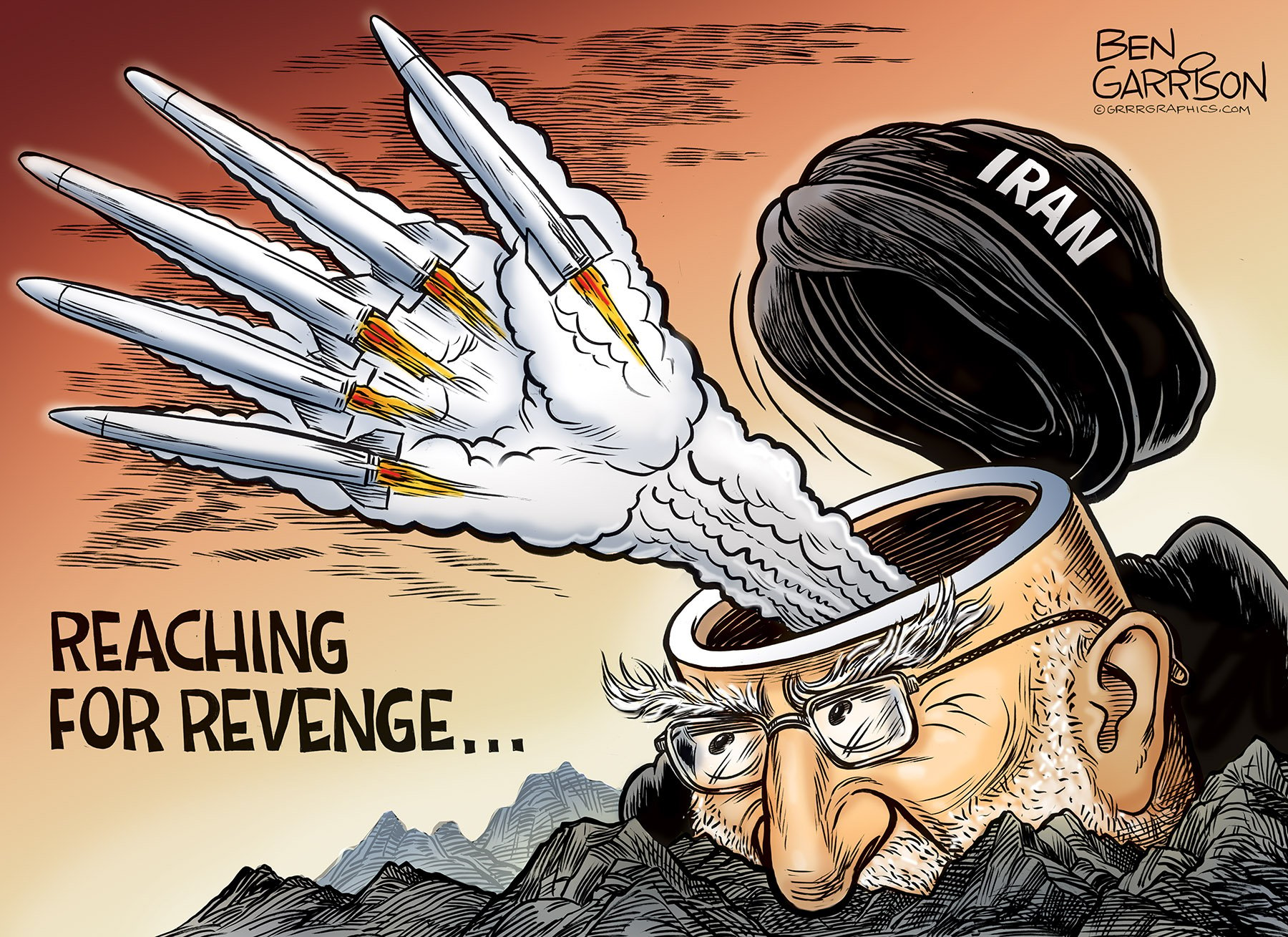


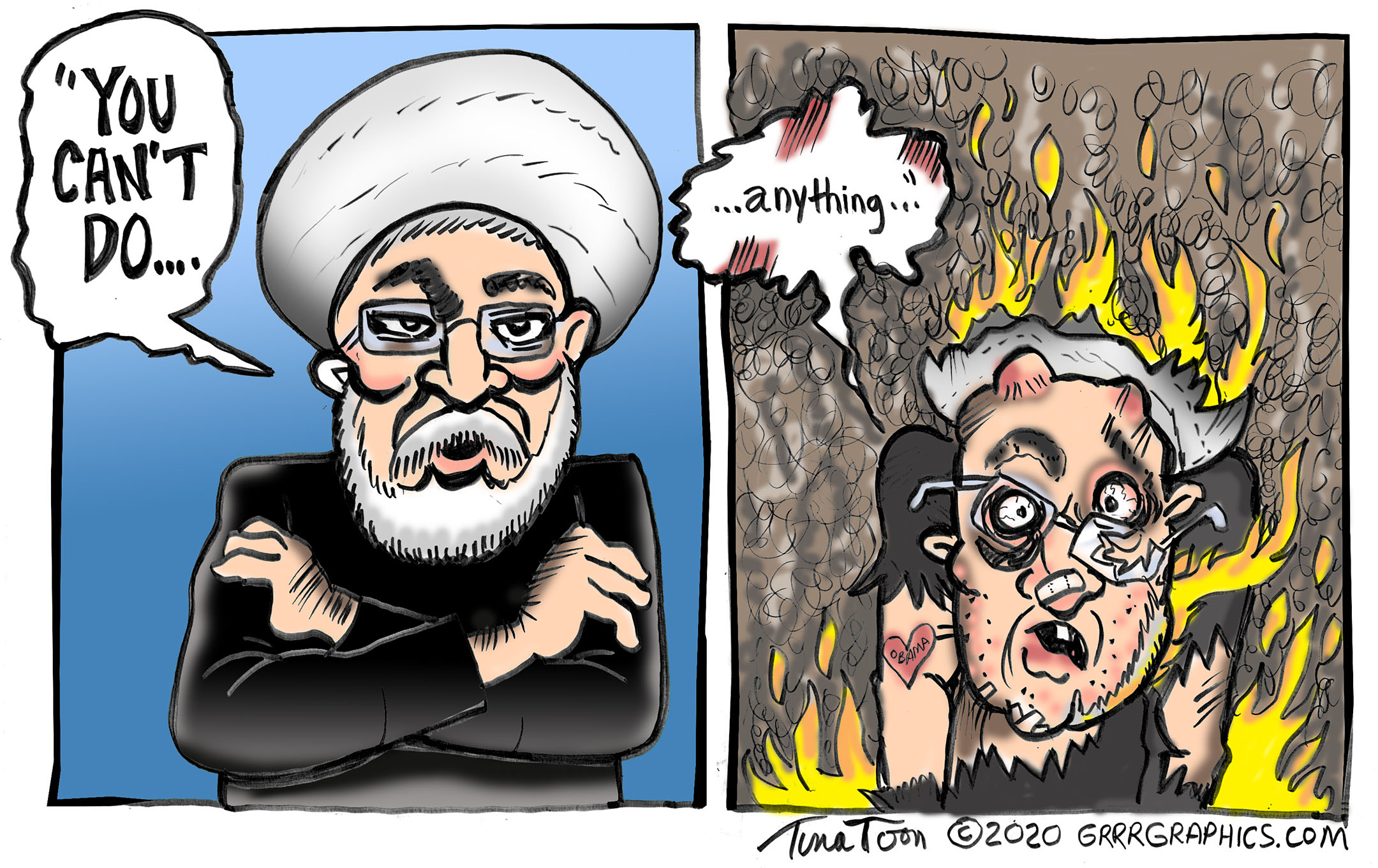
 Centinel2012