Sunday Talks: Rex Tillerson -vs- Chuck Toad


Good grief.  NBC’s Chuck Toad spent two-thirds of his interview opportunity with Secretary of State Rex Tillerson asking repeated questions about the preferred Democrat narrative known as the ‘Muh Russian conspiracy’.

However, Tillerson did have the opportunity to push back against Senator John McCain’s ridiculous attacks against Secretary T-Rex.   Anyone who watched the T-Rex talk to the State Department on May 3rd can fully understand the context of Tillerson’s outline of distinction between “U.S. policies” and “U.S. Values”.   If you haven’t watched or read the speech you should, SEE HERE.

Senator John McCain was furious that Secretary Tillerson would not accept the McCain/Powers “Responsibility to Protect” doctrine which mandates U.S. foreign policy as interventionist around the globe.  Senator McCain wrote an op-ed opposing Tillerson and demanding that U.S. policy must include creating more wars around the world.

.

Here is Secretary Tillerson’s actual words in context, that Senator McCain finds so fundamentally abhorrent:


T-Rex talks about the ongoing State Dept. mission and how values and policies intersect with the larger ‘America-First’ strategy.

Specifically T-Rex explains how the distinction between U.S. ‘values’ relates to U.S. ‘policy’ but determinations of influence and our best interests cannot necessarily be contingent upon foreign governments accepting values that are inherently different to their culture.

These remarks delivered to State Dept personnel are exceptionally well presented and intensely interesting.

.

[Transcript] SECRETARY TILLERSON: Good morning. (Applause.) Thank you. Thank you.  Are we on? Can you all hear me back there in the back? Can you hear me now? (Laughter.) Can you hear me now?

AUDIENCE: Yes.

SECRETARY TILLERSON: All right. I told them I have to walk around. My wife has always said if you tied my hands down to my side, I would be a complete mute. (Laughter.) So I’m not great at podiums. I do know how to read a speech, but I thought today we’d just have a chat.

So I’ve been here about three months now, we’ve been working alongside one another, and so I thought it’d be worthwhile to just share a few of my perspectives with you on where I think we are and some things that are coming that I know are of interest to you.

But before I do that, I would be remiss if I did not thank all of those who have stepped into acting roles during these past three months to help me, and starting with acting Deputy Secretary Tom Shannon, who’s just been stellar. (Applause.) But I also want to acknowledge the large number of people who are – stepped into under secretary, assistant secretary roles, director roles, and a number of chief of missions around the world as well.

Your willingness to step up and not just fill that role, but to take responsibility for the role and to lead the organization through some pretty challenging first 90 days – it’s not like we haven’t had some things to work on. And so I want to express my appreciation to all of you for helping me and helping my team as we came on board. And I’ve just been really gratified at the work that everyone’s undertaken in that regard.

So I thought we’d talk about a couple of things. I want to share my perspective as to how does this administration’s policies of “America first” fit into our foreign policy and foreign affairs. And so I want to touch on that. And then I’ll take a quick walk around the world.

Most of you have some familiarity of what’s going on around the world, but I thought just regionally I’d hit each one of them very quickly, to share with you my perspective on kind of where I feel we are, and then in some areas where we’ve not yet had time to devote the attention to we would like, and I don’t want that to be in any way considered that we don’t think those are important. It’s kind of a – what’s the hottest fire that we’ve got to deal with?

So I want to talk about that a little bit, and then spend some time at the end talking about where we’re going in the future of the department, USAID, and, as you know, we just kicked off this listening exercise.

So let’s talk first about my view of how you translate “America first” into our foreign policy. And I think I approach it really that it’s America first for national security and economic prosperity, and that doesn’t mean it comes at the expense of others.

Our partnerships and our alliances are critical to our success in both of those areas. But as we have progressed over the last 20 years – and some of you could tie it back to the post-Cold War era as the world has changed, some of you can tie it back to the evolution of China since the post-Nixon era and China’s rise as an economic power, and now as a growing military power – that as we participated in those changes, we were promoting relations, we were promoting economic activity, we were promoting trade with a lot of these emerging economies, and we just kind of lost track of how we were doing. And as a result, things got a little bit out of balance.

And I think that’s – as you hear the President talk about it, that’s what he really speaks about, is: Look, things have gotten out of balance, and these are really important relationships to us and they’re really important alliances, but we’ve got to bring them back into balance.

So whether it’s our asking of NATO members to really meet their obligations, even though those were notional obligations, we understand – and aspirational obligation, we think it’s important that those become concrete. And when we deal with our trading partners – that things have gotten a little out of bounds here, they’ve gotten a little off balance – we’ve got to bring that back into balance because it’s not serving the interests of the American people well.

So it doesn’t have to come at the expense of others, but it does have to come at an engagement with others. And so as we’re building our policies around those notions, that’s what we want to support. But at the end of it, it is strengthening our national security and promoting economic prosperity for the American people, and we do that, again, with a lot of partners.

Now, I think it’s important to also remember that guiding all of our foreign policy actions are our fundamental values: our values around freedom, human dignity, the way people are treated. Those are our values. Those are not our policies; they’re values. And the reason it’s important, I think, to keep that well understood is policies can change. They do change. They should change. Policies change to adapt to the – our values never change. They’re constant throughout all of this.

And so I think the real challenge many of us have as we think about constructing our policies and carrying out our policies is: How do we represent our values? And in some circumstances, if you condition our national security efforts on someone adopting our values, we probably can’t achieve our national security goals or our national security interests.

If we condition too heavily that others must adopt this value that we’ve come to over a long history of our own, it really creates obstacles to our ability to advance our national security interests, our economic interests. It doesn’t mean that we leave those values on the sidelines. It doesn’t mean that we don’t advocate for and aspire to freedom, human dignity, and the treatment of people the world over. We do. And we will always have that on our shoulder everywhere we go.

But I think it is – I think it’s really important that all of us understand the difference between policy and values, and in some circumstances, we should and do condition our policy engagements on people adopting certain actions as to how they treat people. They should. We should demand that. But that doesn’t mean that’s the case in every situation. And so we really have to understand, in each country or each region of the world that we’re dealing with, what are our national security interests, what are our economic prosperity interests, and then as we can advocate and advance our values, we should – but the policies can do this; the values never change.

And so I would ask you to just – to the extent you could think about that a little bit, I think it’s useful, because I know this is probably, for me, it’s one of the most difficult areas as I’ve thought about how to formulate policy to advance all of these things simultaneously. It’s a real challenge. And I hear from government leaders all over the world: You just can’t demand that of us, we can’t move that quickly, we can’t adapt that quickly, okay?

So it’s how do we advance our national security and economic interests on this hand, our values are constant over here.

So I give you that as kind of an overarching view of how I think about the President’s approach of “America first.” We must secure the nation. We must protect our people. We must protect our borders. We must protect our ability to be that voice of our values now and forevermore. And we can only do that with economic prosperity.

So it’s foreign policy projected with a strong ability to enforce the protection of our freedoms with a strong military. And all of you that have been at this a long time understand the value of speaking with a posture of strength – not a threatening posture, but a posture of strength. People know we can back it up.

So with that in mind, let me just quickly walk around the world and give you my assessment of where we are in some of the early stages of policy that’s underway and some that’s yet to be developed.

So as all of you clearly understand, when we came in to the State Department, the administration came in, was sworn in, immediately confronted with a serious situation in North Korea. Now, the prior administration, as all of you know, President Obama told President Trump this was going to be your greatest threat that you’re going to have to manage, and he was right.

♦  So it was – it’s right on the doorstep. And so it got immediate attention. It was the first policy area that we began to develop in terms of what is our overarching strategic approach and how do we want to execute against that. In evaluating that, what was important to us and to me to understand was, first, where are our allies? And so engaging with our allies and ensuring that our allies and we see the situation the same – our allies in South Korea, our allies in Japan.

And then, secondly, it was to engage with the other regional powers as to how do they see it. And so it was useful and helpful to have the Chinese and now the Russians articulate clearly that their policy is unchanged; they – their policy is a denuclearized Korean Peninsula. And of course we did our part many years ago. We took all the nuclear weapons out of South Korea. So now we have a shared objective, and that’s very useful, from which you then build out your policy approaches and your strategies.

So many people are saying, well, gee, this is just the same thing we’ve tried over and over – we’re going to put pressure on the regime in Pyongyang, they’re not going to do anything, and then in the end we’ll all cave. Well, the difference, I think, in our approach this time is we’re going to test this assumption, and when the – when folks came in to review the situation with me, the assumption was that China has limited influence on the regime in Pyongyang, or they have a limited willingness to assert their influence. And so I told the President we’ve got to test that, and we’re going to test it by leaning hard into them, and this is a good place to start our engagement with China.

And so that’s what we’ve been doing, is leaning hard into China to test their willingness to use their influence, their engagement with the regime in North Korea. All of it backed up by very strong resolve on our part to have a denuclearized peninsula with a commitment to our security alliances on the peninsula and in the region to our important allies Japan and South Korea.

So it’s a pressure campaign that has a knob on it. I’d say we’re at about dial setting 5 or 6 right now, with a strong call of countries all over the world to fully implement the UN Security Council resolutions regarding sanctions, because no one has ever fully implemented those. So we’re going to lean into people to fully implement them. We’ve told them we’re watching what you’re doing. When we see you not implementing, we see companies or we see individuals that are violating these sanctions, we’re going to contact you and we’re going to ask you to take care of it. If you can’t take care of it or you simply don’t want to take care of it for your own internal political reasons, we will. We’ll sanction them through third-country sanctions.

So we are being very open and transparent about our intentions, and we’re asking our partners around the world to please take actions on your own. We want you to control how that happens. We’re not trying to control it for you, but we have an expectation of what you will do. So we’re putting that pressure on. We are preparing additional sanctions, if it turns out North Korea’s actions warrant additional sanctions. We’re hopeful that the regime in North Korea will think about this and come to a conclusion that there’s another way to the future. We know they have – they’re – they aspire to nuclear weapons because it’s the regime’s belief it’s the only way they can secure their future.

We are clear – we’ve been clear to them this is not about regime change, this is not about regime collapse, this is not about an accelerated reunification of the peninsula, this is not about us looking for an excuse to come north of the 38th Parallel. So we’re trying to be very, very clear and resolute in our message to them that your future security and economic prosperity can only be achieved through your following your commitments to denuclearize.

So this is where we are. We’re at – I would say we’re at about the 20 to 25 percent stage of this strategy. Thus far, our assessment is it is going like we had hoped for in terms of the response we’re getting from others, but we’ve got a lot of work left to do to keep that pressure on. And so that’s what the folks that are in the bureaus and out in the missions are doing to help us right now, is to continue this steady, resolute message and continue to talk out here to the North Koreans, but not here, yet, about what our intentions are and what we want. We are ready and prepared to engage in talks when conditions are right.

But as you’ve heard me say, we are not going to negotiate our way to the negotiating table. That is what Pyongyang has done for the last 20 years, is cause us to have to negotiate to get them to sit down. We’ll sit down when they’re ready to sit down under the right terms. So that’s North Korea.

♦  And then if I pivoted over to China, because it really took us directly to our China foreign policy, we really had to assess China’s situation, as I said, from the Nixon era up to where we find things today, and we saw a bit of an inflection point with the Sochi – with the Beijing Olympics. Those were enormously successful for China. They kind of put China on the map, and China really began to feel its oats about that time, and rightfully.

They have achieved a lot. They moved 500 million Chinese people out of poverty into middle class status. They’ve still got a billion more they need to move.

So China has its own challenges, and we want to work with them and be mindful of what they’re dealing with in the context of our relationship. And our relationship has to be one of understanding that we have security interests throughout northeast Asia and security interests throughout the Pacific, and we need to work with them on how those are addressed. So that gets to the island building in the South China Sea, the militarization of those islands, and obviously, we have huge trading issues to talk with them about.

So we are using the entree of the visit in Mar-a-Lago, which was heavy on some issues with North Korea but also heavy on a broader range of issues. And what we’ve asked the Chinese to do is we’re – we want to take a fresh look at where’s this relationship going to be 50 years from now, because I think we have an opportunity to define that. And so I know there have been a lot of dialogue areas that have been underway for the last several years with China. We have asked China to narrow the dialogue areas and elevate the participants to the decision-making level.

So we outlined four major dialogue areas with China, and we’ve asked them to bring people who report directly to the decision-maker, which is President Xi. So for the first time, we are seeking and we – so far it appears we will get people at the politburo level and at much higher levels of the government within China to participate in these dialogues so we can reframe what we want the relationship to be and begin to deal with some of the problems and issues that have just been sitting out there kind of stuck in neutral for a while. So it is a – it’s a much narrower – as we make progress, those things will result in working groups where we can get after solving these things.

So we’re going to have the first meeting of the Diplomatic and Security Dialogue, which is chaired by myself and Secretary Mattis, with our counterparts here in Washington in June, and we’ve put it up as a kind of top priority. The second one is economic and trade, which is chaired by Treasury Secretary Mnuchin and Commerce Secretary Ross, and it’s well underway also.

So that’s kind of the new approach we’re taking with China, is elevate, let’s kind of revisit this relationship, and what is it going to be over the next half century. I think it’s a tremendous opportunity we have to define that, and there seems to be a great interest on the part of the Chinese leadership to do that as well. They feel we’re at a point of inflection also. So that’s China.

Obviously, throughout Asia we’ve got a lot of work do with ASEAN nations and re-solidifying our leadership with ASEAN on a number of security issues but also trade issues and the South China Sea, strengthen relations with Australia and New Zealand – really important partners with us on a number of counterterrorism fronts.

And so throughout the region those engagements are underway. And the President has committed to make the trip to Vietnam and to the Philippines for those meetings this fall, and I think that’s going to be very important that he is going, and we’ll be going in advance, obviously, to prepare for all of that.

♦  So if we walk around to the next hot spot that we worked on, pretty quickly it was the Middle East around the campaign to defeat ISIS and instability that that’s created in, obviously, Syria, Iraq, the issues in Afghanistan.

And as those of you who work that region well know, you can just kind of draw the concentric circles out all the way into North Africa, parts of Africa, all of the Middle East, parts of Central Asia, and this is really a D-ISIS and a counterterrorism effort, is what it really boils down to. And so how do we develop policies and bring regional players together to address these threats of ISIS and counterterrorism?

And we hosted I think what was a very successful coalition to defeat ISIS ministerial here at the State Department. I think there is a real renewed sense of energy and commitment to win this war against ISIS. We will; we are defeating ISIS in their caliphate in Syria and Iraq, but we know that ISIS exists more broadly than that. And so, as we said in that coalition effort, we’ve got to move beyond the battlefield, we’ve got to move into the cyberspace, we’ve got to move into the social communications space, and get inside of the messaging that allows them to recruit people around the world to their terrorism efforts.

So there is a big effort underway with players in the region, most notably the Kingdom of Saudi Arabia, and working with other partners to get inside of this conversation that’s going on within the Muslim community around what this is doing to the way the Muslim faith is understood by others in the world. And I would say it’s a very open conversation we’re having and a renewed commitment on the part of leaders in the Muslim world that want to take this on. So we’re going to be leveraging on that as well.

So as you’re seeing this play out in the Middle East, still a lot of hard work to do to get coalition partners together around ceasefires and peace processes in Syria. How do we advance our interest in Afghanistan to a legitimate peace process is what we’re pursuing in Afghanistan, and then keeping this terrorism network confined as it wants to spread itself through North Africa and Central Africa. So a lot of work ahead of us, and many of you are directly engaged in it already; many more of you are going to become engaged in it, I think you can expect.

♦  The next kind of area of priority is our re-engagement with Russia. Obviously, they are part of the engagement in Syria, but we have other issues with Russia, as you all well know, in Europe, and the situation in Ukraine.

As I know many of you heard from my trip to Moscow, characterized to President Putin that the relationship between our two nations was the lowest it’s been since the Cold War. He did not disagree. He shrugged his shoulders and nodded in agreement. And I said it’s spiraling down, it’s getting worse. And my comment to him was you – we cannot have, the two greatest nuclear powers in the world cannot have this kind of relationship. We have to change it.

And so we have a number of efforts underway to first stabilize the relationship. And Deputy Secretary – acting Deputy Secretary Shannon is leading a working group effort to see if we can address some of the things that are just irritating the relationship, that make it hard for us to talk to one another even in civil tones.

So we’re working hard on that and we’re hoping to begin to solve some of that, while Foreign Minister Lavrov and I, under the direction of President Putin and now President Trump, coming out of the call yesterday are going to continue to see if we can work together on the first big area of cooperation, which would be Syria, and can we achieve a ceasefire that will hold long enough for us to get a peace process underway.

I don’t want to say we’re off to a great start on this, because it’s very early stages. I don’t know where it will go. So I’ve got a bilateral with Foreign Minister Lavrov in Alaska next week on the margins of the Arctic Council. Both our presidents have charged us to take this further and see where we can go with it.

So obviously, close coordination with the Department of Defense, with our intelligence agencies, and importantly our allies in the region, because we want them to always know what we’re doing, because we’re going to need their support as well.

So a lot of work ahead of us on the Russia engagement – work some small things, can we work one big thing together. If we can find space for something we feel we can begin to rebuild some level of trust, because today there is almost no trust between us. Can we build some level of trust?

We’ve got a long list of things to work on from our arms agreements and issues we have with our nuclear arms agreements, to obviously, getting to Ukraine, Crimea, and other places where Russia is not being particularly helpful today.

So that’s what we’re hoping, is that we can begin to build a way in which we can learn how to work with one another. I don’t know whether we can or not. We’ll – we’re going to find out.

♦  So quickly to other parts of the world that are really important to us as well – the continent of Africa is so important from the standpoint that first, from a national security view, we cannot let Africa become the next breeding ground for a re-emergence of a caliphate for ISIS. We also cannot allow the terrorist networks that weave their way through Africa to continue unabated.

You can connect the dots between countries throughout the central part of Africa and northern part of Africa where the terrorist networks are connected. We’ve got to get into the middle of that and disrupt that to save those countries.

But Africa is also a continent of enormous opportunity, and needs and will get and will continue to receive our attention to support stabilizing governments as they are emerging and continuing to develop their own institutional capacity, but also looking at Africa for potential economic and trading opportunities. It’s a huge, I think, potential sitting out there, waiting for us to capture it, and then, obviously, a big focus of our health initiatives, because Africa still struggles with huge health challenges. And those are important to us and they’re going to continue to get our attention.

So we’re going to – we’re working – today we have some things we’re working in North Africa relative to its relationship to the Middle East challenges and our ISIS challenges. We’ve got to step back and take a more comprehensive look at our approach to the entire continent, and that’s out in front of us as well.

♦ And then lastly, I want to go to the Western Hemisphere. And in the Western Hemisphere, obviously, our neighbors are vitally important to us, Canada and Mexico. It’s not as rocky as it looks sometimes, and I think, in fact, the relationships are quite good. Both of our neighbors understand we have to refresh some of the agreements that have governed our relationship, particularly in the areas of trade, and both countries are ready to engage in a good-faith effort with us as well.

In particular, we’re investing a lot of effort into Mexico because of the transmigration issues and organized crime. And so we have an initiative underway where the senior members of the Mexican Government will be coming up here on May the 18th to participate in an interagency process with us to see if we can get at transnational organized crime and begin to break these organized crime units up.

Not only are they a threat to us and to Mexico’s stability and the scourge of drugs that just flow into this country, they also are part of the integrated terrorist financing networks as well. So this is vital to us for a number of reasons and we look forward to making some progress there.

South of Mexico, we’ve got some initiatives underway to work with the Latin American countries, which are where a lot of the people are trying to leave to come up to the U.S., to continue economic development, security investments in Latin America, and working with the Department of Homeland Security.

We’re actually hosting an event in Miami to bring those leaders up so we can talk with them about how we get better organized to address these issues and how we can bring more private capital into investment opportunities in Central and Latin America.

Southern cone, we have a lot of opportunity and some challenges down there. What we want to do is step back and develop a Western Hemisphere strategy that thinks about South America in its entirety and its relationship to Central America, but Cuba and the Caribbean as well.

There are terrorist financing issues. There are terrorist networks that are beginning to emerge in parts of South America that have our attention. There are governance issues in certain countries – certainly all of you are following the situation in Venezuela; a real tragedy, but we’re hopeful that working with others, including interventions by others in Europe, that we may be able to gain some traction in Venezuela. So we have a number of things in front of us yet to develop clear policies on how we want to go forward.

So my view is that we want to look at these regions almost in their entirety first, because everything is interconnected. We can take a country and develop something, but if we don’t have the perspective regionally, we’re probably not going to be as effective. So we’re trying to start out here, and then we’ll bring it down to a country-by-country level so we can execute. So that’s just to give you a little perspective on how we’re approaching these things in policy planning, and then we try to get a big-picture view and then we bring the bureau people in, the experts in, and help us start developing, now, how do you execute something like this? How do you implement it?

So for those of you that have participated in these early efforts, thank you. I feel quite good about the one – the pieces that have been completed and are in execution, I feel good about those. I can tell you the White House feels good about it.

The National Security Council really values the work that we provide in the interagency process. And I would share with you I hear that from them all the time, that the stuff that comes over from the State Department, we’ve done our homework. It’s a complete piece of work, it’s useful, we can use it, and that’s not always the case from all of the other agencies. So thank you for the efforts you’re putting into that in that regard.

♦ So let me turn now quickly to the last thing I wanted to talk about, which is the future and where we’re going. And I alluded to this a little bit when I was commenting about the post-Cold War era. And during the Cold War – and I’ve had this conversation with some of you in this room before in our interactions – in many respects the Cold War was a lot easier.

Things were pretty clear, the Soviet Union had a lot of things contained, and I had a conversation with Secretary-General Guterres at the UN. He described it as during the Cold War, we froze history. History just stopped in its tracks because so many of the dynamics that existed for centuries were contained. They were contained with heavy authoritarianism. And when the Cold War ended and the Soviet Union broke up, we took all of that off and history regained its march. And the world got a whole lot more complicated. And I think that’s what we see. It has become much more complicated in terms of old conflicts have renewed themselves because they’re not contained now. So that’s the world as it is and that’s the world we have to engage with.

And so I’m going to – I’m saying this as a preface to as we get into thinking about how we should deliver on mission is to be thinking about how the way we have been delivering was in many ways shaped and as a residual of the Cold War era. And in many respects, we’ve not yet transitioned ourselves to this new reality either. And I don’t say that just about the State Department, I say that about institutions globally.

In fact, this is the – this – I had this same conversation with Secretary Guterres about the United Nations, that there are many institutions – and you can see when we have our conversations with NATO, another example, but there are many institutions around the world that were created during a different era.

And so they were set up to deal with certain conditions and their processes and their organizations were set up, and as things have changed, we’ve not really fully adapted those. It’s not that we’ve not recognized, but we’ve not fully adapted how we deliver on mission.

So one of the things, as we get into this opportunity to look at how we get our work done, is to think about the world as it is today and to leave behind – we’ve been – well, we do it this way because we’ve been doing it this way for the last 30 years or 40 years or 50 years, because all of that was created in a different environment.

And so I think – I guess what I’m inviting all of you to do is to approach this effort that we’re going to undertake with no constraints to your thinking – with none.

One of the great honors for me serving in this department, the Department of State, and all of you know, the Department of State, first cabinet created and chartered under the Constitution. Secretary of State, first cabinet position chartered and created under the Constitution. So we are part of a living history and we’re going to get to carve our little piece of it, our increment, in that clock of time. We’re going to carve our piece into that history.

And I think the question is how we will do that; and how effectively we will do that. And history is moving around us as we just spoke. And how do we adapt to that? And so I want to ask all of you to be very free in your thinking.

So the process going forward, as you know we’ve just kicked off this listening exercise and I really encourage all of you to please go online and participate in the survey online. This is vital to how we understand where we want to go and I think we have about 300 individuals that we’ve selected to sit down face-to-face and do some interviews so we have a more fulsome understanding.

We want to collect all of these – all this input and your thoughts and ideas, both here and at USAID, and that is going to guide how we approach both our organizational structure, but more importantly, our work process design: How do we actually deliver on mission? That’s the real key. How do you deliver on mission?

And really, the way I have found these things to be the most successful is I understand how to deliver on mission first, I understand how the work processes work, and then I’ll put the boxes around it to make all that work. Most people like to start with the boxes and then try to design it. I’m – I do it the other way around. How do we get the work done? We’ll then put the organization structure in place to support that.

So we need a lot of creative thinking. We need to hear from you. This is going to inform how this turns out. I want to emphasize to you we have no preconceived notions on the outcome. I didn’t come with a solution in a box when I showed up. I came with a commitment to look at it and see if we can’t improve it.

And I know change like this is really stressful for a lot of people. There’s nothing easy about it, and I don’t want to diminish in any way the challenges I know this presents for individuals, it presents to families, it presents to organizations. I’m very well aware of all of that.

All I can offer you on the other side of that equation is an opportunity to shape the future way in which we will deliver on mission, and I can almost promise you – because I have never been through one of these exercises where it wasn’t true – that I can promise you that when this is all done, you’re going to have a much more satisfying, fulfilling career, because you’re going to feel better about what you’re doing because of the impact of what you are doing.

You will know exactly how what you do every day contributes to our delivery on mission, and that is when I find people are most satisfied with their professional careers. And you’re going to have clear line of sight about what do you want for yourself in the future.

So this is a – it’s a big undertaking. This is a big department, between this and USAID, and we are including all of our missions, all of our embassies, all of our consular offices, because we all are part of how we deliver on mission. So we want to look at it in its entirety as to how we do that.

So I appreciate your participating openly in this listening exercise, but importantly, I want to condition you to be ready to participate in the next phase, because that’s when it’ll become more challenging.

But we’re all on this boat, on this voyage – I’m not going to call it a cruise; it’s not – may not be that much fun. (Laughter.) But we’re on all this ship, on this voyage together. And so we’re going to get on the ship and we’re going to take this voyage, and when we get there, we’re all going to get off the ship at wherever we arrive. But we’re all going to get on and we’re going to get off together. We don’t intend to leave anybody out.

So I appreciate your participation. I hope you will approach this with a level of excitement as to what it may hold for this State Department first and then for you as an individual and what it means for you. So we’re asking all of you to do that.

Let me lastly say that I do appreciate all of the work that you do. Believe it or not, I do read all these memos that come to me from – all the way from missions to the various bureaus. I appreciate those of you that get them on one page, because I’m not a fast reader. But they’re extraordinarily helpful to me, and so keep sending me insights as to what you’re doing, how you’re doing it, and in particular the perspective on how we got to where we are. It is very valuable to me.

I had the opportunity to address a group of young people yesterday – about 700 middle school, high school people – that were here participating in the model UN conference. We were hosting it here at the State Department. One of the – there’s a few fun things you get to do in this job, and talking to young people is one of them. So I had a Q&A time, and a young lady – I think she was in middle school – asked a question. She said, “What inspires you as Secretary of State when you come to work every day?” And I told her it’s quite easy. I said the men and women of the State Department inspire me, my colleagues – their professionalism, their commitment, their patriotism.

And I said, then our partners over at the Department of Defense, the men and women in uniform, because it’s really the State Department and the Defense Department that deliver our national security. I’m inspired by you, and I thank you for that, and I’m honored to serve alongside of you.

We’ll be talking again.

Thank you. (Applause.)

(link)

Advertisements

Wilburne Talks More About Ongoing China Trade Negotiations and NAFTA…


Two great interviews with Commerce Secretary Wilbur Ross, aka “Wilburine”. Secretary Ross is easily the most comprehensively well-versed trade policy commerce secretary in modern history, perhaps ever.

Wilburine is discussing the recent U.S./China trade breakthrough. –BACKSTORY HERE– Additionally, at 08:30 of the interview Ross discusses NAFTA against the backdrop of the Senate not yet accepting his “letter of intent” to renegotiate the agreement.  Secretary Ross discusses how Robert Lighthizer’s confirmation should help speed up the senate process.

.

In substantive terms the bigger aspect to remember is how much more leverage there is in bilateral trade negotiations than multilateral agreements.

The Trans-Pacific-Partnership (TPP) would have held the U.S. hostage to agreements that in many cases were against our interests and to the benefit of the larger group of TPP nations. Former Secretary of State John Kerry stated openly: while China was not part of the original TPP framework, the participating nations held open a back door for China to enjoin.

Because President Trump pulled away from TPP, the U.S. is able to negotiate terms for trade with our market that may have specific and purposeful benefit exclusive to the United States. This is critical as we review current negotiated bilateral deal with China.

.

As you watch this second interview it is worth noting FOX’s Neil Cavuto is very close personal friends with the U.S. Chamber of Commerce President Tom Donohue – the biggest lobbying group (spender) in Washington DC.

Donohue’s U.S. CoC wrote almost all of the structural language within the former TPP agreement.  Trump won the presidency and trashed that globalist trade deal.

Wilburine politely smacks down Donohue as an annoying gnat; and Cavuto’s tender sensibilities show almost immediately thereafter.

.

The China Trade Press Release is HERE

Here’s what it means to you.

On #1 – In two short months the Chinese market will be open to import from the U.S. beef industry. Previously, against the backdrop of BSE (bovine spongyform encephalopathy), ie. mad cow disease, China banned U.S. beef. That ban is now lifted.

#2 and #3 are connected. The U.S. will allow processed (cooked) Chinese chicken products to be imported to the U.S; However –important note– (#3) the U.S. politely forces China to adopt U.S. FDA type regulations, specifically HACCP (Hazard Assessment Critical Control Plans) in their manufacturing and processing of that product. China agrees.

This is important because under TPP there would have been a watering down of overall food-safety regulation due to the inability of TPP nations to be compliant with the stringent expectations exclusive to the U.S. However, because this deal is bilateral China is agreeing to a much more stringent set of food safety standards. Additionally, current U.S. “C.O.O.L (country of origin labeling) laws” will ensure that all China processed poultry will be readily identifiable. {remember, this is not raw product – it is processed}

#4 – Almost immediately the U.S. will be positioned to export Liquified Natural Gas to China. China is authorized to negotiate immediate import purchases of LNG from any U.S. energy company involved in the production and sale. Big boon for energy sector.

#5 – China begins a credit rating system for their citizens. This allows U.S. lenders to be able to evaluate the worthiness of loans to Chinese nationals, and also more stunningly removes the control authority from the Chinese government. This will expand freedom and democracy in China because the Chinese government will not as easily be able to control upward economic mobility based on patriarchy or oligarchy.

#6 – China agrees to a financial clearing house which guarantees payments to U.S. sellers who engage in trade with Chinese companies. Chinese manufacturers will not be allowed to default on their debts to U.S. exporters. In furtherance of this agreement #7 sets up the basis for electronic funds, bankcards and credit cards, which can be used in financial transactions between the U.S. and China. #8 retains the understanding that applicable U.S. law on these transactions applies to both nations. China/U.S. Buyers and Sellers are protected by the financial transactions as outlined in U.S. law.

“Compricated business froks, ..compricated business”…

President Trump Delivers Commencement Speech at Liberty University (Video)…


President Donald Trump highlighted his commitment to faith, and to faith-based education, today with his decision to deliver the commencement speech for Liberty University and the graduating class of 2017.

President Trump delivered a wonderfully uplifting speech to the graduating class with a  genuine appreciation of faith and, of course, his customary humor.

The Full Liberty University Ceremony is below:

*UPDATE* – President Trump Drops Another MOAB – Media Missing Sally Yates and James Comey Timeline…


President Trump drops another Mother Of All Bombs, this time in a twitter version directly targeted at a corrupted and politicized James Comey Dept. of Justice.

And what’s more stunning in the aftershock is the media’s incapacity to take the new Trump/Comey timeline information and add it to the existing Sally Yates timeline.

Then again, to do so would be to expose another level of FBI/DOJ politicization that remains hidden from public consumption.  Another political operative, Asst. Director of Counter Intelligence, Bill Priestap, who accompanied acting AG Sally Yates to the meeting with White House Counsel Don McGahn, is a Hillary Clinton campaign donor.


♦We know from Director James Comey’s own admission to congress that he intentionally withheld congressional notification of a counter-intelligence investigation that began in July of 2016.

Within Comey’s March 20th testimony to explain why he intentionally avoided congressional oversight, he cited the recommendation of Bill Priestap, Asst. Director of Counter Intelligence.

Bill Priestap is married to Sabina Menshell a self-employed “consultant” with a history of donations to Democrat candidates, specifically to Hillary Clinton.

(link)

♦We also know from Sally Yates testimony (May 8th), where she outlined the notification of White House Counsel Don McGahn of the issues the DOJ had with Michael Flynn, that Yates took Bill Priestap with her to the WH meeting on January 26th.

So let’s add President Trump’s meeting with FBI Director James Comey into the timeline of Sally Yates, and add her version of what McGahn’s concerns were about the content of the afternoon meeting:

Friday January 20th – Inauguration

Tuesday January 24th – Lt. Gen. Mike Flynn was interviewed at the White House by the FBI.

Wednesday January 25th –  The Department of Justice received a detailed readout from the FBI agents who had interviewed Flynn. Yates said she felt “it was important to get this information to the White House as quickly as possible.”

Thursday January 26th – (morning) Yates called McGahn first thing that morning to tell him she had “a very sensitive matter” that had to be discussed face to face. McGahn agreed to meet with Yates later that afternoon.

Thursday January 26th – (afternoonSally Yates traveled to the White House along with a senior member of the DOJ’s National Security Division, Bill Priestap, who was overseeing the matter.  This was Yates’ first meeting with McGahn in his office, which also acts as a sensitive compartmented information facility (SCIF).

Yates said she began their meeting by laying out the media accounts and media statements made by Vice President Mike Pence and other high-ranking White House officials about General Flynn’s activity “that we knew not to be the truth.

According to Sally Yates testimony, she and Bill Priestap reportedly presented all the information to McGahn so the White House could take action that they deemed appropriate.  When asked by McGahn if Flynn should be fired, Yates answered, “that really wasn’t our call.”

Yates also said her decision to notify the White House counsel had been discussed “at great length.”  According to her testimony: “Certainly leading up to our notification on the 26th, it was a topic of a whole lot of discussion in DOJ and with other members of the intel community.”

Friday January 27th – (morning)  White House Counsel Don McGahn called Yates in the morning and asked if she could come back to his office.

Friday January 27th – (late afternoon) According to her testimony, Sally Yates returned to the White House late that afternoon.  One of McGahn’s topics discussed was whether Flynn could be prosecuted for his conduct.

Specifically, according to Yates, one of the questions McGahn asked Yates was, “Why does it matter to DOJ if one White House official lies to another?” She explained that it “was a whole lot more than that,” and reviewed the same issues outlined the prior day.

McGahn expressed his concern that taking action might interfere with the FBI investigation of Flynn, and Yates said it wouldn’t. “It wouldn’t really be fair of us to tell you this and then expect you to sit on your hands,” Yates had told McGahn.

McGahn asked if he could look at the underlying evidence of Flynn’s conduct, and she said they would work with the FBI over the weekend and “get back with him on Monday morning.”

Friday January 27th – (evening) In what appears to be only a few hours later, President Trump is having dinner with FBI Director James Comey where President Trump asked if he was under investigation.

Now, accepting the politicization of the entire Russian Conspiracy Narrative that was leading the headlines for the two months prior to this dinner; and knowing moments earlier your Chief White House counsel informs you that two political operatives (Yates and Priestap) within the DOJ were providing classified intelligence reports about General Flynn; and knowing the prior months (Nov/Dec/Jan) were fraught with leaks from intelligence reports identical to those discussed;  wouldn’t you perhaps think that any action you take could be utilized to add fuel to this Russian narrative?  And/Or be used by these same leak facilitators to make something seem like something it is not?

Think about it.

If you were President under those circumstances, wouldn’t you ask FBI Director James Comey what the deal was with these investigations, and whether or not you were under investigation BEFORE you took action to retain or fire Mike Flynn?

Given the circumstances it could appear, and most definitely should be considered, that the President was being ‘set-up’ to impede an FBI investigation by taking action against Flynn.

If Trump took action – What mechanism was in place for the President to protect himself from accusations of impropriety and impeding an investigation?

Who is to say Yates and Priestap would stand behind the White House and support action taken by the President?

What confidence would President Trump have that Yates/Priestap would speak publicly about their advice?

What would FBI Director Comey and Asst. FBI Director McCabe do with a President Trump conversation about Mike Flynn who was “under investigation”?

Remember, for reference:  On February 15th while discussing another issue FBI Assistant Director Andrew McCabe asked Chief of Staff Reince Priebus for 5 minutes alone after the meeting.  At the one-on-one McCabe told Priebus the New York Times Russia and Trump campaign story was a “bunch of BS”.

Priebus asked McCabe if McCabe would be able to say that publicly.  McCabe said he would check.  Later, McCabe called back and said he couldn’t issue a statement about it. SEE SCREENGRAB:

reince-preibus-mccabe(LINK)

These are not exactly the most trustworthy of FBI and DOJ officials.

Exactly the opposite is true.  These are known political operatives, in appointed positions of government, with admitted intentions to manipulate transparency, accountability and they even testify to congress they are intentionally not allowing oversight.

President Trump was expected to trust this crew?

Seriously?

UPDATE 7:30pm: As if on cue, THIS is the exact trap we are talking about above.

SEE? In the first paragraph of the first article to draw attention to the timeline, the accusation is made that President Trump was “interfering with an ongoing FBI investigation”.

That is exactly the trap that Director Comey, Acting AG Yates and Asst. Director of DOJ Counter Intel Priestap were laying out.  Director Comey went to that dinner HOPING that Trump would ask him about Michael Flynn which would be seen as impeding a federal investigation.

For several months the media have been steadfast in their efforts to turn this into Watergate 2.0.  To achieve that objective the political angle-players and media need only to paint Trump into a corner with a credible accusation of the president interfering with an FBI investigation (Flynn).   Against the timeline above, as played out this week with Sally Yates testimony to congress, they were only a couple more timely misinformation leaks and twisted reports away from making that happen.

Now look at this tweet again:

Advertisements

Senators Grassley and Feinstein Confirm Trump Not Part of Russia FBI Investigation…


The firing of FBI Director James Comey has sent the professional political left into blinding fits of ridiculously over-the-top outrage.

The protestations are so ridiculous that a reasonable person has to ask if Comey wasn’t the center of a much larger political value for their ideological needs.

Made all the more clear when you consider that Comey stunningly admitted to congress (March 20th) he was actively working with the Obama White House, Susan Rice (Nat. Sec. Adviser), James Clapper (ODNI) and Sally Yates (Asst. AG – DOJ), all political operatives, while intentionally not allowing intelligence investigation oversight from congress.

Perhaps it is the removal of that specifically partisan Comey value that has the left-wing politicians and their MSM water-carriers so angered. It would be intellectually dishonest in the extreme not to fully accept this motivation for their behavior.

Therefore when President Trump says that Director Comey told him he was not the subject of, or participatory party to, the FBI counter-intelligence investigation of Russian election efforts, the rage filled oppositional ideologues go bananas.

However, Senator Chuck Grassley, a Republican, and Senator Dianne Feinstein, a Democrat, seemingly validate the exact same position:

Senator Grassley – […] Mr. Comey testified before the Judiciary Committee last week. Senator Blumenthal asked him whether the FBI had ruled anyone out as a potential target of the investigation of allegations of collusion between the Trump campaign and the Russians. In response, Mr. Comey stated: “Well, I haven’t said anything publicly about who we’ve opened investigations on. I briefed the Chair and Ranking on who those people are.”

Mr. Comey was asked if the FBI is investigating the President. He refused to answer. Mr. Comey said he didn’t want people to over-interpret his refusal, but that he wasn’t going to comment on anyone in particular. He thought it would put him on a slippery slope of having to answer who else is or is not under investigation. That could reveal who is being investigated.

I understand why he took that position, but I don’t agree – at least not when it comes to the President and senior government officials. The American people deserve to know if senior government officials are under active criminal or intelligence investigation.

Mr. Comey did brief Ranking Member Feinstein and me on who the targets of the various investigations are. It would not be appropriate for me to reveal those details before the professionals conducting the investigations are ready. So, I will not answer any questions about who are targets of the ongoing Russia investigations. But I will say this: Shortly after Director Comey briefed us, I tweeted that he should be transparent. I said he should tell the public what he told Senator Feinstein and me about whether the FBI is or is not investigating the President.

On Tuesday, the President’s letter said that Director Comey told him he was not under investigation. Senator Feinstein and I heard nothing that contradicted the President’s statement. Now Mr. Comey is no longer the FBI director. But the FBI should still follow my advice. It should confirm to the public whether it is or is not investigating the President. Because it has failed to make this clear, speculation has run rampant.

The intelligence community said that one of the Russians’ goals is to undermine the American public’s faith in our democratic institutions. Wild speculation that the FBI is targeting the President in a criminal or intelligence inquiry is not just irresponsible and unfounded. It provides aid and comfort to the Russians and their goal of undermining faith in our democracy.

So, what I suggest is that before this Committee does anything more on this matter, that all the Members get briefed by the FBI on what is actually going on.

Hopefully, that will help temper some of the unsubstantiated statements that have been made.  (link)

Additionally, John Solomon from Circa News highlights independent reporting, from independent FBI sourcing, that state the exact same thing as Trump, Grassley and Feinstein.

Congressional officials were told by FBI Director James Comey before he was fired that there are just a small number of Americans who are targets of the criminal or counterintelligence probes involving Russia and that none were President Trump or his top aides, Circa has confirmed.

Behind closed doors, Comey provided specific updates on about a half dozen or less targeted US citizens who were the focus of either counterintelligence probes or criminal investigations emanating from the Russia election scandal, sources familiar with the intelligence told Circa.

“President Trump is not a target nor is any senior government official if Comey’s account is correct,” one source said, who spoke on the condition of anonymity because that person was not authorized to comment.  (link)

With almost all of the Washington DC media FBI reporting being debunked as fast as it is printed, and Trump’s attachment to the Muh Russia conspiracy theory narrative collapsing around them, it is no wonder why the Democrats, NeverTrumper’s, and the DC Politburo media are grasping wildly at any available straws.

Robert Lighthizer Confirmed as U.S. Trade Representative – Senate Vote: 82-14


All positions have some bearing on the average American; however, some confirmation votes are more directly tied to the well-being of ordinary people than others.  This confirmation will directly and specifically make the lives of middle-class workers, and ordinary American people, improve.

Thank you to those who contacted their Senator and applied the pressure.  There was a great deal of feedback received by the senate in the past 24 hours.  There are those within the swamp lobbying community who are beginning to understand that WE KNOW far more than they ever thought we know.  Change is a direct consequence of that reality.

In a strong showing of bi-partisan support for Trump’s ‘America First’ trade platform the nominee for U.S. Trade Representative, Robert Lighthizer, was confirmed by the Senate with a vote of 82-14.  The U.S. Trade Representative is a critical position ahead of renegotiations of the North American Free Trade Agreement with Canada and Mexico.

Three Republicans voted NO: ♦Cory Gardner (Colorado), ♦John McCain (Arizona), and ♦Ben Sasse (Nebraska).

For the past 30 years Lighthizer has been a trade lawyer representing American steel companies in their efforts to fight dumping of foreign-made steel below costs and unfair steel subsidies from foreign governments. He has pledged to strengthen enforcement of existing trade deals and to find new legal tools to combat unfair trade practices.

Lighthizer has criticized some Republicans for being too pro-free trade. He told a Senate panel this year that the U.S. should have an “America first trade policy.”  “We can do better in negotiating our trade agreements and stronger in enforcing our trade laws,” he said.

(Reuters) […]  [President]  Trump has said the 23-year-old trade pact devastated U.S. workers and has vowed to tear it up if he fails to get a better deal.

Some Democrats, while critical of Trump’s own views on trade, said they were confident Lighthizer, who served in the Reagan administration as deputy U.S. Trade Representative, would work to help U.S. workers.

“He’s a real pro,” Senator Ron Wyden, a Democrat from Oregon, said before voting in favor of Lighthizer’s nomination.

Lighthizer’s approval came despite the objections of two Republican senators, John McCain of Arizona and Ben Sasse of Nebraska, who said they were worried Lighthizer did not appreciate NAFTA’s benefits.

While the U.S. trade deficit with Mexico has ballooned since the trade deal was enacted in 1994, U.S. farmers have profited from exports to America’s southern neighbor while automakers have cut costs by building cross-border supply chains that benefit from lower Mexican wages.

Orrin Hatch, a Utah Republican who chairs the Senate Finance Committee and voted in favor of Lighthizer’s nomination, also urged the incoming trade representative to be careful not to put at risk the gains NAFTA has brought.  (read more)

Here’s how they voted.

Voted NO:

Blumenthal (D-CT), Nay
Gardner (R-CO), Nay
Gillibrand (D-NY), Nay
Harris (D-CA), Nay
Markey (D-MA), Nay
McCain (R-AZ), Nay
Merkley (D-OR), Nay
Reed (D-RI), Nay
Sanders (I-VT), Nay
Sasse (R-NE), Nay
Schatz (D-HI), Nay
Schumer (D-NY), Nay
Warren (D-MA), Nay
Whitehouse (D-RI), Nay

Voted Yes:

Alexander (R-TN), Yea – Baldwin (D-WI), Yea – Barrasso (R-WY), Yea – Bennet (D-CO), Yea – Blunt (R-MO), Yea – Booker (D-NJ), Yea – Boozman (R-AR), Yea – Brown (D-OH), Yea – Burr (R-NC), Yea – Cantwell (D-WA), Yea – Capito (R-WV), Not Voting – Cardin (D-MD), Yea – Carper (D-DE), Yea – Casey (D-PA), Yea – Cassidy (R-LA), Yea – Cochran (R-MS), Yea – Collins (R-ME), Yea – Coons (D-DE), Yea – Corker (R-TN), Yea – Cornyn (R-TX), Yea – Cortez Masto (D-NV), Yea – Cotton (R-AR), Yea – Crapo (R-ID), Yea – Cruz (R-TX), Yea – Daines (R-MT), Yea – Donnelly (D-IN), Yea – Duckworth (D-IL), Yea – Durbin (D-IL), Yea – Enzi (R-WY), Yea – Ernst (R-IA), Yea – Feinstein (D-CA), Yea – Fischer (R-NE), Yea – Flake (R-AZ), Yea – Franken (D-MN), Yea – Graham (R-SC), Yea – Grassley (R-IA), Yea – Hassan (D-NH), Yea – Hatch (R-UT), Yea – Heinrich (D-NM), Yea – Heitkamp (D-ND), Yea – Heller (R-NV), Yea – Hirono (D-HI), Yea – Hoeven (R-ND), Yea – Inhofe (R-OK), Yea – Isakson (R-GA), Not Voting – Johnson (R-WI), Yea – Kaine (D-VA), Yea – Kennedy (R-LA), Yea – King (I-ME), Yea – Klobuchar (D-MN), Yea – Lankford (R-OK), Yea – Leahy (D-VT), Yea – Lee (R-UT), Yea – Manchin (D-WV), Yea – McCaskill (D-MO), Yea – McConnell (R-KY), Yea – Menendez (D-NJ), Yea – Moran (R-KS), Yea – Murkowski (R-AK), Not Voting – Murphy (D-CT), Yea – Murray (D-WA), Yea – Nelson (D-FL), Yea – Paul (R-KY), Yea – Perdue (R-GA), Yea – Peters (D-MI), Yea – Portman (R-OH), Yea – Risch (R-ID), Yea – Roberts (R-KS), Yea – Rounds (R-SD), Yea – Rubio (R-FL), Yea – Scott (R-SC), Yea – Shaheen (D-NH), Yea – Shelby (R-AL), Yea – Stabenow (D-MI), Yea – Strange (R-AL), Yea – Sullivan (R-AK), Not Voting – Tester (D-MT), Yea – Thune (R-SD), Yea – Tillis (R-NC), Yea – Toomey (R-PA), Yea – Udall (D-NM), Yea – Van Hollen (D-MD), Yea – Warner (D-VA), Yea – Wicker (R-MS), Yea – Wyden (D-OR), Yea – Young (R-IN), Yea

K-Street wants to retain three decades of Wall Street control over trade to position the multinational interests as a priority.  President Trump wants to break K-Streets lobbying grip and work trade policies that benefit Main Street, not Wall Street.

The issue(s) behind the argument is/are complex, and the political lobbying expenditures only compound the matter.  In essence over the past three decades large portions of U.S. agriculture have been sold to multinational corporations.  With control over production principles, those multinational corporations manipulate the market value of U.S. agricultural outputs to retain the highest profit margin.

It is not a free market system, it’s a controlled market system; and the control is not domestic ownership, it’s multinational corporations.  Part of the way they control the pricing of U.S. agriculture outputs is through export control; the traditional supply and demand commodity equation is non-existent.

This is not a free market.  When multinational corporations control commodity pricing, it is not a free market.  The paradigm that everyone needs to remember is that a free market doesn’t exist because the owners (control agents) of the market are not independent – they are massive institutional multinational corporations.  Through heavy handed contracts pushed on farmers they control the product from field to processing and beyond.

The export of domestic food production is a big part of the reason why U.S. food prices have skyrocketed in the past decade.  The corporations factor in an ability for the U.S. to afford higher prices than alternative destination nations; they know you have the ability to pay more, so they export more and recipient nations pay less.

Again, it’s a complex dynamic but this also ties into the same groups lobbying for increased consumer welfare payments on SNAP and EBT (food stamp) legislation.  Yes, multinational corporations -who control agriculture- lobby congress to fund more subsidy payments for food.  This allows them to export more, tighten the domestic supply, drive up U.S. pricing and increase their profit.  It’s a deeply tentacled controlled process toward increasing the bottom line profit margin of the Wall Street entities.

They have more to export (they make more money), and they drive up the domestic pricing (they make more money), and they pay the lobbyists for welfare legislation to subsidize U.S. food pricing (they make more money).   That’s the basic scheme, and when you know the financial con you can spot their motives.


James Comey Pens Farewell Letter…


FBI Director James Comey pens a farewell letter to his colleagues.  Cue the sad virtue signaling music:

**sniff**

Senators John McCain and Ben Sasse Announce Intent to Vote Against Robert Lighthizer Trade Rep Confirmation…


The economic lobbyist community known as The Big Club is represented most visibly by the U.S. Chamber of Commerce and Tom Donohue.

Via the Wall Street community, CoC President Donohue pours tens of millions of multinational corporate contributions into DC lobbying efforts to retain control over politicians and legislation that relates to U.S. trade and economic matters.   [FYI Donohue’s Chamber of Commerce lobbying group were the primary architects of the now dispatched TPP trade deal; they actually wrote the U.S. part of the construct.]

Tom Donohue funds a large number of politicians in DC in an effort to control the outcomes of legislation and policies that could become adverse to his multinational interests.  Two of those primary beneficiaries are John McCain and Ben Sasse.

As a consequence it doesn’t come as a surprise to see McCain and Sasse announce their intention to block the confirmation of U.S. Trade Representative Robert Lighthizer:

REUTERS – Republican U.S. Senators John McCain and Ben Sasse said on Wednesday they would vote against President Donald Trump’s nominee for U.S. trade representative, Robert Lighthizer, because of his opposition to the North American Free Trade Agreement.

“Unfortunately, your confirmation process has failed to reassure us that you understand the North American Free Trade Agreement’s (NAFTA) positive economic benefits to our respective States and the nation as a whole,” McCain and Sasse said in a letter to Lighthizer. (read more)

Commerce Secretary Wilbur Ross, Treasury Secretary Steven Mnuchin and President Trump strongly support Lighthizer for U.S. Trade Rep.   The institutional control agents within K-Street, aka the economic lobbying group, do not.

The bottom line arguments center around retention of global multinational economic interests that are antithetical to President Trump’s ‘America-First’ economic and trade platform.   K-Street wants to retain three decades of Wall Street control over trade to position the multinational interests as a priority.  President Trump wants to break K-Streets lobbying grip and work trade policies that benefit Main Street, not Wall Street.

The issue(s) behind the argument is/are complex, and the political lobbying expenditures only compound the matter.  In essence over the past three decades large portions of U.S. agriculture have been sold to multinational corporations.  With control over production principles, those multinational corporations manipulate the market value of U.S. agricultural outputs to retain the highest profit margin.

It is not a free market system, it’s a controlled market system; and the control is not domestic ownership, it’s multinational corporations.  Part of the way they control the pricing of U.S. agriculture outputs is through export control; the traditional supply and demand commodity equation is non-existent.

This is not a free market.  When multinational corporations control commodity pricing, it is not a free market.  The paradigm that everyone needs to remember is that a free market doesn’t exist because the owners (control agents) of the market are not independent – they are massive institutional multinational corporations.  Through heavy handed contracts pushed on farmers they control the product from field to processing and beyond.

The export of domestic food production is a big part of the reason why U.S. food prices have skyrocketed in the past decade.  The corporations factor in an ability for the U.S. to afford higher prices than alternative destination nations; they know you have the ability to pay more, so they export more and recipient nations pay less.

Again, it’s a complex dynamic but this also ties into the same groups lobbying for increased consumer welfare payments on SNAP and EBT (food stamp) legislation.  Yes, multinational corporations -who control agriculture- lobby congress to fund more subsidy payments for food.  This allows them to export more, tighten the domestic supply, drive up U.S. pricing and increase their profit.  It’s a deeply tentacled controlled process toward increasing the bottom line profit margin of the Wall Street entities.

They have more to export (they make more money), and they drive up the domestic pricing (they make more money), and they pay the lobbyists for welfare legislation to subsidize U.S. food pricing (they make more money).   That’s the basic scheme, and when you know the financial con you can spot their motives.

Unfortunately, when you know the con it can explode your blood pressure to fully grasp how much we are getting ripped off.  Especially when you read their insufferable reasoning to keep the current system in place.

So knowing that, here’s the letter of opposition from McCain and Sasse who are being paid by these lobbying entities to retain this controlled market system:

Dear Mr. Lighthizer,

We write to explain our intent to oppose your nomination to be United States Trade Representative (USTR). Unfortunately, your confirmation process has failed to reassure us that you understand the North American Free Trade Agreement’s (NAFTA) positive economic benefits to our respective States and the nation as a whole. We fear that you do not have an appreciation for the millions of jobs created by this free trade deal, and that you would not champion agriculture during your time as USTR. Furthermore, we worry that you would not negotiate trade deals that would protect the American consumer and expand economic growth. These concerns, along with the need for Congress to grant you a waiver to serve in the Trump Administration in a must-pass omnibus spending bill is troubling.

Beyond your vocal advocacy for protectionist shifts in our trade policies, the Administration’s ongoing, incoherent, and inconsistent trade message has compounded our concern. This is especially troubling because confirming a USTR grants the Administration additional legal authority to negotiate trade deals that Congress must consider under “fast track” procedures. Given these circumstances, granting the Trump Administration additional legal powers through your confirmation without understanding how you or the Administration intend to use those powers would be irresponsible.

A constant theme throughout your confirmation process has been your failure to grasp the importance of protecting agriculture in trade negotiations. Your meeting with one of us (Senator Sasse) did nothing to disabuse of us this notion. America needs a USTR who will effectively defend agriculture during trade negotiations and fight to expand agricultural export markets, not let America’s farmers and ranchers become collateral damage in a trade war.

You also have made your skepticism of NAFTA well known, which we find to be alarming. America deserves a USTR who will renegotiate NAFTA in order to build on its successes, not as a pretext for unraveling it. Mexico and Canada are two of our largest export markets and the free movement of goods is essential to the growth of our national economy. For example, Mexico is Arizona’s number one trading partner, accounting for 40 percent of the State’s exports to foreign markets. This is due to the free trade policies in NAFTA that create fewer trade barriers with Canada and Mexico, which makes it easier for Americans to make a living and provide for their families. Further, according to the Nebraska Farm Bureau, a withdrawal from NAFTA could cost Nebraska farmers and ranchers more than $2.6 billion per year in agricultural exports. Increasing trade barriers with Canada and Mexico, and risking a trade war, only hurts American families and small businesses.

The Trump Administration’s incoherent and inconsistent trade posture to date makes it impossible for us to overlook our concerns with your nomination. On April 29, 2017, President Trump signed an executive order that required the Secretary of Commerce and the USTR, in consultation with several federal agencies, to “conduct comprehensive performance reviews” of all of the United States’ free trade agreements and “renegotiate or terminate” policies that the Administration believes are harmful to the United States. This executive order was signed only days after the release of troubling reports of the Trump Administration’s preparations to withdraw from NAFTA. Reports that the Administration is even considering withdrawal from NAFTA is contrary to previous statements from key Administration officials – including Dr. Peter Navarro,[1] Secretary Wilbur Ross, [2] and Secretary Steve Mnuchin,[3] – that NAFTA would only be up for re-negotiation, not withdrawal. These disjointed positions are causing great uncertainty over the Administration’s trade objectives.

Moreover, this incoherent and protectionist message on trade has caused serious uncertainty for export markets, and has harmed our valuable relationships with Canada and Mexico. The Administration’s actions may also encourage our trading partners to move their markets elsewhere, especially if they believe that future negotiations will hurt their interests. For example, Mexican officials have cited the possible re-negotiation of NAFTA as a major reason why they are currently pursuing actions to import less corn from the U.S. and more from other nations, including Argentina and Brazil.

Other countries may follow Mexico’s suit. For example, China continues to advance the Regional Comprehensive Economic Partnership (RCEP), a regional multilateral trade agreement in the Pacific that includes our current FTA partners, South Korea and Australia, as well as Japan, a potential FTA partner. According to the Congressional Research Service, should the RCEP move forward in its current form, the “United States would face higher tariffs in RCEP markets”[4] and thus many of our trading partners could run to RCEP markets under trade rules set by China.

Confirming your nomination would allow the Trump Administration to negotiate “fast track” trade agreements, a power that Congress granted the executive branch in the 2015 reauthorization of TPA. For us to consider the complete implications of confirming you, the Administration would need to provide Congress with clear trade objectives with respect to: 1) the North America Free Trade Agreement (NAFTA), as well as a timeline for upcoming negotiations; 2) other free trade agreements (FTA); and 3) future FTAs, including which countries the Administration intends to pursue trade negotiations and timelines on those intended negotiations.

We hope the future actions and the Administration’s future actions will prove us wrong. The economic well-being of consumers, small businesses, farmers, and ranchers across our country depend upon it.

Sincerely,

U.S. Senator Ben Sasse

U.S. Senator John McCain

(source link)

Now you can see why this same group of usurping senators are refusing to accept the NAFTA letter of intent from Secretary Ross.  We have to fight these jackasses head on.  The first step in fighting them is to understand the rigged system they control and why they are controlling it…. that is currently important battle-space.

Advertisements

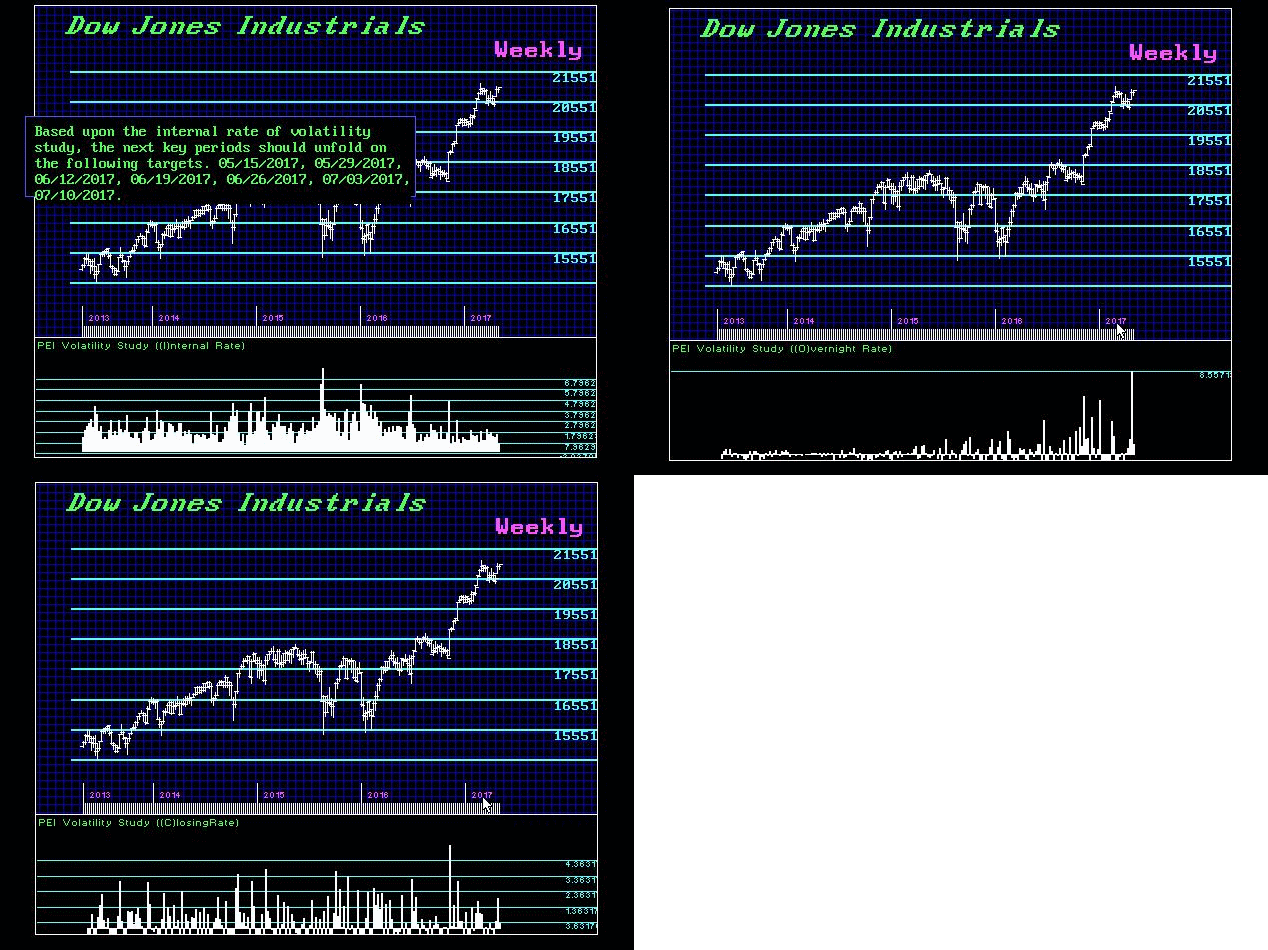
The Dow & Volatility


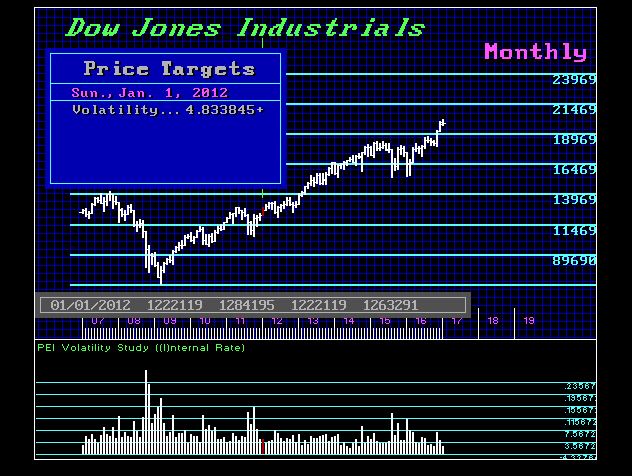
With the CBOE Volatility Index (STOXX: .VIX) at its lowest level in over 10 years, many people call this the fear gauge and are concerned that people have become complacent. The VIX, is by no means a perfect measure of overall fear in the market. How we measure volatility depends upon the formula. Here are just three indicators of volatility each measured differently (1) internal being the different between the high and low of that session, (2) the close to close degree of volatility, and then (3) overnight volatility which is measured from the day’s close to the next day’s open.

The VIX is not a perfect indicator and it is different from how we look at volatility. You can see here that we ran our Internal Volatility measurement on the VIX and the low was January 2012. Here is the comparison on the Dow so you can see where the VIX low took place whereas our Internal Volatility has declined since that period of time.

The biggest risk to volatility going forward was Trump’s dismissal of Comey. This could now act as a battle cry to stop his tax reform – very stupid decision.

Trump Fires Comey – Right Decision – Wrong Timing


Trump fired Comey who was the head of the FBI. Trump said he fired Comey for his handling of an election-year email scandal involving then-Democratic presidential nominee Hillary Clinton. This is a perfectly valid argument, but he should have done that some time ago. Removing Comey now has only raised suspicions among Democrats and the Republic Elite who both want to stop Trump from really reforming anything for they like their perks as is. Worse still, this was a stupid decision that may now put in jeopardy his whole tax reform.

The timing of this is really bad when it is the FBI probe that is involving Russia and the claims that his people were in contact with Putin. Some Democrats compared this move to the “Saturday Night Massacre” of 1973, when President Richard Nixon fired an independent special prosecutor investigating the Watergate scandal.

Trump should have had better judgment in this matter. I question his real motives because he had plenty of time to fire Comey and should have done so for his whitewash of Hillary. Moreover, Comey was the Assistant US Attorney in the Southern District of New York – the most corrupt judicial post in the nation. Comey always did his part in protecting the bankers. His whitewash of Hillary was interlinked with that position and should have been questioned long ago.

Nevertheless, this raises concerns about Trump’s political advisers. Are they really this stupi