
October 7, 2019
Today at 3:30pm ET, President Trump will sign the U.S-Japan trade agreement and U.S-Japan digital trade agreement. This represents “stage-one” (agriculture, industrial tariffs, digital trade) of a complex U.S-Japan trade agreement negotiated by U.S. Trade Representative Robert Lighthizer and Japanese Foreign Minister Motegi. (Details)
[Update – Video and Transcript Added]
[Transcript] THE PRESIDENT: Well, thank you very much everybody. I want to start by wishing my very good friend, Prime Minister Abe of Japan, a very happy birthday. He’s 39 years old today. (Laughter.) So please extend my wishes to the Prime Minister. He’s a great gentleman and we have had tremendous success.
As you know, in addition to what we’re talking about today, they’re building — Japan — many car plants in the United States, which they weren’t doing for a long time. And they’re building in Michigan, Ohio, lots of different states. And we just appreciate it very much. Been a tremendous investment.
But we’re here to talk about a little bit of a different purchase, and that’s good as far as we’re concerned. And I want to thank you very much. Very much. Thank you. (Applause.)

So we’re gathered here today at the White House this afternoon to discuss a very strong and groundbreaking achievement for the United States and Japan: the signing of the new U.S.-Japan Trade Agreement and the U.S.-Japan Digital Trade Agreement. Digital is becoming a very big factor in the world.
These two deals represent a tremendous victory for both of our nations. They will create countless jobs, expand investment and commerce, reduce our trade deficit very substantially, promote fairness and reciprocity, and unlock the vast opportunities for growth.
In the United States, these deals are a game changer for our farmers and our ranchers — we love our farmers and we love our ranchers; we’ve been working very hard on this — providing them with significantly enhanced access to a critical foreign market.
In a moment, I’ll be really honoring a lot of the folks in the room that are here with us from farm country, ranch country. And we’re going to be witnessing a historic signing by Ambassador Robert Lighthizer and Ambassador from Japan — a long trip, but you just got here — Sugiyama of Japan. And we’re grateful to both of you for the outstanding job you’ve done and all of the people that were involved with both of you, your staffs and your representatives. Thank you both very much. Bob, thank you. Thank you very much. It’s a lot of work.
We’re also delighted that Secretary of Transportation Elaine Chao is here. Where is Elaine? (Laughter.) Where is Elaine? Hi, Elaine.
SECRETARY CHAO: Sir.
THE PRESIDENT: Great. She’s busy. (Laughter.) Doing a fantastic job. Thank you —
SECRETARY CHAO: Thank you, sir.
THE PRESIDENT: — very much, honey.
Deputy Secretary of Agriculture Stephen Censky is here. Where is Stephen?
DEPUTY SECRETARY CENSKY: Right here.
THE PRESIDENT: Stephen? Hi, Stephen.
DEPUTY SECRETARY CENSKY: Good you see you.
THE PRESIDENT: Great job. Thank you very much. Spoke to Sonny last night. We’re doing well.
A very great gentleman, a very popular man too, in the world and especially his wonderful state, Steve Daines. Steve, I saw you back there. (Applause.) Hi, Steve. Hi, Steve. I also should — I saw your poll numbers. You are strong. (Laughter.) You’re doing good. And that’s a good decision by the voters, I can tell you. Thanks, Steve.
Representatives Jodey Arrington and Kevin Hern. And thank you, fellas, for being here. As well as, North Dakota Governor Doug Burgum. Doug, thank you. Thank you.
PARTICIPANT: Over there.
THE PRESIDENT: Thank you. Doug? Where’s Doug? Good, Doug. Good job. Say hello to your wife.
GOVERNOR BURGUM: I will.
THE PRESIDENT: North Carolina Lieutenant Governor Dan Forest. Hi, Dan. Hi. We just approved that last amount of money for the hurricane.
LIEUTENANT GOVERNOR FOREST: Thank you.
THE PRESIDENT: You know about that, right?
LIEUTENANT GOVERNOR FOREST: Yes, Mr. President. Thank you.
THE PRESIDENT: Iowa Lieutenant Governor Adam Gregg. Adam, great job.
LIEUTENANT GOVERNOR GREGG: Thank you, Mr. President.
THE PRESIDENT: Great job.
And many other state and local officials. We have some tremendously respected people here — political people.
I want to extend a special welcome to all of the leaders here today representing American farmers and ranchers benefitting from this deal — this is a tremendously important deal and a very big deal — including those from our beef, pork, poultry, wheat, dairy, and corn associations.
I would particularly like to recognize Zippy. Zippy Duvall. He’s been with us from the beginning. Zippy? Zippy?
MR. DUVALL: Hey, Mr. President.
THE PRESIDENT: Where’s my Zippy? Hi. Very good. Thank you for being here.
MR. DUVALL: Thank you.
THE PRESIDENT: Zippy is always — he’s always — he’s always here trying to make good deals for your folks, right?
MR. DUVALL: Yes, sir.
THE PRESIDENT: He’s the President and CEO of the American Farm Bureau Federation. And we’re doing really well. I — in fact, we’re doing a deal with — a big deal with Japan. But, you know, China is big — buying again. You see that China is buying very big.
MR. DUVALL: We see that, Mr. President.
THE PRESIDENT: A lot of people don’t like to talk about that, but China is in the market buying very big –agricultural.
We’re also joined by several senior leaders from our nation’s top technology companies, including Chris Padilla of IBM. Hi, Chris. How are you? How’s IBM doing?
MR. PADILLA: Doing very well, sir.
THE PRESIDENT: Very good. You have a lot to do with farming, too, I know, right?
MR. PADILLA: We do.
THE PRESIDENT: With all of those programs that you do. Smart farming. Very smart farming.
Peggy Johnson of Microsoft. Peggy, thank you very much for being here. Please say hello, too.
And Craig Albright of Business Software Alliance. Thank you very much, Craig. We appreciate it.
We do appreciate your support, and it really is now smart farming. In fact, going to MIT doesn’t hurt either, right? When you’re a farmer nowadays. It’s incredible what they do.
From day one, my administration has fought tirelessly to achieve a level playing field for the American worker.
In addition to the agreements we’re signing with Japan today, we reached a tremendous agreement with Mexico and Canada to replace NAFTA with the new USMCA. And hopefully that’ll get done in the not-too-distant future. Everybody wants it. Manufacturers want it, farmers want it, even unions want it. People want it. And that’s a great deal for all of the countries, but in particular, it’s a great deal for us and our workers.
We’re also completely renegotiating — and now we’ve completed that and signed it — the U.S.-Korea Trade Agreement to substantially expanding American auto exports. It’s made a tremendous difference. That was a terrible agreement, and we renegotiated it and it’s now a very good agreement for the United States. It was not a good agreement for the United States at all.
Today’s signing of the U.S.-Japan Trade Agreement and U.S.-Japan Digital Trade Agreement builds on these incredible successes to the benefit of both of our nations. And I have to say that, while we’re here, and because of the fact that we’re talking about agriculture, ethanol, and the farmers of Nebraska and Iowa and all of the different places that wanted it, we’ve come to an agreement. And it’s going to be, I guess, about getting close to 16 billion barrels. Right? Something like that. That’s a lot.
LIEUTENANT GOVERNOR GREGG: Sixteen billion gallons.
THE PRESIDENT: That’s a lot. Say it again.
LIEUTENANT GOVERNOR GREGG: Sixteen billion gallons.
THE PRESIDENT: That’s a lot. (Laughter.) That’s a lot of gallons. So I think they — so they should like me out in Iowa and all of the different places, huh?
LIEUTENANT GOVERNOR GREGG: Very appreciative of your actions, sir.
THE PRESIDENT: I think so.
And also, and very importantly, we’ve taken in tremendous amounts of money in the form of tariffs from China. China has eaten the cost of those tariffs because they’ve devalued their currency and they’ve also pumped a lot of money into their system. Deflation is — we have no inflation. If anything, it’s going below the number so, therefore, we’re entitled to an interest rate cut. I hope the Fed does that because we’d be like a rocket ship. And we’re already the strongest economy in the world and doing better than just about any economy in the world. And a lot of people are asking us the secret. But we’d like to see an interest rate cut — a very substantial one. And whatever else they want to do. But we would be a rocket ship.
And if you look at from the time I got elected — if you go to November 9th, the day after the election — we’re up close to 60 percent in the market, which is numbers that are pretty much unheard of because it’s a fairly short period of time.
Our country is doing really well. But we are taking care of our farmers out of the billions and billions of dollars that we’ve gotten. You know about that Zippy, right?
MR. DUVALL: Yes, sir.
THE PRESIDENT: So we’re giving $12 billion from the year before — $12 billion. And that’s compliments of China. Thank you very much. And $16 billion this last year. And then we’ll see what happens next year. Maybe by that time it’s straightened out. But the farmers and ranchers were targeted, to put it mildly, by China. And it’s nice that they’re coming back.
And, by the way, China is also coming here on — their representatives — they’re coming on Thursday and Friday, Bob, I believe. And so you’ll start some negotiations. And the relationship is very good. As to whether or not we make a deal, I don’t know. But there’s certainly a good possibility. But the relationship is a very good one. But we’ve taken in billions of dollars.
And of those many, many more billions, we’re giving $16 billion to our farmers because I asked Sonny Perdue — I said, “Sonny, what was the amount of money that — last year, that the farmers were hurt?” He said, “Let me get back to you.” He got back to me. The number was $16 billion. I said, “That’s okay. We’re going to take $16 billion out of the tariffs and we’re going to give it to the American farmer.” And I think they appreciated that.
It never gets reported by the “fake news,” as I say. But it never gets reported. Never. I don’t know why. They don’t want to do it.
And then, Zippy, as you know, we took $12 billion from the year before. And that also came from large amounts of tariff and — tariffs. And people were actually saying — I read a report today, I believe in the Washington Times, where they talked about the tremendous amount of money that has actually come in from tariffs. And it’s been a number that we’ve never even seen before in this country. We’ve had a tremendous amount of money coming in.
And some of the Republican senators — and it’s not a bad idea — said, “Why don’t we give it?” Because we have a lot of money left over after taking care of our farmers. And what we’re doing is we’re bringing it right up to the level that the farmers were targeted by. So, in theory, they should be — it should be, in its own way, a level playing field. The amazing thing about the farmer — and I’ve been with so many — they don’t even want that, right?
MR. DUVALL: That’s right.
THE PRESIDENT: They just want a level playing field. They don’t even want $16 billion. I think almost anybody else — Larry Kudlow — wants $16 billion. The farmer doesn’t want it. They want a level playing field. They want to play the game the way it should be played. And I think we’re probably pretty close to doing that too. But in the meantime, no other President would get $16 billion and $12 billion for the American farmer or rancher — that I can tell you. So —
MR. DUVALL: Thank you.
THE PRESIDENT: — maybe it was your great work. I don’t know. Right?
MR. DUVALL: Your work, Mr. President.
THE PRESIDENT: It was all of us. Everybody standing up here, frankly.
Under the terms of the agreement, today Japan has committed to dramatically increase market access to American food and agricultural exports. It’s a very dramatic number. It’s one of the larger trade deals ever signed. As a result, 126 million Japanese consumers will have greater access to high-quality American almonds, blueberries, corn, wine, poultry, and egg products, beef, pork, wheat, and so much more. Anything else you folks can think of? Do you want to shout it out? Anything? Steve? Anybody? No?
SENATOR DAINES: Beef.
THE PRESIDENT: Beef. Did I not say that?
PARTICIPANT: Ethanol.
THE PRESIDENT: Ethanol. (Laughs.) Yes. (Laughter.) That’s an interes- — let me think about that one.
Once this agreement enters into force, Japanese tariffs will be completely eliminated, so that Japan will not be charging us, as they have, for many, many years — and that’s — we appreciate it — and substantially reduced over 90 percent of the United States agricultural exports. That’s a big thing because we’re getting charged a lot of tariffs. And it’s okay for us to charge, but we can’t have other countries charge.
Our farmers, ranchers, and growers will now be able to compete fairly in Japan against major competitors worldwide. In addition to these agricultural agreements, the extraordinary digital agreement that we’re signing — so, that digital agreement is a very big deal in its own right — we’re signing today, sets standards on the $40 billion in digital trade between the United States and Japan.
And we just won a big — talking about digital and talking about the Internet — but we just won the big case, as you know. And you people would really know, right? But that was a big case that we won on net neutrality. Just won it. And that’s a — going to receive — maybe they won’t even appeal it, because it’s a very hard case to appeal, but it was a tremendous victory in terms of speed and in terms of investment on the Internet.
This deal is remarkable in that it will ensure that Americans have a level playing field in trading cutting-edge products and services, such as videos, music, e-books, and software. These comprehensive provisions meet the gold standard of digital trade rules that were set in the landmark USMCA. And, again, we hope that’s going to get voted on. We hope that Nancy Pelosi gets it voted on because everyone wants it, and she’ll have to make her own decision. Let her make her own decision. But I can tell you the American public is tired of Do-Nothing. And we are doing a lot, and the Democrats are doing nothing.
Thriving commerce between the United States and Japan is essential to advancing opportunity and prosperity for our people. The United States and Japan are the world’s largest and third-largest economies. Together, our nations comprise nearly one-third of the entire globe’s GDP. Japan is America’s third-largest agricultural export market, and this makes it even bigger. And America is Japan’s foreign investor, and that’s what I was talking about — all of the plants that are going up all over the country.
I said to Prime Minister Abe: “Please, we need auto plants.” And I said that right at the beginning when I first met with him, and immediately liked him a lot. And they’ve really produced. They’re doing a lot of plants, not just auto. Many, many — many, many plants and factories are being built in the United States by Japan and Japanese companies.
These agreements will ensure that our economic partnership flourishes brighter than ever before. I think we’re probably at a stage with Japan where I don’t think our relationship has ever been stronger or better than it is right now.
In the months ahead, our teams will continue negotiations on remaining areas of interest to achieve a final and very comprehensive agreement. We’re working on that right now. There’s some big, big things that we’re working on.
And I’d like now to invite Ambassador Robert Lighthizer to provide further details on these historic deals. And I want to thank you very much. I want to thank everybody in the room for being here. And thank you very much to the media for being here too. Thank you.
Please, Robert. (Applause.)

AMBASSADOR LIGHTHIZER: Well, thank you very much, Mr. President. Thank you for helping us get this agreement across the finish line. But more importantly, thank you for reorienting trade policy in the United States in the direction of America’s workers, farmers, and ranchers.
For too long, we had lost our way, quite frankly. And during the last almost three years, you’ve brought us back. And I’m very grateful for that, and I’m grateful to have been a part of it.
I want to thank, if I can, a few people on my team. We had a huge group involved. Jeff Gerrish and Greg Doud, my — two of my deputies; Michael Beeman; Sharon Bomer Lauritsen. And then there are lots of other people who gets a lot of credit for doing this.
Let me just quickly make the point that the President has already made: This is a very big trade deal. This is about 55 billion dollars’ worth of trade. With this, we’ll have more than 95 percent of the GDP that would have been in TPP. So it’s very important for farmers. It’s also important for digital trade.
Japan is the biggest market for United States in beef, pork, wheat. And it’s a substantial market in a variety of other things, including potatoes, which weren’t mentioned, and a lot of the nuts and other products. It also affects wine and the like. So we see — we think we’ll have substantial additional sales as a result of this.
So, thank you again, Mr. President. It’s a pleasure — it’s an honor for me to be the person who gets to sign this.
I would like now to turn it over to — the podium over to Ambassador Sugiyama, who is not only the Ambassador from Japan to the United States, but also was very active in actually getting this deal across the finish line. So thank you very much. (Applause.)

AMBASSADOR SUGIYAMA: Well, frankly speaking, I must tell you that I feel really daunting, and I feel very much tense. And I couldn’t feel more honored to be here in this signing ceremony place in the White House, Mr. President. In front of this top leadership, no ambassador couldn’t feel as I just told you.
Mr. President, Ambassador Lighthizer, and members of Congress, and members of Cabinet, and governors, distinguished guests, and ladies and gentlemen: Actually, I couldn’t forget the time when Mr. President and my Prime Minister Abe declared, just about one month and — one year and one month ago, something in the sideline of UNGA last year, to declare that we should, sooner than later, kick off a bilateral trade agreement. That was 13 months ago or something.
And with some reasons, I think it took (inaudible) something like six months to wrap things up by Mr. President and my Prime Minister in New York on the 25th of last month to declare that, politically, it was all done. It was only remaining, you know, legal (inaudible), technical sort of things.
And then, my people and Bob Lighthizer’s people, and your people and everybody, spent 24 hours, day and night, to finalize everything so that we are able to have, today, for the formal signing ceremony day, to sign up the (inaudible) trade agreement, as well, as Mr. President rightly mentioned, important thing is plus digital trade agreement, as well as other related, attached document (inaudible).
Actually, I had to sign 16 or 18 places prior to this — (laughter) — with my very beautiful fountain pen. Actually, Mr. President was kind enough to give me a really, really memorable pen to sign with — with his really good signatures.
So, to me, as Bob Lighthizer was kind enough to mention that, from the stretch I was in, in the (inaudible), and then Bob Lighthizer and my Minister Motegi — their team and our team seemed to be sometimes very much — you know, tense discussions, something which is quite not abnormal, because after all, this is a trade deal.
But, basically, based upon the fundamental friendship and trust relations between the two leaders, Mr. President and my Prime Minister Shinzo Abe. And plus, Ambassador Lighthizer and his opposite number, Minister Motegi, and us.
So we have had a really serious and fierce sometimes debates, which is really natural. But really, a (inaudible) was something to go to try to target the same target to gain, for both of us, a beneficial outcome, which is something that I feel very much honored to sign this afternoon.
So — and then, as Mr. President and Lighthizer — Ambassador Lighthizer mentioned, we have — well, Mr. President, unfortunately, we are outnumbered by the people you have here — (laughter) — because you are here in the States. We are in Washington. But nonetheless, we have three gentlemen from Japan Commerce Association of Washington, D.C.: Tetsuo Iguchi, Toshiba Corporation. Here they are. And then, two Mitsubishi Corporation: Go Eguchi and Akihiko Nakazono. And these are the guys who are kind enough to join us.
As I told you, repeatedly, we are unfortunately slightly outnumbered — (laughter) — but they are kind enough to come over to see this signing ceremony because of the importance for the Japanese business and Japanese market and all Japan.
Thank you, Mr. President. And thank you everybody. (Applause.)
AMBASSADOR LIGHTHIZER: I’m not doing this until you tell me.
THE PRESIDENT: Go ahead. (Laughter.)
I do want to pay compliments, though. Look at these five gentlemen right there. Right there. That’s central casting. They are very tough negotiators. (Laughter.) Tough negotiators. Good. Congratulations.
(The agreements are signed.) (Applause.)

Well, that’s a big one. That’s a very big one. And I’d like to just introduce, if I might, some of the folks here. As you know, Ambassador Gerrish and Doud have been introduced. And great job, fellas. But Bruce Kettler, Director of the Indiana State Department of Agriculture. Eddie Settle, Commissioner — Chairman of the Wilkes County [Board of Commissioners], North Carolina. And that’s a lot of territory. That’s great stuff. Where are you? Good. Congratulations.
Tony Kurtz, State Representative, Vice Chair of the Wisconsin Assembly Committee on Agriculture. Good job. Good job, Tony. Go back and say you did it. You’re going to be — you can run for anything, right?
Barbara Glann, National Association of State Department of Agriculture. Barbara, congratulations. Ben Scholz, National Association of Wheat Growers. It’s a big — that’s a big deal, Ben.
MR. SCHOLZ: (Inaudible) we’re ready to sell wheat.
THE PRESIDENT: They’re ready. They’re ready to buy it, I’ll tell you. They’re going to buy a lot of wheat.
Jennifer Houston, National Cattlemen’s Beef Association.
MS. HOUSTON: Mr. President.
THE PRESIDENT: Good. I thought that was you. I could tell with the hat. (Laughter.)
Kevin Ross, National Corn Growers Association. Congratulations.
MR. ROSS: Thank you, Mr. President.
THE PRESIDENT: Fantastic job.
Randy Mooney, National Milk Producers Federation.
MR. MOONEY: Back here, Mr. President.
THE PRESIDENT: Great job. Good, Randy.
David Herring, National Pork Producers Council. And, David, you are a very big beneficiary to things that are going on, but the pork is off the charts — the numbers. Aren’t they? It’s going good.
MR. HERRING: This is wonderful news for our pork producers in this country.
THE PRESIDENT: Yeah.
MR. HERRING: Japan has been our number one value market for many years. And it’s just great momentum. It creates tremendous opportunity in rural America.
THE PRESIDENT: And China is a big buyer right now, right?
MR. HERRING: Pork is starting to move to China.
THE PRESIDENT: Yep. I know. China — they’re going to be a very big buyer. It’s already happened.
Kody Carson — thank you very much.
MR. HERRING: Thank you.
THE PRESIDENT: Kody Carson, National Sorghum Producers. Where is Kody? Great. Good job. Good job. Are you happy about this one?
MR. CARSON: Extremely (inaudible).
THE PRESIDENT: You said the right thing. I got to be careful. (Laughter.)
MR. CARSON: With China and Japan in the market —
THE PRESIDENT: Oh, I know that. It’s great.
MR. CARSON: (Inaudible.)
THE PRESIDENT: This is going to be phenomenal. This — Julie Anna Potts, North American Meat institute. Thank you. Thank you, Julie, very much.
MS. POTTS: Thank you.
Darren Armstrong, U.S. Grains Council. Hi, Darren.
MR. ARMSTRONG: Thank you, Mr. President. It’s a great deal.
THE PRESIDENT: Thank you very much. Yeah, it’s great. Thank you very much.
Hobey Bauhan, Virginia Poultry Federation. Hobey, thank you very much.
MR. BAUHAN: Thank you, Mr. President.
THE PRESIDENT: Tom Nassif, Western Growers Association.
MR. NASSIF: Right here, Mr. President.
THE PRESIDENT: Good. Thank you, Tom.
MR. NASSIF: We’re going to bring fresh produce.
THE PRESIDENT: You better believe it. Thank you. Congratulations. Say hello to everybody.
Tom Stenzel, United Fresh Produce Association.
MR. STENZEL: Yes, sir. Thank you.
THE PRESIDENT: Tom, thank you very much. Saw you back there.
Vince Peterson, U.S. Wheat Associates. Vince?
MR. PETERSON: Sir, thank you very much.
THE PRESIDENT: Thank you very — congratulations. It’s going to be a lot of wheat.
MR. PETERSON: A lot of wheat.
THE PRESIDENT: A lot of wheat going to Japan.
And Fred Wacker, Montana Stockgrowers Association.
MR. WACKER: Right here, Mr. President.
THE PRESIDENT: Fantastic. Thank you very much.
MR. WACKER: Thank you so very much.
THE PRESIDENT: Fantastic job you’ve all done. And again, my friend.
SENATOR DAINES: Thank you.
THE PRESIDENT: Great job, Steve.
Okay, so we’ve had a tremendous success. Likewise, we’re having a lot of successes. We have tremendous success at the border.
I want to thank Mexico for what they’ve been doing. You look at the numbers; they’re tumbling down. This is one on catch and release. Look at that. See that, fellas? Catch and — would you say that’s pretty good? I’d say it’s pretty good. I’d say it’s pretty amazing, Steve, even for your — from your standpoint, Steve, fellas. That’s some number, huh? Getting down to almost zero. Look.
So it was not doing so good for a long time. Catch and release. We had no help from the Do-Nothing Democrats, so we did it with Mexico. We did it with Guatemala. We did it with — I mean, we did it with some countries that really stopped — El Salvador; Honduras; and others — other countries — countries that are signing safe third agreements, which nobody thought would be even possible. And the border is really doing well.
And again, Mexico, today has 27,000 soldiers. Twenty-seven thousand. I want to thank the President of Mexico, because he’s been great.
But the border is really looking good. The wall is moving rapidly. Large sections are being built every day. More contracts are being given out. We’re — we’re doing it in about 17 different sections, because it’s over 450 miles long –the area we have to close up. And it could even hit 500 at some point. And we expect to have anywhere between 4- and 500 built, hopefully by the end of next year. It’s going up very rapidly.
It’s a very — it’s a very powerful wall. It’s got everything you can have. It was — and the Border Patrol just left, actually. We were going over some of the numbers. And we gave them every single element of the wall that they wanted.
We had mountain climbers come in to climb — do you believe this? We had different samples put up and we had mountain climbers, literally, come in. “Which is the hardest one to climb?” The panel — the steel panel on top makes it very difficult. It’s called an anti-climb panel. I never thought I would be doing this for a living: anti- — (laughter) — we built an anti-climb panel. Without the panel, they get across it easy. With the panel, it’s not so — it’s not easy. So, anti-climb panel at the top.
And the border is coming along well. The economy is doing great. We’re doing — as I said before, we’re the hottest economy in the world. We’re the largest economy in the world. We’re up $15 trillion, at least, since the election. Fifteen trillion.
And China is down, probably, 22 or 24 trillion. So I think China might have caught us if my opponent had gotten in. By now, they would have caught us. And now it’s going to be a long time before they catch us, if they ever catch us. I don’t think anybody is going to catch us. If we’re smart, nobody will catch us.
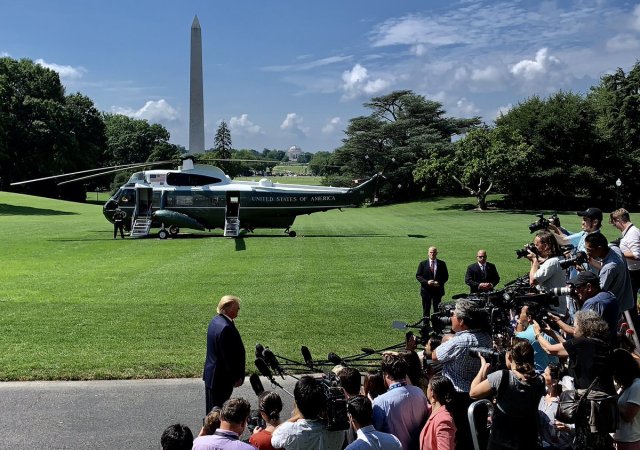
So with that being said, if you have any questions on the trade deal, please. Anything on the trade deal, specifically? Yeah, please.
Q Do you have any predictions about China? Do you expect a whole new offer or any optimism?
THE PRESIDENT: Well, they want to make a deal. They’re down three and a half million jobs since we started doing what we do. And their supply chain is really cracked and broken. And they want to make a deal.
Now, they’re coming to see us on Thursday and Friday. We think there is a chance that we could do something very substantial. Bob, I think you think that. We’ll see what happens. But, in the meantime, we’re taking in billions and billions of dollars of tariffs every month and we’ve never had this. We never took in 10 cents from China and we’re taking in billions of dollars and tens of billions a year.
And on October 15th, as you know, it goes up from — up to 35 — I guess, it goes to 35. It’s going to — it’s going to raise fairly substantially. We could always do it a lot more, but we’ve decided not to.
So that’s the story. And I think that they will — they’re coming to make a deal. We’ll see whether or not a deal can be made, but it’s got to be a fair deal.
Look, we’ve lost $500 billion a year for many, many years on average. If you include intellectual property theft and all of the other things that took place, it’s incredible that past administrations could have allowed it to happen. We’re talking about $500 billion — not million; that’s a lot, too — $500 billion a year, for many years, taken out of our country.
We rebuilt China. They did a great job and I don’t blame them. I told President Xi, “I don’t blame you one bit.” I blame the people that ran this country to allow that to happen. And they understand that. But we don’t let that happen anymore.
So, we’ll see what happens. We’re going to have a very important meeting. And they have their top people coming in. And I have my top people doing the job. And if I don’t think they’re doing a good job, I’ll fire them and I’ll go over and take their place. (Laughter.) Okay?
Yeah, please.
Q On Hong Kong, sir, are the Hong Kong protests linked, in your view, to the China trade negotiations in any way?
THE PRESIDENT: Well, we’d like to see a very humane solution to that. I hope that’s going to happen. And, you know, Hong Kong is very important as a world hub — not just for China, but for the world. And you have great people over there.
I see they’re flying the American flags. They even have signs: “Make China Great Again.” “Make Hong Kong Great Again.” (Laughter.)
And I’m saying, “Get those signs.” But they have, you know, tremendous signage and tremendous — they have a tremendous spirit for our country. They have a lot of American flags, a lot of Trump signs.
I’d just like to see a humane deal be worked out. And I think President Xi has the ability to do it.
I sort of said that I think if he met — he’s a very convincing man, and I think if he met with some of the leaders — that could be one problem, you don’t seem to have a specific leader of the group. But I really think they can do something. We just want to see a humane solution.
Q Did you tell Xi Jinping in any way that you would be quiet about Hong Kong protests during the course of these negotiations?
THE PRESIDENT: No, I didn’t. But I do say that we are negotiating. If anything happened bad, I think that would be a very bad for the negotiation. I think, politically, it would be very tough maybe for us, and maybe for some others, and maybe for him.
But, no, I think that they have to do that in a peaceful manner. It’s — now, I will say, the first time I saw it, if you look — a number of months ago, I saw 2 million people. I’ve never seen anything like it. We talk about crowd size. That was serious crowd size, right? The crowd size is much smaller now, so maybe that’s saying something. But hopefully they can work out something that’s amicable.
Yes, sir.
Q Mr. President, would you accept a partial trade deal with China? There has been some talk today about whether or not it could be headed in that direction.
THE PRESIDENT: Well, it’s a very good question. I think it’s not what we prefer at all. They are starting to buy a lot of our agricultural products. You see that. They’re coming in very strong on pork, also — very, very strong — and in particular. But on other products, that — so, I don’t know if you call that a “partial.” We don’t have an agreement.
My inclination is to get a big deal. We’ve come this far. We’re doing well. Again, the fact that they’ve done what they’ve done with their currency — the devaluation — it really has not increased prices. And now we’re talking China. It doesn’t mean that in all cases that happens; other countries prices increase, but in the case of China that hasn’t happened. And they put a lot of money into their goods. They want to keep their people working. I understand that very well.
But I think that we’ll just have to see what happens. I would much prefer a big deal. And I think that’s what we’re shooting for. Can something happen? I guess, maybe. Who knows? But I think it’s probably unlikely. Okay?
Q Mr. President, on Syria — on withdrawing forces in Syria —
THE PRESIDENT: Yeah.
Q — why are you siding with an authoritarian leader and not our Kurdish allies?
THE PRESIDENT: Well, I’m not siding with anybody. We’ve been in Syria for many years. You know, Syria was supposed to be a short-term hit — just a very short-term hit. And we were supposed to be in and out. That was many, many years ago. And we only have 50 people in that area. That’s a small sector.
And I don’t want those 50 people hurt or killed or anything. I don’t want anything bad to happen to our people. And I told that to President Erdoğan. I said, “Don’t hurt any of our — any of our people get hurt, big trouble.”
Now, a couple of things: I think there’s a lot of pressure on Turkey. They have been fighting with the PKK for many years. They’re natural enemies. If you read today, a couple of reports saying that when President Obama started this whole thing — as you know, it was started by President Obama — he created a natural war with Turkey and their long-time enemy, PKK. And they’re still there. And they’re still hating each other beyond anybody’s belief.
But I have told Turkey that if they do anything outside of what we would think is humane — to use the word a second time; we talk about Hong Kong, we talk about this — they could suffer the wrath of an extremely decimated economy. And I’ve done it once. I did it with Pastor Brunson. You remember the Pastor Brunson? And they wouldn’t give Pastor Brunson back, and they ended up giving Pastor Brunson back pretty quickly. Their currency fell at record levels and lots of other things happened. And it was good. I have a very good relationship with President Erdoğan. I want to see it happen.
I will tell you this though: We defeated ISIS. And when I wanted to — when we were at 96 and 95 and 97 percent, I sort of said, “Let the other countries in the area finish it off.” And I was met with a lot of anger from some people in our country. I said, “All right. I’ll finish it off.” And I got together with our generals. I flew to Iraq. I got together. And we did it very quickly. Far quicker than any general from here told us we could do it. We have some great people over there. They did it quickly.
And I said to the European countries, “You’ve got to take your ISIS…” You know we have 60,000, maybe even 70,000 people — that includes families, that includes wives of fighters that were killed. We have many fighters that were killed in the battles. And we took it. Over 100 percent of the caliphate, I took over quickly. Nobody else was — it was a mess when I came to office. And I think most of you would agree to that. It was a real mess.
I took it over. But then I said, “What are we going to do with these 60- to 70,000 people that are being held and being guarded and we can’t release them?” And many fighters also. And I said, “I want them to go back to Germany, to France, to different European countries from where they came.” And I said to the European countries — I said to all of them, “Take the people back.” And they said, “No, no, no. We don’t want to do it. We don’t them back.” I said, “Well, they came from Germany or they came from France. Take them back.”
And they’re so used to the United States being a sucker, being a fool — we’re talking about billions and billions of dollars. You’re talking about life. You’re talking about so many things, so many elements — and elements of complexity. Because they’re going to walk back into Germany. They’re going to go back into these countries from where they came.
So I said, “Take them back.” And they said, “No.” And then I said again, “I’m going to give you another 30 days. Take them back.” And they kept saying, “No.” Maybe they won’t be saying “no” now. I don’t know.
So I told President Erdoğan, “You got to — it’s going to be your responsibility.” Now, really, who’s responsible — it’s really Russia, it’s Turkey, it’s Iran, it’s Iraq, and it’s Syria, and anybody else in the neighborhood. Okay? We call it the “neighborhood.” It’s not a friendly neighborhood. But these countries should do it.
Now, ISIS is the sworn enemy of all of these countries. Many of them they hate far more than they hate us, and those countries hate them at the same level as we do. They’re — they’re terrible, terrible, savage killers. I said, “Take them back.”
But these countries are rich, in most cases. They’re powerful. They’ve got armies. They can do the work. But we’re not bringing 50-, 60-, 70-, or even 10,000 people to Guantanamo Bay in Cuba. We’re not going to paying them for the next 50 years, or paying to take care of them for the next 50 years. So we told Europe — we did a great service to the world. And we did a great service to Europe in particular, where so many of these fighters came from.
We said, “Take them back.” And, you know, unfortunately, like NATO, they take advantage. NATO, as you know, I got the Secretary General [DEL: Stolheim :DEL] [Stoltenberg] said — and, I think, very loudly — the Secretary General of NATO, said that because of what I did, they have paid over $100 billion more money toward NATO defense. But that’s still not enough, okay? It’s still not enough. Not fair. Because United States pays far too much, relative. And obviously, NATO affects them more.
But, like NATO, like trade with the European Union, which is a very tough group to trade with — very, very tough group. Almost as tough as Japan — not quite. (Laughter.) But they are a very tough group to trade with. They take advantage. And I said, “Look, you take them back. We’re not — we’re not going to do this. We’re not going to put in Guantanamo Bay and put them all over our prisons.”
So, right now, we’re at a position where, if Turkey does anything out of what they should be doing, we will hit them so hard on the economy. But when you talk about soldiers — we only had 50 soldiers in the area. I think the area was — it’s a very small area and — very small area. But we only had 50 soldiers there. I don’t want them to be in a bad or compromising position.
And I will tell you this: Everybody respects our country again. If we want to go in, if we have to go back for any reason — because bad things happen. But we’re 7,000 miles away. These ISIS people — whatever you want to call them — these people are right there. They’re right there. They’re touching many of these countries that I just named. Iran, as an example, hates ISIS. And ISIS hates Iran. Iraq, you know all about that. Turkey, Syria — let them take care of it. Let them take care of it.
We want to bring our troops back home. It’s been many, many years. It’s been decades, in many cases. We want to bring our troops back home. And I got elected on that. If you go back and look at our speeches, I would say, “We want to bring our troops back home from these endless wars.”
And we’re like a police force over there. We’re policing. We’re not fighting; we’re policing. We’re not a police force. We’re the greatest military force ever assembled because of what I’ve done over the last three years with $2.5 trillion, Mr. Ambassador, we’ve spent on our military — $2.5 trillion.
But we’re not going to be there longer. And we’re going to be watching Turkey and we hope that them and all of the other countries — or some of the other countries, including the European Union — goes in and does whatever they’re supposed to do with these captured ISIS fighters and families. Okay?
Q Mr. President, a number of Republicans, including — including Nikki Haley and Lindsey Graham and Mitch McConnell were very critical of this decision today. Mitch McConnell put out a statement saying, wish you would recon- — exercise leadership and reconsider, and suggested not doing so would be reminiscent of what the Obama administration would do. Would you respond to that, sir?
THE PRESIDENT: Yeah.
Q And also, did you –
THE PRESIDENT: Sure.
Q Did you consult with the Joint Chiefs of Staff when you made this decision?
THE PRESIDENT: Sure. I consulted with everybody. I always consult with everybody. If you remember, about eight months ago, I talked about doing this. And we kept 2,000 people there, and then slowly brought them out. But once we captured ISIS, I didn’t see — I don’t want to stay there for the next 40 years. It’s not going to do anything. The end game is going to be the same.
I have great respect for all of the people that you named. And they have their opinion, and a lot of people do. And I could also name many more than you just named of people that totally are supportive. You see the names coming out; people are extremely thrilled because they say it’s time to bring our people back home. We’re not a police force. They’re policing the area. We’re not a police force.
The UK was very thrilled at this decision. As you know, they’re over there — they have soldiers over there also. And others. But many people agree with it very strongly. And I understand both sides of it. I fully understand both sides of it. But I campaigned on the fact that I was going to bring our — our soldiers home, and bring them home as rapidly as possible.
I, we, all together, you — we defeated and took over 100 percent of the ISIS caliphate. Everybody said that was going to be an impossible thing to do. I did it, and I did it quickly because we have a great military now.
When I took over our military, we didn’t have ammunition. I was told by a top general — maybe the top of them all — “Sir, I’m sorry. Sir, we don’t have ammunition.” I said, “I’ll never let another President have that happen to him or her.” We didn’t have ammunition.
Now, we’ve captured ISIS. We’ve done what we’ve done. We had 50 soldiers in the area you’re talking about. And I said, “We want to bring our soldiers back home. It’s been a long time.”
Again, we were supposed to be in there for a — just a tiny spot. Like, a 30- to 90-day period. That was many years ago. It’s time.
Q Mr. President, the Kurds themselves have lost thousands of fighters in battling ISIS.
THE PRESIDENT: That’s true. And we’ve lost a lot of fighters, too.
Q Can you guarantee their safety?
THE PRESIDENT: Well, we’re going to try. If you look at some of the Kurds, as you know, that was — that’s a natural enemy of — of Turkey. It’s — you know, specifically, as I said. I mean, they have natural enemies. They’ve been fighting each other for — somebody said, today — hundreds of years. I mean, one historian said they’ve been fighting for hundreds of years.
We interject ourself into wars, and we interject ourselves into tribal wars and revolutions and all of these things that are very — they’re not the kind of thing that you settle the way we’d like to see it settled. It just doesn’t — it just doesn’t work that way. But hopefully, that’ll all be very strong and strongly done.
We’re spending tremendous amounts of money. I can tell you, the two countries that are most disappointed that we’re leaving are China and Russia because they love that we’re bogged down and just watching and spending tremendous amounts of money instead of continuing to build our forces.
We have tremendous new weapons under development now. We have weapons that nobody can even believe. We’re going to be making some stops over the next four or five weeks. Some we show, some we don’t show.
But we’ve rebuilt our nuclear. We’ve renovated and rebuilt nuclear. We’re building submarines the likes of which has — they’ve never been even thought of before, the genius of them. Hopefully and hope to God we never have to use them.
But we are doing what we have to do. But we’ve been there for many years. Long — many, many, many years beyond what we were supposed to be — not fighting, just there. Just there. And it’s time to come back home.
But I can understand the other side of it. But if you go by the other side, that means we should never, ever come home. We should never, ever come home.
And, you know, I have to sign letters often to parents of young soldiers that were killed. And it’s the hardest thing I have to do in this job. I hate it. I hate it. Afghanistan. I signed one the other day — Iraq, Syria. They get blown up by mines. They get taken out by a sniper. And I have to write letters to people. And we make each letter different. Each person is different. And we make them personal. But no matter what you do, it’s devastating. The parents will never be the same. The families will never be the same. People are killed. Many people are still being killed. It’s going to go on that way for perhaps a long time.
And we’re willing to do what we have to do, but there has to be an end game. And if you stay, it’s going to be the same thing. Eventually, you’re going to have to leave. It’s going to be the same thing.
So, I think what we’re doing is the right thing. A lot of people agree with me. A lot of people agree with me. And again, you go back and see my speeches, a big part of my speech and always — when I won what some people consider to be a surprise election — now I just see a poll that just came out where I’m up massively with independent voters. I don’t know if it’s this or because of the hoax, you know, that’s going on with Nancy Pelosi and her — her friend, Adam Schiff. He’s another beauty. He got caught lying all over the place. He doesn’t know what to do. He’s a mess. Right now, he’s a mess. And everybody knows it. Just all you have to do is a little good reporting, you’ll see he’s a total mess because he got caught.
But, you know, we have to do the right thing for our country, whether it — whatever it may be. And I just think that’s the right thing. I respect both opinions. The problem with the other opinion is: When do we leave? When do we leave? We’re going to stay there forever?
Yeah, Jeff.
Q Mr. President, the White House Counsel’s Office is preparing a letter to —
THE PRESIDENT: Yeah.
Q — to Speaker Pelosi about the impeachment inquiry. What do you hope to achieve with that letter?
THE PRESIDENT: Well, first of all, the impeachment inquiry is a scam. The conversation that I had with the Ukrainian President Zelensky was a very good conv- — it was a very cordial, very good conversation. The mistake they made — the opponents, the opposition, the Democrats, the radical Left, deep state, whatever you want to call them — they came out with a whistleblower report before they saw the conversation.
Had they waited one day, Nancy Pelosi wouldn’t have made a fool out of herself, and she would have been able to say what I said. Because when she saw it, she said, “This is not what the whistleblower said.” I had a very, very congenial, nice conversation with a man that I like. And he ran on corruption. Because, as you know, Ukraine is known as a very corrupt country — one of the most in the world, shockingly, because I know Ukrainian people. It’s surprising to me. But it’s known as one of the most corrupt countries.
And under the past leadership, it was having a lot of difficulty. This gentleman — the current President, the new President — ran on the basis of anti-corruption, as you know. I think it was his single-biggest thing. And we had a great conversation, but it wasn’t reported that way. The only reason I would have released a letter — because I think it’s terrible to have to release a letter that you have with the leader of a country. I think it’s a terrible precedent.
But the whistleblower report or whatever the news was, was so off. It was so horrible. I said, “I never said that.” I said, “Let me see it.” We have a stenographer report. We have a very, very word-for-word report of what I said; I released it. And almost everybody that read it said it’s either perfect or really very good. But it’s a very normal, nice conversation.
And when you see that the President of Ukraine, President Zelensky, said, “There was no pressure put on me whatsoever.” His spokesman came out two days ago — said there was absolutely no pressure put on the President. I didn’t tell him to say that. There was no pressure put on him. All you have to do is read the report.
The problem is, I released it a day after they had already made their big statements. And again, it’s a big scam. And I think Adam Schiff should be investigated for what he did. He took to the great Chamber — Congress — and he made a speech. And his speech was a fraud. Everything he said was a fraud. He went out as though I wrote it. He defrauded the American people. He defrauded Congress. He defrauded himself and his family. He made a speech as — it was a horrible speech. I said, “What is this go- — what’s going on here?” I think he’s having some kind of a breakdown. Because he got up and made a speech that bore no relationship to what the conversation was.
And I’ll tell you, a lot of people heard that speech and a lot of people thought that’s what I said because they heard his speech. Because they’re not going to read a three- or four-page conversation. They don’t have access to it. But I thought it was one of the — I thought it was a terrible thing, where he’s going up speaking as the President of the United States, saying things that I never said. And the meaning was horrible. And the whole thought was horrible.
And then, the whistleblower, he did — through his committee, through himself — he met with a whistleblower. They never said that. They never talked about it.
And Nancy Pelosi knew all of this stuff. I mean, she’s as guilty as he is because she knew all of that. She knew everything about it. And she didn’t do anything about it.
And I’ll tell you what: They should really be looked at very strongly because what they did is unthinkable. What they did to this country is unthinkable. And it’s lucky that I’m the President, because I guess — I don’t know why — a lot of people said very few people could handle it. I sort of thrive on it. You know why? Because — because it’s so important that we get to the bottom.
We went through the whole Mueller scam — two and a half years. We went through that. And I had three, four days where it was, like, over. And then I’m walking into the United Nations, and they released it as I’m walking in, Mr. Ambassador. I’m walking in. I’m going to meet with — I won’t name, but one of the top leaders of the world. And I see up on the screen and people start screening about this scam called “impeachment.”
You can’t impeach a President for doing a great job. You can’t impeach a President for having the lowest and best unemployment numbers that we’ve had in 51 years. You can’t impeach a President for tax cuts and regulation cuts and creating — and even the Ambassador would say — the strongest economy in the world. We have the strongest economy in the world.
This is a scam. And the people are wise to it. And that’s why my polls went up, I think they said, 17 points in the last two or three days. I’ve never had that one. I’ve never had that one.
So, I think it’s very sad for our country. I think it makes it harder to do my job. But I do my job, and I do it better than anybody has done it for the first two and half years, based on results. I mean, you look at not only the unemployment numbers — look at the employment numbers, Jeff. We have — we’re up to almost 160 million people are working.
And now, today, we’ve signed the deal with Japan, which is such an honor. And you have a great country — a great, great country. And to have you partake in our agricultural product and digital is a real honor for me.
So thank you very much for coming all this distance and — to be here. And I look forward to seeing you for many years to come. Please, again, wish Prime Minister Abe a happy birthday. He’s a very special man. Thank you. Thank you very much. Thank you. (Applause.)
WH Livestream Link – Fox Business Livestream – Fox News Livestream
.
.


 “By 1939, the French had been preparing for and were content to fight a total, defensive, attritional war. They could see no other way to defeat a German offensive; this was, after all, how they had emerged victorious from the terrible conflict twenty years earlier….[T]here was neither the strength of leadership nor the political stability to indulge in the sort of long-term thinking that was required for a bespoke, flexible military machine that perfectly fitted the country’s strategic requirements” (pp. 382-383, “Blitzkrieg: Myth, Reality, and Hitler’s Lighting War: France 1940,” Lloyd Clark, Atlantic Monthly Press, ©2016.)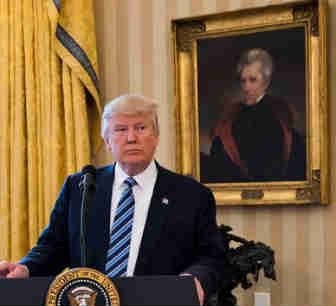



 Centinel2012