Syria and Israel Mend Ties


Posted originally on Jan 7, 2026 by Martin Armstrong |  

Syria.US_.Trump_

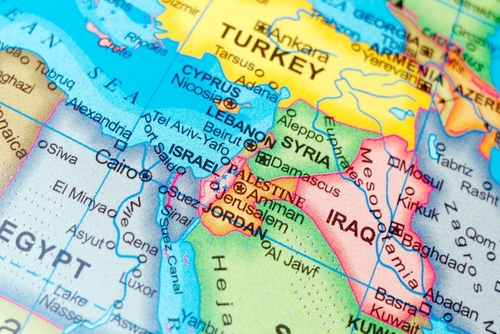
Syria has agreed to create an intelligence network with the United States and Israel. Syrian President Ahmed al-Sharaa, a former Sunni jihadist and known terrorist, became a CIA asset after he was captured while fighting for Al Qaeda in Iraq. I explained on numerous occasions that he was compromised and installed into his position by the CIA; Syria’s new alignment with Israel should not come as a shock.

Steve Witkoff, Jared Kushner, and Tom Barrack represented the US envoy for Syria during the Israel-Syria meeting in Paris this week. Washington reported that the meeting went as intended, with Israel and Syria agreeing to a  “fusion mechanism” by which they will share intelligence, diplomatic engagement, military de-escalation, and commercial issues.

For decades, Syria and Israel have technically been at war. That hostility has been useful politically for both sides. It justified military budgets, internal repression, and foreign alliances. This development reiterates what the computer has warned: the Middle East is fragmenting into blocs, and the old Cold War alignments are collapsing.

Middle East Map 2

Reports have emerged that Iranian officials are seeking to assassinate al-Sharaa. Al-Assad’s former military intelligence chief, Major General Kamal Hassan, is building a militia among Syria’s Alawite minority community, according to a December 2025 Reuters report. The ousted dictator’s billionaire cousin, Rami Makhlouf, has been financing Hassan’s efforts. Feared special forces commander Suhail al-Hassan, known as “The Tiger,” has been recruiting thousands of men to oppose al-Assad and retake control.

Syria is no longer beholden to Iran as its new financiers are from the West. Russia is no longer policing the region and the US has a stronghold over Syria. This alignment is temporary and a precursor to a larger regional conflict on the horizon.

Monday Should Be Really Interesting – And Other Random Stuff


My grandpa, and later my father, used to say something at particular moments that generally annoyed me but turned out to be entirely accurate, much to my youthful angst… “Well, hang around a one-legged group long enough, and you’re eventually going to end up limping.”

Yup, I learned to hate that lesson because the truth of it was always annoying.

This is perhaps the first time in memory when I look forward to Donald J Trump getting out of the Mar-a-Lago bubble and back to Washington DC.  Good grief, just typing that I can’t believe I’m saying it.  Here’s why:

Having followed and written about the optimal solution approach within the Trump Doctrine, a process that assigns responsibility to regional actors, then exits while providing support but not direct involvement [the delegation metric of high-support/low-direction], perhaps that is unfolding again in the background.  However, it seems like Trump is accepting the annoying Iran monkey problem on our behalf. [REF: How to Make The Monkey Jump]

To be clear in my personal position, charity begins at home.  (1) I don’t want conflict with Iran, nor do I really care about their internal political struggles; most of my day-to-day contacts feel the same. (2) At the same time, yes, I can imagine a scenario where Venezuela represents a threat to our continental objectives and national security, but would prefer to see them isolated from the outside.  Embargo them, stuff them inside an economic confinement zone (if needed), tell them why, then let the internal mess work itself out; most of my day-to-day contacts seem to feel the same.

Granting President Trump the long view of support; I mean, we don’t know what he is aware of; I sure hope all of this Iran stuff has a direct connection to American strategic interests.

Simultaneously, I can certainly see where deconflicting the USA, vis-a-vis Ukraine (literally London and the EU) from friction with Russia, has a strategic interest and factual bearing on the dollar-based trade system.  Attention on the Ukraine vs Russia stuff does have direct, albeit complicated outcomes attached to the economic standing of the average American.  Iran less so.

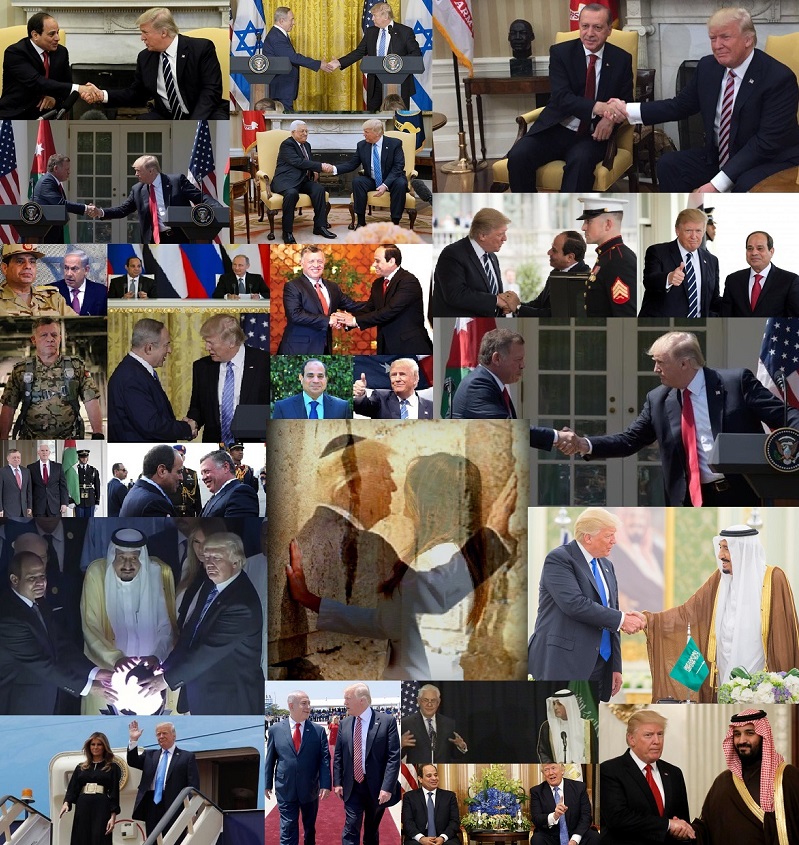
Pictured Center: a one-legged man.

Pictured Center: a one-legged man.

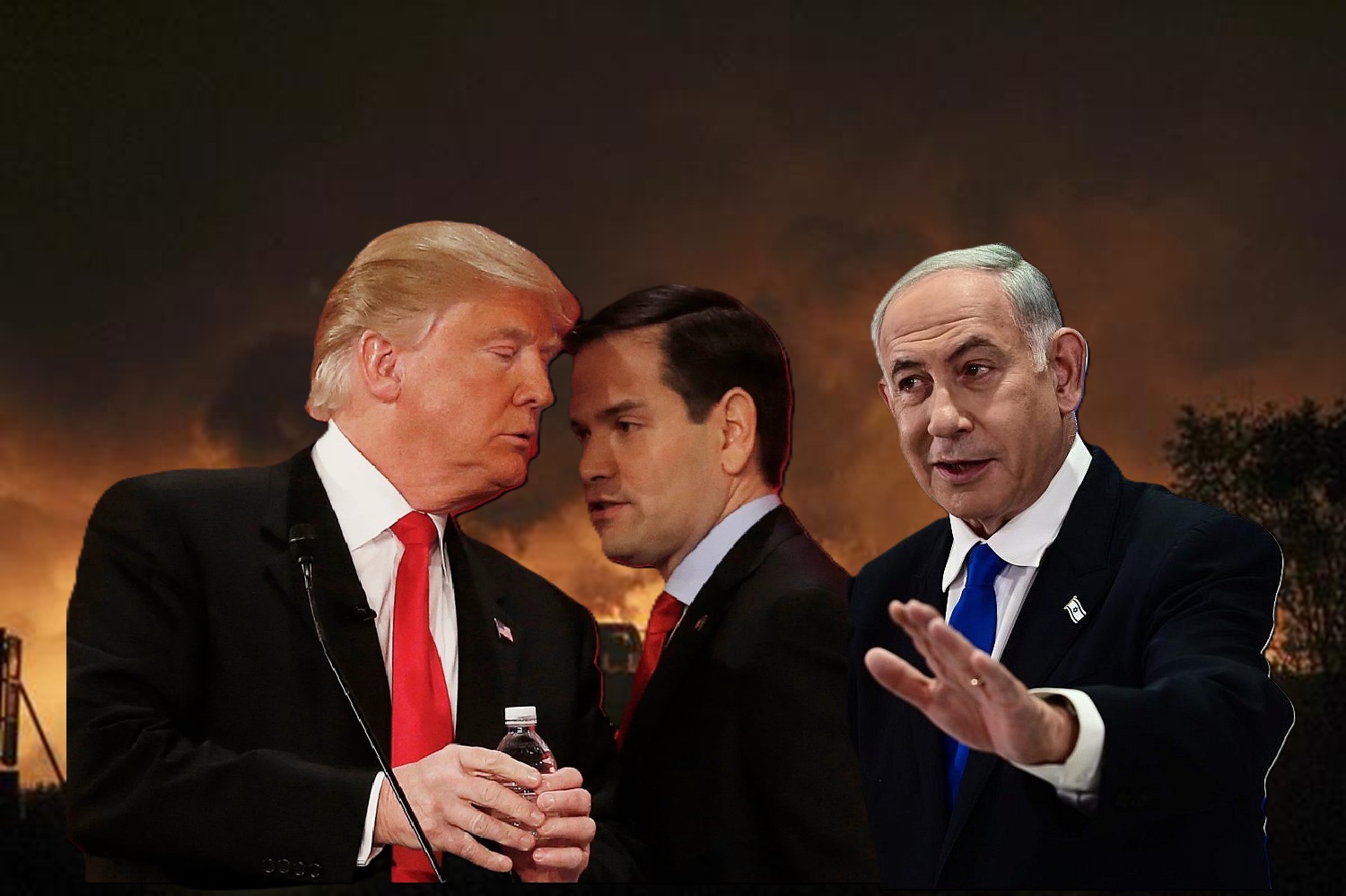
Looking at it from a geopolitically logical approach…. President Trump and Marco Rubio need Syria to remain stable.

Secretary Rubio has explained this aspect very well when he summarized the reason for President Trump lifting the sanctions against Syria.  I get that part.  But is this “locked and loaded” simply a brush back pitch against Iran to stop them from disrupting Trump’s Gaza objective.  Maybe so, it does make sense; thus, we extend the benefit of doubt.

If Syria destabilizes the tenuous Israel/Gaza stuff gets more complicated.  Iran can destabilize Syria. Therefore, putting pressure on the Iranian regime while simultaneously telling Israel to cool it over their Turkish opposition to the Gaza assist again does make sense.

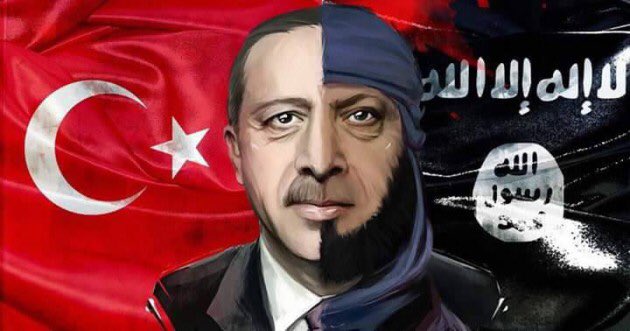
Benjamin Netanyahu dislikes Recep Erdogan immensely and doesn’t trust him an inch.  I get that part also, but Turkey is a weird place held together by Erdogan’s very specific brand of Muslim Brotherhood patriotism.

In very direct ways keeping Syria stable helps Turkey and by extension the EU.

If Syria erupts, the refugee exodus heads north, and cunning Erdogan – a tenuous NATO member  seemingly never giving up on his Ottoman Empire rebuild – will play his “I can only absorb so much” card, thereby opening the gates for more authentic Islam travel further north into Europe.

[Our solid contacts in Istanbul have confirmed around 5 million Syrians have repatriated since President Ahmed al-Sharaa started his agenda to stabilize the region. The busy former al-Qaeda guy, 43-years-old, is also a bridge between Trump and Putin. So, there’s that.]

Keeping Syria stable also permits Trump’s Arab state coalition to deal with Gaza/Hamas in a constructive way. Trump told Netanyahu this publicly during the recent visit, essentially rebuking Israel’s justification for more IDF military action in Gaza.  Again, President Trump is dancing through the minefield here with the long game to get us the f**k out of it, while Netanyahu is hugging Trump to pull the USA deeper into it.

If you understand the Iranian tentacles that still remain in Syria (see recent ISIS attacks), confronting Iran makes Israel very happy; however, it’s not Netanyahu’s happiness that stands behind Trump’s motive for the confrontation.  Ultimately, the motive is Syria’s stability, Turkish Gaza support and the Arab money/engagement needed for the Mideast mess.

If our suspicions are correct, we should see Team Trump leaning toward Recep Erdogan, toward the Arab coalition and toward Syria at the same time he is managing Iran, managing Israel and managing a U.S. congress.

If the Ayatollahs are busy tamping down street protests, they are less likely to be poking Syria.

All of that is giving President Trump the maximum benefit of the doubt combined with the application of common sense.

♦ Meanwhile inside Russia, you might not hear about it from western media, but Ukraine and NATO are striking non-military targets, civilian areas, throughout Russia currently focusing heavy drone fire at Kazan, Russia’s third largest city.

STATE DEPT: “There have been drone attacks and explosions near the border with Ukraine, and in Moscow, Kazan, St. Petersburg, and other large cities.

Russian citizens are now very familiar with the sound of air raid sirens as increased drone attacks from Ukraine are extending into Russia.  This noticeable increase in activity is happening in combination with U.S/Ukraine strategic discussions on an EU created ceasefire agreement.

The Rubio state department has now updated the Russia advisory summary warning all Americans of the danger in traveling throughout Russia.

The update is also timed with the increased drone attacks into Russia’s main population centers and is likely due to concern that Americans would be street targets for angered Russian nationalists.

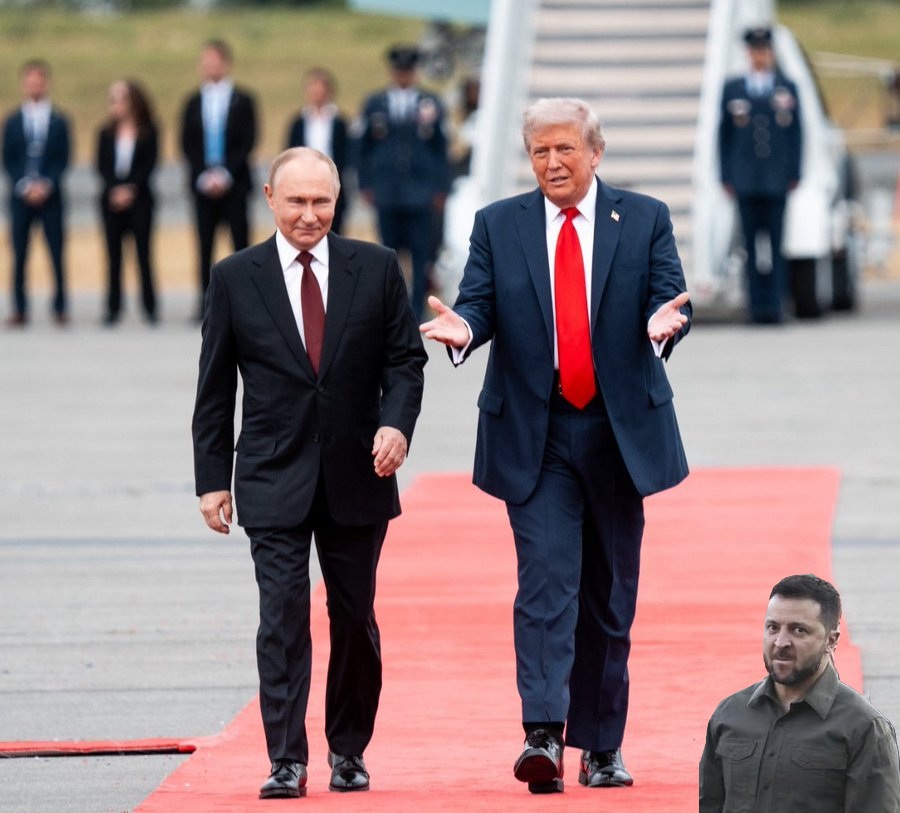
If President Trump walks away from the EU/Ukraine peace agreement construct, Russian Federation President Vladimir Putin will likely increase retaliatory attacks against Ukraine by significant levels.   One of my good contacts shared, “if Trump walks away, Kiev will now be leveled.”

Apparently, despite the incoming fire increasing, Putin is holding back his response to give Trump room to operate, while still carefully managing the Kremlin politics and striking into Ukraine to appease those in Russian government who want the full weight of the Russian military to come down hard on Zelenskyy.

…”If Trump walks away, Kiev will now be leveled.” 

Joint Statement from U.S Negotiators, Arab Partners, Turkey and Gaza Officials on Next Steps in Peace Plan


Posted originally on CTH on December 21, 2025 | Sundance

President Trump Special Emissary Steve Witkoff relays this official statement following meetings with U.S. Negotiators, Arab state partners, Turkey and Gaza officials about the next phase in the Israel-Gaza peace plan.

STEVE WITKOFF – “We, the representatives of the United States of America, the Arab Republic of Egypt, the State of Qatar, and the Republic of Türkiye, met yesterday in Miami to review the implementation of the first phase of the Gaza ceasefire and to advance preparations for the second phase.

The first phase has yielded progress, including expanded humanitarian assistance, the return of hostage bodies, partial force withdrawals, and a reduction in hostilities.

In our discussions regarding phase two, we emphasized enabling a governing body in Gaza under a unified Gazan authority to protect civilians and maintain public order.

We also discussed regional integration measures, including trade facilitation, infrastructure development, and cooperation on energy, water, and other shared resources, as essential to Gaza’s recovery, regional stability, and long-term prosperity.

In this context, we expressed our support for the near-term establishment and operationalization of the Board of Peace as a transitional administration for the civilian, security, and reconstruction tracks of the reconstruction. We reviewed next steps in the phased implementation of the Comprehensive Peace Plan for Gaza, underscoring the importance of sequencing, coordination, and effective monitoring in partnership with local Gazan institutions and international partners.

We reaffirm our full commitment to the entirety of the President’s 20-point peace plan and call on all parties to uphold their obligations, exercise restraint, and cooperate with monitoring arrangements. Further consultations will continue in the coming weeks to advance the implementation of phase two. (source)

It always seems odd to write Turkey, Egypt and Qatar working collaboratively when you consider the history of their rather oppositional relationship regarding the Muslim Brotherhood.  However, this collaboration highlights the nature of a very historic assembly for peace that President Trump was able to put together.

Secretary Rubio recently spoke about the current Gaza status:

QUESTION: Thank you. Returning to Gaza, what is the U.S. understanding of what Hamas is willing to concede on disarmament? Reports suggest that Hamas might hand over its heavy weapons but retain its smaller arms. Is the U.S. prepared to accept partial disarmament as sufficient in phase two?

SECRETARY RUBIO: Yeah, I’m not going to get into the details of those types of negotiations. Let me just couch it to you this way: Everyone wants peace. No one wants a return to a war. If Hamas is every in a position in the future that they can threaten or attack Israel, you’re not going to have peace, okay? You’re not going to convince anyone to invest money in Gaza if they believe another war is going to happen in two to three years. So, I would just ask everyone to focus on what are the kind of weaponries and capabilities that Hamas would need in order to threaten or attack Israel as a baseline for what disarmament needs to look like. Because you’re not going to have peace. If two years from now Hamas is launching rockets or killing Israelis or carrying out, God forbid, another 7th of October type terrorist attack and so forth, you’re not going to have peace. So, who is going to invest in a peace, who is going to invest in rebuilding a place, that’s going to get destroyed again in a future war? So that’s why disarmament is so critical.

Now, what that entails, we’re going to leave that to the technical teams to work on. It would have to be something obviously that they’re willing to agree to that our partners can push them and pressure them to agree to. It also has to be something that Israel agrees to. In order for that to work, both sides have to agree on it, and we need the space to do it. But that’s the way to think about it, okay? You cannot have a Hamas that can threaten Israel in the future. If they can, you won’t have peace. So that’s the goal.

QUESTION: Thank you, Mr. Secretary. You said a few moments ago that everyone wants peace for Gaza, and yet by any metric the Israelis are flouting the ceasefire that President Trump negotiated by killing an average of two children a day, not allowing the agreed-upon humanitarian aid into Gaza. How long can this continue? How long can the Israelis be allowed to show such disrespect to President Trump?

SECRETARY RUBIO: Well, look, that’s your characterization of it about the term “disrespect.” What I would say is this. This – we – this was – first of all, it was a miracle that it happened in the first place. We all understand how difficult it was for that to come to the conclusion that it did, where the actual – the bombing and everything else, the scale and scope of what we saw ended, all the hostages were released, and we have relative peace right now for the most part, despite the things you’re pointing to. That was very difficult.

But this is not easy. Peace is a verb. It’s not – it’s an action. It’s not a sentiment. Every single day will bring challenges. Every single day. We also have had instances, for example, over the last couple weeks where Hamas elements emerged from a tunnel, attached an explosive device to the side of a vehicle, and injured and almost killed Israeli soldiers. We still have this threat. We still have and see every single day Hamas openly taking steps to strengthen themselves with – inside of those places in Gaza that they still control. We saw early on the atrocities they were committing in the streets against people as they were trying to show people how strong they were.

So, I don’t think I’m standing here to tell you this is going to be easy. This is an hour-by-hour, day-by-day challenge. It’s one of the reasons why we have stood up this center there in – operating in Israel in partnership as well with another cell that exists in a regional country. It’s why every single day there are leading – there are meetings among both intelligence, diplomatic, and military officials of multiple countries that helped bring about this deal to manage this. And that’s why it is so critical, it is so critical and so key, that we move to complete this first phase, that we move to put in place the Board of Peace, get everybody to agree to be a part of it, move to put in place this Palestinian technocratic organization so that they can begin to provide some governance structure, and move to put in place the stabilization force.

That’s the goal here. But it’s not going to be easy. Every day will bring new challenges to that, and we recognize those challenges are coming from all sides.

QUESTION: Very quick follow-up. Who’s going to be – want to be a part of a stabilization force if Israel is effectively using Gaza as a free fire zone?

SECRETARY RUBIO: Well, these are the things we – that’s – these are the things that we’re working through right now. Again, that’s why it didn’t happen yesterday. That’s why we didn’t – I don’t mean yesterday literally. That means why we’re not there yet. This is the hard work of diplomacy and peacemaking. Peacemaking isn’t just signing a piece of paper. It’s actually complying with it. And compliance oftentimes requires – in many cases, in most cases requires – daily, constant follow-up and nurturing.

So that is why we are in such a hurry – and I say as a priority – to get to this point where we have the stabilization force in place overseen by the Board of Peace and ultimately a Palestinian technocratic entity that can increase in its capability to provide governance. The stronger they are, the weaker Hamas will be in terms of threatening Israel, and I think the more security Israel should feel and less need for some of these things to happen.

But no one is claiming this is going to be easy. We have to work on this every single day. We have people in this building and deployed abroad – this is all they do 24 hours a day, day after day, elements of the State Department, the Department of War, and all other agencies, and including Jared and Steve and even myself who talk or do something about – there isn’t a day in the last since we – this was signed two months ago – that haven’t had to do something with regards to making progress on the phases of the ceasefire.

[SOURCE]

President Trump Warns of “Very Serious Retaliation” Following ISIS Attack in Syria Killing Three Americans


Posted originally on CTH on December 13, 2025 | Sundance 

Two U.S. National Guard servicemen were killed along with a U.S. civilian interpreter in an ISIS attack in Syria.  Three additional American troops were wounded. President Trump said during an impromptu presser at the White House, the three wounded Americans “seem to be doing pretty well.” The U.S. military said the gunman was killed in the attack. Syrian officials said the attack also wounded members of Syria’s security forces.

Posting on Truth Social, President Trump:  “We mourn the loss of three Great American Patriots in Syria, two soldiers, and one Civilian Interpreter. Likewise, we pray for the three injured soldiers who, it has just been confirmed, are doing well. This was an ISIS attack against the U.S., and Syria, in a very dangerous part of Syria, that is not fully controlled by them. The President of Syria, Ahmed al-Sharaa, is extremely angry and disturbed by this attack. There will be very serious retaliation.” 

.

(VIA AP) – […] The shooting took place near historic Palmyra, according to the state-run SANA news agency, which earlier said two members of Syria’s security force and several U.S. service members had been wounded. The casualties were taken by helicopter to the al-Tanf garrison near the border with Iraq and Jordan.

Syria’s Interior Ministry spokesman Nour al-Din al-Baba said a gunman linked to IS opened fire at the gate of a military post. (more)

History Unfolding – President Trump, Mideast Coalition and Prime Minister Netanyahu Announce Gaza Peace Deal


Posted originally on CTH on October 9, 2025 | Sundance

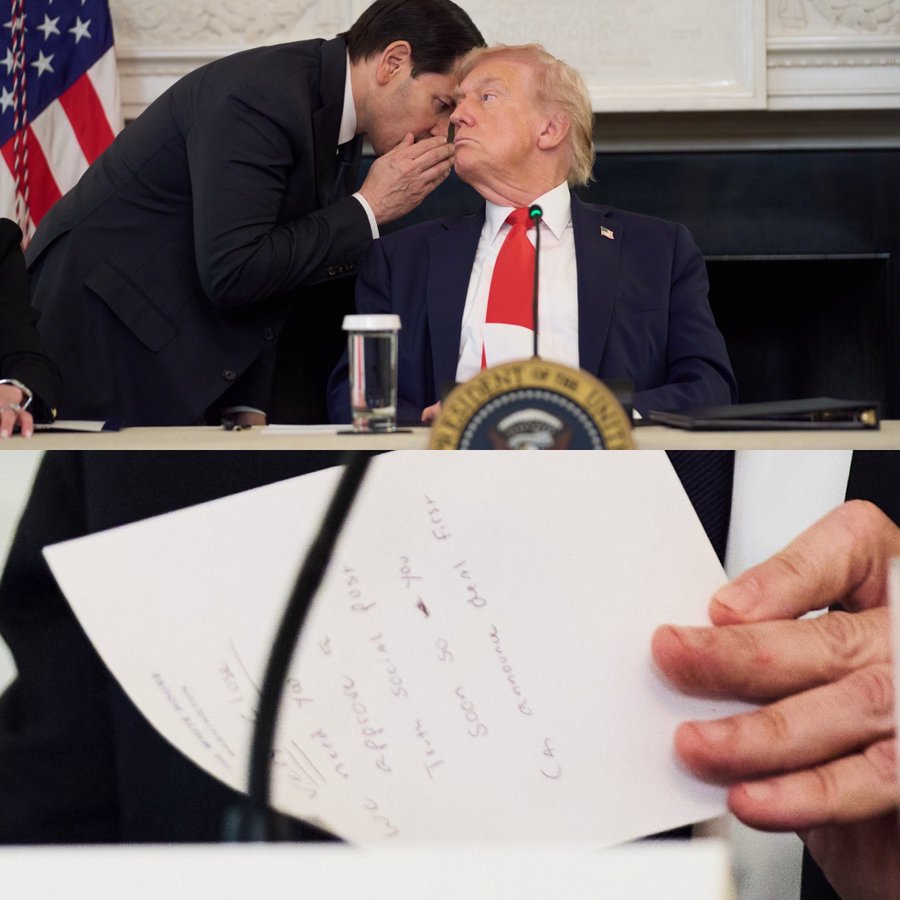
In a remarkable moment of transparent diplomacy, President Donald Trump and Secretary of State Marco Rubio were simultaneously working on a Gaza peace agreement while conducting a domestic security roundtable event at the White House.

The cameras were rolling when President Trump stated the negotiation team was close to an agreement. WATCH:

Evan Vucci of the Associated Press captured an image of Rubio’s note, which read: “Very close. We need you to approve a Truth Social post soon so you can announce deal first.” Shortly after the roundtable event, President Trump shared the results of the discussions taking place in Egypt.

I am very proud to announce that Israel and Hamas have both signed off on the first Phase of our Peace Plan. This means that ALL of the Hostages will be released very soon, and Israel will withdraw their Troops to an agreed upon line as the first steps toward a Strong, Durable, and Everlasting Peace. All Parties will be treated fairly! This is a GREAT Day for the Arab and Muslim World, Israel, all surrounding Nations, and the United States of America, and we thank the mediators from Qatar, Egypt, and Turkey, who worked with us to make this Historic and Unprecedented Event happen. BLESSED ARE THE PEACEMAKERS!”

~DONALD J. TRUMP, PRESIDENT OF THE UNITED STATES OF AMERICA

WASHINGTON DC – […] Prime Minister Benjamin Netanyahu, called it “a great day for Israel” and thanked the Israel Defense Forces and the U.S. president.

“Tomorrow I will convene the government to approve the agreement and bring all our beloved hostages home,” he said in a statement. “I extend my gratitude to the brave IDF soldiers and all the security forces, whose courage and sacrifice have brought us to this day.”

He signaled support for a longer-term agreement, saying “With God’s help, together we will continue to achieve all our goals and enhance peace with our neighbors.” (more)

For the past several days U.S. Special Envoy Steve Witkoff and Trump’s son-in-law Jared Kushner have been in Egypt conducting negotiations with Qatari Prime Minister Sheikh Mohammed bin Abdulrahman bin Jassim Al-Thani and Ron Dermer, the head of Israel’s negotiation team and a close confidant of Netanyahu.  The Hamas delegation was led by Khalil al-Hayya, a senior Hamas official.

The agreement represents a significant diplomatic accomplishment by the Trump administration, and -if it holds- this will mean the end to two years of bloodshed and a spiraling humanitarian catastrophe.

As noted by Politico“A Qatari official also heralded the agreement in a post on X, writing that the two sides agreed late Wednesday “on all terms and mechanisms for implementing the first phase of the Gaza ceasefire agreement, which will lead to stopping the war, releasing Israeli detainees and Palestinian prisoners, and allowing aid to enter. The details will be announced later.”

In recent weeks, Trump worked closely with Qatar in particular to unify other Arab allies behind his peace plan and to help convince Hamas officials to accept the deal.

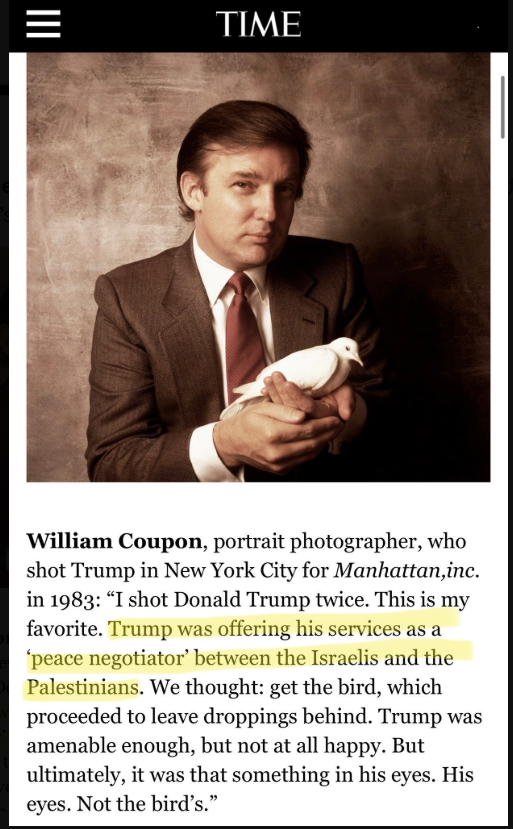
Throughout the non-political life of Donald Trump, he has always expressed an interest in solving the continual conflicts in the Middle East.  Now, 40 years later as President of the USA, this remarkable objective could potentially be within grasp.

“Peace is the prize”

President Donald Trump and Secretary Marco Rubio will likely head to the region this weekend to participate in a remarkable peace agreement signing ceremony.

BANNON: The Moment Netanyahu Takes Orders As Head Of A U.S. Protectorate, AIPAC Moves To Install Its Own Man. Ted Cruz


Posted originally on Rumble on By Bannon’s War Room on: October, 07, 2025

POSOBIEC: Trump Isn’t Going Through Qatar Or Playing Mediator Games; He’s Going Straight To Israel And Hamas With One Message: Sit Down, Stop It, And Fix This


Posted originally on Rumble on By Bannon’s War Room on: October, 06, 2025

Italy at a Standstill Over Gaza Protests


Posted originally on Oct 7, 2025 by Martin Armstrong |  

American news outlets are not reporting that Italy has come to a complete standstill over the Gaza protests. Millions of Italians took to the streets after Israel seized the Sumud flotilla. The Italian military was initially guiding the flotilla until it was forced to standby.

Four Italian opposition politicians from the Five Star Movement, Greens, and Left Alliance (AVS) were among those detained, and around 20 of the activists detained by Israel were of Italian origin. Dock workers in Genoa, Naples, Livorno, Ancona, and other ports will not touch any shops bound for Israel. CGIL and USB, the largest unions in Italy, called for a general strike on October 3. The protest spread like a contagion across the nation to over 100 cities.

Public transportation is not available. Flights are grounded. Schools and universities temporarily shut their doors. Hospitals are operating at minimal capacity as workers simply walk out. In Rome alone, over 300,000 people marched from Piazza Vittorio to Porta Maggiore demanding freedom in Gaza, but it is believed at least one million people descended on the nation’s capital overall. Over 100,000 protestors in Bologna blocked the A14 motorway. Another 80,000 men and women marched through the streets of Milan. Organizers stated 50,000 people took to the streets in Turin and another 40,000 in Genoa. This movement spread extremely rapidly with little notice. There were existing grievances against the Italian government, clearly, and Italian authorities are simply outnumbered.

Transport Minister Matteo Salvini responded by warning the organizers will “pay personally” for beginning the massive unrest, adding “if violence prevails, the state will react.” Georgia Meloni mocked the protests, brushing them off as “a long weekend disguised as revolution.” Strikes blocking transportation in Italy are commonplace, but not of this magnitude. “Today, 1 million Italians will be left stranded on trains alone,” Deputy Prime Minister Matteo Salvini told the Mattino Cinque television show.

That’s one expense “long weekend” with early estimates believing the nation lost €143–178 million due to the strike, at the low end. Other estimates, factoring in the 2 million striking workers, blocked transport, lost labor hours, and delayed commerce, put the cost at €600–900 million.

The protests are about more than simply the flotilla or Gaza aid. The working class and youth are leading these protests, disgruntled at the cost-of-living crisis, while the European Union sends endless aid to fund foreign wars. Discontent is growing on a global scale. There is a reason that the American media refuses to air what is happening in Italy—and across the continent of Europe, as similar protests are on the rise.

Sunday Talks – Secretary Marco Rubio Outlines Current Status of Hostage Release Efforts in Gaza


Posted originally on CTH on October 5, 2025 | Sundance

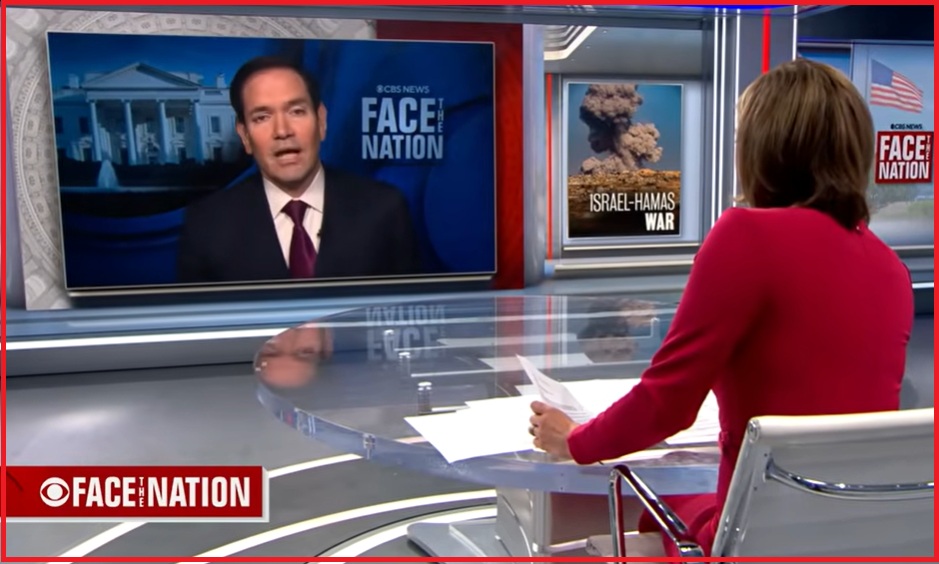
As a U.S. delegation arrives in Israel to coordinate the ongoing effort to end the Israeli-Hamas war in Gaza, Secretary of State and National Security Advisor, Marco Rubio, appears on Face the Nation to outline the current status of the hostage release efforts.

[Transcript] – MARGARET BRENNAN: We turn now to Secretary of State and National Security Adviser, Marco Rubio. Good morning to you, Mr. Secretary.

SECRETARY OF STATE MARCO RUBIO: Good morning.

MARGARET BRENNAN: It would be extraordinary to end what has been one of Israel’s longest and bloodiest wars. The prime minister said he’s only allowing these talks that will be underway in Egypt to go for a few days. What exactly is the deadline for Hamas and the terror groups who are holding hostages? When do they need to release them?

SEC. RUBIO: Well, yeah, so a couple points. Hamas has- obviously, look, we’re dealing with Hamas. Okay. So let’s take that with- for what it is. But they have said that they agree with the President’s framework for the release of the hostages. So what those talks should be about, and some of that conversation is already happening now, it’s not waiting until Monday in Cairo, is the logistics behind the release of these hostages. How do you stop the fighting? Who’s going to go in and get them? You know, when are they going to be released? Where are they picked up? What are the processes for this? That’s what should be- that’s what this conversation should be about at this point, because they’ve agreed to the framework of it. Then there’s second- beyond that is what happens after that. And that is, how do we ensure that we can create and help build a Gaza free of terrorism, free of Hamas, free of anything like Hamas and that’s going to take work and some time, not just to agree on but to implement. But that’s important, because that’s what’s going to bring a permanent end to these hostilities in the long term. And so those are the two phases here. But right now, the most emergent and immediate phase is the one that Hamas claims to have agreed to already, and that is they are prepared to release the hostages. Let’s discuss, through the mediators, the logistics and the mechanics behind how that happens. And that has to happen very quickly. That cannot drag on.

MARGARET BRENNAN: So my sources have indicated to me that because the upper echelon of Hamas fighters has been so decimated, communication is difficult. The other terror groups who also hold hostages in Gaza aren’t necessarily easily controlled by them. How do you manage around this reality and is full release by October 7 the demand?

SEC. RUBIO: Well, I don’t know about the date. I’d be great if it was before October 7. We wish it would happen yesterday. But there are realities here, and then there are things people do to impede progress. Reality is, this is a war zone. I mean, this is a place that suffered a tremendous amount of destruction that fighting needs to stop. You can’t release hostages while there’s still bombardments going on, but at the same time that can’t, you know- so that has to end, but that has to stop, but you also have to work through the other logistics. Who’s going to go pick them up? We saw how this happened in the past. You know, the Red Cross would go in, they would be handed over through this process, et cetera. And so all of that’s what has to be worked on, and is being worked on as we speak. So I’m not telling you there aren’t some logistical hurdles here, but I am saying that the expectation is that this happens quickly. And I would also say that while we want all the hostages to be released, if there are five that are ready to go right now, they should be released right now. If another 10 are ready to go in 12 hours after that, the next group should come out, but ultimately they should all come out. And I think what you’re hearing from people is, yes, there has to be some logistics that have to be worked through. But what you can’t have, and what we can’t see, and what we hope we will not see, is that we get into these talks, and these talks are then delayed, and it looks like they’re unnecessarily delaying it. That would be a very bad sign. Let’s hope that’s not what happens. And it’s going to be very important for our partners in the region who signed on to this deal, the UAE, Qatar, Turkey, Jordan, Egypt, etc, for them to be putting a lot of pressure on Hamas to make sure this happens as quickly as possible.

MARGARET BRENNAN: But you pointed out that releases can’t happen when bombardments are underway. Our CBS team in Gaza tells us that there are Israeli bombardments underway. There were strikes Saturday. Tens killed, more injured, bombings continuing. One incident included 10 people killed when they tried to check in on their homes in areas where there are also military sites. Is that acceptable?

SEC. RUBIO: Well, I think, ultimately, what you’re going to see here is that when an agreement is reached on these logistics behind when the release is going to happen, then I think you’ll see those bombardments stop, and I think some of that activity has already decreased somewhat. So, there’s a framework here, and the framework is simple. Once you agree on the logistics of how this is going to happen, I think the Israelis and everyone acknowledge you can’t release hostages in the middle of strikes, so the strikes will have to stop. And, as you saw, the president state that very clearly on Friday, where he asked the Israelis to begin to pull back to create the conditions for these releases–

MARGARET BRENNAN: So this is not a violation of that?

SEC. RUBIO: Well, we’re trying to get the hostages out. That’s the bottom line. We want to get the hostages out as soon as possible. For that to happen, there can’t be a war going on in the middle of it, and Hamas has to agree to turn them over. We have to have the right people go in and get them. That’s what we’re going to focus on right now, and that’s what we’re going to- that’s what we’ve been focused on, and that’s what the talks are going to be about today, on Monday, on Tuesday, to get this done as soon as possible.

MARGARET BRENNAN: I hear you, there are two phases here. The Hamas releasing the hostages is the one you’re most focused on. But, big picture, does the United States assess that Israel has so reduced the threat posed by Hamas that it can end combat and transition to the kind of lower-tempo counter-terrorism campaign that, say, the United States carries out against terrorist threats to this country?

SEC. RUBIO: Well, look, I mean, the ideal outcome here is you don’t have to carry out any counter-terror missions because there are no terrorists in Gaza–

MARGARET BRENNAN: But can they take the win? Can Netanyahu say he won this war?

SEC. RUBIO: Well, first of all, creating a Gaza, or setting up a Gaza that is governed by Palestinian technocrats that are not terrorists and are not sponsoring terrorism, that’s not going to happen in 72 hours. That’s going to take some time to build up, and it’s going to require a lot of work and a lot of international support, and that’s the end goal here of this entire endeavor, after you get the hostages out. By the way, if you can’t get the hostages out, you have no hope of getting that done. So that’s why I say, you know that these two steps need to happen. But it’s going to take a lot of hard work and time. You know, you’re trying to build something that doesn’t exist right now, which is a sort of civilian, Palestinian leadership that’s not tied to terrorism. That doesn’t exist right now. It’s going to take a lot of help from international partners. That’s why having the countries in the region and the Europeans and all others involved in this in both money and resources, that’s why building that coalition is so critical, and then implementing it is not going to be easy. It’s going to take some time here, but I think, certainly, for the first time in a long time, you see the framework and the outlines of something that could work.

MARGARET BRENNAN: But combat operations can end?

SEC. RUBIO: Well, that’s the goal here. Well, you wouldn’t need combat operations if there weren’t terrorists there. But, by the same token, I would remind everybody, if, in fact, at the end of all this terrorism and a terrorist group remains active inside of Gaza, you’re not going to have peace. That’s the fundamental truth here that everyone needs to accept. You’re never going to have peace in Gaza as long as there are terrorists operating from that territory, threatening the security of Israel.

MARGARET BRENNAN: But in terms of occupation and combat operations, that’s different than a counterterrorism campaign. But, let me ask you specifically what President Trump said. He told Barak Ravid of Axios that Prime Minister Netanyahu, quote, “took it very far and Israel lost a lot of support in the world. Now I’m going to get all that support back.” At what point did President Trump decide that Netanyahu took this fight in Gaza, or his operations throughout the Middle East- When did he take it too far?

SEC. RUBIO: I think the President’s- the president’s observation, basically, is that because of the length of this war and how it’s gone- we’ve all seen the international narrative. We’ve all seen it, whether we agree with it or not. We have seen countries like the U.K., Australia, Canada and others come out and sort of signal support, or announce support for a Palestinian state. We have seen, even in our own domestic politics, some of the attacks on Israel. We don’t forget what happened on October 7. That’s the other thing the President repeatedly points to is, remember October 7. But the impli- whether we agree with it or not, we have seen the impact that this has had on Israel’s global standing. And I think that’s the point the President is making here, is that whether you believe it was justified or not, right or not, that we- you cannot ignore the impact that this has had on Israel’s global standing. That said, if we never want to see this happen again, meaning a war like this, you can never have another October 7 or anything like it ever happen again. And that’s the thing the President has reiterated and repeatedly made clear to our partners in the region, and that is, if you truly want peace and stability and a better future for the Palestinian people, then there has to be a Gaza that is not governed or controlled in any way, shape or form by Hamas, or anything that looks like Hamas.

MARGARET BRENNAN: Okay. Does the United States support a Palestinian state? Because point 19 in your White House plan talks about “a credible pathway to Palestinian self determination and statehood.”

SEC. RUBIO: Well, again, we’ve always said, I mean, this has been a consistent position throughout, that the only way you’re ever going to have anything that looks like statehood is in a negotiated deal with the Israelis. We are so far from that right now–

MARGARET BRENNAN: Right, but Prime Minister Netanyahu opposes a Palestinian state and thanked President Trump for speaking against recognition of one. That’s why I’m asking you to clarify.

SEC. RUBIO: Well, we haven’t recognized the Palestinian state–

[CROSSTALK]

MARGARET BRENNAN: I understand.

SEC. RUBIO: –the United States has not. And right now, there’s no point in doing that–

MARGARET BRENNAN: Does the US want to see one?

[CROSSTALK ENDS]

SEC. RUBIO: –because it’s not even possible. That’s not even a realistic thing right now. Because who, who would govern that Palestinian state, Hamas?

MARGARET BRENNAN: Well, it’s point 19 in your plan–

SEC. RUBIO: –Who would govern it?

MARGARET BRENNAN: –I thought.

SEC. RUBIO: Well, but that’s talking about a pathway long term and in the future.

MARGARET BRENNAN: Right.

SEC. RUBIO: But one of the- before you can even get there, okay, that’s, you know, before you can even get there, you have to have someone to turn that land- Israel’s made clear they have no interest in governing Gaza. They have no interest in occupying Gaza long term and being the government of Gaza. I think Israel, I can’t speak for Israel, but I think Israel would tell you they would love to turn over Gaza to a Palestinian organization that isn’t terrorists. They would love to do that. But that doesn’t exist right now. That has to be built, and that’s going to take time. You’re not going to build that in 72 hours. You’re not going to build that in 72 weeks. I mean, it’s going to take some time to get to that point. So that’s the pathway this discusses. And I think if you look forward into the future where there is suddenly a Palestinian government-like organization, that can govern territory, then there’s a lot of possibilities. But that has to be negotiated and agreed to by Israel. In the end, it’s very simple. There can be peace in Gaza, there can be Palestinian governance in Gaza, whether you call it statehood or something else, as long as it is not terrorists that are in charge of that territory. That’s what Israel agreed to when they turned over Gaza in the first place, and then Hamas took over Gaza and turned it into a terrorist camp, and that’s what’s led us to the point that we are at today. So we can get off that road and onto a different road. There are a lot of possibilities long term and in the future, but right now–

MARGARET BRENNAN: So maybe?

SEC. RUBIO: –we are far from that. Right now, we need to get these hostages out, and we just need technocrats that are not terrorists to be able to begin the basic reconstruction of Gaza.

MARGARET BRENNAN: That interview was taped earlier today, with the camera off, Secretary Rubio clarified that President Trump still opposes Israeli annexation of the West Bank though there is no mention of the Occupied Territory in the 20 point White House peace plan.

[END TRANSCRIPT]

Secretary Rubio also appeared on NBC Meet the Press. Below:

WarRoom Battleground EP 863: LeoChurch in US authorizes first “gaywashed” bible and Germany in shock as INVADER shoves Ukrainian girl under train


Posted originally on Rumble on By Bannon’s War Room on: October, 04, 2025