Importers, Exporters and Producers Trigger Force Majeure Notifications for Gulf LNG Shipments


Posted originally on CTH on March 4, 2026 | Sundance

Force Majeure is a common clause in contracts which essentially frees both parties from liability or obligation when an extraordinary event or circumstance beyond the control of the parties, such as a war, strike, riot, crime, epidemic, or sudden legal change prevents one or both parties from fulfilling their obligations under the contract.

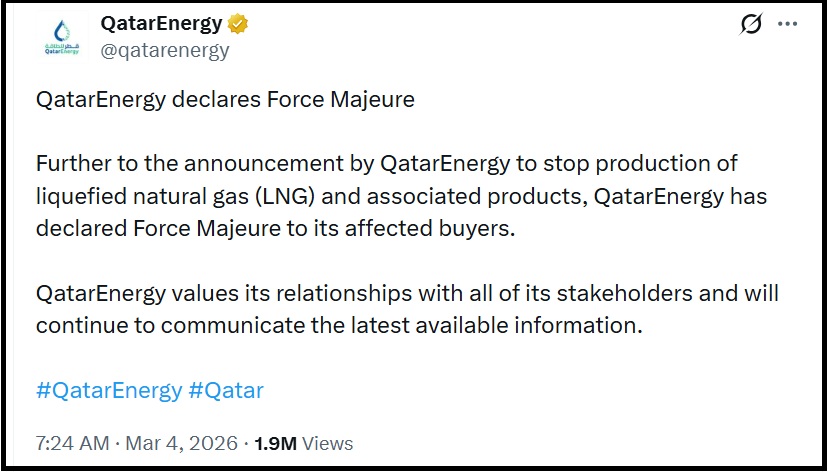
People would be well advised to wait a few days when announcements are made before jumping to immediate conclusions. The announcement by Qatar Energy of a force majeure notification did not originate from Qatar’s inability to produce contractual LNG supplies…..
[SOURCE]

…. two days prior to this announcement, India’s top gas importer Petronet LNG Ltd issued a force majeure notice to Qatar Energy and local buyers because its LNG tanker ships were unable to reach the Ras Laffan load port due to the crisis in the Middle East.  Without ships arriving to take the LNG Qatar Energy cannot keep producing.

Qatar Energy operates 14 liquefied natural gas (LNG) trains with a total annual production capacity of 77 million tonnes {SOURCE}.  If ships don’t reach the terminals, there’s no need for Qatar Energy to keep pumping and liquifying from well heads.  It’s a downstream issue.

Bahrain made the same announcement for their refined aluminum exports {SOURCE}. Indonesian company Chandra Asri made the same announcement for petrochemicals {SOURCE}. Chevron made the same announcement two days ago after Israel shut down the Leviathan natural gas field {SOURCE}.  Thus, we see the ramifications for the entire region around the Iran conflict zone and the downstream destinations (Asia and Europe) for energy products therein.
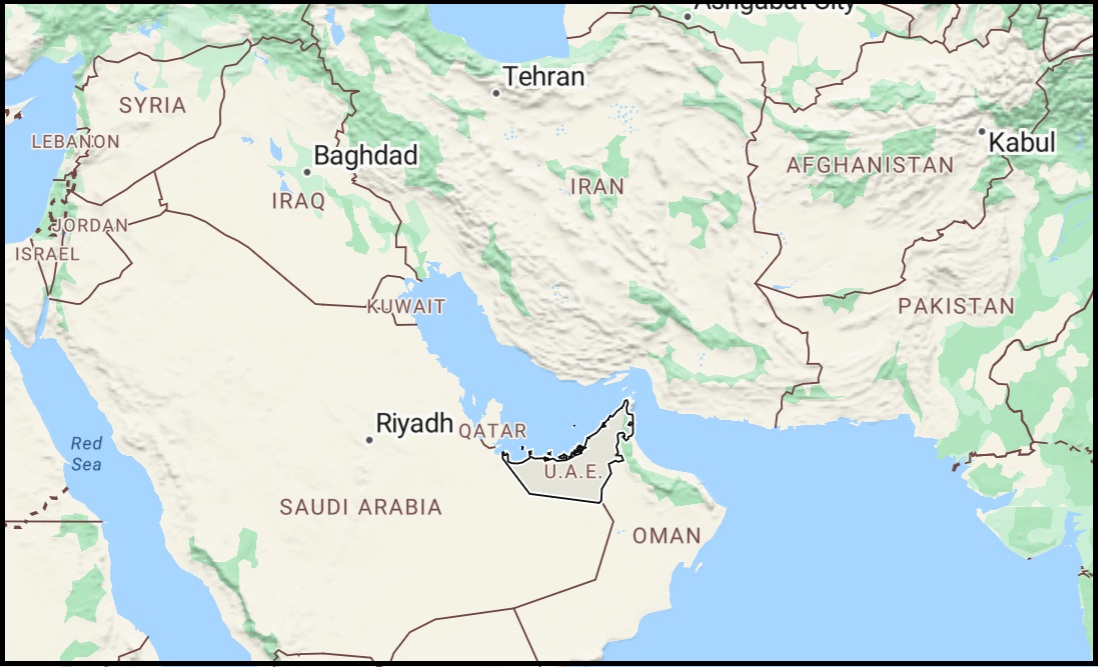
Dutch shipping company Maersk has also suspended operation for cargo container ships cancelling all bookings between the Indian subcontinent—India, Pakistan, Bangladesh and Sri Lanka—and the Upper Gulf. {SOURCE} German shipping group Hapag-Lloyd made the same decision.

These are not decisions being made due to maritime insurance or reinsurance rates or availability. These are decisions being made by private corporations that go beyond their actuarial risk.  They simply don’t want to operate in a region where there is the potential for loss of life or cargo.

This is not solely an insurance issue and people should pause before offering analysis that only considers the financial aspect.

MAERSK -Maersk announced on Wednesday that it is temporarily suspending most cargo reservations in and out of Iraq as security worries mount throughout the Gulf.

The business said that the ban applies to shipments involving many regional nations, including the UAE, Oman, Kuwait, Qatar, Bahrain, and Saudi Arabia.

Maersk said that the measure would stay in effect until further notice. The firm did not disclose any more information on how long the disruption will endure or the scope of the operating effect.

The decision comes as increased tensions and military action in the Gulf area have prompted worries about the safety of maritime routes and logistical operations, hurting commerce flows via many Gulf nations. (LINK)

Susan Kokinda and the Lyndon LaRouche network give their perspective on the British reaction to the U.S. strikes against Iran.  The analysis has some value from a review of the historic relationship of the British imperialist policy toward matters of foreign entanglement and the control mechanisms that have historically flowed from the U.K

As a consequence of British government policy much of the Kokinda analysis accurately touches on the root cause of U.K response. However, the emphasis on the modern UK government as the lead of a global control network is not always as severe or complicated as the Lyndon LaRouche network would espouse.

Prior to visiting the White House, German Chancellor Fredrich Merz had just returned from China and gave a press conference in Germany saying Germans need to “work harder” and “ditch the four-day week” to compete.

Merz visit to Shenzhen shocked him, and he is right to be rattled by the cold indifference of Chairman Xi Jinping.  This was Merz first visit to meet Chairman Xi in person.  A cold and productivity focused Merz just met an even colder and more productivity focused industrial giant.

Merz met the industrial dragon and returned home visibly shook.  The Chancellor thought he represented an apex industrial nation. However, he experienced something far more industrial than he ever imagined.

As noted by Nina Schick: “Take Germany’s famous auto industry, 5% of GDP, 800,000 jobs, but losing ground fast. VW’s market share in China has plunged from 24% to 15% in four years. Chinese brands doubled their European market share in 2025 and now outsell Mercedes on the continent. Germany lost 120,000 industrial jobs last year. And cars are just the most visible example.

But it’s not just competition. Germany has some of the highest industrial energy prices in the world, nearly triple what the US pays. After shutting down nuclear and losing cheap Russian gas via Nord Stream, Berlin built its first LNG terminal in 194 days. Now 96% of the LNG arriving at those terminals comes from the US. (That LNG is even more important in light of events in the Gulf….)

The US is Germany’s second-largest trading partner (€240 billion in two-way trade last year.) German auto exports to the US fell 18% in 2025 under tariffs. Merz cannot afford a trade war with Washington. Today, he watched Trump threaten to cut off all trade with Spain, while sitting next to him in the Oval Office. He backed him up.

Now look at how Merz is positioning on Iran. Spain blocked the US from using its bases. Sánchez called the strikes “unjustified.” Starmer hesitated before eventually allowing UK bases for “defensive” strikes. Merz is the first EU leader invited to the White House for a tête-à-tête with Trump.

Days before, he said legal assessments under international law “achieve relatively little” and that now is “not the time to lecture allies.” Compare that to Sánchez insisting Spain’s agreement with the US “must operate within the framework of international law.” From a German chancellor, Merz’s position is seismic.

And none of this is separable from home. Germany’s economy is in its fourth year of industrial contraction. An aging population, a shrinking workforce, sky-high welfare costs, and an immigration debate that’s handing the AfD seats on a plate. Merz needs the US relationship, because it’s one of the levers he has left to keep the economy blowing in the right direction.

All of this points to a Germany that’s understood its critical vulnerabilities and is pursuing a hard-nosed realpolitik in response. To stay industrially competitive, they need American LNG. They need access to US compute and critical hardware. They need EU member states to spend on defense: something Trump has been remarkably effective at unleashing.

The result is an astonishingly pro-Trump German chancellor. In a country where only about 15% of the population views Trump favorably. The question isn’t whether Merz has realistically assessed Germany’s vulnerabilities (he’s starting to see the bigger picture). It’s whether this wins or loses him votes at home. And on that, my guess is it won’t. {LINK}

Fredrich Merz thought he was an apex predator, until he met Xi Jinping.

Suddenly, Merz looks at the unpredictable Trump, an apex predator who swims around Chairman Xi as if it’s just another boring Tuesday, with an entirely new perspective.

Chancellor Merz realizes that this rather unorthodox American President likely possesses the only qualified skillset that can deal with a REAL apex predator like Xi.

Fredrich Merz dismounts his EU high horse and uppishness turns into respect.
President Trump Announces U.S. Economic Boycott of Spain During Meeting with German Chancellor Friedrich Merz


Posted originally on CTH on March 3, 2026 | Sundance 

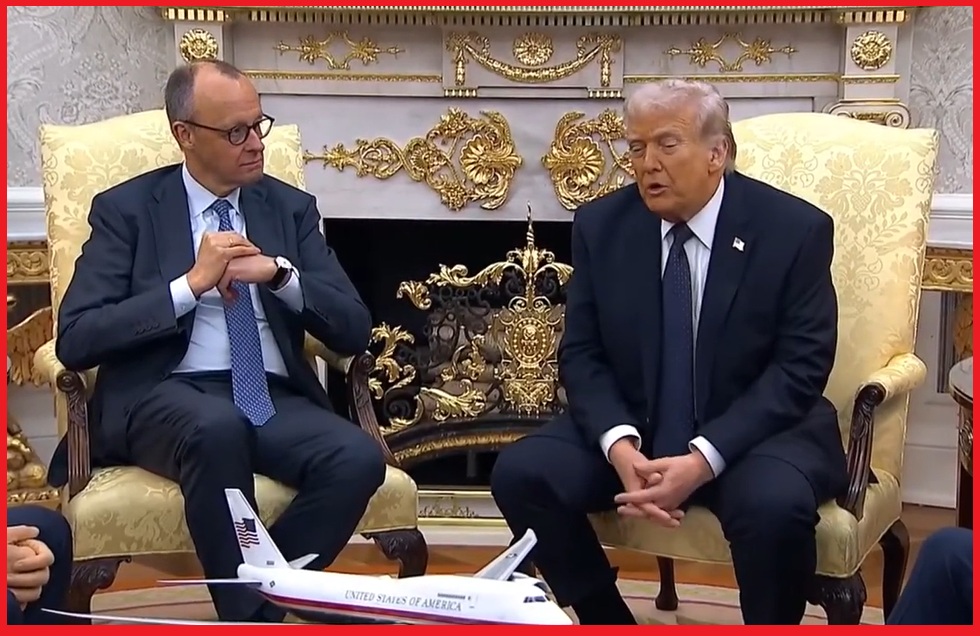
President Trump holds a bilateral meeting with German Chancellor Friedrich Merz in the Oval Office.  After brief remarks of mutual appreciation, President Trump and Chancellor Merz responded to questions from the assembled press pool.

Chancellor Merz expressed support for the objective of eliminating the regime threat from Iran.  President Trump notes at the beginning how Iran is targeting civilian targets in the region and generating even more support from the Gulf states for the USA.

When asked about the British and Spanish refusal to support U.S. military logistics and deployment, President Trump let the media be aware he is not happy with the position of Spain and the U.K.  President Trump also announced [11:00 of video] an economic embargo of trade with Spain as an outcome of their position.

.

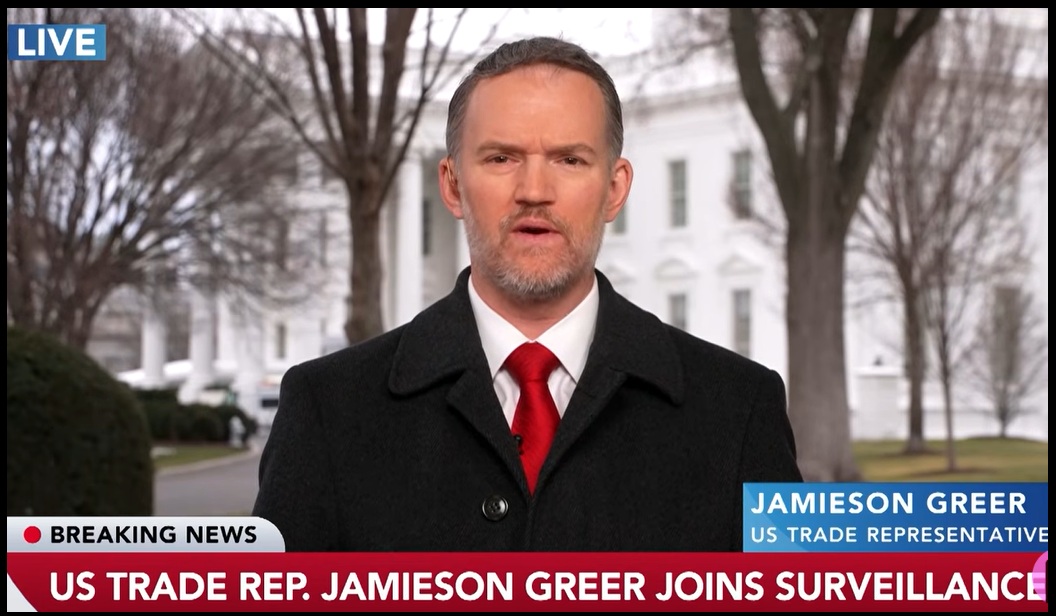
Cutting Through the SCOTUS Tariff Fog, USTR Jamieson Greer Discusses Baseline Tariff Reset Shifts and Reciprocity Tariffs


Posted originally on CTH on February 25, 2026 | Sundance 

The Supreme Court tariff ruling has created the need for U.S. Trade Representative Jamieson Greer and U.S. Commerce Secretary Howard Lutnick to modify the baseline tariff approach with the approvals of President Trump.

The baseline tariffs are being reset to 10% with upward adjustment to 15% as planned.  The reciprocal tariffs will not require any substantive modifications as most of the Free Trade Agreements have been cemented with reciprocity tariffs as part of the negotiated deals.

USTR Greer appears on Bloomberg to clarify the current situation and provide some information as to the transitional baseline tariffs as now modified. Additionally, and importantly, Greer begins discussing the USMCA review and his acceptance that President Trump is openly questioning the value for us. Greer notes Mexico and Canada being used as import hubs to avoid tariffs is a big issue. WATCH:

Section 232 [Steel and Aluminum examples] of the Trade Expansion Act of 1962 (19 U.S.C. §1862, as amended) authorizes the President to impose trade restrictions—such as a tariff or quota—if the Secretary of Commerce determines, following an investigation, that imports of a good “threaten to impair” U.S. national security. {SOURCE}

Section 301 tariffs are a trade enforcement mechanism established under the Trade Act of 1974. They allow the U.S. government to impose tariffs on imports from countries that are found to be engaging in unfair trade practices. The Office of the United States Trade Representative (USTR) conducts investigations to determine if a country is violating trade agreements, and if so, it can impose tariffs as a corrective measure {SOURCE}

Section 122 of the Trade Act of 1974 allows the U.S. president to impose tariffs of up to 15% to address “large and serious” balance-of-payments deficits. This authority can be exercised without prior congressional approval for a limited duration of 150 days. After this period, any tariffs must be extended by Congress. {SOURCE}

*FYI, there is a lot of distracting noise in the various social media platforms about internecine MAGA battles and ego-driven points of specific interest.  CTH chooses to focus energy and attention on the substantive policy issues that will generate substantive policy outcomes for America.

Following a Court Ruling, The Government of Panama Has Taken Back Control Over Both Entrances to the Panama Canal – Cancelled Chinese Contracts


Posted originally on CTH on February 24, 2026 | Sundance

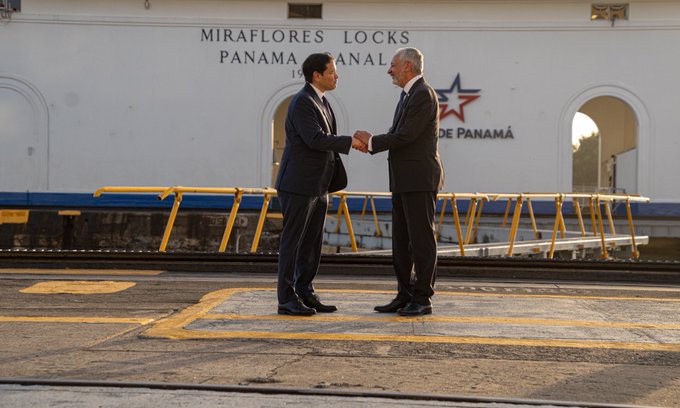
The highest court in Panama has nulled the ‘Chinese’ contract for the operation of both entrance ports on the Panama Canal.  The Panamanian government took back control and assigned operations to APM Terminals, a subsidiary of the Danish group A.P. Moller-Maersk.

The state takeover comes after a 14-month long saga begun by President Trump who reasserted American interests in the hemisphere and rejected the concept of allowing China to have strategic control over such vital North American infrastructure.

President Trump did not mince words in December of 2024 when he said“[The Panama Canal] was not given for the benefit of others, but merely as a token of cooperation with us and Panama,” Trump concluded. “If the principles, both moral and legal, of this magnanimous gesture of giving are not followed, then we will demand that the Panama Canal be returned to us, in full, and without question.”  Marco Rubio was then dispatched as an intermediary in Feb 2025.

Then, last month, Panama’s Supreme Court struck down the law approving the concession contract for Panama Ports Company, a subsidiary of CK Hutchison (China/Hong Kong). The court ruling also invalidated an extension granted in 2021, stripping the port operations of any current legal standing.  Now, Panama has taken over.

(MSM) – The government of Panama has seized control of two ports on either end of the Panama Canal from a Hong Kong conglomerate following a recent ruling by the country’s Supreme Court.

Hong Kong’s CK Hutchison said on Tuesday that Panama’s government had “made direct physical entry into the terminals at Balboa and Cristobal” and assumed “administrative and operational control” over the two ports on the Panama Canal.

The company said the “unlawful” takeover reflects the culmination of a campaign by the Panamanian state against its subsidiary, Panama Ports, following the Supreme Court ruling last month.

According to a government decree, the Panama Maritime Authority has been authorised to occupy the ports for “reasons of urgent social interest”, according to The Associated Press (AP) news agency. (read more)

VIA AP:

[…] Panama’s government announced days ago that it will guarantee the continuity of port operations and job stability, and that APM Terminals, a subsidiary of the Danish group A.P. Moller-Maersk, would temporarily assume the administration of the terminals while a new contract is awarded.

Meanwhile, CK Hutchison Holdings started arbitration proceedings against Panama under the rules of the International Chamber of Commerce. It’s unclear what the impact of the proceedings would be and how long they could take. It also threatened to sue APM Terminals, if it operates the concession. The Danish group responded that it’s not a party to the legal proceedings.

A PPC spokesperson told local media last week that the company was seeking an agreement with the Panamanian government to continue operating. (more)

President Trump Expresses Disappointment and Determination


Posted originally on CTH on February 20, 2026 | Sundance 

President Trump reacts to the Supreme Court ruling with much the same perspective of many MAGA supporters.

For most of us the core of MAGA policy surrounds economics; specifically, GDP growth, jobs and wages. Economic security is national security. Immigration enforcement, border security and other priorities come after MAGAnomics.

PRESIDENT TRUMP – “The Supreme Court’s Ruling on TARIFFS is deeply disappointing! I am ashamed of certain Members of the Court for not having the Courage to do what is right for our Country. I would like to thank and congratulate Justices Thomas, Alito, and Kavanaugh for your Strength, Wisdom, and Love of our Country, which is right now very proud of you.

When you read the dissenting opinions, there is no way that anyone can argue against them. Foreign Countries that have been ripping us off for years are ecstatic, and dancing in the streets — But they won’t be dancing for long! The Democrats on the Court are thrilled, but they will automatically vote “NO” against ANYTHING that makes America Strong and Healthy Again. They, also, are a Disgrace to our Nation.

Others think they’re being “politically correct,” which has happened before, far too often, with certain Members of this Court when, in fact, they’re just FOOLS and “LAPDOGS” for the RINOS and Radical Left Democrats and, not that this should have anything to do with it, very unpatriotic, and disloyal to the Constitution. It is my opinion that the Court has been swayed by Foreign Interests, and a Political Movement that is far smaller than people would think — But obnoxious, ignorant, and loud!

This was an important case to me, more as a symbol of Economic and National Security, than anything else. The Good News is that there are methods, practices, Statutes, and other Authorities, as recognized by the entire Court and Congress, that are even stronger than the IEEPA TARIFFS, available to me as President of the United States of America and, in actuality, I was very modest in my “ask” of other Countries and Businesses because I wanted to do nothing that could sway the decision that has been rendered by the Court.

I have very effectively utilized TARIFFS over the past year to MAKE AMERICA GREAT AGAIN. Our Stock Market has just recently broken the 50,000 mark on the DOW and, simultaneously, 7,000 on the S&P, two numbers that everybody thought, upon our Landslide Election Victory, could not be attained until the very end of my Administration — Four years! TARIFFS have, likewise, been used to end five of the eight Wars that I settled, have given us Great National Security and, together with our Strong Border, reduced Fentanyl coming into our Country by 30%, when I use them as a penalty against Countries illegally sending this poison to us. All of those TARIFFS remain, but other alternatives will now be used to replace the ones that the Court incorrectly rejected.”

“To show you how ridiculous the opinion is, the Court said that I’m not allowed to charge even $1 DOLLAR to any Country under IEEPA, I assume to protect other Countries, not the United States which they should be interested in protecting — But I am allowed to cut off any and all Trade or Business with that same Country, even imposing a Foreign Country destroying embargo, and do anything else I want to do to them — How nonsensical is that? They are saying that I have the absolute right to license, but not the right to charge a license fee. What license has ever been issued without the right to charge a fee? But now the Court has given me the unquestioned right to ban all sorts of things from coming into our Country, a much more powerful Right than many people thought we had.
 
Our Country is the “HOTTEST” anywhere in the World, but now, I am going in a different direction, which is even stronger than our original choice. As Justice Kavanaugh wrote in his Dissent:
 
“Although I firmly disagree with the Court’s holding today, the decision might not substantially constrain a President’s ability to order tariffs going forward. That is because numerous other federal statutes authorize the President to impose tariffs and might justify most (if not all) of the tariffs issued in this case…Those statutes include, for example, the Trade Expansion Act of 1962 (Section 232); the Trade Act of 1974 (Sections 122, 201, and 301); and the Tariff Act of 1930 (Section 338).”
 
Thank you Justice Kavanaugh!
 
In actuality, while I am sure they did not mean to do so, the Supreme Court’s decision today made a President’s ability to both regulate Trade, and impose TARIFFS, more powerful and crystal clear, rather than less. There will no longer be any doubt, and the Income coming in, and the protection of our Companies and Country, will actually increase because of this decision. Based on longstanding Law and Hundreds of Victories to the contrary, the Supreme Court did not overrule TARIFFS, they merely overruled a particular use of IEEPA TARIFFS. The ability to block, embargo, restrict, license, or impose any other condition on a Foreign Country’s ability to conduct Trade with the United States under IEEPA, has been fully confirmed by this decision. In order to protect our Country, a President can actually charge more TARIFFS than I was charging in the past under the various other TARIFF authorities, which have also been confirmed, and fully allowed.
 
Therefore, effective immediately, all National Security TARIFFS, Section 232 and existing Section 301 TARIFFS, remain in place, and in full force and effect. Today I will sign an Order to impose a 10% GLOBAL TARIFF, under Section 122, over and above our normal TARIFFS already being charged, and we are also initiating several Section 301 and other Investigations to protect our Country from unfair Trading practices. Thank you for your attention to this matter. MAKE AMERICA GREAT AGAIN!”
 
PRESIDENT DONALD J. TRUMP

Treasury Secretary Scott Bessent Outlines “Multiple Tools” Now Deployed in Tariff Policy – Sec. 232, 301 and 122 Explained


Posted originally on CTH on February 20, 2026 | Sundance 

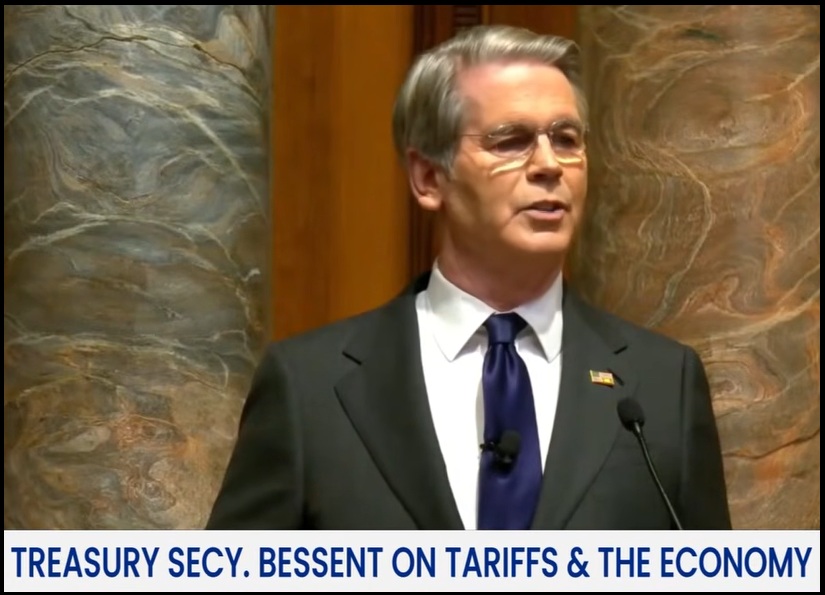
Speaking to the Economic Club of Dallas, Treasury Secretary Scott Bessent outlines what technical procedures the Trump administration will trigger now to retain tariff authority.  As anticipated Bessent outlines section 232 tariffs, section 301 tariffs, and Section 122 tariffs.  WATCH (prompted):

Section 232 [Steel and Aluminum examples] of the Trade Expansion Act of 1962 (19 U.S.C. §1862, as amended) authorizes the President to impose trade restrictions—such as a tariff or quota—if the Secretary of Commerce determines, following an investigation, that imports of a good “threaten to impair” U.S. national security. {SOURCE}

Section 301 tariffs are a trade enforcement mechanism established under the Trade Act of 1974. They allow the U.S. government to impose tariffs on imports from countries that are found to be engaging in unfair trade practices. The Office of the United States Trade Representative (USTR) conducts investigations to determine if a country is violating trade agreements, and if so, it can impose tariffs as a corrective measure {SOURCE}

Section 122 of the Trade Act of 1974 allows the U.S. president to impose tariffs of up to 15% to address “large and serious” balance-of-payments deficits. This authority can be exercised without prior congressional approval for a limited duration of 150 days. After this period, any tariffs must be extended by Congress. {SOURCE}

President Trump Holds a Press Availability on the Issue of Tariffs 


Posted originally on CTH on February 20, 2026 | Sundance | 113 Comments

President Donald Trump delivers remarks and holds a media availability following the Supreme Court 6-3 decision on the meaning of the word “regulate.”  WATCH:

.

Strong Possibility of SCOTUS Ruling on President Trump IEEPA Tariffs – Friday, Tuesday or Wednesday


Posted originally on CTH on February 18, 2026 | Sundance 

The high court has indicated it will be releasing opinions on one or more of the previously argued cases on Friday February 20, Tuesday Feb 24, or Wednesday Feb 25.  The decision over tariffs triggered by President Trump using the International Emergency Economic Powers Act (IEEPA) is one of the decisions now considered highly likely to surface.

If the decision doesn’t come this Friday, a rather interesting situation unfolds.  The following week falls into the Tuesday Feb 24 State of the Union address.

Typically, several Supreme Court justices sit in front row of the House floor during the speech.  The decision could be released on the morning of the speech, or justices could actually sit in the audience – knowing the outcome and the morning after the State of the Union address, the ruling could be released.

Now, there is a possibility the ruling will not come out in this cycle, but that is diminishing possibility considering the length of time the Supreme Court has sat on this opinion.

The court knows the importance of this decision, and they obviously know the State of the Union speech is scheduled to be delivered on Tuesday the 24th.  This will be an interesting dynamic to watch unfold.

Canadians Embrace Cheap Chinese Electric Vehicles


Posted originally on CTH on February 17, 2026 | Sundance 

While the government of Canadian Prime Minister Mark Carney has inked a trade agreement with China to accept cheap imported vehicles in exchange for Beijing purchasing some agricultural products, President Trump has promised those cheap Chinese EVs will never cross the border into the USA.

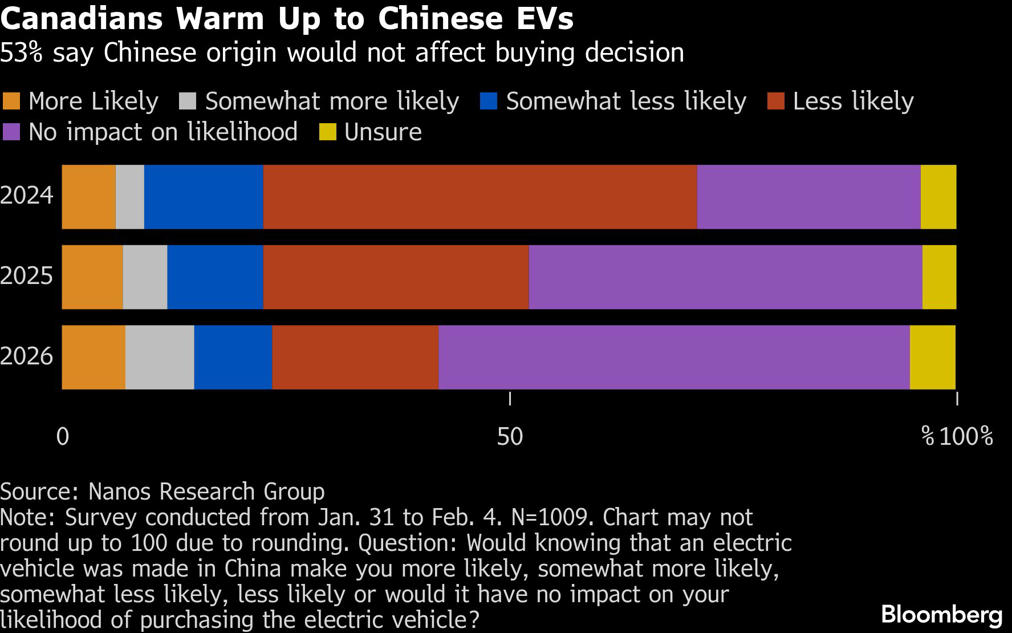
The Canadian polling on the issue has done a remarkable chang in the past few years.  Now, the majority of Canadians are willing to purchase cheap Chinese EVs. As outlined by Bloomberg, “More than half of Canadians, or 53%, say that knowing an EV was made in China would have no effect on their purchasing decision, according to a new poll by Nanos Research Group for Bloomberg News.”

Approximately 50,000 Chinese electric vehicles will enter the Canadian market in the first year. “The pact with China includes a provision that part of the quota will be reserved for electric vehicles priced at C$35,000 ($25,700) or less, the government has said.” {SOURCE}

The Canadian government wants a Chinese auto manufacturer, any Chinese auto manufacturer, to build factories in Canada to produce these electric vehicles.  Canada wants the jobs and economic activity because Canada is currently bleeding jobs and economic activity due to the trade conflict with the U.S.

Building cheap Chinese EVs in Canada might help offset a few thousand job losses, but building Chinese EVs in Canada only further ensures there will not be a substantive trade agreement between the USA and Canada once the USMCA (CUSMA) is dissolved.  [More on that coming]

Meanwhile, Chinese EV company Build Your Dream (BYD) has announced they sold 4.6 million vehicles worldwide last year, far surpassing Tesla and even surpassing all of the Ford global auto manufacturing.  BYD is now the sixth largest auto manufacturing company in the world.

[Auto News] […] The 2025 sales figures place BYD at sixth largest among global automakers, meaning Ford slipped to seventh in total global deliveries. Toyota remains the dominant global seller with sales exceeding 10 million units followed by Volkswagen Group, Hyundai Motor (including Kia and Genesis), General Motors, and Stellantis.

BYD’s sixth position in the global automotive sales index is particularly notable for an auto maker that focuses almost exclusively on new energy vehicles (NEVs) — a category that includes battery-electric vehicles (BEVs) and plug-in hybrid vehicles (PHEVs). (more)

CTH previously outlined the specific explosion in BYD auto sales HERE.  Europe, Russia, Asia and Australia are flooded with cheap Chinese EVs particularly from the BYD brand.  Canada is now opening themselves to face the same issue.

Secretary of State Marco Rubio Critically Important Speech to Munich Security Conference


Posted originally on CTH on February 14, 2026 | Sundance

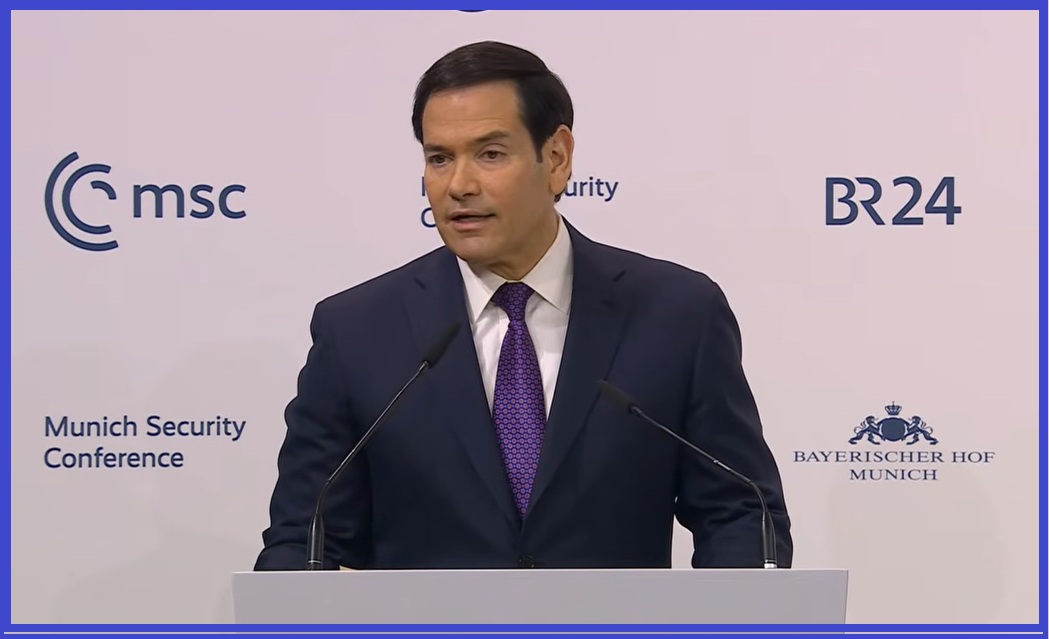
Overnight in the USA time zones, Secretary of State Marco Rubio delivered a very important speech at the Munich Security Conference [3:00am ET].  The video is below [prompted] and a FULL transcription will soon follow.

This is a critically worded speech that is very important to listen to with great deliberation.  Within his remarks Rubio is telling Europe that we want to remain allied in our interests, but we are no longer going to allow the system of “globalism” to destroy our uniquely American life.

The United States is separating from the madness; this is not up for debate. The only question is whether Europe is too far gone, or whether they will join us.

The euphoria that followed the collapse of the Berlin Wall, “led us to a dangerous delusion.  That we had entered quote the end of history. That every nation would now be a liberal democracy; that the ties formed by trade and by commerce alone would now replace nationhood. That the rules-based global order, an overused term, would now replace the national interest, and that we would now live in a world without borders where everyone became a citizen of the world. This was a foolish idea that ignored both human nature and it ignored the lessons of over 5,000 years of recorded human history, and it has cost us dearly.” 

.