GINI Index Explained


Hard to believe this …

The importance of the GINI index to intellectuals and others of the liberal or progressive persuasion cannot be dismissed. This popular index is used to rank countries as to how good a place to live they are by organizations such as the UN the World Bank and our own CIA. Those of us that believe that the American way of life is the best ever devised by man would place America at the top of any list of countries — American Exceptionalism — is what be believe in. We would however be very, very wrong. The chart below is based on our own CIA’s ratings and it places us way down the list at about 100 out of the 149 rated countries. Places like Cambodia, Uganda, Iran and Macedonia all have better ratings then America. The CIA gives America a GINI of 45.0 and to put that in perspective Kazakhstan has a GINI of 26.7 and that makes them the 9th best place in the world to live (lower is better). How can this be?
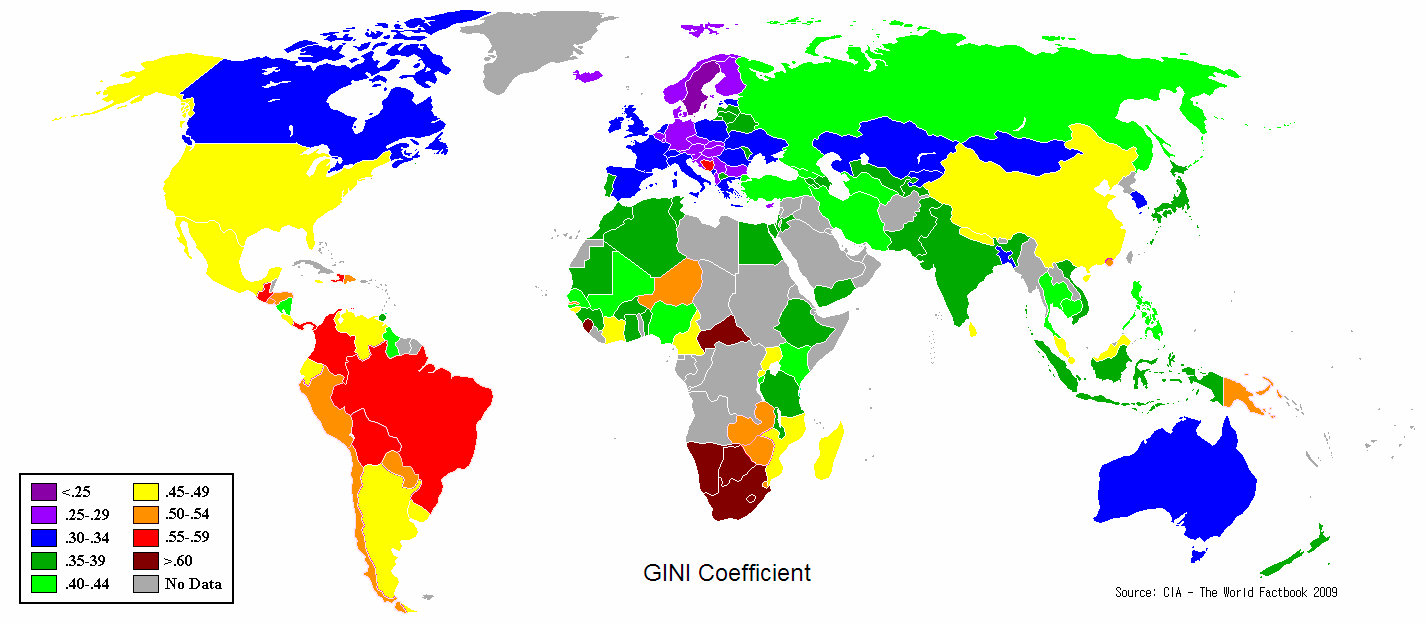
gini-coefficient-map1

Most Americans would find this very hard to believe for just using common sense if this GINI index were true why would just about everyone in the world be trying to get into the United States both legally and illegally? For example India with a 36.8 GINI rating is ranked as 59th verses the American ranking of 100th — almost twice as good as America. So based on the GINI rating why would anyone move from a good place to a bad place? If the facts don’t match the theory there is one conclusion that can be made and that is that the theory (rating in this case) is wrong. This should be to no surprise to those of us that have a great distrust of things coming from agencies controlled by those seeking personal power.

One of the core precepts used to make this factious rating redistributing wealth can be understood by looking at what Milton Friedman wrote in his 1962 book Capitalism and Freedom. The answer can be found in Chapter X The Distribution of Income on page 171 of the fortieth anniversary edition. But first before we get into the explanation we must first understand why the rating exists at all. It’s actually very simple those that desire power need to find ways to justify their desires to the common man. Since America was so far above all the rest of the world they had to find some way to make it seem like it wasn’t as good as “we” thought it was. There was one segment of the Boomer generation that thought they knew a better way to run the country and when their revolutionary ideas failed in the 60’s and the 70’s to take hold in the general population they took a different tack.

The Education System and Politics was their path to the power they desired. Previous generations did not have their beliefs so all they had to do was wait till those that believed in America were retired and/or dead. The strategy was to out live the previous generations and manipulate the younger ones through propagandized education while they moved up in the ranks of the government at all levels. Most of us did not see this shift we were to busy living and raising our families. But we awakened after the election of 2008 put a believer of central planning and socialism in as president of the United States of American. The answer was the Tea Party, which changed the complexion of congress in time to stop further damage but not enough to reverse what was already done. The job needs to be finished this November.

Friedman has written many excellent books on the subject of economics and politics and when you read them you quickly find they are well thought out, the arguments logically developed and the conclusions sound. The issues are discussed putting both sides on the table and then he goes on to prove definitively that the only way to get a truly free and just society is to get government out of the peoples life’s. The key here is the fact that government is run by people and people have personal agendas and those are almost 100% self-serving. The founders understood that and that is why the powers they gave the federal government were so limited.

The opposite of what we have is America is central planning and limited freedom and that is what most of the rest of the world has — but we have seen that it just doesn’t work. Hundreds of million of people were killed in setting up these systems all through Europe and Asia over the last hundred years, and where are they now? These systems all had at their core an economy that was run (directly or indirectly) by their federal government, the names of the systems were different but the practice was the same in each case. We understand that and reject the concept but those that want to rule are clever and they found a way to get what they wanted through the back door while we weren’t paying attention. It started with changing our history and even the definition of words so things seemed to be different than what they really were. Keep in mind George Santayana, who, in his Reason in Common Sense, The Life of Reason, Vol.1, wrote “Those who cannot remember the past are condemned to repeat it.”

Starting in 1913 with the creation of the federal reserve and them in earnest with Social Security and quickly running through The Great Society, Medicare, Medicaid, The Department of Education and many other programs and Departments we now have government (federal state and local) running (directly and indirectly) over 40% of the American economy. When the health care system take over with the Patient Protection and Affordable Care Act (PPACA) of 2010, is completed in a few more years the government will be running almost 2/3 of the economy. When that happens we will no longer be citizens we will be subjects of those that rule us.

Now the explanation of why the GINI index is what it is and how it is used to justify the Federal government taking over more and more segments of our country using every trick in the book and even some new ones as those who desire power transform the country into one that is run out of Washington.

The GINI index has many factors but the one that seems to give many counties a bad rating and others a good rating is the one that measures income disparity between the classes. This factor measures the difference between those at the top, the 1% today, verses those at the bottom, the 99% today. For example lets say the bottom segment of country A earns on average $5,000 per year and the top segment earns $50,000 so there is a difference of 10:1 which is low and that gives country A a high rating. Now we have country B where the bottom segment earns on average $10,000 per year and the top segment earns $250,000 so we have a difference of 25:1 clearly this is a great discrepancy between the top and the bottom and so country B gets a lower rating. Based on those earnings numbers and the resulting GINI rating, policy is developed to reward country A for being good and penalizes country B for being bad. But is this even a valid measure and if it isn’t of what good is it?

Friedman gives an example like this in his book and then explains what if country A has a cast system with no mobility between the classes. This is not speculation many countries have de facto cast systems where if you are born poor you stay poor. These countries are almost all poor economically because of their system of no freedom no private property and a strong central governments run by rulers that have no reason to change anything. He goes on to explain that country B has freedom, private property and limited federal government. This gives the people the incentive to work hard and make something of themselves. Sure some make a lot of money and get to the top and some don’t. But all are better off even with this income spread for the bottom of those of country B have twice the earning power as those in country A. But more importantly those in country B can be born at the bottom and through hard work and effort end up at the top. The upward mobility is the key.

But there is another factor here often over looked. When you graduate from high school or college you enter the work force at the bottom. You maybe making a reasonable amount but you also expect to move up and be earning more later in life. So you are in a lower income group when young and in a higher income group when older. The point is that the people in a free society move up and down the income groupings over time. The top today is not made of the same people from 20 years ago and the bottom is made up of different people as well. Those seeking power and using class warfare try to made us think that people stay in a group all there life — maybe they do in some countries but most do not here.

Clearly we are in country B and most of the rest of the world are in countries like county A; the prove of this is not found in the GINI index but with people that come here because of the opportunity they know is here. They voted with their feet and that is the only vote that counts.

A Constitutional Republic


Our Form of Government

When the American Revolution started there had been a 500 year debate going on within political theorists that was having the effect of undermining the prevailing validity of the heredity based monarchies’ that predominated Europe and most of the rest of the world at that time.  Therefore western civilization was ripe for a change and that change came from the British colonies in America. Residing there was a group of very special men: Washington, Jefferson, Franklin, Adams, Madison, and Hamilton to name but a few of those that created this new system.

An interesting fact is that if we look at science and engineering for the period 50 years before and 50 years after 1776 we find that is the heart of the industrial revolution.  Mostly in England but also in the Americans we have the perfection of the steam engine, the flying shuttle loom, the crucible process for making steel, the small pox vaccine, the first machine tools, interchangeable parts, the battery and photography all being invented. From there things moved faster and faster resulting in the standard of living that we have today.

Since this was also the period of political economic and legal writing that included the likes of Adam Smith, William Blackstone, John Locke, Jean-Jacques Rousseau and Thomas Paine it is safe to say that we are today the result of these men and what they did during that period.

But back to politics and government to find out what was created after the end of the American Revolution with the signing of the Treaty of Paris on September 3, 1783.  A few years before that on March 1, 1781 the newly freed colonies begin operating under a loose form of government called the Articles of Confederation described in the first section of this book.

But there were problems with that form of government and so a few years later in 1786 a conventional was called to make changes as was allowed by the Articles of Confederation.  That quickly lead to the writing of the United States Constitution that we now have and that was ratified and put into effect on September 13, 1788.  By April of 1789 the elections had been held the 1st congress convened and Washington sown in as the first President.  The rest is history in the making.

We know most of that and most of us know a little about the form of government that we have but few know why we have what we have.  That is sad for the why is the important part, especially today when some wish to make changes to the form of government that we have that will basically make the Constitution we have an obsolete document.

We know from historical records that there was a significant debate between those wanting a relatively strong central government (Federalist) and a weak central government (Anti-Federalist).  The compromise that allowed for the ratification was the Bill of Rights which was the name given to the first ten amendments to the United States Constitution.  The purpose of these amendments was to ensure that the power (for the serious readers the Sovereignty) stayed as much as possible with the people and the states.

Most of the first eight years of the new government were taken up in forming the government and forming the operating procedures for how it would actually function.  There was little historical help to those that wrote the constitution and those that were elected to run it.  And since the system was specifically set up to be cumbersome in operation with all kinds of checks and balances this was not an easy task.  So why was our government set up to be hard to get things done?

To get that answer we need to look at the forms of government and what you know about them is not necessarily what the first impression is.  If we go back to Locke and Rousseau we see that the power resides in the people and that they, through the ‘social’ contract give some of that power to the government.  The purpose of this ‘social’ contract is primarily for the protection of the people.  But it’s also to set up a system of governance that gives the people the rules (statutory and common laws) that determine the legal basis of how society operates day to day and year to year.

We can see that if there is no government and therefore no law that all the power resides in the people and they are free to do anything that they want.  This is called anarchy.  If we move to the other end as in a monarchy we have the opposite with all the power resting in the Monarch (king, emperor etc).  The people here are subjects with no rights except those that the Monarch grants them.  Today we hear about the right and the left or communism or fascism as forms of government but they are all really the same thing.  Oh there are differences but the important thing is that they all have as their base a strong central government. Which makes them little different than the heretical monarchies that ruled the world for so long.  Different titles and different procedures with or without voting but they all had at their core a ‘ruling class’ that governed the country some with almost absolute power.

Historically most countries ended up with a group that supported the monarch since it would be impractical for one person to run an entire country.  These people ended up being the royalty with a whole range of titles to establish a pecking order.  But even that wasn’t enough to affectively rule as the size of the countries increased and so councils were formed mostly of educated but not always aristocrats mostly with blood lines to the crown, so to speak.  There were various names for these councils such as the parliament in England generally the rule makers served at the Monarchs’ pleasure and were called magistrates.

When the United States Constitution was being written the founders did not want to establish a system like existed elsewhere for they had just finished fighting a long war to get rid of that kind of system.  But what else was there?  Well that is why the work of Locke and Rousseau were so important.  This is not to say that many others didn’t contribute to the thinking of that time but only that these two gave a theoretical basis for a different form of government.

So the task that those attending the constitutional convention in 1787 faced was to come up with something that was not a monarchy and not anarchy.  Something in-between the two that would give the people soon to be called citizens their freedom but yet allow for the protection of the people through a federal government. To get a better understanding of this process one of the best books written is The Five Thousand Year Leapwritten by W. Cleon Skousen.  First published in 1981 and then again in 2009 by American Documents Publishing.

The system that was set up here was deigned to fall between anarchy and a monarchy and be anchored there with strong controls and limits on what power the various governments’ power centers had.  There were Local, County, State and Federal systems each with a defined and limited ability to make laws.  Further, since their biggest concern was the Federal system it was broken up into many sections to defuse the power for they knew that the tendency would be for power to concentrate and once that accrued the form of government they had set up would be lost.

The purpose for all the checks and balances and splits in power and states rights and individual rights and the electoral system of determining the president was to prevent the concentration of power in the federal government which would inevitably lead to the Citizens be turned once more into subjects.

John Adams, “Liberty cannot be preserved without a general knowledge among the people, who have … a right, an indisputable, unalienable, indefeasible, divine right to that most dreaded and envied kind of knowledge, I mean the character and conduct of their rulers.”

Special Forces Creed


Americas Best

I am an American Special Forces Soldier!

I will do all that my nation requires of me.
I am a volunteer, knowing well the hazards of my profession.

I serve with the memory of those who have gone before me.
I pledge to uphold the honor and integrity of their legacy
in all that I am – in all that I do.

I am a warrior.
I will teach and fight whenever and wherever my nation requires.
I will strive always to excel in every art and artifice of war.

I know that I will be called upon to perform tasks in isolation,
far from familiar faces and voices.
With the help and guidance of my faith,
I will conquer my fears and succeed.

I will keep my mind and body clean, alert and strong.
I will maintain my arms and equipment in
an immaculate state befitting a Special Forces Soldier,
for this is my debt to those who depend upon me.

I will not fail those with whom I serve.
I will not bring shame upon myself or Special Forces.

I will never leave a fallen comrade.
I will never surrender though I am the last.
If I am taken, I pray that I have the strength
to defy my enemy.

I am a member of my Nation’s chosen soldiery,
I serve quietly, not seeking recognition or accolades.
My goal is to succeed in my mission – and live to succeed again.

De Oppresso Liber

A Soliders Duty


I am an American Soldier

Liberty never ever comes free,
and a soldier’s life is the key.
My blood in Lexington first flowed,
giving sweet life to her precious seed.
But liberty is a demanding thought,
and its growth with much sacrifice is bought.
I am an American Soldier

Liberties demands are many,
and the price we all must pay.
When next my blood flowed a plenty,
it came forth from both blue and gray.
But liberty is a demanding thought,
and its growth with much sacrifice is bought.
I am an American Soldier

Some help for others was now needed,
and they were not to be denied.
Answered now was this distant quest,
with my blood in the Argonne forest.
But liberty is a demanding thought,
and its growth with much sacrifice is bought.
I am an American Soldier

Storms now formed both east and west,
and their deep darkness threatened all.
Now for my dear blood there was no rest,
until Midway and Bastogne brought evils fall.
But liberty is a demanding thought,
and its growth with much sacrifice is bought.
I am an American Soldier

The storms were cleared and the sun was set,
When new alliances brought a different threat.
Yet again my red blood was sorely needed,
From so many, before Pusan succeeded.
But liberty is a demanding thought,
and its growth with much sacrifice is bought.
I am an American Soldier

Now perceived threats a new do grow,
In places hidden both near and far.
Still my red blood in earnest does flow,
From far away Nam’s ever present scar
But liberty is a demanding thought,
and its growth with much sacrifice is bought.
I am an American Soldier

Freedoms path is by the two towers,
which our liberty’s bright torch empowers.
But now she cries for the loss so dear,
dealt from those that deal in fear.
So sons and daughters of this land,
Must yet again to battle go.
This time our blood will flow in the sand,
So those seeds of liberty can grow.
But liberty is a demanding thought,
and Its growth with much sacrifice is bought.
I am an American Soldier


Written by David Pristash after 9/11

Our Way of Life, Part I


Before we can start a discussion on civilization and society and our way of life we must briefly address the issue of how humans came to populate the earth, and this brings us to the issue of God, since all the major religions of the world teach that God created man.  Some believe that God created the earth some 5,000 odd years ago in a six-day period.  Others who are also religious are more flexible in this belief. Those that are of the first group of teachings are prescriptively rigid and therefore they cannot account for the abundance of observations and phenomena in our natural world, which point to a much greater age for the planet (ten to fifteen billion years).

Why the red shift in astronomy?  Why the many fossils that point to evolutionary development for all terrestrial life?  Why the existence of geological structures millions, even billions, of years old? Why human brains with the capacity to discover these things as we study ourselves and the universe?  Why would a God who had created the universe in six days go to such great efforts to make it appear otherwise?

We should bypass this issue by assuming that, given the existence of a God/Creator, the universe was created in a manner consistent with our scientific knowledge, but that man was an intentional result of the creation process, planned by the God/Creator from the beginning.  In other words, God created man via an indirect, evolutionary process, that many  today call “intelligent design.”   If we can agree to make this one simple assumption, then we can move on to the discussion and analysis of our humanity without getting into an argument about the existence of God and whether here is an afterlife. There will be more on this subject in future post.

Assuming that human life developed in an evolutionary process we can begin our discussion of civilization with the pre-human ancestors of modern man, who began to roam the planet coming out of Africa approximately two and a half million years ago.   By this stage of our development, pre-humans had developed a complex brain as a means of adapting to a hostile environment.   It is generally believed that at the time the earliest humans developed sentience they had banded together in small groups for protection.   The importance of this practice was three-fold:

First, living in groups provided general protection for all members of the band or tribe (in other words there was, “safety in numbers”).

Second, since the human female is particularly vulnerable during the later stages of pregnancy (pregnancy easily adds twenty-five to thirty percent to her body weight), group protection of gestating females was a very strong asset to the viability of the human species.  Whether it is politically correct or not — the primary purpose of a man is to protect and care for his mate and their children

Third, human babies are absolutely helpless (unlike most other mammals) for an extended period of time after birth, and children require many years of growing and learning before becoming independent individuals (14 to 16 years back then and much longer today), and thus group protection of infants and young children was absolutely imperative if the human species was to survive.

The females of almost all species with complex brains (and developmental patterns similar to ours) developed very strong protective instincts.  It follows logically that human males, unburdened with childbearing, became the aggressive gender of the species, whose core job was foremost to protect and provide for the females and young. In addition, males were much more expendable than females, since one male could impregnate many females.  Maybe this is one of the reasons that approximately 7% more males are born than females.  They were expected to die off and so more were needed.

These defined gender roles must have been beneficial to the development and propagation of the human species, or we would not have continued to evolve.  By the time humans had developed language and had begun to use tools and fire, the social roles of both males and females had been “programmed” into human DNA: Aggressive males protected the tribe (even at the cost of their lives), while the more passive females bore and cared for the young.  Probably as a direct result of the major physical demands of childbearing, females also became physiologically much stronger than males, thus increasing their longevity potential in comparison to males. This has major ramifications today as women live much long then men do and older people require more health care.

Based on observations of the social behaviors of other species with large, complex brains, we can assume that early humans developed specific social structures within their bands and small tribes.   Typically, a dominant male becomes the band or tribe leader; parallel to this, a dominant female also arises, thus providing the basis for a “pecking order,” or social structure, of both males and females within the group.

Probably about thirty thousand years ago basic, “civilization” was born when humans began to retain knowledge through speech, art, and writing, and the relatively simple social structure of early humans began to evolve into something more complex.  The evolutionary process became much more complicated as humans gained the knowledge that allowed them to exercise ever greater control over their environment.  Farming, mining, metal working, and the building of mechanical devices developed quickly and spread throughout the world in short very short order.

A critical mass of knowledge was reached about five thousand years ago, and the conquest of the planet then began in earnest.  It has continued in spurts ever since (periods of rapid gain of knowledge followed by periods of absorption of that knowledge) and is now progressing geometric rate. Given that most of the easy to get resources of the plant have been found and used it is critical that we continue to push the knowledge frontier so we can get to the point that we are not limited to ‘easy’ to get resources. Turing back now is not an option for if there is a second modern dark age it will not be easy to come back.

With the rapid expansion of civilization throughout the globe, the aggressive nature of the male began to constitute, at least somewhat, a liability to the development of the human race.   To some extent, war and the desire for conquest were simply an outgrowth of the male’s role as protector of the tribe.  As bigger and bigger territories were brought under the control of a single dominant, male, large areas assumed a certain stability, which, in turn, promoted the development of technology.  Since by this time no other thing on the planet could challenge the human race it began to dominate the planet.

As the number of humans grew and their knowledge base expanded, all areas or aspects did not develop equally.  Initially male-oriented skills predominated and resulted in the advancement of technology and the physical sciences.  The skills of warfare and conquest were perfected, driven by technological advances.  Human cultures that did not develop these skills were quickly swept aside by highly organized and increasingly mechanized armies.

Prior to the twentieth century, however, aggression and warfare did not impact the overall survival of the human race.  Today, unfortunately, with man’s ability to make nuclear bombs, lethal gases, and custom-designed killer viruses, warfare has the potential to threaten the survival of the human species and has become a very important issue.

“Civilization” has now reached a point at which mankind must rethink its purpose and, in fact, its very existence.  With billions of humans on the planet, and with the knowledge we now possess, it would be easy for mankind to destroy all life on the planet.  Some international tension has been displaced with the collapse of the USSR in the late ‘80s, but it must be kept in mind that, historically, a power always rises to fill a void. India, China, Japan (probably not now after the 2011 earthquake), or some other country will assert itself and replace the USSR in the pantheon of world powers. Disarmament is also not an issue as weakness breeds war, it always has and that cannot be allowed today.

Today with the apparent decline of the United States since 2008 this looks to be more and more like China will assume this role of the replacement country to the old USSR and in the process possibly even surpass the United States if the current direction is not reversed.  This is not a certainty as there are internal problems in China that are not obvious, but that is a subject for a different discussion.

The decline of the United States to a lesser status would be very bad for mankind for we can no longer allow these old aggressive power patterns of a strong leader as part of a closed political system trying to gain control of a region or significant portion of the world.  We must come to an understanding of who we are and why we do what we do; we must be able to address these issues realistically or our civilization will collapse under the onslaught of our increasing numbers our technology and our relentless impact on the ecostructure of the world.

The reason that our decline would be bad is that we are different. Because of this difference the U.S. rose to its present position as the world’s leading industrial and political power in less than 200 years. The industrial base, governmental structure and military might of our country are the culmination of five thousand years of western civilization.  The U.S. is presently unchallenged by any nation on the planet; simply said, we are the best (nation) and we got to where we are by being the best (individually) because there was no central control. However, since 2008 that is being changed and not for the good. This fact must be kept in mind or all discussion of change will lack a solid base, for if we already are the best than what are we going to change to that is better?

We got here by the intellect and hard work primarily by men of European ancestry.  This is not to imply that people with other cultural backgrounds did not contribute to America’s growth, but, prior to a very few years ago, the core leadership of this country came predominantly from western European stock (English, French, Italian, Spanish and German). This “melting pot” of people and ideas worked well as long as the melting was encouraged by the citizens.  The social structure that developed from this experiment in self rule became the “American” culture.  It makes no sense to postulate whether the contributions of eastern European or non-European cultures would have changed American culture in some substantial or “better” way, since the fact remains that the influence of these cultures was — nominal or minimal at best.

The American citizen was not ruled by the federal government and that was because of the U.S. Constitution and “Bill-of-Rights” which prevented an oppressive government from developing; that is until now.  We are being told that those documents are obsolete and must be changed or gotten rid of.  There is no logic to that thinking and it is only being promoted by those that want the power that those documents now deny. We should be very careful about making changes for another system other than what we have now for that is a return to past systems that do not and have never worked.

There are, of course, imperfections in our society we are after all human. But we should not abandon all the good we have accomplished within the parameters of American culture just because we have some negative aspects.  For sure we should not start over because of some perceived problems areas.  Make adjustments yes, but not start over.