January job numbers jump, beat economists expectations again. The new jobs boom comes despite the government shutdown. Will Trump winning mean more GOP victory?
Attendees for the Oval office meeting include: President Donald J. Trump; Mick Mulvaney, Acting White House Chief of Staff; John Bolton, National Security Advisor; Larry Kudlow, Director of the National Economic Council; Peter Navarro, Assistant to the President for Trade & Manufacturing Policy; Matt Pottinger, Deputy Assistant to the President and Senior Director for Asian Affairs; Clete Willems, Deputy Assistant to the President and Deputy Director of the National Economic Council.
U.S. Administration team members: Secretary Mike Pompeo, Department of State; Secretary Steven Mnuchin, Department of the Treasury; Secretary Wilbur Ross, Department of Commerce; Ambassador Bob Lighthizer, Office of the U.S. Trade Representative
Chinese Delegation: Liu He, Member of the Political Bureau of the Central Committee of the Communist Party of China and Vice Premier of the People’s Republic of China; Wang Shouwen, Vice Minister of Commerce of the People’s Republic of China.
.
[Transcript] 3:43 P.M. EST – THE PRESIDENT: Thank you very much. It’s a great honor to have the Vice Premier of China with us, and also the Vice Minister of Trade of China. We have had long discussions. This has been going on for quite some time. It will be, by far, if it happens, the biggest deal ever made — not only the biggest trade deal ever made. It will be the biggest trade deal by far, but it’ll also be the biggest deal ever made. The two largest countries doing a trade deal. There won’t be anything that will match that. And we’ll see what happens.
We’ve done very well. We’ve had a very, very strong relationship, as my relationship is with President Xi.
I think we’ll start by reading the letter that President Xi sent to me and to us. It puts us off to a good foot. And then we’ll also repeat a couple of the remarks that the Vice Premier stated. And then we are going to have Mr. Lighthizer speak for a couple of seconds. And we’re then going to get back to business, and you can go and have fun and write your stories.
So thank you very much for being here. We appreciate it. And if you could start by reading the letter from President Xi, and maybe you could speak louder.
INTERPRETER: Message from President Xi to President Trump:
Mr. President,
I send you my best wishes as a new round of high-level consultations is being held between our two countries on economic and trade issues. I ask Mr. Liu He to bring to you sincere greetings and best wishes from me.
Right now, China-U.S. relations are at a critically important stage. Last month, we had a successful meeting in Argentina, in which we agreed to work together to build a bilateral relationship based on coordination, cooperation, and stability. That was followed by the good conversation we had through a phone call and the letters of congratulations we sent each other on the 40th anniversary of our diplomatic relations.
Guided by the agreement we reached, our economic teams have engaged in intensive consultations and made good progress. I hope our two sides will continue to act in a spirit of mutual respect and win-win cooperation, and step up consultations by meeting each other halfway in order to reach an early agreement that works for the interests of both sides.
Such an agreement will send a positive signal to our two peoples and the broader international community. It will serve to ensure healthy development of China-U.S. relations and contribute to steady growth of the world economy.
Mr. President, in our last phone call, you said you wanted for China to buy more agricultural products. I have made some arrangements about which, I believe, you might have been briefed.
As I often say, I feel we have known each other for a long time, ever since we first met. I cherish the good working relations and personal friendship with you. I enjoy our meetings and phone calls in which we could talk about anything. It falls to us to work together and accomplish things meaningful for the people of our two countries and the world at large.
Mr. President, if there is anything, you could always approach me through various means. I hope we’ll keep close contact in various ways. As the Chinese Lunar New Year draws near, my wife and I wish to send our New Year greetings to you, to Melania, and to your family. May you enjoy a happy and prosperous New Year.
THE PRESIDENT: That’s a beautiful letter and we appreciate it. You may go with the Vice Premier’s statements, and then I’m going to ask for you to say a few words, Bob, if you don’t mind.
Please.
INTERPRETER: The Vice Premier said that President Xi attaches tremendous importance to the personal friendship with you, and he hopes to you — to see your continued success. And over the past two years, since you took office, you have made tremendous accomplishment on both the domestic and diplomatic front.
Thanks to your policies of tax reduction and deregulation, your U.S. economy, as I heard from my American colleagues over there, has now been enjoying high growth and low employment with unprecedented prosperity. And it is because of your decisive decision that has directly facilitated the major breakthrough — the relationship between the U.S. and the DPRK.
And under the strategic guidance of you and of President Xi and you, Mr. President, it is possible that China and the U.S. will have the possibility of striking a successful deal on trade.
And my trip to the U.S. this time is to follow through on the important agreement reached between you and President Xi to accelerate the 90-day consultation between China and the United States in the hope of striking a comprehensive deal. And we’ve been working conscientiously with Ambassador Lighthizer and Secretary Mnuchin over the past couple of days, and our discussions are going well. We have achieved a lot of important consensus towards the direction of striking a comprehensive deal, which is to be ultimately reached between you and President Xi.
THE PRESIDENT: Well, thank you very much. Bob, maybe you could say just a few words as to where we are, how we’re doing, what we’re discussing. And then maybe I’ll ask the Vice Premier to say a few words, and we’ll get on with our negotiations.
AMBASSADOR LIGHTHIZER: Great. Thank you, Mr. President.
THE PRESIDENT: Perhaps, go ahead, if you want to say that.
(Interpreter speaks.)
THE PRESIDENT: Got it? He speaks very good English.
AMBASSADOR LIGHTHIZER: Based on many months of negotiations, we had two very intense, very long days of discussions. Your team was — all of your team was involved. I think we’ve made progress. We have much work to do if we’re going to have an agreement, but we made substantial progress. We focused on the most important issues, which are the structural issues and the protection of U.S. intellectual property, stopping forced technology transfer, intellectual property protection, agriculture and services issues, and enforcement, enforcement, enforcement.
Both sides agree this agreement is worth nothing — if we can get an agreement, it’s worth nothing without enforcement. That’s been your instruction from the beginning. So we’re focusing — we have a lot more issues to cover, but we focused on the structural issues — the ones that you’ve been so focused on — and we talked about enforcement, enforcement, enforcement.
THE PRESIDENT: And you’ll be going in early February, with your group, to China to continue negotiations.
AMBASSADOR LIGHTHIZER: We are more or less — Mr. President, we are more or less in continuous negotiations. There will be a brief pause for the Chinese New Year — briefer than the Chinese want — but our people will be in contact. We’re going back and forth with papers and with discussions. The Secretary and I will be going over there shortly, and then we’ll see where we are.
At this point, it’s impossible for me to predict success, but we are in a place that, if things work, it could happen.
THE PRESIDENT: Okay. Thank you very much. I appreciate it. And we look forward to that, and we look forward to the results of your trip. But you’re really discussing it anyway, whether you’re in China or here. We have a thing called the telephone and other means of talking. So I know you’re spending a lot of time, and it’s moving along well.
So I just want to say the Vice Premier is a friend of mine. He has become — he is truly one of the most respected men in Asia, one of the most respected men in all of China, and, frankly, one of the most respected men anywhere in the world. And it’s a great honor to have you with us.
VICE PREMIER LIU: Thank you.
THE PRESIDENT: And if you’d like to say a few words — please, Liu.
VICE PREMIER LIU: It’s an honor to meet you, Mr. President.
I don’t think you can hear me.
And I fully agree with the report that satisfies Ambassador Lighthizer, and we actually have to establish three key themes. First about (inaudible). And secondly, about drugs coming through. And thirdly, about enforcement or implementation.
But, at the same time, we’ll also discuss something from China: the need to do something where (inaudible) U.S. some problem with (inaudible).
So I thank you so much to be with you, and I’m waiting for (inaudible) in Beijing (inaudible), and I hope we will make a deal.
THE PRESIDENT: We’ll be going. And we look forward to that. And then a little back-and-forth, and ultimately, I know that I’ll be meeting with President Xi, maybe once and maybe twice, and it’ll all seem — it seems to be coming together.
I do appreciate the fact that you said so much about our farmers and that you’ll be doing purchases quickly about the farmers. That’s really wonderful.
VICE PREMIER LIU: Five — five million.
THE PRESIDENT: Five million —
INTERPRETER: Five million tons of soybeans.
THE PRESIDENT: Five million tons of soybeans. Wow.
VICE PREMIER LIU: Per day.
THE PRESIDENT: Per day. That’s going to make our farmers very happy. That’s a lot of soybeans. That’s really nice. And I know they said some other things, and we’ll put out a release for the press.
But the relationship is very, very good between China and the United States. And the personal relationships are very good, with the Vice Premier, with myself and President Xi, and with our representatives. It’s been very, very good. And, you know, you read a lot of things. Sometimes you hear good, sometimes you don’t hear good. But I will say that I think that the relationship that we have right now with China has never been so advanced. I don’t think it’s ever been better. But I can you tell you for a fact, it’s never been so advanced.
And certainly a deal has never been so advanced. Because, essentially, we don’t have a deal. We never had a trade deal. We’re going to have a great trade deal. But we never really had a trade deal with China, and now we’re going to have a great trade deal with China, if it all works out. And we look forward to it. It’s going to be great for both countries — not just us, not just them. This is going to be great for both countries.
And I know you’ve already done a lot of opening up China to the financial services industry. It’s been happening very much, very rapidly. And hopefully we can get that done for our farmers, our manufacturers, and likewise, the United States.
So it’s just an honor to be with you. And I will see you today, but I’ll see you a lot over the next month, that I can tell you. Okay?
Thank you very much. It’s a great honor. Thank you.
Q Mr. President, when do you want to meet with President Xi?
THE PRESIDENT: We haven’t set up a meeting yet. I think we’re working on seeing where everybody is, and then we’ll meet to discuss some final issues. It may be a lot, it may be a small amount. But I have a feeling it will be agreed to pretty quickly by both countries. Both countries would like to see a positive result.
Q And have you seen enough progress, based on what you’ve heard from your team so far, on IP and technology transfers?
THE PRESIDENT: Yeah. Yeah, very much. Technology transfer, IT. I think that we have made tremendous progress. That doesn’t mean you’re going to have a deal, but I can say that there is a tremendous relationship and warm feeling, and we’ve made tremendous progress.
Q Mr. President, did you talk to your intelligence chiefs today about the displeasure you had with their (inaudible)?
THE PRESIDENT: I did. And they said that they were totally misquoted and they were totally — it was taken out of context. So what I’d do is I’d suggest that you call them. They said it was fake news, so — which, frankly, didn’t surprise me.
Q We just ran exactly what they said to Congress.
THE PRESIDENT: Excuse me. Excuse me. It didn’t surprise me at all. But we’re here to talk right now about China.
Q Did the fact they didn’t bring up the border as the world threat assessment, did that undermine or undercut what you have said — that there’s a crisis at the border?
THE PRESIDENT: It didn’t undermine anything. We need a wall. And if we don’t have a wall, we’re never going to have security for our country.
Q But they didn’t bring it up as part of the national security assessment.
THE PRESIDENT: Next.
Q Does that undercut —
THE PRESIDENT: Please.
Q Is there any more detail about the soybean offer and deal?
THE PRESIDENT: Well, I think it’s so nice that — you said soybeans?
Q Yes, sir.
THE PRESIDENT: That’s a tremendous purchase, which will take place now. And our farmers are going to be very happy.
Q When does that start?
THE PRESIDENT: When is the soybean taking place?
VICE PREMIER LIU: They have already (inaudible).
THE PRESIDENT: They’ve already started.
VICE PREMIER LIU: And they will start another (inaudible).
THE PRESIDENT: So they’ve started on a smaller scale, and today they’re starting very big. And I very much appreciate that. Please tell President Xi. And on behalf of the agricultural industry, and on behalf of our farmers, frankly, we appreciate it very much. It’s a very big order.
VICE PREMIER LIU: Chinese people like U.S. farmers very much.
THE PRESIDENT: They like the U.S. farmers. Well, we have good product. And you can use it, and it’s —
VICE PREMIER LIU: (Inaudible.)
THE PRESIDENT: No, but I really appreciated that. That was really fantastic to say. And that’s before we make a deal. It’s a fantastic sign of faith.
Q Mr. President, was the Huawei case discussed during negotiations?
THE PRESIDENT: No, we haven’t discussed that yet. It will be, but it hasn’t been discussed yet.
Q In what aspect? How will it be discussed?
THE PRESIDENT: Well, it will be discussed. I’m sure at some point that’ll be — that, actually, as big as it might seem, is very small compared to the overall deal, but that will be discussed.
Anything else?
Q Mr. President, is the plan (inaudible) the trips to see Xi and to meet Chairman Kim again?
THE PRESIDENT: Excuse me?
Q Would you combine the trips to see Chairman Kim for your meeting again?
THE PRESIDENT: It’s possible. We’ll see how it is. We haven’t discussed it yet. When President Xi and I meet, we want to have it down so that we have certain points that we can discuss and, I would say, agree to. But we’re not quite at that stage yet. But all of these representatives and these representatives are coming to a conclusion, except for certain very important points. And we want to make it comprehensive. We want to make a deal that we can look at and be proud of for many years — not where we have to go back and renegotiate, or we left things out.
So whether it’s intellectual property or whether it’s any of the other things that we discuss all the time, we want to try — would you say? — have everything included. We want to have it very comprehensive.
Q What are the specific points that you feel like you need to negotiate one on one with him personally?
THE PRESIDENT: Well, we really — we really have discussed many of those points today. But I would say, probably more than any other thing, every single point that you discuss in the newspapers and on television. Those are the points that we’re discussing. I don’t think I’ve ever heard of any point that was discussed by the folks that really represent you, and represent you well. It’s every single one of those points have been discussed in our transactions and our trade deal — in this trade deal.
Q Mr. President, you said earlier you would be willing to postpone this. What did you mean by that? Do you want to extend the deadline? Or what did you mean by that?
THE PRESIDENT: We haven’t talked about extending the deadline. The deadline is March 1st. That deadline has stayed, and we really haven’t talked about it. Maybe we don’t — I don’t think we have to extend. Now, at a certain point, you’re going to have — this is a very complex, and a very large — it’s the largest transaction ever made, to be perfectly straight. We have to get this put on paper at some point if we agree. There are some points that we don’t agree to yet, but I think we will agree. I think, when President Xi and myself meet, every point will be agreed to.
One of the things that we discussed in Argentina was fentanyl. This is not a trade deal, this is a fact that President Xi was extremely good when he said that they would criminalize fentanyl, because fentanyl is killing a lot of our great American people. And if they did what they are going to do, it would very much halt or at least — I think it would stop fentanyl from coming into this country, which would be a tremendous thing. And so that’s a separate than a trade deal, but it’s a very important thing.
Q Mr. Lighthizer mentioned enforcement. How do you envision an enforcement mechanism working?
THE PRESIDENT: Well, I think we’re going to have strong enforcement language both ways. They want enforcement, too. And I think we’re going to have it both ways, and we’ll have strong enforcement language. This is a serious deal that we’re doing. This could be done very quickly, very easily, but it wouldn’t be comprehensive; it would be small.
And I just want to end by saying it really is a sign of good faith for China to buy that much of our soybeans and other product that they’ve just committed to us prior to the signing of the deal — is something that makes us very proud to be dealing with them. I think that the farmers who have already been notified of this by me and my representatives — and by Sonny. Sonny Perdue is here, the Secretary of Agriculture. I think that was music to your ears, Sonny.
SECRETARY PERDUE: Absolutely. Good news.
THE PRESIDENT: And that’s a big number. That’s a big number even for you to hear. Right?
SECRETARY PERDUE: Good news. Our folks will be happy.
THE PRESIDENT: Will you let the farmers know right away?
SECRETARY PERDUE: They’ll know before I (inaudible). (Laughter.)
THE PRESIDENT: And that was more than even soybeans — that was the other things that we discussed before the press came in. They discussed other things that they are buying also. So, Sonny, if you let everybody know, that would be great.
SECRETARY PERDUE: We’d be happy to do that.
THE PRESIDENT: Were you surprised to hear that?
SECRETARY PERDUE: Pleased to hear that.
THE PRESIDENT: Ah, that’s going to keep the farmers busy. That’s going to keep them busy. That’s a big order.
So let’s keep going. Let’s start our discussions and we’ll ask the media to leave. Thank you all very much. We appreciate it. Thank you. Thank you very much, everybody. Thank you.
Q Is Secretary Mnuchin going over with Ambassador Lighthizer?
THE PRESIDENT: I think so. Steve, you’re going?
SECRETARY MNUCHIN: Yes, I’ll go with Ambassador Lighthizer.
THE PRESIDENT: Are you going? Are you going, too? Ask Mnuchin. She wanted to know about Mnuchin.
Q Is there a date for that?
SECRETARY MNUCHIN: We have a tentative date we need to confirm in the next couple of days.
Q What about the summit with North Korean leaders?
THE PRESIDENT: It’s moving along well. The end of the month. The end of February.
Q Any other details you can provide?
THE PRESIDENT: Early next week, probably State of the Union. Okay?
President Trump delivers remarks [transcript below] while signing an executive order to support American Workers and American Manufacturing. The executive orderemphasizes enhanced strength for “America First” during U.S. infrastructure projects.
The president delivered comprehensive remarks on a myriad of issues. [There’s a fun little (off central focus of the camera) moment at 05:43 as President Trump gives the copy of his printed remarks to an attendee when the room’s focus is on Navarro. It really highlights Donald Trump.] This is the Heartbeat of MAGA!Must watch/read.
.
[Transcript] 11:59 A.M. EST – THE PRESIDENT: Well, thank you very much. I’m honored to be here with many of the great American workers as we take historic action to accelerate the incredible revival of American manufacturing. It truly is a revival. Nobody thought it was possible, actually. And not only is it possible, but we’re thriving.
We’re also grateful to be joined by Secretary Acosta, Administrator McMahon, and Representative Robert Aderholt, Mario Diaz-Balart. And we’re working on a lot of interesting projects in your neck of the woods, aren’t we, huh? How’s that all going?
REPRESENTATIVE DIAZ-BALART: Mr. President, you are a champion of freedom in this country.
THE PRESIDENT: I didn’t expect that. I never told him to say that. (Laughter.) Well, that was a great move. Every once in a while (inaudible). (Laughter.) And you too, that I can tell you. Thank you very much. I appreciate it.
Robert Aderholt. Robert, thank you very much. David Joyce, Anthony Gonzalez, and David Rouzer. Thank you all for being here. We really worked hard on this. And I appreciate your support.
In the eight years before I took office, we lost nearly 200,000 manufacturing jobs. They were leaving. People were talking about the fact that you needed a magic wand; you’ll never bring them back. You remember the previous administration, he said that they said — he said — they all said you needed a magic wand; manufacturing jobs were over. I guess you people heard that too. It was a little bit discouraging.
And since the election, we’ve gained more than 500,000 jobs — and that number is going to be very soon to 700,000 jobs — all in the manufacturing world, which is a beautiful world, a high-paying world, and very important for our country.
Last year, we saw the biggest increase in manufacturing employment in more than 20 years. Early in my presidency, I issued an executive order directing the federal government to live by two very crucial rules: Buy American and hire American. And I think that sounds appropriate. Remember in the old days? It was not that. It was almost the opposite. You’d say, “Where are they coming from?”
Thanks to my executive order and a really great group of people, we have increased reliance on American-made goods very, very substantially. Federal agencies are now spending an additional $24 billion on American-made products instead of going to other countries or foreign-made products.
Federal spending on foreign goods is now the lowest it’s been in more than 10 years, and it’s going down very substantially. And, by the way, we don’t get treated great by many countries in terms of our trade deals, and that’s changing rapidly. But we are now looking out a little bit for ourselves and it’s about time.
Today, I’m taking action to build on this tremendous success by strengthening the Buy American principle for federal infrastructure and federal spending.
We want American roads, bridges, and railways, and everything else to be built with American iron, American steel, American concrete, and American hands. And if you look at what’s happened with the steel industry, it’s actually amazing. The steel industry is thriving now and it was dead when I came to office. It was dead. It was a dead industry. They were dumping steel all over the place. The jobs were going. And if any of you were in the steel industry, I think you can probably tell them, you know. And aluminum, too.
But when you look at what’s happened to the steel industry, it’s been incredible. One of the great successes. And now prices are starting to come down because they’re competing with each other. Nucor and U.S. Steel and so many of these companies, they’re building many, many plants all over the United States. And as those plants open, they’re finally competing with themselves.
We literally were not going to have steel companies. We weren’t going to make steel in this country. And that in itself is a very important thing. We have to have steel. There are some products you have to have. And, by the way, steel is one of them.
You talked about defense — how do you do it without steel and aluminum and the kinds of things that we’re really very heavily focused on.
By signing this order today, we renew our commitment to an essential truth: It matters where something is made, and it matters very greatly.
When I came to office, and I witnessed for many years — for decades, frankly — they didn’t care where it was made. I care where it’s made. It should be made right here in the USA. And we’ve taken a very strong stand.
I want to introduce, before I sign, Peter Navarro and Kevin Hassett, two of my great economic people. And they’re going to give you a little talk as to what’s happened and how good we’re doing.
Peter, do you want to start?
MR. NAVARRO: Thank you, Mr. President. I remember back during the campaign, the naysayers said that this President could not restore the manufacturing base.
I’m just going to show you a couple pictures here. What we have here is a chart that shows the loss of 192,000 jobs during the eight years of the Obama administration. It did tick up a little bit during Obama’s last two years: 73,000. But it is absolutely dwarfed by the policies of this President: 473,000 since Inauguration Day, and over 500,000 since the election.
And then you can see how the emphasis is on this administration in putting men and women who work with their hands to work. You can see the jobs created in the Obama administration: One percent of the total job gains were manufacturing compared to 10 percent.
And the folks here that you see on the President’s right come from across this great country, and they build essentially the mother’s milk of Americana. It’s lamppost, it’s fire hydrants, it’s water mains. And we salute these workers today coming in this White House.
Kevin is going to show you another chart that shows how these distribution of manufacturing gains are across this country, and then we’ll kick it back to Mr. President.
CHAIRMAN HASSETT: And again, the economics literature, Mr. President, when you were running for office basically said that manufacturing was going the way of agriculture in the previous century; that it was just on an inevitable decline as a percentage of GDP. But it also focused a lot on this idea that there was a rust belt in America. There was a place where there used to be manufacturing, where there was disproportionate harm to workers.
And I think the thing that’s really, really interesting about the manufacturing jobs that have been created by our policies — your policies — are that they’re scattered throughout America. The dark red part is a place where manufacturing jobs are up by 20 percent or more since you last took office.
THE PRESIDENT: Wow. That’s fantastic.
CHAIRMAN HASSETT: And then the lighter reds are 10 percent or more. And the lightest red is 5 percent or more.
But if you look at all the pockets all across the country, including in places that people used to call the Rust Belt, where manufacturing employment is booming, what it means is that there’s basically a boom belt from coast to coast that’s been created by our policies.
THE PRESIDENT: Well, you know, Kevin, when I took over, the Rust Belt was really in trouble. Many people were saying it’s dying, it’s dead; people were leaving. And I love the Rust Belt, and the Rust Belt is no longer the Rust Belt as far as I’m concerned. It’s vibrant. It’s doing so well. You look at all of those red marks, those red marks are where it’s flourishing. Tremendous numbers. And that’s fantastic. We’re very proud.
I wish, frankly, that the media would report how well we’re doing in manufacturing, how well we’re doing with the economy. They don’t seem to report how well we’re doing. I think if you had another President, it would be the biggest story, because it really is the biggest story, or certainly one of the biggest stories. And you see the market, how it is. It hit 25,000 yesterday. We’re doing great. We’re doing great as a country.
And we have a lot of bite-back because other countries are not doing well. China is having a very hard time. They’re here now. We’re going to be seeing them a little bit later. We’re trying to work out a new trade deal with China. I think it will happen. Something will happen. But it’s a very big deal. It will be — if it does happen, it will be, by far, the largest trade deal ever made.
And we essentially didn’t have a trade deal with China. We lost $500 billion with China, for many years, a year. Anywhere from $300- to $500-, $505 billion a year was lost in our dealing with China. And I have a very good relationship with President Xi, and I think we’ll sit down at the end — at the end of the negotiation by our representatives — and do something with respect to making a deal with China. I think it has a very good chance of happening.
But China is having a very hard time with their economy, and the European Union is having a hard time. A lot of things going on. And we’re getting tremendous numbers. Tremendous unemployment numbers — among the best we’ve ever had in the history of our country. Individual groups the best: African Americans, Hispanics, Asians, women. Numbers that we haven’t seen before. The overall is the best numbers. Best employment numbers in 51 years.
So we’re doing really well. I wish the press would report it.
I’m going to sign this. Before I do, I think I want to just ask a few of you folks, would you like to say something? Anybody? Anybody want to become a congressman by (inaudible)?
MR. MULLER: Mr. President, I’d like to thank you for the tax cuts. It’s been rocket fuel for our business for manufacturing.
THE PRESIDENT: Thank you very much. That was great. Charlie? That was great.
MR. FORTNEY: Mr. President, I’d like to thank you for the — this Buy American push that you’ve got with federal funding for the infrastructure that’s Buy American. It’s jobs for us. And it puts us in a position where we can compete. Otherwise, we tend to walk to away from jobs where foreign competition is going to take our business.
THE PRESIDENT: Yeah. We’re changing that fast.
MR. FORTNEY: Thank you.
THE PRESIDENT: Big difference. Big difference.
MS. HARRISON: And I’m with McWane, in Birmingham. We’re based out of Birmingham, Alabama. We have seen a tremendous uptick. We’re representing several divisions with McWane here, but thank you for everything you’ve done.
THE PRESIDENT: That’s great. Great group. Thank you. Thank you all very much. You want to say anything? Anybody else?
Anybody want to become a congressperson?
MS. MARTINEZ: Just that it gives us an opportunity to hire, obviously even more opportunities that we have to fill positions as jobs increase.
MR. FORTNEY: That’s Brenda Martinez with U.S. Foundry. She’s our HR, and she hires people when we get more work.
THE PRESIDENT: Big difference. Right?
MS. MARTINEZ: Yes.
THE PRESIDENT: Thank you all very much.
So how about our politicians? Now, they want to say, that I know. (Laughter.) These people — they’re not shy.
REPRESENTATIVE ADERHOLT: Well, let me say, first of all, that this is a very commonsense, a bipartisan piece of executive order that the President — we have worked on legislation in the past that’s worked this from the appropriations side from year to year.
But what this executive order does, it goes beyond that and it really tries to make sure that we — as the President said, American hands are doing the job and this is what we’re — when we go back home, we want to see our manufacturers do well. We want to see them grow. We want to see our workers do — have better jobs. So thanks, Mr. President, for doing it. So, thank you.
THE PRESIDENT: Thank you. Appreciate it.
MR. NAVARRO: Mr. President, if I may — this gentleman here has been a long-time leader on the hill carrying the Buy American banner, and his leadership is very much appreciated.
THE PRESIDENT: That’s why he wins by so much.
MR. NAVARRO: Yes. That is correct. (Laughter.)
THE PRESIDENT: That’s why he doesn’t worry too much about races. You know? Just wins.
REPRESENTATIVE ADERHOLT: It helps when you’ve got a district that he wins about 80 percent. So — (laughter).
THE PRESIDENT: I think I did very well. (Laughter.) Come to think of it.
REPRESENTATIVE ADERHOLT: The best of 435 districts, so —
THE PRESIDENT: That’s great. That’s very nice. Thank you very much. Say hello.
Linda?
ADMINISTRATOR MCMAHON: Well, thank you very much. I hear from small businesses, you know, all over the country, and they are very happy to be buying American and hiring American. And, you know, the job growth, it just speaks for itself. And our businesses are growing and starting and expanding.
THE PRESIDENT: Great job you’re doing too. She runs the Small Business, and they’re big business when you add it all up. She’s done a fantastic job — Linda McMahon.
Mr. Secretary?
SECRETARY ACOSTA: Mr. President, you know, in the past, we’ve encouraged individuals out there to buy American. But what you’re doing is so important because you’re leading by example. You’re saying the federal government will buy American. And we’ve seen the impact last year with, you know, a 10-year record low in foreign purchases. And this is going to take it to the next step, and it will translate into more jobs for individuals, just like those here today.
THE PRESIDENT: It’s having an incredible effect. I mean, people don’t realize it yet, but they’re seeing it more and more. We are mandating even pipelines and things that were made elsewhere. They’re starting to be made here because we have a steel industry again. But it’s having a tremendous effect.
Please.
REPRESENTATIVE JOYCE: Thank you, Mr. President, I have been co-sponsoring a bill for years with Daniel Lipinski. Couldn’t get it to go anywhere. I’m honored that you’re doing it today to force it into action because, as you said, these are American jobs. It’s American concrete, it’s American steel, it’s American asphalt. Thank you for doing so.
THE PRESIDENT: Thank you very much. I appreciate it.
REPRESENTATIVE ROUZER: Well, Mr. President, you can’t believe how much my folks back home in Eastern North Carolina appreciate your commitment to the American worker, and particularly the American farmer. And I personally really appreciate you taking it to China. They have eaten our lunch for a long, long time, and I appreciate you standing up and really fighting hard for our American workers, and the job creation that’s going to result from that. And keep plugging for America’s farmers.
THE PRESIDENT: So China, as you know, has opened up because of us to the financial services industry, which is a big thing. Nobody thought that was possible. And they’ve opened up to financial services and things of the like.
But I just want to let everyone know we won’t have a deal if we don’t open it up to the farmers, and we won’t have a deal if they don’t open it up to our manufacturers, and just all of it. And I think China is very prone to do this. So we’re going to have a talk. But we’ve already got financial services. A big impact. You have tremendous amounts of money. Tremendous amounts of people. It’s a whole different market, and a massive market. I guess you could certainly say the biggest, or one of the biggest markets in the world, but maybe the biggest market in a certain way in the world.
But we’re the number-one country in the world economically. I don’t want people to forget that. We’re the number one. And we were heading — we were heading south fast. We were going down, and we turned it around. And it started with the regulations that we cut. We cut more regulations than any administration in the history of our country in two years. And, actually, less than two years. And it also was helped by the tax cuts. Put a lot of people to work and really gave companies something where they’re now coming back into our country, they’re investing in our country, and they’re expanding in our country.
So, a lot of great things are happening.
Mario?
REPRESENTATIVE DIAZ-BALART: Mr. President, I, again, it’s amazing what leadership does. The economy is booming, you’re rebuilding our military, you’re leading around the world. Enough said.
THE PRESIDENT: Thank you. I’m liking this guy more and more. (Laughter.)
REPRESENTATIVE ADERHOLT: Let me just add one thing that I have — this makes my 22nd year serving in the House of Representatives. This President has stood up more for manufacturing jobs in Alabama and across the country — not just Alabama — than any President. So I thank you for standing up.
MR. NAVARRO: And Robert and Mario have been leaders on the Reciprocal Trade Act, as well, that you’re sponsoring.
THE PRESIDENT: I know. Reciprocal trade is going be very important. We’re going putting in a bill very soon, where when a country charges us tariffs that are massive, and we charge them nothing for the same exact product, we just say, “Hey, got to be equal. You charge us, we charge you.” You could call it a reciprocal tax, but some people call it a mirror tax.
So, if Europe, as an example — the EU charges us 72 percent tariff on corn, and they don’t even want it, and we charge them nothing — it doesn’t work that way anymore. So, you know, I’ve gone to many people that aren’t that familiar with it, including politicians that you’ll be dealing with soon. And I went to a couple that are always tough. I said, “What do you think of that? They charge us, we charge them.” They looked at me and they said, Robert, “Huh. Sounds fair to me.”
And, actually, you probably get rid of tariffs, because rather than charging 75 percent to nothing, now if you’re both at 75, you say, “Let’s call it quits. We’ll go to nothing.”
So it really has that impact too, as you know. Please.
REPRESENTATIVE GONZALEZ: Thank you, Mr. President. So, as you know, northeast Ohio is all about jobs and the economy. And Dave and I are from the same neck of the woods. And to see the cranes, buildings going up, to see steel jobs coming back — to your point, they said it couldn’t be done, and now wages are going up. When was the last time real wages went up? It’s been a while. So keep doing what you’re doing, and we support you in northeast Ohio on everything with the economy.
THE PRESIDENT: Thank you.
REPRESENTATIVE GONZALEZ: So, thank you.
THE PRESIDENT: And they’re getting — it’s a beautiful thing because I opened up, as you know — the best iron ore, they say, virtually in the world is in Minnesota. The big mines. They were closed. President Obama decided to close them. I opened them. And we’re not bringing it in; we’re taking it right from our own home. And we’re having it made in Ohio. We have good ore in Ohio, too. But we’re having it made in Ohio, in Pennsylvania, in North Carolina, and all the different places. It’s been really incredible to see what’s happening. We don’t need anything from outside of our own boundaries. So that’s been really great.
Okay, let’s go. (Laughter.) Does anybody want this pen? Thank you very much. Thank you all for being here. I appreciate it.
(The executive order is signed.)
Okay, here you go. (Applause.) Thank you, everybody, very much. I appreciate it.
Q Mr. President, (inaudible) your intelligence officials yesterday. Do you still have confidence in Gina Haspel and Dan Coats to give you good advice?
THE PRESIDENT: No, I disagree with certain things that they said. I think I’m right, but time will prove that. Time will prove me right, probably. I think Iran is a threat. I think it’s a very big threat. And I think I did a great thing when I terminated the ridiculous Iran nuclear deal. It was a horrible, one-sided deal that was $150 billion, plus $1.8 billion in cash, and lots of other bad things.
If you remember, they took our 10 sailors out of waters that people are disputing, and made us look very bad. But, of course, the payment was due the following day, so they eventually let them go, which they had to. I disagree very much on that.
I also think — and you’ll be seeing something next week — because you look at what’s happened in Syria with respect to ISIS and the caliphate. We took over a lot of area in the last two weeks. We’ve done tremendous in the last couple of weeks. At the same time, we’re consolidating, and a tremendous amount of good things are happening.
You even look at what’s going on — and I can’t tell you that this is a guarantee because we’re going into close to 19 years in being in Afghanistan. And, for the first time, they’re talking about settling. They’re talking about making an agreement. And we bring our people back home if that happens. We’ll see what happens, but they’re in very serious negotiations for the first time. There’s a reason for that.
So I think we’re doing so well on a foreign policy basis. If you look at North Korea — and many of you are going to be traveling with us to North Korea and — for the meetings with North Korea. We’re going to a certain location. I think most of you know where the location is. I don’t think it’s any great secret. But we’ll be announcing the location and the date — the exact date. It will be at the end of February. And we’ve made tremendous progress with North Korea.
When I came in — or, let’s say, at the end of the last administration — frankly, it looked like we were going to war with North Korea. Now there’s no missile testing. There’s no rocket testing. There’s no nuclear testing. We got back our prisoners or our hostages. And we’re getting back our remains; they’re coming in. And we’ve had some beautiful ceremonies in Hawaii, other places.
So I just tell you that we are doing really well. Our military is being rebuilt. It’s very close to being rebuilt. We have tremendous amounts of new aircraft, new ships, new weapons of all kinds, which we need — because, hopefully, the stronger we get, the less you have to use it. I guess you know that from growing up in school. The stronger we are, the less we’re going to have you use it, and we don’t want to have to use it. But we’re going to have the strongest military, by far, that we’ve ever had.
So I didn’t see the report from the intelligence. When you read it, it’s a lot different than it was covered on in the news. But I think that Iran is somebody — is a nation that we have to watch very closely. They sent up a rocket the other day, and it failed. But it was sent up. Now, they can say they’re sending it up for civilian purposes, but I don’t think too many people believe that. They’re doing tests. And we don’t want to be in a position where we’re behind. We’re not going to be leading from behind anymore.
So that’s the story. I have great respect for a lot of people, but I don’t always agree with everybody. Okay?
Q What concessions has China made so far in the talks? Anything on IP theft?
THE PRESIDENT: So, it’s great. Well, we’re going to — look, we’re going to go into everything. You probably saw, this morning I put out a statement. We’re going into everything. This isn’t going to be a small deal with China. This is either going to be a very big deal or it’s going to be a deal that we’ll just postpone for a little while.
But we’ve been dealing with China. We’ve had a great relationship. I have a great relationship with President Xi. The relationship of my people to Chinese representatives has been very good. They’re negotiating now. They’ll be coming over here at about 4 o’clock, and we’ll be talking to, actually, one of the top leaders in China, as you know.
I think that probably the final deal will be made. If it’s made, will be made between myself and President Xi. But we’re certainly talking about theft. We’re talking about every aspect of trade with a country. And we’re talking about fentanyl, too.
As you know, most of the fentanyl — which is killing 80,000 Americans a year is — it comes through China. And, in China, it was not criminalized. And they’ve agreed to criminalize fentanyl and give it the maximum penalty. The maximum penalty in China, if you’re selling drugs, is death; it’s the death penalty. And they’ve agreed to do the death penalty for selling fentanyl. And if it’s shipped to the United States, that would be a very severe penalty.
So I think that’s going to have a tremendous impact. We put that one item into the trade deal — the fentanyl. I think that’s a very important item to put in. But they’ve agreed — they’ve agree, and agreed very readily — we really appreciate it — to criminalize the sale of fentanyl.
Steve?
Q Do you think you’ll make the March 1 deadline?
THE PRESIDENT: I don’t know. I mean, it’s —
Q And you are going to add (inaudible)?
THE PRESIDENT: I can tell you, there’s — a lot of people are working. What happens — we’re charging large tariffs to Chinese products that are coming in, which hurts China. As you know — you saw the reports — out of the 25 points, we’re paying for four points out of the 25. They’re paying for 21. That’s a big difference. I’ve always said that.
We’re taking in billions of dollars. And, frankly, we’re creating a lot of industry. But the rate goes from 10 percent to 25 percent on March 1st. So they would like to do it, and I’d like to accommodate them. If we can, I’d like to accommodate China if we can get the deal done.
It’s a lot of work because this is a very comprehensive deal. This isn’t what we’re talking about, you know, they’re going to buy some corn and that’s going to be it. No, they’re going to buy corn. Hopefully, they’re going to buy lots of corn, and lots of wheat, and lots of everything else that we have. But they’re also talking heavy technology, heavy manufacturing, financial services, and everything else.
Q So you may have to extend the talks beyond March the 1st? Is that what you’re saying, sir?
THE PRESIDENT: I think we can do it by March 1st. Can you get it down on paper by March 1st? I don’t know. I can say, on March 1st, the tariff on China goes to 25 percent, and that’s a big tariff.
Q I’m just curious, what’s the tone looking like for the State of the Union, sir? And then, I don’t know if you’ve seen, the Democrats have tapped the rebuttal speech — Stacey Abrams, who ran for Governor of Georgia. Any thoughts on their pick, sir, or any of the messaging?
THE PRESIDENT: Oh, I campaigned against Stacey Abrams. I know that President Obama campaigned for her. Michelle Obama campaigned for her. And Oprah campaigned for her. And all Brian had was me. And he won fairly easily — you know, fairly easy.
So I hope that she does a good job. I mean, I respect her. I don’t know her. I haven’t met her. But I hope she does a good job.
Q And the tone for your speech, sir — can you tell us —
THE PRESIDENT: I think it’s unification. I think it’s industry. I think it’s about the people that you see right here. It’s also working with these people, because they’ve been incredible. We have had some incredible report. And we’ve have incredible Republican support.
The problem is, the Democrats — you know, when they say, “We don’t want to build…” — as an example, “We don’t want to build a wall because it doesn’t work or because it’s immoral.” Well, it’s also immoral the people that come into our country that shouldn’t be here and kill people. That’s immoral, too. That’s a lot more immoral.
So — but I really think it’s doing to be a speech that’s going to cover a lot of territory. But part of it is going to be unity.
Yeah, please.
Q Mr. President, Nancy Pelosi said this morning that there is not going to be a wall in this deal, but she did say she’d be open to other kinds of physical barriers. Would you accept that?
THE PRESIDENT: No, because if there’s no wall, it doesn’t work. She’s just playing games. So if there’s no wall, it doesn’t work.
And we’re building the wall right now. I mean, a lot of people don’t know that, but we have a lot of wall under construction. We’ve given out a lot of contracts over the last three, four weeks — good contracts. A lot of wall is soon going to be under construction.
We will be — we’re finishing up design on certain areas, the most important areas — the Rio Grande area and others. We are building a lot of wall. You know, I’m not waiting for this committee. And I’ve told a lot of people I don’t expect much coming out of the committee because I keep hearing the words that, “We’ll give you what you want, but we’re not going to give you wall.”
The problem is, if they don’t give us a wall, it doesn’t work. Without a wall, it doesn’t work. We have caravans right now coming up from Honduras, who we give a lot of money to — which is stopping, by the way. But we pay hundreds of millions of dollars to Guatemala, Honduras, and El Salvador. And then they have caravans leaving their country, coming up here.
And, by the way, if you go to Tijuana and you take down that wall, you will have so many people coming into our country that Nancy Pelosi will be begging for a wall. She’ll be begging for a wall. She will say, “Mr. President, please, please give us a wall.” It’d be very interesting. Some people have suggested: Let me take the wall along California, let’s move it to Arizona, let’s move it to Texas. And, you know, it’s going to — it would be a very interesting statement.
About Nancy: So, in California, they wanted the wall built in San Diego so badly. And we built it. And probably I should have waited, because as soon as it was finished, they started screaming, “We don’t want a wall. We don’t want a wall.” But they wanted the wall so badly. And, by the way, it worked. Nobody is getting through.
But the minute it was built, they started saying, “We don’t want a wall.” Without a wall, it doesn’t work. It’s very simple. I mean, I’m not saying this as a Republican. I’m not saying it as anything other than a fact-stater. Without a wall, it just doesn’t work.
Q Mr. President, after listening to the hardship from many federal government workers, as well as those who were contractors and who relied on the federal government employees’ finances to fund their businesses, are you willing to jeopardize the economy again, and also your presidency, with people who are fearful of another government shutdown over this wall?
And also, I want to ask you about Jussie Smollett. Have you heard about that story? In Chicago, a situation — the actor from “Empire” who was allegedly attacked with racist and homophobic —
THE PRESIDENT: That, I can tell you, is horrible. I’ve seen it last night. I think that’s horrible. It doesn’t get worse, as far as I’m concerned.
As far as the people are concerned, many of those people wanted me to stay out, but I didn’t want to do it because people were getting hurt.
People — what I think is the worst sin of all is the fact that we’re allowing people to come into this country and sell drugs and human traffic, and do all of these horrible things. That if we had the simplicity of a well-constructed, beautiful barrier or wall, they wouldn’t be able to come into our country. That, to me, is the great sin. And everybody knows it works. I watched this morning, early in the morning, somebody trying to justify walls are immoral.
I mean, if walls are immoral, maybe we should take down all the walls that are built right now. You will see a mess like you’ve never seen before.
So I only say this: I was elected partially on this issue — not as much as people say, but partially on this issue. This is a very important issue. Nothing to do with elections. Nothing to do with votes. Nothing. Only to do with common sense and only to do with security. And if we don’t put up a barrier or wall — a strong one, but one that looks good — in the old days, they used to build them; they looked terrible. Now we build them, they look really good.
If we don’t put up a physical barrier, you can forget it. Our country is going to be a very unsafe place. People are coming in. Drugs are coming in. Human trafficking is coming in, which is so horrible. Things are happening that won’t happen after the wall is constructed.
So we’re building a lot of wall. We’re building new sections that are starting in about two weeks. We’re building some brand new sections — large sections. And the wall is getting built. I would like to build it even faster, but it’s getting built, and it’s getting built very substantially, as some of you see because you’ve been there.
Yeah, please.
Q I have an immigration question. But first, if I could just clarify something you said about North Korea. Do you have an agreement with North Korea on the time and place for that next summit?
THE PRESIDENT: Yes. I do.
Q Can you share it?
THE PRESIDENT: Yeah, we’re going to very soon. We’re going to announce it pretty soon. We’ll be announcing it early next week.
Q Okay. And you also said that —
THE PRESIDENT: And they very much want the meeting, and I think they really want to do something. We’ll see. But I think they really want.
But again, remember, North Korea was a whole different story. When I came to office, many people thought we were going to war with North Korea. I would sit and listen, and I would read people saying, “Go to war with North Korea.” Well, you’d lose, I mean potentially, hundreds of millions of lives. You know, Seoul has 30-some-odd million people, and it’s literally right off their wall, by the way. But that wall works, I can tell you.
Q About the wall, you just said that people make that out to be a bigger deal on your election than you —
THE PRESIDENT: Well, it was one of my points. I had — yeah.
Q I mean, you would consider that the biggest campaign —
THE PRESIDENT: Now they say it’s the wall, because I’ve accomplished practically everything else. Look, I accomplished the military. I accomplished the tax cuts. I accomplished the regulation cuts. I accomplished so much. The economy is the number-one economy in the world. We’re the number-one economy in the world. We’re the number one, not even close. Companies are pouring into our country.
I’ve accomplished so much. So now they say, “Oh, if he doesn’t get the wall…” — they make that the only issue. But it’s not going to work, because I’m building the wall. The wall is happening right now, okay?
Q The government has been reopened for several days now. Are you closer or farther apart on an immigration deal, now that — since you opened the government?
THE PRESIDENT: With respect to the committee?
Q Yes.
THE PRESIDENT: I would say we’re the same. Because I’m hearing they don’t want to do a wall, for political reasons. I actually think it’s bad politics. I mean, frankly, I think them fighting us on what everybody knows has to be done to have proper security.
And you can add the other things, but the other things only really work if you have the physical barrier. Without the physical barrier, you just won’t — what are you going to have? Drones flying over the 12,000 people? You’re going to have a nice drone flying — doing circles around the 12,000 people that are walking in from Honduras and Guatemala and El Salvador? No, you don’t want that.
So I want to do real things, like the deal with China. I want it to be a real deal. I could do a deal with China, where people would say, “Isn’t that wonderful?” It’s not wonderful. I have to do the real deal. We have to open up China. We’re open to them. They have to be open to us.
So, it would be so easy for me to make a deal with China, but it wouldn’t be a real deal. I could get them to buy more corn than they’ve ever bought, and more soybeans than they’ve ever bought. And they’d be so happy if I did that. But they’re going to do that, but in even higher numbers. But we’re going to do a lot of other things.
And just remember, we are taking in billions and billions of dollars from China. We never took in 10 cents from China. China is being charged tremendous amounts of money for the privilege of coming in and doing what they do to our country. They’re being charged a tremendous amount of money. And we’re going to make a deal. I think we’re going to make a deal with China, but it’s going to be a very comprehensive deal. We’re going to cover everything, okay?
Q You mentioned all the economic indicators are going up. Why then is the — are U.S. deficits and the financial debt increasing at a time when the economy is —
THE PRESIDENT: Well, the trade deals won’t kick in for a while. You know, number one, the USMCA hasn’t even been approved yet. It has to go before Congress and get approved. Now, it should get approved quickly. NAFTA was one of the worst deals ever made. During the campaign, I said I will either terminate NAFTA or negotiate a new deal. And we negotiated a good deal.
Now, if you went back to pre-NAFTA, that would be, frankly, okay with me. Pre-NAFTA or the new deal. But I won’t allow NAFTA. NAFTA was a horrible deal for this country. If you look at the scars all over our country, where you go to New England, you go to Ohio, you go to Pennsylvania, you see what — I mean, what happened in North Carolina — you have factories that are still empty from what happened with NAFTA. NAFTA was a horrible deal. The USMCA is a great deal.
But pre-NAFTA was — we had huge surpluses with Mexico. With NAFTA, we have huge deficits. We lose $100 billion a year on trade with Mexico. Does that sound good? And this has been going on for many years. So I stopped it. I stopped it a lot.
Q One more on the wall. You said the wall is being basically held hostage for political reasons by the Democrats. Is there anything you would have done differently in the first two years to get this —
THE PRESIDENT: No, there’s nothing — look, they had this from day one.
Q — (inaudible) wall finished —
THE PRESIDENT: Could I have done it differently? No, not really. I mean, I think what — by having the shutdown, we’ve set the table for where we are now. If I didn’t do the shutdown, people wouldn’t know — they wouldn’t understand the subject. Now they understand the subject. They realize what a humanitarian crisis it is.
It’s sort of — it’s called, like in deal-making, “setting the table,” or, you know, setting the stage. We’ve set the stage for what’s going to happen on the 15th of February. I don’t think they’re going to make a deal. I see what’s happening. They’re all saying, “Oh, let’s do this, but we’re not giving one dime for the wall.” That’s okay. But if they’re not going to give money for the wall, it’s not going to work. And if it’s not going to work, then the politicians are really wasting a lot of time.
Okay.
Q Mr. President, will you declare a national emergency if there’s no money for the wall?
THE PRESIDENT: I would do that. I would do that.
Q So why hasn’t —
THE PRESIDENT: We have money. Just so you understand: We have money. We’re building the wall right now — a lot of it. People don’t know that, and nobody reports it, but that’s okay. Because it’s not very exciting when you say it’s built. You know, people.
But let me just tell you: We’re building the wall right now. It’s going up fairly rapidly. We’re renovating tremendous amounts of wall, which is good stuff that’s in very bad shape with massive holes in it and fencing coming down. It’s being beautifully renovated. In some cases, we have to replace it. We renovate some. We replace some. We build some new. But the wall is going up right now in all different forms.
Thank you very much, everybody.
Q What’s been holding you back from declaring a national emergency?
THE PRESIDENT: We’re going to see what happens on February 15th.
Q Are you concerned about legal challenges?
THE PRESIDENT: Against who?
Q Are you concerned about legal challenges?
THE PRESIDENT: No, I’m not concerned. I’m not concerned.
Q But you still don’t think there’s going to be a deal, but you’re not going to declare it now. Don’t you think that —
THE PRESIDENT: I’m waiting — excuse me. I didn’t say that. I said I’m waiting until February 15th. On February 15th, the committee will come back, and if they don’t have a wall, I don’t even want to waste my time reading what they have because it’s a waste of time. Because the only thing that works for security and safety for our country is a wall.
Now, when you couple the wall with sensors and drones and all of these other things, that works, as a combination. But if you don’t have a wall, they’re all just wasting their time. It’s just politics.
House Speaker Nancy Pelosi starts shifting the semantic granules to avoid a political loss. The financing for, and construction of, a see-through fencing system (Trump’s position) is the request of DHS and Border Patrol, and supported by the vast majority of Americans.
Today, Speaker Pelosi starts by claiming no wall will ever be permitted, then garbles her way through a pretzel response by saying “Normandy Barriers” being replaced by “Normandy See-Through Fencing”, is ok. She’s trying to avoid a political loss. Watch:
.
This is the clearest indication that Pelosi knows: (a) she’s losing the argument; and (b) the topic is now politically hazardous to her team. It is clear that Predator Trump also smells blood in the political water. He sees Pelosi trying to claim a “Normandy Fence” is not a wall. He strikes:
Russia and China have invested billions in Venezuela to prop-up the Maduro regime. On Monday the U.K. denied Maduro access to $1.2 billion in gold held by the Bank of England. On Monday night a Russian aircraft landed in Caracus. On Tuesday it was reported that 20 tonnes of Venezuela gold bars have gone missing (link).
“President Donald J. Trump spoke today with Venezuelan Interim President Juan Guaido to congratulate him on his historic assumption of the presidency and to reinforce President Trump’s strong support for Venezuela’s fight to regain its democracy.”
“Interim President Guaido thanked President Trump for the United States’ commitment to freedom and prosperity in Venezuela and the region, and noted the importance of the large protests across Venezuela against former dictator Maduro, set to occur today and Saturday. They agreed to maintain regular communication to support Venezuela’s path back to stability, and to rebuild the bilateral relationship between the United States and Venezuela.” ~ White House
(Via White House) RECOGNIZING THE LEGITIMATE GOVERNMENT OF VENEZUELA: The United States has officially recognized Juan Guaido as the Interim President of Venezuela.
President Trump officially recognized the President of the Venezuelan National Assembly, Juan Guaido, as the Interim President of Venezuela on January 23.
Venezuela’s National Assembly invoked the country’s constitution to declare Nicolas Maduro illegitimate and declared the presidency vacant.
Other governments in the region and across the world have joined the United States in recognizing Guaido as Venezuela’s Interim President.
The Administration has authorized Guaido to receive Venezuelan Government assets held at the United States Federal Reserve and other insured United States financial institutions.
Venezuela’s legitimate government, led by Guaido, must be allowed to safeguard its assets for the benefit of the Venezuelan people.
PRESSURING MADURO AND HIS CRONIES: The United States has imposed tough sanctions on Maduro and members of his previous regime.
President Trump signed an Executive Order to make clear that United States sanctions continue to target Maduro and his corrupt cronies.
The United States will not tolerate those who seek to undermine Venezuela’s democratic institutions and loot Venezuelan resources to enrich themselves at the expense of the people.
The Trump Administration is blocking assets in the United States owned or controlled by Venezuela’s state-owned oil company.
This action will further international efforts to disconnect Maduro and his cronies from their revenue sources, while preserving critical assets for the future of Venezuela.
More than 100 individuals, entities, and aircraft have been designated as blocked property.
The United States is confident that energy markets will remain well supplied despite reduced imports of Venezuelan oil.
Respected forecasters like the United States Energy Information Administration expect global oil supply to exceed demand in 2019 and 2020.
Over the next year, United States production is forecasted to increase to an all-time high of more than 12 million barrels per day.
STANDING WITH THE VENEZUELAN PEOPLE: President Trump stands with the people of Venezuela as they demand democracy, human rights, and prosperity denied to them by Maduro.
The United States continues to provide humanitarian assistance to the Venezuelan people.
Food and medicine have long been – and remain – exempt from our sanctions.
More than three million people have fled Venezuela since 2015 and the United Nations estimates that number may swell to more than 5.3 million by the end of 2019.
As of December 2018, there were more than 280 known political prisoners in Venezuela.
Venezuelans have suffered from violence at the hands of the security services, including extrajudicial killings and arbitrary arrests.
Mismanagement by Maduro led to hyperinflation exceeding one million percent in 2018, worsening already dire economic circumstances.
Giddy up. Two days of intense trade discussions begin today in the Eisenhower building led by U.S. Trade Representative Robert Lighthizer and his Chinese counterpart Vice Premier Liu He. The stakes are high as the deadline for an agreement is March 2nd.
Ambassador Lighthizer is joined by Commerce Secretary Wilbur Ross, Treasury Secretary Steven Mnuchin, and China’s arch nemesis, White House trade advisor Peter Navarro.
.
Adding to the intensity, the United States just charged Chinese telecommunications company Huawei Technologies and its chief financial officer, Meng Wanzhou, with conspiring to violate U.S. sanctions on Iran by doing business through a subsidiary. Ms. Meng was arrested in Canada at the request of the United States; her extradition has been requested by the Department of Justice.
President Trump has made sure the Chinese are aware the status quo cannot stand. Additionally, USTR Lighthizer has previously affirmed that significant, substantive and deliverable progress must be made to avoid pending tariff increases.
This is the first time China has faced such significant and openly hostile push-back within a trade discussion. To say the talks are tense would be a massive understatement. President Trump wants a deal; however, Trump, Lighthizer, Ross and Mnuchin have already put the consequences for failure in the middle of the table.
China knows what will happen on March 2nd, if they do not negotiate in full faith.
Beijing has provided little indication these current officials are willing to address the core U.S. demands to fully protect American intellectual property rights and end policies that Washington has said force U.S. companies to transfer technology to Chinese firms. Thus the severity of the two-day talks takes on a very confrontational tone.
Additionally the U.S. Team have previously accused China of cyber theft and illicit acquisition of U.S. technological trade secrets. China’s prior acquisition of U.S. technology firms is the basis for President Trump to leverage pending U.S. tariffs on $250 billion worth of Chinese imports.
If an agreement is not reached President Trump will raise tariffs on $200 billion of goods from 10 percent to 25 percent, effective with the March 2nd deadline. The U.S. administration has also threatened new tariffs on the totality of all remaining Chinese products shipped to the United States.
Initially China retaliated with their own tariffs; however, following the dinner between Chairman Xi and President Trump China suspended some of their reciprocal tariffs on U.S. agriculture.
Lastly, President Trump has blunted the traditional leverage of the Red Dragon by agreeing to meet with North Korea Chairman Kim Jong-un. Not coincidentally the timing for that summit intersects with the deadline for the U.S-China trade deal.
When you plant your trees in another man’s orchard, don’t be surprised if you end up paying for your own apples…
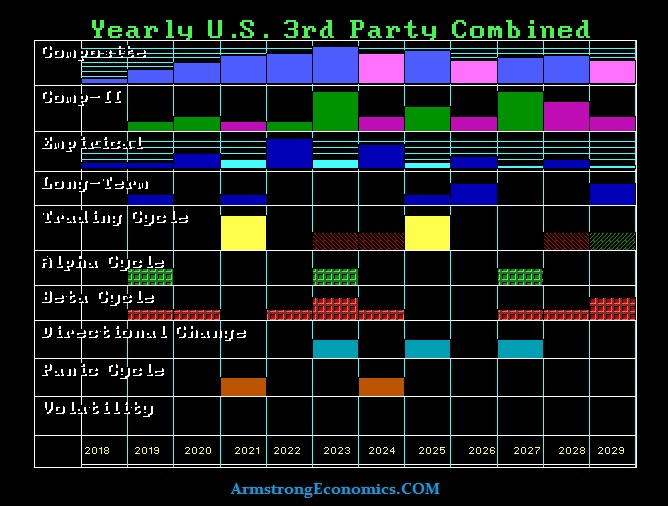
There is a very interesting aspect of our model which will begin to come into play in 2020. The cycle is changing here in 2019 and we are entering a period of a new political trend into 2023. This not such a great thing for either party. What is clearly taking place is that the shutdown seems to have been a turning point. True, Trumps polls have collapsed to 37% approval. But at the same time, faith in Congress has also collapsed. This is introducing a trend our model has been pointing to – the rise of a 3rd Party going all the way into 2024. Polls are fickle. It is a long time between here and the election in 2020.
The attention span of the people seems to be too short to remember this shutdown one two years from now. Trump miscalculated. The President is ALWAYS credited or blamed because people assume the President is all powerful. So Pelosi understood that no matter what she does, Trump will be blamed and not her. Trump had to yield for the shutdown will reduce the GDP and he will be unable to say he has done a good job with a strong economy. That is just how politics works in Washington and it was a hard lesson Trump had to learn. Still, the damage is not really about the shutdown itself. It seems to be centered on the fact that both sides acted like children demonstrating that neither party seems capable of managing anything.
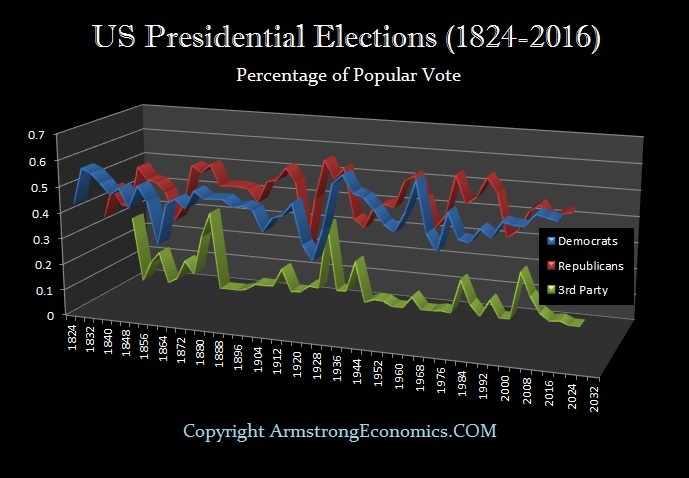
When we arrive at 2020, this is the big turning point for a 3rd Party. The Press and career politicians on both sides are out to get Trump simply because he is not one of them. But that does not mean the people are ready to surrender to career politicians once again. The crazy thing on our model is that it clearly shows that there is a 13 election year cycle coming into play in 2020 for a strong 3rd Party Showing. In 1912, there was a 30% vote for a 3rd party. Then in 1968, there was a 13% vote for a 3rd party. Since the last 3rd party took 19% in 1992 and 10% in 1996, a 3rd party this time could match or exceed 19% in 2020.
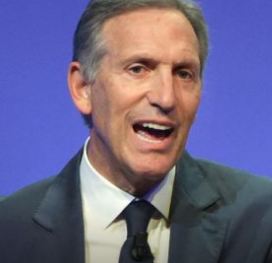
We already have the former Starbucks CEO Howard Schultz talking about that he may run in 2020 but as an Independent. As crazy as that may sound to those wrapped up in party politics, our model is showing that this is the trend.
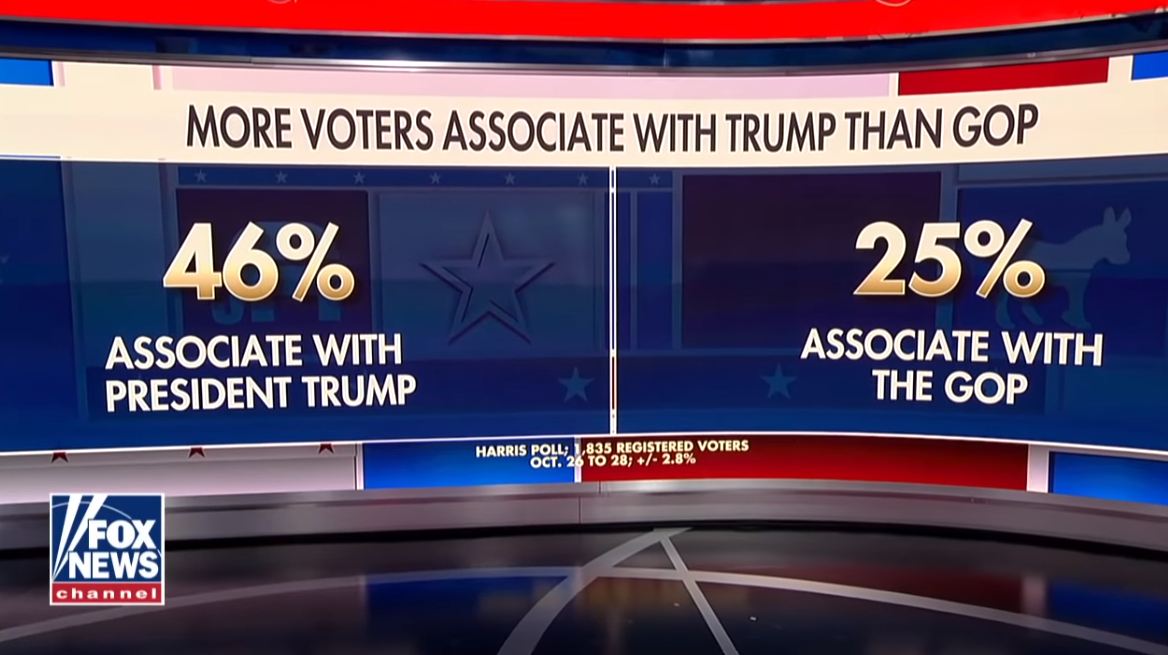
That Fox Poll is most interesting. It said that 46% of Republicans identified with Trump rather than the Republican Party. The implications of this are significant. It is not that Trump is some fantastic person, but that people are beginning to identify with candidates instead of parties. This is confirming what our computer is forecasting. The rise of a 3rd party is ripe for the taking. More and more people will vote for a person rather than a party.
The generation of Roosevelt is gone. There is really no adult from the Great Depression still alive today. Therefore, despite the critical emails I get, this is never about my opinion. The numbers are the numbers as is time. This has NOTHING to do with who I would vote for. Quite frankly, I do not see either party as doing anything to save the nation no less the world from the shift in power our computer is forecasting.
According to the DOJ announcement released today three companies: Huawei Technologies Co. Ltd., Huawei Device USA Inc. and Skycom Tech Co. Ltd. are charged with bank fraud and conspiracy to commit bank fraud, wire fraud and conspiracy to commit wire fraud, violations of the International Emergency Economic Powers Act (IEEPA) and conspiracy to violate IEEPA, and conspiracy to commit money laundering. Huawei and Huawei USA are charged with conspiracy to obstruct justice related to the grand jury investigation in the Eastern District of New York.
Additionally Ms. Meng Wanzhou is charged with bank fraud, wire fraud, and conspiracies to commit bank and wire fraud. Acting U.S. Attorney General Matthew G. Whitaker, Secretary Kirstjen Nielsen of the U.S. Department of Homeland Security, Secretary Wilbur Ross of the U.S. Department of Commerce, U.S. Attorney Richard P. Donoghue for the Eastern District of New York, FBI Director Christopher A. Wray, Assistant Attorney General Brian A. Benczkowski of the Justice Department’s Criminal Division and Assistant Attorney General John C. Demers of the National Security Division, announced the charges:
Keep in mind that China has loaned Venezuela over $50 billion in the past five years. In exchange, Venezuela gave China a 49% stake in PDVSA. Venezuela makes payments on the loans via oil shipments to China.
(VIA U.S. Treasury Dept) Today the Department of the Treasury’s Office of Foreign Assets Control (OFAC) designated Petroleos de Venezuela, S.A. (PdVSA) pursuant to Executive Order (E.O.) 13850 for operating in the oil sector of the Venezuelan economy. PdVSA is a Venezuelan state-owned oil company and a primary source of Venezuela’s income and foreign currency, to include U.S. dollars and Euros.
“The United States is holding accountable those responsible for Venezuela’s tragic decline, and will continue to use the full suite of its diplomatic and economic tools to support Interim President Juan Guaidó, the National Assembly, and the Venezuelan people’s efforts to restore their democracy,” said Secretary of the Treasury Steven T. Mnuchin.
“Today’s designation of PdVSA will help prevent further diverting of Venezuela’s assets by Maduro and preserve these assets for the people of Venezuela. The path to sanctions relief for PdVSA is through the expeditious transfer of control to the Interim President or a subsequent, democratically elected government.”
As with previous OFAC designations of certain Venezuelan officials and their supporters, U.S. sanctions need not be permanent. Sanctions are intended to change behavior. The United States has made it clear that we will consider lifting sanctions for those who take concrete, meaningful, and verifiable actions to support democratic order and combat corruption in Venezuela, including PdVSA.
As Venezuela’s state owned oil company, PdVSA has long been a vehicle for corruption. A variety of schemes have been designed to embezzle billions of dollars from PdVSA for the personal gain of corrupt Venezuelan officials and businessmen. For example, a 2014 currency exchange scheme was designed to embezzle and launder around $600 million from PdVSA, money obtained through bribery and fraud. By May 2015, the conspiracy had allegedly doubled in amount, to $1.2 billion embezzled from PdVSA.
Abraham Edgardo Ortega, a Venezuelan national who was PdVSA’s executive director of financial planning, pled guilty to one count of conspiracy to commit money laundering for his role in the billion-dollar international scheme to launder funds embezzled from PdVSA.
In a separate case, U.S. prosecutors have alleged that, from 2011 to 2013, senior Government of Venezuela and PdVSA officials, including Nervis Villalobos, the former Venezuelan vice minister of energy; Rafael Reiter, who worked as PdVSA’s head of security and loss prevention; and Luis Carlos de Leon, a former official at a state-run electric company, sought bribes and kickbacks from vendors in exchange for helping them secure PdVSA contracts and gain priority over other vendors for outstanding invoices during its liquidity crisis.
Today’s action designating PdVSA follows a determination by Secretary Mnuchin pursuant to E.O. 13850 that persons operating in the oil sector of the Venezuelan economy may be subject to sanctions.
Concurrent with this action, OFAC is issuing general licenses that authorize certain transactions and activities related to PdVSA and its subsidiaries within specified timeframes.
As a result of today’s action, all property and interests in property of PdVSA subject to U.S. jurisdiction are blocked, and U.S. persons are generally prohibited from engaging in transactions with them. (link)
8:15 p.m. – AP – The Mexican government says it disagrees with a map displayed by the White House that shows Mexico among those countries that support Venezuela’s embattled president, Nicolas Maduro.
National security adviser John Bolton held a press briefing Monday with a map that showed in red the countries supporting Maduro and in blue those nations supporting the Venezuelan congress leader Juan Guaido, who has declared himself Venezuela’s interim president.
Mexico’s ambassador to the U.S. told reporters in Washington that her government isn’t taking sides in the crisis.
In Ambassador Martha Barcena’s words: “We are not against the U.S. regarding the position on Venezuela. We are not siding with Maduro. We are not siding with Guaido. We think a third way of a peaceful solution can be found.” (read more)
I have created this site to help people have fun in the kitchen. I write about enjoying life both in and out of my kitchen. Life is short! Make the most of it and enjoy!
This is a library of News Events not reported by the Main Stream Media documenting & connecting the dots on How the Obama Marxist Liberal agenda is destroying America




 Centinel2012