Visit our friends at The Patriot Post: America’s News Digest http://bit.ly/37SbmhP —– There’s bipartisan agreement that the Office of Personnel Management (OPM) is inefficient, using antiquated and vulnerable computer systems. But after 18 months of trying to eliminate an agency that employs 5,500 bureaucrats, President Trump now says he won’t. Despite telling campaign crowds he would cut the size of government so fast your head will spin, he has accomplished no substantial reductions in the size or scope of the federal bureaucracy. Should Republicans abandon their talk of ending the era of big government and just accept that once a federal agency starts, like OPM did in the 1970s, it will live on eternally? Bill Whittle Now with Scott Ott comes to you 20-time each month thanks to our Members. Join them today at https://BillWhittle.com/register/ – Support us on Patreon: https://www.patreon.com/billwhittle – Listen to our shows on the go with your podcast app: http://bit.ly/BWN-Podcasts – Watch us now on Amazon’s Fire TV by downloading the Bill Whittle Network app. http://bit.ly/BWN-FireTV – Ask your Amazon smart device, “Alexa, play Bill Whittle Network on TuneIn radio.” – We’re on Bitchute too: http://bit.ly/BWN-Bitchute
USTR Robert Lighthizer made a rare appearance in the media to discuss the “big picture”, and some specifics, around the U.S-China phase-one agreement.
Ambassador Lighthizer notes the principle challenge is generating an enforceable set of standards -within a written agreement- between a totally controlled communist economic system (China) and a free-market system (USA). No other nation has ever tried, and there is no preexisting trade agreement to facilitate a mapping. What Lighthizer is constructing will be what all nations will start to use going forward. This is historic stuff.
Arguably, next to President Trump, USTR Lighthizer is one of the most consequential members of the administration. What he is constructing, with the guidance of President Trump, is going to influence generations of Americans.
.
[Transcript] MARGARET BRENNAN: This week, the U.S. and China agreed on the first phase of a trade deal that would roll back some American tariffs. It’s expected to be signed in early January. We’re joined now by the U.S. Trade Representative, Robert Lighthizer, the top negotiator in those talks with Chinese officials. Good to have you here.
U.S. TRADE REPRESENTATIVE ROBERT LIGHTHIZER: Thank you for having me, MARGARET.
MARGARET BRENNAN: It’s huge to have the two largest economies in the world cool off some of these tensions that have been rattling the global economy. But I want to get to some of the details here. China says still needs to be proofread, still needs to be translated. Is you being here today a sign this is done, this deal’s not falling apart?
AMB. LIGHTHIZER: So first of all, this is done. This is something that happens in every agreement. There’s a translation period. There are some scrubs. This is totally done. Absolutely. But can I make one point? Because I think it’s really important. Friday was probably the most momentous day in trade history ever. That day we submitted the USMCA, the Mexico-Canada Agreement with bipartisan support and support of business, labor, agriculture. We actually introduced that into the House and the Senate on this, which is about 1.4 trillion dollars worth of the economy- I mean of- of trade. And then in addition to this, which is about 600 billion, so that’s literally about half of total trade were announced on the same day. It was extremely momentous and indicative of where we’re going, what this president has accomplished.
MARGARET BRENNAN: Well, that is significant and I do want to get to the USMCA. But because the China deal just happened–
AMB. LIGHTHIZER: Right.
MARGARET BRENNAN: –and we know so little about it, I’d like to get some more detail from you. You said this is set.
AMB. LIGHTHIZER: Yes.
MARGARET BRENNAN: You expect the signing in early January still.
AMB. LIGHTHIZER: Right.
MARGARET BRENNAN: What gives President Trump the confidence to say China’s going to go out and buy $50 billion worth of agricultural goods because Beijing hasn’t said that number?
AMB. LIGHTHIZER: First of all- let me say first of all, I would say this. When we look at this agreement, we have to look at where we are. We have an American system, and we have a Chinese system. And we’re trying to figure out a way to have these two become integrated. That’s what’s in our interest. A phase one deal does the following: one, it keeps in place three hundred and eighty billion dollars worth of tariffs to defend, protect U.S. technology. So that’s one part of it. Another part of it is very important structural changes. This is not about just agricultural and other purchases, although I’ll get to that in a second. It’s very important. It has IP. It has- it has–
MARGARET BRENNAN: Intellectual property–
AMB. LIGHTHIZER: –technology. It has- it has currency. It has financial services. There’s a lot of very- the next thing is, it’s- it’s enforceable. There’s an enforcement provision that lasts 90 days- it takes 90 days and you get real, real enforcement. The United States can then take an action if China doesn’t keep its commitments–
MARGARET BRENNAN: Put the tariffs back on?
AMB. LIGHTHIZER: Well, you would take a proportionate reaction like we do in every other trade agreement. So that’s what we expect. And finally, we’ll- we’ll find out whether this works or not. We have an enforcement mechanism. But ultimately, whether this whole agreement works is going to be determined by who’s making the decisions in China, not in the United States. If the hardliners are making the decisions, we’re going to get one outcome. If- if the reformers are making the decisions, which is what we hope, then we’re going to get another outcome. This is a- the way to think about this deal, is this is a first step in trying to integrate two very different systems to the benefit of both of us.
MARGARET BRENNAN: But that $50 billion number, is that in writing?
AMB. LIGHTHIZER: Absolutely. So- so here’s what’s in writing. We- we have a list that will go manufacturing, agriculture, services, energy and the like. There’ll be a total for each one of those. Overall, it’s a minimum of 200 billion dollars. Keep in mind, by the second year, we will just about double exports of goods to China, if this- if this agreement is in place. Double exports. We had about 128 billion dollars in 2017. We’re going to go up at least by a hundred, probably a little over one hundred. And in terms of the agriculture numbers, what we have are specific breakdowns by products and we have a commitment for 40 to 50 billion dollars in sales. You could think of it as 80 to 100 billion dollars in new sales for agriculture over the course of the next two years. Just massive numbers.
MARGARET BRENNAN: And that is important in no small part because also this is a key political constituency for President Trump going into the election, to take some pain off of American farmers who’ve been feeling it pretty strongly. I mean, the USDA projects that the soybean market won’t recover, I think til 2026 because of the damage that has been done to it.
AMB. LIGHTHIZER: Listen–
MARGARET BRENNAN: Is that- how much of that, that political calculus, factored into the agreement to do this in phases? Because you didn’t want to do it in phases.
AMB. LIGHTHIZER: Well, it was MARGARET–
MARGARET BRENNAN: The Chinese did.
AMB. LIGHTHIZER: It was always going to be in phases. The question was, how big was the first phase? Anyone who thinks you’re going to take their system and our system that have- that have worked in a very unbalanced way for the United States and in- in one stroke of the pen change all of that is foolish. The president is not foolish. He’s very smart. The question was, how big- how big was the first phase going to be? This is going to take years. We’re not going to resolve these differences very quickly. On the agriculture point, that’s a good point. Let me say this. If you look at American agriculture in between USMCA, which is Canada and Mexico, China, Japan, Korea, we have rewritten the rules in favor of American agriculture on more than half, 56 percent, of all of our exports from agriculture. This, over the course of the last year, what this president has accomplished in this area, is remarkable. And you’re already- any one of these deals would have been monstrous. And the fact that we have all of them together–
MARGARET BRENNAN: Right.
AMB. LIGHTHIZER: –is- is great for agriculture.
MARGARET BRENNAN: I just want to button up on China, though, because the promise here was to do the things that American businesses have been complaining about for years–
AMB. LIGHTHIZER: Absolutely.
MARGARET BRENNAN: Not just the intellectual property theft, but subsidizing corporations in China in an unfair way for Americans. Cybertheft. None of that’s here.
AMB. LIGHTHIZER: Well–
MARGARET BRENNAN: That’s phase two. When do you start negotiating that?
AMB. LIGHTHIZER: So let me say first of all–
MARGARET BRENNAN: Is there a date?
AMB. LIGHTHIZER: Let’s talk about what’s here rather than what’s not here.
MARGARET BRENNAN: But that’s huge.
AMB. LIGHTHIZER: Absolute rules on–
MARGARET BRENNAN: That’s what President Trump said this whole trade war was starting on.
AMB. LIGHTHIZER: Look at tech- tech transfer is huge. That’s what’s in the 301 report. Look, we had a plan that- the president came up with a plan. We’ve been following it for two and a half years. We are right where we hope to be. Tech transfer, real commitments, IP, real specific commitments. I mean, this agreement is 86 pages long of detail. Agricultural barriers removed in many cases, financial services opening, currency. This is a real structural change. Is it going to solve all the problems? No. Did we expect it to? No. Absolutely not.
MARGARET BRENNAN: Do- the president said those talks in to start immediately, though. Do you have a date?
AMB. LIGHTHIZER: We don’t have a date, no. What we have to do is get this- we have to get the- the final translations worked out, the formalities. We’re going to sign this agreement. But I’ll tell you this. The second Phase 2 is going to be determined also by how we implement phase one. Phase one is going to be implemented right to the- right down to every detail.
MARGARET BRENNAN: I want to–
AMB. LIGHTHIZER: It really is a remarkable agreement, but it’s not going to solve all the problems.
MARGARET BRENNAN: Well, we need to take a short break. We’ll be back with US Trade Representative Lighthizer in a moment.
*COMMERCIAL*
MARGARET BRENNAN: Welcome back to Face the Nation and our conversation with US Trade representative Robert Lighthizer. Let’s talk about the other agreement. The House is set, Democratic controlled House, is set to vote on the USMCA, the free trade deal with Mexico and Canada that’s been rewritten. This is a win for the president to get this through, but Nanc- Speaker Pelosi and her caucus did have some last minute maneuvers here. Speaker Pelosi is quoted as saying we ate their lunch when it comes to the Trump administration.
AMB. LIGHTHIZER: So–
MARGARET BRENNAN: How do you respond to that?
AMB. LIGHTHIZER: We had a great–
MARGARET BRENNAN: You made some concessions to labor here. That was not insignificant and it did irk some Republicans.
AMB. LIGHTHIZER: So- so- so let me- let me make a point about that. We had an election and the Democrats won the House, number one. Number two, it was always my plan and I was criticized for this, as you know, it was always my plan that this should be a Trump trade policy. And a Trump trade policy is going to get a lot of Democratic support. Remember, most of these working people voted for the president of the United States. These are- these are not his enemies. So what did we concede on? We conceded on biologics. Yes. That was a move away from what I wanted, for sure. But labor enforcement? There’s nothing about being against labor enforcement that’s Republican. The president wants Mexico to enforce its labor laws. He doesn’t want American manufacturing workers to have to compete with people who are- who are operating in- in- in very difficult conditions. So there’s–
MARGARET BRENNAN: But you don’t think there’s a political cost because Republican senators were annoyed to be cut out of this last phase?
AMB. LIGHTHIZER: Look it there are- there are always process issues. This bill is better now with the exception of biologics, which is a big exception. With the exception of biologics, it’s more enforceable and it’s better for American workers and American manufacturers and agriculture workers than it was before. For sure.
MARGARET BRENNAN: Mr. Lighthizer, Thank you very much for joining us.
National Economic Council Chairman Larry Kudlow appears with Maria Bartiromo to discuss the ratification of the USMCA and the U.S-China “phase one” trade deal.
.
USTR Lighthizer appeared on CBS to discuss the China agreement, he goes into more detail. That conversation is coming next.
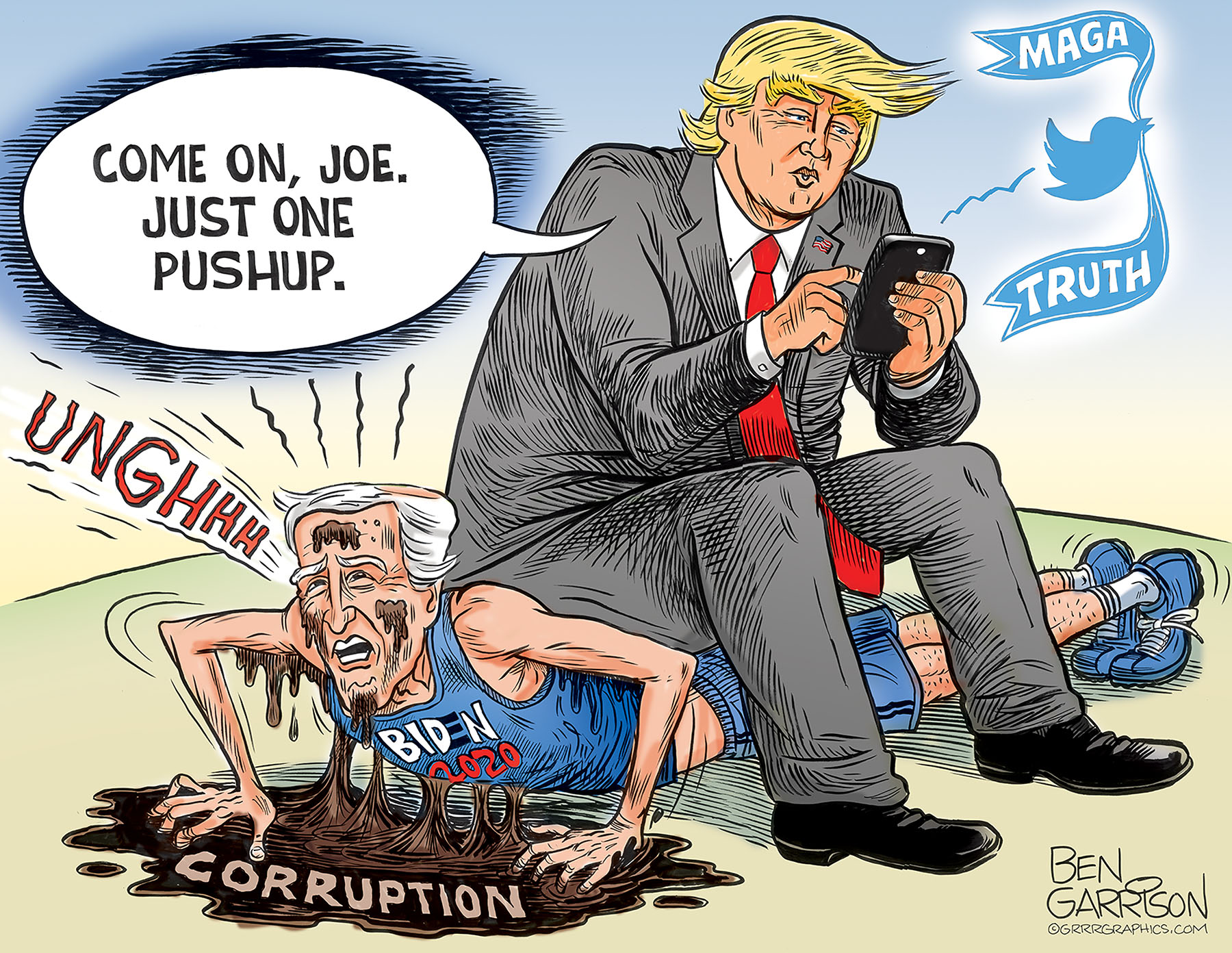
Rudy Giuliani went to Ukraine and reported back to the president. He has plenty of evidence in hand, and it’s obvious to anyone with a brain—Creepy Joe Biden is corrupt to the marrow.
Biden’s son, Hunter, landed a $50,000 per month position with Barisma, a corrupt Ukrainian gas company. Even though Hunter’s experience amounts to nothing more than sniffing cocaine and impregnating stripper club girls, he was appointed to the board of a company to which had zero experience.
It’s graft, folks. You know it, I know it, Trump knows it, and soon everyone will know it. It’s why the Democrats want to impeach Trump. They know it runs deeper than Biden. Too many Democrats dipped into the corruption trough made possible under Obama. The Democrats are rotten to the core, and that’s why the impeachment procedure is happening. It’s their last, dying gasp to stop people from seeing just how swampily rotten they truly are.
U.S. Trade Representative Robert Lighthizer has released a two-page summary fact sheet [pdf link here] outlining the “Phase-One” agreement in principal. From research into the material the principal agreement appears to be an 86-page document covering nine chapters. The fact sheet covers the top lines of seven chapters:
For undisclosed reasons (we can guess, but probably shouldn’t on this one) the 86-page agreement is unlikely to be made public until after the USMCA completes the ratification process in congress (both chambers).
Given the politics in China, and Beijing’s position following the U.S. resolution vis-a-vis Hong Kong, it is doubtful there will be a high level signing ceremony. Chairman Xi would appear weak internally as dominant President Trump would be seen as digging Eagle claws into vulnerable dragon. Vice-Premier Liu He and USTR Lighthizer are likely to be visible faces.
It remains in President Trump’s strategic interests for Beijing to refuse being committed to granular specifics. In a very unusual way ‘uncertainty‘ actually works in favor of the U.S. objective within this trade dynamic as future investment in China will be tenuous without those specifics. An unstable ‘status quo’ is an advantage to Trump.
Because President Trump has flipped the leverage dynamic; and because hundreds of manufacturers are seeking alternatives to the risk China represents; the historic cunning and duplicity -China’s forte’- that creates distrust, actually works in favor of the U.S.
While many multinational investor interests will be watching, waiting, to see if China will (for the first time) live up to their words, President Trump will be providing alternatives and incentives…. while highlighting stability in North America.
The stock market responded exactly as would be expected on Friday to the announcement of the ‘phase-one’ agreement in principal… the market didn’t buy it, because everything remains tenuous at best. This is an indication the multinationals would/will be more likely to follow the alternatives the USMCA provides.
The Wall Street multinationals not responding favorably is a very good sign. This predicts an ongoing decoupling, which is exactly President Trump’s goal.
It really is remarkable. No-one else could have pulled this off.
Two years ago the Democrats were saying President Trump was being too hard on China… too disruptive to the world economy… Now those same Democrats say he’s not being hard enough; without realizing that’s exactly what President Trump wants them to say…
You gotta laugh.
Two years ago the Wall Street financial pundits were apoplectic, demanding President Trump resolve the China issue so they could get back to business…. President Trump now provides a resolution and those same financial voices are saying: meh, no thanks; we’ll wait to see what better stuff you’ve got planned; North America looks pretty good.
Too darned funny.
.
President Trump, Secretary Ross, Secretary Mnuchin and especially Robert Lighthizer will likely never get the full credit they deserve… but hey, then again, tell me the last time you knew the name of the United States Trade Ambassador?
Deep and compelling discussion between Victor Davis Hanson and Epoch Times’ Jan Jekielek about President Trump, his effectiveness, and an overall era of apoplexy amid the left as President Trump deconstructs the progressive agenda.
It’s an hour long interview that goes into a much more complex discussion; but it’s also well presented, explained and well worth the time to watch:
Today President Trump attended the Army Navy game at Lincoln Field in Philadelphia. The Commander-in-Chief visited both teams in their locker room prior to the start of the game.
.
The stadium erupted with applause during the introduction and coin toss (video below); and then an act of serendipity or planning? (I think planning)…. at the conclusion of the coin toss, when POTUS was leaving the field, the stadium played The Rocky theme.
.
PHILADELPHIA – President Donald Trump participated in the coin toss at the 120th Army-Navy football game at Lincoln Financial Field to a round of applause from the crowd Saturday.
The president stood on the field with representatives from both service academies during the national anthem and then walked to midfield, waving at supporters on his way. Trump stood on the Navy sideline, wearing his red cap, as the team ran onto the field before kickoff.
Trump walked out to midfield for the coin toss, with security personnel roping off the area. Trump was introduced to a round of applause from the crowd and tossed the coin.
Navy called tails and won the toss.
The president watched the first half from the Army side with Defense Secretary Mark Esper and other military leaders, according to the official pool report.
Trump crossed over to the Navy side at halftime. Some audience members chanted, “Commander in chief” and “Trump we love you” was also heard. A couple dozen people in uniform chanted, “Four more years!” (read more)
Likely the Navy side was extra happy this year with the strength of support President Trump has given the SEALs.
Even though it’s Philly where they play it all the time; playing the Rocky theme while POTUS was on field was cool.
Visit The Patriot Post: America’s News Digest http://bit.ly/2MUKjda —– Time magazine dubs Swedish teen climate activist Greta Thunberg as the 2019 person of the year, but Bill Whittle has his own nominee — a humanitarian and environmentalist who actually did something. Here’s why the editors of Time should have picked President Donald Trump, and why they never can. Bill Whittle Now with Scott Ott comes to you 20 times each month thanks to our Members. – Become a Member: https://BillWhittle.com/register/ – Support us on Patreon: https://www.patreon.com/billwhittle – Listen to our shows on the go with your podcast app: http://bit.ly/BWN-Podcasts – Watch us now on Amazon’s Fire TV by downloading the Bill Whittle Network app. http://bit.ly/BWN-FireTV – Ask your Amazon smart device, “Alexa, play Bill Whittle Network on TuneIn radio.” – We’re on Bitchute too: http://bit.ly/BWN-Bitchute
Visit our friends at The Patriot Post: America’s News Digest http://bit.ly/2qc2BOt —– Democrats are in a pickle for 2020, as the Labor Department reports a 6th straight month of record job growth, and a 50-year low in unemployment. How can they compete with this economic juggernaut. Quick, impeach Trump! Bill Whittle Now with Scott Ott comes to you 20 times each month thanks to our Members. You can become one of them to advance these messages at https://BillWhittle.com/register/ – Support us on Patreon: https://www.patreon.com/billwhittle – Listen to our shows on the go with your podcast app: http://bit.ly/BWN-Podcasts – Watch us now on Amazon’s Fire TV by downloading the Bill Whittle Network app. http://bit.ly/BWN-FireTV – Ask your Amazon smart device, “Alexa, play Bill Whittle Network on TuneIn radio.” – We’re on Bitchute too: http://bit.ly/BWN-Bitchute
As we expected the Supreme Court has granted the petition for a writ of certiorari and will hear cases related to attempts to gain President Trump financial records and tax filings.
The Supreme Court has issued a stay upon all lower court action and consolidated the cases into one writ. The court will hear arguments in March and release a ruling later in the summer of 2020.
President Trump went to the Supreme Court after the House Financial Services and Intelligence Committees issued subpoenas to Deutsche Bank and Capital One seeking President Trump’s tax records. In his request to the court [Read Here] Trump asked SCOTUS to block the subpoenas on the ground they go beyond the committees’ powers.
Justice Ginsburg stayed the lower court decision and ordered the House of Representatives to file a response by Wednesday, December 11. The cases and issues were then discussed at their private SCOTUS conference. Today’s writ is the outcome.
The underlying House case has several defects.
Attorney Ristvan previously provided a good encapsulation of the problems for the House that explains why President Trump could likely win the case:
House Oversight is one of three committees that 26USC§6103(f) requires the IRS to turn over individual returns “upon request”.
They requested (PDJT taxes for 6 years 2013-2018) long before Pelosi announced her impeachment inquiry, way before the House vote on same, to which Pelosi said Sunday, (paraphrased) “We haven’t decided to impeach. We are only inquiring about it.”
The ‘upon request’ is not as absolute as it seems. The request must still be predicated on a legitimate legislative purpose. SCOTUS has held (I skip the rulings, since previously commented on here many months ago) that there are only two valid purposes, both constrained to legislative powers expressly granted by A1§8.
1. An inquiry into making, repealing, or amending an A1§8 law.
2. Oversight of executive administration of an existing law.
With respect to (1), a legitimate legislative purpose would be reviewing real estate tax law for possible changes. BUT then, the request should have come from Ways and Means (Neal) where tax laws originate. AND, it should have included requests for tax returns from other big real estate developers also. Singling out only PDJT is a fatal defect to this purpose.
With respect to (2), after Nixon/Agnew the tax code was amended to require a special IRS audit of annual POTUS and VPOTUS returns, with the results held in the National Archive. Reviewing those special audits by IRS would be a proper Oversight and Reform legislative purpose, BUT ONLY for 2017-2018 after PDJT was inaugurated. The earlier 4 years demanded are a fatal defect to this purpose.
Both these valid points were raised by President Trump and were already on their way to SCOTUS. Now the committee is trying to ‘cure’ these fatal request defects by claiming the returns are necessary for impeachment. This raises four new issues where PDJT can also win.
1. Impeachment is not a legislative purpose within A1§8.
2. Articles of Impeachment have historically been the the province of Judiciary, NOT Oversight.
3. The demand was made BEFORE the impeachment inquiry unofficially started and cannot be retrospectively cured.
4. No tax ‘high crimes of misdemeanors’ have even been alleged. Impeachment fishing expeditions are unconstitutional.
IMO this case has the potential to set a major constitutional precedent about POTUS harassment via political impeachment. The constitutional convention minutes and Federalist #65 both make it clear why ‘maladministration’ (the original third test after treason and bribery, and which WOULD allow for political impeachment) was replaced by ‘High Crimes and Misdemeanors’. The phrase was borrowed from prior British law, has a specific set of meanings, and DOES NOT allow political impeachment. (link)
The quest for President Trump’s financial records is essentially a legislative fishing expedition in an attempt to gain opposition research for their Democrat candidate in the 2020 election.
I have created this site to help people have fun in the kitchen. I write about enjoying life both in and out of my kitchen. Life is short! Make the most of it and enjoy!
This is a library of News Events not reported by the Main Stream Media documenting & connecting the dots on How the Obama Marxist Liberal agenda is destroying America




 Centinel2012