
Control “history” and you control the present!
If you control the “present” the future is yours!
Tag Archives: Crowd Control
The Criminal Arrogance of Hillary Clinton
30,000 deleted emails… Bill Whittle looks at the lawlessness, the arrogance, and the unmasked contempt that Hillary Clinton and Barack Obama have for the American people.
Meet the 19th Century American Who Warned About Big Government, Religious Liberty Assaults

By Robert Moffit / March 09, 2015
2015 marks a milestone in American history. One hundred and fifty years ago, Confederate General Robert E. Lee surrendered to General Ulysses S. Grant and ended the Civil War. Shortly thereafter, Orestes Augustus Brownson (1803-1876), a prominent journalist and philosopher, published “The American Republic,” an erudite defense of the Federal Constitution.
As noted in our Heritage Foundation “First Principles” essay, today a fresh reading of Brownson’s masterwork can give Americans a deeper understanding of their precious civic birthright, the unique federal order that guarantees their personal and political freedom.
Prophetically, Brownson warned that the greatest future threats to the Republic were internal. He called upon his fellow Americans to oppose the relentless centralization of power in Washington; a transformation fueled by a new secular ideology—“humanitarian democracy”—that would war against all prescriptions and traditions, as well as state and local powers, in the name of equality, and seek to crush all genuine diversity, individual distinctions, and subordinate even personal conscience itself on the altar of a fully secularized, and thus absolute, state.
The Founders’ genius was in devising a constitutional order that recognized the truth of man’s individuality, his flourishing in freedom, and the sacredness of his person, particularly in his relationship to God: “The American constitution is not founded on political atheism, but recognizes the rights of man, and therefore, the rights of God.”
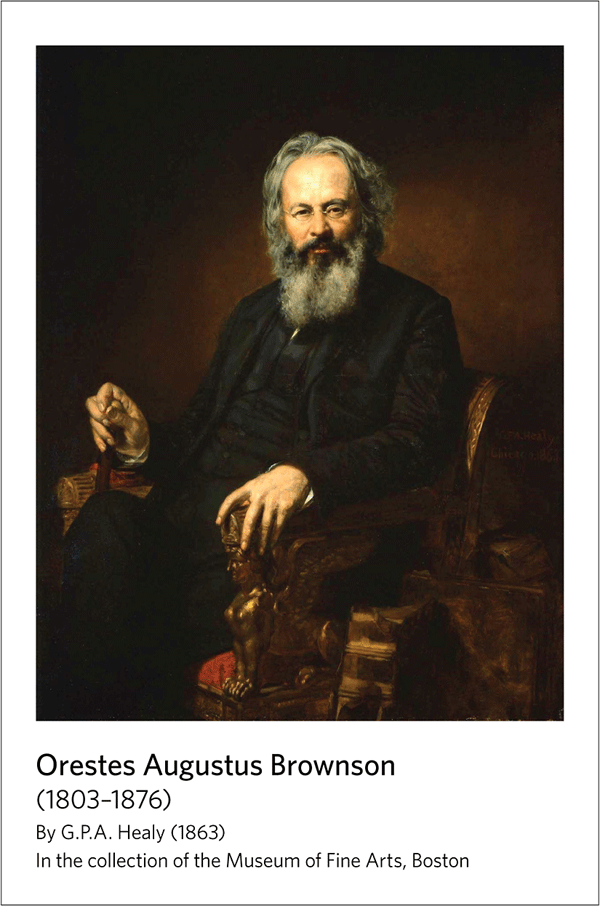
Today, when Americans of all religious faiths have just cause to fear government assaults on religious liberty, the wisdom of Brownson—a devout Catholic—is a bounteous benefit for all. Protect the sacred, he warned, from the profane and thus preserve the moral order: “If they [government officials] could subject religion to the secular order, or completely secularize the church, they would reduce themselves to the secular order alone, and deprive themselves of all aid from religion. To secularize religion is to nullify it.”
While a journalist, urgently writing on contemporary topics in his Quarterly Review, many of his opinions, right or wrong, were exclusively relevant to his own time. However, Brownson also developed a sophisticated and consistent philosophical conservatism that imparted a timeless quality to his observations. Those hard hitting commentaries are strikingly relevant to contemporary America. For example:
- On immigrants’ duty to assimilate: “It is not attachment to American soil, or sympathy with the American nationality, spirit, genius, or institutions, that brings the great mass of foreigners to our shores. No doubt we derive great advantages from them, but the motive that brings them is not advantage to us or service to our country. They come solely from motives of personal advantage to themselves; to gain a living, to acquire a wealth, or to enjoy a freedom denied them in their own country, or believed to be more easily obtained or better secured here than elsewhere. The country, therefore, does not and cannot feel that it is bound either in justice or in charity to yield up its nationality to them, or to suffer the stream of its national life to be diverted from its original course to accommodate their manners, tastes or prejudices…If I from motives of hospitality open my doors to the stranger, and admit him to the bosom of my family, I have the right to expect him to conform to my domestic arrangements, and not to undertake to censure or interfere with them.”
- On crony capitalism: “Louis XI was not weaker against Charles the Bold than is Congress against the Pennsylvania Central Railroad and its connections, or the Union Pacific, built at the expense of the government itself. The great feudal lords had souls, railroad corporations have none.”
- On fiscal irresponsibility and debt: ‘The journalists tell us that the country is rich, and we count our millionaires by the thousands, if not by hundreds of thousands; and yet, if called upon suddenly to pay its debts or to redeem its bonds of every sort, it would be found to be hopelessly insolvent, and the reputed wealth of the millionaires would vanish in smoke. Our present wealth is chiefly in evidences of debt, that is, created by mortgages on the future.”
- On Communism’s false promises: “Communism, if it could be carried out, would not…as the communists dream, secure to all the advantages of wealth, but would result in the reduction of all to the most abject poverty—the very thing which they are ready to commit any crime or sacrilege in order to escape.”
The Civil War was a terrible trial for millions—Brownson himself lost two sons—but the calm courage of the American people prepared them for world leadership:
“With larger armies on foot than Napoleon ever commanded, with their line of battle stretching from ocean to ocean, across the whole breadth of the continent, they never, during four long years of alternate victories and defeats—and both unprecedently bloody—or a moment lost their equanimity, or appeared less calm, collected and tranquil, than in ordinary times of peace…Their success proves to all that what, prior to the war, was treated as American arrogance or self-conceit, was only the outspoken confidence in their destiny as a providential people, conscious that to them is reserved the hegemony of the world.”
That “hegemony” was moral, not militaristic. Rather it was the success, for the entire world to witness, of America’s providential mission to secure the greatest degree of human liberty under law; a unique experiment in self-government realized through the ingenious Federal Constitution, the priceless gift of America’s Founders. This was a recurrent theme in Brownson’s writings. It was a theme that, over a century later, President Ronald Reagan also expressed in his vision of America as a “Shining City on a Hill.” Brownson’s name recognition may be low, but his ideas and insights have endured.
Netanyahu Wins – Official Vote Tallies Not Even Close to Media Reported Exit Polling – A Resounding Victory For Benjamin Netanyahu…
So it wold seem that Netanyahu beat Obama — that is not going to go well in the White house!
WHAT IF ILLEGALS LEFT?
It really simple the “Illegal” aliens that are pouring in are destroying the country which is exactly what Obama wants. Legal immigrants come here to be Americans and have skills that make them valuable like a 100 years ago. . Illegal invaders are not immigrants as they are not here to become Americans they are here to collect the benefits that we created for out progeny not theirs.
Another Failed Obama Coup
Great picture of Satan — lets hope Netanyahu succeeds.

A few years ago, President Obama tried to overthrow the government of Egypt and replace it with the Muslim Brotherhood. That worked for a few months before the people revolted.
الوفد – أوباما “شيطان” على “فيس بوك”
Popular and widely read Egyptian newspaper Al Wafd published the above picture today portraying U.S. President Barack Hussein Obama as Satan himself. The unflattering picture has been making the rounds on Facebook in the Middle East and, according to Al Wafd, is representative of the hatred growing numbers of people in the region have for the American president, thanks to his staunch and unwavering support for Islamists and jihadiis — whether in Nigeria, Libya, Egypt, or Syria — even as they terrorize, murder, rape, and burn down Christian churches, that is, even as they engage in diabolical activities.

Now his plans to replace…
View original post 29 more words
The State Department Can’t Find Hillary’s Separation Statement … how convenient.
You would have to be an idiot to believe anything a Clinton said!
Two Warnings

This is one smart American that should be listened to!

When Israeli prime minister Benjamin Netanyahu addressed a joint session of Congress on March 3rd, it was the third time he had done so. The only other person to address a joint session of Congress three times was the legendary British prime minister Winston Churchill.
The parallels between the two leaders do not end there. Both warned the world of mortal dangers that others ignored, in hopes that those dangers would go away. In the years leading up to World War II, Churchill tried to warn the British, and the democratic nations in general, of what a monstrous threat Hitler was.
Despite Churchill’s legendary status today, he was not merely ignored but ridiculed at the time, when he was repeatedly warning in vain. Knowing that his warnings provoked only mocking laughter in some quarters, even among some members of his own party, he said on March 14, 1938 in the House of Commons, “Laugh but listen.”
Just two years later, with Hitler’s planes bombing London, night after night, the laughter was gone. Many at the time thought that Britain itself would soon be gone as well, like other European nations that succumbed to the Nazi blitzkrieg in weeks (like France) or days (like Holland).
How did things get to such a desperate situation, with Britain alone continuing the fight, and struggling to survive, against the massive Nazi war machine that now controlled much of the material resources on the continent of Europe?
Things got that desperate by following policies strikingly similar to the policies being followed by the Western democracies today, including some of the very same notions and catchwords being used today.
Just recently, a State Department official in the Obama administration said that Americans have remained safe in a nuclear age, not because of our own nuclear arsenal but because “we created an intricate and essential system of treaties, laws and agreements.”
If “treaties, laws and agreements” produced peace, there would never have been a Second World War. The years leading up to that monumental catastrophe were filled with international treaties and arms control agreements.
The Treaty of Versailles, which ended the First World War, imposed strong restrictions on Germany’s military forces — on paper. The Washington Naval Agreements of 1922 imposed restrictions on all the major naval powers of the world — on paper. The Kellogg-Briand pact of 1928 created an international renunciation of war — on paper.
The Munich agreement of 1938 produced a paper with Hitler’s signature on it that British Prime Minister Neville Chamberlain waved to the cheering crowds when he returned to England, and said that it meant “Peace for our time.” Less than a year later, World War II began.
Winston Churchill never bought any of this. He understood that military deterrence was what preserved peace. With England playing a leadership role in Europe, “England’s hour of weakness is Europe’s hour of danger,” he said in the House of Commons in 1931.
Today, with the Obama administration “leading from behind” — in practice, not leading at all — we see in Ukraine and the Middle East what that produces.
As for disarmament, Churchill said in 1932, “Alone among the nations we have disarmed while others have rearmed.”
Today, the United States has that dubious and reckless distinction. Our pacifists, like those in England during the 1930s, argue that we should disarm to “induce parallel” behavior by others. In England between the two World Wars, the rhetoric was that they should disarm “as an example to others.”
Whether others would follow that example was just as dubious then as it is today. While Russia and China increased the share of their national output that went to military spending in 2014, the United States reduced its share. Churchill deplored the “inexhaustible gullibility” of disarmament advocates in 1932. That gullibility is still not exhausted in 2015.
“Not one of the lessons of the past has been learned, not one of them has been applied, and the situation is incomparably more dangerous,” Churchill said in 1934. And every one of those words is more urgently true today, in a nuclear age.
Orwellian nightmare unleashed on schoolkids Teachers now thought police with extreme new spy ‘tools’Orwellian nightmare unleashed on schoolkids Teachers now thought police with extreme new spy ‘tools’
WND Exclusive
Leo Hohmann is a news editor for WND. He has been a reporter and editor at several suburban newspapers in the Atlanta and Charlotte, North Carolina, areas and also served as managing editor of Triangle Business Journal in Raleigh, North Carolina.

Technology is increasingly being used by schools to gather data on students, testing not just their knowledge of subjects like reading, math and science but subjective “social skills.”
Technology is increasingly being used by schools to gather data on students, testing not just their knowledge of subjects like reading, math and science but subjective “social skills.”
Parents and students have been “opting out” of high-stakes testing in record numbers over the past year, saying the standardized tests waste valuable instruction time, cause undue stress and often measure “skills” that have nothing to do with academic knowledge.
Rather than merely asking for a right or wrong answer to a math, history or science question, the new assessment industry is capable of boring into a child’s attitudes, values, opinions and beliefs, all of which parents and privacy advocates say is no business of the government’s.
The pushback has led some state education systems to recommend a reduction in the amount of high-stakes testing in public schools.
But, parents beware, the sudden realization that maybe too much testing is going on is not going to lead to less data being collected. Quite the opposite.
In fact, traditional testing may no longer be needed. Schools have found they have better, more efficient ways to collect even more data on your child, without resorting to paper and sharpened No. 2 pencils.
Oregon’s Gov. John Kitzhaber, for instance, assigned a task force to this problem recently and after a year of private meetings, the group is ready to unveil its recommendations which are expected to include replacing standardized tests with high-tech “observation” tools.
Fewer tests might sound like a relief to stressed-out students and wary parents.
But what if your child’s teacher could have access to a software application that allows her to collect data on your child in real time, without ever rolling out a test?
Enter the BOSS app. It is just one of countless new data-collection products available to school systems looking to collect data on the sneak.
BOSS stands for Behavioral Observation of Students in Schools. The app was designed to “enable psychologists to observe” patients but is now being marketed to schools interesting in tracking students’ behavioral patterns.
Created by the British-based textbook giant Pearson, the BOSS app can be loaded onto a smartphone and used to secretly monitor every move of targeted students in the classroom.
Does little Johnny fidget in his seat a bit too much? Does he socialize with the students around him in an appropriate manner? Does he tend to stare aimlessly out the window when he should be paying attention to the teacher?
All of this information can be pulled in and stored in an individual dossier for later analyzing and assigned an intervention and remediation that will deal with Johnny’s shortcomings, whether they be laziness, lack of assertiveness, over-aggressiveness or whatever psychological problem the app may discover.
BOSS app can be downloaded from iTunes for $29.99 and comes in age-appropriate versions from pre-K through 12th grade. The product description boasts that BOSS is able to “record students’ behaviors in real time. The BOSS software uses interactive buttons labeled to a particular behavior for the observer to press while observing a student during a given duration. The software keeps track of the amount of times a behavioral button is depressed during an observation.”
The app tracks “a student’s active or passive engagement in activities” and will collect data and email it to the teacher “for future use to help support a disability diagnosis,” the Pearson promotional material states.
The BOSS app is not the only new technology percolating in the education industry that has the ability to invisibly assess students in real time without their knowledge, or the knowledge of their parents.
Below is a small sampling of other apps being marketed to educators:
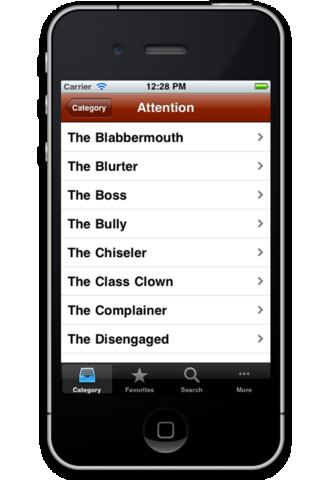
You Can Handle Them All app• “You Can Handle Them All”: This app, produced by Master Teacher, describes 124 behaviors that teachers may encounter in their students and identifies the primary cause of each. A teacher using this app places each student into a category, with options that include “The Blabbermouth,” “The Blurter,” “The Boss,” “The Bully,” “The Complainer,” “The Disengaged” and “The Class Clown.” It then prompts the teacher with suggestions on how to remedy each unwanted behavior.
• “Pearson Dash”: Another product by Pearson, Dash, according to the iTunes product description, enables teachers to “Organize and track your students” according to classroom seating charts, to “record, edit, and e-mail observational notes on your students,” to “View student performance and mastery of skills with SuccessTracker data.”
• “What Would You Do at School If”: This app focuses squarely on social skills. Put out by Super Duper Publications, it seeks to elicit answers to sensitive, revealing questions that help schools develop a psychological profile on each student. Instead of a test, this app is presented to a young child as a fun “game” while collecting data on the child’s parental upbringing and personality.

what would you do in school if“Select the cards you want students to see, and have them work on solving problems and practicing good social skills as they discuss situations in and around school,” the product description says. “The prompts include questions like, ‘What would you do if … you forgot your homework?’ and, ‘What would you do if … your classmate teased you about the new shirt you wore?’”
Students are then graded based on how many “right” answers they give in what is clearly a test of one’s attitudes, behaviors, values and beliefs. The problem with such questions, say privacy experts, is that the “right” answer is clearly subjective and has nothing to do with a student’s ability to acquire and retain objective academic knowledge.
For instance, a parent may teach a boy to defend a weaker boy or a girl who is getting beat up by a bully. But what if the “right” answer in the role playing game is to go and tell a teacher or principal? Will the child get marked down if he answers that he would intervene and physically stop the bully’s attack? What will the remediation for this “wrong” behavioral skill be?
According to promotional details on iTunes, the “What Would You Do at School If” app lets teachers:
• Track correct and incorrect responses for an unlimited number of players.
• Receive feedback for incorrect and/or correct responses
• View results in a graph and see which questions a player missed during a session.
• Print, E-mail and share your results.
The same vendor, Super Duper Publications, puts out a separate app called “Super Duper Data Tracker” that allows teachers to “increase the accuracy and efficiency of your data collection” on each individual student.
There are literally dozens of these apps out there being downloaded by teachers, often at the behest of administrators, and many of them come tailored to the Common Core national education standards.
One teacher who reviewed the Super Duper Data Tracker on iTunes said he liked it but wished the data came with increased portability and could be more easily integrated into other platforms.
“It would also be great if this was tied to a website where teachers had an account and could input large amounts of data on something other than the small screen or tempermental (sic) keyboard of an iPad/iPhone,” the teacher said. “Then everything would be backed up, we could share data with other team members (especially in situations where many people see one student!). It is a great app, I just think in the day of icloud and spreadsheets it is BEGGING for a big overhaul.”
Playing video ‘games’
Another hot trend is using role-playing computer games to assess students. The games would be programmed to scoop up data based on every reaction the child has to the challenges presented in the game. The questions could then be changed “on the fly” to probe areas of weakness and collect more data.
One of these games, called the MineCraft Behavioral Improvement Plan, can be programmed to pose a series of ethical dilemmas to which students are asked to respond. It has the ability to adjust the line of questioning depending on the student’s answer to the original set of questions.
“How is it legal or even remotely ethical for untrained teachers to be expected to use devices like these to assess the psychological status of your child?” asks Charlotte Iserbyt, a former aide to President Ronald Reagan’s Education Department and now a blogger on education issues at The ABCs of Dumb Down.
Iserbyt calls the replacement of high-stakes testing with high-tech data-collecting a “bait and switch” tactic that many parents won’t pick up on.
As one YouTube instructional video cited by Iserbyt explains about the personified video games, “We know whenever you click. We know how long you stood waiting to make a jump. We can take in vast amounts of data and if we want, dynamically alter the experience [of the student] based on that data.”
The New York Times recently reported that MineCraft is highly addictive and can quickly become an obsession for many students. Schools around the world are taking advantage. Schools in Stockholm, Sweden, for instance, made the game mandatory for 13-year-old students to learn about sustainable city planning and environmental issues.
While these games might have some value if programmed to build and evaluate students’ knowledge of math equations or science principles, they could be dangerously invasive when used to gauge students’ personalities, ethical responses, political views and emotional makeup.
All of the above apps and games are marketed for use on students in general-instruction classrooms, not just students in special-ed classes with known, serious behavioral problems.
Privacy advocates say technology meant to collect data on a student’s academic knowledge is one thing, but they question whether teachers should be acting like psychologists and collecting data on a student’s “social skills” and personality traits?
Some critics are sounding the alarm that schools will be building a psychological dossier on their students through the use of this technology, and they are starting to ask questions.
Who will have access to this data besides the teacher in the classroom who is collecting it? Where will the data ultimately be stored and for how long?
Who ultimately owns a child’s private data? The school, the school system, the state or the parents? And who has the right to view it?
Will this data be made available to any third-party contractors outside the school, the school district or the state? President Obama took executive action to weaken the FERPA (Family Education Rights and Protection Act) in 2011 giving third-party contractors access to some student data, lending more reason for concern among parents.
And what rules will be set to make sure these new tools are transparent for parents who actually want to know what their children are being taught or tested on?
Iserbyt poses a chilling question:
“If parents can’t even get a hard copy of the current high stakes assessments that their children are taking now, how are they EVER going to get evidence, much less be aware of, the assessments given to their children via computer games or teacher smart phone apps based on a child’s experiential or project-based work, or any of the other invisible assessment model coming down the pike?”
So far, at least, the jury is out on all these questions.
Read more at http://www.wnd.com/2015/03/orwellian-nightmare-unleashed-on-schoolkids/#LfuWMuRqkbqX3lhp.99
38 Principles of Self-Sufficiency
Very Good Advice here.
 Centinel2012