US Trade Representative Robert Lighthizer and Treasury Secretary Steven Mnuchin returned from two days of talks in Shanghai on Thursday. After debriefing President Trump on the results the president announced a decision to apply a 10 percent tariff on $300 billion worth of Chinese products.
This announcement would answer the question of whether the Chinese were willing to restart discussions from the previous point of contention. Obviously they are not.
The Wall Street financial/investment class will go bananas. U.S. based multinationals who have invested massively in Chinese manufacturing are apoplectic. The ‘Wall Street’ -vs- Main Street battle now enters a new phase of confrontation and adversarialism.
As we have discussed, President Trump consistently implied he did not see how any deal with China is possible unless they were willing to fundamentally restructure their trade position. It has been clear -validated by the G20 outcome- that President Trump is not going to accept anything less than a full and complete structural change in the U.S. trade position with China. Lighthizer’s severe compliance and enforcement clauses, specific to each unique trade sector, are non-negotiable.
There was always only a very small chance a trade deal with China will be reached. The reforms within the original Lighthizer and Vice-Premier Liu He agreement were antithetical to Beijing. Chairman Xi Jinping and the communist politburo rejected them.
For Beijing the compliance and enforcement sections within the agreement were too severe and did not allow China to retain control over the trade terms.
The agreement was rejected.
President Trump understands Chairman Xi is looking at this as a zero-sum position. As we stated earlier, it’s was not a matter of “if” Trump would apply more tariffs; it was always a matter of “when” Trump would apply the tariffs.
Price inflation is low because manufacturing economies (EU and China) are devaluing their currency, and subsidizing their industries (China), in an effort to avoid Trump’s trade policies (tariffs). Their efforts increase the value of the dollar and we are importing deflation. As a consequence of those factors, and the high value of the dollar, any tariffs on Chinese imports will not raise consumer prices.
The .25 point lowering of the federal reserve rate did nothing to lower the value of the dollar. Now is the perfect time to hit China will larger tariffs. There will be no U.S-China trade deal unless Beijing agrees to the compliance issues.
An excellent discussion between White House Trade Advisor Peter Navarro and Fox Business host Maria Bartiromo about the current state of President Trump’s Main Street policy and economy. The second half of the interview is the best part. Navarro outlines the background of the second quarter GDP result, and he hits the nail on the head. Hi Pete.
As CTH previously highlighted, the two primary drags on the Q2 release are also the most volatile: Export/Import contributions (-.65%), and Inventory contributions (-.86%) [table 2]. However, consumer spending was much stronger than anticipated (+4.3%) showing the internal strength of the U.S. labor market and the impact of wage growth which now exceeds 5.5 percent. The rebound in Q3 is going to be very, very good.
.
Note to Mr. Navarro: Enjoy the winning. Relax, you’re solid. Despite the financial punditry class consistently trying to downbeat the good news; you don’t have to carry the burden of adversarialism. You’re a good warrior; we know. You don’t have to prove your salt. The American people can see the results, and the entire MAGAnomic team, including you, have our full support. Have some fun.
GO PLACIDLY amid the noise and the haste, and remember what peace there may be in silence. As far as possible, without surrender, be on good terms with all persons.
Speak your truth quietly and clearly; and listen to others, even to the dull and the ignorant; they too have their story.
Avoid loud and aggressive persons; they are vexatious to the spirit. If you compare yourself with others, you may become vain or bitter, for always there will be greater and lesser persons than yourself.
Enjoy your achievements as well as your plans. Keep interested in your own career, however humble; it is a real possession in the changing fortunes of time.
Exercise caution in your business affairs, for the world is full of trickery. But let this not blind you to what virtue there is; many persons strive for high ideals, and everywhere life is full of heroism.
Be yourself. Especially do not feign affection. Neither be cynical about love; for in the face of all aridity and disenchantment, it is as perennial as the grass.
Take kindly the counsel of the years, gracefully surrendering the things of youth.
Nurture strength of spirit to shield you in sudden misfortune. But do not distress yourself with dark imaginings. Many fears are born of fatigue and loneliness.
Beyond a wholesome discipline, be gentle with yourself. You are a child of the universe no less than the trees and the stars; you have a right to be here.
And whether or not it is clear to you, no doubt the universe is unfolding as it should. Therefore be at peace with God, whatever you conceive Him to be. And whatever your labors and aspirations, in the noisy confusion of life, keep peace in your soul. With all its sham, drudgery and broken dreams, it is still a beautiful world. Be cheerful. Strive to be happy.
We previously outlined Mr. Zhongtian Liu [HERE] as part of the early 2018 explanation for how China was exploiting the NAFTA loophole as an end-run around tariffs. Today the Central District of California U.S. Attorney announces his indictment.
LOS ANGELES– A federal grand jury indictment unsealed late Tuesday alleges a complex financial fraud scheme in which a Chinese company exported to the United States huge amounts of aluminum – disguised as “pallets” to avoid customs duties of up to 400 percent – and “sold” the purported pallets to related entities to fraudulently inflate the company’s revenues and deceive investors around the world.
The 53-page indictment alleges that China Zhongwang Holdings Limited, Asia’s largest aluminum extrusion company; Zhongtian Liu, the company’s former president and chairman; and several individual and corporate co-defendants lied to U.S. Customs and Border Protection to avoid paying the United States $1.8 billion in anti-dumping and countervailing duties (AD/CVD) that were imposed in 2011 on certain types of extruded aluminum imported into the United States from China.
The aluminum sold to United States-based companies controlled by Liu were simply aluminum extrusions that were spot-welded together to make them appear to be functional pallets, which would be finished goods not subject to the duties, according to the indictment. In reality, there were no customers for the 2.2 million pallets imported by the Liu-controlled companies between 2011 and 2014, and no pallets were ever sold. (read more)
In 2015 CTH outlined how candidate Donald Trump’s proposals were in-line with those who had long argued for a return of “economic nationalism”. We also outlined when those proposals (now policy) are implemented, Fed action would be essentially irrelevant.
The Federal Reserve is pegged to the Wall Street Economy. President Trump’s policies are pegged to the Main Street Economy. There is a disconnect; a new dimension in U.S. economics; and very few people understand what happens in this space between them.
Thirty-five years ago Fed monetary policy impacted the U.S. economy directly because almost all activity (durable good manufacturing) was within our borders. The natural dynamic of inflation could be influenced by the Fed. Rate changes could offset inflation and also enhance domestic investment etc.
However, as time progressed that manufacturing activity -the basic underpinning of middle-class jobs, wages etc- shifted overseas. When monetary policy became controlled by multinationals (Wall Street influencers purchasing politicians), capital investment moved to generate purely higher profits. Businesses, specifically manufacturing, went abroad. As a consequence the determination of prices, ie ‘inflation’, was no longer influenced by the Fed because the actual economic activity was/is outside the U.S. borders.
We see this today.
President Trump’s middle-class policy, through tariffs, is intended to bring manufacturing back to the U.S. China and the EU are trying to keep their manufacturing foothold by devaluing their currency and subsidizing their industries.
This action by China and the EU lowers the value of their currency, increases the value of the dollar, and simultaneously lowers the prices of their exports. This offsets the U.S. tariffs, and the China/EU stuff costs less to import. In essence, we import deflation.
No action by the U.S. Fed can change this pricing mechanism because the price determination is outside the reach of the Fed. Hence, the disconnect.
NEW YORK (Reuters) – The U.S. dollar rose to two-year highs on Wednesday after Federal Reserve Chair Jerome Powell, having made the first cut to interest rates since 2008, signaled the move was not the start of a rate-cutting cycle.
[…] In a widely expected move, the U.S. central bank cut rates by 25 basis points to shore up the economy against risks including global weakness. But in the subsequent press conference, Powell said he viewed the cut as a “mid-cycle policy adjustment” rather than a broader loosening of monetary policy.
[…] The statement upended expectations of some market participants who anticipated confirmation of further rate cuts. A day prior, traders had forecast at 35% chance of three cuts by the end of the year; on Wednesday afternoon that figure had fallen to 12%, according to CME Group’s FedWatch tool.
“They acknowledged strong labor markets, recent reasonable signs of moderate growth. It still leaves the playing field wide open as to what they’re going to do in future months,” said Tony Bedikian, head of global markets at Citizens Bank in Boston. (more)
♦RATE CHANGES – Currently multinational investment is in a holding pattern, waiting to see what happens with President Trump’s global trade reset. Manufacturing multinationals don’t know exactly where to put their investment money because they are waiting to see what happens with trade and tariffs. They don’t want to invest in a new China factory only to see the end product become subject to POTUS Trump tariffs.
The Fed views those stalled investment dollars through the prism of a global economy, their historic reference. Financial pundits have also been selling the global economy model for 35 years; so they too mistakenly view stalled (unappropriated) investment dollars as a sign the U.S. economy might be weakening. It ain’t.
We are in the aforementioned flux space where Trump is favoring Main Street…. and all trade policy is shifted therein.
U.S. Federal Reserve lending rates won’t make the multinationals move their investment money until the geopolitical trade reset is worked out. Ergo, lower Fed rates won’t currently help Wall Street…. Nor will lower Fed rates have much impact on Main Street because internal U.S. economic influences are larger and stronger than the Fed influence.
Because the Fed cannot influence prices of manufactured goods, the Fed cannot influence inflation. The U.S. worker wage rates are stronger than any inflation; again the disconnect that CTH has noted for three years that will work in favor of the middle-class.
So long as the Fed is pegged to Wall Street, meaning has primary focus on lending to U.S. manufacturing multinationals; and as long as that lending (investment) is stalled pending the outcome of Trump’s trade and economic reset; the Fed is essentially irrelevant on the bigger dynamic.
If a variable rate mortgage loan goes up by $100/month, and simultaneously (outside of the Fed influence) the worker is getting a $300/month wage increase (currently 5.5% wage growth), there is no material negative impact.
If a variable rate mortgage loan goes down by $100/month, and the worker is still getting a $300/month wage increase, blue collar spending and savings jumps [current status], no substantive downside. The blue-collar spending is a self-fulfilling prophecy. This is the reason why we noted in 2016 the Fed would essentially be irrelevant to Main Street.
The Fed remains pegged to Wall Street.
Trump policy remains pegged to Main Street.
We are in the space between.
Until this dynamic changes and the majority of the underlying economic activity is returned to the U.S action by the Fed is essentially moot to Main Street.
Once the U.S. economy rebalances; meaning once the trade policy brings more production based manufacturing and assembly back into the U.S; and once we reverse the 35-year Wall Street dynamic and become a more production-driven economy (where the best return on investment is inside the USA); then yes, Fed action will start to have influence.
When? Once the USMCA is ratified, President Trump will trigger tariffs on China. This will move all of the multinationals who are in a ‘holding pattern’ because they will see what areas are safe. Capital investment will flow very fast.
Where? The China exodus will benefit North America (USMCA) and those ASEAN nations who have partnered with Trump and made proactive trade agreements. That’s where the capital investment will flow.
The Bureau of Economic Analysis (BEA) released significant wage and salary datayesterday which held stunning upward revisions for 2018 and 2019. Wage growth of 5.5% combined with low inflation remaining at 1.4 percent; the disposable income of U.S. workers jumped to a stunning 4.1%. [Data Tables]
Within the revised BEA data, we find employee compensation rose 4.5% in 2017 and 5% in 2018. Importantly the growth trend continued into 2019, with compensation increasing 3.4 percent in the first six months alone. Year-over-year wages and salaries were revised upward to 5.3% for May, and 5.5% in June. These are stunning increases in worker pay.
There are various economic indicators we have shared through the years, but wage growth is one of the more critical. First, wage growth lags behind business activity – workers don’t get pay raises until after business volume demands/provides it. Second, wage growth is generally uni-directional – once businesses hike pay, the increases cement.
(VIA WSJ) […] Recall how liberals blamed “secular stagnation” as the reason worker incomes weren’t growing faster during the latter years of Barack Obama’s Presidency. Yet employee compensation has increased by $150 billion more in the first six months of 2019 than all of 2016.
Compensation increased 42% more during the first two years of the Trump Presidency than in 2015 and 2016. This refutes the claim by liberals that the economy has merely continued on the same trajectory since 2017 as it was before.
The economy barely skirted recession in the final Obama years, and economic policy changed in 2017. Deregulation has unleashed repressed animal spirits, especially in energy. Tax reform has also spurred business investment in new facilities and equipment, which over time should translate into higher worker productivity and wages.
Those reforms are continuing to pay economic dividends despite the damage from Mr. Trump’s trade policies. While Democrats and even some conservatives complain that workers haven’t benefited from tax reform, the evidence suggests otherwise. (read more)
SUMMARY: The U.S. consumer is driving the economy. The jobs and labor market remains strong. Wage growth is rising in proportion to the diminished availability of the labor pool. Price inflation is low because manufacturing economies (EU and China) are devaluing their currency, and subsidizing their industries (China), in an effort to avoid Trump’s trade policies (tariffs). Their efforts increase the value of the dollar and we are importing deflation.
Simultaneously, global manufacturers -multinationals- need access to the U.S. consumer market. As President Trump applies a series of strategic global trade moves, intended to draw manufacturing back to the U.S., those multinationals are in somewhat of a holding pattern for further investment. Simply, the multinationals are trying to figure out where to put their investment capital for the highest return.
Example: The U.S. economy is strong, unemployment is low and wage rates up; so if China is a non-option, the profit determination shifts. Where to manufacture? It might be more profitable for a multinational in either Southeast Asia or North America. The key is which country has a long-term agreement with the U.S. That’s why the USMCA is critical.
CTH still predicts POTUS Trump will eliminate the uncertainty as soon as the USMCA is ratified. I suspect President Trump will drop massive tariffs on all Chinese goods.
Think of China like a big lake filled with U.S. economic value. Through his Asian discussions with Vietnam, S Korea, Malaysia, Singapore, Australia, Japan, et al, President Trump has stealthily built a thin levy, an ASEAN dam of sorts, that will direct the China lake of economic value into Southeast Asia.
Once the USMCA is signed, Trump will blow the dam by triggering the tariffs. This will move all of the multinationals who are in a ‘holding pattern’, and capital investment will flow fast. The China exodus will benefit North America (USMCA) and those ASEAN nations who have partnered with Trump and made proactive trade agreements.
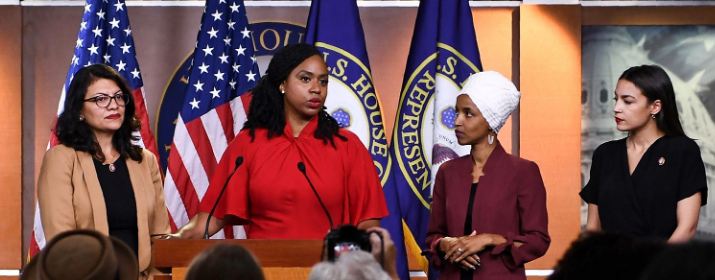
Behind the curtain, many House Democrats are becoming deeply concerned that the attention given to the “Squad of Four” among their ranks is having the same effect from the media that Donald Trump received during the primaries before the 2016 election. By focusing always on Trump as the novelty, many believe that the media made Trump and caused 17 career politicians to be ignored. The fears are rising that this Squad of Four, which is extremely hard left, are painting all Democrats as radicals.
While the House Democrats united in their vote to condemn President Donald Trump’s racist tweets, behind the curtain they know they were not racist for it was about their political views, not a race. Trump is not backing down on that and the Democrats fear that calling him racist may really polarize the nation and send white Democrats to the Trump ranks who are not racist but fed up with the anti-American statements that are emerging from the Squad of Four.
The fear rising among some Democratic lawmakers is that these far-left progressives have been the overriding influence of the whole with their tiny caucus and are painting all Democrats with the same brush. Many are expressing frustration with the repeated headlines involving the four progressive congresswomen who are overshadowing the liberal agenda which is not far-left.
There are those claiming the Squad’s reference to concentration camps were the Japanese, rather than the Germans. In both cases, the Jews and the Japanese were citizens — not illegal immigrants. The German camps were known as “concentration camps” whereas the US version for the Japanese were “internment camps” which were upheld by the Supreme Court (Korematsu v. United States, 323 U.S. 214 (1944)) – which is one of the top 10 worst decisions ever along with Dred Scot.
Nevertheless, it went over most people’s heads that the Supreme Court overruled Korematsu when they wrote in the majority opinion upholding President Donald Trump’s travel ban. The Supreme Court also overturned a long-criticized decision that had upheld the constitutionality of Japanese-American internment during World War II. Indeed, Justice Sonia Sotomayor had mentioned the 1944 case, Korematsu v. United States,in her dissent, arguing that the rationale behind the majority decision had “stark parallels” to Korematsu; in both cases, she argued, the government “invoked an ill-defined national security threat to justify an exclusionary policy of sweeping proportion.”
Writing for the majority, however, Chief Justice John Roberts argued that the case was not relevant to the travel ban, but went ahead and wrote that it is now overturned. “The dissent’s reference to Korematsu … affords this Court the opportunity to make express what is already obvious: Korematsu was gravely wrong the day it was decided, has been overruled in the court of history, and — to be clear — ‘has no place in law under the Constitution,’” he wrote.
The Korematsu decision upheld the internment of the Japanese under the pretense that being Japanese, they might aid their native country despite the fact that they were American having “dual loyalty” and thus they were relying on national security, and the government plays that card all the time.
Chopper Pressers are the best pressers; and today we get two. One upon departure, and one upon return to the White House from Virginia. [Video Below – Transcript will follow]
Chopper pressers are the best pressers. Earlier today President Trump held an impromptu press conference as he departed the White House for an event in Virginia.
[Video below – Transcript ADDED]
.
[Transcript] – 9:12 A.M. EDT – THE PRESIDENT: So I just want to tell you the economy is doing fantastically well. We have people over in China right now. We’re negotiating with China. We’ll see what happens. We’re either going to make a great deal or we’re not going to make a deal at all. But a lot of great things are happening, and including with China.
Our country has gone way up in terms of its differential. We’re the number one economy in the world. It’s picked up tremendously in the last three years since I’ve been here. So a lot of great things are happening. A lot of really great things are happening. The economy is through the roof. I guess we’ll hopefully get good decisions from certain branches of government. We’ll see what happens. But we have a lot of good things happening.
We were just speaking with the Department of Commerce, and we have interest in our country like we’ve never had before.
Q Mr. President, do you regret targeting Baltimore?
THE PRESIDENT: No. Baltimore has been very badly mishandled for many years. As you know, Congressman Cummings has been there for a long time. He’s had a very iron hand on it. It’s a corrupt city; there’s no question about it. All you have to do is look at the facts. The government has pumped in, over the years, billions and billions of dollars to no avail — to absolutely no avail.
Baltimore is a — it’s an example of what corrupt government leads to. Billions of dollars have been given, and I feel so sorry for the people of Baltimore. And if they ask me, we will get involved. But we’re already involved from the standpoint that, over many years, billions and billions of dollars have been given to Baltimore. It’s been misspent. It’s been missing. It’s been stolen with a lot of corrupt government. And as you know, Cummings has been in charge.
Now, I will say this: I think that Representative Cummings should take his Oversight Committee and start doing oversight on Baltimore. He’d find out some real things.
Q On China, how did the talks go today? And on the Fed, what should the rate cut be?
THE PRESIDENT: So the talks are moving very well with China, but they were often with China. But China always makes a new deal at the end, or seems to. We’re taking in billions and billions of dollars from China in the form of tariffs. Our people are not paying for it. China reduced their currency. They devalued their currency, and they’re pumping money into the system in order to pay for it.
They had the worst year in 27 years. They’ve had a terrible year because of the tariffs. A lot of companies are moving out of China. You’ve never seen this before. The United States is doing phenomenally well and we’re taking in tens of billions of dollars for — from China.
We’re giving some money to our farmers who have been really targeted by China to do a number on them, and — because they like me. The farmers like me and I love the farmers. And I will say that the farmers are very grateful. The most they’ve ever spent on agricultural product is $16 billion. So when they pulled out, I took just a small part of the money that China is paying us, and I gave it toward the farmers and the farmers are very happy.
Q Is a quarter-point rate cut from the Fed enough for you, sir?
THE PRESIDENT: The Fed moved, in my opinion, far too early and far too severely. It puts me at a — somewhat of a disadvantage. Fortunately, I’ve made the economy so strong that nothing is going to stop us. But the Fed could have made it a lot easier. I would like to see a large cut, and I’d like to see immediately the quantitative tightening stopped. It should be stopped. For them to have done quantitative tightening and also higher interest rates simultaneously, I think, was a big mistake.
I also think that had they not done it — as good as we’ve done, we’ve set a record, as you will tell, as you will say, in the stock market. We have the all-time high in the history of the stock market. I think I would have been 10,000 points higher and I think we would have been in the fours with GDP.
President Obama had zero interest rates; we have normalized interest rates. With zero interest rates, anything happens. And yet we still blew his economy away.
Q Was it a mistake not retaining Janet Yellen?
THE PRESIDENT: I don’t talk about that. I just — I’m very disappointed in the Fed. I think they acted too quickly by far. And I think I’ve been proven right. People have said I was right; they were wrong. The Fed is often wrong. The Fed is often wrong.
Q (Inaudible) Washington Post op-ed called Mitch McConnell a “Russian asset.”
THE PRESIDENT: The Washington Post called Mitch McConnell what?
Q A Russian asset.
THE PRESIDENT: I think the Washington Post is the Russian asset, by comparison. Mitch McConnell loves our country. He’s done a great job. We’re trying to pass an infrastructure bill. It’s being written up right now, as we speak, for our highways and our roadways.
Mitch McConnell has got more judges than probably any — I mean, in all fairness, with my help. But at the combination, we’ve got up — we’re going to be up very soon to 179 federal judges. Nobody has ever seen anything like that. And other than George Washington, we’ll end up having the highest percentage of judges put on the court and it’s going to be a legacy.
Mitch McConnell is a man that knows less about Russia and Russia’s influence than even Donald Trump. And I know nothing.
So I think it’s a horrible thing when a paper — which is really just a paper for the benefit of Amazon — the Washington Post is fake news, just like the New York Times is fake news. It’s put there for the benefit — the Washington Post — of Amazon. That’s my opinion. And I think it’s a disgrace.
And if they actually said that, I didn’t read it. If they actually said that — that Mitch McConnell is an asset of Russia — they ought to be ashamed of themselves and they ought to apologize.
Q Are you going to watch the Democratic debate tomorrow night? And do you have a sense yet, in your gut, as to who your likely opponent will be in 2020?
THE PRESIDENT: Well, I think right now — I am watching — I think right now it will be Sleepy Joe. I think. I feel he’ll limp across the line. That’s what I think.
So what I think doesn’t mean anything, but I know the other people. I know him. I think he’s off his game by a lot, but I think — personally, I think it’s going to be Sleepy Joe.
Q Mr. President, do you think you’re alienating voters when you tweet at the Squad and at Congressman Cummings?
THE PRESIDENT: No, I think I’m helping myself because I’m pointing out the tremendous corruption that’s taken place in Baltimore and other Democratic-run cities. All you have to do is look at the past mayors in Baltimore — see what happened. No, I think I’m helping myself.
And I’ll tell you what: The White House and myself — in letters and emails and phone calls — have received more phone calls than I think on any other subject, of people from Baltimore and other cities corruptly run by Democrats, thanking me for getting involved. Those people are living in hell in Baltimore. They’re largely African American. We have a large African American population and they really appreciate what I’m doing and they’ve let me know it. They really appreciate it.
And, by the way, the numbers just came out. Unemployment for African Americans is the lowest it’s been. The best numbers — meaning, in the history of our country. The lowest in the history of our country.
But people have called from Baltimore thanking me so much, because all that money that’s been spent over 20 years has been stolen and wasted by people like Elijah Cummings.
Q Do you want a free trade agreement with Brazil?
THE PRESIDENT: Well, I have a great relationship with Brazil. I have a fantastic relationship with your President. And he’s a great gentleman. He was here, as you know. In fact, they say the “Trump of Brazil.” I like that. That’s a compliment.
And, by the way, I think he’s doing a great job. It’s a tough job, but I think your President is doing a fantastic job. He’s a wonderful man with a wonderful family.
Q And you will discuss free trade agreement?
THE PRESIDENT: Yeah, we’re going to work on a free trade agreement with Brazil. Brazil is a big trading partner. They charge us a lot of tariffs, but other than that we love the relationship.
Q Are you concerned about the health of Russian opposition leader —
THE PRESIDENT: The what?
Q The Russian opposition leader, Alexei Navalny, who apparently might’ve been poisoned while in prison. Have you heard about that?
THE PRESIDENT: I don’t — I’ve heard about it. I don’t know about it, but I’ll find out about it. This is new. I heard about it last night.
Q Are you concerned more about the Ratcliffe nomination? You have Democrats and Republicans who say a Trump loyalist should not be in a DNI position.
THE PRESIDENT: Well, John Ratcliffe is a brilliant man. He is a wonderful person. I spoke to him long before about this — long before, months ago. I spoke to him long before the Mueller fiasco. That was a fiasco. I think probably nobody in the history of Capitol Hill has embarrassed themselves like what Mueller did to himself and to the Democrats.
But John Ratcliffe — I spoke to him about this for a long time. He’s a very talented guy. He’s a strong man. It’s what we need in that position.
Q More and more people are calling you “racist.” Does that bother you?
THE PRESIDENT: I am the least racist person there is anywhere in the world. When con men — who I’ve known almost — you know, almost all my business life, because I had to deal with him, unfortunately, in New York. But I got along with him — Al Sharpton. Now, he’s a racist. He’s a racist. But when people — when people —
Q Racist against who?
THE PRESIDENT: Let me explain it to you. What I’ve done for African Americans in two and a half years, no President has been able to do anything like it. Unemployment at the lowest level in the history of our country for African Americans — nobody can beat that. You look at poverty levels, they’re doing better than they’ve ever done before. So many things: Opportunity Zones, criminal justice reform. President Obama couldn’t get it done. It was done.
Really, the biggest beneficiary, probably, is African Americans. I got criminal justice reform done. President Obama couldn’t get it done. No other President was able to get it done. What I’ve done for African Americans, no President, I would say, has done.
Now, I’ll say this: They are so happy — because I get the calls. They are so happy at what I have been able to do in Baltimore and other Democratic-run, corrupt cities. The money has been stolen — what they’ve done. It’s been wasted and it’s been stolen — billions and billions of dollars. And the African American community is so thankful. They’ve called me and they said, “Finally, somebody is telling the truth.”
Q Mr. President, do you think there will be a trade deal with China before November of 2020?
THE PRESIDENT: Well, I think the biggest problem to a trade deal is China would love to wait and just hope — they hope it’s not going to happen. I hope. But they would just love if I got defeated so they could deal with somebody like Elizabeth Warren or Sleepy Joe Biden or any of these people because then they’d be allowed and able to continue to rip off our country like they’ve been doing for the last 30 years.
China has been taking out hundreds of billions of dollars a year with our country. And now what I’ve done with the tariffs is — number one, they had the worst year they’ve had in 27 years, yesterday — the Wall Street Journal. The worst year in 27 years. Companies are leaving China by the thousands, and their prices are coming down.
And I will tell you this: China is dying to make a deal with me. But whether or not I’ll do it — it’s up to me; it’s not up to them.
Q What can you get China to give you this week? Just this week, what do you think you can get China to give you in the negotiations?
THE PRESIDENT: Well, I think China is willing to give up a lot. But I — that doesn’t mean I’m willing to accept it. I think if China had their wish, they’d wait until after the election, they’ll pray that Trump loses, and then they’ll make a deal with a stiff — somebody that doesn’t know what they’re doing — like Obama and Biden, like all of the Presidents before. Because what they’ve done is they’ve just picked our pockets as a nation. That’s not happening with Trump.
Q On Virginia — the black Virginia lawmakers are boycotting your event today.
THE PRESIDENT: That’s okay.
Q What do you say to them? I mean, they’re offended by your remarks.
THE PRESIDENT: Well, I think if that’s the case, I’d be shocked. But if that’s the case, they’re fighting against their people because the African American people have been calling the White House. They have never been so happy as what a President has done. Not only the lowest unemployment in history for African Americans; not only Opportunity Zones for — really, the biggest beneficiary are the inner cities; and not only criminal justice reform. But they’re so happy that I pointed out the corrupt politics of Baltimore. It’s filthy dirty. It’s so horrible. And they are happy as hell.
So, you may have a couple of politicians boycott, but it’s all a fix. It’s all a fix. The fact is African American people love the job I’m doing because I’m working for them. I’m not working for the politicians.
Q Mr. President, do you believe that congressional oversight, is (inaudible), in your case?
THE PRESIDENT: Oh, absolutely. It’s — what he should do — what Elijah Cummings should do is he should take his Oversight Committee, bring them down to Baltimore, and invest all of it, and really study the billions and billions of dollars that’s been stolen. It’s been wasted; it’s been stolen. They ought to take that beautiful waste of an oversight committee, go down to Baltimore and other Democratic-run cities, and take a look. See if you can find the billions that have been stolen.
Q Is your goal in North Korea simply containment — just a status quo?
THE PRESIDENT: My relationship with Kim Jong Un is a very good one, as I’m sure you’ve seen.
We’ll see what happens. I can’t tell you what’s going to happen. I know one thing: that if my opponent was President — if she won — you would be in a major war right now with North Korea. And we are nowhere close.
So we’ll see. I have a good relationship with him. I like him; he likes me. We’ll see what happens.
Q Mr. President, are you willing to visit Baltimore to go see — are you willing to visit Baltimore and go tour it today?
THE PRESIDENT: At the right time, I’ll visit.
But the people of Baltimore are very thankful — they have let us know by the thousands of people — because of the fact that finally somebody is pointing out how corrupt Baltimore is, how billions and billions of dollars have been stolen. And the ones that like it the best — what I’m doing — are African American voters. Those are the ones.
Good interview between Fox Business’ Maria Bartiromo and former White House trade official Clete Willems. Essentially Willems confirms the current outlook of the Trump administration that a deal with China is not likely in the short-term; however, Willems is optimistic of the probability in the longer term (as China realizes consequences).
The financial media still doesn’t get it… Obviously! Transfixed and jaw-agape at seemingly at-odds aspects to a new engagement with Beijing, the MSM financial media are clueless. They are genuinely disconnected, and have no idea what is going on.
The majority of financial pundits are perplexed at what they can see on the surface. USTR Robert Ligthizer and Treasury Secretary Steven Mnuchin are beginning discussions with Beijing. Meanwhile President Trump’s tweets seem to dismiss the potential of the deal-making. The media call this mixed-messaging; however, that’s not what this is.
Secretary Wilbur Ross was very insightful last week when he also spoke of the current U.S. perspective toward the U.S-China trade negotiation. If you have followed the basic road-map of America-First trade policy, there’s was a very clear picture. However, as we expected, most pundits and trade analysts ignored the administration message.
Commerce Secretary Ross warned the professional investment class when he said the current objective for Mnuchin and Lighthizer was to find out if Beijing is willing to re-engage from the starting point where they left-off when talks collapsed.
That was a big tell.
After weeks of phone calls and staff contacts if the U.S. team didn’t know the answer to that question, well, there’s almost zero likelihood of any optimistic outlook.
In essence, the only value within the current engagement is financial ‘optics’ to stabilize stock markets.
It has been clear -validated by the G20 outcome- that President Trump is not going to accept anything less than a full and complete structural change in the U.S. trade position with China. Lighthizer’s severe compliance and enforcement clauses, specific to each unique trade sector, are non-negotiable.
There’s only a very small chance a trade deal with China will be reached. The reforms within the original Lighthizer and Vice-Premier Liu He agreement were antithetical to Beijing. Chairman Xi Jinping and the communist politburo rejected them. For Beijing the compliance and enforcement sections within the agreement were too severe and did not allow China to retain control over the trade terms. The agreement was rejected.
President Trump understands Chairman Xi is looking at this as a zero-sum position. As a consequence it’s not a matter of “if” Trump will apply more tariffs; it is a matter of “when” will Trump apply the tariffs.
That said, there’s no duplicity in the U.S. Position. Mnuchin and Lighthizer are earnestly working in good faith; but President Trump is expecting ‘no deal’.
When President Trump expresses that hardened position, just accept it – and then look around at what else he is positioning to counteract that expectation/result.
Tariffs on China are coming; the question is the scale and timing. It’s likely Trump won’t strike against Chairman Xi until the USMCA is ratified.
That’s why October 21st, 2019 is important. That’s the Canadian election. If Justin from Canada loses his re-election, Speaker Pelosi cannot hold out on the USMCA until after the 2020 election.
Mexico has already ratified the USMCA. If Justin loses the next Canadian election, his successor will assuredly ratify the USMCA quickly. Nancy Pelosi cannot hold out if Mexico and Canada have both ratified.
Once the USMCA is set, there’s no motive for a low China tariff targeted to gain leverage toward a deal that would avoid higher tariffs. In this landscape there is no deal possible; therefore the scale of the tariffs against China will be very significant. My best guess is 25 percent on everything, based on: (A) the continued devaluing of currency and subsidies that Beijing is pre-committed to; and (B) Trump’s message about that manipulation.
President Trump is positioning for an economic platform in 2020 with specific deliverables. Trade and tariffs with China + the USMCA + trade and tariffs on the EU + the possibility of an independent U.K trade deal…. all adds up to massive net American economic value that will extend for decades. It’s like a series of dominoes.
The USMCA changes the global dynamic of how multinationals will gain access to the U.S. market. That kicks off a series of geopolitical moves. I firmly believe the U.S-Japan deal is already worked out. Lighthizer, Ross, Mnuchin and Navarro didn’t spend all that time with Japan in the month ahead of the G20 meeting in Osaka for nothing.
Think of China like a big lake filled with U.S. economic value. Through his Asian discussions with Vietnam, S Korea, Malaysia, Singapore, Australia, Japan, et al, President Trump has stealthily built a thin levy, an ASEAN dam of sorts, that will direct the China lake of economic value into Southeast Asia.
Once the USMCA is signed, Trump will blow the dam by triggering the tariffs. The exodus will benefit those who partnered with Trump.
You think it’s an accident that Australian Prime Minister Scott Morrison is scheduled to come to the U.S. as an official state guest of President Trump on Sept. 20th?
I have created this site to help people have fun in the kitchen. I write about enjoying life both in and out of my kitchen. Life is short! Make the most of it and enjoy!
This is a library of News Events not reported by the Main Stream Media documenting & connecting the dots on How the Obama Marxist Liberal agenda is destroying America


 There was always only a very small chance a trade deal with China will be reached. The reforms within the original Lighthizer and Vice-Premier Liu He agreement were antithetical to Beijing. Chairman Xi Jinping and the communist politburo rejected them.





 Centinel2012