Decline in Craftsmanship Between the 1st and 3rd Centuries


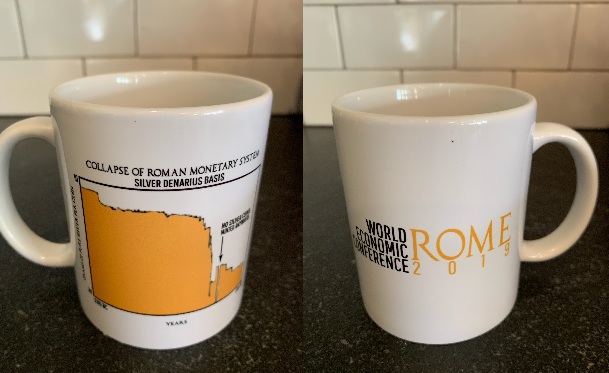
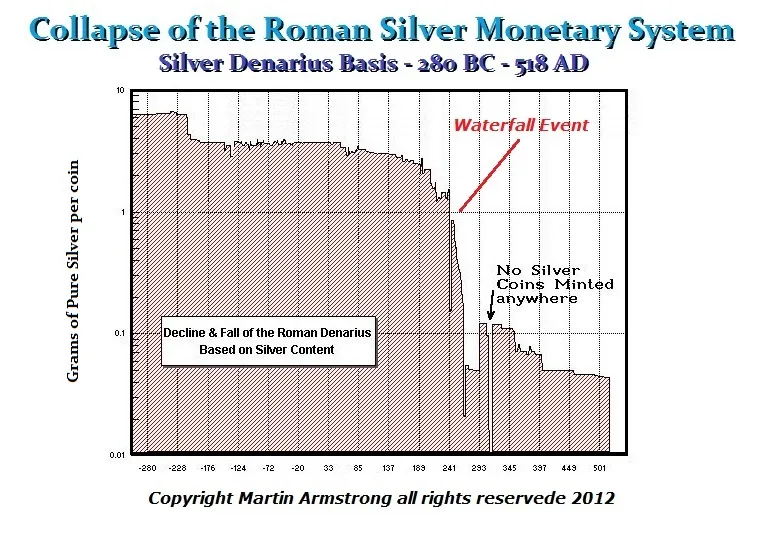
COMMENT: I took the tour of the Vatican museum and the sculpture collection is unsurpassed. It was great that a pope told the people to bring statues to the Vatican rather than destroy them as some pagan god. The guide also pointed out how the best art was the first century and the quality diminished into the third and fourth century. I remember the mug from the WEC. It was interesting how the quality of art declined following your chart on the collapse of the monetary system.

I can get an extra mug?

KW

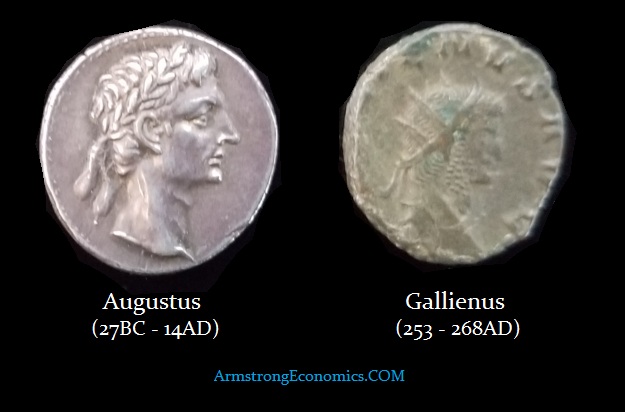
ANSWER: Yes, several people took that same tour. The quality of art declined with the collapse of the monetary system as well as the artistic quality of coins. Each die was hand engraved back then, so you can also see the decline in craftsmanship. Sculptures are the same. The details in the face, hair, and clothing during the 1st century is easily distinguishable from the 3rd century as we see in the coinage.

The quality of craftsmanship declines with the economy. Buildings constructed today are far cheaper in construction materials than you see even decades before. Most historians claim that Emperor Augustus’ right-hand man, Agrippa, built the first Pantheon in 27 BC. It burned in the great fire of 80 AD, was rebuilt by Emperor Domitian, and then was struck by lightning and burned again in 110 AD. The Pantheon as we know it today was built in 120 AD by Emperor Hadrian who was passionate about architecture and design. The inscription states that it was attributed to Marcus Agrippa. Nevertheless, this is a building that has stood almost 2,000 years.

As for the mugs, sorry, they are all gone. People have been making collections of them. Even I have only have one myself. I didn’t even have any leftover to give to Nigel.

A Strong US Dollar is the Only Way to Create Change


COMMENT: It is interesting how these people take your interviews and inject headlines like you say the dollar will collapse in April 2019 when you have said exactly the opposite. Just unbelievable how these people use your name to promote their BS.

JD

REPLY: I know. They keep preaching the dollar will collapse when it is exactly the opposite. They are trying to sell their biased view which is always based upon the idea of the quantity theory of money – the same exact philosophy used by the central banks in Quantitative Easing.

The ONLY way the monetary system will break is with a STRONG dollar – not a weak dollar.The monetary system has broke ONLY when the dollar rises as in 1934 and 1985. The US always wants a weak dollar to increase corporate profits and and create a trade surplus. It is really quite amazing how these people keep preaching the same nonsense for decades and have never been right for more than 30 years.

Cycles & Turning Points


QUESTION:

Hello Mr. Armstrong;

Rome was fantastic!. I find it very interesting that you hold the conference on the dates when the markets hit their peak and I come back and Monday we start the decline that you cautioned us that we could see at the conference. Was this planned:)?

Cycles are amazing and now i have to live and invest only based on the cycles.

Thank you again for Rome and bringing Nigel!!

BB

ANSWER: Yes, I do time the conferences around the cycles. That gives us something to talk about. They are simply points where the human emotions shift. This pull back is necessary for we are treading water (i.e. time) until the consolidation is complete in order to produce the next phase.

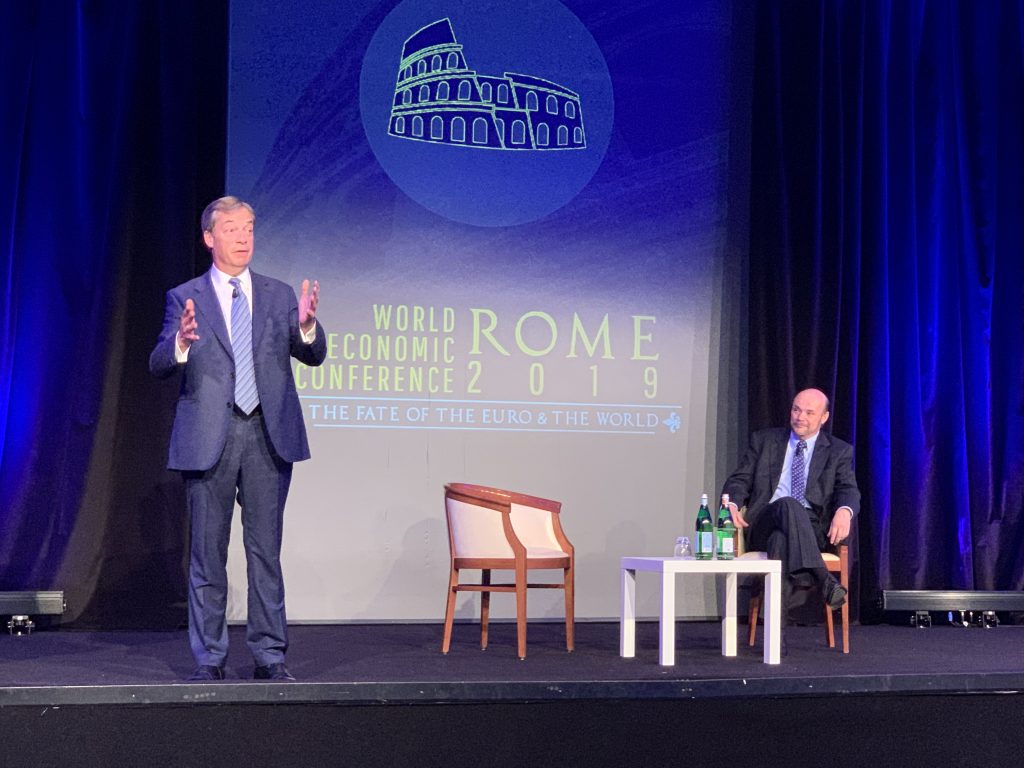
Just for the record for those who did not attend the Rome WEC, Nigel came because, as he put it, we are the “alternative to Davos.” He was not paid a fee. He had agreed to come and wanted to attend the conference and be at our famous networking cocktail party.

As things turned out, Nigel started his new BREXIT Party after he agreed to come to the WEC. I was concerned he would be too busy to attend with the change in plans. Nevertheless, he flew in for a few hours to make his appearance and then sadly had to leave because of a rally back in the UK the next morning.

The May Turning Point


COMMENT: It is interesting how your model picks the timing for a turn in the market as of May yet it leaves us guessing as to what the fundamental will be. Very interesting to say the least.

Fantastic event in Rome. The cocktail party was the best view of Rome ever!

Cheers

HKD

REPLY: The fundamentals really do not matter. What I have come to understand is TIME is everything. The market will turn on these targets regardless of the fundamental. It is simply a turning point in human emotion for maintaining a given trend. They will exit a trend regardless of the news. How many times have we seen bearish news ignored in a bull run or bullish news ignored during a bearish decline? It is only a matter of the length of a rally or decline.

Robo Trading v Human Trading


QUESTION: So is there any difference between a Robot and a person trading if they just follow the same system on a single market?

ANSWER: Any system that is created which claims to be some robo-trading system is vulnerable to a contagion that impacts a given market from external sources. We are entering a highly correlated global capital flow era which events external to a domestic market can overwhelm a domestic economy and any market.

The only difference between a robo-trading system and a human is that the human can get all emotion and panic. The computer would not do that, but it would be vulnerable to external forces and would not be able to make a judgment call.

The only possible way to overcome this is a complete global model which is monitoring everything and will pick up the external contagions. You can visually see this using the Global Market Watch. You can glance at the trends in all world stock markets for example on one page.

The End of Diversification?


Recent years there has been a shift in how various assets classes are trading. There is emerging a high degree of positive correlation among various financial asset classes that have many concerned since it is not conforming with the perceived historic norms. Many are reading into this as a warning of what is to come. When different asset classes move in the same direction simultaneously, this obviously eliminates the theory of diversification is asset allocation.

Asset allocation over the years has been the way portfolios are arranged because they lack the ability to forecast the major trends. The belief has been that the possible benefits of diversification across classes reduces risk and offers a management tool knowing that you will lose on one side but win on another class.

When there is a high correlation between classes, these asset allocation models fail. The concerns become that this injects a negative development because they fear if one asset class falls, it will take all of the others with it.

What is being overlooked here is the fact that there is a major shift underway which is not understood and this creates the risk of a LIQUIDITY CONTAGION whereby a loss in one asset class causes liquidation in all others to raise cash to cover the losses in one particular asset class. Welcome to the new age of international contagion which is far more serious and cannot be reduced by simply diversification.

We will be looking at establishing a Webinar for Institutional Clients on this subject matte

WEC 2019 Rome The Great Unknown


24,26,367,391.603394

This year’s World Economic Conference was most interesting. We really had to put our thinking caps on because we have entered the Great Unknown where Keynesian Economics has crumbled to dust. We have to reassess the future and how this will unfold as the central banks are beside themselves in many countries and the contagion of Quantitative Easing combined with Negative Interest rates has completely altered the economy and have driven a huge wave of disparity between Public v Private sectors of the economy. This is clearly the times that will test the best skills of what traders are made of.

WEC Rome 2019


The Rome 2019 World Economic Conference was a lot of fun. We have a very diverse crowd from around the world including central bankers, hedge funds, pension funds, and private investors. Nigel Farage was great and he calls our conferences the “alternative to Davos” which inspired applause from attendees.

The Sixth Wave & 2032


QUESTION: Dear Mr. Armstrong

It was my great honour to meet you in Orlando in November. I couldn’t help hugging you! Thank you so much for all you are doing.

Two questions:

1. In terms of societal collapse, I have been looking at 2032 as the date of armegeddon , or the next major asteroid impact when life as I know it will completely cease (needless to say, kind of a downer), but in a recent blog post you mentioned the collapse of the West might stretch out for another 600 years (OMG, thank you!). Which is it? 😰

2. When you hand over the reigns of Socrates, please let this naive, gentle soul know how you will ensure its (super-) power will be used for good. You are incorruptible, but sadly, most are not.

God bless you always,

M in Ottawa

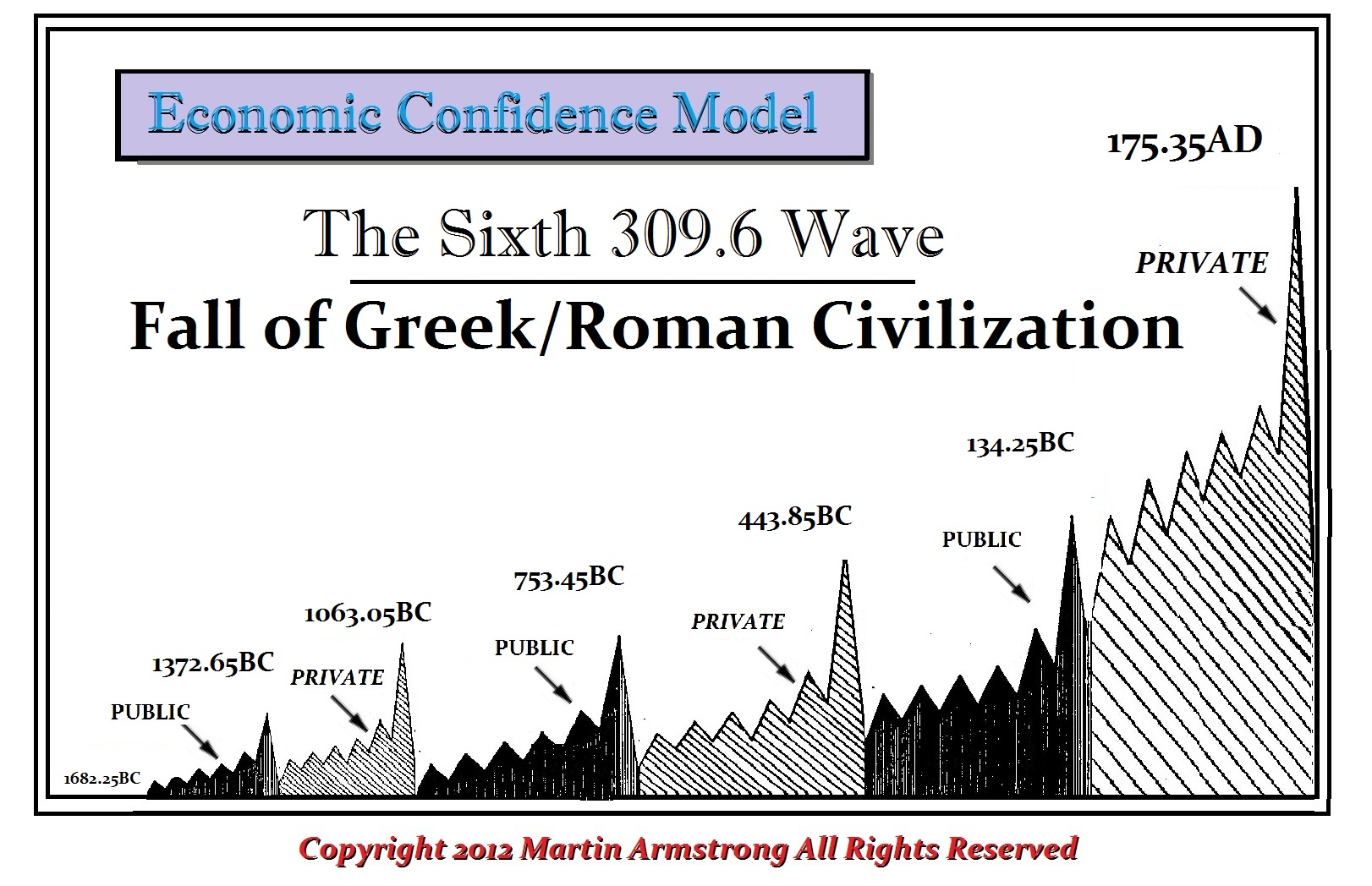
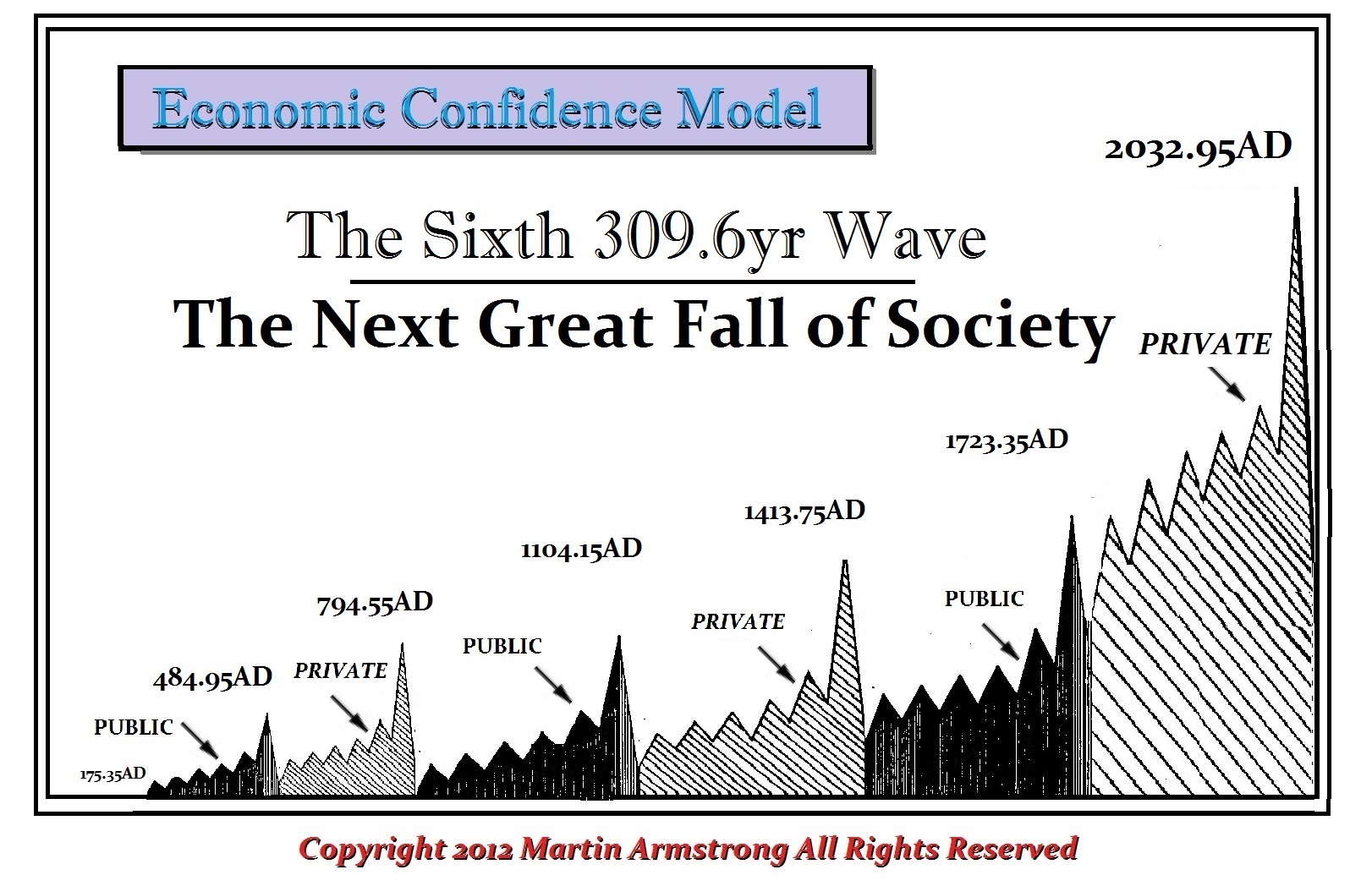
ANSWER: I do not believe that 2032 is the end of civilization. Even if we assume this Sixth Wave will be of equal importance as the one that picked the end of Rome in 175 AD. Roman society declined for the next 300 years, and then the Dark Age emerged for another 600 years. So from the actual peak in Roman society, the low was about 900 years later.

That time frame is probably correct for North America but it does not mean society comes to an end. The financial capital of the world will shift to China, which will be the dominant economy for the subsequent 309.6-year period. Then it will migrate to Russia and then to Europe. It will probably take 900 years before it reappears in North America.

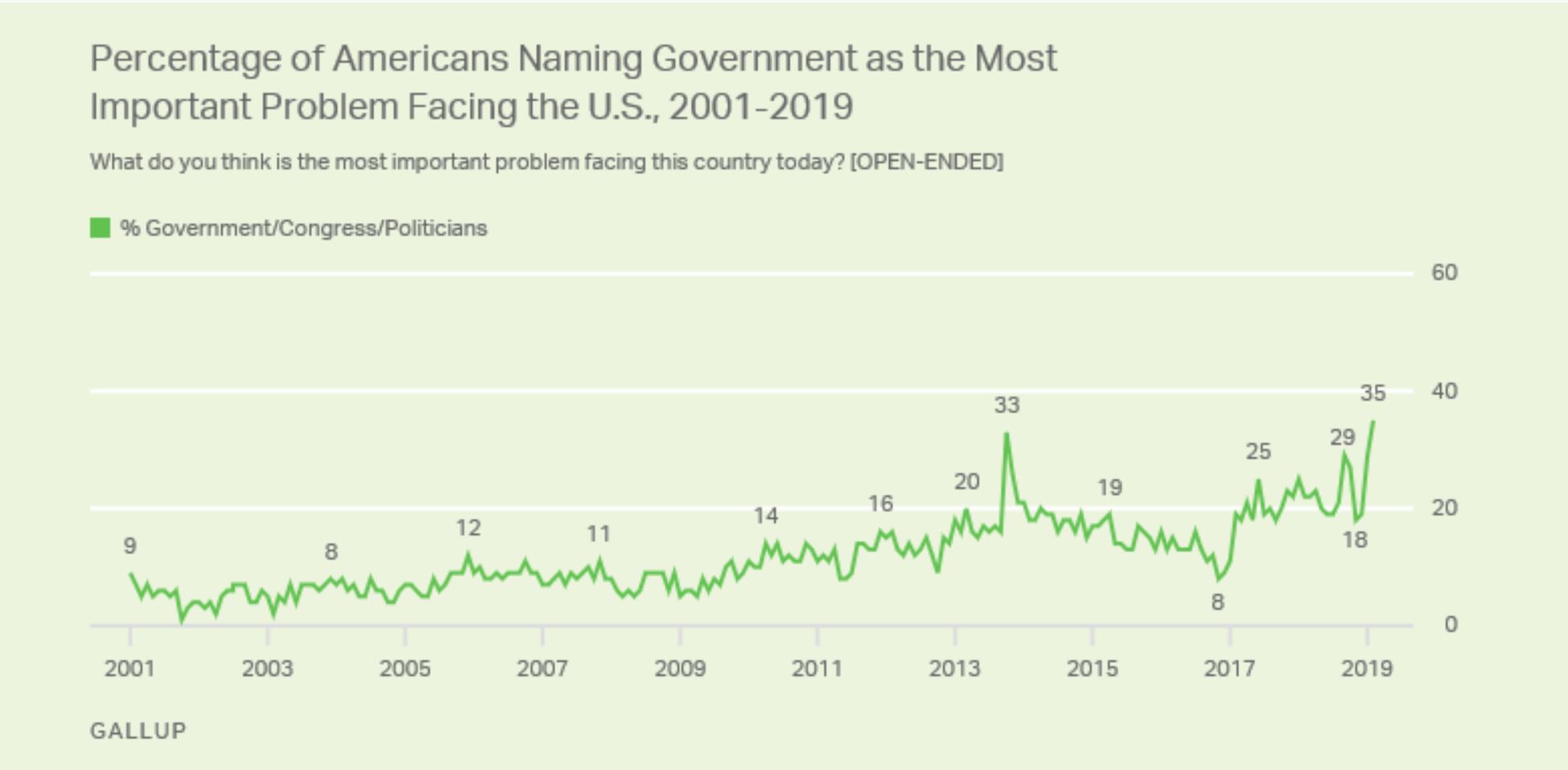
None of that says you should hide in a bunker or wait for an asteroid to crash. Just look at the politics and how there is no longer a possibility of actually managing the government. The political in-fighting will render it incapable of government as was the case in Rome following 180 AD. Life will continue. Governments will be recognized by the vast majority as the major problem. That is already at 35%.

The question will turn on how rapidly the monetary system will collapse. In the case of Rome, there was no public debt. The debasement unfolded as people hoarded coinage which then forced the state to reduce the silver content in order to meet the demand to fund the government. In our modern sense, we are on a debt-based system. The crisis this time will not be due to people simply hoarding, but from governments being unable to sell their debt to keep the government funded. This time, it will be different. The modern economic system is LEVERAGED unlike that of Rome. Therefore, it will be prone to extreme sharp flash-crashes.

Keeping it Simple Keeps you Stupid


There was a 14th-century Franciscan friar by the name of William of Ockham who is credited with having formalized the principle that “simpler solutions are likely to be more correct than complex ones.” Hence, we seem to always try to reduce everything to a single cause and effect. Some have rephrased this as “keep it simple, stupid,” and it has emerged with the label “Ockham’s razor,” which is supposed to be a tool that cuts through complexity to get from point A to point B. However, is this the very problem that prevents us from seeing reality? It was, after all, this very principle that supported the flat earth theory. It prevailed and even led to the execution of people such as Giordano Bruno (1548–1600)  for daring to propose that the universe was not revolving around a flat Earth. Even Galileo Galilei (1564-1642) was charged in 1633 by the Roman Inquisition and forced to sign the confession or suffer the same fate of Bruno that the Earth was flat.
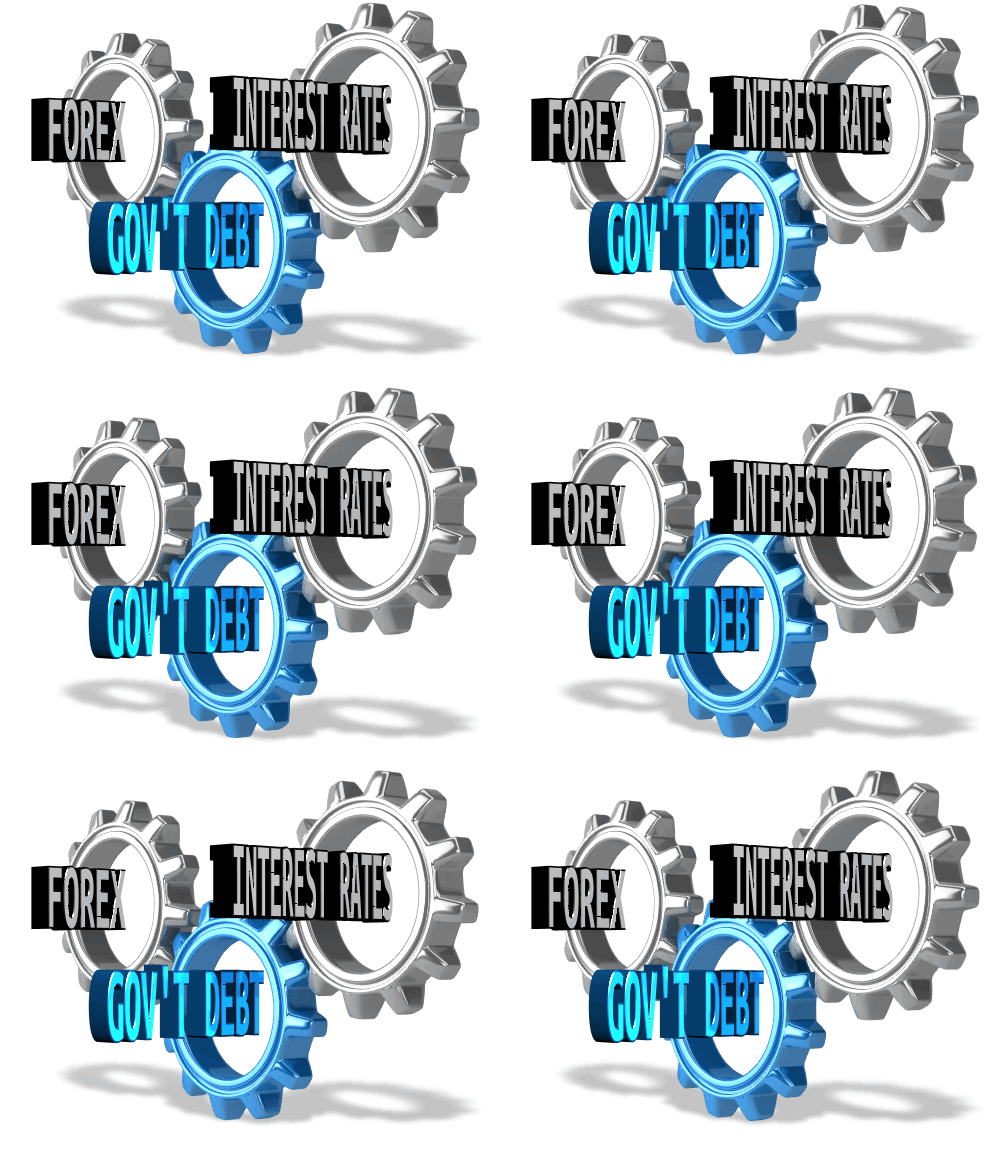
In funds management, the statement that proves there is complexity is a legal requirement: Past performance is not a predictor of future success. All investing involves the risk of loss.While there is a desire to make complexity simple and understandable, this is really completely misguided. Clearly, simplicity rather than complexity is by no means the proper course of action for we then cannot see the interconnections of how everything truly functions. The greatest mistake in the analysis is always trying to reduce any effect down to a single cause. The world is a complex mechanism. It is indeed like a rainforest. There are countless species and each is interconnected. Exterminate one and you will find that it was the food source for another. That species, in turn, was the food source for yet another and so on. The world economy is equally complex. This is why I say we are ALL CONNECTED. Create a war in one region, we may not be involved with troops, but the capital flows shift. How can we forecast anything by ignoring all the interrelated influences?
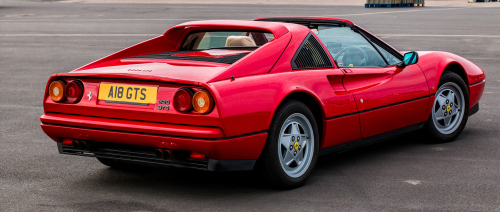
There are those who advocate that the best way to achieve your long-term investment objectives is to keep in simple. Yet they are looking at history and banking everything on a continuation of inflation. I have told the story at conferences how I bought a 328 Ferrari when I lived in London in 1985 when the British pound fell to $1.03. The Italians were getting $60,000 for the car in the states. It was still priced in pounds when it was $2. I bought the car for about $35,000. The Italians could no longer sell cars at that price so they doubled the price in pounds. Then the pound rallied and went to almost $2. I drove the car for 2 years, sold it used, and nearly doubled my money. Then people were buying Ferraris as an investment, thinking it was the car that appreciated when in fact it was just a currency play. If you did not look at the currency, you missed the whole point, so keeping it simple indeed made you stupid.

Rapid technological development in recent years across industries has helped to expose the fact that we live in a global economy and are all interconnected. Fund managers, because of regulation, are blinded by this interconnected world for they are not allowed to invest globally in a diversified portfolio. This is why we have so many specified funds and people claiming to “just keep it simple” with a hold policy because it always comes back.

Markets, on the one hand, appear deep and complex, rendering them impossible to understand fully when limited even by law to a purely domestic view. This has resulted in the advice of buy and hold as a strategy to fight against complexity with simplicity. Then there are investors who believe they need investment solutions that are nimble and flip positions based upon the talking heads on TV. They are brainwashed by their market myths. This has merely become grand sophistry trying to fight complexity with a simplicity that sounds logical by reducing all activity to a single cause and effect.

Asset allocation philosophies have emerged which invest other diverse market sectors knowing that they are polar opposites. They assume that the world is too complex beyond their comprehension so spread the wealth and hope for the best. These strategies have expanded as of late beyond the traditional stock/bond mix that was really exclusively domestic-oriented. In modern times post-1985, alternative strategies emerged introducing hedge funds that also incorporated foreign exchange, commodities, options, private debt, venture capital, and even real estate.

As hedge funds began to report their 2018 performance, an abyss quickly emerged between managers who outperformed the index and those who saw staggering losses with a third group landing somewhere in between. Overall, the industry saw its biggest annual loss since 2011, declining 4.1% on a fund-weighted basis, according to Hedge Fund Research Inc. Mostly, the smaller funds were able to flip portfolios quickly and that allowed them to trade around the big funds that can no longer maneuver. Most were unable to navigate the market turbulence in what became the worst year for the S&P 500 Index since the financial crisis. Most took “views” of what they thought would unfold and it cost them dearly. The funds that relied upon a personal opinion proved to be the worst for the vast majority kept viewing the stock market would crash any day, which never happened.

The illusion that simplicity provides the best long-term investment return is really predicated upon an assumption since the Great Depression that if you just held through all the 50-70% corrections you would be OK at the end of the day. The problem with this argument is that we are all human. I have never met someone who can actually do that. Then there is the problem of surviving the long-term. The city of Detroit suspended its debt payments in 1937 and resumed in 1963. If you owned such bonds for retirement, perhaps your heirs benefited, but you would have died broke and starving. It all depends where you are in the business cycle.