President Trump and Justin from Canada hold a bilateral discussion on the sidelines of the G7 Summit in Biarritz, France. No-one is exactly sure why Justin from Canada is there; both leaders talked about the USMCA, again; and the media did not have any questions for anyone about Canada. [Video and Transcript Below]
.
[Transcript] – PRIME MINISTER TRUDEAU: Well, it’s always a pleasure to sit down with President Trump. We’ve had some good conversations already, particularly on the global economy. The Canadian and American economy are doing well, partially because of the trading relationship we have and the great work we did.
Quite frankly, around the table there’s a lot of people wanting to make trade deals with each other. And we have a deal that we were able to negotiate that’s good for our workers, good for our citizens, good for the middle class. And that’s the kind of thing that we need to see more of around the world.
Always a pleasure to talk about a broad range of global issues. And it’s good to sit down with you.
PRESIDENT TRUMP: So, we’re going to be significantly expanding our trading relationship when the USMCA gets done and completed. Our farmers love it. The unions love it. The workers love it. Manufacturers love it. Everybody likes it. I think most Democrats like it. So, hopefully, that’ll be put to a vote fairly soon.
It’s got tremendous support — both, I believe, Democrat and Republican. It has been signed and finalized, essentially, by Canada and, essentially, by Mexico. So we’re waiting for that from the United States.
And we have — we have really great support. And it’s something — I think it’s a very special agreement. And it replaces NAFTA, which is perhaps the worst trade agreement ever done. Certainly within our country it’s the worst. I can think of one worse, but it’s not within our country, it’s outside of our country, and that’s the WTO. That’s a beauty.
So we’re very happy with the agreement, and I congratulate you. I hope it gets done. I guess we should save the congratulations for when they vote, but hopefully that will be put to a vote pretty soon.
President Donald Trump and Japanese Prime Minister Shinzo Abe hold bilateral discussions on the sidelines of the G7 Summit in Biarritz, France. The U.S. and Japan have agreed to the terms of a trade deal. [Video and Transcript Below]
.
[Transcript] – PRESIDENT TRUMP: Thank you very much. It’s a great honor to be here. We’re having some very good discussions, maybe even great discussions. And I will say that our relationship with Prime Minister Abe and Japan has been, I think, the best it’s ever been. I don’t know, I’ll let you speak to that. But I think it’s the best it’s ever been.
Go ahead.
We’re discussing trade. We’re doing a lot of trade together; a lot of military trade, actually, which is a big component. We’re also talking, obviously, about North Korea. And those discussions are going very well. And we’re discussing lots of other things. And the relationship between us, but also the relationship with us and the other countries, has really been — of the G7 — has really been outstanding.
From the moment we got here, we’ve been treated beautifully. I think I speak for Shinzo and myself. We’ve been treated beautifully. And I want to congratulate — and I have to say “thus far,” because we’re probably halfway through. But thus far, this has been really a great G7, and I want to congratulate France and your President because they have really done a great job.
Thank you.
PRIME MINISTER ABE: (As interpreted.) I would like to congratulate you on the birth of your 10th grandchild.
PRESIDENT TRUMP: Thank you.
PRIME MINISTER ABE: (As interpreted.) And speaking of our intensive diplomatic engagement, as shown by my own visit to Washington, D.C. back in April, followed by you and Madam First Lady’s state visit to Japan in the month of May as a very first state guest under the new era called Reiwa, and also followed by our meeting on the margins of G20 Osaka Summit.
So, as shown by these meetings, we have been conducting very frequent exchange of opinions, as well as visits. And looking back at the history of Japan-U.S. relations, we’ve never seen this frequent level of visits between the two leaders as we have seen at this moment.
So I think it is fair to say that, we as the leaders of Japan and the United States, now enjoy a robust relationship of trust more so than ever, and same can be said vis-à-vis the status of the Japan-U.S. relations in general.
And thanks to your tremendous support for me as a chair of the G20 Osaka Summit, we could send out a really powerful message toward addressing various global challenges. And just as importantly, I am ready to work very closely with you, Donald, so as to bring this year’s G7 Summit to a successful conclusion.
So, on this occasion, I certainly look forward to discuss with you specific ways to deepen our alliance between the two countries and also the regional situations, including North Korea as well as Iran. And, of course, we look forward to discussing bilateral trade as well as the economic relationship. And I certainly hope to have a very productive discussion with you.
PRESIDENT TRUMP: Well, thank you. And I want to also congratulate the great Matsuyama. You know who Matsuyama is? He’s a great golfer that we played with and we had a lot of fun.
And Shinzo is a very good golfer, and we have a lot of fun playing golf together. And we played with Ernie Els here, and Shinzo reciprocated with a great player, Matsuyama. And last week, in a big tournament — which is a one of the very biggest tournaments — he came in third, and he shot a 62 or 63 in the final round, which is not bad. Right? Which is not bad. So, he’s a great young man and he’s a great golfer. And please congratulate him for me. Thank you.
Okay.
Q Mr. President, do you have a trade deal with Japan? Have you agreed on a trade deal?
PRESIDENT TRUMP: We’re working on one, and we’re fairly close. And I don’t know as to, Bob Lighthizer, what’s happening. Can you give us a status report?
AMBASSADOR LIGHTHIZER: Well, we’re very close and we’ve been working intensively. And hopefully, as a result of this meeting, we’ll be able to come to an agreement on core principles.
PRESIDENT TRUMP: A very big deal. It’s a major deal with Japan. If it gets done, we’ll possibly know by the end of this meeting.
Q Mr. President, did you sign off on a statement to Iran — a message to Iran that President Macron says he’s going to deliver on behalf of all the G7 countries?
PRESIDENT TRUMP: No, I haven’t discussed that. No.
Q It’s —
PRESIDENT TRUMP: No, I haven’t.
Q Do you support President Macron’s outreach to Iranian authorities?
PRESIDENT TRUMP: Sure. And I also support Prime Minister Abe’s outreach because he’s also speaking to Iran, and they have a very good relationship, from what I understand. But Iran is no longer the same country it was — as it was two and a half years ago. But we’ll do our own outreach. But, you know, I can’t stop people from talking. If they want to talk, they can talk.
Q What are some of the issues you all talked about at dinner last night?
PRESIDENT TRUMP: Why don’t you tell me what we spoke about last night? (Laughter.)
Q I’m asking you, sir.
PRESIDENT TRUMP: Because there was a lot of inaccurate reporting. We had a really good dinner last night.
And I had a fantastic lunch with the President of France yesterday. The best — frankly — and I told him, and I was totally honest — probably an hour and a half. Many of you saw it. I think it was the best hour and a half I’ve ever spent with him, President Macron.
It was a perfect period of time. And yet, I picked up stories, and I read like it was the opposite. It was really was. I mean, it doesn’t matter; you can write whatever you want to write. But it was false reporting.
We had a very, very good lunch, and we had a very, very good dinner last night. Everybody was at the dinner. And I think it was really good. We discussed Iran. We discussed trade. We discussed China. And we discussed many things. But it was a very, very good — a very good dinner.
Q Mr. President, you said you discussed Russia, and you said earlier it was a “lively” discussion. Do you feel that the other members of the G7 would encourage Russia to join again, the way you are?
PRESIDENT TRUMP: I think that’s a work in progress. We have a number of people that would like to see Russia back. I think it would be — I think it would be advantageous to many things in the world. I think it would be a positive. Other people agree with me. And it’s something that we’re discussing.
I don’t know that we’ll make a decision one way or the other, but we did have a discussion about Russia last night, as to whether or not we want to invite them back. I think it’s advantageous. I think it’s a positive. Other people agree with me, and some people don’t necessarily agree.
Q How do you expect to overcome those differences?
PRESIDENT TRUMP: Well, I don’t think we’re going to — maybe we won’t. Maybe we’ll just leave it the way it is.
Q Can you say who were some of those who agreed with you on inviting Russia back?
PRESIDENT TRUMP: I could, but I don’t think it’s necessary. Some of the people that I was surprised — I was actually surprised at a couple of them because I didn’t think they had a good relationship, and it was good enough that they said, “Yes, we’d like to have them back.”
It’s — it’s ongoing discussion. No decision — no decision was made. We didn’t do a vote or anything. Just discussion.
Q Are you concerned at all about North Korea conducting more tests?
PRESIDENT TRUMP: I’m not happy about it. But, again, he’s not in violation of an agreement. We speak. I received a very nice letter from him last week. We speak. He was upset that South Korea was doing the “war games,” as you call them. I don’t think they were necessary either, if you want to know the truth.
And I said to my people, “You can have them or not. I would recommend against them, but I’m going to let you do exactly what you want to do.” I said that to all of my people. I said, “I don’t want to interfere because I think if you want to do them, you can do them, if you think it’s necessary. But I think it’s a total waste of money.” And they did a modified version of them.
John Bolton, would you say that’s correct? It’s a very much —
AMBASSADOR BOLTON: Yes, very much modified.
PRESIDENT TRUMP: — modified version. But I think it was unnecessary to do, frankly.
Q Any update on another meeting with North Korea?
PRESIDENT TRUMP: Probably have one. Yeah. Probably. But — so I’m not — I’m not liking short range because short range is Shinzo’s — you know, it’s really his territory. I mean, I’d like to ask, Shinzo, how do you feel about North Korea and the testing of short-range missiles? He’s not thrilled.
PRIME MINISTER ABE: (As interpreted.) So, our position is very clear: That the launch of short-range ballistic missiles by North Korea clearly violates the relevant U.N. Security Council resolutions. So, in that sense, it was extremely regrettable for us to experience another round of the launch of the short-range ballistic missiles by North Korea in recent days.
PRESIDENT TRUMP: And I can understand how the Prime Minister of Japan feels. I mean, I can. It’s different. But, I mean, I can understand that fully.
Q Mr. Prime Minister, would you like President Trump to come further to your position on this?
PRIME MINISTER ABE: (As interpreted.) As we have done before, I would like to make sure that we — meaning, myself and President Trump — will always stay on the same page when it comes to North Korea.
And also, I would like to underscore that I fully support the U.S.-North Korea process 100 percent.
Q But are you on the same page, if you see these things so differently? I mean —
PRESIDENT TRUMP: I think, ultimately, we’re always on the same page. As long as he’s Prime Minister and as long as I’m President, I think we’re always on the same page.
Q Sorry, but, Mr. President, you don’t think that the short-term — or the short missile launches are —
PRESIDENT TRUMP: No, because I never —
Q — are a violation of U.N. resolutions?
PRESIDENT TRUMP: — because I never discussed that with him personally. I mean, you’re talking about personally; I never discussed that with him. I discussed long-range ballistic, and, that, he cannot do. And he hasn’t been doing it. And he hasn’t been doing nuclear testing. He has done short range, much more standard missiles. A lot of people are testing those missiles, not just him. A lot of people are testing those missiles. We’re in the world of missiles, folks, whether you like it or not.
I have confidence that, in the end, Kim Jong Un — who I’ve gotten to know very well — will do the right thing. I feel that he will do the right thing. I think it’s to his advantage to do the right thing. I think North Korea has tremendous potential as a country, economically. I think it’s got — I think, maybe, there’s no country that you could talk of in terms of emerging that has the potential that North Korea has. I think he understands that better than anybody. And I think, in the end, he will do the right thing.
We’ll see. Maybe not, but maybe. But I think he’ll do the right thing. We’ll see what happens.
U.S. President Donald Trump and British Prime Minister Boris Johnson held a working breakfast prior to the Sunday session of the G7 summit in Biarritz, France. The primary topics include Brexit and trade. [Video and Transcript Below]
.
[Transcript] PRESIDENT TRUMP: Thank you very much, everybody. We’re having a very good meeting — a very good series of meetings. Last night, we had dinner. It worked out. I think it was fantastic.
PRIME MINISTER JOHNSON: It was fantastic. We covered — well, we covered three subjects, actually. We were going to cover 10 subjects, but in the end, we did three.
PRESIDENT TRUMP: Three that we’ll talk about.
PRIME MINISTER JOHNSON: We do three in detail.
Q Mr. President, do you have any advice for Boris Johnson on Brexit?
PRESIDENT TRUMP: He needs no advice. He’s the right man for the job. I’ve been saying that for a long time. It didn’t make your predecessor very happy. But I’ve been saying it for a long time: He’s the right man for the job.
PRIME MINISTER JOHNSON: You’re on message there. (Laughter.) I’m grateful — I’m very grateful for that. And we’re looking forward to having some pretty comprehensive talks about how to take forward the relationship in all sorts of ways, particularly on trade. And we’re very excited about that.
PRESIDENT TRUMP: We’re having very good trade talks between the UK and ourselves. We’re going to do a very big trade deal — bigger than we’ve ever had with the UK.
And now, they won’t have it. At some point, they won’t have the obstacle of — they won’t have the anchor around their ankle, because that’s what they had. So, we’re going to have some very good trade talks and big numbers.
PRIME MINISTER JOHNSON: Talking of the anchor — talking of the anchor, Donald, what we want is for our ships to be able to take freight, say, from New York to Boston, which at the moment they can’t do. So, we want cabotage. How about that?
PRESIDENT TRUMP: Many things — many things we’re talking about.
PRIME MINISTER JOHNSON: That would be a good thing.
Q How fast do you think you’ll be able to make a trade deal?
PRESIDENT TRUMP: Pretty quickly. We don’t anticipate any problems. Before, we were sort of stymied. Well, I was stymied by the other side because nothing went — nothing got done on the other side, as you’ve seen from Brexit. This is a different person, and this is a person that’s going to be a great prime minister, in my opinion. Boris, it’s only my opinion.
PRIME MINISTER JOHNSON: No, look, I’m not going to — I’m not going to dissent. I’m not going to discourage you from that, Donald.
But obviously, I have memories of American trade negotiations in the past, and I have a formidable respect for U.S. trade negotiations. And I know that there will be some tough talks ahead, because, at the moment, you know, we still don’t — I don’t think we sell a single joint of British lamb to the United States. We don’t sell any beef. We don’t sell any pork pies. And there are clearly huge opportunities for the UK to penetrate the American market in the way that we currently don’t. And we’re very interested to talk about that with you.
Q Mr. President, do you think that you will invite Putin to next year’s G7, sir?
PRESIDENT TRUMP: That, I don’t know. We did discuss it. We had a very good discussion on Russia and President Putin, and a lively discussion, but, really, a good one. And it’s certainly —
PRIME MINISTER JOHNSON: It was lively.
PRESIDENT TRUMP: It’s certainly possible. It’s certainly possible. We’ll see.
Q Mr. President, are your allies pressuring you to give up the trade war with China?
PRESIDENT TRUMP: No. Not at all. I haven’t heard that at all, no. I think they respect the trade war. It has to happen. China has been — I can only speak for the United States. I can’t say what they’ve been doing to the UK and to other places. But from the standpoint of the United States, what they’ve done is outrageous that Presidents and administrations allowed them to get away with taking hundreds of billions of dollars out every year, putting it into China. So, the answer is, nobody has told me that, and nobody would tell me that.
Q Mr. President, any second thoughts on escalating the trade war with China?
PRESIDENT TRUMP: Yeah, sure. Why not?
Q Second thoughts? Yes?
PRESIDENT TRUMP: Might as well. Might as well.
Q You have second thoughts about escalating the war with China?
PRESIDENT TRUMP: I have second thoughts about everything.
Q Are you going to declare a national emergency on China?
PRESIDENT TRUMP: Well, I have the right to, if I want. I could declare a national emergency. I think when they steal and take out, and — intellectual property theft, anywhere from $300 billion to $500 billion a year, and where we have a total loss of almost a trillion dollars a year — for many years, this has been going on — in many ways, that’s an emergency.
I have no plan right now. Actually, we’re getting along very well with China right now. We’re talking. I think they want to make a deal much more than I do. We’re getting a lot of money in tariffs. It’s coming in by the billions. We never got 10 cents from China. So we’ll see what happens. But we are talking to China very seriously.
Q Are you concerned about how the market is reacting to the tariffs?
PRESIDENT TRUMP: No. The market is doing great. Our country is doing great. Everybody was telling me, yesterday, people are trying to copy the formula. We’ve cut taxes way down. We got rid of regulations — large numbers — more than any President has gotten rid of. And we’re doing very well. Our country is doing fantastically well.
I mean, you people want a recession because you think maybe that’s the way to get Trump out. Maybe that’s the way we get him out.
But I don’t even think that would even work, because, look, if there’s anything, it’s — you know, we’ve got to go into trade negotiations to get it right. But, ultimately, it’ll be many times what it was before. Our country is doing really well. We have horrible trade deals, and I’m straightening them out. The biggest one, by far, is China.
PRIME MINISTER JOHNSON: Yeah. Look, I just want to say I congratulate the President on everything that the American economy is achieving. It’s fantastic to see that.
But just to register the faint, sheep-like note of our view on the trade war, we’re in favor of trade peace on the whole, and dialing it down if we can.
Q Are you in favor of trade peace with China?
PRIME MINISTER JOHNSON: Well, we think that, on the whole, we’re — the UK has profited massively in the last 200 years from free trade, and that’s what we want to see. And so we’re keen to see — we don’t like tariffs on the whole.
PRESIDENT TRUMP: How about the last three years? (Laughs.) Don’t talk about the last three. Two-hundred, I agree with you.
Q Prime Minister, have you made clear that, in any trade talks with the U.S., the NHS will be off the table and (inaudible)?
PRIME MINISTER JOHNSON: Not only — not only have I made clear that, but Donald, the President, has made that very, very clear as well. And so there’s complete unanimity on that point.
Q Mr. President, do you have plans today to announce a trade deal with Japan?
PRESIDENT TRUMP: We’re very close to a major deal with Japan. As you know, Prime Minister Abe and I are very good friends and — really good friends. We’ve been working on it for five months. Bob Lighthizer is here someplace. Bob? Do you want to say something about the deal with Japan?
AMBASSADOR LIGHTHIZER: I’m going to say that, presumably, something will be announced after you meet with the Prime Minister of Japan. That’s all I’m going to say.
PRESIDENT TRUMP: We’re working on a very big deal with Japan, and we’re very close to getting it. And, frankly, I think what’s happening in China helps with respect to Japan. But it’s a very big deal. It’ll be one of the biggest deals we’ve ever made with Japan.
An interesting line-up of scheduled meetings (bilats) for U.S. President Donald Trump as the first official full day of the G7 Summit agenda takes place.
French President Macron has scheduled summit priorities around gender studies, global inequities, climate issues and planetary justice. However, the majority of international media focus will likely be on President Trump and Boris Johnson’s economic discussions.
♦ 2:15am EST / 8:15am CEST – THE PRESIDENT participates in a working breakfast with Prime Minister Boris Johnson of the United Kingdom of Great Britain and Northern Ireland, Biarritz, France
♦ 3:20am EST / 9:20am CEST – THE PRESIDENT departs Hotel du Palais en route to Centre de Congrès Bellevue, Biarritz, France
♦ 3:25am EST / 9:25am CEST – THE PRESIDENT arrives at Centre de Congrès Bellevue, Biarritz, France, the primary venue for the G7 Summit.
♦ 3:30am EST / 9:30am CEST – THE PRESIDENT participates in the G7 Working Session on the Global Economy, Foreign Policy, and Security Affairs, Biarritz, France. [NOTE: This is the economic segment of the summit requested by the U.S. delegation – keep an eye open for very specific remarks to the audience by President Trump.]
♦ 5:15am EST / 11:15am CEST – THE PRESIDENT participates in a bilateral meeting with Prime Minister Shinzo Abe of Japan, Biarritz, France
♦ 6:20am EST / 12:20pm CEST – THE PRESIDENT participates in a bilateral meeting with Justin from Canada, the Prime Minister of Canada, Biarritz, France
♦ 7:00am EST / 1:00pm CEST – THE PRESIDENT participates in a G7 working lunch on inequality, Biarritz, France. [To reflect their global magnanimity Emmanuel Macron has selected sustainable algae cakes as the menu. /kidding]
♦ 9:00am EST / 3:00pm CEST – THE PRESIDENT participates in a G7 working session on the G7 partnership with Africa, Biarritz, France
♦ 10:35am EST / 4:35pm CEST – THE PRESIDENT participates in an unusual pull-aside with Prime Minister Scott Morrison of Australia [Not a G7 Participant?] Biarritz, France
♦ 10:55am EST / 4:55pm CEST – THE PRESIDENT departs the Centre de Congrès Bellevue en route to the Hotel du Palais, Biarritz, France
♦ 11:00am EST / 5:00pm CEST – THE PRESIDENT arrives at the Hotel du Palais, Biarritz, France
♦ 2:00pm EST / 8:00pm CEST – THE PRESIDENT and THE FIRST LADY participate in the G7 extended partners program, Biarritz, France, [This is usually a cultural program for summit guests]
France and President @EmmanuelMacron have done a really great job thus far with a very important G-7. Lunch with Emmanuel was the best meeting we have yet had. Likewise, evening meeting with World Leaders went very well. Progress being made!
China understands the difference between the German mercantilist model of manufacturing and sells to everyone else and the United States which became the largest economy in the world because it allowed its domestic consumer economy to develop. China will become the largest economy in the world and take the crown from the United States because America lacks the political stability to foster long-term economic growth like China.
That statement will be a political bombshell no doubt. The demise of the United States is easily seen by the polarization of American politics. The Democrats come in and want to raise taxes and hunt the rich sending jobs and capital overseas. The Republicans come in and want to lower taxes and bring jobs and capital back home. The problem is very clear. Tax rates should NOT be a political yoyo. Corporations must have a budget. They cannot plan long-term because it all depends upon the next election every time. Unless the Supreme Court outlaws Marxism, there is no hope for the United States to survive long-term. Our political system will self-destruct the economy. There is just no consistency which is vital to economic growth.
China, in contrast, has a long-term plan. Its politicians are a career employee, but they need not stand for election. That actually allows for actual long-term planning where the United States cannot compete because of the polarization in American politics dominated by free-market Adam Smith v Marxist Socialism. This political war keeps getting worse and it is tearing the economy apart.
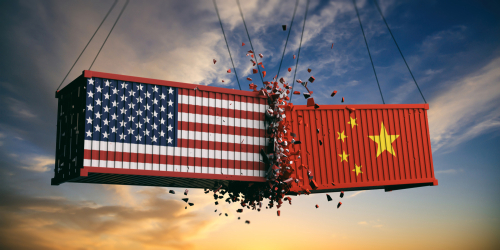
Those who have been expecting a quiet solution to the China v USA Trade War were shocked by the statements on Friday. China’s trade war escalation increased tariffs on imports imposing $75 billion worth of duties on U.S. goods, beginning Sept. 1 and December 15. China’s foreign ministry said that it would resume tariffs on U.S. imports of automobiles and auto parts and place an additional 5% or 10% tariff on agricultural and food products like soybeans, coffee, whiskey, and seafood.
China has a major car manufacturing operation. China had no problem allowing investment in its financial sector because there is a serious problem which can use capital at this point in time. China’s banks are not intricately connected to US banks as was the case with European and American banks. Therefore, a debt problem in China is more likely to have an isolated Asian influence rather than create a contagion infecting the US economy directly.
Donald J. Trump
✔@realDonaldTrump
Trump responded in a series of 4 tweets where he said:
Our Country has lost, stupidly, Trillions of Dollars with China over many years. They have stolen our Intellectual Property at a rate of Hundreds of Billions of Dollars a year, & they want to continue. I won’t let that happen! We don’t need China and, frankly, would be far better off without them. The vast amounts of money made and stolen by China from the United States, year after year, for decades, will and must STOP. Our great American companies are hereby ordered to immediately start looking for an alternative to China, including bringing your companies HOME and making your products in the USA. I will be responding to China’s Tariffs this afternoon. This is a GREAT opportunity for the United States. Also, I am ordering all carriers, including Fed Ex, Amazon, UPS and the Post Office, to SEARCH FOR & REFUSE, all deliveries of Fentanyl from China (or anywhere else!). Fentanyl kills 100,000 Americans a year. President Xi said this would stop – it didn’t. Our Economy, because of our gains in the last 2 1/2 years, is MUCH larger than that of China. We will keep it that way!
To put this all in perspective, $75 billion in tariffs to an American economy in excess of $20 trillion, amounts to .003%. You would not think all the wild swings and talk of trade would be a major factor in the US economy. However, China would very much like to see Trump lose the election so they can get back to negotiating trade deals by offering special treatments to the career politicians who look to get something out of everything for themselves.
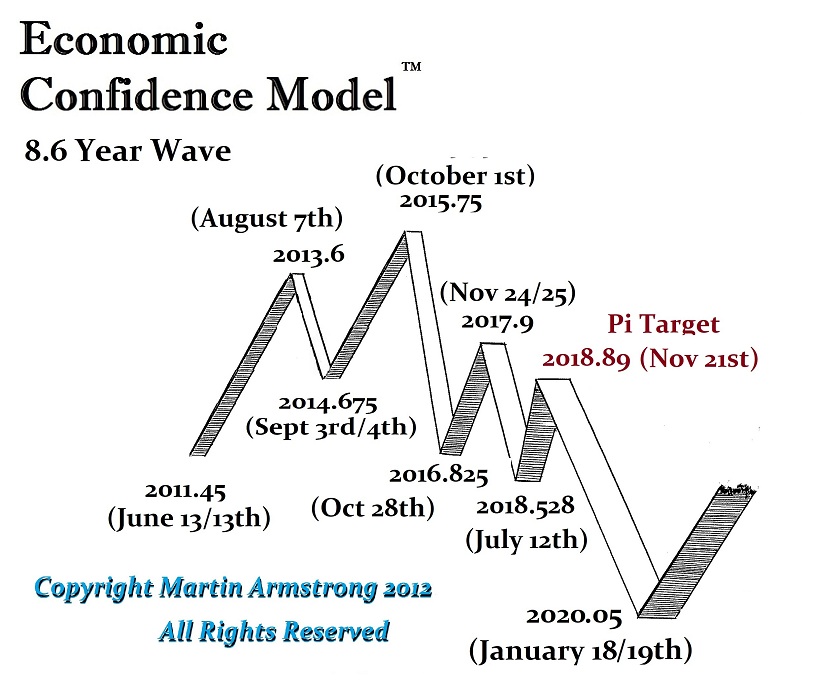
The way the markets respond to every issue with trade is really over-kill. But the market is in a bearish mode as the Economic Confidence Model heads into its business cycle low come January 2020.
It has become obvious that the mainstream press is FAKE NEWS. They are indeed out to get Trump and are using their position to desperately try to support the bureaucracy. The Washington Post has run a story stating Trump is wrong about the strength of the US economy. They claim his own advisors are warning that a recession is coming but he keeps saying the economy is strong. They’re accusing him of being a liar, which is no surprise.
What is really fascinating is that until Trump came to power, the press always talked up the economy because the belief has been if you tell the people there will be a recession, the people will contract their spending and create one. Larry Summers has explained that they cannot predict recessions, and if they could it would be a self-fulfillment of their forecast for if you tell the people there will be a recession, you will create one.
February 25th, 2009
Back in 2009, the Washington Post always talked optimistically about the economy and how Obama would save the day. Now we have the Post talking up a recession in the USA into the 2020 election when NEVER IN HISTORY has any major newspaper preached the economy will crumble just to influence a presidential election. This is really amazing and a complete turning around for the media demonstrating they no longer report the news, they are trying to create it. Even the photos they showed of Epstein with Trump and his ex-wife were always used rather than those of Epstein with Bill or Hillary.
Every time there is a crash, the president ALWAYS comes out and says the economy is fundamentally sound. Hoover did that in 1929 and they have done that every time ever since — both parties. The theory is if the president ever came out and said we are doomed, the people would panic even more. It is just NEVER done until now when the press calls for a recession to defeat a president.
An announcement from China on Saturday, pledging a full economic war against the United States, will likely not come as a surprise for most CTH readers. However, it does serve as emphasis for our 2017 statement: “prepare your affairs accordingly“…
When we followed up a few months later with the warning:
“There is no upper limit to the level of economic pain Team U.S.A. (America First) is willing to inflict upon China. There is no ending perimeter of action too far for President Trump to travel. Trump will battle his adversary far beyond traditional horizons and will follow them in retreat if that’s what it takes to ensure the safety of the our economic nation.”
Those words were not written lightly. We accept Trump’s history; we accept three decades of his expressed intent on these issues; and we also accept the historic and cultural position of China which takes us into this conflict. From Beijing today:
China on Saturday said it would continue fighting the trade war with the US “until the end” after the two sides slapped further tariffs on each other’s goods.
The commerce ministry issued a statement calling on Washington not to “misjudge the situation and underestimate the determination of Chinese people” after US President Donald Trump announced new tariffs on Chinese imports. “The US should immediately stop its wrong action, or it will have to bear all consequences,” the statement said.
“China’s will to defend the core interests of the country and the fundamental interests of the people is indestructible, and will not fear any challenge,” the commentary said.
An earlier commentary from Taoran Notes, a social media account affiliated with official newspaper Economic Daily, said China’s countermeasures were akin to a “precision instrument”, targeting industries such as US soybeans, crude oil and cars. (read more)
Donald J Trump is not engaged in this political and economic battle as a matter of creating benefit to himself or his business enterprise.
President Donald J Trump is approaching this geopolitical issue from a perspective of stewardship. President Trump will intensely protect America with the ferocity the same Donald Trump protects his family.
Unfortunately, Beijing has no formative understanding of how intensely this American President views his role of national stewardship. This is not a typical American political adversary Chairman Xi Jinping has ever encountered within the body of U.S. politicians.
President Trump is not a typical western politician from the perspective of self-interest. This president would grind the bones in his own hand to make lady liberty a rib if that was what is necessary to generate a win for America. Believe it.
Adding to the dynamic, China has no cultural or political space between peace and war; they are a historic nation based on two points of polarity. They see peace and war as coexisting with each other.
China accepts and believes opposite or contrary forces may actually be complementary, interconnected, and interdependent in the natural world, and they may give rise to each other as they interrelate to one another. Flowing between these polar states is a natural dynamic to be used -with serious contemplation- in advancing objectives as needed.
Peace or war. Win or lose. Yin and Yang. Culturally there is no middle position in dealings with China; they are not constitutionally capable of understanding or valuing the western philosophy of mutual benefit where concession of terms gains a larger outcome.
SIMPLY:if it does not benefit China, it is not done. The outlook is simply, a polarity of peace or war. In politics or economics the same perspective is true. It is a zero-sum outlook.
Therefore, when you see China publicly use strong language – it indicates a level of internal disposition beyond the defined western angst. Big Panda becomes Red Dragon; there is no mid-status or evolutionary phase.
Every American associated with investment, economics and China would be well advised to accept the dynamic, and put their business affairs in order accordingly.
President Trump will not back down from his position; the U.S. holds all of the leverage and the issue must be addressed. President Trump has been waiting three decades for this moment. Middle-class America has waited decades for this moment. This President and his team are entirely prepared for this.
We are finally confronting the geopolitical Red Dragon, China!
President Trump hasn’t been talking about this for three decades only to put limits on his approach; including daring this economic adversary, China, to strike back by nationalizing U.S. private corporate assets. President Trump is the most accessible and transparent President in modern history… He also doesn’t bluff. Trump may modify or delay based on his oppositions’ counter-moves, but he doesn’t bluff.
Donald J. Trump
✔@realDonaldTrump
For all of the Fake News Reporters that don’t have a clue as to what the law is relative to Presidential powers, China, etc., try looking at the Emergency Economic Powers Act of 1977. Case closed!
President Trump doesn’t apply force, he simply creates outcomes where the best alternative for the adversary is to change their approach according to their own best interests. President Trump positions the location of the interests themselves, he does not need the direct application of force.
President Trump also doesn’t seek to apply force to the mouse running through the economic maze; he simply changes the location of the cheese, and the mouse’s travel responds accordingly.
There’s no limit to the economic squeeze President Trump is willing to apply toward China. The U.S. Treasury, the U.S. Dept of Commerce, the U.S. Dept of State, the U.S. Dept of Agriculture, these are all tools in the sequential approach that are far more powerful than bombs, planes and rockets….
President Trump will use the full measure of economic tools at his disposal.
The stakes are high at this G7 Summit in Biarritz France. Against the rising tide of populist nationalism -pushing against the globalist/corporatist world order- perhaps these stakes are the highest in the modern political era.
(Where are the spouses?)
Italian President Giuseppe Conte’ is a lame duck summit participant having just quit his job due to economic and immigration backlash from his Italian population. German Chancellor Angela Merkel has steered her export dependent economy into a recession; and has announced she won’t seek reelection while simultaneously putting the EU central bank into a 28 nation economic quagmire filled with unsustainable IOU’s….
French President Emmanuel Macron, the host for this year’s summit, has spent the better part of the last year trying to violently block the rising yellow vest populist movement, and he is desperate for any distraction away from his own economic reality.
Meanwhile EU President Donald Tusk is locked in an economic death match with British Prime Minister Boris Johnson over the terms of the U.K. Brexit from the union; while simultaneously dealing with a lack of tax receipts from the aforementioned banks of Germany and France…
The EU’s only North American ideological ally, Justin from Canada, is essentially useless. Trudeau has used his political self-identification to hurt his own citizens economically; Canada is experiencing a continued loss in private-sector employment amid the malaise Justin coordinates; and his tenuous (at best) re-election is scheduled for October 21st…
On the other side of the equation, the more nationalist minded Shinzo Abe (Japan) and U.S. President Donald Trump are not encountering the same economic collapse as their Euro-centric counterparts.
Not coincidentally both Prime Minister Shinzo Abe and U.S. President Trump hold the highest domestic approval ratings amid the group of seven nations. Huh, funny that…. And also not coincidental, both President Trump and PM Abe stand to gain the majority of benefit from a Chinese economic contraction.
So the 2019 G7 in Biarritz, France, ends up happening at a crucial time for those who generationally supported the globalist central-banking “New World Order”.
It all boils down to the economics of things; Globalism -vs- Nationalism, or the multinationals -vs the Main Street yellow vests.
There are trillions at stake amid the layers of banks and multinational financial institutions.
Into that mix of ideology comes President Trump with his MAGA ‘America First’ tariff arsenal in one hand and the massive leverage of the U.S. $20 trillion market in the other.
With both weapons, 30 years of plans for how to use them and a sense of unyielding urgency, what President Trump has begun is a comprehensive global trade reset based on bilateral agreements.
President Trump’s economic plan destroys decades of multilateral terms constructed to the exclusive benefit of corporations and institutions that gained power and wealth over the yellow-vested people. The scale of consequence within this economic inflection point is generational.
The nationalists (Trump, Abe) with strong economies; and the globalists (Macron, Merkel, Trudeau and Tusk) with ever-weakening economies; and the fence sitters (Johnson and Conte) who are being literally forced, against their preferred outlook – by their respective populations, out of the globalist world and into a populist/nationalist economy.
Quite a dynamic.
This geopolitical struggle is why Emmanuel Macron is fighting so hard to control the optics of this G7.
It is truly quite remarkable when you know what to look for.
I have created this site to help people have fun in the kitchen. I write about enjoying life both in and out of my kitchen. Life is short! Make the most of it and enjoy!
This is a library of News Events not reported by the Main Stream Media documenting & connecting the dots on How the Obama Marxist Liberal agenda is destroying America







 Centinel2012