WEC Rome 2019


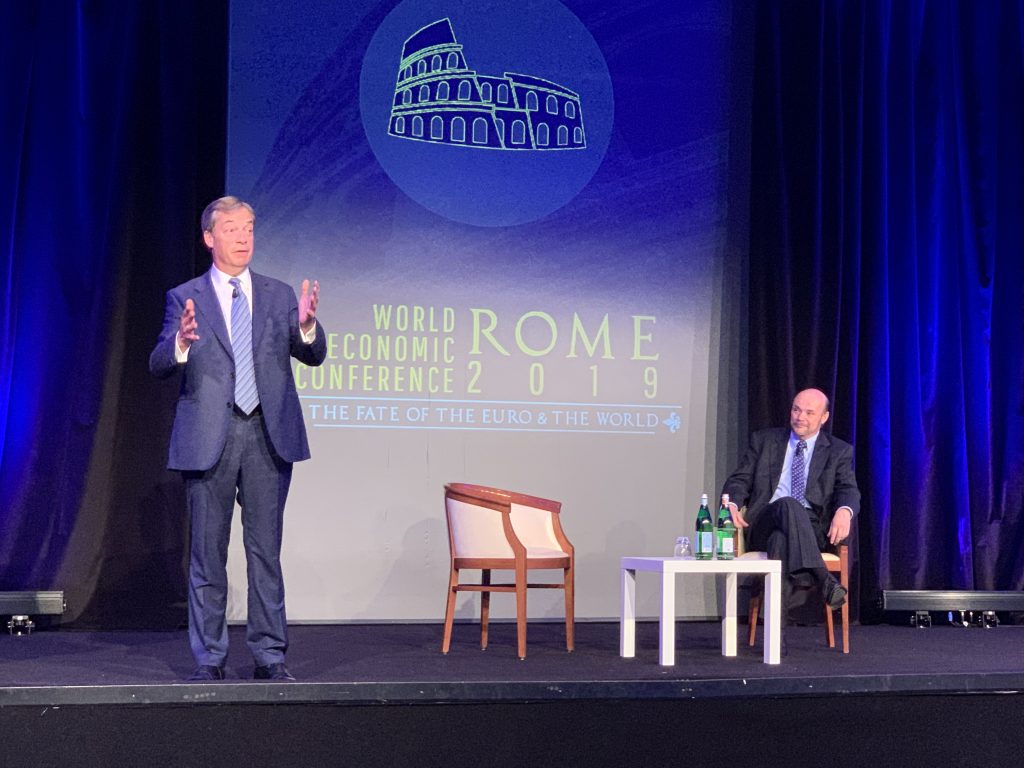
The Rome 2019 World Economic Conference was a lot of fun. We have a very diverse crowd from around the world including central bankers, hedge funds, pension funds, and private investors. Nigel Farage was great and he calls our conferences the “alternative to Davos” which inspired applause from attendees.

Our Spiral toward War


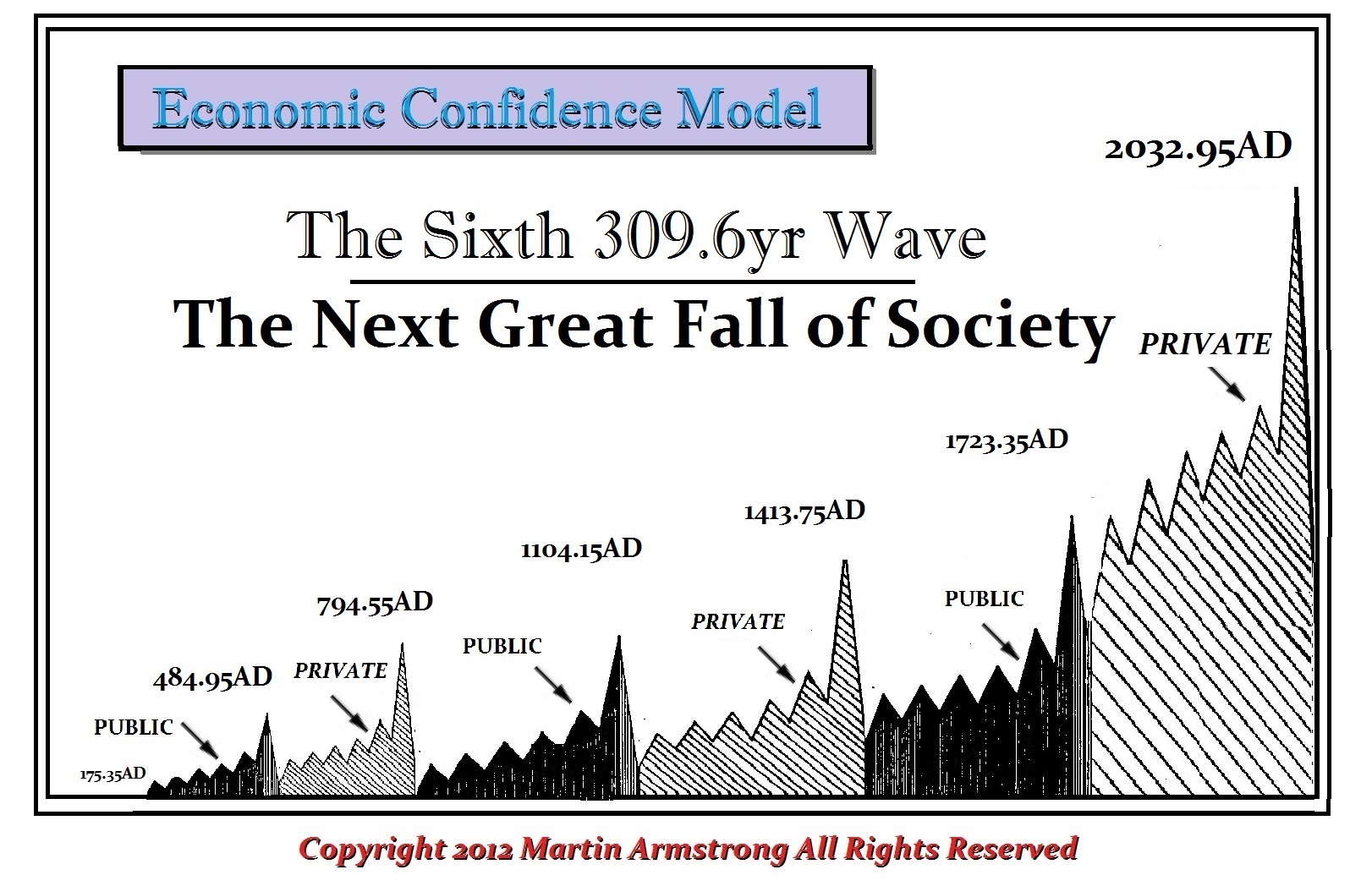
The Sixth Wave & 2032


QUESTION: Dear Mr. Armstrong

It was my great honour to meet you in Orlando in November. I couldn’t help hugging you! Thank you so much for all you are doing.

Two questions:

1. In terms of societal collapse, I have been looking at 2032 as the date of armegeddon , or the next major asteroid impact when life as I know it will completely cease (needless to say, kind of a downer), but in a recent blog post you mentioned the collapse of the West might stretch out for another 600 years (OMG, thank you!). Which is it? 😰

2. When you hand over the reigns of Socrates, please let this naive, gentle soul know how you will ensure its (super-) power will be used for good. You are incorruptible, but sadly, most are not.

God bless you always,

M in Ottawa

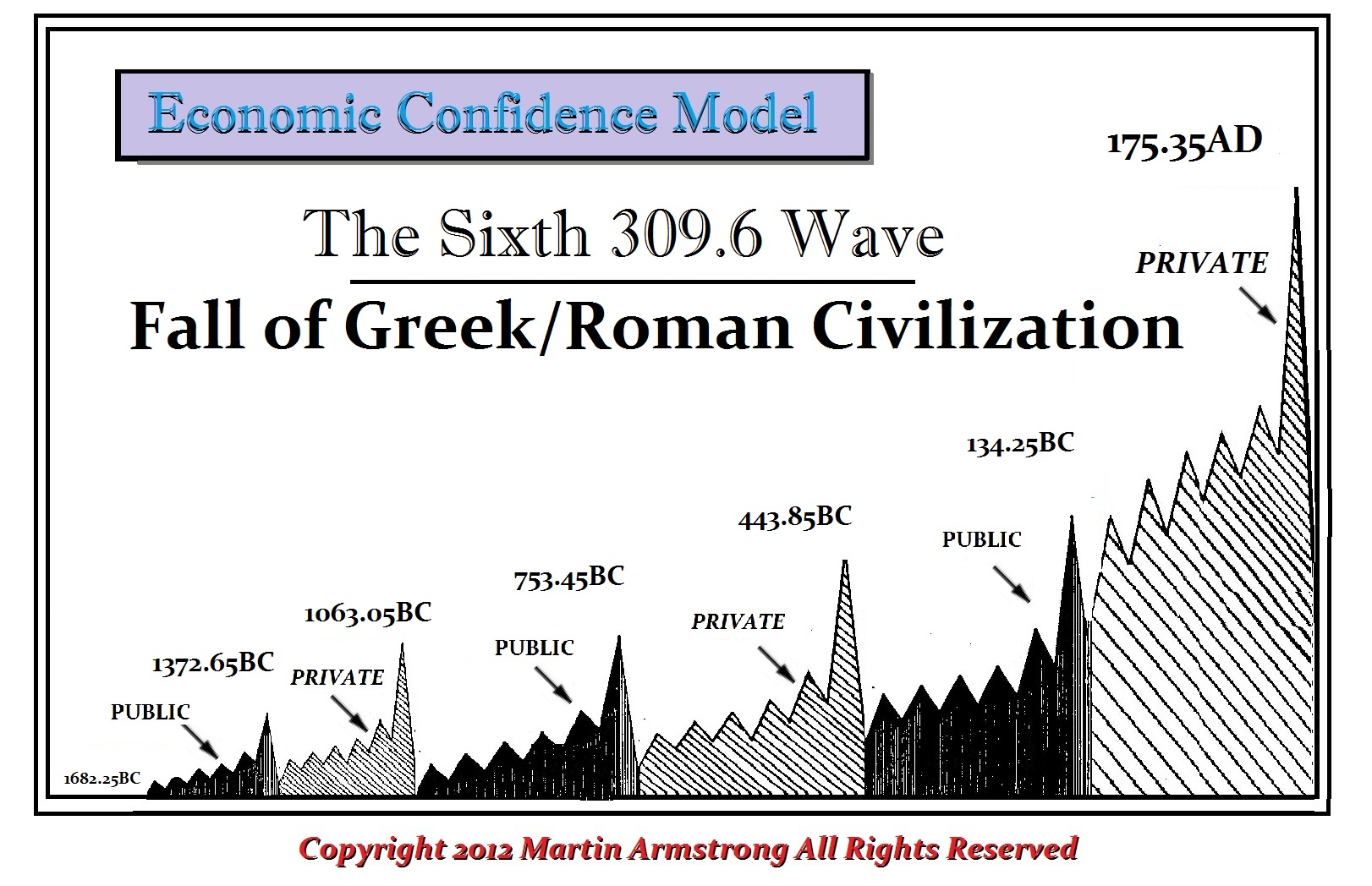
ANSWER: I do not believe that 2032 is the end of civilization. Even if we assume this Sixth Wave will be of equal importance as the one that picked the end of Rome in 175 AD. Roman society declined for the next 300 years, and then the Dark Age emerged for another 600 years. So from the actual peak in Roman society, the low was about 900 years later.

That time frame is probably correct for North America but it does not mean society comes to an end. The financial capital of the world will shift to China, which will be the dominant economy for the subsequent 309.6-year period. Then it will migrate to Russia and then to Europe. It will probably take 900 years before it reappears in North America.

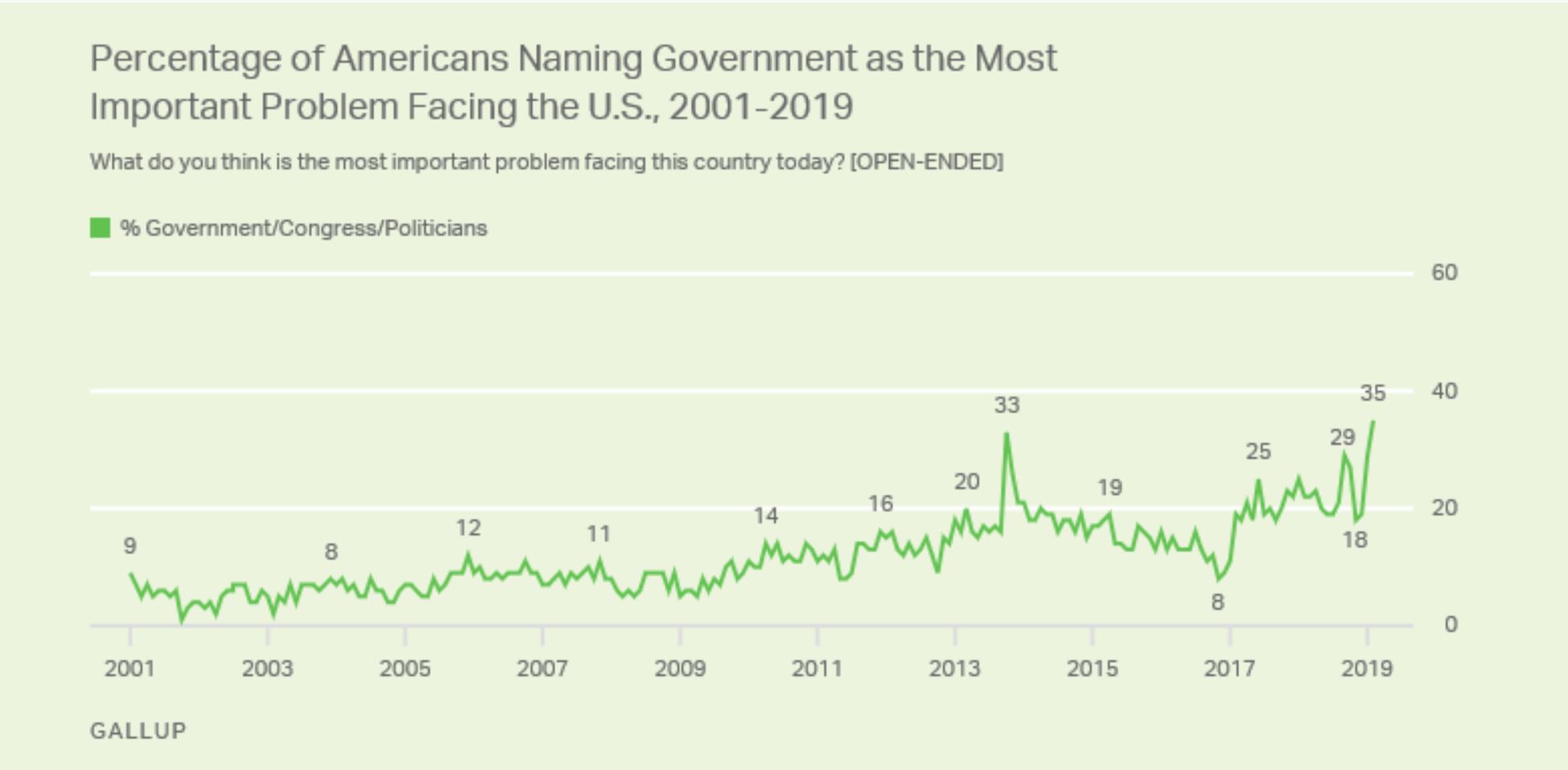
None of that says you should hide in a bunker or wait for an asteroid to crash. Just look at the politics and how there is no longer a possibility of actually managing the government. The political in-fighting will render it incapable of government as was the case in Rome following 180 AD. Life will continue. Governments will be recognized by the vast majority as the major problem. That is already at 35%.

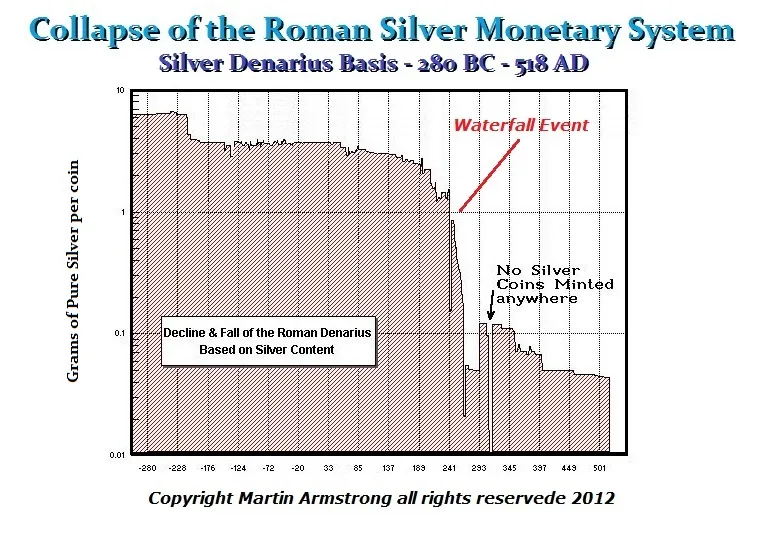
The question will turn on how rapidly the monetary system will collapse. In the case of Rome, there was no public debt. The debasement unfolded as people hoarded coinage which then forced the state to reduce the silver content in order to meet the demand to fund the government. In our modern sense, we are on a debt-based system. The crisis this time will not be due to people simply hoarding, but from governments being unable to sell their debt to keep the government funded. This time, it will be different. The modern economic system is LEVERAGED unlike that of Rome. Therefore, it will be prone to extreme sharp flash-crashes.

Keeping it Simple Keeps you Stupid


There was a 14th-century Franciscan friar by the name of William of Ockham who is credited with having formalized the principle that “simpler solutions are likely to be more correct than complex ones.” Hence, we seem to always try to reduce everything to a single cause and effect. Some have rephrased this as “keep it simple, stupid,” and it has emerged with the label “Ockham’s razor,” which is supposed to be a tool that cuts through complexity to get from point A to point B. However, is this the very problem that prevents us from seeing reality? It was, after all, this very principle that supported the flat earth theory. It prevailed and even led to the execution of people such as Giordano Bruno (1548–1600)  for daring to propose that the universe was not revolving around a flat Earth. Even Galileo Galilei (1564-1642) was charged in 1633 by the Roman Inquisition and forced to sign the confession or suffer the same fate of Bruno that the Earth was flat.
In funds management, the statement that proves there is complexity is a legal requirement: Past performance is not a predictor of future success. All investing involves the risk of loss.While there is a desire to make complexity simple and understandable, this is really completely misguided. Clearly, simplicity rather than complexity is by no means the proper course of action for we then cannot see the interconnections of how everything truly functions. The greatest mistake in the analysis is always trying to reduce any effect down to a single cause. The world is a complex mechanism. It is indeed like a rainforest. There are countless species and each is interconnected. Exterminate one and you will find that it was the food source for another. That species, in turn, was the food source for yet another and so on. The world economy is equally complex. This is why I say we are ALL CONNECTED. Create a war in one region, we may not be involved with troops, but the capital flows shift. How can we forecast anything by ignoring all the interrelated influences?
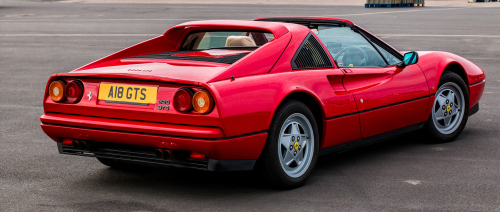
There are those who advocate that the best way to achieve your long-term investment objectives is to keep in simple. Yet they are looking at history and banking everything on a continuation of inflation. I have told the story at conferences how I bought a 328 Ferrari when I lived in London in 1985 when the British pound fell to $1.03. The Italians were getting $60,000 for the car in the states. It was still priced in pounds when it was $2. I bought the car for about $35,000. The Italians could no longer sell cars at that price so they doubled the price in pounds. Then the pound rallied and went to almost $2. I drove the car for 2 years, sold it used, and nearly doubled my money. Then people were buying Ferraris as an investment, thinking it was the car that appreciated when in fact it was just a currency play. If you did not look at the currency, you missed the whole point, so keeping it simple indeed made you stupid.

Rapid technological development in recent years across industries has helped to expose the fact that we live in a global economy and are all interconnected. Fund managers, because of regulation, are blinded by this interconnected world for they are not allowed to invest globally in a diversified portfolio. This is why we have so many specified funds and people claiming to “just keep it simple” with a hold policy because it always comes back.

Markets, on the one hand, appear deep and complex, rendering them impossible to understand fully when limited even by law to a purely domestic view. This has resulted in the advice of buy and hold as a strategy to fight against complexity with simplicity. Then there are investors who believe they need investment solutions that are nimble and flip positions based upon the talking heads on TV. They are brainwashed by their market myths. This has merely become grand sophistry trying to fight complexity with a simplicity that sounds logical by reducing all activity to a single cause and effect.

Asset allocation philosophies have emerged which invest other diverse market sectors knowing that they are polar opposites. They assume that the world is too complex beyond their comprehension so spread the wealth and hope for the best. These strategies have expanded as of late beyond the traditional stock/bond mix that was really exclusively domestic-oriented. In modern times post-1985, alternative strategies emerged introducing hedge funds that also incorporated foreign exchange, commodities, options, private debt, venture capital, and even real estate.

As hedge funds began to report their 2018 performance, an abyss quickly emerged between managers who outperformed the index and those who saw staggering losses with a third group landing somewhere in between. Overall, the industry saw its biggest annual loss since 2011, declining 4.1% on a fund-weighted basis, according to Hedge Fund Research Inc. Mostly, the smaller funds were able to flip portfolios quickly and that allowed them to trade around the big funds that can no longer maneuver. Most were unable to navigate the market turbulence in what became the worst year for the S&P 500 Index since the financial crisis. Most took “views” of what they thought would unfold and it cost them dearly. The funds that relied upon a personal opinion proved to be the worst for the vast majority kept viewing the stock market would crash any day, which never happened.

The illusion that simplicity provides the best long-term investment return is really predicated upon an assumption since the Great Depression that if you just held through all the 50-70% corrections you would be OK at the end of the day. The problem with this argument is that we are all human. I have never met someone who can actually do that. Then there is the problem of surviving the long-term. The city of Detroit suspended its debt payments in 1937 and resumed in 1963. If you owned such bonds for retirement, perhaps your heirs benefited, but you would have died broke and starving. It all depends where you are in the business cycle.

Understanding Rogue Waves


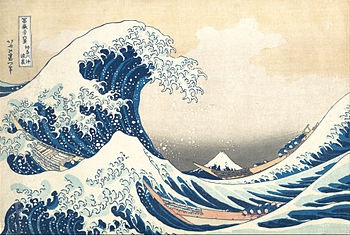
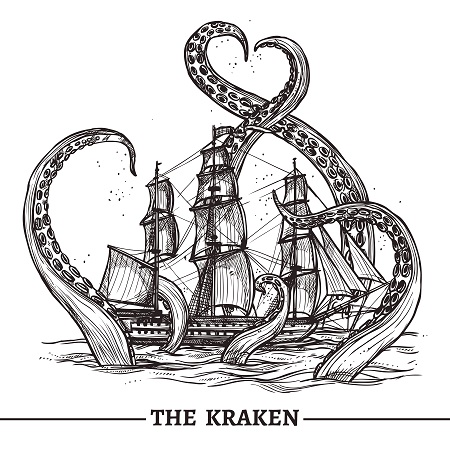
Over the centuries, sailors have told legends of monster waves that would appear out of nowhere in the middle of the open sea. Most scientists dismissed the stories as fabrications and legends. These stories were reported over the centuries by sailors who repeatedly saw these rogue waves of gigantic proportions rise up from nothing far above the surrounding waves in the middle of nowhere. In the 16th century when sailors began to venture past the Pillars of Hercules after Columbus, these stories began to commonly emerge. Many attributed them to the wake of some hidden sea monster. The ships that vanished were said to have been swallowed by these sea monsters they called the Kraken from Greek mythology.

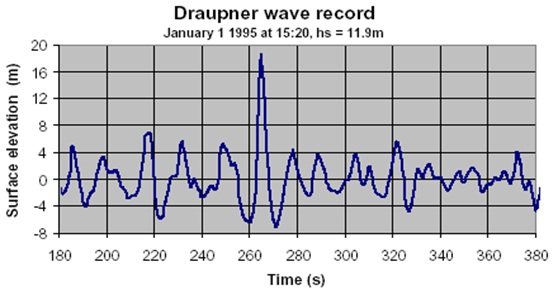
What was missing were any reliable measurements until New Year’s afternoon in 1995. On that day,  there were between ten to twelve-meter high storm waves and a wave of almost 83 feet (26 meters) high under the oil drilling platform named Draupner. This was the very first time one of these rogue waves was actually measured by the sensors on the platform. Since then, what was once dismissed as legend has entered the field of reality.

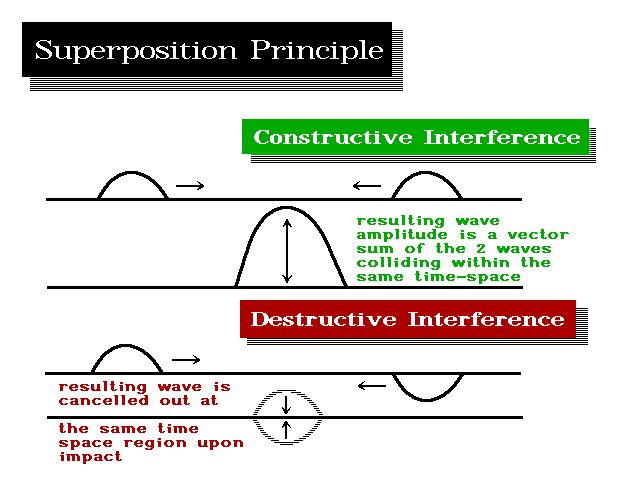
Hundreds of such monster waves have since been documented and they occur in different forms. For example, the convergence of waves in a nonlinear process can cause single superwaves to result from otherwise ordinary waves. I have found this stunning for scientists have been baffled by these rogue waves when in fact the same exact thing takes place is wave analysis of even the economy.

The Draupner wave was one of those mysterious lone superwaves that appeared to tower over all other waves. They are strikingly different from a tidal wave, which is when energy is passing through the wave until it hits shore. One of these superwaves appear out of nowhere, but they also vanish and disappear without a trace. This is what the scientists have failed to comprehend.


Since the Draupner wave discovery, finally, research has been taking place to try to understand these interesting wave formations. Essentially, a normal wave that hits the shoreline is produced by a wave of energy that flows through the water which is the medium. Those are quite distinct whereas a rogue wave is produced by the cycle of several waves that suddenly sync and produce a combined wave which is a singularity. If you look at something floating just off the beach, you will notice it rises and falls with the waves for it is not actually the water which is moving, rather it is the energy passing through the water. It is similar to what would occur if you received an electric shock; your flesh is not moving, it is the electricity passing through your flesh.

Essentially, everything in the universe is subject to cyclical theory. These rogue waves are no different from a market that suddenly erupts, crashes, and in the end, wipes out economies and investors. Politicians then respond with laws and investigations to try to blame the event on some human cause and effect.

Now, look at Bitcoin. The computer pinpointed the high in Bitcoin to the day. It understands these rogue waves, how they form, and how they will quickly vanish. We heard nothing but scenarios of the new age of knowledge and how Bitcoin would become the new reserve currency. So many people lost their shirt because they wanted to believe the hype and they ignored the reality of what takes place in a rogue wave.

India v Pakistan & the 2019/2020 Turning Point


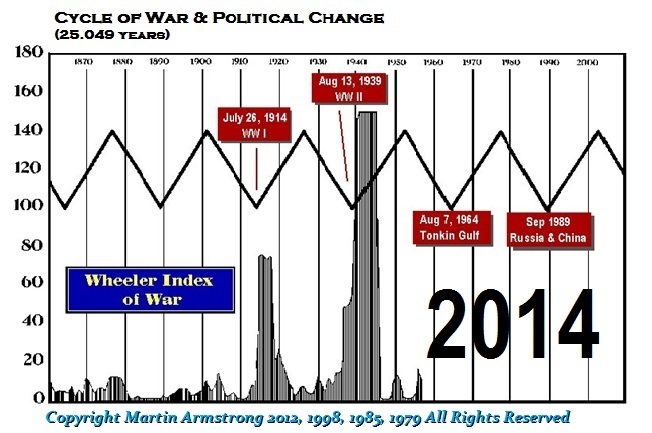
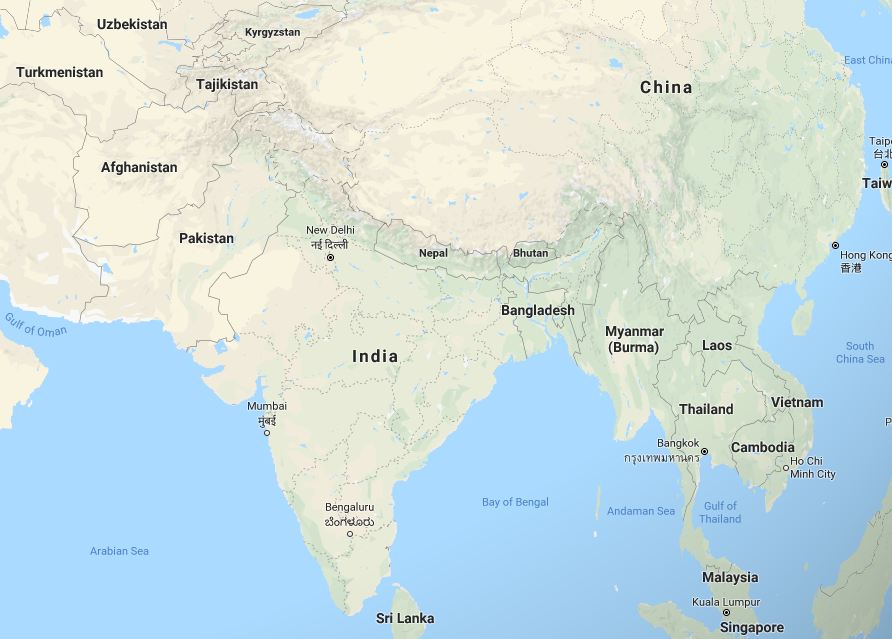
The last time that Indian and Pakistan were at war was back in 1971. Our War Model turned up in 1964 and indeed it marked the beginning of the US Vietnam War. In reality, the separation or the partition of India took place in 1947 based upon religion. The British created two independent dominions, India and Pakistan. India became the Republic of India in 1950, and in 1957 the Dominion of Pakistan became the Islamic Republic of Pakistan. In 1971, the People’s Republic of Bangladesh came into being. On March 25, 1971, there was also the Bangladesh War of Independence against Pakistan. Bangladesh was a Sunni Muslim state as was the case with Pakistan.  The partition involved the division of three provinces — Assam, Bengal, and Punjab — based on separating Hindus from Muslim majorities.

Ironically, here we are at the 72-year mark from 1947 which equals 2019. This is PRECISELY on target for a confrontation. Back in 1971, neither side possessed nuclear weapons as both do today. Indian warplanes began bombing inside Pakistan’s on February 26, which was really the culmination of the most serious confrontation South Asia has seen in a long time.

The origins of India’s air raid can be traced to a suicide bombing on February 14th in the Pulwama district of the state of Jammu & Kashmir that killed 40 Indian policemen. That was by far the deadliest attack and the worst jihadist assault to date. Prime Minister Narendra Modi faces reelection. The Hindu hardliners argue he has been weak and thus the attacks are clearly because of the upcoming elections. Then there are those who believe his attempt to modernize India to bring jobs to his countrymen has also failed. Modi is in a place where personal power depends upon him appearing strong. Unfortunately, this is precisely on target for 2019 after 72 years.

Even the volatility model of the Economic Confidence Model component is 6 years. Where the 8.6-year wave builds into waves of 51.6 years, due to turn in January 2020, the major volatility wave coincides here as well — 72 years from 1947. It was also 1947 when the International Monetary Fund began. It was also 1947 when the Marshall Plan came into force.

Ironically, 2019-2020 is a very formidable turning point both in conflicts and war/civil unre

When is Forecasting Not Forecasting?


QUESTION: There are a number of people who claim to have called the 2008 crash. What I find absent is that there is no one who brags on calling the rallies and crashes as you have and I have witnessed from going to your WECs since 1985. I still remember you in 1985 standing up and showing us all the projections of so many economic indicators all point to the moon for the next 51.6 years. Your call on the Dow going from 1,000 to 6,000 was an eye-opener back then and to watch it unfold was unbelievable. Then at the bottom in 2009 you called for new record highs. I read Barrons even wrote on that as if it was just a foolish comment. That happened exactly the same way when you stood up at the 1987 WEC and said the same thing.

My question is this. I recently read where a value investor from Boston claimed that the stock market would produce 2% to 3% for the next 20 years not 6% to 8%. He claimed to have called the 2000 and 2008 crash. Why do these people only claim to forecast the crash and not the rally?

Your life long subscriber who has grown old with you in this journey for knowledge as you put it.

PG

ANSWER: Good to hear from you. Yes, it has been a long time. I believe your answer lies in the fact that so many analysts are focused on 1929 and constantly view the market in that light. Even Germany and its austerity policy that has devastated Europe is fixed on the hyperinflation of the 1920s. In both cases, they failed to ever do the research to comprehend the real reasons behind the events of the 1920s and 1930s. So you will always find people claiming to predict every crash. There is an absence of those who forecast rallies. This is the result of the very same reason. They are all focused only on the events of 1929. You even have the Goldbugs constantly telling people everything will collapse and only gold will rally based upon their understanding of the 1930s which again is completely wrong.

If you are going to forecast any market, you have to be UNBIASED and willing to forecast the rally and the decline or else it is not forecasting. All the pretend gold analysts who only constantly forecast rising prices are really preaching, not forecasting, and they typically have skin in the game and will never say down when they own gold or mining stakes. When I was called by the Brady Commission for the Crash of 1987, the investigation showed that the theory that computer trading caused the crash was proven wrong because most people did not follow the computers and unplugged them because they did not believe in them.


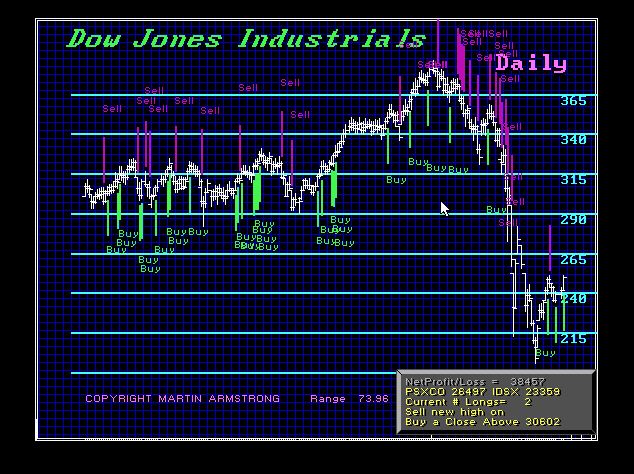
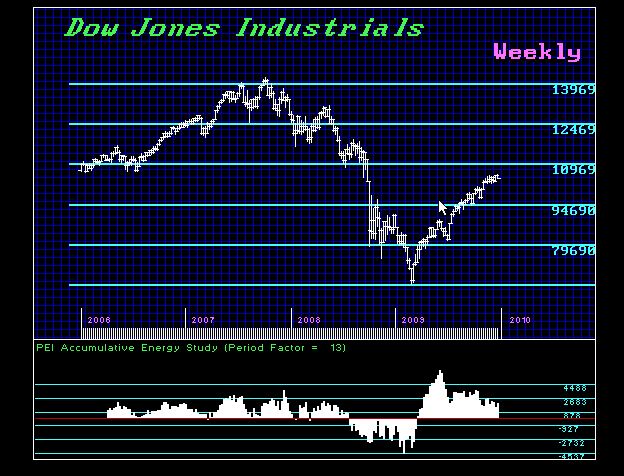
All you have to do is look at our Energy Models. They track the strength and weakness of a market and show you when the energy in a market is declining even though you may not see that in a chart pattern. Likewise, the energy was immediately making new record highs coming out of the major low.

You must also understand that the press needs content. They have their stable of people to put on and they prefer to show a consistent prediction. They do not want to put me on the air as I contradict everything they are putting out there. This immediate rally has been the most hated bull market in history. Every high there was someone forecasting the crash of all time. Even Goldman Sachs told everyone to sell 2019. Granted, at the Orlando WEC I stood up and said the market would make a correction and we should drop to retest the Monthly Bearish. We dropped to 21712 when the target was 21600.

But we have to look at this UNBIASED from every angle. You cannot forecast from a personal opinion perspective. I find it really funny when someone tries to argue against me and offers some logical fundamental, reducing everything to a single cause and effect. They fail to understand I am NOTmaking forecasts on what I “think” or my “opinion” personally I have been wrong and the model proves to always win if I dared to try to compete.

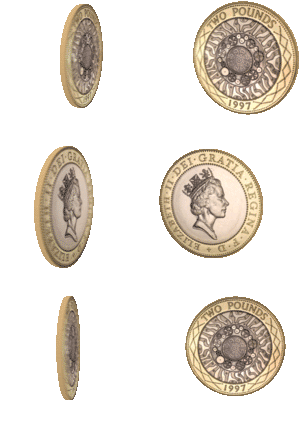
I suppose when you are always forecasting every high as the big one, then you can claim to call the crash. But nobody asks how many highs before then did they say the same thing. Markets are like the two sides to a coin. If you cannot forecast the rally and the decline, then you are not really forecasting

Thailand and the Future


COMMENT: Hi Marty,

As with so many others, I am very appreciative of your writing and am seeing your predictions come true as chaos piles up. Most recently, here in Thailand! The sister of the king, Princess Ubolrat (sp?) announced she would contest the upcoming election as prime minister. This is not only unprecedented in Thailand but perhaps anywhere in the world. In Thailand, the monarchy is treated with reverence and there are very strict laws about criticizing the monarchy, using their names or images for commercial or political purposes. And up until now, the monarchy has been strictly non-political. But there is a new regime now…indeed the king’s coronation is due to take place less than two months after the election on March 24 (coronation May 4).

The sister claims she is no longer a royal as she was stripped of her titles by her father, the former king (who died two years ago) when she married an American, but after 20+ years she divorced her husband and came back from America where she had been living to Thailand where she resumed royal duties. Thai people are so respectful/afraid of the monarchy that the election result is now considered to be a done deal as no one will dare to contest in any meaningful way. The small party she will lead is backed by the former billionaire prime minister Thaksin Shinawatra who has been living in exile for many years after being dumped from power in a coup. He is the darling of the impoverished rural masses while the incumbent Prime Minister General Prayut, who deposed Thaksin’s sister Yinglak as prime minister in a second coup, has the support of the business elite. Thailand up to now has been a very traditional society resting on three solid foundations…the nation, religion, and monarchy. This, despite frequent coups and regular rewriting of constitutions, has given it stability. I wonder if one of these legs is about to be kicked away…with a member of the monarchy descending down to the political fray. Now we await the battle between the general and the princess….most bets, of course, are on the princess!

The king has now criticized the actions of his sister “inappropriate”. Since the king must approve the prime minister, it seems that her name can’t go forward. So the traditions still hold after all in Thailand.

Thank you


ANNONYMOUS

REPLY: I love Thailand. It is one of the real gems in the world. Despite all the political turmoil, the structure keeps going. To a large extent,  this demonstrates that the economy is self-sustaining and really does not require government in any country. People will interact with or without the presence of governments. Nevertheless, the beginning of the Chakri dynasty under King Rama I took place in 1782 in Thailand, which rules to this day. The country was then known as Siam and the new capital of Bangkok was found. It was during the reign of King Mongkut (Rama IV) (1804-1868), who embraced Western innovations and initiated Thailand’s modernization.

When we look at the broader picture, the 224-year cycle of political change came into play in Thailand as well and was due in 2006. Indeed, it was during April-May 2006, when a snap election was called by the PM amid mass rallies against him that were boycotted by the opposition and subsequently annulled. This resulted in a political vacuum. The PM took a seven-week break from politics. Then in August 2006, the Prime Minister Thaksin Shinawatra accused several army officers of plotting to kill him after police found a car containing bomb-making materials near his house. Then on September 19, 2006, military leaders staged a bloodless coup while Prime Minister Thaksin Shinawatra was at the UN General Assembly. Retired General Surayud Chulanont was appointed as interim prime minister during October 2006. Finally, in January 2007 martial law was lifted in more than half of the country. Therefore, 2006 was a major turning point in Thailand.

Ever since 2006, we have witnessed rising political change. Opposition protesters occupied Bangkok’s main government complex in 2008, and began a mass anti-government protest calling for the resignation of Prime Minister Samak Sundaravej. Eventually, Sundaravej was forced out of office by December that year. In March-May 2010, tens of thousands of Thaksin supporters emerged in their trademark red shirts. The major political change seems to be on schedule for 2032 into 2048.

Superbowl LIII – A Historic Low Point & Low Viewership?


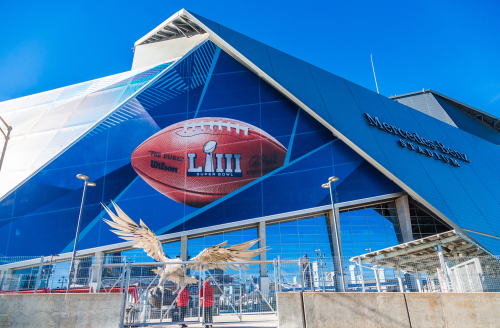
The Patriots beat the Rams but only a score of 13-3. Superbowl LIII (53) at half-time was the second lowest scoring game in history. The first half of Sunday’s game between the Patriots and the Rams ended in the second lowest scoring first half in a Super Bowl at 3–0, New England. It was 44 years ago when the Steelers led the Vikings 2–0 at half time in Super Bowl IX back in 1975. About 103.4 million people watched Superbowl LII last year, which was the smallest audience for television’s biggest yearly event since 2009. Note the year – 2009. Interestingly enough, when the economy turns down, so do sports. The all-time record high for viewership was 114.4 million for the Patriots-Seahawks game back in 2015, peaking with the Economic Confidence Model. It is curious that in good-times, when everyone is fat and happy, we do not see wars and we see sports do well. The sharp decline post-2015 seems to be correlating with the economy. True, the US economy has been holding up the world. But its growth rates has been steadily declining.

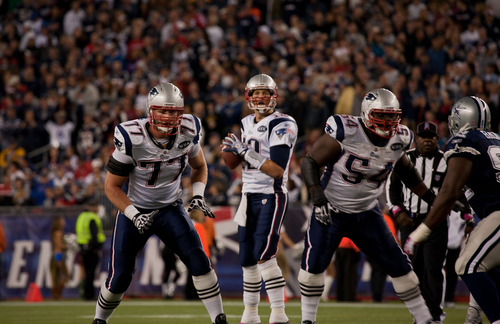
Last year’s Super Bowl (LII) came down to the wire, with Nick Foles leading the Philadelphia Eagles to a 41-33 victory over the Tom Brady-led New England Patriots. That stunning victory for Philadelphia over the favorite, was down significantly in viewership. Last year, I noted that just looking at the risk analysis, it appeared that Tom Brady, New England’s quarterback, had peaked. He entered the NFL in 2000 and he is one of only two players to win five Super Bowls (the other being defensive player Charles Haley) and the only player to win them all playing for one team. Last year he lost to the Philadelphia Eagles. Cyclically reviewing the prospects, Tom Brady appeared to have peaked with his win in 2017 which was 17 years (2 * 8.6) from the beginning of his career. Here we have in Superbowl LIII, certainly a very low scoring game.

How do we measure this peak? Points, wins, or viewership?

From a point perspective, scoring 13 points compared to last year’s 33 points for Brady was a significant decline. So was this just a reaction rally within a broader declining trend? In case you were wondering, six points is the fewest scored through the first three quarters in Super Bowl history. When we get the final viewership numbers, I suspect we will see the bear market decline still in motion. Then there are the pundits that say the Patriots’ Super Bowl win warns of a bear market for the stock market. That is one of the popular myths as is the rise and fall of women’s skirts – very short like the Roaring ’20s = bull market; down to the ankles in the ’30s was the sign of depression.

Our Traditions are Often those of the Roman Empire


QUESTION: Just curious. Did the Romans ever celebrate their founding of Rome like we celebrate the fourth of July?

ZT

ANSWER: Oh yes. We seem to have adopted whatever they did as traditions as well. For example, there are nuns in the Catholic Church who take vows of chastity and are in theory married to God. The Romans had the very same tradition known as Vestal Virgins. They kept the eternal flame burning, which we see at John F. Kennedy’s grave as well, symbolizing his memory will live on.

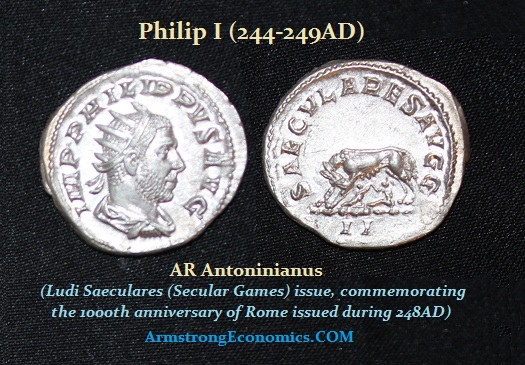
Pictured above is a silver Antoninianus issued during 248 AD by the then Emperor Philip I(244-249 AD) celebrating the 1,000th year anniversary of the founding of Rome.

We are still awaiting the final contract with the hotel in Rome for this year’s Spring WEC. Those attending will receive a guide to Rome where you can even find the original doors to the Roman Senate commission by Julius Caesar that is rarely mentioned in any guidebook.

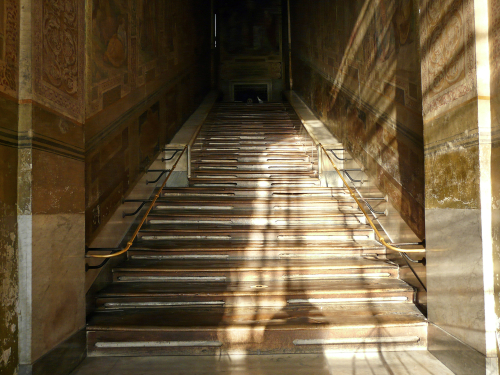
Of course, I have probably been to Rome more than 100 times and I have still not visited everything. It really is the Eternal City. For the religious tourist, there is even the Scala Sancta, or Holy Stairs, that are a set of 28 white marble steps which were the steps leading up to the praetorium of Pontius Pilate in Jerusalem on where Jesus Christ walked on his way to trial. The stairs reputedly were brought to Rome by St. HelenaConstantine’s mother, during the fourth century