The partially completed Mk1 Starship at SpaceX’s Boca Chica facility was undergoing tank pressure tests when the top few meters of the rocket exploded off and were propelled about 100 meters into the sky. Footage of the RUD was captured by LabPadre and @BocaChicaMaria1 and it shared here: https://www.youtube.com/watch?v=PF1NE… The failure happened under high tank pressure, the forward LOX tank unzipped along the circumferential weld line, resulting in the bulkhead being propelled upwards while the pressure change propagated downwards and damaged the lower parts of the vehicle. The project is in the process of building other test vehicles with improved fabrication techniques, but this will no doubt result in slowed progress. Images of the event and the aftermath by: https://twitter.com/labpadrehttps://twitter.com/BocachicaMaria1https://twitter.com/bocachicagal
QUESTION: Marty, is it true that Al Gore was behind the Y2K scare back in 2000 that all the computers would crash and nothing happened?
JC
ANSWER: Yes. It was Al Gore back then who was behind the hype that the world was going to crash because the computers would all fail when the date turned from 1999 to 2000. I remember those days well. I ran tests on Socrates to see if there would be a problem and nothing happened. In computers, we generally do not use calendars. Instead, we use a Scalar Date System. In Socrates, for example, day 1 is 6,000 BC. All of our data is recorded in this Scalar Date format. In other words, November 18, 2019, is day 2,929,261. In this manner, we can calculate the number of days between events and determine true cycles. We then have algorithms to translate that Scalar Date to the current calendar. We can translate the ancient date based upon whatever calendar they used at that point in history into our Scalar Date system.
So yes, Al Gore was a big proponent of the Y2K Crisis which resulted in billions spent on a problem that did not exist. Computer do not store dates in calendar format. So yes. He is at it again crying that the entire world is going to crash, again, but this time because of CO2.
Here is Al Gore Speech on Year 2000 Conversion.
Date: July 14, 1998.
Source: The White House, Office of the Press Secretary.
REMARKS BY THE VICE PRESIDENT
AT YEAR 2000 CONVERSION EVENT
National Academy of Sciences
Washington, D.C.
THE VICE PRESIDENT: Thank you very much, ladies and gentlemen. Thank you, thank you very much. I didn’t know I was going to get that kind of build-up, Bruce. Thank you. I do come over here a lot, and I appreciate all the kind words. And, Dr. Alberts, I want to thank you and all of your staff and team here for all of the help that you’ve given to the President and me, and to the administration, and to the Congress, and for the role that you play in our country.
It’s a great pleasure to be here with so many distinguished guests. And on behalf of the President, I’d like to spend just a moment acknowledging the folks who are on stage with us here. Before I do that, I want you to know that there are several members of the President’s Cabinet who are present here today, including the OMB Director, Jack Lew, who plays such a prominent role in this issue; and, of course, John Koskinen, who is Chair of the President’s Council on the Year 2000 Conversion. And we want to thank John for all the work that he’s done on this. Having been a part of the effort to persuade him to come back out of retirement and take this on, I want to really lay it on thick because he’s done a great job. Why don’t you stand up, John. We appreciate what you’re doing.
Also, let me point out that the Secretary of Labor, Alexis Herman, is here; and the Acting Secretary of Energy, Betsy Moler is here; Deputy Secretary of Labor Kitty Higgins and Deputy Secretary of Transportation Mort Downey; Deputy at SBA, Fred Hochberg; also, FCC Commissioner, Michael Powell; and others in the administration — Janet Abrams is the Executive Director of the Year 2000 Council; Morley Winograd with the Partnership for Reinventing Government.
And from the — I probably should have started with the members of the Senate and the House — I want to say a special word of acknowledgment to Senator Bob Bennett and his partner, Senator Chris Dodd — the two of them are leading the charge on the Senate side to create a very thoughtful, bipartisan forum for addressing this issue that faces our country and the world. And on the House side, I want to especially acknowledge Congressman Steve Horn of California and Congressman Dennis Kucinich of Ohio, Congressman John LaFalce of New York and Congressman Jim Turner of Texas.
Now, behind me here on stage are some distinguished Americans who are hard at work on the issue, and the President will be referring to some of them. But I want to acknowledge Erle Nye, a CEO of Texas Utility Corporation; Stephen Wolf, CEO and Chairman of the U.S. Airways Group; John Pasqua, Vice President for Y2K at ATT; Peter Turner, who is the COO at Torrington Research Company; and Sandra Wells who is in charge of Y2K for Torrington; and Ed Brown who is Vice President for Internet Services with First Union Bank.
Now, I took notes, Dr. Alberts, of your comments about me and technology, and I was recalling a magazine article — one of these airline magazines. And they had a list a few years ago of 31 signs that technology has taken over your life. I’ll just read a few of them: If you know your e-mail address, but not your Social Security number; if you rotate your screen saver more than your tires; if you have never sat through a movie without having at least one device on your body beep or buzz.
Now, here’s the point. My personal favorite was number 23: If Al Gore strikes you as an intriguing fellow. I don’t understand that. Why is that? But technology is, without question, a vital part of our everyday life, and we constantly face the challenge of making sure that we’re on top of it and mastering it instead of letting it take control of our lives and master us. And we’re here today to discuss what we all need to do to ensure that technology continues to be a path to prosperity and not a source of new problems, especially on the day when the calendar turns on the year 2000.
I’m speaking, of course, about the so-called year 2000 problem which, as everybody knows — well, unfortunately, not everybody does know it — but as many people know, and certainly everyone in this auditorium knows, it could cause serious problems for commerce and communications all over the world if we’re not serious about fixing it.
This is a story of conscious decisions by people years ago that led to completely unintended consequences. Back in the 1960s and ’70s, managers and programmers tried to save money by saving on memory. At that stage of the computer revolution memory was at a premium and they were trying to avoid using any unnecessary space in the memory storage areas. And so they came up with the notion of representing the date with only two digits, instead of four. So 1965 became just 65. And it saved millions of dollars, but it also created one whale of a problem.
The software assumed that every year began with 19, and it wasn’t programmed to read the year 2000. The programmers assumed, of course, that the early versions of software that they were using would quickly become obsolete, so they really didn’t think about it that much. But software has turned out to be a different kind of technology from toasters or cars — when you get a new version you don’t just throw away the old software, or at least when you develop a new version they didn’t throw away the earlier version, they built upon it and added to it.
And software began to evolve in ways that are not completely dissimilar to the evolution of life forms in the sense that the new forms recapitulated some of the earlier evolutionary steps. And without spending much time considering it, the software writers continued to think, well, we’ll soon replace this and if we fix the numbers, well, they’ll have to go back and fix it all over the place. And so they fell into a pattern of denial and it didn’t really seem to them to be a problem.
But as a result the flawed programs were replicated by each successive generation. And over time they built up and today we have hundreds of millions of computers and devices and tens of billions of imbedded chips that will not accurately read — many of which will not accurately read the year 2000. When you have that many of them, if only a small percentage of them don’t accurately read the date, then the world has a problem. And unless the old lines of code are fixed, the problems, of course, will be serious. And that means that if somebody gets a bill in December ’99 and doesn’t send a check until January of 2000, if that company’s computer isn’t fixed it might not register your payment because it will think the check is from 1900. And that would be the least of the problem. So it has to be fixed.
And this is a challenge that exists on four different levels. First of all, it’s a challenge to the federal government. With more than 7,000 mission critical systems at the federal level, carrying out functions ranging from Social Security payments to air traffic control, it is critical that our electronic systems run effectively and efficiently.
Secondly, it’s a challenge to state and local government. States use computers to run vital public health and safety systems, from Medicaid to unemployment insurance to water treatment plants.
Third, it’s a special challenge to the private sector. Virtually every American business, both large and small, has a stake in our information economy and ultimately has to take personal responsibility for fixing their own system. The people who are with us on stage today, to whom I referred earlier, have taken a special leadership role on this issue and we want to hold them up as examples, and they’re working with us to solve the problem. And private businesses are really doing a wonderful job, in most cases — we’ll talk about some of the others.
Now, fourth, it’s an international challenge. In a world with hundreds of different languages, the way in which our computers speak to one another across national boundaries drives our markets, our jobs, and our future.
The President will talk more broadly about all four of these areas in just a moment. Let me take just one minute to focus on the federal role. The federal government has been working very hard to ensure that our critical computer systems will in fact run smoothly when the date changes. Earlier this year the President established the President’s Council on the Year 2000 Conversion, and appointed John Koskinen, as the highly respected former Deputy Director of Management at OMB, to head up this effort.
Along with John, I met with the President’s Management Council to make clear that their number one job was to meet this challenge. And I joined in the Cabinet meeting when the President laid down the law and went to each Cabinet Department and set in motion efforts to make sure that every Cabinet member understands this is priority number one.
And today, over 30 Executive Branch, independent and regulatory agencies have representatives on that Council and great progress is being made. At the Social Security Administration, for example, more than 90 percent of critical systems are already year 2000 compliant. There are areas where extra attention is being devoted, I assure you, and we know very well that we have serious work ahead of us and we have to remain diligent.
Our goal is to have 100 percent government-wide compliance not by December 31, 1999, but by March of next year. And John Koskinen really is a tireless and talented manager with a stellar record, and I know that together we will continue to make good progress toward meeting that goal.
And we want to thank our colleagues in the Legislation Branch of the government for approaching it with the seriousness of purpose and dedication that they have brought to this task. This can be a model of partnership and, in fact, one of the lessons that businesses are learning is that some of the instinct for conflict or to take advantage of some competitor’s problems have to be submerged into a common effort to make sure that everybody in a particular industry sector is solving the problem, because it will affect everybody if that’s not stopped. And the same thing is true where the federal government is concerned.
Our Office of Personnel Management is currently working to make sure that every agency has the talent and the personnel needed to address this issue. Last March OPM issued a memorandum that will enable us to bring back retired government programmers to meet this challenge without requiring them to give up their retirement benefits.
After all, much of the work that needs to be done involves computer languages that were en vogue 30 years ago, but are not as prevalent today. And some of these languages even have dialects that can throw you for a loop if you haven’t been conversant in them personally. And these programmers have the training and the skills that are greatly needed right now.
So we’re doing our part, and part of the message today is that everybody has to do his or her part. Let me be clear about one thing in closing. The year 2000 problem is a management challenge and a programming challenge. It must not be a political football. We need bipartisan cooperation to solve the year 2000 problem, not political rhetoric. More than anything else, the year 2000 problem has revealed how interconnected and interdependent we have become. As software has evolved, so has our society. We’re all in this together and we must solve it together.
Ladies and gentlemen, there is no person who understands that better than President Bill Clinton. Over the past five and a half years, no person has worked harder or done more to give our families and communities the tools that they need to make technology work for them and to make it a pathway to a brighter future. And, of course, we see the results in all of the great economic news in most parts of our country — 16 million new jobs, new records for small business creation every year now, 78 percent of America’s schools wired to the Internet, and the biggest increase in education opportunity in a generation.
The President is here today to talk about how the United States of America can keep this progress going and continue to address the year 2000 problem today. It is my great honor to present to you, ladies and gentlemen, the President of the United States, Bill Clinton.
The corruption in the Rule of Law is the #1 cause of the decline and fall of nations. One major step would be to replace judges with AI. Lawyers already use AI to research legal positions that junior staff once did. It is only a matter of time before courts can be replaced with AI, which would then ensure that judges will not rule in favor of the bankers or governments. Prosecutors make the decision as to who should be indicted and that too is entirely discretionary. The FBI, which never exonerates anyone, just did so claiming Hillary did not intentionally violate the law. That was clearly an intentional effort to boost her for running in 2020. When the Rule of Law is controlled politically, that is when governments begin to decline and eventually collapse. It is the Rule of Law that enables civilization to form. Without the Rule of Law, you end up with total chaos. It is about time we move toward something that is desperately needed to save society.
QUESTION: You have never actually stated what type of technology is behind Socrates. Is it a neural network? Have you accomplished something nobody else has yet reached in neural nets since there are no such systems that can identify market movements and then verbally articulate them?
ANSWER: Socrates is NOT a neural network. I looked at that technology when it was designed as a software back in the 1980s and discarded it as impractical for true financial market forecasting. For example, in the ’70s, the theory was to study how the voice box made sounds. Attempts to replicate that for computers to enable them to speak proved impossible and highly complex. Back then, I worked with Dragon Systems where the speech was tackled from a phonetic approach that was originally hardware.
Teaching computers to see was easy. It would take an image and reduce it to binary black or white and then it could ascertain the shape of the object. However, neural networks needed a tremendous amount of examples of photographs before they could distinguish between a cat and a dog or a cup. Humans can see a single picture of one dog or cat and recognize various species of that animal without ever seeing a picture of every single particular breed. Neural nets cannot accomplish that from a single photograph. This is one major difference between neural nets and our brain. This made it impossible to create a neural net that could simply recognize a market pattern but just looking at a chart.
Neuromorphic engineering is yet another concept developed back in the late 1980s. Thus, neuromorphic differs from neural networks which are a set of algorithms, modeled loosely on the theory of how the human brain functions. They were designed to recognize patterns such as trying to distinguish between the cat, dog, and a cup. They attempt to create very large-scale integration (VLSI) systems containing electronic analog circuits to mimic neuro-biological architectures that are present in the nervous system. The neuromorphic is really more hardware-based but also requires a software operating system.
The implementation of neuromorphic computing has raised the theory that perhaps one day we will be able to copy the content of the brain into a synthetic replacement as in the movie “Replicas.” The actual key aspect of neuromorphic computing is understanding how the morphology of individual neurons, circuits, applications, and overall architectures create learning and development constituting who we are. I would not consider this a technology that would be able to become a synthetic mind replacement for quite some time, assuming we could ever get to that level of understanding the complexity of the human brain.
Obviously, Socrates is a hybrid between neuromorphic computing and neural networks. I chose a different path of actually creating a synthetic network capable of learning by example but expressly targeted to global analysis. I input my own basic abilities to conduct analysis and taught it my methodology. Socrates is now free to explore the entire world database and return with answers. We are now teaching it to verbalize its results.
The Global Market Watch is purely pattern recognition where it is identifying patterns and assigning them a number for its catalog of market patterns. Besides the fact it has exceeded more than 50,000 patterns, demonstrating the true complexity of market movement, it has also proven that those patterns it may discover in wheat, for example, are applicable to even individual stocks. It has proven beyond a shadow of a doubt that fundamental analysis is not only worthless, but the common link is human behavior — not the underlying instrument. We are looking at HOW humans will interact with whatever the instrument might be to establish why history bothers to repeat because human nature never changes throughout millennia
Earlier today President Trump and First Lady Melania attended the New York City Veterans Day parade to honor our nations service members. President Donald J. Trump has made it a priority to support American veterans. [Video and Transcript Below]
.
[Transcript] – THE PRESIDENT: Well, thank you very much, Stanley. And thank you for your tremendous support of this wonderful parade. Today, we come together as one nation to salute the veterans of the United States Armed Forces — the greatest warriors to ever walk the face of the Earth. Our veterans risked everything for us. Now it is our duty to serve and protect them every single day of our lives.
It is truly an honor to come back to New York City, right here in Madison Square Park, to be the first President ever to attend “America’s Parade.” (Applause.)
To every veteran here with us, to the thousands preparing to march on 5^th Avenue — it’ll be really something — and to the 18 million veterans across our country: The First Lady and I have come to express the everlasting love and loyalty of 327 million Americans.
I want to recognize Department of Veterans Affairs Deputy Secretary James Byrne for joining us. Thank you, James. Thank you, James. (Applause.) Great job. I’m pleased to report that our administration and all of the work that we’ve done — the veteran satisfaction with the VA is at 90 percent. It’s the highest rate ever recorded in the history of this particular program. And that’s awfully good, and we’re very proud of you and the Secretary. Thank you very much. Great job. (Applause.)
Also with us is New York City Mayor Bill de Blasio. Thank you very much, Mr. Mayor. Thank you. (Applause.) Along with many other distinguished guests.
Thanks as well to everyone at the United War Veterans Council for putting on this incredible event, including Bill White, Doug McGowan, and a very special acknowledgement to someone who has devoted his life to this parade: Marine Vietnam veteran Vince McGowan. Thank you. (Applause.) Thank you very much. Thank you.
Thank you, each of you, and all of the supporters whose generosity make this parade possible. Tremendous amounts of work has been done, and tremendous, frankly, amounts of money has been donated. And we appreciate it, and we appreciate Stanley.
We’re very glad to be joined as well by the Honorary Grand Marshal of the Parade, Marine Corps Commandant General David Berger and the Sergeant Major of the Marine Corps Troy Black. Thank you very much. Thank you. (Applause.) Thank you very much.
Let us also show our profound appreciation to the 2019 grand marshals of the parade who have served in World War Two, Korea, Vietnam, the Gulf War, and Iraq.
This morning, as more than 30,000 patriotic Americans line the streets of Manhattan, we carry on a noble tradition that began one century ago. In 1919, the people of this city filled block after block to welcome home General Pershing and his 25,000 American soldiers after victory in World War One.
Just a few years before, many of those soldiers had boarded ships not far from here at Hoboken Port. More than 4 million Americans fought in the Great War, and more than 116,000 made the ultimate sacrifice.
At the 11th hour, of the 11th day, of the 11th month, in 1918, the Armistice was declared, the war had come to an end, and the Allies achieved a great, great victory.
Every year since, on November 11th, we have shared our nation’s deepest praise and gratitude to every citizen who has worn the uniform of the American Army, Navy, Air Force, Coast Guard, and Marines.
We are profoundly moved to have with us veterans of World War Two, including one of the grand marshals, Woody Williams. Thank you. (Applause.) Thank you, Woody. Thank you very much, Woody.
To each veteran of the war: The glory of your deeds will only grow greater with time. This city is graced by your presence. This nation is forever in your debt. And we thank you all.
We’re also pleased to be joined by veterans of the Korean War, the Vietnam War, the Gulf War, and the War on Terror. You are the reason our hearts swell with pride, our foes tremble with fear, and our nation thrives in freedom. Would you please stand so that we can honor your heroic service? Please. (Applause.) Thank you very much. Thank you. Thank you all.
Each year, this parade highlights one branch of our military. This year, we honor the elite masters of air, land, and sea — the legendary Leathernecks, the feared Devil Dogs, the “first to [DEL: flight :DEL] [fight]”: the United States Marines. Let’s hear it. (Applause.) That’s great.
Yesterday, we celebrated the Marines’ 244th birthday. That’s pretty good. (Applause.) The Few and the Proud are always faithful, and they always win.
I also want to thank the Marine Corps Law Enforcement Foundation, which provides scholarships to children of our fallen heroes. To every Gold Star Family: We will stand by your side forever.
It is very fitting that the Veterans Day Parade begin right here in New York City. Since the earliest days of our nation, New York has exemplified the American spirit and has been at the heart of our nation’s story of daring and defiance.
On July 2nd, 1776, the British Armada sailed into New York Harbor, numbering more than 400 ships and carrying more than 30,000 men. The British came here to snuff out what they thought was just a minor American Revolution. Didn’t turn out to be that way. But the Redcoats did know — what they did know was they were going to have a problem, but they didn’t know that New York would meet them with the fearsome power of American patriots.
In World War One, New York regiments like “Harlem Hellfighters,” the “Lost Battalion,” and “the Fighting 69th^” were revered all over the globe.
During World War Two, 63 million tons of supplies and more than 3 million service members shipped out of New York Harbor.
On September 11, 2001, the whole world saw the horror and responded to America’s wicked enemies with [DEL: unwaving :DEL] [unwavering] courage, unbreakable spirit and resolve that is deeper than oceans, fiercer than fires, and stronger than steel.
Last week, I was honored to award the Presidential Citizens Medal to an extraordinary American: Rick Rescorla. Rick enlisted in the Army at the recruiting center in Times Square, became a great war hero in Vietnam, and then became head of security at Morgan Stanley in the World Trade Center. On September 11th, he saved 2,700 lives before giving his own. Today, we are immensely grateful to be joined by Rick’s son, Trevor. Thank you, Trevor. Thank you. (Applause.) Thank you very much. Thank you. To Trevor and every 9/11 family, we pledge to never, ever forget.
The towering spirit of strength that we see in this city lives within the heart of every American warrior. From the snow of Valley Forge to the jungles of Vietnam, from the forests of Belleau Wood to the beaches of Normandy, from the mountains of Afghanistan to the deserts of Iraq, that spirit has helped our fighters defeat tyrants, conquer fascism, vanquish communism, and face down terrorism.
Just a few weeks ago, American Special Forces raided the ISIS compound and brought the world’s number one terrorist leader to justice. Thanks to American warriors, al-Baghdadi is dead — (applause) — his second in charge is dead, we have our eyes on number three, his reign of terror is over, and our enemies are running very, very scared. Thank you. Thank you. (Applause.)
Those who threaten our people don’t stand a chance against the righteous might of the American military.
In a few weeks, we will mark the 75th anniversary of the Battle of the Bulge — our nation’s bloodiest battle of World War Two. More than 47,000 Americans were wounded, and 19,000 gave their last breath for their country.
We are proudly joined today by a veteran of the Battle of the Bulge, a native New Yorker who is 94 years old and still going very, very strong: Corporal Jack Foy. (Applause.) You look good, Jack. You look good.
Jack enlisted in the Army right out of high school. He fought through brutal months of the campaign in northern France. On Christmas Eve, after marching nearly 100 miles in the snow in sub-zero temperatures, he arrived outside the town of Bastogne in Belgium. For two weeks, Jack fought under ceaseless artillery fire and helped push the enemy back from a critical road. At one point, a mine blew up and it destroyed his vehicle, badly hurting many. He was wounded three times, but he kept on fighting.
After the Allied victory at the Battle of the Bulge, Jack fought for the remaining nine months of the war — across the Siegfried line, up the Moselle River, through the Rhineland, and all the way across Germany until he reached the gates of Ohrdruf concentration camp, the first Nazi camp to be liberated. That was number one. That was a big, big event.
As Jack has said about the Battle of the Bulge, “When the chips were down and the situation was desperate, the American soldiers stood up to be counted. For a brief moment in history, these men held our nation’s destiny in their hands. We did not fail.” Thank you very much, Jack. (Applause.) Great.
And, Corporal Foy, we will forever be proud of what you and your fellow soldiers achieved for all of humanity.
Also here with us today is Lauren Mathews, the granddaughter of a Battle of the Bulge veteran who has since passed away. His name was Master Sergeant Roddie Edmonds. Like so many of our veterans, Roddie never talked about the war. Lauren never knew her grandfather’s story until she embarked upon a school project about 10 years ago.
Roddie was in the 422nd regiment, which was overwhelmed when the Nazis launched their surprise assault. He and his men fought for three treacherous days before being taken as prisoners of war.
After they arrived at a prison camp, the German commander sent an order over the loud speaker. The Jewish-American soldiers were all told to step out of line during the roll call the next day. Knowing the terrible fate that would come to his Jewish comrades, Roddie immediately said, “We’re not doing that.” He sent orders to have every American step out of line with their Jewish brothers-in-arms.
The next morning, 1,292 Americans stepped forward. The German commander stormed over to Roddie and said, “They cannot all be Jews.” Roddie stared right back; he said, “We are all Jews here.”
At that point, the German put a gun to Roddie’s head and demanded, “You will order the Jews to step forward immediately or I will shoot you right now through the head.” Roddie responded, “Major, you can shoot me, but you’ll have to kill us all.” That’s something. (Applause.) The German turned red, got very angry, but put down his gun, and walked away.
Master Sergeant Edmonds saved 200 Jewish-Americans — soldiers that day. So proud to be Jewish and so proud of our country. Lauren, thank you for being here today as we remember your grandfather’s unbelievable and exceptional valor. Lauren, please stand up. Thank you very much. (Applause.)
One of the 200 Jewish-American soldiers who was saved that fateful day is Staff Sergeant Lester Tanner. Lester is now 96 years old — (applause) — and he joins us here. Boy, you guys are looking very good. Ninety-six. Lester — you’re really 96, Lester? I don’t believe it. You’re looking good. Thank you very much. Thank you also for your very noble service and for sharing this incredible story with the world. Thank you very much, Lester.
The men and women who have donned our nation’s uniforms are the bravest, toughest, strongest, and most virtuous warriors ever to walk on Earth.
You left your families and fought in faraway lands. You came face-to-face with evil and you did not back down. You returned home from war, and you never forgot your friends who didn’t return, including prisoners of war and those missing in action.
Every day, you think of them and pray for them. But your greatest tribute of all is the way you lived your lives in the years since. You raised your families, you endured the wounds of war, and you endured the pains of that memory. Yet, you keep going, you keep serving, you keep giving, and you keep loving. You volunteer at your local veterans post, and you keep in touch with your battle comrades. You support our Gold Star Families, you take care of our wounded warriors, and you stand alongside of our service members when they return from war.
On Veterans Day, our nation rededicates itself to our most solemn duty. While we can never repay our warriors for their boundless service and sacrifice, we must uphold with supreme vigilance our sacred obligation to “care for those who have borne the battle.”
In just a minute, we will have a moment of silence and we will lay a wreath at the Eternal Light Monument. As we do, with God as our witness, we pledge to always honor our veterans and pay immortal tribute to those who have laid down their lives so that we might be free.
Together, we must safeguard what generations of fearless patriots gave everything to secure. We will protect our liberty, uphold our values, and defend our home. We will ensure that righteous legacy of America’s veterans stands as a testament to this nation from now until the end of time.
To every veteran here today and all across our land: You are America’s greatest living heroes and we will cherish you now, always, and forever.
Thank you. God bless our veterans. And God bless America. Thank you. (Applause.) Thank you very much.
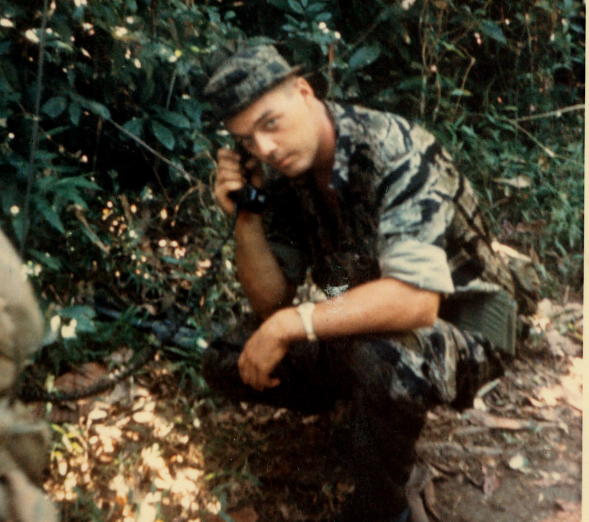
The first hour is about the Irish civil war and the American civil war, which is very informative and worth listening to. I speak in the 2nd hour about some of my experiences in Vietnam between September 1967 and December 1967 when I was wounded in a fire fight near the Cambodian border in III Corps. After recovering I wrote down what happened to me because my mom and my wife made me do it. Always listen to your mom and your wife. I think it may have helped me avoid PTSD for we were not treated well after coming back to the world all the way to the 1990’s.
In the section on this blog titled My Books and Papers is a copy of the the book I wrote from the work I did while in the hospital in 1968. The title is Diary of a Special Forces Trooper in Vietnam 1967.
Bosstown Dynamics video of an autonomous robotic soldier drone makes a future of remote robot war seem real. Are we already OK with bringing our troops home and sending in the bipedal land drones? Will our technological prowess, once again, change our morality, or do we need to decide now where to draw the moral line when it comes to remote-controlled, or autonomous, drone soldier? The full archive of Right Angle with Bill Whittle, Stephen Green and Scott Ott lives at our website: https://BillWhittle.com , where Members not only fund this enterprise, but create a vibrant conservative community with their own blog, new forums feature, nested comments, and private messaging. They also get to see how the sausage is made with a weekly Members-only backstage episode of Right Angle.
Special Operations dogs are picked form the best of the breed just like the special ops men and women. This one that chased down “Abu Bakr al Baghdadi” and was wounded is way smarter than anyone that works at the Washington Compost Rag.
This video series covers what the 3 types of permanent magnet motive force systems are. Part 01 defines an Imbalanced system (Spin Alignment System), explains how it works, and how to test a magnetic assembly properly to know if it’s a true imbalanced system.
I have created this site to help people have fun in the kitchen. I write about enjoying life both in and out of my kitchen. Life is short! Make the most of it and enjoy!
This is a library of News Events not reported by the Main Stream Media documenting & connecting the dots on How the Obama Marxist Liberal agenda is destroying America








 Centinel2012