Posted originally on the CTH on March 18, 2024 | Sundance
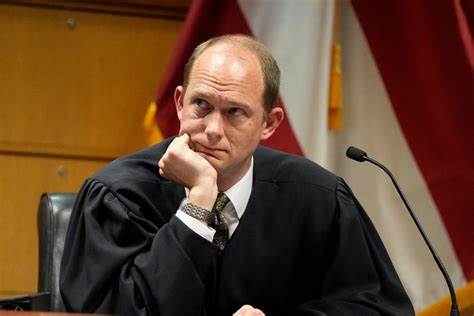
When Atlanta Judge Scott McAfee ruled recently in the Fani Willis decision TechnoFog noted, “Judge McAfee rules that only one potential liar can prosecute the case – but not both potential liars. Instead of curing the “appearance of impropriety”, it allows it to continue. If Nathan Wade goes, why can Fani Willis stay? McAfee doesn’t give an answer.”
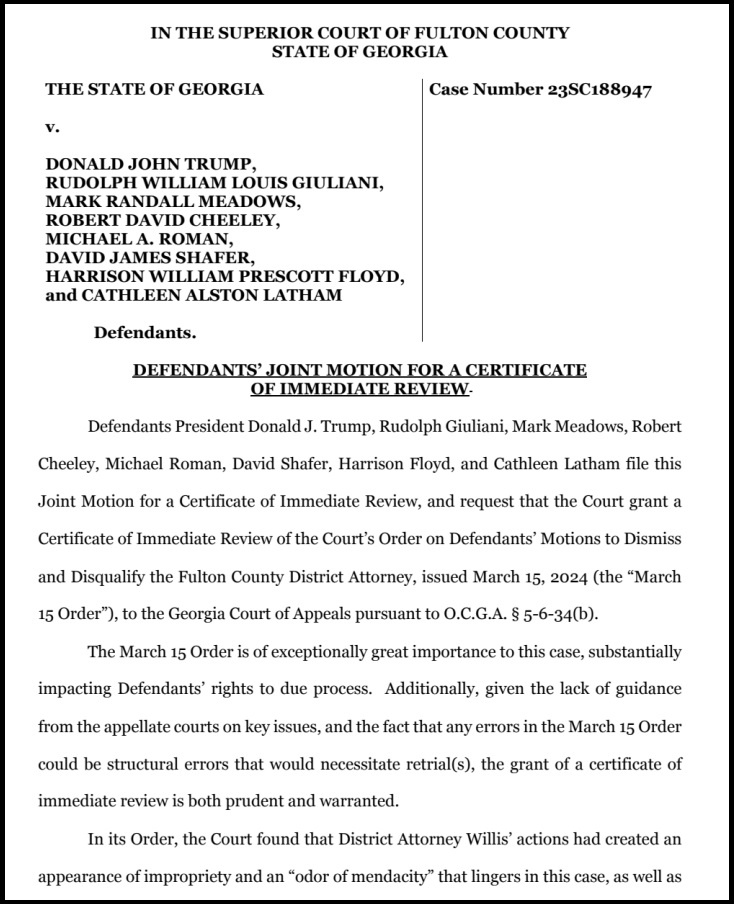
To chase down this judicial question, lawyers representing President Trump and seven co-defendants, collectively accused of RICO conspiracy, today asked McAfee to issue a certificate of immediate review of his order denying disqualification of Fani Willis.
The certificate, if issued, would allow the defendants to seek an immediate appeal of the order. Because in order for President Trump to appeal the order denying disqualification prior to trial, the defendants must obtain a certificate of immediate review within 10 days from the date of the order. Today Trump’s lawyers asked for that certificate. [pdf of motion HERE]
(VIA NBC) – […] It’s important to note that there isn’t an automatic right to appeal at this stage. Rather, McAfee would need to grant permission to do so within 10 days of his ruling, and then the state appeals court would need to agree to hear the case. If that happens, it could bring yet more delay to the prosecution that doesn’t even have a trial date yet and has already been sidetracked by the disqualification motion that led to McAfee’s ruling.
It’s unclear if the judge would grant such permission to appeal at this stage. In a recent unrelated ruling in which he dismissed some of the indictment’s counts, McAfee said he’d be inclined to permit an appeal of that ruling. But he didn’t say that in his disqualification order. That doesn’t automaticallymean he wouldn’t permit an appeal, but he didn’t go out of his way to signal his openness to the idea like he did in his dismissal ruling.
In his disqualification order, McAfee said that the defense failed to prove an actual conflict of interest, but that the appearance of impropriety meant that either Willis (and her whole office) or special prosecutor Nathan Wade had to go. Wade resigned that same day. Though he deemed a speech she gave improper, McAfee declined to disqualify Willis because of alleged “forensic misconduct” based on it. If defendants are allowed to mount an appeal, they could cite the damning facts McAfee found to argue that he reached the wrong legal conclusion by not disqualifying Willis. (read more)
Judge McAfee rules that only one potential liar can prosecute the case – but not both potential liars.
Instead of curing the "appearance of impropriety", it allows it to continue.
If Nathan Wade goes, why can Fani Willis stay? McAfee doesn't give an answer. pic.twitter.com/Lj1pgF6Bgk
Here is the joint motion that President Trump and I filed today asking Judge McAfee to issue a certificate of immediate review. We want the Georgia Court of Appeals to immediately take up the disqualification of District Attorney Fani Willis.https://t.co/vUPyHcSd0Lpic.twitter.com/eAKM8FADe4
Statement of Steve Sadow, lead defense counsel for President Trump in the Fulton County, GA case:
“President Trump and seven defendants have jointly filed a motion requesting the Court to grant a certificate of immediate review of its Order denying dismissal of the case and disqualification of Fulton County DA Willis. The motion notes that the Court found that Willis’ actions created an appearance of impropriety and an “odor of mendacity” that lingers in this case, but it nonetheless refused to dismiss the case or disqualify her. The motion further notes that the Court found Georgia case law lacks controlling precedent for the standard for disqualification of a prosecuting attorney for forensic misconduct. For these reasons among others, the Court’s Order is ripe for pretrial appellate review.” (LINK)
Posted originally on Mar 12, 2024 By Martin Armstrong
The Constitution doesn’t directly discuss presidential immunity from criminal or civil lawsuits or immunity for other government officials. Instead, this privilege of Presidential has developed over time through the Supreme Court’s interpretation of Article II, Section 2, Clause 3:
The President shall have Power to fill up all Vacancies that may happen during the Recess of the Senate, by granting Commissions which shall expire at the End of their next Session.
The legal doctrine concerning Presidential Immunity dates back to its 1867 decision Mississippi v. Johnson, 171 U.S. (4 Wall.) 475 (1867), where the Supreme Court established that the President is largely beyond the reach of the judiciary by holding that it could not direct President Andrew Johnson in how he exercised his purely executive and political powers. The ONLY exception is an impeachment for a crime. The Court stated it had no jurisdiction . . . to enjoin the President in the performance of his official duties.
In Franklin v. Massachusetts, 505 U.S. 788, 825–28 (1992) Justice Scalia, concurring, noted Mississippi v Johnson, stating:
“I am aware of only one instance in which we were specifically asked to issue an injunction requiring the President to take specified executive acts: to enjoin President Andrew Johnson from enforcing the Reconstruction Acts. As the plurality notes, ante, at 802-803, we emphatically disclaimed the authority to do so, stating that” ‘this court has no jurisdiction of a bill to enjoin the President in the performance of his official duties.’” Mississippi v. Johnson, 4 Wall. 475, 501 (1867). See also C. Burdick, The Law of the American Constitution §50, pp. 126-127 (1922); C. Pyle & R. Pious, The President, Congress, and the Constitution 170 (1984) (“No court has ever issued an injunction against the president himself or held him in contempt of court”). The apparently unbroken historical tradition supports the view, which I think implicit in the separation of powers established by the Constitution, that the principals in whom the executive and legislative powers are ultimately vested-viz., the President and the Congress (as opposed to their agents)-may not be ordered to perform particular executive or legislative acts at the behest of the Judiciary.2″
Two vice presidents have been indicted: Aaron Burr in New York and New Jersey for killing Alexander Hamilton in a duel at Weehawken, New Jersey on July 11, 1804, and Spiro Agnew, who pleaded no contest to several offenses at the moment of his resignation. However, the same arguments have not been made for vice presidential immunity as for presidential.
In 1973, during the infamous Watergate scandal, the Department of Justice’s Office of Legal Counsel (OLC) issued a memorandum concluding that it was unconstitutional to prosecute a sitting president, then Bill Clinton. The question becomes, what is an insurrection?
Legally, sedition is conduct or speech that incites individuals to rebel violently against the government’s authority. Insurrection includes the actual acts of violence and rebellion. In a Republic, sedition and insurrection refer to inciting or participating respectfully in rebellion against the constitutionally established government, including its processes, institutions, or the rule of law. In other words, it MUSTviolently seek to overthrow the government or its institutions by overthrowing the Constitution itself. One cannot commit sedition or insurrection to “overthrow a government” while still claiming to uphold and defend the Constitution. Consequently, the rule of law and the Constitution are inextricably linked. There MUST be violent attacks that would thus not be protected actions.
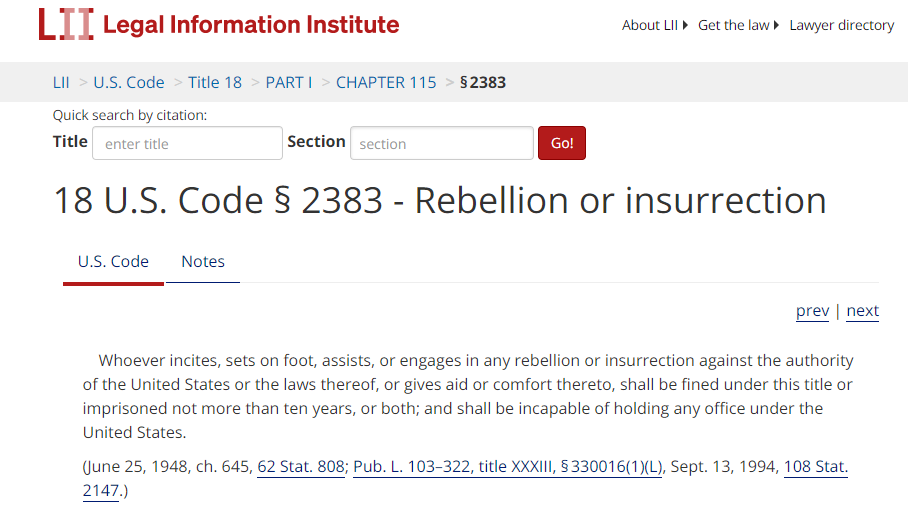
Nobody has been charged with 18 USC 2383 because they knew they had to prove there was a violent attempt to overthrow the government. Special Prosecutor has Charged Trump with CONSPIRACY, which is simply an agreement – not the substantive crime of insurrection. They have charged Trump with what someone could charge all of these prosecutors for interfering in the 2024 election. The statute is Civil Rights Violation 18 USC 241, widely used as a catch-all for anything you can allege. It carries a punishment of up to 10 years in prison. It has been routinely used in election fraud conspiracies, like ballot box stuffing.
Smith has alleged “a conspiracy against the right to vote and to have one’s vote counted.” Essentially, Mr. Smith has accused Mr. Trump of trying to rig the outcome of the election to claim victory falsely. Naturally, the Democrats refused to investigate election fraud of dead people voting, etc. This has been a selective prosecution. The Washington Appellate Court claimed that Trump was acting not as the President but as a candidate.
U.S. DC Circuit Judge Sri Srinivasan in Marxville was NEVER even a judge before who was controversially appointed under former President Barack Obama to the position of Chief Judge no less of the DC US Court of Appeals because of his race. This questionable judge, in trying to destroy Donald Trump, wrote in the ruling:
“In arguing that he is entitled to official-act immunity in the cases before us, President Trump does not dispute that he engaged in his alleged actions up to and on January 6 in his capacity as a candidate. But he thinks that does not matter. Rather, in his view, a president’s speech on matters of public concern is invariably an official function, and he was engaged in that function when he spoke at the January 6 rally and in the leadup to that day. We cannot accept that rationale,”
He has stripped everyone of immunity, and all you now have to do is file a suit against him and argue he was not acting as a judge and did not follow the law because he was doing so for personal gratification. Special Prosecutor Smith could be libeled for the very same statute interfering in everyone’s right to vote, and he was acting as a partisan – not according to established law.
The Supreme Court has recognized various immunity statutes by Congress that give immunity in return for testimony, as in Kastigar v. United States, 406 U.S. 441, 445–46 (1972). The English Parliament first enacted a statute providing immunity in 1710 (9 Anne, c. 14, 3–4 (1710)). That created the precedent that America followed. Finally, it was Congress that enacted the first federal immunity statute in 1857, providing immunity in return for who would rat on someone the government wanted (Ch. 19, 11 Stat. 155 (1857). However, there was an exception for perjury committed while testifying before Congress.
The Supreme Court’s decision in Counselman v. Hitchcock 142 U.S. 547 (1892) soon rendered Congress’s immunity statute unenforceable, holding that providing limited immunity was unconstitutional to compel testimony.
Article I, Section 6, Clause 1:
The Senators and Representatives shall receive a Compensation for their Services, to be ascertained by Law, and paid out of the Treasury of the United States. They shall in all Cases, except Treason, Felony and Breach of the Peace, be privileged from Arrest during their Attendance at the Session of their respective Houses, and in going to and returning from the same; and for any Speech or Debate in either House, they shall not be questioned in any other Place.
If the Constitution did not create IMMUNITY for anyone other than Article I, Section 6 Clause 1 on a limited basis to prevent criminal law from interfering with a vote, arrest a Congressman to prevent him from voting for or against a bill. Courts or statutes have created all other immunities. My question boils down to HOW can you create immunity for any government official that would violate the Eighth Amendment, be it excessive fines or cruel and unusual punishment? If you have ABSOLUTE immunity for Special Prosecutor Smith and judges regardless of their actions, then how can you deny IMMUNITY for Trump? Either everyone has it, or nobody has it. These are all judicially crafted immunities – not prescribed by the Constitution.
Posted originally on the CTH on March 11, 2024 | Sundance
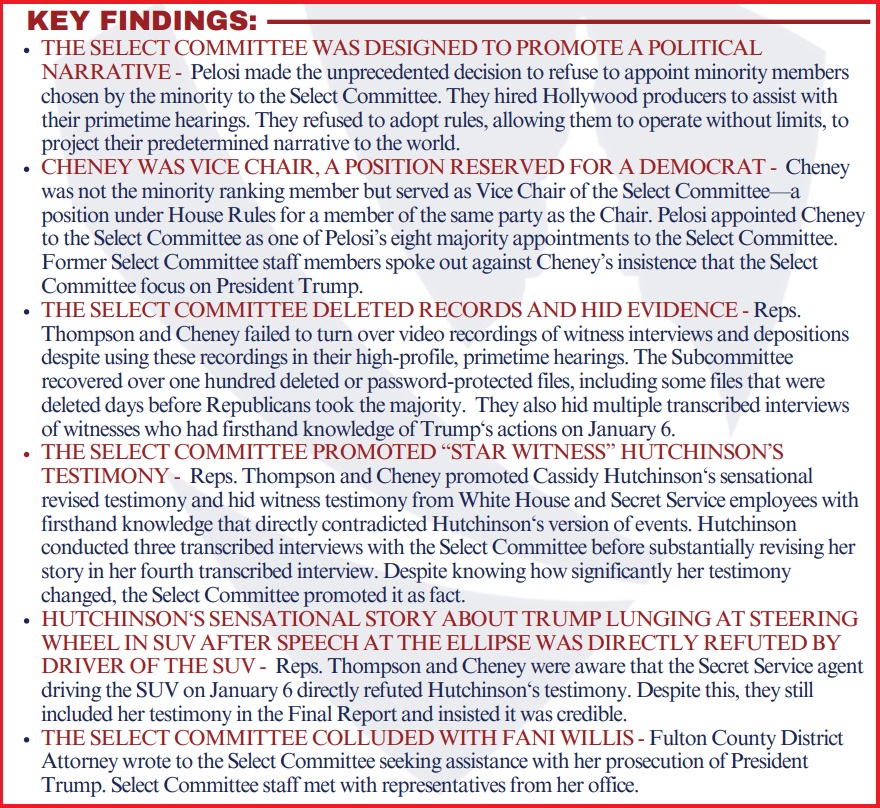
The House Subcommittee on Oversight released a report [SEE HERE] and overview [SEE HERE] highlighting just how political the J6 committee was. The report outlines how Nancy Pelosi structured the J6 committee for political intents, and the longer report showcases the evidence of how Liz Cheney assisted.
WASHINGTON– Today, Committee on House Administration’s Subcommittee on Oversight Chairman Barry Loudermilk (GA-11) released his “Initial Findings Report” on the events of January 6, 2021 as well as his investigation into the politicization of the January 6th Select Committee. (more)
The last bullet point has a name. The “Select Committee staff” who met with Fani Willis was likely Mary McCord.
“For nearly two years former Speaker Nancy Pelosi’s January 6th Select Committee promoted hearsay and cherry-picked information to promote its political goal – to legislatively prosecute former President Donald Trump,” said Chairman Loudermilk. “It was no surprise that the Select Committee’s final report focused primarily on former President Trump and his supporters, not the security failures and reforms needed to ensure the United States Capitol is safer today than in 2021.
“The American people deserve the entire truth about what caused the violent breach at the United States Capitol of January 6, 2021. It is unfortunate the Select Committee succumbed to their political inclinations and chased false narratives instead of providing the important work of a genuine investigation. In my committee’s investigation, it is my objective to uncover the facts about January 6, without political bias or spin. My report today is just the beginning.” (LINK)
Pay very close attention to these next two citations:
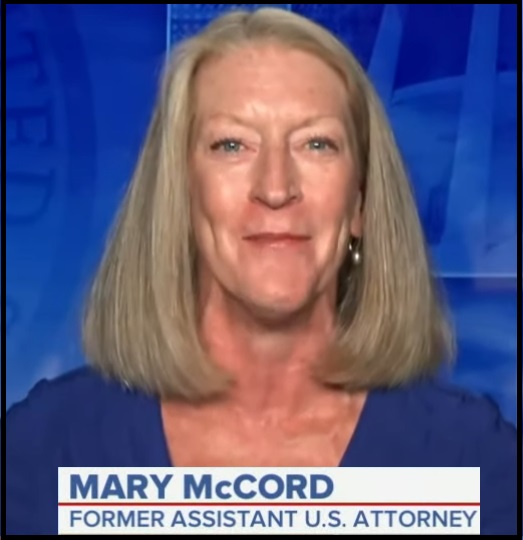
November 3, 2021 – In Washington DC – “Rep. Bennie Thompson (D-Miss.) and the House Jan. 6 Select Committee has tapped Mary McCord, who once ran the Justice Department’s National Security Division, for representation in its fight to obtain former President Donald Trump’s White House records. (read more)
Then consider:
January 10, 2024 – Georgia prosecutors probing Donald Trump’s effort to subvert the 2020 election got an early boost in the spring of 2022. It came from another set of investigators who were way ahead of them: the House Jan. 6 select committee.
Committee staff quietly met with lawyers and agents working for Fulton County District Attorney Fani Willis in mid-April 2022, just as she prepared to convene a special grand jury investigation. In the previously unreported meeting, the Jan. 6 committee aides let the district attorney’s team review — but not keep — a limited set of evidence they had gathered. (read more)
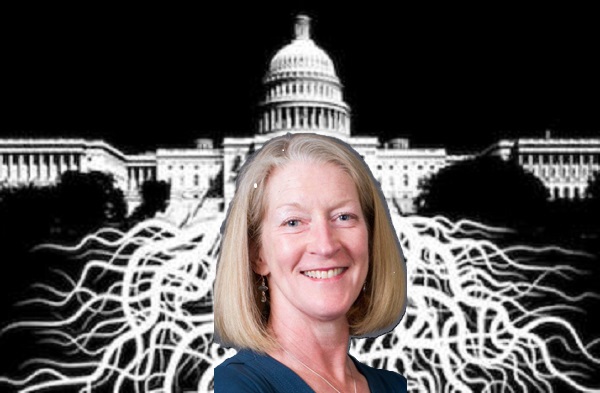
The “J6 committee staff” that led the conversations with Fani Willis is a person, and that person’s name is Mary McCord. As the lead in the J6 staff effort, there is simply no way to believe the committee staff that met with Fani Willis did not include McCord.
♦ McCord submitted the fraudulent FISA application to spy on Trump campaign.
♦ McCord created the “Logan Act” claim used against Michael Flynn and then went with Sally Yates to confront the White House.
♦ McCord then left the DOJ and went to work for Adam Schiff and Jerry Nadler.
♦ McCord organized the CIA rule changes with Intelligence Community Inspector General Michael Atkinson.
♦ McCord led and organized the impeachment effort, in the background, using the evidence she helped create.
♦ McCord joined the FISA Court to protect against DOJ IG Michael Horowitz newly gained NSD oversight and FISA review.
♦ McCord joined the J6 Committee helping to create all the lawfare angles they deployed.
♦ McCord then coordinated with DA Fani Willis in Georgia.
♦ McCord is working with Special Counsel Jack Smith to prosecute Trump.
QUESTION: Your argument on the Commerce Clause is spot on, I believe. Why do the lawyers involved in the Colorado case removing Trump does not grasp the structure of the Constitution as you do? They admit that ruling in favor of Colorado would result in national chaos. Your analysis of the Commerce Clause demonstrates that the writers of the Constitution understood such a result would break the union. Any comment on this oversight would be greatly appreciated.
BW
ANSWER: Sometimes, lawyers focus too intently because statutory law is wordsmithing. They are arguing if Trump is an officer when they should be looking at the subject matter jurisdiction of the law. I have had to study law from a global perspective, looking at its evolution from ancient times to the present. Continental Europe followed Canon Law, whereas England created Common Law. There are huge differences such as under French law, not even your brother-in-law can be compelled to testify against you, whereas under English Common Law, the king is ruthless, so the only one with such a privilege is a spouse. They can throw your children in prison on contempt until they testify against a parent. We do not respect the family unit, whereas, under Canon Law, anyone related by marriage is covered.
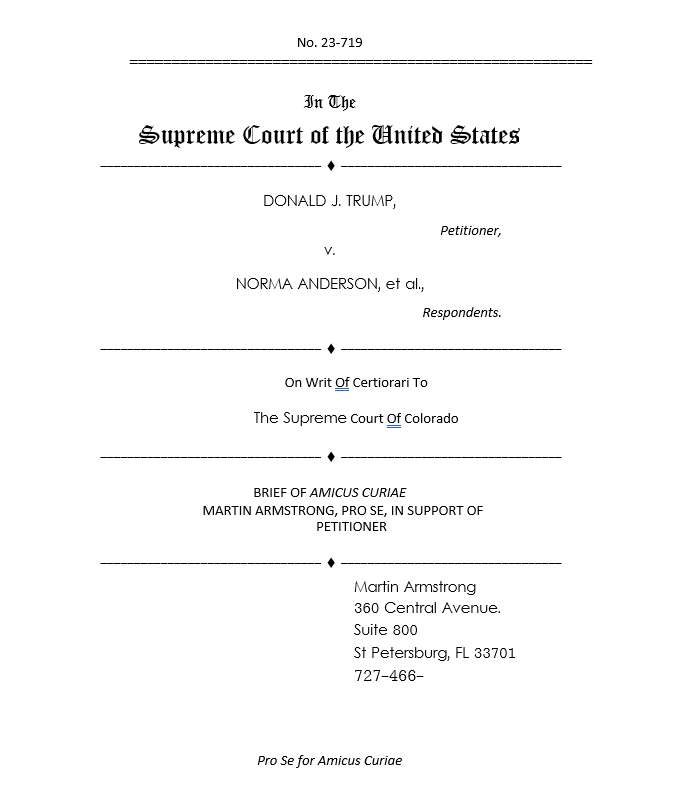
I was so appalled that the oral arguments were focused on wordsmithing I decided to submit my own Amicus Curiae brief. The Court is not supposed to raise an argument that is not presented. They will probably reject it because it was after oral argument. But if they want a clean escape that is constitutionally correct rather than not addressing the issue directly, then just maybe they might make an exception and accept a Pro Se Amicus. It might be a first, anyway.
I have created this site to help people have fun in the kitchen. I write about enjoying life both in and out of my kitchen. Life is short! Make the most of it and enjoy!
This is a library of News Events not reported by the Main Stream Media documenting & connecting the dots on How the Obama Marxist Liberal agenda is destroying America





 Centinel2012