It is hard to believe but it’s been three years since we first outlined what would happen if candidate Donald Trump’s “America First” policy was implemented. Specifically how the Federal Reserve would essentially become disconnected and functionally obsolescent for a few years. As a result of the evidence visible, we are in a unique position to explain.
Staying in the big picture, a disconnected Fed was very predictable. In the past 35 years the Wall Street multinationals gained as cheap money flowed overseas to start global manufacturing operations; Main Street USA suffered. When you reverse this process by punishing the multinationals (tariffs), shifting the global supply chain, and changing the best location for investment dollars, Main Street USA benefits. President Trump August 7th tweets statement:
Notice the “we are competing against other countries” part of the statement. This is key to understanding what is in the future. The Wall Street ‘multinationals’, corporations making and selling goods, are invested in production within other countries.
On one hand, Wall Street loves cheap money (low fed rates). However, on the other hand Wall Street multinationals are invested in overseas manufacturing; and those corporations don’t want to see the retention efforts of China and the EU undermined with a lower dollar value (lower fed rate). So Wall Street is schizophrenic (check the stock market).
U.S. tariffs hurt the Wall Street multinationals because they want to keep making cheap goods overseas and they have invested in this process. To retain the multinationals, the EU and China are devaluing their currency in an attempt to lower the price of goods they produce.
Lowered currency means their stuff costs less when exported to the U.S. market. They need the U.S. market for their products; AND they don’t want to move their supply chain, or manufacturing into the United States.
Devaluing currency is what competing countries are doing to offset tariffs and try to block Trump’s America-First policies. China also directly subsidizes their industries with free electricity, free domestic raw materials, and zero cost loans from their central bank.
As the EU and China devalue their currency, the value of the dollar increases. President Trump responds to this in a Twitter thread today:
One way for the U.S. to respond is for the federal reserve to cut interest rates, which should lower our dollar value and make it easier to export products; but can also raise the price of things we import. That is why President Trump notes “(there is no inflation)”.
[However, I doubt any action from the Fed will change anything. All the data looks to me like the Fed is disconnected in this process.]
We are currently importing deflation as the devalued cost of goods from China and the EU is lower than the tariff rate upon them. The goal is to move those manufacturing jobs out of China. Thus the incentive is for President Trump to raise the tariff rate on China even higher. This looks like the most predictable outcome.
Three variables:
(1) The USMCA ratification. If/when the USMCA is ratified, this will give multinational manufacturers an established and cemented option to evaluate for supply chain moves. (Watch Canada election; Trudeau loses and the U.S. stock market will bump.)
(2) The Fed’s rate cut. If/when the Fed cuts the lending rate again; it will only modestly benefit domestic investment. The rate cut is against the interest of multinational corporations because it undercuts the defensive efforts of China and the EU; though the cheaper money could help offset relocation costs. [I strongly doubt much impact.]
(3) Timing. The Chinese delegation is scheduled to visit in September. There is almost zero possibility for a deal, unless the Chinese economy is in collapse.
President Trump has a quiver filled with deadly arrows; and after labeling China a currency manipulator, he’s now more likely to raise the tariff rate, perhaps as high as 25% across all sectors. When this happens U.S. multinational corporations with heavy investment in China will see their supply chain and business model completely changed.
After visiting with victims, families and first responders in Dayton, OH, President Trump traveled to El Paso to visit with victims and first responders from Texas. President Trump delivered remarks from the El Paso Regional Emergency Communications Center. [Video and Transcript Below]
THE PRESIDENT: We had an amazing day. As you know, we left Ohio. And the love and the respect for the office of the presidency, it was — I wish you could have been in there to see it. I wish you could have been in there.
And it was no different here. We went to the hospital — just came from the hospital. We were there a lot longer than we were anticipated to be. It was supposed to be just a fairly quick — we met with numerous people. We met with also the doctors, the nurses, the medical staff. They have done an incredible job — both places. Just incredible.
And the enthusiasm, the love, the respect, and also the — telling me, “Let’s see if we can get something done.” And Republicans want to do it and Democrats want to do it.
And, by the way, here is a great hero. This man — the job he did. You all know who it is. Everybody — the whole world knows who you are now, right?
PRIVATE FIRST CLASS OAKLEY: Yes, Mr. President.
THE PRESIDENT: So you’ll be a movie star, the way you look. That’ll be — hey, that’ll be next. Who knows, right?
PRIVATE FIRST CLASS OAKLEY: Yes, sir.
THE PRESIDENT: But what a job. What a job you did.
PRIVATE FIRST CLASS OAKLEY: Thank you, sir.
THE PRESIDENT: There are a lot of heroes. There are a lot of heroes. A lot of people did just incredible work. Now we’re going in, I believe, Chief, and say hello to some of your folks.
POLICE CHIEF ALLEN: Yes, sir.
THE PRESIDENT: This is one of the most respected men in law enforcement, and I want to thank you very much.
POLICE CHIEF ALLEN: Thank you, Mr. President.
THE PRESIDENT: Thank you very much.
Q President Trump, you said today was about healing and unity, and you’ve attacked a number of your critics — Vice President Biden, Senator Brown, Mayor Whaley, as well as various members of the media. Can you explain why you chose to take that tone?
THE PRESIDENT: Well, they shouldn’t be politicking. Yeah, they shouldn’t be politicking today. I had it with Sherrod Brown. He and the mayor, Nan Whaley, they asked to go in — “Could we possibly go in and make the tour with you?” I said, “Yeah, let’s do it.”
They couldn’t believe what they saw, and they said it to people. They’ve never seen anything like it. The entire hospital — no different than what we had in El Paso — the entire hospital was — I mean, everybody was so proud of the job they did because they did a great job. They did a great job here.
And then I said goodbye. I took them in, at their request. We made the tour. They couldn’t believe it. She said it to people. He said it to people.
I get on Air Force One, where they do have a lot of televisions. I turn on the television, and there they are, saying, “Well, I don’t know if it was appropriate for the President to be in…” You know, et cetera, et cetera. You know, the same old line. And they’re very dishonest people and that’s probably why he got, I think, about zero percent and he failed as a presidential candidate.
We’re going to go in and see some very brave people. And I wanted to meet this hero before I did anything. And we appreciate it.
Conveying a message of support for those suffering and appreciation for the first responders, President Trump and First Lady Melania Trump traveled to Dayton Ohio to visit victims from last weekend’s horrific mass shooting.
President Donald Trump and Melania met with patients at Miami Valley Hospital in Dayton; and stopped between rooms to thank the hardworking medical staff.
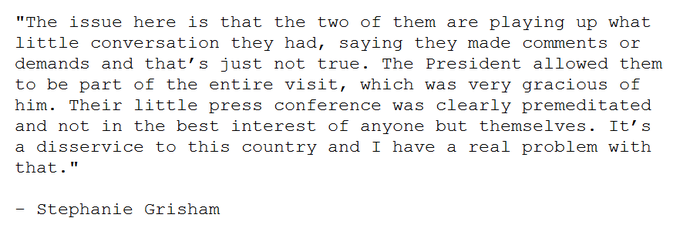
Unfortunately two Ohio politicians decided to make a political argument about the visit itself, instead of focusing on the positive message of healing and appreciation.
Ohio Senator Sherrod Brown and Dayton Mayor Nan Whaley chose to politicize the event for their own purposes and held a press conference while President Trump was visiting Miami Valley Hospital.
Both Democrat Senator Brown and Democrat Mayor Whaley flat-out lied about their encounter with President Trump and instead delivered a false message to the media about their demand for gun control.
If you listen to the first moments of their presser, it’s easy to identify how they planned to lie to their constituents and the media about their tarmac meeting with President Trump.
Their malicious lies are evident with a quick review of the tarmac meeting. Additionally, it is clear from their body language and conduct with each-other, both politicians had a pre-planned intent to use the meeting to generate fake news and a false narrative. Their tarmac meeting lasted a few seconds. {Prompted} Watch their body language, after President Trump and Melania pass them on the reception line.
Very SAD to see Ohio Senator Brown, & Dayton Mayor Nan Whaley – LYING & completely mischaracterizing what took place w/ the President’s visit to Miami Valley Hospital today. They are disgraceful politicians, doing nothing but politicizing a mass shooting, at every turn they can..
Chopper pressers are the best pressers. As President Trump departed the White House to travel to Dayton, OH and El Paso, TX, he stopped to deliver remarks and answer questions from the press pool. [Video and Transcript below]
.
[Transcript] – THE PRESIDENT: So, we’re going to Dayton first, and then we’re going to El Paso. And we’ll be meeting with first responders, law enforcement, and some of the victims, and paying my respects and regards. I’ll be going with the First Lady. And it’s a terrific opportunity, really, to congratulate some of the police and law enforcement. The job they’ve done was incredible. Really incredible.
Q Mr. President, no doubt — I don’t think anybody will argue this is a difficult time in our country for all of us. So, from your heart, from your mind, what do you say to your critics that believe it’s your rhetoric that is emboldening white nationalists and inspiring this anger?
THE PRESIDENT: So, my critics are political people. They’re trying to make points. In many cases, they’re running for President and they’re very low in the polls. A couple of them, in particular, are very low in the polls. If you look at Dayton, that was a person that supported, I guess you would say, Bernie Sanders, I understood; Antifa, I understood; Elizabeth Warren, I understood. It had nothing to do with President Trump.
So these are people that are looking for political gain. I don’t think they’re getting it. And, as much as possible, I’ve tried to stay out of that.
Q Mr. President, Senator Ted Cruz today said that people on both sides of the political aisle need to tone down the rhetoric. Do you agree with that?
THE PRESIDENT: Well, I do agree, but I think we have toned it down. We’ve been hitting — we’ve been getting hit left and right from everybody. Many of the people, I don’t know. A couple of people from Texas — political people from Texas that aren’t doing very well. I guess somebody said — the mayor — I had one very nice conversation with the mayor of Dayton; could not have been nicer. And then she goes and says I tried to call her. Well, I spoke to her, and I didn’t receive any call.
So they’re trying to make political points. I don’t think it works because, you know, I would like to stay out of the political fray.
As I was saying, and as just came out, the Dayton situation — he was a fan of Antifa. He was a fan of Bernie Sanders and Elizabeth Warren. Nothing to do with Trump. But nobody ever mentions that.
Q (Inaudible.)
THE PRESIDENT: Say it?
Q (Inaudible) supported Elizabeth Warren and Bernie Sanders. Should they be blamed for (inaudible)?
THE PRESIDENT: No, I don’t blame Elizabeth Warren, and I don’t blame Bernie Sanders in the case of Ohio. And I don’t blame anybody. I blame — these are sick people. These are people that are really mentally ill, mentally disturbed. It’s a mental problem.
And we’re going to be meeting — we’re going to be meeting with members of Congress. I’ve already got meetings scheduled. And I have had plenty of talks over the last two days. And I think something is going to be come up with. We’re going to come with something that’s going to be, really, very good — beyond anything that’s been done so far.
Q Do you support bringing the Senate back to consider legislation on —
THE PRESIDENT: Well, we’re going to see where we are. We’re dealing with leadership right now. And, you know, you have two sides that are very different on this issue, and, let’s say, all good people. But two sides that are very different. If we get close, I will bring them back. But it has to be — you know, we have to see where we are with leadership.
Normally, this has been, really, a decision — Congress gets together and they try and do something. But if you look over the last 30 years, not a lot has been done.
Q The background check bill already that has passed the House, what good (inaudible)?
THE PRESIDENT: Well, I’m looking to do background checks. I think background checks are important. I don’t want to put guns into the hands of mentally unstable people or people with rage or hate, sick people. I don’t want to — I’m all in favor of it.
Q What about assault rifles? A lot of people would like to see them banned. What is your position?
THE PRESIDENT: Well, I can tell you that there is no political appetite for that at this moment. If you look at the — you could speak, you could do your own polling. And there’s no political appetite, probably, from the standpoint of legislature.
But I will certainly bring that up. I’ll bring that up as one of the points. There’s a great appetite — and I mean a very strong appetite — for background checks. And I think we can bring up background checks like we’ve never had before. I think both Republican and Democrat are getting close to a bill on — they’re doing something on background checks.
Q (Inaudible.) South Korea and Japan exports are (inaudible.)
THE PRESIDENT: Yeah. South Korea and I have made a deal. They’ve agreed to pay a lot more money toward the United States. As you know, we’ve got 32,000 soldiers on South Korean soil, and we’ve been helping them for about 82 years. And we get nothing. We get virtually nothing. And South Korea and I have made a deal where they’re paying a lot more money, and they’re going to pay a lot more money. And the relationship is a very good one.
But I felt, all along, I felt for years it was a very unfair one. So they’ve agreed to pay a lot more, and they will agree to pay a lot more than that. And we’re with them. We’re with them.
Q Mr. President, you banned bump stocks. Would you consider a ban on these huge, large-capacity magazines?
THE PRESIDENT: So, you have to have a political appetite within Congress. And, so far, I have not seen that. I mean, I can only do what I can do. I think there’s a great appetite to do something with regard to making sure that mentally unstable, seriously ill people aren’t carrying guns. And I’ve never seen the appetite as strong as it is now. I have not seen it with regard to certain types of weapons.
Q Mr. President, how concerned are you about the rise in white supremacy? And what are you going to do about it?
THE PRESIDENT: I am concerned about the rise of any group of hate. I don’t like it. Any group of hate, I am — whether it’s white supremacy, whether it’s any other kind of supremacy, whether it’s Antifa, whether it’s any group of hate, I am very concerned about it. And I’ll do something about it.
Q Do you believe that your rhetoric has any impact on (inaudible)?
THE PRESIDENT: No, I don’t think my rhetoric has at all. I think my rhetoric is a very — it brings people together. Our country is doing incredibly well. China is not doing well, if you look at the trade situation.
China just admitted yesterday that they’ve been a currency manipulator. First time they’ve ever been called out. Companies are moving out of China by the thousands, and our country is doing very well. We’re going to see how it all works out. Somebody had to do this with China because they were taking hundreds of billions of dollars a year out of the United States. And somebody had to make a stand. So, I think our country is doing really well.
Q What’s your reaction to the market reaction to the trade war? And what’s next with China?
THE PRESIDENT: I think the market — I think the market reaction is anticipated. I would have anticipated. I would have maybe anticipated even more. But ultimately, it’s going to go much higher than it ever would have gone because China was like an anchor on us. China was killing us with unfair trade deals. The people that allowed that to happen are a disgrace. China, what they were doing to us, for years and years, taking hundreds of billions of dollars out, stealing intellectual property, targeting our farmers. All of that is ending, and they understand that.
Q Mr. President, you still believe there’s no political appetite for an assault weapons ban, but as the leader of this country, do you personally believe people should be able to buy assault weapons?
THE PRESIDENT: That’s right. I’ll be — I’ll be convincing some people to do things that they don’t want to do, and that means people in Congress. But you’ve got a lot of people on one side, and you have a lot of people in the other. But I can — I have a lot of influence with a lot of people, and I want to convince them to do the right thing.
And I will tell you, we’ve made a lot of headway in the last three days. A lot of headway.
Q Mr. President, do you still believe that illegal immigration into this country is an invasion? You and the shooter in El Paso used that same language. Do you regret that?
THE PRESIDENT: I think that illegal immigration — you’re talking about illegal immigration, right? Yeah? I think illegal immigration is a terrible thing for this country. I think you have to come in legally. Ideally, you have to come in through merit. We need people coming in because we have many companies coming into our country. They’re pouring in. And I think illegal immigration is a very bad thing for our country. I think open borders are a very bad thing for our country.
And we’re stopping; we’re building a wall right now. We won the lawsuit in the Supreme Court two weeks ago. The wall is well under construction. It’s being built at a rapid pace. We need that. We need strong immigration laws. But we want to allow millions of people to come in because we need them. We have companies coming in from Japan, all over Europe, all over Asia. They’re opening up companies here. They need people to work. We have a very low unemployment rate.
So, I believe we have to have legal immigration, not illegal immigration.
Q Are you watching the stock market’s reaction to China, sir?
THE PRESIDENT: I am. I think the market reaction is to be expected. I might’ve expected even more.
At some point, as I just said, we have to take on China. They’ve been taking — look, they’ve been taking us to the cleaners for 25 years. This should’ve been done long before me as a President. You know the story better than anybody. You know it better than I do, frankly. Hundreds of billions of dollars a year taken out of our country. Stealing intellectual property.
And you know what? We, right now, we’re sitting on top. We have money pouring in. We have powerful companies, strong companies. China is losing so many — they’re losing — thousands and thousands of companies are leaving China now because of the tariffs. And we’re in a very good position as to whether or not a deal will be made. I will tell you this: China would like to make a deal very badly.
Q Mr. President, Joe Biden. Joe Biden says you have more in common with George Wallace than George Washington.
THE PRESIDENT: Well, you know, Joe is a pretty incompetent guy. I’ve watched his interviews. I’ve watched what he said and how he said it. And I wouldn’t have rated him very high in the first place, but Joe Biden has truly lost this fastball, that I can tell you.
Wow. Go Wilburine! U.S. Commerce Secretary Wilbur Ross has slapped a whopping $4.4 billion countervailing duty on Chinese cabinet manufacturers. The rate of manufacturing subsidy identified within the ‘wood cabinet‘ study shows a massive 229% subsidy rate via discounted land, free lumber, electricity, raw materials, direct grants from government and discounted loans from Chinese banks to enhance export incentives.
The current study and duty only applies to wood cabinets and vanities, but if you ever wondered how come Chinese furniture is so cheap, well, it’s not a stretch to consider those same subsidy rates likely apply to their household furniture and wood products.
(Bloomberg) Add $4.4 billion in imported cabinets to the long list of Chinese goods slapped with U.S. levies in the escalating trade dispute between Washington and Beijing.
The Commerce Department said Tuesday it will ask the U.S. Customs and Border Protection to collect cash deposits from importers of the wooden cabinets and vanities from China based on subsidy rates of as much as 229%. Commerce issued a preliminary determination in response to a petition filed earlier this year by the American Kitchen Cabinet Alliance, alleging at least $2 billion in harm from the Chinese shipments.
The petition alleged dumping margins of more than 200%. Tim Brightbill, a trade lawyer from Wiley Rein LLP in Washington representing the industry, said in March that Chinese exporters get double-digit subsidy margins based on the number of programs supporting their domestic industry, including discounted land, electricity, raw materials, grants, discounted loans and export incentives.
“Today’s determination gives the American kitchen cabinet industry the hope it needs in our fight against China’s unfair trade practices,” Stephen Wellborn, director of product and research development at U.S. manufacturer Wellborn Cabinet and a member of the American alliance, said in an emailed statement. (more)
That $4.4 billion is a pretty hefty duty within a relatively small manufacturing sector. Can you imagine if anyone has filed a trade/manufacturing complaint against the much larger ‘wood furniture’ and household goods? Jumpin’ ju-ju bones.
In related news a lot more exporters operating manufacturing in China are starting to see the writing on their noses, realizing that Trump tariffs are only going to get worse, and are making plans to get the heck out of China, ASAP.
(CMP) Traditional export manufacturers in China’s Pearl and Yangtze River Delta regions already struggling under the weight of existing tariffs levied by the Trump administration expect the new tariffs on US$300 billion of Chinese imports to cause their businesses to shrink, force them to lay off workers, and for some, speed up relocation plans. (more)
Think of China like a big lake filled with U.S. dollars and economic value; the result of our purchases of their products. Through his ASEAN discussions with Vietnam, S Korea, Malaysia, Singapore, Australia, Japan, et al, President Trump has stealthily built a thin levy, an ASEAN dam of sorts, that will direct the China lake of economic value into Southeast Asia.
At any given moment Trump can blow that dam by triggering bigger tariffs. The exodus will benefit those who partnered with Trump. Vietnam’s economy has jumped over eight percent so far this year…. almost exclusively as a result of companies leaving China.
China has no substantive tools in their economic armory to defend against President Trump in a one-on-one battle. And Trump keeps landing body blows, the latest was the seizure of all Venezuelan assets. The number one investor in Venezuela is China (by a mile). China owns 49% of PDVSA Venezuela’s state owned oil company as an example.
The labeling of China as a currency manipulator opens the door to even more sanctions, and Beijing has no measurable way to respond. Beijing can threaten other trade partners, but more than China everyone wants access to the U.S. market; so no-one wants to become a target for Trump by standing near Xi Jinping or engaging in transnational shipping.
(On Devaluation) Shen Jianguang, chief economist at JD Digit and a veteran Chinese economy watcher, said the timing is not good for Beijing to allow the yuan to slide below seven, and that a currency war would not favour China.
“It is not in China’s interest to escalate the trade war into currency or financial fields,” Shen said. “The countermeasures available for Beijing are quite limited.” (more)
CTH writes a great deal about President Trump’s economic policies, and how those policies are reversing the decades-long erosion of the middle-class. Factually, substantively and empirically the workers of America are gaining ground. Bigger and better than before, and far beyond what anyone else could have delivered.
This is not a theoretical exercise. The execution of a broad-based economic and global trade reset is underway. Today’s economic results, the growing strength of our U.S. economy, is a testament to the success of MAGAnomic policy being delivered. These results, when fully realized, will secure our economic future and last for generations.
All of that said, there is something we don’t emphasize enough: The team of Secretary Mnuchin, Secretary Ross, USTR Lighthizer, Trade and Manufacturing advisor Navarro and NEC Director Larry Kudlow, face a scale of opposition almost unfathomable in modern political terms. There are trillions at stake; hundreds of the most powerful financial interests in the world are against them; and yet this team is succeeding.
It takes incredible stewardship and fortitude to face down the Goliath’s of global interests. From Wall Street to the International Monetary Fund; to the World Bank and World Trade Organization; to the interests of Europe and China; and across all of the geopolitical boundaries enmeshed with all the multinationals therein. Quite remarkable.
Just sit for a minute and think about the scale of opposition…. it really is an incredible accomplishment, beyond almost anything anyone would have hoped or imagined.
The people’s president, Donald Trump and this private sector economic team; arguably the best and most qualified group ever assembled in modern history; deserve our appreciation, unyielding and full-throated support.
National Economic Council Chairman Larry Kudlow, appears on CNBC to discuss the U.S-China trade conflict that led to yesterday’s stock market drop. Additionally, Kudlow notes the strong key performance indicators that highlight the strength of the U.S. Main Street economy.
White House trade and manufacturing policy advisor Peter Navarro, appears with Lou Dobbs to discuss the current status of the U.S.-China trade conflict.
Within the interview Navarro discusses the impact of China devaluing their currency as a strategy to avoid U.S. tariffs on Chinese imports. WATCH:
Beijing has once again used their proxy province of North Korea to launch small two short-range ballistic missiles as leverage in the U.S. and China trade confrontation.
WASHINGTON – For the fourth time in less than two weeks, North Korea has fired projectiles into the Sea of Japan, a U.S. official said.
The two projectiles, fired on Tuesday morning local time, were assessed to be similar to the short-range ballistic missiles tested by North Korea last week, the official said. (read more)
Moments later President Trump and Treasury Secretary Steven Mnuchin fired a counter-missile directly into the heart of Beijing’s trade currency manipulation:
(Treasury) The Omnibus Trade and Competitiveness Act of 1988 requires the Secretary of the Treasury to analyze the exchange rate policies of other countries.
Under Section 3004 of the Act, the Secretary must “consider whether countries manipulate the rate of exchange between their currency and the United States dollar for purposes of preventing effective balance of payments adjustments or gaining unfair competitive advantage in international trade.” Secretary Mnuchin, under the auspices of President Trump, has today determined that China is a Currency Manipulator.
As a result of this determination, Secretary Mnuchin will engage with the International Monetary Fund to eliminate the unfair competitive advantage created by China’s latest actions. (more)
And so the dance with the dragon continues…
Chairman Xi devalues Chinese currency… Trump hits Chairman Xi with tariffs…. Beijing launches DPRK rockets…. Trump hits Chairman Xi with IMF/WTO designations….
Unfortunately for Chairman Xi Jinping, President Trump has bigger economic missiles than Beijing. Kyle Bass outlines the scale of what economic weapons President Trump has in his arsenal that are far more devastating than little Kim’s rockets. WATCH:
China needs to buy dollars to backstop their own currency (¥uan). When China trades with the U.S. they hold the return dollars as a peg against their weak currency. Remove the flow of dollars (lessen exports) and they start to run out of strong pegged currency.
What is happening today is not as much direct devaluation by China; rather they are intentionally allowing their currency to drop in value, in an effort to lower export prices and off-set any tariffs from the U.S. Simultaneously, Beijing is spending internally, burning cash, to keep their economy from weakening. Their Yuan burn rate is greater than the influx of higher valued dollars needed to hold their position.
They cannot keep this position indefinitely.
First, here’s a solid interview with former CEO Gerald Storch on how the currency devaluation leads to lower prices for U.S. consumers. Again, emphasizing the point that U.S. consumers are not paying for the tariffs against China. Watch:
President Trump responds to the current activity by China:
.
Beijing says they will keep lowering the value of their currency to keep the flow of cheap Chinese manufactured goods flowing to the United States, regardless of tariffs. Simultaneously they need the returning higher valued dollars to prop-up their own diminishing currency.
I have created this site to help people have fun in the kitchen. I write about enjoying life both in and out of my kitchen. Life is short! Make the most of it and enjoy!
This is a library of News Events not reported by the Main Stream Media documenting & connecting the dots on How the Obama Marxist Liberal agenda is destroying America




 Centinel2012