President Trump asks: “Are these “dirty cops” going to pay a big price for the fraud they committed?”
However, the only person who can honestly answer that question is the person in the mirror when President Trump brushes his teeth. Perhaps forgotten…
In the spring of 2018 a group of congressional reps led by Devin Nunes, Mark Meadows, Jim Jordan, Matt Gaetz, Louie Gohmert, Lee Zeldin and Bob Goodlatte, asked President Trump to declassify a series of documents so the public could see how former officials in the DOJ & FBI abused their offices and conducted political surveillance.
In September of 2018, Deputy Attorney General Rod Rosenstein asked President Trump not to declassify those same documents until after the Mueller probe was complete. Rosenstein informed the President (confirmed in later POTUS interviews) that declassifying the material could be interpreted as impeding the Mueller investigation.
Two months later, in November 2018, the mid-term election took place. Republicans lost the House and their committee chairs. Many people suspected (I concur) the mid-term election was the real motive for the Sept. 2018 request from Rosenstein. Four months after the mid-term, March 2019, the Mueller investigation of President Trump ended.
Two months after the Mueller probe ended U.S. Attorney General Bill Barr, a profoundly supportive voice for DAG Rosenstein, asked President Trump to grant him unilateral declassification authority to assist the purposes and intents of his DOJ effort. President Trump granted U.S. Attorney General Bill Barr with the authority to declassify on May 23rd, 2019; granting access to the same documents requested by congress a year earlier.
May 23, 2019:
Each time President Trump has come close to declassifying the material someone from the DOJ intercepts the anticipated action and blocks the release. In 2018 it was DAG Rod Rosenstein. In 2019 it was AG Bill Barr…. Both motives identical.
Amid the twists and turns many people have forgotten about the material congress asked President Trump to declassify two-years-ago. Additionally there has been some material cited that just seemingly slipped away without follow-up. Consider:
Whatever happened to the forty pages of Lisa Page and Andrew McCabe text messages that Catherine Herridge noted nine months ago? Herridge only published four of the pages in March 2019.
Why are the Lisa Page and Peter Strzok text messages still redacted two years after their original release (December 1st, 2017)?
Where’s the release of the Susan Rice inauguration day memo to the file?
Why didn’t the DOJ/FBI release all of the Bruce Ohr 302’s without redaction? Will those fully unredacted 302’s be part of the IG report release?
Where’s the unredacted David Archey FBI declarations that were previously ordered to be released by a DC judge?
The Mueller investigation ended 9 months ago. Why are we still not able to see the unredacted three authorization memos that Rosenstein gave to the special counsel on May 17th, August 2nd and October 20th, 2017?
Those simple questions (and releases) are in addition to the original list that congress provided to President Trump back in the spring of 2018. A declassification list that DAG Rod Rosenstein asked President Trump not to release until after the Mueller investigation.
All versions of the Carter Page FISA applications.
All of the Bruce Ohr 302’s filled out by the FBI. [Without redactions]
All of Bruce Ohr’s emails. All supportive documents and material provided by Bruce Ohr to the FBI. [Without redactions]
All relevant documents pertaining to the supportive material within the FISA application.
All intelligence documents that were presented to the Gang of Eight in 2016 that pertain to the FISA application used against U.S. person Carter Page; including all intelligence documents that may not have been presented to the FISA Court. Presumably this would include the revealed State Dept Kavalac email; and the FBI transcripts from wiretaps of George Papadopoulos (also listed in Carter Page FISA). [AKA ‘Bucket Five’]
All unredacted text messages and email content between Lisa Page and Peter Strzok on all devices.
The originating CIA “EC” or two-page electronic communication from former CIA Director John Brennan to FBI Director James Comey that started Operation Crossfire Hurricane in July 2016.
Additionally, since the 2018 list was developed, more information surfaced about the underlying material. This created the tell-tale sign of a document trail that is easily followed:
♦ The August 2nd, 2017, two-page scope memo provided by DAG Rod Rosenstein to special counsel Robert Mueller to expand the fraudulent Trump investigation, and initiate the more purposeful obstruction of justice investigation. Also the October 20th, 2017, third scope memo that expanded the investigation again, and targeted additional people including Michael Flynn’s family. The Scope Memos are keys to unlocking the underlying spy/surveillance cover-up. [SEE HERE and SEE HERE]
♦ The July 31st, 2016, Crossfire Hurricane counterintelligence operation originated from a scheme within the intelligence apparatus. The CIA operation created the originating “Electronic Communication” memo. Declassify that two-page “EC” document that Brennan gave to Comey. [The trail is found within the Weissmann report and the use of Alexander Downer – SEE HERE]
♦ Release and declassify all of the Comey memos that document the investigative steps taken by the FBI as an outcome of the operation coordinated by CIA Director John Brennan in early 2016. [The trail was memorialized by James Comey – SEE HERE] Release and declassify the declarations of FBI Agent David Archey that describe the purpose of the Comey memos:
♦ Reveal the November 2015 through April 2016 FISA-702 search query abuse by declassifying the April 2017 court opinion written by FISC Presiding Judge Rosemary Collyer. Show the FBI contractors behind the 85% fraudulent search queries. [Crowdstrike? Fusion-GPS? Nellie Ohr? Daniel Richman?] This was a weaponized surveillance and domestic political spying operation. [The trail was laid down in specific detail by Judge Collyer – SEE HERE]
♦ Did anyone question former DOJ-NSD (National Security Division) head John Carlin, and get his testimony about why he hid the abuse from the FISA court in October 2016; why the DOJ-NSD rushed the Carter Page application to beat NSA Director Admiral Mike Rogers to the FISA court; and why did John Carlin quit immediately thereafter?
♦ The Carter Page FISA application (October 2016) was fraudulent, and likely based on deceptions to the FISA Court. Declassify the entire document, and release the transcripts of those who signed the application(s); and/or depose those who have not yet testified. The creation of the Steele Dossier was the cover-up operation. [SEE HERE] What version of the FISA application will be released (if at all)?
♦ Release all of the Lisa Page and Peter Strzok text messageswithout redactions. Let sunlight pour in on the actual conversation(s) that were taking place when Crossfire Hurricane (July ’16) and the FISA Application (Oct ’16) were taking place. The current redactions were made by the people who weaponized the intelligence system for political surveillance and spy operation. This is likely why Page and Strzok texts were redacted!
♦ Release all of Bruce Ohr 302’s without redactions. And FBI notes from interviews and debriefing sessions, and other relevant documents associated with the interviews of Bruce Ohr and his internal communications. Including exculpatory evidence that Bruce Ohr may have shared with FBI Agent Joseph Pientka. [And did anyone get a deposition from this Pientka fella?] Bruce Ohr is the courier, carrying information from those outside to those on the inside.
If President Trump genuinely wants to deal with the FBI issue… All he has to do is remind himself what congressional allies wanted almost two years ago; and release the requested documentation… everything after that becomes much easier.
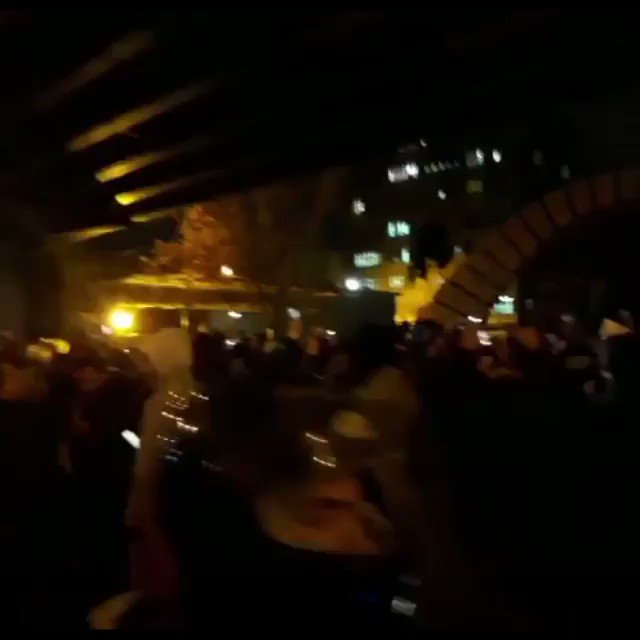
Protests against the regime of Ayatollah Khamenei erupted today in Tehran following the government admission of shooting down Ukraine Airline Flight 752. In scenes that look familiar to the 2010 ‘green movement’, thousands of Iranian protestors, many young women, have gathered to express their opposition to the dictatorial government.
Stunningly, it has been reported that the U.K. Ambassador in Tehran was arrested for filming the protests.
(Via Daily Mail) Iranians have gathered in the streets of Tehran to demand the resignation of Ayatollah Seyed Ali Khamenei after the regime admitted it had mistakenly shot down a civilian passenger plane.
Angry crowds gathered on Saturday night in at least four locations in Tehran, chanting ‘death to liars’ and calling for the country’s supreme leader to step down over the tragic military blunder, video from the scene shows.
What began as mournful vigils for Iranian lives lost on the flight soon turned to outrage and protest against the regime, and riot police quickly cracked down, firing tear gas into the crowd.
‘Death to the Islamic Republic’ protesters chanted, as the regime’s security forces allegedly used ambulances to sneak heavily armed paramilitary police into the middle of crowds to disperse the demonstration. (read more)
Protesters in Tehran clash with riot police as they demand the Ayatollah RESIGNS and call for regime change after Iran finally admits to shooting down jet and killing 176 peoplehttps://www.dailymail.co.uk/news/article-7876363/Iranian-protesters-Tehran-turn-against-regime-military-admits-shooting-plane.html …
#BREAKING: Reports: British ambassador in Tehran arrested tonight while photographing the protests against the downing of the Ukrainian plane. I bet they’re going to accuse him of being a spy. This is against the laws of diplomatic immunity.
The voice of the Iranian people is clear. They are fed up with the regime’s lies, corruption, ineptitude, and brutality of the IRGC under @khamenei_ir‘s kleptocracy. We stand with the Iranian people who deserve a better future.
The results of a massive turnout vote in Taiwan reflect the country wishes to remain free from the overbearing influence of communist China.
(Hong Kong Free Press) […] Taiwan’s incumbent leader Tsai Ing-wen has won Saturday’s presidential election, defeating her Beijing-friendly rival Han Kuo-yu by a wide margin.
[…] With 8.1 million votes as of 10:30pm, Tsai won the highest number of votes of any presidential candidate in Taiwan’s history of democratic elections. Han, on the other hand, received just over 5.5 million votes, according to the Central Election Commission (CEC).
Tsai stated in her victory speech: “I want to once again call upon Beijing authorities to remind them that peace, clarity, democracy and dialogue are key to positive cross-strait interactions and long-term development,” she added. “I also hope that Beijing authorities understand that democratic Taiwan and our democratically-elected government will not concede to threats and intimidation.” (more)
President Trump continues to dodge a disastrous war with Iran, and my hat is off to him once again.
Many have doubted him and even I thought this was it—we were going to war against Iran. It would have been a war we would win, but at the cost of thousands if not millions of lives, especially if Russia or China got involved. It would have probably cost Trump his reelection.
Houdini-like, he’s been able to maneuver out of traps that would thwart a lesser president. Now if only he could figure out a way to get us out of the Middle East completely. After that, he could also help our country escape from the Federal Reserve’s immoral system of money.
Let’s hope he makes more progress during his second term.
Much of the public discussion since President Trump struck down Qassem Soleimani, the leader of Iran’s terrorist Quds Force, calls into question Trump’s reasons, his sanity, and his political motives. Is it possible to disagree with , or even dislike, Donald Trump, but still think the move had a rational basis that may turn out to have been morally and strategically correct. Join Bill Whittle, Scott Ott and Stephen Green in debunking some of the top theories about Trump’s decision. Right Angle is a production of our Members. Join them today and find your people at https://BillWhittle.com/register
President Donald Trump is doing three things that should “scare the hell out of Democrats” according to Jonathan Capehart in the Washington Post. Bill Whittle thinks Capehart almost gets it, and then goes wildly off the rails. Can Trump’s historic campaign war chest, plus his outreach to Blacks and Latinos virtually assure his reelection? Bill Whittle Now with Scott Ott analyzes the news of the date from a solid conservative perspective, thanks to our Members who fund it. Join them today, and unlock access to Members-only content and features at https://BillWhittle.com/register/ Visit our friends at The Patriot Post: America’s News Digest: http://bit.ly/2rd2Hpx Join Bill Whittle, Scott Ott and a bunch of folks who think right like you on a Caribbean cruise May 15-18, 2020. Find out more and book your cabin at http://bit.ly/StratoCruise2020
The BLS released the December jobs report earlier today showing a stable 145,000 new job gains last month, and the unemployment rate remaining a very low 3.5%.
During an interview discussing the health of the U.S. economy in 2020 with National Economic Council Director Larry Kudlow, the DOW Jones industrial average crossed 29,000 for the first time in history.
Earlier today Secretary of State Mike Pompeo and Secretary of Treasury Steven Mnuchin held a press conference in the White House to announce new sanctions against Iran. The secretaries also took questions from the press pool. [Video and Transcript Below]
.
[Transcript] – SECRETARY MNUCHIN: Good morning, everybody. Thank you for being here today. I’d just like to make a brief comment before we talk about Iran sanctions. I’m sure everybody saw that the DOW hit 29,000. The President’s economic plans are clearly working. We’re looking forward to the China signing, USMCA, and a very strong economy this year.
As previously announced by the President, we are announcing additional sanctions against the Iranian regime as a result of the attack on U.S. and allied troops.
First, the President is issuing an executive order authorizing the imposition of additional sanctions against any individual owning, operating, trading with, or assisting sectors of the Iranian economy, including construction, manufacturing, textiles, and mining. And let me be clear: These will be both primary and secondary sanctions. The EO also allows us to designate other sectors in the future as Secretary Pompeo and me think is appropriate.
Second, we are announcing 17 specific sanctions against Iran’s largest steel and iron manufacturers, three Seychelles-based entities, and a vessel involved in the transfer of products. As a result of these actions, we will cut off billions of dollars of support to the Iranian regime, and we will continue our enforcement of other entities.
Third, we are taking action against eight senior Iranian officials who advanced the regime’s destabilizing activity and were involved in Tuesday’s ballistic missile strike. Secretary Pompeo will comment more on this.
Today’s sanctions are part of our commitment to stop the Iranian regime’s global terrorist activities. The President has been very clear: We will continue to apply economic sanctions until Iran stops its terrorist activities and commit that it will never have nuclear weapons.
I’ll now turn it over to Secretary Pompeo.
SECRETARY POMPEO: Thank you, Steven. Good morning, everyone.
Today, President Trump is delivering on the pledge that he made the day after Iran attacked American forces in Iraq: There will be a series of new sanctions.
Secretary Mnuchin just mentioned eight senior Iranian officials that are responsible for the regime’s violence, both at home and abroad. We’re striking at the heart of the Islamic Republic’s inner security apparatus. These sanctions targets include the Secretary of the Supreme National Council and the Commander of the Basij Forces; that’s the regime’s brute squad, which has, in the last few months, killed approximately 1,500 Iranians who were simply demanding freedom.
Our action targets other senior leaders close to the Ayatollah. They’ve carried out his terrorist plots in destabilizing campaigns across the Middle East and around the world. They’ve employed soldiers across the region’s battlefields. They’ve trained militias in Iraq, Syria, and elsewhere in the arts of domestic repression.
Today, they’re accountable for murder and mayhem. The goal of our campaign is to deny the regime the resources to conduct its destructive foreign policy. We want Iran to simply behave like a normal nation. We believe the sanctions that we impose today further that strategic objective.
Our campaign is composed of diplomatic, economic components that have deprived the regime of billions in revenue the regime has used to fuel death and destruction across the Middle East and all across the world.
Sadly, the previous administration had opened up revenue streams for Iran. But under our administration, oil revenues are down by 80 percent and Iran cannot access roughly 90 percent of its foreign currency reserves. And not even two weeks ago, President Rouhani of Iran admitted that our sanctions have cost Iran over $200 billion in lost foreign income and investment. As long as Iran’s outlaw ways continue, we will continue to impose sanctions.
Finally, I want to reiterate President Trump’s concern for Americans and dual national citizens detained inside of Iran. Iran knows these individuals have committed no crime. They know the charges against them are fake. And we will do all that we can to get each of them returned home safely to their families.
With that, we’ll take just a few questions.
Yes, ma’am.
Q Mr. Secretary, the administration said this strike was based on an imminent threat, but this morning you said we didn’t know precisely when and we didn’t know precisely where. That’s not the definition of “imminent.” The President has also suggested that there was some sort of attack being planned against an embassy, perhaps several embassies.
Can you clarify? Did you have specific information about an imminent threat, and did it have anything to do with our embassies?
SECRETARY POMPEO: We had specific information on an imminent threat, and those threats included attacks on U.S. embassies. Period. Full stop.
Q So you were mistaken when you said you didn’t know precisely when and you didn’t know precisely where?
SECRETARY POMPEO: Nope. Completely true. Those are completely consistent thoughts. I don’t know exactly which minute. We don’t know exactly which day it would’ve been executed. But it was very clear: Qasem Soleimani himself was plotting a broad, large-scale attack against American interests. And those attacks were imminent.
Q Against an embassy?
SECRETARY POMPEO: Against American facilities, including American embassies, military bases. American facilities throughout the region.
Q Mr. Secretary —
SECRETARY POMPEO: Yes, sir. John?
Q Mr. Secretary, in the initial hours after the missile attacks on Al-Asad, in Erbil, it was believed that Iran may have taken steps to avoid U.S. casualties. But then, the Chairman of the Joint Chiefs, Mark Milley, came out, the Secretary of Defense came out, other officials came out to say, “No, these missiles were intended to kill Americans.”
If it was Iran’s intent to kill Americans, does that not deserve some sort of response? I mean, if somebody takes a shot at you and they don’t hit you simply because you duck, does that mean that they weren’t trying to kill you?
SECRETARY POMPEO: So, look, I’ll defer to the Department of Defense on the details, but there’s no doubt in my judgment, as I observed the Iranian activity in the region that night, they had the full intention of carrying — killing U.S. forces, whether that was our military folks or diplomatic folks who were in the region. And I am confident that the response the President has taken is appropriate.
The President said we don’t want war; we want Iran to behave like a normal nation. The reason that the Secretary of Treasury and I are here this morning is to continue this campaign — our strategic effort to get Iran to behave in a way that doesn’t continue their 40-year-long effort to terrorize the world.
Q Mr. Secretary and Secretary Pompeo, do you believe that the Iranians shot down the Ukrainian International Airways [sic] plane? And if the Iranians shot that plane down, will there be consequences?
SECRETARY POMPEO: We do believe that it’s likely that that plane was shot down by an Iranian missile. We’re going to let the investigation play out before we make a final determination. It’s important that we get to the bottom of it.
I’ve been on the phone — I was on the phone with President Zelensky. Just before I came here, I was on the phone with my Canadian counterpart. They’re working to get their resources on the ground to conduct that thorough investigation. We’ll learn more about what happened to that aircraft. And when we get the results of that investigation, I am confident we and the world will take appropriate actions in response.
SECRETARY MNUCHIN: And let me just —
Q Will you allow the NTSB to work with the Iranians?
SECRETARY MNUCHIN: Yeah, I was just going to comment on that. The Treasury will issue waivers for anybody, whether it’s Americans or others, that can help facilitate the investigation.
Q The last time that you both joined us in this room, it was back in September and you were announcing additional sanctions, including on the Quds Force. And, Secretary Mnuchin, at that point you said, “I think we’ve done more sanctions on Iran than anybody, and it’s absolutely working.”
Since then, we’ve seen an escalation in violence from Iran: shooting down the drone, attacking the embassy, a contractor who was killed, U.S. troops that were wounded. How are sanctions keeping the United States — economic sanctions keeping the United States and United States’ interests more secure?
SECRETARY MNUCHIN: I think we have 100 percent confidence, and we are consistent in our view that the economic sanctions are working; that if we didn’t have these sanctions in place, literally Iran would have tens of billions of dollars. They would be using that for terrorist activities throughout the region and to enable them to do more bad things. And there’s no question, by cutting off the economics to the region, we are having an impact.
And as the President has said, the fact that the Obama administration turned over $150 billion to the regime, we think we wouldn’t be in this situation had that not been the case.
SECRETARY POMPEO: May I just add, it’s important to keep in mind what’s taking place in Iran today. This country has never been in the place that it is today. Big, challenging problems. Their budget — they’re going to fail by tens of billions of dollars of achieving their revenue for this year. They’ve got real challenges, and figuring out how to make difficult decisions: Do you underwrite Hezbollah? Do you pick Hamas? Do you underwrite the Shia militias in Iraq? Or do you allow your people to have the opportunity to live the life they want and grow your economy? Those are the difficult choices that the regime is facing.
And you can see the protests — protests that we expect will continue — that we’ll demand from the Iranian regime that they begin to treat the Iranian people in the way that they so richly deserve. And this administration will continue to support those efforts as well.
SECRETARY MNUCHIN: In the back.
Q Thank you, Mr. Secretary. You mentioned secondary sanctions here. What is your message to our European allies who continue to do business with the Iranians? And then, specifically, if you can, will this impact the INSTEX barter mechanism, which was set up by a number of European countries to avoid U.S. sanctions and continue to do business without using the U.S. dollar?
SECRETARY MNUCHIN: Sure. Thank you. I think those are both very important questions.
So let me first comment on INSTEX. I don’t believe there’s been any INSTEX transactions. As we’ve made clear, we are working on a Swiss channel that we have approved for humanitarian transactions. We’ll continue to allow humanitarian transactions. We’ve warned INSTEX and others that they will most likely be subject to secondary sanctions, depending on how they use that. So that’s absolutely the case.
As it relates to the Europeans, both the Secretary and I have spoken to our counterparts in Europe several times over the last few days. We’ve emphasized the impact and the issue of — Iran has announced that they are no longer part of the JCPOA. And we’ve had very direct conversations with our counterparts about that.
Q Secretary Pompeo, what is your definition of “imminent”?
SECRETARY POMPEO: This was going to happen, and American lives were at risk. And we would have been culpably negligent. As the Chairman of the Joint Chiefs of Staff said, we would have been culpably negligent had we not recommended to the President that he take this action at Qasem Soleimani. He made the right call, and America is safer as a result of that.
Q But then why has there been these — Secretary Pompeo, why have there been these shifting definitions —
(Cross-talk.)
Q Thank you. Thank you, sir.
SECRETARY MNUCHIN: Go — go ahead. We’re going to —
Q — shifting explanations of the intelligence?
SECRETARY MNUCHIN: We’re going to try to do one question for everybody, just —
Q Were they trying to hit Iranian troops — was Iran trying to hit our troops or not?
SECRETARY MNUCHIN: — so that as many people can get questions. So I don’t mean to cut you off, but we’re trying to — go ahead.
Q I mean, let me defer to my colleague — but, sir, six months ago, Secretary Pompeo, the President said that U.S. intelligence agencies had been running amok. He spent most of the past three years he’s been in office denigrating and attacking the intelligence community and disputing findings, whether it’s on Russia or North Korea, or really any area that contradicts things that he has said publicly.
Why then should Americans suddenly believe your assertions that you had good intelligence on this when the head of the Executive Branch has been casting aspersions on the intelligence community for most of his time in office?
SECRETARY POMPEO: Look, I served as the CIA Director for the first year and a half of this administration. I watched the President rely on the work that the intelligence community did for the entire time I served as the head of the Central Intelligence Agency. I watched him rely on the capable men and women who are delivering exquisite information to the Executive Branch. I watched the President have confidence in that information.
We all challenge their work. We have to make sure we get it right. The intelligence community is not flawless. We — we get it wrong. In this case, the intelligence community got it fundamentally right. Even the reflections we’ve seen after the after-effect, after the strike that Qasem Soleimani took, has demonstrated that we were quite right. There was an imminent attack. There was active plotting. And we took an action that we thought was likely to create less risk for the American people, and I’m confident that we did that.
SECRETARY MNUCHIN: Go ahead, in the back. In the back.
Q Thank you. This question is for Secretary Pompeo. There are reports that the Iraqi Prime Minister has asked you to start negotiating some withdrawal of U.S. troops from Iraq immediately. Is that the case? Can you comment on that?
SECRETARY POMPEO: Yeah, he didn’t quite characterize the conversation correctly. But to the larger, more important point, we are happy to continue the conversation with the Iraqis about what the right structure is. Our mission set there is very clear: We’ve been there to perform a training mission to help the Iraqi security forces be successful and to continue the campaign against ISIS, the counter-Daesh campaign.
We’re going to continue that mission. But as the — as times change and we get to a place where we can deliver upon what I believe and the President believes is our right structure, with fewer resources dedicated to that mission, we will do so.
We also have today a NATO team that’s here at the State Department working to develop a plan, which will get burden-sharing right in the region, as well, so that we can continue the important missions to protect and defend and keep the American people safe while reducing our cost, our resources, and our burden, and the risk to our soldiers and sailors who are in the region.
Q Secretary Pompeo, if I can — here, today, at the podium, you said that the imminent threat was a threat to U.S. embassies. You didn’t know precisely when or where. Last night, the President said it was a threat to embassies, including to our Baghdad embassy.
Why can you say that here, and the President could say it at a rally in Toledo, but no one said it to lawmakers behind closed doors in a classified setting, as multiple senators have since said?
SECRETARY POMPEO: We did.
Q You said —
SECRETARY POMPEO: Yes.
Q So the senators are lying when they say that (inaudible) imminent threat was a threat?
SECRETARY POMPEO: We told them about the imminent threat. All of the intelligence that we’ve briefed, that you’ve heard today, I assure you, in an unclassified setting, we provide in the classified setting as well.
Q To be clear, you told them that embassies were the — were to be targeted? That was the imminent threat?
SECRETARY POMPEO: I’m not going to talk about the details of what we shared in a classified setting. But make no mistake about it: Those leaders, those members of Congress who want to go access this same intelligence, can see that very same intelligence that will reflect what I described to you and what the President said last night, as well.
Q Is that threat now gone with Soleimani gone?
SECRETARY POMPEO: Threats are never gone. Uh, right? It’s always — a lot of danger in the world.
Q The next general will pick it up?
SECRETARY POMPEO: Always — always a lot of danger in the world, throughout the region. Nobody believed that a single mission, in any respect, took down the risk of terror — terror from al Qaeda, terror from ISIS, terror from al-Shabaab. No — no one believes that. The President doesn’t.
Look at the list though; look at the achievements in the administration. We took away the caliphate in its entirety. We took down Hamza bin Laden. We took down al-Baghdadi. We took down Qasem Soleimani. This is a list that has reduced the capacity for terrorists around the world to perform the functions that put American men and women and the homeland at risk. We’re very proud of what we accomplished. We’re going to stay the course.
SECRETARY MNUCHIN: Why don’t we take one more over there? Yes. Thank you.
Q I’m curious —
SECRETARY MNUCHIN: No, no. Next to you. Right there. Yes.
Q Me?
SECRETARY MNUCHIN: Yes.
Q Thank you. Secretary Mnuchin, this is a question for you too about the China trade deal. So the Chinese side is going to be here next Wednesday to sign the phase one part of that deal. But China is also a big importer of Iranian oil and Iranian minerals, and that’s a big part of their economy as well. So how do you balance the two? And are you concerned about the Iran issue coming up in either the signing of the phase one deal or the negotiation for the phase two deal?
SECRTEARY MNUCHIN: Well, let me just comment: I had no idea you’d ask that question, but that’s a good last question to end on.
So let me first say that we are looking forward to the Chinese delegation coming next week. Phase one is very significant. It includes very significant components of changes to technology issues, intellectual property issues, and $50 billion of purchases for our farmers.
I would comment: I don’t agree with your comment that China is a big buyer of oil. The China state companies are not buying oil from Iran. And I would just say we are having conversations with China, as well with any other counterparty on sanctions evasion.
UPDATE: TRUMP REASSURES AMERICA HE IS NOT STARTING WAR WITH IRAN AND DE-ESCALATES AS IRAN STANDS DOWN. TRUMP SIGNALS FURTHER SANCTIONS AND NATO ENGAGEMENT.
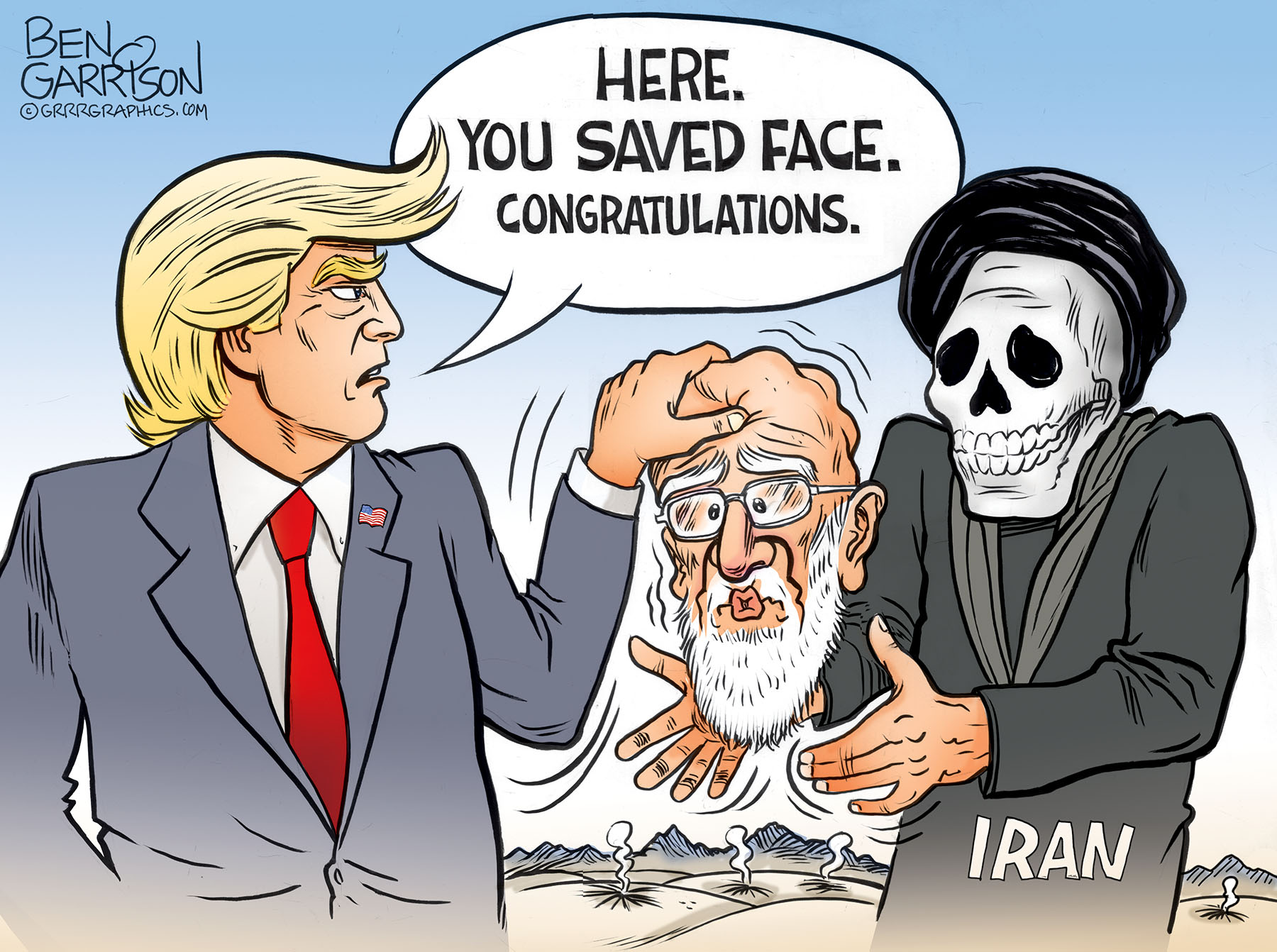
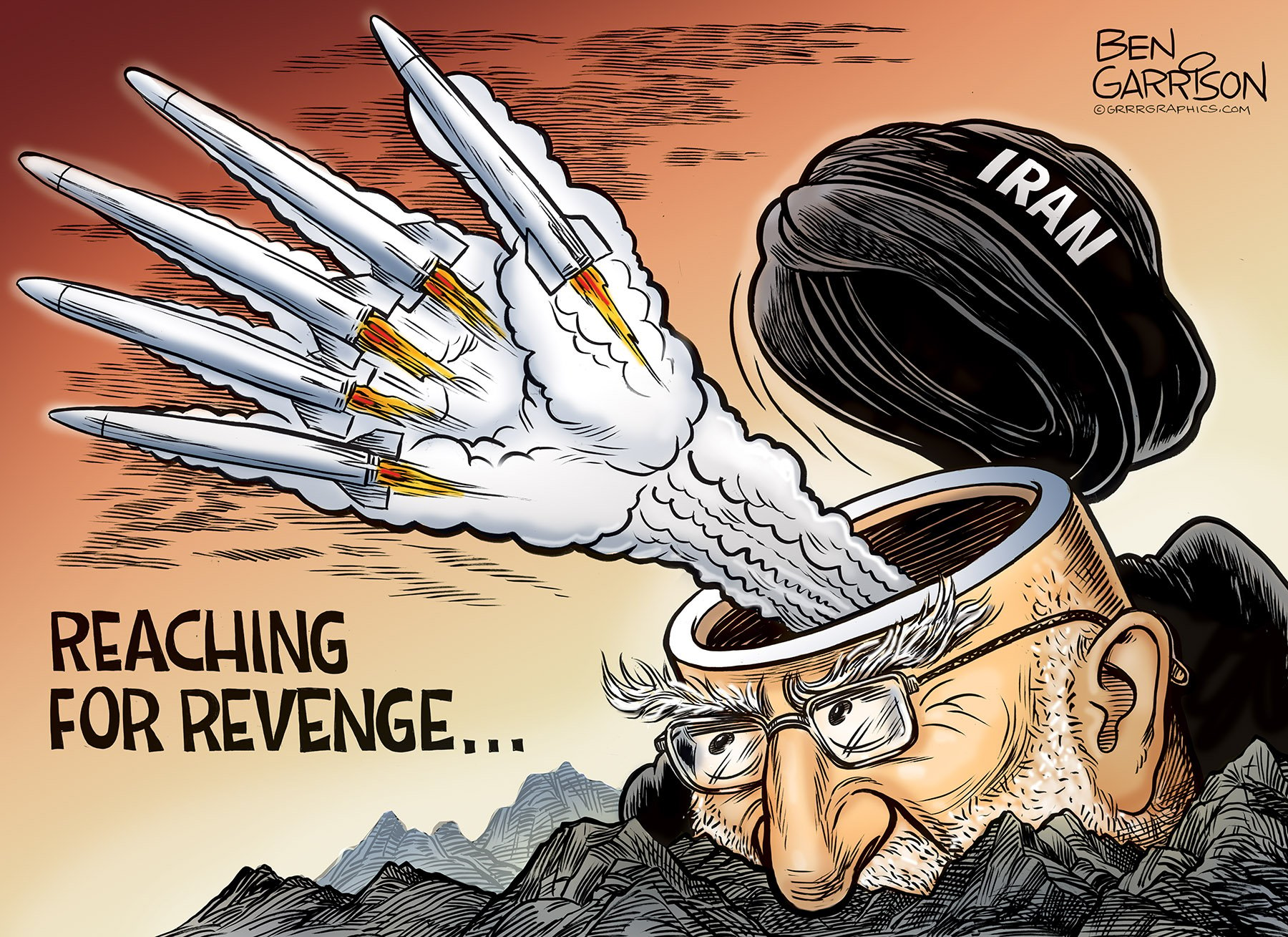
It’s difficult to draw a cartoon while events are rapidly changing, so this cartoon came to mind. As I penned this I learned a jet crashed outside of Tehran, killing a great many people.
Was it accidentally shot down or targeted intentionally by Iran?
UPDATE: Reports indicate Iranian officials informed the Iraqi government before the attack that they were launching missiles at US bases, and the Iraqis informed US officials to prepare for attack. Conclusion is this attack was meant for Tehran to save face.
Even through Iran is ruled by religious lunatics, they must have some sanity left, because they made it clear they do not a full-blown war with the United States. Let’s hope the president shows restraint and avoids a full war with the Persian nation. We would defeat Iran, but at the cost of many lives on both sides.
It’s time to stop the tit-for-tat game and get out of the Middle East entirely. Iraq wants us to go. We supposedly brought Democracy there, so let’s respect their vote and get out. That probably won’t happen. The neocon deep state swamp, the globalists, Saudi Arabia, Israel, and our military industrial complex want Iran taken out. Trump has done a good job of avoiding war with Iran and I’ve praised him for it. Iran is foolishly playing into their hands by escalating the situation. Did they overreach to save face?
We don’t need another never-ending war. Trump promised to get us out of the useless wars in the Middle East and Afghanistan. It’s time for him to deliver on his promise.
Tonight President Trump heads to Toledo, OH for a massive Keep America Great rally at the Huntington Center. President Trump is expected to speak at 7:00pm ET.
I have created this site to help people have fun in the kitchen. I write about enjoying life both in and out of my kitchen. Life is short! Make the most of it and enjoy!
This is a library of News Events not reported by the Main Stream Media documenting & connecting the dots on How the Obama Marxist Liberal agenda is destroying America







 Centinel2012