Former Walmart CEO Bill Simon Discusses Strong Holiday Sales and What It Means for Economy…


It’s a little funny to watch this.  The chicken little pearl-clutchers at Fox Business: ‘orange-man-bad tariffs‘ -vs- former Walmart CEO Bill Simon on strong holiday retail sales, global growth and the U.S-China trade reset.

The Wall Street business-pundits are pre-programmed, at an institutional dna level, to jump into the “tariffs are bad” talking points.  Mr. Simon aptly dispatches them with a dose of reality from the Wal-Mart/Main Street perspective.  [It’s kinda funny]

Wait a minute….. Are Financial Analysts/Media Playing Games With Holiday Growth Rate of Consumer Spending?…


Here’s a weird question.  I’ve been looking at this all day.  Something sketchy is afoot.  I waited specifically for CBS to report so that I could share an exact comparison.

In 2017 total holiday sales were reported as follows:

2017 CBS – […] They had a lot of company across the country. Total retail sales this holiday season added up to a record $598 billion dollars — up $33 billion from last year. (link)

In 2018 total holiday sales were reported as follows:

2018 WSJ and CBS – […]  Overall, U.S. consumers spent over $850 billion this holiday season, according to Mastercard. The figures suggest a stock-market swoon and partial government shutdown haven’t curbed consumer confidence and spending. (link)

See the issue?..

In all 2017 financial media reports $598 billion was the holiday spending total.  And in all of 2018 financial media reports $850 billion was the total holiday spending.

That’s a difference of $252 billion more spent in 2018.  An increase of 42%.

A forty-two percent increase !!

Now, you might say it’s simply a difference in the media source.  However, CBS is cited specifically to avoid this possible disparity.

Additionally, the exact same analyst is quoted in both years:

2017 – “”This is literally the best season since before the recession,” business owner Craig Johnson said. “Johnson’s company, Customer Growth Partners, analyzes all things retail. He credits low unemployment and a booming stock market for this humbug-free holiday season.

“The single biggest drive of retail sales is growth in real disposable income,” he said. “And when real income goes up, people have money in their pocket and they’re able to spend it.” (link to 2017 analysis)

-AND in 2018-

2018– ““Wall Street is running around like a chicken with its head cut off, while Mr. and Mrs. Main Street are happy with their jobs, enjoying their best wage increases in a decade,” said Craig Johnson, president of Customer Growth Partners, a retail research and consulting firm. A recent drop in gas prices has helped last-minute spending, he said.”  (link to 2018 analysis – and additional citation via identical CBS)

If $598 billion was spent in 2017; and $850 billion was spent in 2018; that means this years holiday shopping increase was truthfully, factually, and actually a jaw-dropping 42% !!

Now….

Why would the overall media, and specifically the Wall Street focused financial media, downplay results that reflected a stunning 42% increase in consumer spending?

Could the institutional bias be that overt?

Then again…. perhaps the underlying truth explains this:

(LINK)

Do you realize the scale of this?


U.S. Sending Trade Delegation to China January 7th…


According to a report in Bloomberg News the U.S. is sending a trade negotiation team to Beijing on January 7th, 2019.  If accurate this would be the first face-to-face delegation since President Trump and Chairman Xi outlined the structure for strategic trade discussions during the G20 meeting in Buenos Aires.

(Via Bloomberg) A U.S. government delegation will travel to Beijing in the week of Jan. 7 to hold trade talks with Chinese officials, two people familiar with the matter said.

Deputy U.S. Trade Representative Jeffrey Gerrish will lead the Trump administration’s team, which will also include Treasury Under Secretary for International Affairs David Malpass, according to the people, who spoke on the condition of anonymity. Neither the USTR nor Treasury responded to requests for comment. (more)

When President Trump outlined the preliminary terms for negotiations between the U.S. and China, U.S Trade Representative Robert Lighthizer was assigned the lead position for the contacts.   Abassador Lighthizer has been very firm in pointing out the 90-day window for discussions, prior to enhanced tariff action, was not going to change.  The deadline is March 1st, 2019, for a principle agreement, or the next phase of tariffs is triggered.

THE DANCE – There are some signs Beijing is trying to bring an aggressive North Korea back into play as leverage toward China’s economic negotiation goals.  President Trump will almost certainly instruct Secretary Mike Pompeo to engage and schedule a second meeting between Chairman Kim Jong-un and President Trump.

Trump’s move to keep North Korea’s Chairman Kim visible and negotiating is less about DPRK denuclearization and more specifically about keeping Chairman Xi from being able to leverage DPRK denuclearization as part of China’s trade leverage.  This aspect to the U.S -vs China geopolitical confrontation can be described as the dance of the panda mask.

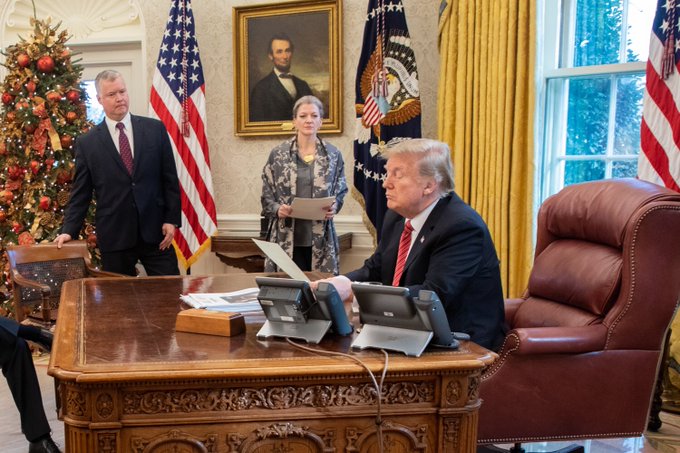
Donald J. Trump

@realDonaldTrump

Christmas Eve briefing with my team working on North Korea – Progress being made. Looking forward to my next summit with Chairman Kim!

47.6K people are talking about this

No other president would, could, or has, ever considered publicly taking on this dual economic and diplomatic challenge.   Not only is President Trump taking on China, but he is simultaneously taking on every financial interest who previously acquiesced to China – because they saw no option.

Only, and I do mean O.N.L.Y President Trump has the cunning to take on China, Wall Street, the multinational banking system (IMF), the World Trade Organization, and every vested global politician…. while simultaneously taking on Beijing’s DPRK control ploys.

The vast majority of punditry and news discussion will focus on Trump and Xi as if they are direct adversaries.  That adversarial perspective is not only misplaced, it is merely the tip of the iceberg.  A limited perspective will entirely miss what is happening beneath the surface.   That’s where the fight is.  That’s where the really good stuff is happening.

The real challenge in dealing with or confronting China is what happens in the places we cannot see directly attached.  Specifically because politicians suck at complex strategies that not entirely obvious to the consuming masses – we have never had a politician with the right skills, in the right position, to take on a cunning Eastern economic adversary.

We do now.

POTUS Trump’s life dealing with predatory financial adversaries, including the Chinese, has provided him with a very specific set of skills.  Trump is keenly aware of the cunning nature behind the panda mask; and the results so far are excellent.  It is also clear that Robert Lighthizer holds a solid understanding of this specific adversary.

Those who follow global politics and global economics well understand the significance and massive consequence in this U.S. -vs- China confrontation.   This economic challenge is planetary in scale.  This one is for all the marbles.  There are trillions upon trillions at stake, and Donald Trump is confronting decades of planning by global financial interests.


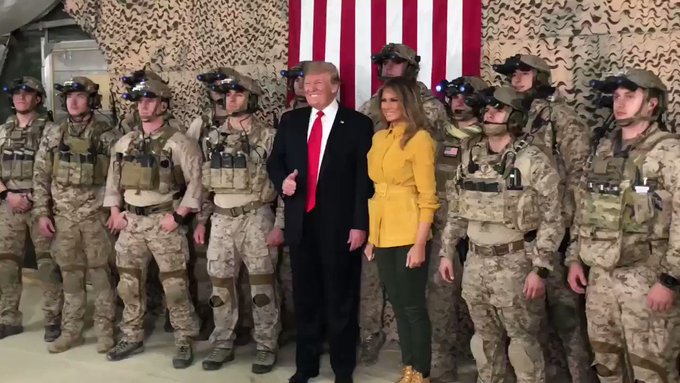
President Donald Trump Surprise Speech To Troops in Iraq (Full Speech Video)…


President Donald Trump and First Lady Melania Trump deliver remarks to U.S. military during a surprise visit to Al Asad Air Base in Iraq.

During his remarks President Trump outlines his determination to remove U.S. military from Syria and to hold regional allies accountable to retain stability and security.

Additionally President Trump directly addresses the notion that any withdrawal from the region means a reconstituted terror threat that might strike the U.S: “if that was to happen, they would suffer consequences like never before.”  “That’s not a threat, that’s going to be a fact.” … “If anything were to happen at all.”

Embedded video

Donald J. Trump

@realDonaldTrump

.@FLOTUS Melania and I were honored to visit our incredible troops at Al Asad Air Base in Iraq. GOD BLESS THE U.S.A.!

72.7K people are talking about this

Dow Surges With Biggest Gains on News of Best Holiday Shopping Season…


…The Dow Jones Industrial Average rose 5%, or more than 1,000 points, and recorded the largest daily point gain in its history. Meanwhile, the S&P 500 climbed 4.9%…. (more)

(Via CNBC) Retail is having its best holiday shopping season in six years, according to early data tracking consumers’ purchases.

Sales in the U.S. from Nov. 1 through Christmas Eve were up 5.1 percent to more than $850 billion, according to Mastercard SpendingPulse, which monitors spending both in stores and online via all forms of payment. Mastercard also said online sales during that time frame were up 19.1 percent from a year ago, in line with earlier reports that showed robust growth in e-commerce this holiday season.

And this all comes amid the latest fluctuations in the stock market, worries on Wall Street about a potentially slowing economy and a partial government shutdown. Consumer confidence remains strong, translating into robust retail sales, said Steve Sadove, former CEO of Saks and currently advisor for Mastercard.  (read more)

CEA Chairman Kevin Hassett Discusses Main Street Growth and Fed Impacts…


Council of Economic Advisers Chairman Kevin Hassett appears on Fox Business news to discuss the impact of the Federal Reserve’s interest rate hikes on the Main Street economy and the state of the Wall Street stocks.

The key metric is to accept what’s happening around us.  Fed rate hikes are hurting Wall Street (investment class).  However, Fed activity is not yet impacting Main Street.  This is because the two economic engines (Wall St. -vs- Main St.) are so far apart.

.

Part Two of this interview (and expanded review) is below:

.

Three decades of monetary and administrative policy has favored Wall Street (globalism) over Main Street (nationalism).  Decades ago… Main Street and Wall Street used to be connected; stocks were evaluated on company performance; the companies were mostly American, and invested in the success of USA (middle class).

However, changes in monetary policy and political priorities, specifically to the benefit of Wall Street investment instruments (multinational global expansion), drove Wall Steet and Main Street ever further apart.

As a direct result when the Main Street economic engine becomes the focus of favorable policies (trade policy, energy policy, manufacturing policy, tax policy, deregulation etc.), the domestic US economy expands… bigly…

….AND now the Fed takes action in response to ever-expanding strength in our Main Street economy; but, that Fed action will take time to traverse the decades-wide gap… and the first impact will be negative to the original benefactor; the one closer to the actual monetary policy, that’s Wall Street.

I hate to keep harping the point, but this was predicted two years ago:

Understanding the distance between the real Main Street economic engine and the false Wall Street economic engine will help all of us to understand the scope of an upcoming economic lag; which, rather remarkably I would add, is a very interesting dynamic.

Think about these engines doing a turn about and beginning a rapid reverse. GDP can, and in my opinion, will, expand quickly. However, any interest rate hikes (monetary policy) intended to cool down that expansion -fearful of inflation- will take a long time to traverse the divide.  (more)

The Fed is using the opportunity of a strong national U.S. economy, and strong growth in U.S. wealth, to withdraw all of the underlying stimulus money (cheap money) that was needed to fill the gap during the global exfiltration of wealth under prior administration policies.

During the Bush, Clinton-Clinton, Bush-Bush, Obama-Obama years, Main Street middle-class Americans became more poor.   Wall Street investment class became more rich. Multinational corporate globalism drove the policy. The wealth gap is a direct result.

Over the past 30-years, increased income subsidies became a part of administration policy in an effort to fill a void from depressed wage growth. Welfare and food stamp distribution necessarily expanded.

President Trump’s economic policies are the exact opposite of globalism.  Policy to the benefit of working middle-class Americans (ie. America-First nationalism) is against the interests of the corporate multinationals.

Yes, it is unfair to President Donald Trump for the Federal Reserve to essentially buy back all the cheaply printed money used to prop up Wall Street’s schemes.  After all, it is a Fed action only possible because the U.S. economy is so strong.  President Trump’s success is essentially providing the Fed the opportunity to strengthen dollars and make them more valuable.  However, it is what it is…. though Trump’s annoyance is well understood.

Wall Street is getting hurt most; there is more pain ahead for those investment instruments on Wall Street that are dependent on globalism; but the negative Fed impacts to Main Street –as a whole– will not be felt in the aggregate until the two engines once again gain parity.

Again, as predicted: “Those who benefit from high-yield international investment instruments will see less wealth. Those who live on savings will see a benefit.  Those living day-to-day and week-to-week on their paychecks will see more income and wealth.”

2016 – […] Those global manufacturing economies will first respond to any increases in export costs (tariffs etc.), by driving their own productivity higher as an initial offset, in the same manner American workers went through in the past two decades.  The manufacturing enterprise and the financial sector remain focused on the pricing.

♦ Inflation on imported durable goods sold in America, while necessary, will ultimately be minimal during this initial period; and expand more significantly as time progresses and off-shored manufacturing finds less and less ways to be productive.   Over time, durable good prices will increase – but it will come much later.

♦ Inflation on domestic consumable goods ‘may‘ indeed rise at a faster pace. However, it can be expected that U.S. wage rates will respond faster, naturally faster, than any monetary policy because inflation on fast-turn consumable goods becomes re-coupled to the ability of wage rates to afford them.

The monetary policy impact lag, caused by the distance between federal fiscal action and the domestic Main Street economy, will now work in our favor.  That is, in favor of the middle-class.

President Trump and First Lady Melania Make Surprise Trip to Middle-East…


Speculation of President Trump heading to visit troops began early this morning as an overnight takeoff for Air Force-One was strongly rumored.  Additionally the White House press room has been silent and POTUS Trump has been unusually quiet on his social media.

In a statement posted on Twitter, White House Press Secretary Sarah Sanders confirmed the visit in a tweet shortly after Reuters shared the photos of the president in Iraq.

President Trump and the First Lady traveled to Iraq late on Christmas night to visit with our troops and Senior Military leadership to thank them for their service, their success, and their sacrifice and to wish them a Merry Christmas.  (Link)

Additionally, the Daily Mail has more pictures  in Iraq.

Advertisements

MAGAnomics: Mastercard Releases First Tabulated Holiday Sales Report With Whopping 5.1% Increase


As CTH anticipated the first tabulated holiday sales report via Mastercard® shows the results of a very strong consumer confidence level.  The first report highlights a very strong 5.1% increase in holiday purchases:

“Wall Street is running around like a chicken with its head cut off, while Mr. and Mrs. Main Street are happy with their jobs, enjoying their best wage increases in a decade”…

~ Craig Johnson, president of Customer Growth Partners

(Via Wall Street Journal)  Shoppers delivered the strongest holiday sales increase for U.S. retailers in six years, according to early data.

Total U.S. retail sales, excluding automobiles, rose 5.1% between Nov. 1 and Dec. 24 from a year earlier, according to Mastercard SpendingPulse, which tracks both online and in-store spending with all forms of payment. Overall, U.S. consumers spent over $850 billion this holiday season, according to Mastercard.

[…] Retailers entered the holidays with momentum as online sales jumped 26.4% from a year earlier between the Wednesday before Thanksgiving through Black Friday.

[…] Sales at department stores fell 1.3% in the period tracked by Mastercard, in part due to store closings. Stores that mainly sell apparel, however, experienced robust sales, growing 7.9% during the same period. Overall, sales from bricks-and-mortar stores rose 3.3%.  (read more)

It will be interesting to see how the fourth quarter GDP growth is impacted by strong consumer sales.  Generally consumer sales make up two-thirds of GDP calculations; however, there was a strong front-loading of imported inventory at the end of the 3rd quarter (Sept).

The preliminary data suggests Main Street is indeed benefiting from a strong domestic economy.  Low unemployment, lower taxes and higher wages equals more disposable income.  That foundation likely fueled the increase in consumer spending throughout the holidays.

Wall Street is being impacted by their multinational reliance which is heavily weighted toward global investments.  Main Street is driven by the actual U.S.A. checkbook economic factors.  This is the modern disconnect.  After decades of Wall Street companies investing overseas, and generating investment products that are fundamentally detached from the U.S. economy, they do not benefit from a strong U.S. economy.  However, Main Street directly gains from internal U.S. economic growth.

It is likely retail stocks with a heavy weight on the U.S. consumer market will see a resurgence in stock market value.  Last year’s 2017 holiday sales were approximately $598 billion as measured by Consumer Growth Partners.  This year’s holiday sales look to be around $850 billion, as measured by the same data firm.

There really is a big disconnect between Wall Street and Main Street.

If you understand the basic elements behind the new dimension in American economics, you already understand how three decades of DC legislative, monetary and regulatory policy was structured to benefit Wall Street and not Main Street. The intentional shift in monetary policy is what created the distance between two entirely divergent economic engines.

REMEMBER […] there had to be a point where the value of the second economy (Wall Street) surpassed the value of the first economy (Main Street).

Investments, and the bets therein, needed to expand outside of the USA. hence, globalist investing.

However, a second more consequential aspect happened simultaneously. The politicians became more valuable to the Wall Street team than the Main Street team; and Wall Street had deeper pockets because their economy was now larger.

As a consequence Wall Street started funding political candidates and asking for legislation that benefited their interests.

When Main Street was purchasing the legislative influence the outcomes were -generally speaking- beneficial to Main Street, and by direct attachment those outcomes also benefited the average American inside the real economy.

When Wall Street began purchasing the legislative influence, the outcomes therein became beneficial to Wall Street. Those benefits are detached from improving the livelihoods of main street Americans because the benefits are “global”. Global financial interests, multinational investment interests -and corporations therein- became the primary filter through which the DC legislative outcomes were considered.

There is a natural disconnect. (more)

As an outcome of national financial policy blending commercial banking with institutional investment banking something happened on Wall Street that few understand. If we take the time to understand what happened we can understand why the Stock Market grew and what risks exist today as the monetary policy is reversed to benefit Main Street.

President Trump and Treasury Secretary Mnuchin have already begun assembling and delivering a new banking system.

Instead of attempting to put Glass-Stegal regulations back into massive banking systems, the Trump administration is creating a parallel financial system of less-regulated small commercial banks, credit unions and traditional lenders who can operate to the benefit of Main Street without the burdensome regulation of the mega-banks and multinationals. This really is one of the more brilliant solutions to work around a uniquely American economic problem.

♦ When U.S. banks were allowed to merge their investment divisions with their commercial banking operations (the removal of Glass Stegal) something changed on Wall Street.

Companies who are evaluated based on their financial results, profits and losses, remained in their traditional role as traded stocks on the U.S. Stock Market and were evaluated accordingly. However, over time investment instruments -which are secondary to actual company results- created a sub-set within Wall Street that detached from actual bottom line company results.

The resulting secondary financial market system was essentially ‘investment markets’. Both ordinary company stocks and the investment market stocks operate on the same stock exchanges. But the underlying valuation is tied to entirely different metrics.

Financial products were developed (as investment instruments) that are essentially wagers or bets on the outcomes of actual companies traded on Wall Street. Those bets/wagers form the hedge markets and are [essentially] people trading on expectations of performance. The “derivatives market” is the ‘betting system’.

♦Ford Motor Company (only chosen as a commonly known entity) has a stock valuation based on their actual company performance in the market of manufacturing and consumer purchasing of their product. However, there can be thousands of financial instruments wagering on the actual outcome of their performance.

There are two initial bets on these outcomes that form the basis for Hedge-fund activity. Bet ‘A’ that Ford hits a profit number, or bet ‘B’ that they don’t. There are financial instruments created to place each wager. [The wagers form the derivatives] But it doesn’t stop there.

Additionally, more financial products are created that bet on the outcomes of the A/B bets. A secondary financial product might find two sides betting on both A outcome and B outcome.

Party C bets the “A” bet is accurate, and party D bets against the A bet. Party E bets the “B” bet is accurate, and party F bets against the B. If it stopped there we would only have six total participants. But it doesn’t stop there, it goes on and on and on…

The outcome of the bets forms the basis for the tenuous investment markets. The important part to understand is that the investment funds are not necessarily attached to the original company stock, they are now attached to the outcome of bet(s). Hence an inherent disconnect is created.

Subsequently, if the actual stock doesn’t meet it’s expected P-n-L outcome (if the company actually doesn’t do well), and if the financial investment was betting against the outcome, the value of the investment actually goes up. The company performance and the investment bets on the outcome of that performance are two entirely different aspects of the stock market. [Hence two metrics.]

♦Understanding the disconnect between an actual company on the stock market, and the bets for and against that company stock, helps to understand what can happen when fiscal policy is geared toward the underlying company (Main Street MAGAnomics), and not toward the bets therein (Investment Class).

The U.S. stock markets’ overall value can increase with Main Street policy, and yet the investment class can simultaneously decrease in value even though the company(ies) in the stock market is/are doing better. This detachment is critical to understand because the ‘real economy’ is based on the company, the ‘paper economy’ is based on the financial investment instruments betting on the company.

Trillions can be lost in investment instruments, and yet the overall stock market -as valued by company operations/profits- can increase.

Conversely, there are now classes of companies on the U.S. stock exchange that never make a dime in profit, yet the value of the company increases. This dynamic is possible because the financial investment bets are not connected to the bottom line profit. (Examples include Tesla Motors, Amazon and a host of internet stocks like Facebook and Twitter.) It is this investment group of companies that stands to lose the most if/when the underlying system of betting on them stops or slows.

Specifically due to most recent U.S. monetary policy, modern multinational banks, including all of the investment products therein, are more closely attached to this investment system on Wall Street. It stands to reason they are at greater risk of financial losses overall with a shift in monetary/fiscal policy.

That financial and economic risk is the basic reason behind Trump and Mnuchin putting a protective, secondary and parallel, banking system in place for Main Street.

Big multinational banks can suffer big losses from their investments, and yet the Main Street economy can continue growing, and have access to capital, uninterrupted.

Bottom Line: U.S. companies who have actual connection to a growing U.S. economy can succeed; based on the advantages of the new economic environment and MAGA policy, specifically in the areas of manufacturing, trade and the ancillary consumer benefactors.

Meanwhile U.S. investment assets (multinational investment portfolios) that are disconnected from the actual results of those benefiting U.S. companies, and as a consequence also disconnected from the U.S. economic expansion, can simultaneously drop in value even though the U.S. economy is thriving.

Advertisements

President Trump and First Lady Melania Deliver a White House Christmas Message…


U.S. President Donald Trump and First Lady Melania Trump deliver their Christmas holiday message from the White House.

.

Advertisements

President Trump Participates in Christmas Call To Military….


Earlier today President Donald Trump participated in a Christmas call to service members stationed at remote sites worldwide thanking them for their service to our Nation.

The participants were units from all five branches of the Armed Forces: •Army – Task Force Talon, Anderson Air Force Base, Guam; •Marine Corps – Marine Attack Squadron 223, Sheik Isa Airbase, Bahrain; •Navy – Naval Forces Central Command, Manama, Bahrain; •Air Force – 379th Air Expeditionary Wing, Al Udied Air Base, Qatar; •Coast Guard – Coast Guard District 7, Juneau, Alaska.