The manner in which the press acts and Congress, shows they are colluding to the point that they are desperately trying to get rid of Trump at all costs. However, what they are doing in the process is completing the forecast made by our model that this is the collapse in the confidence of government.
This desperate act to prevent any reform is dangerously taking the domestic political situation in the United States and attributing everything to Russian influence. What they are actually doing is harming the image of the United States globally. Their actions reveal that they are either just stupid or they are really sinister, dangerous, and highly dishonest people seeking to establish their own personal agenda regardless what the people vote for or what is best for the nation.
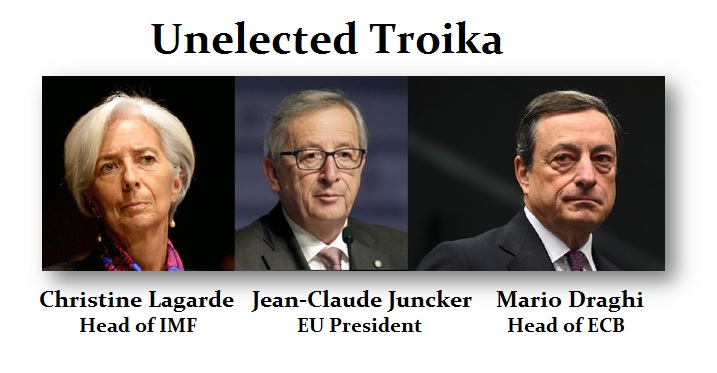
There are many politicians who are against democracy for this is exactly what is going on. We are witnessing an unprofessional and detrimental agenda to the entire business of managing any state. Of course there will be those who instantly say I am referring to Putin. No – this anti-democratic movement applies directly to those in Washington DC as well as Brussels. The very structure of the EU was a deliberate denial of any messy democratic process. The Commission never stands for election. The people can only vote for those in Parliament which has no real vote to do anything but put of a show. The Troika is composed of the head of the ECB, head of the IMF and head of the EU. None of these people are elected.
What is taking place in the United States at this moment indeed exposes the fallacy of democracy. The move to overthrow Trump is the belief that democracy is not fair when one side loses. They refuse to accept anything that Trump promised, and we have women being removed from airplanes for beating up a fellow passenger because he voted for Trump. They really expect that removing Trump will not further divide the country and send it into serious civil unrest. We are witnessing the end of any pretended democratic process.
So why is the press and the Democrats fighting so hard no less the pretend Republicans like John McCain and Lindsey Graham? McCain and Graham are simply against reforming a perfectly good corrupt system where they get all the perks. The Democrats and the Press are in crash mode. They are fighting against extinction.
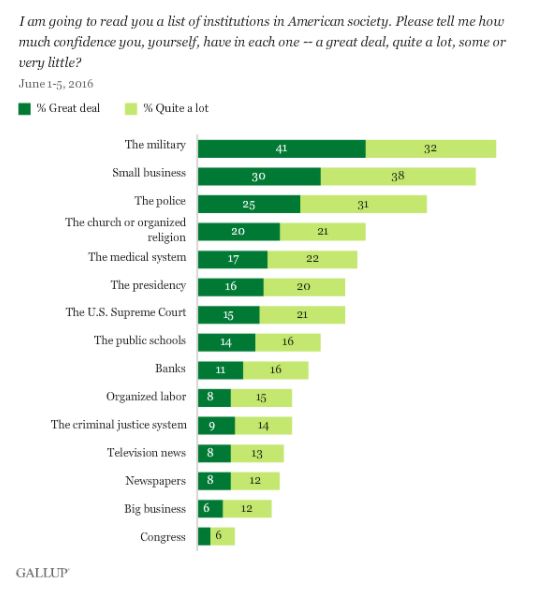
The confidence in the mainstream media is at historic lows. You would think they should look at what they are doing and reflect upon reform. No, they simply go all the way with their bias. The Gallup Pollis now at 32% of the people trust the media.
When we look at the Gallup Poll in the degree of trust people have in Congress, we see an astonishing 6% number.
As the confidence in government and the press collapses, this is what is undermining the future. They are not merely destroying the image of the country while making themselves look like buffoons, they are setting this all up for a collapse in the bond markets and a shift to private assets as we conclude this economic business cycle wave. Confidence in Congress and the Press are collapsing.
The Saudi people and the Kingdom of Saudi Arabia are very proud of what they were able to accomplish during this historic visit by President Donald Trump to the summit of a united Arab coalition. (Summit Production Video):
.
The entire region should be proud.
Despite the popular western dismissive media narrative, the summit was a resounding success. Beyond the royal pageantry, we can only imagine the internal anxiety if our beloved America was defined by the abhorrent behavior of the Westboro Baptist Church.
Consider:
Imprimipostest – This is an incredible American initiative, very pragmatic in its overall tone, yet filled with tremendous theoretical implications for future relations with Near-Eastern Islamic cultures.
Even the iconic symbolism of President Trump, Melania, Ivanka, and those accompanying the President (from the single Marine in dress uniform standing vigilantly behind him when walking down the reception red carpet, to the extremely competent cabinet members accompanying him in the conferences) that has been televised throughout those regions will have dramatic repercussions for the good.
The long-term potential shift of mentality within the general population throughout those regions may now include an enhanced awareness the United States and the true principles upon which it is founded.
As well, such may have implications long-term on how the Qur’an may be interpreted as critical historical scholarship concerning its historical sources and meanings will likely become more thoroughly examined and assimilated. This may be but one of the fruits to emerge from the President’s proposal of establishing a ‘Globalist Center for Combating Extremist Ideology’.
This dramatic American action may well have laid the foundation and conditions for a new and fruitful future for Islam, Israel, and Christianity. (link)
There are sure to be detractors, antagonists, who would choose the dismissive route even amid our own country.
Within that reaction from David Axelrod we find the inherent liberal disconnect known as projection. Notice his use of the term “we”, who said “we”?
President Trump is challenging Islam to cleanse itself of evil, not us; “them“, their fight, their struggle – our support.
[…] The expressed policy outlook of President Trump is for the United States to be the best; and through our actions and behaviors to lead on global initiatives that show how we define ourselves and our values.
This approach is specifically centered around a policy position stating we do not need to demand acceptance of those values, and we respect independent nations’ that may hold values or beliefs not identical to our own.
Secretary of State Rex Tillerson has cultured this approach throughout each of his diplomatic engagements. The U.S. leans forward on all Trump policy objectives through the perspective of our national needs first; but that does not necessarily mean we demand or force other nations into a compliance mindset.
Compliance implies aversarialism. President Trump and Secretary Tillerson do not view international engagements as necessarily adversarial.
The U.S. can engage eye-to-eye with the same level of respect to the smallest as we exhibit toward the largest (our own size does not need to be part of the equation, it is self evident), and work policy objectives toward the point of mutual benefit. If the engaged nation does not receive benefit from the policy, we do not demand an acceptance of it; and more importantly we express both an understanding and a respect of their position and inability.
This Trumpian approach, a willingness not to undermine and to accept the partners downside position within any policy, is grounded on inherent truth.
President Trump and Secretary Tillerson openly accept and admit when the engaged partner will be unable to meet our defined terms; we discuss what actions can be take to remove the inherent obstacle in the future; we make a commitment (or not) toward removing that obstacle; we shake hands and we part company retaining the position of friendship and optimism for the potential of re-engagement at a later date.
[…] This dynamic is unique – because no member of the Trump Administration’s policy team is approaching any of the policies from a position of their own inherent politics. Team Trump, writ large, represents America’s best interests, not the political construct of America’s best interests. [Coincidentally this approach is why Trump has so much domestic opposition]
This non-political approach and simultaneous respect exhibits honesty within the transaction. Yes, both Tillerson and Trump approach politics through the transactional prism, it’s what deal-makers do. (more)
♦”Sorry I don’t know the answer, but Trump does not understand Islam. Wait and see.”
SHARON – If, on the other hand, he does actually understand Islam and as the President of our Sovereign Nation wishes to speak truth to a great assembly of Islamic leaders while demanding their respect and expecting a yielding response, how would he speak differently?
There are people I do not trust as far as I can throw them (including some in my own extended family) but I do not thereby refuse to speak with them or count every occasion in their presence as an opportunity to go after their worst foibles.
Are you assuming that Trump does not understand Islam because he is present with them? Do you assume that he doesn’t understand Chinese Communism because he met with President Xi? Do you assume that he doesn’t understand Catholicism because he won’t (as a Presbyterian) go to the Vatican and preach John Calvin?
Are you projecting your perceptions of what he should do instead of what he did do and assuming that his choice – different than yours – reflects lack of understanding?
This actually is the man who has persisted in stopping/restricting Moslem immigration into the United States. Seems to me that reflects some basic understanding of Islam. (link)
We, the proud deplorables, we band of brothers and sisters, are entirely clear-eyed as to the scope of the challenge. No-one amid our association is naive to the seemingly impossible scale against the backdrop of history.
It may be that their task is impossible. Yet, if they do not try then how will we know it can’t be done? And if they do not try, it most certainly won’t be done…
The pageantry and scale of the royal reception toward President Trump and the U.S. is reflective of much more than a singular presidential visit to a nation and region of geo-strategic importance.
The word “reset” is frequent amid media reporting of the Saudi trip but few people have followed the recent regional history to thoroughly understand what exactly is being reset.
~ President Donald Trump and Saudi King Salman – Joint Statement.
President Trump is being recognized and respected by the regional Arab coalition for his specific approach and outward worldview which is based on eye-to-eye diplomacy.
Through the contacts, discussions, emissary meetings and individual diplomatic engagements over the past six months, the Arab region members of the Gulf Cooperation Council (GCC) -and specifically Saudi Arabia- are overjoyed to find a fresh U.S. perspective based on mutual respect.
The pageantry/scale of the royal reception is directly proportional to the scale of respect being shown by the regional partners toward the worlds largest and most influential leader.
Around the world no-one doubts who is the biggest most significant nation; the size of the U.S. economy speaks for itself. It does not need to be proven – it is self evident.
What is different with the Trump administration as they engage each nation is the change in nationalistic outlook, and specifically foreign policy therein, toward other national leaders as independent sovereign representatives – with respect to their individual cultures and norms.
No longer is the U.S. approaching nations from an inherent need to prove we are ‘better than’, or leverage our interests into their neighborhood.
The expressed policy outlook of President Trump is for the United States to be the best; and through our actions and behaviors to lead on global initiatives that show how we define ourselves and our values. This approach is specifically centered around a policy position stating we do not need to demand acceptance of those values, and we respect independent nations’ that may hold values or beliefs not identical to our own.
Secretary of State Rex Tillerson has cultured this approach throughout each of his diplomatic engagements. The U.S. leans forward on all Trump policy objectives through the perspective of our national needs first; but that does not necessarily mean we demand or force other nations into a compliance mindset.
Compliance implies aversarialism. President Trump and Secretary Tillerson do not view international engagements as necessarily adversarial.
The U.S. can engage eye-to-eye with the same level of respect to the smallest as we exhibit toward the largest (our own size does not need to be part of the equation, it is self evident), and work policy objectives toward the point of mutual benefit. If the engaged nation does not receive benefit from the policy, we do not demand an acceptance of it; and more importantly we express both an understanding and a respect of their position and inability.
This Trumpian approach, a willingness not to undermine and to accept the partners downside position within any policy, is grounded on inherent truth.
President Trump and Secretary Tillerson openly accept and admit when the engaged partner will be unable to meet our defined terms, we discuss what actions can be take to remove the inherent obstacle in the future, we make a commitment (or not) toward removing that obstacle, we shake hands, and we part company retaining the position of friendship and optimism for the potential of re-engagement at a later date.
In all recent previous administrations there was an implied message that engagement with the United States came with terms and conditions that might be antithetical to the sovereign nations’ best interests. If you want “X” (their need) you must deliver “Y” (our need), and the “Y” might be something which creates conflict or tension.
President Trump and Secretary Tillerson ask about the impact of “Y”, the possibility of the downside, prior to making a decision on fulfillment of the request (“X”), but the inquiry does not necessarily preclude our willingness to deliver.
This dynamic is unique to the engaged nation because no member of the Trump Administration’s policy team is approaching any of the policies from a position of their own inherent politics. Team Trump, writ large, represents America’s best interests, not the political construct of America’s best interests. [Coincidentally this approach is why Trump has so much domestic opposition]
This non-political approach and respect, exhibits honesty within the transaction. Yes, both Tillerson and Trump approach politics through the transactional prism, it’s what deal-makers do.
This non-political approach is what causes leaders like Egyptian President Abdel Fattah al-Sisi make the following remarks:
Abdel Fattah al-Sisi: “I first saw the campaign of his excellency President Trump, and I listened to his speech of the neccessity of facing and confronting terrorism all over the world; that he is a great personality and a unique individual, and that he will find great success.”
“I fully trust the capabilities of President Trump, and I have full conviction that he can do things, exert efforts, that very few people can do. And he can succeed in so many fields that others cannot. I trust him wholeheartedly.”
“I followed all his announcements through his campaign, he has a very unique personality and administration, and now I’m speaking with full confidence of unprecedented success for him. He is seeking the interests of the United States and the American people in a very clear manner, and a very direct manner. And a very strong manner as well.”
“His true will is a very strong will to counter terrorism and extremism in the world; and that is a very strong commitment from his excellency the president, and in addition I am very supportive with full force in facing this terrorism.”
“There is a true understanding to the realities in the region, and there is a seriousness and responsible actions in facing extremism and terrorism in the region, and that’s a wonderful thing indeed. There is nothing better than to counter evil.” (link)
QUESTION: Good morning Martin,recently you stated communism originated in France was wondering if you could give us a short history on that sometime.Keep up the good work as always.
W
ANSWER: Communism emerged during the French Revolution. It was an experiment known as the Parisian Commune of 1793. Marx was introduced to the idea whereas Marx had been at first just a socialist. He was converted to communism whereby the government owned all property compared to socialism where you own, are taxed and regulated to prevent you from doing what you would like to do without government permission.
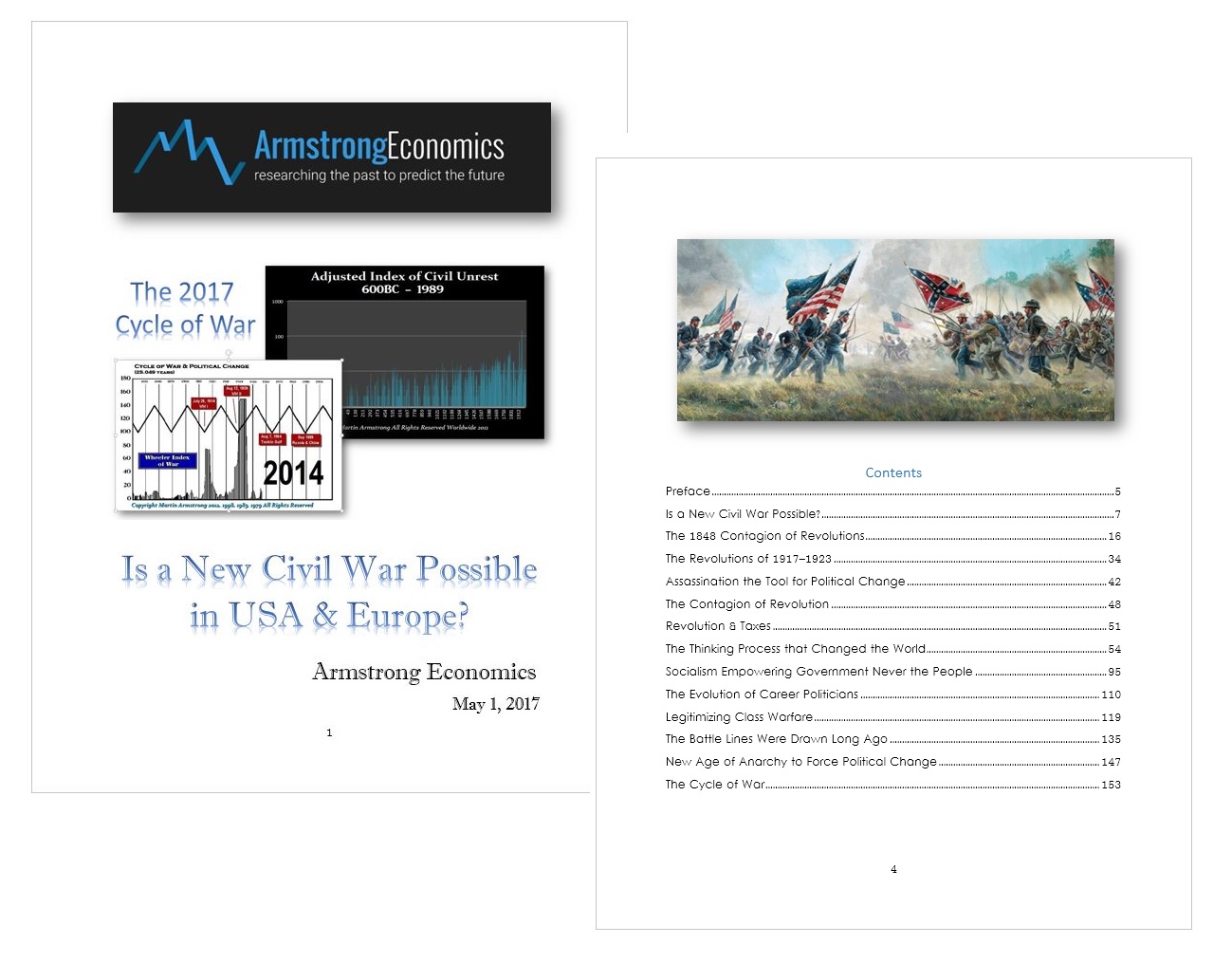
I have gone into the complete history in the 2017 Cycle of War, for this edition deals with civil unrest and revolution.
This will go on sale after the Hong Kong Conference next week
Long time CTH readers will note we extended well over a year of benefit-of-the-doubt to the motives of former FBI Director James Comey with regard to the severity of his politicized nature and disposition. Throughout the entire Clinton investigation we remained ambivalent to Comey’s motives.
Indeed it wasn’t until after the Pulse nightclub terrorist attack when Comey obtusely noted the FBI had been contacted (prior to the attack) about the sketchy behavior of Omar Mateen by a ‘random concerned citizen’ -and our finding that the actual ‘citizen’ was the far more substantive St Lucie county sheriff Ken Mascara– that we recognized how far Comey was willing to go to save his political face.
Yesterday, a friend of James Comey by the name of Benjamin Wittes, editor and writer for lawfare blog, now steps out and admits he was one of the primary sources for the New York Times Comey Memo article (Michael Schmidt); and in so doing outlines the severity of the political nature of the former FBI Director:
[…] I called Schmidt Friday morning after reading his earlier story, which ran the previous evening, about Comey’s dinner with President Trump and the President’s demands at that dinner for a vow of loyalty.
[…] I did this interview on the record because the President that morning was already issuing threatening tweets suggesting that Comey was leaking things, and I didn’t want any room for misunderstanding that any kind of leak had taken place with respect to the information I was providing.
[…] I insisted that Schmidt record the conversation and give me a copy of the recording, so that we had a good record of what was said.
[…] Comey understood Trump’s people as having neither knowledge of nor respect for the independence of the law enforcement function. And he saw it as an ongoing task on his part to protect the rest of the Bureau from improper contacts and interferences from a group of people he did not regard as honorable.
This was a general preoccupation of Comey’s in the months he and Trump overlapped—and the difference between this relationship and his regard for Obama (which was deep) was profound and palpable. (read full article)
The gist of Benjamin Wittes outline is that he interpreted his friend -the magnanimous harbinger of truth, justice and the American way- James Comey, as expressing a feeling of undue potential influence by horrible Trump that Comey did not feel with the more well regarded Obama. etc. etc. {insert pearl-clutching/couch-fainting violin music here}
Except there’s a problem.
Not only did FBI Director James Comey testify to congress that neither President Trump nor President Obama ever attempt interference; but there are earlier media reports which outlined President Obama’s administration specifically interfering with an investigative intention of FBI Director Comey (emphasis mine):
March 29th 2017 – Newsweek: FBI Director James Comey attempted to go public as early as the summer of 2016 with information on Russia’s campaign to influence the U.S. presidential election, but Obama administration officials blocked him from doing so, two sources with knowledge of the matter tell Newsweek.
[…] the source with knowledge of Comey’s request says that the FBI director wanted the Russian interference made public earlier and that it was a sluggish White House that denied Comey and delayed the announcement. “The White House shut it down,” that source says. “They did their usual—nothing.” Both sources spoke to Newsweek on the condition of anonymity because they weren’t authorized to speak to the press. (link)
Funny how FBI Director James Comey, as relayed by his good friend Benjamin Wittes, was concerned about Trump’s potential innuendo of influence, but Director Comey was perfectly okay with Obama’s specific interference to block Comey’s intended investigative action.
Additionally, the New York Times and Washington Post feeder pools are writing articles based on the hearsay recollections of Mr. Comey’s good friend Mr. Wittes. Those feeder stories are fueling second, third, fourth toward infinity level rehashes and revisions of the same structured woe-is-Jim narrative.
When journalists write articles based on media reports of media reports, the concentric circles of self-serving sanctimony expand toward the infinite horizon of nothingness.
Personally, I hope Benjamin Wittes keeps writing on behalf of, and with full approval of, his good friend James Comey. We are bound to find out much more about how severe the former FBI director was willing to go in advancement of his political objectives. After all…
[…] “This was a general preoccupation of Comey’s in the months he and Trump overlapped—and the difference between this relationship and his regard for Obama (which was deep) was profound and palpable”…
All of the daily accusations against Trump, as presented by his political opposition and media, are based on the false premise that President Trump is carrying a malicious intent and self-interest.
His political opposition seem to miss this structural flaw in their argument because they are not familiar with facing a political opponent who is absent of career self-interest, influence or power.
The factual reality that Trump harbors no malicious disposition, evidences itself, and inevitably means all the attacks go nowhere. In every single manufactured media controversy President Trump is inherently never in a position where he is personally gaining from the details within the controversy du jour.
[…] Political Trump uses this “intent” and “motive” approach to draw attention to his opponents, and it is structurally successful because the opposition is, FACTUALLY, always holding a motive.
When political Trump gets to the point where he’s ready to crush his opposition he simply points out their obvious motive and intent; it becomes common sense for the observing public to see it. Trump’s opposition cannot do the same. (more)
President Donald Trump held an informal luncheon with news reporters and TV anchors today in advance of the upcoming international visit. Brett Baier reports President Trump was relaxed, warm and comfortable and showing no change in disposition from all prior encounters. Most of the discussion was off the record, however the president did release the following response to a question from one of the participants at the meeting:
Reporter Question: “You made a point about the special counselor and and you believe it hurts this country” —
President Trump: “I believe it hurts our country terribly, because it shows we’re a divided, mixed-up, not-unified country. And we have very important things to be doing right now, whether it’s trade deals, whether it’s military, whether it’s stopping nuclear… all of the things that we discussed today. And I think this shows a very divided country.
It also happens to be a pure excuse for the Democrats having lost an election that they should have easily won because of the Electoral College being slanted so much in their way. That’s all this is. I think it shows division, and it shows that we’re not together as a country. And I think it’s a very, very negative thing. And hopefully, this can go quickly, because we have to show unity if we’re going to do great things with respect to the rest of the world.”
U.S. Secretary of State Rex Tillerson and Department of Homeland Security Secretary John F. Kelly hold a press conference with Mexican Foreign Secretary Luis Videgaray and Mexico’s Secretary of Government Miguel Angel Osorio Chong.
President Trump has instructed the State Department and DHS to initiate a new -more aggressive- posture toward the elimination of drugs. The United States is now developing new strategies to directly combat Mexican drug cartels, including cash flow, banks, cross-border incursions, and political corruption.
This press conference happens on the same day that U.S. Trade Representative Robert Lighthizer and Commerce Secretary Wilbur Ross jointly travel to the U.S. Senate to initiate starting the clock (intent notification to senate) for the 90-period prior to reopening NAFTA.
.
Combating violent drug cartels, securing the southern U.S. border and the new NAFTA trade agreement are all extremely important undertakings. That said, look at the poor media attendance. Update: Transcript Added
SECRETARY TILLERSON: Morning, all, and thank you for coming. I appreciate the opportunity to meet again with Foreign Secretary Videgaray and Secretary of the Interior Osorio, and I also want to express my appreciation for the entire Mexican delegation who made the trip up to Washington, D.C. today for very, very useful and fruitful conversations. Also want to thank my colleague, Secretary Kelly, and the representatives of the Department of Homeland Security who participated today, as well as Treasury, who had participants here in our dialogue.
Both Mexico and the United States are focused on destroying the criminal organizations that bring drugs into the United States and carry out violence across Mexico. We will keep our commitments to protecting our people from lawlessness, drugs, and criminal violence. Almost 20,000 Americans died from overdoses of heroin or synthetic opioids, including fentanyl, in 2015. An estimated 100,000 Mexicans have died in drug-related violence since 2006, many of them brave members of law enforcement who died in the line of duty, and we honor their sacrifice.
America must also confront the reality that we are the market, but for the seemingly endless demand by addicted users and the successful recruitment of young and vulnerable new users, there would be no market. We as Americans, parents, and friends of those who become addicted or would-be targets, must take new approaches as well. We Americans must own this problem. It is ours.
Stopping the cross-border flow of drugs is an essential step in putting an end to widespread addiction and drug-related violence. Too many families in America have been devastated by illegal drugs and we must stop this epidemic in its track. No parent should endure the nightmare of a child succumbing to drug addiction. By aggressively confronting the cartels operating in the United States and Mexico, we’re striving to stop merchants of death who have already helped cause unspeakable pain to so many on both sides of the border.
Today, we identified fresh strategies to attack the business model of these multi-billion dollar criminal organizations with particular emphasis on cash flow and the flow of weapons. We will work with Mexico to refocus assistance on better disrupting the business model of the traffickers. We will attack their means of production, their cross-border distribution networks, their cash flow and their weapons procurement.
The Trump administration’s efforts to fight the demand for these devastating drugs and the criminal activity and drug trafficking at the Mexican border and elsewhere has only just begun. We will continue to partner with Mexico to disrupt and destroy the criminal organizations which threaten our citizens, our communities, and our country, and we will commit to addressing the pervasive demand for illicit drugs among our fellow citizens. Thank you.
FOREIGN SECRETARY VIDEGARAY: Thank you very much. Thank you, Secretary Tillerson, for hosting us. Thank you, Secretary Kelly, for being here. And for all the – to all the people involved from the U.S. Government as well as the Mexican agencies that participated in this meeting today, thank you very much.
I will switch to Spanish in a moment to refer to the conversation that we just had here at the State Department, but before doing that, let me refer to something that just happened today, which is very important to the U.S.-Mexico relationship and to North America. And today, as you all know, the U.S. Trade Representative sent notice to the U.S. Congress about its intention to start the process of NAFTA renegotiation. The Government of Mexico welcomes this development; we are prepared; we are ready. This is to work together with both the governments of the U.S. and Canada to make our trade agreement better – better for the people of Mexico, the people of the U.S., and the people of Canada.
And we understand that this is a 25-year-old agreement, when it was negotiated. The world has changed, we’ve learned a lot, and we can make it better. We can make this a negotiation that is good for the three parties involved, certainly, under a win-win framework. The ministry of the economy in Mexico, la secretaria de economia, will lead the process. We have a very capable negotiating team. And we’ll approach this process constructively and we are sure that this is going to be a step towards improving our relationships and building a future together.
Now, if you’ll allow me, I will switch to Spanish.
(Via interpreter) Today, we have taken one more step in the building of a new bilateral relationship between Mexico and the United States – a broad, deep, and undoubtedly complex relationship, a relationship with many angles, and all of them from a comprehensive perspective we are working. Just as for trade there is a process underway, also our cooperation on the issue of security and especially in the fight against criminal organizations operating in both territories and other regions of the world is an essential element of our cooperation. Today’s discussions were based on previous discussions – in particular, the meeting where we had the honor of counting with Secretaries Tillerson and Kelly in the City of Mexico, where we decided to discuss this shared problem from the perspective of a team and a comprehensive approach, understanding all of the components of the problem. Today we had an analysis meeting with shared diagnoses so as to build a new shared strategy.
While it was not a meeting where we reached new agreements or where specific strategies were developed, it was indeed a meeting where we were able to achieve fundamental agreements on the nature of the problem, on our diagnostics, and also an understanding that we need to tackle jointly all of the elements in the chain of this criminal business model. We need to overcome the blame game and the finger-pointing aspect. We must understand that every demand creates supply and every supply creates demand. If the governments of Mexico and the United States discuss who’s to blame, who’s responsible, the only one who wins is organized crime that is bringing violence and death on both sides of the border.
The time has come for us to dare think in a different way. We need to trust more in ourselves and work jointly on all of the elements in this production chain, starting with the crops, the importation of material, production, financial flows of cash, flows of weapons, and of course, the problem of demand, which is at the root of this scourge which has cost so much to both countries. We will continue to work. Undoubtedly, it is a long path ahead, but today we have taken an important step by establishing together the diagnosis and undertaking the commitment – the commitment for both governments to work together as a team to face this problem, which is a problem of everyone.
I’d like to express my thanks to the different areas of the Mexican Government, the secretary of government, and other areas of our government who are represented here – with the ministry of finance, the general prosecutor’s office, the financial intelligence agency – with the objective of reaching shared diagnostics. They will continue to work jointly on the process.
Finally, and from this podium, I’d like to acknowledge the Mexican armed forces which for years have been an essential pillar in the fight against this serious phenomenon and which, with their lives and their effort, have shown their love for their motherland, so our gratitude and highest level of recognition to them for their participation in this action.
Thank you very much, Secretary Tillerson. Thank you, Secretary Kelly.
SECRETARY KELLY: Well, thank you for that. It’s certainly a great pleasure for me to be meeting with our good friends again from Mexico. In my previous life, I served at the SOUTHCOM – as the SOUTHCOM commander. During that period of time, I built relationships with the Government of Mexico and particularly with the military and the police that serve Mexico, and I would like to add my voice to the minister’s voice, to the Secretary’s voice, about the brave men and women in the Mexican armed forces and police that have done so much to protect your country and to provide leadership in the region. You’ve lost many, many hundreds of men and women in this fight against these terrible scourges.
One of my first stops – well, my first stop, actually, as the Secretary of Homeland Security was to Mexico City, as has been referenced, to meet with the foreign secretary and many others in the Mexican Government, to include the president. We are in constant contact – I am, my department is – with our counterparts in Mexico, and our people, Mexican and Americans, work together every day, whether it’s to deal with drug smuggling or human smuggling or terrorism.
Our working relationship is vitally important and it is a very, very good one. Part of that is because of our collaboration is built on co-responsibility. We must own the problems of cartels and the solutions to deal with those cartels. While the United States is indeed the magnet that feeds drug smuggling through Central and South America, and all the ills that are associated with that activity, it is mostly our friends in Mexico and to the south that feel the brunt of the violence and the crime.
We are attacking the cartels in many ways, including to attack their business models, attacking their financing, attacking their funding, attacking their ability to run a profitable criminal business, and it has been successful to a degree, and we will continue – as you have heard up here, we’ll continue that, deepen it, and broaden it, with some very, very innovative new ideas.
Now, while the specific focus today was on the cartels and other aspects of the drug trade, this is an indication of the broadened number of issues we – the United States and Mexico – work with every single day.
I look forward to working with my Mexican friends later this summer when they are participating – indeed, co-sponsoring a Central American Security and Prosperity conference in Miami, where a wide range of security issues will be on the agenda, including transnational criminal organizations. This will be an opportunity to bring Mexico and their fantastic leadership team together on these issues as we deal with the problems of security and economic conditions in the Northern Triangle countries. And we’ll try to address the regional threats to security and stability. We are excited – I am personally excited to have Mexico as a partner at that conference.
And so I will close by saying thank you, secretaries, and Rex Tillerson as well, for this opportunity to collaborate in this very, very important endeavor. Thank you.
GOVERNMENT SECRETARY OSORIO: (Via interpreter) Good afternoon, Secretary Tillerson, Secretary Kelly, Secretary Videgaray. Today, representatives from both countries, as it was already said – we had a follow-up meeting, and we addressed one of the most important issues in our bilateral agenda, which is the joint activities to combat organized crime related to drug trafficking. This phenomenon is one of the largest risks to the health, security, and of course, for the development of the peoples in Mexico and the U.S.
During this meeting, the representatives of Mexico expressed our vision and our experience in the fight against organized crime. And as a result of this, both countries have agreed how urgent it is to work on a bi-national level in a more equitable way, as Secretary Videgaray just said, and we have to work in a comprehensive manner. We understand the decision and the commitment of Secretary Tillerson and Secretary Kelly to look for new ways to address this issue. We have found in them a shared vision and a spirit of cooperation. We agreed how important it is to address the whole chain of supply and to fight the organized crime organizations that operate on both sides of the border.
It is a meeting that would – that allowed us to work on an issue that affects both countries, that generates violence, that calls for a lot of resources on both countries. And if we cannot coordinate in an efficient manner, and if we don’t share information, we won’t be able to progress.
I think that this meeting gives us a good path to follow in the fight against the drug trafficking, and it’s very important for both countries and the continent.
MS NAUERT: We’ll open it up to questions now. If you could please ask your question – direct your question to one minister at a time. We’ll start first with Felicia Schwartz from The Wall Street Journal. Felicia.
♦ QUESTION: Thank you. Secretary Tillerson, this is at least the third time that the President has made an announcement ahead of your talks with the Mexicans that could sour them. When you flew to Mexico, he said that he would deport all migrants there, which the Mexicans didn’t appreciate. He signed an executive order about the wall when the foreign minister was in town, and then this morning told Congress that he’d renegotiate NAFTA. Are you going to be able to negotiate with Mexico when the President keeps stepping on your toes?
MR VIDEGARAY: I want to say something.
SECRETARY TILLERSON: Okay.
♦ QUESTION: And also, to Mr. Foreign Minister: Are the Americans negotiating in good faith, and what did you say about NAFTA in your meetings?
SECRETARY TILLERSON: Well, I hope what this morning’s press avail with you is demonstrating is that there are a broad range of issues of great importance and common concern between the United States and Mexico. Obviously, trade is an important, extremely important, issue. And I think the filing of the authorities with the Congress this morning to start moving towards a fast-track authority is a very positive move, and I think it does demonstrate a sincere effort on the part of the President. And I’ll leave it to those who will be involved directly in those discussions to comment in the future about those.
But what I would tell you is I hope what you take away from today is an understanding that there is much more to the U.S. relation – U.S.-Mexico relationship than just NAFTA. The wall does not define our relationship. We have so many areas of mutual interest, and I think the focus on trans-criminal organizations, the focus on the devastating effect that drug trafficking, illicit trafficking of drugs, and other illicit trafficking through organized crime is affecting both of our countries in very tragic ways. And I think what – we had a spirit today of very open, very frank, very candid conversations about where we have succeeded in the past, what is standing in the way of our success in the future, and I think a very strong willingness – and you’ve heard this expressed, I think, in the comments of both secretaries from Mexico – a very strong commitment to overcoming whatever those obstacles may have been in the past. Whether it be in sharing of intelligence information, sharing of resources, we have one common objective here, and this is to end the tragic impacts of illicit drug trade on both sides of our border. We know what we own, and we as Americans need to confront that we are the market. There is no other market for these activities. It is all coming here. But for us, Mexico wouldn’t have the trans-criminal organized crime problem and the violence that they’re suffering. And it’s – we really have to own up to that.
So I think we’ve had very open, frank conversations. There are so many areas of cooperation between our two countries, and we’re going to focus on those that we can make progress on now. And there will be other talks to make progress on other areas of importance, including the renegotiation, restructuring of NAFTA.
FOREIGN SECRETARY VIDEGARAY: Let me just be really clear about this. We’ve been informed all along the way, at each and every step of the process of sending the notice that happened today by the USTR’s office, by the Department of Commerce, and by the White House. And let me say something else: This is something that we very much welcome, and this is a development that we’ve been waiting for for quite some time. It’s good news for Mexico and we are willing and we are prepared to start the constructive negotiation once the 90 days period go by. This will be mid-August, and we’re ready to go. So this is – what happened today, what the USTR sent to Congress, is something that is a significant net positive for the Mexico-U.S. relationship, and we will build upon that.
MODERATOR: (Via interpreter) We give the floor to Jose Diaz Briseno from newspaper Reforma.
♦ QUESTION: Secretary Videgaray, the Mexican – sorry – the U.S. Government continues to toy with the idea of splitting NAFTA into two bilateral agreements and not just one trilateral. Is this an up-jump for Mexico?
And Mr. Tillerson, journalists in Mexico are being killed at record numbers. This week, probably one of the most important reporters covering the drug trade was killed in Mexico. Will you raise this issue with the Mexican Government of effectively prosecuting these crimes?
FOREIGN SECRETARY VIDEGARAY: (Via interpreter) Thank you. NAFTA is a trilateral agreement and the conversations need to be trilateral in nature. This is our position. And what we have heard from the United States Government, especially from Wilbur Ross, the secretary of trade, is that the United States does not have a preference in one sense or another. We do have a preference. The agreement is trilateral and should continue to be a trilateral platform. Why? Because this is what allows us to maximize the competitive potential of the region that should be the most competitive one in the world, North America. Chains of value are highly integrated, especially with regards to manufacturing, and this would allow us to have the best platform to continue to work in this regards.
We need to acknowledge that, even with the current treaty, there are certain aspects that apply only bilaterally. Each of the countries excluded, at the time, over 20 years ago, certain sectors from the agreement. Some sectors in Mexico have a special treatment as a result of the agreement. So within the framework of the agreement, there could be certain issues that are bilateral in nature between Mexico and the United States, or Mexico and Canada, or Canada and the United States. But our preference is clear: We believe the framework of a trilateral agreement is the most suitable and the most convenient for the peoples of Mexico, Canada, and the United States.
SECRETARY TILLERSON: With respect to the tragic death of the important journalist in Mexico, we offer our deepest condolences, certainly to the loved ones and the family members. And it is, yet again, another tragic loss among journalists but also many others as a result of the violence related to the illicit drug trade. I think in terms of how we address that, we had very good discussion about how do we improve the information-sharing among law enforcement agencies on both sides of the border, because these cartels and organizations operate across the border as well. And we discussed how do we identify those organizational connections, how do we share information that will allow us to better identify who is responsible, have those people arrested and brought to justice.
Similarly, we had discussions around how to strengthen the judicial system, and we know that Mexico has a draft law and – for consideration that would allow the seizure of property and assets of those who have been arrested and charged in the illicit drug trade. We have similar laws in this country, and we have encouraged Mexico to proceed with the enactment of that law as well. So there has been very good sharing among ideas on the law enforcement side as well and the justice side, so we are working together cooperatively to attack the problem.
MS NAUERT: Rich Edson from Fox News.
♦ QUESTION: Secretary Kelly and Secretary Tillerson, given the frequency with which you both interact with foreign counterparts, as evidenced by today and much of what’s involved in your everyday work, and given the investigations, the former FBI director’s memo, and all that’s happening domestically ahead of the President’s first foreign trip with significant meetings scheduled with foreign leaders, has the President lost leverage or credibility, and have these issues hampered efforts that you have with international counterparts? Thank you.
SECRETARY KELLY: Can I go first?
SECRETARY TILLERSON: Yep, go ahead. I’ll go when —
SECRETARY KELLY: No. I would tell you, I just actually returned from a trip I took to Jordan and Saudi Arabia, and they are so looking forward in that part of the world to the arrival of the President and the gesture of where he’s going first. I could say the same thing about the Israelis and others. I’ll let the Secretary of State answer that.
But no, I interact with a fairly large number of international players, often – most often by phone, but Europeans, Latin Americans, Central Americans, Africans, I mean across the globe – and they are working with us as partners on a range of issues – aviation security, drugs as you’ve heard here today, immigration. So I feel no effect at – from when the President is, say, taken to task in the press about something he may or may not have said, and certainly something he may or may not have meant. So —
♦ QUESTION: On intelligence sharing, sir?
SECRETARY KELLY: Am I concerned about intelligence sharing?
♦ QUESTION: Are foreign countries concerned about sharing intelligence with the U.S.?
SECRETARY KELLY: We share – and as I say, I interact with a great many foreign leaders at the ministerial level, my counterparts, and I share as much information with them as our laws allow, and they are open to that. In those places I cannot share more, they understand that, and the fact that this country, my department, our President, has the safety of our citizens and their citizens number one in his mind.
SECRETARY TILLERSON: I guess I would characterize the expectation among the rest of the world and whether – and I have had the opportunity now to pretty well interact and meet with leaders from Europe to Russia to Central Asia to the Middle East, to Africa, to Southeast Asia, Northeast Asia, so I have a pretty good exposure now to the – globally to how the world is seeing the current administration.
And what I would tell you is there is a great sense of expectation and I think a great welcomeness of America returning to the scene. Many of the leaders, particularly in the part of the world we’ll be traveling – the Middle East, Central Asia, and even parts of Africa – are ready for a period of what they view to have been neglect to outright dismissal of their concerns. They’re ready for re-engagement with America.
And so I think there is a great anticipation of the President’s trip as to what could be accomplished, and we in our dialogues have identified much that can be accomplished when we work together. And that is the purpose of this trip, is really one of conveying a message that America is back in terms of our role as a convener, our role as a facilitator to address the daunting challenges that exist in that part of the world, most particularly the challenge of global terrorism and how we confront global terrorism as a global peoples. It is not just one nation’s challenge; it is one that’s shared by all of us.
And I think the importance of this trip and President Trump’s leadership around bringing people the world over to understand we are in this together. This is not a battle about religions. This is not a battle about cultures. This is a battle about good and evil. And their – the goodness of people of all faiths will prevail over this evil, and that is the President’s message he’ll be taking. And he will be convening people globally to confront this face of evil wherever it presents itself in the world. There is a great anticipation around that leadership.
♦ QUESTION: And is the domestic (inaudible)?
SECRETARY TILLERSON: I think the people in the rest of the world take – do not have the time to pay attention to what’s happening domestically here. They are more concerned about what they see happening in the relationship with their country and what we are bringing to address these very serious challenges that are affecting all of us.
MS NAUERT: Rich, thank you.
MODERATOR: (Via interpreter) The last question by Ruben Barrera from Notimex. Go ahead, please.
♦ QUESTION: (Via interpreter) Thank you. Secretary Osorio, I would like to see if you could explain when you said that you would like to see a bi-national effort that is more balanced, what do you mean by that? And what would be the possible changes that could happen vis-a-vis how the Mexican Government is fighting the drug trafficking organizations based on the start of these comments.
(In English) And for you, Secretary Kelly, the Trump administration has been talking a lot about the drop in illegal crossings because of the policy that President Trump has announced on the immigration front. But we have not heard anything regarding drugs. My question is why, and if – can we expect to see a significant drop on drugs issue across the south border after the wall is finished, maybe by the end of this administration?
GOVERNMENT SECRETARY OSORIO: (Via interpreter) When we were taking this dialogue, we talked about the costs to the U.S. and to Mexico, the issue of the drugs. We are talking about human cost in the U.S. because of consumption and human loss in Mexico on the side of the armed forces and the law enforcement and different organizations that fight organized crime. So we can’t just talk about unilateral actions under U.S. or Mexico; we have to have very strong actions based on actions for both. We have to share information and we have to reach agreements that will – would not allow access to market to these organizations. And Mexico is part of the problem. Production has to be curtailed. So, basically, that’s the balance that we have to achieve, and it has to be based on these comprehensive talks, as Secretary Videgaray said.
One of the issues is security. We have to work on that because we don’t want to give the idea that this violence is not being addressed on our side, and this is why we talked about the comprehensive issue on all the problems that both sides face and what are the alternatives that we could find to solve this issue together.
SECRETARY KELLY: On the issue of the smuggling of drugs into the United States, we already do a great deal at the border, and not alone. We do it with our Mexican counterparts to the south. The vast majority of hard drugs – methamphetamines, cocaine, and heroin – come up smuggled primarily in vehicles – trucks, that kind of thing – oftentimes with the – particularly in the commercial trucks. Oftentimes the driver doesn’t even know that they’re in there.
So the first point, or the – let me start at the end. The end is to get after the TCOs, transnational criminal organizations, the networks in Mexico and in the United States. That’s the last thing. The first thing we need to do, because it is – it generates all of the problems, and that is the drug demand in the United States. And not only the drugs that are used by addicts, but the recreational use of drugs – if Americans understood that playing around with drugs on a weekend for fun ultimately ends or results in the lives lost in Mexico by law enforcement and by the military, or lives lost in Colombia or Central America – if Americans understood that recreational playing around with drugs is resulting in the deaths of reporters and media people throughout the region, but particularly, unfortunately, in Mexico right now; police officers; as I say, soldiers; prosecutors, judges – if Americans that use drugs recreationally understood that and stopped doing that, that would significantly reduce the amount of drugs and, consequently, the amount of profits that come out of the United States.
So the most important thing we can do is reduce the drug demand. We’ve never tried it, we’ve never done it. We have to have – develop a comprehensive drug demand reduction program in the United States that involves everybody – involves professional sports, Hollywood; involves governors, mayors; involves parents, priests; involves everybody. We can reduce the amount of drugs consumed in the United States significantly – never go to zero, but we can reduce it. But until we do, we’ll be fighting at best a neutral battle on the border. The drug traffickers are extremely agile, extremely innovative in how they do business, incredibly brutal. If you won’t take their bribes and their money, they’ll kill your daughter and make their point that way. So it’s all about drug demand and drug demand reduction.
♦ QUESTION: (Off-mike.)
SECRETARY KELLY: No, the physical barriers work. Where there is – there are 650 miles of physical barrier already on the southwest border between the United States and Mexico, all of that built previous to this administration. So there is use for physical barrier. There’s also use for technology. There’s – to say the least, there’s use in terms of the collaboration between Mexican authorities and U.S. authorities. And then, obviously, it’s all about people that patrol, talk to each other; police actions on both sides of the border. So there’s no one single solution to this. It’s a multifaceted problem and it needs multifaceted solutions.
MS NAUERT: Thank you. That’s all we have time for.
Appearing tonight on the Sean Hannity TV show on Fox News, former Ohio democrat congressman Dennis Kucinich states he believes the unelected institutional Washington DC based bureaucratic system known as “deep state” is attempting to destroy the presidency of Donald Trump.
People within Deep State institutions attempting to damage President Trump because he is an existential threat to their interests.
Understanding The UniParty “DEEP STATE” – During the time in 2011 when political warfare over the debt ceiling was beginning to paralyze the business of governance in Washington, the United States government somehow summoned the resources to overthrow Muammar Ghaddafi’s regime in Libya, and, when the instability created by that coup spilled over into Mali, provide overt and covert assistance to French intervention there.
At a time when there was heated debate about continuing meat inspections and civilian air traffic control because of the budget crisis, our government was somehow able to commit $115 million to keeping a civil war going in Syria and to pay at least £100m to the United Kingdom’s Government Communications Headquarters to buy influence over and access to that country’s intelligence.
Since 2007, two bridges carrying interstate highways have collapsed due to inadequate maintenance of infrastructure, one killing 13 people. During that same period of time, the government spent $1.7 billion constructing a building in Utah that is the size of 17 football fields.
This mammoth structure is intended to allow the National Security Agency to store a yottabyte of information, the largest numerical designator computer scientists have coined. A yottabyte is equal to 500 quintillion pages of text. Yes, they need that much storage to archive every single trace of your electronic life.
Yes, there is another government concealed behind the one that is visible at either end of Pennsylvania Avenue, a hybrid entity of public and private institutions ruling the country according to consistent patterns in season and out, connected to, but only intermittently controlled by, the visible state whose leaders we choose.
[…] The Deep State does not consist of the entire government. It is a hybrid of national security and law enforcement agencies: the Department of Defense, the Department of State, the Department of Homeland Security, the Central Intelligence Agency and the Justice Department. I also include the Department of the Treasury because of its jurisdiction over financial flows, its enforcement of international sanctions and its organic symbiosis with Wall Street. All these agencies are coordinated by the Executive Office of the President via the National Security Council.
Certain key areas of the judiciary belong to the Deep State, such as the Foreign Intelligence Surveillance Court, whose actions are mysterious even to most members of Congress. Also included are a handful of vital federal trial courts, such as the Eastern District of Virginia and the Southern District of Manhattan, where sensitive proceedings in national security cases are conducted.
The final government component (and possibly last in precedence among the formal branches of government established by the Constitution) is a kind of rump Congress consisting of the congressional leadership and some (but not all) of the members of the defense and intelligence committees.
The rest of Congress, normally so fractious and partisan, is mostly only intermittently aware of the Deep State and when required usually submits to a few well-chosen words from the State’s emissaries.
[T]he Deep State does not consist only of government agencies. What is euphemistically called “private enterprise” is an integral part of its operations. In a special series in The Washington Post called “Top Secret America,” Dana Priest and William K. Arkin described the scope of the privatized Deep State and the degree to which it has metastasized after the September 11 attacks.
There are now 854,000 contract personnel with top-secret clearances — a number greater than that of top-secret-cleared civilian employees of the government. While they work throughout the country and the world, their heavy concentration in and around the Washington suburbs is unmistakable: Since 9/11, 33 facilities for top-secret intelligence have been built or are under construction. Combined, they occupy the floor space of almost three Pentagons — about 17 million square feet.
Seventy percent of the intelligence community’s budget goes to paying contracts. And the membrane between government and industry is highly permeable: The Director of National Intelligence, James R. Clapper, is a former executive of Booz Allen Hamilton, one of the government’s largest intelligence contractors. His predecessor as director, Admiral Mike McConnell, is the current vice chairman of the same company; Booz Allen is 99 percent dependent on government business.
These contractors now set the political and social tone of Washington, just as they are increasingly setting the direction of the country, but they are doing it quietly, their doings unrecorded in the Congressional Record or the Federal Register, and are rarely subject to congressional hearings.
Washington is the most important node of the Deep State that has taken over America, but it is not the only one. Invisible threads of money and ambition connect the town to other nodes. One is Wall Street, which supplies the cash that keeps the political machine quiescent and operating as a diversionary marionette theater.
Should the politicians forget their lines and threaten the status quo, Wall Street floods the town with cash and lawyers to help the hired hands remember their own best interests. The executives of the financial giants even have de facto criminal immunity.
On March 6, 2013, testifying before the Senate Judiciary Committee, Attorney General Eric Holder stated the following: “I am concerned that the size of some of these institutions becomes so large that it does become difficult for us to prosecute them when we are hit with indications that if you do prosecute, if you do bring a criminal charge, it will have a negative impact on the national economy, perhaps even the world economy.”
This, from the chief law enforcement officer of a justice system that has practically abolished the constitutional right to trial for poorer defendants charged with certain crimes. It is not too much to say that Wall Street may be the ultimate owner of the Deep State and its strategies, if for no other reason than that it has the money to reward government operatives with a second career that is lucrative beyond the dreams of avarice — certainly beyond the dreams of a salaried government employee.
The corridor between Manhattan and Washington is a well trodden highway for the personalities we have all gotten to know in the period since the massive deregulation of Wall Street: Robert Rubin, Lawrence Summers, Henry Paulson, Timothy Geithner and many others.
Not all the traffic involves persons connected with the purely financial operations of the government: In 2013, General David Petraeus joined KKR (formerly Kohlberg Kravis Roberts) of 9 West 57th Street, New York, a private equity firm with $62.3 billion in assets. KKR specializes in management buyouts and leveraged finance. General Petraeus’ expertise in these areas is unclear. His ability to peddle influence, however, is a known and valued commodity.
Unlike Cincinnatus, the military commanders of the Deep State do not take up the plow once they lay down the sword. Petraeus also obtained a sinecure as a non-resident senior fellow at the Belfer Center for Science and International Affairs at Harvard. The Ivy League is, of course, the preferred bleaching tub and charm school of the American oligarchy.
Petraeus and most of the avatars of the Deep State — the White House advisers who urged Obama not to impose compensation limits on Wall Street CEOs, the contractor-connected think tank experts who besought us to “stay the course” in Iraq, the economic gurus who perpetually demonstrate that globalization and deregulation are a blessing that makes us all better off in the long run — are careful to pretend that they have no ideology.
Their preferred pose is that of the politically neutral technocrat offering well considered advice based on profound expertise. That is nonsense. They are deeply dyed in the hue of the official ideology of the governing class, an ideology that is neither specifically Democrat nor Republican.
Domestically, whatever they might privately believe about essentially diversionary social issues such as abortion or gay marriage, they almost invariably believe in the “Washington Consensus”: financialization, outsourcing, privatization, deregulation and the commodifying of labor. Internationally, they espouse 21st-century “American Exceptionalism”: the right and duty of the United States to meddle in every region of the world with coercive diplomacy and boots on the ground (keep reading).
En route back to the White House from the Coast Guard commencement address, White House Press Secretary gives a brief presser aboard Air Force-1 (Audio Below):
I have created this site to help people have fun in the kitchen. I write about enjoying life both in and out of my kitchen. Life is short! Make the most of it and enjoy!
This is a library of News Events not reported by the Main Stream Media documenting & connecting the dots on How the Obama Marxist Liberal agenda is destroying America







 Understanding The UniParty “DEEP STATE”


 Centinel2012