President Trump Davos Speech During World Economic Forum…


Earlier today President Trump delivered a speech at the World Economic Forum in Davos, Switzerland. (Video and Transcript below)

[Transcript] 2:02 P.M. – PRESIDENT TRUMP: Thank you, Klaus, very much. It’s a privilege to be here at this forum where leaders in business, science, art, diplomacy, and world affairs have gathered for many, many years to discuss how we can advance prosperity, security, and peace.

I’m here today to represent the interests of the American people and to affirm America’s friendship and partnership in building a better world.

Like all nations represented at this great forum, America hopes for a future in which everyone can prosper, and every child can grow up free from violence, poverty, and fear.

Over the past year, we have made extraordinary strides in the U.S. We’re lifting up forgotten communities, creating exciting new opportunities, and helping every American find their path to the American Dream — the dream of a great job, a safe home, and a better life for their children.

After years of stagnation, the United States is once again experiencing strong economic growth. The stock market is smashing one record after another, and has added more than $7 trillion in new wealth since my election. Consumer confidence, business confidence, and manufacturing confidence are the highest they have been in many decades.

Since my election, we’ve created 2.4 million jobs, and that number is going up very, very substantially. Small-business optimism is at an all-time high. New unemployment claims are near the lowest we’ve seen in almost half a century. African American unemployment has reached the lowest rate ever recorded in the United States, and so has unemployment among Hispanic Americans.

The world is witnessing the resurgence of a strong and prosperous America. I’m here to deliver a simple message: There has never been a better time to hire, to build, to invest, and to grow in the United States. America is open for business, and we are competitive once again.

The American economy is by far the largest in the world, and we’ve just enacted the most significant tax cuts and reform in American history. We’ve massively cut taxes for the middle class and small businesses to let working families keep more of their hard-earned money. We lowered our corporate tax rate from 35 percent, all the way down to 21 percent. As a result, millions of workers have received tax cut bonuses from their employers in amounts as large as $3,000.

The tax cut bill is expected to raise the average American’s household income by more than $4,000. The world’s largest company, Apple, announced plans to bring $245 billion in overseas profits home to America. Their total investment into the United States economy will be more than $350 billion over the next five years.

Now is the perfect time to bring your business, your jobs, and your investments to the United States. This is especially true because we have undertaken the most extensive regulatory reduction ever conceived. Regulation is stealth taxation. The U.S., like many other countries, unelected bureaucrats — and we have — believe me, we have them all over the place — and they’ve imposed crushing and anti-business and anti-worker regulations on our citizens with no vote, no legislative debate, and no real accountability.

In America, those days are over. I pledged to eliminate two unnecessary regulations for every one new regulation. We have succeeded beyond our highest expectations. Instead of 2 for 1, we have cut 22 burdensome regulations for every 1 new rule. We are freeing our businesses and workers so they can thrive and flourish as never before. We are creating an environment that attracts capital, invites investment, and rewards production.

America is the place to do business. So come to America, where you can innovate, create, and build. I believe in America. As President of the United States, I will always put America first, just like the leaders of other countries should put their country first also.

But America first does not mean America alone. When the United States grows, so does the world. American prosperity has created countless jobs all around the globe, and the drive for excellence, creativity, and innovation in the U.S. has led to important discoveries that help people everywhere live more prosperous and far healthier lives.

As the United States pursues domestic reforms to unleash jobs and growth, we are also working to reform the international trading system so that it promotes broadly shared prosperity and rewards to those who play by the rules.

We cannot have free and open trade if some countries exploit the system at the expense of others. We support free trade, but it needs to be fair and it needs to be reciprocal. Because, in the end, unfair trade undermines us all.

The United States will no longer turn a blind eye to unfair economic practices, including massive intellectual property theft, industrial subsidies, and pervasive state-led economic planning. These and other predatory behaviors are distorting the global markets and harming businesses and workers, not just in the U.S., but around the globe.

Just like we expect the leaders of other countries to protect their interests, as President of the United States, I will always protect the interests of our country, our companies, and our workers.

We will enforce our trade laws and restore integrity to our trading system. Only by insisting on fair and reciprocal trade can we create a system that works not just for the U.S. but for all nations.

As I have said, the United States is prepared to negotiate mutually beneficial, bilateral trade agreements with all countries. This will include the countries in TPP, which are very important. We have agreements with several of them already. We would consider negotiating with the rest, either individually, or perhaps as a group, if it is in the interests of all.

My administration is also taking swift action in other ways to restore American confidence and independence. We are lifting self-imposed restrictions on energy production to provide affordable power to our citizens and businesses, and to promote energy security for our friends all around the world. No country should be held hostage to a single provider of energy.

America is roaring back, and now is the time to invest in the future of America. We have dramatically cut taxes to make America competitive. We are eliminating burdensome regulations at a record pace. We are reforming the bureaucracy to make it lean, responsive, and accountable. And we are ensuring our laws are enforced fairly.

We have the best colleges and universities in the world, and we have the best workers in the world. Energy is abundant and affordable. There has never been a better time to come to America.

We are also making historic investments in the American military because we cannot have prosperity without security. To make the world safer from rogue regimes, terrorism, and revisionist powers, we are asking our friends and allies to invest in their own defenses and to meet their financial obligations. Our common security requires everyone to contribute their fair share.

My administration is proud to have led historic efforts, at the United Nations Security Council and all around the world, to unite all civilized nations in our campaign of maximum pressure to de-nuke the Korean Peninsula. We continue to call on partners to confront Iran’s support for terrorists and block Iran’s path to a nuclear weapon.

We’re also working with allies and partners to destroy jihadist terrorist organizations such as ISIS, and very successfully so. The United States is leading a very broad coalition to deny terrorists control of their territory and populations, to cut off their funding, and to discredit their wicked ideology.

I am pleased to report that the coalition to defeat ISIS has retaken almost 100 percent of the territory once held by these killers in Iraq and Syria. There is still more fighting and work to be done and to consolidate our gains. We are committed to ensuring that Afghanistan never again becomes a safe haven for terrorists who want to commit mass murder to our civilian populations. I want to thank those nations represented here today that have joined in these crucial efforts. You are not just securing your own citizens, but saving lives and restoring hope for millions and millions of people.

When it comes to terrorism, we will do whatever is necessary to protect our nation. We will defend our citizens and our borders. We are also securing our immigration system, as a matter of both national and economic security.

America is a cutting-edge economy, but our immigration system is stuck in the past. We must replace our current system of extended-family chain migration with a merit-based system of admissions that selects new arrivals based on their ability to contribute to our economy, to support themselves financially, and to strengthen our country.

In rebuilding America, we are also fully committed to developing our workforce. We are lifting people from dependence to independence, because we know the single best anti-poverty program is a very simple and very beautiful paycheck.

To be successful, it is not enough to invest in our economy. We must invest in our people. When people are forgotten, the world becomes fractured. Only by hearing and responding to the voices of the forgotten can we create a bright future that is truly shared by all.

The nation’s greatness is more than the sum of its production. A nation’s greatness is the sum of its citizens: the values, pride, love, devotion, and character of the people who call that nation home.

From my first international G7 Summit, to the G20, to the U.N. General Assembly, to APEC, to the World Trade Organization, and today at the World Economic Forum, my administration has not only been present, but has driven our message that we are all stronger when free, sovereign nations cooperate toward shared goals and they cooperate toward shared dreams.

Represented in this room are some of the remarkable citizens from all over the world. You are national leaders, business titans, industry giants, and many of the brightest minds in many fields.

Each of you has the power to change hearts, transform lives, and shape your countries’ destinies. With this power comes an obligation, however — a duty of loyalty to the people, workers, and customers who have made you who you are.

So together, let us resolve to use our power, our resources, and our voices, not just for ourselves, but for our people — to lift their burdens, to raise their hopes, and to empower their dreams; to protect their families, their communities, their histories, and their futures.

That’s what we’re doing in America, and the results are totally unmistakable. It’s why new businesses and investment are flooding in. It’s why our unemployment rate is the lowest it’s been in so many decades. It’s why America’s future has never been brighter.

Today, I am inviting all of you to become part of this incredible future we are building together.

Thank you to our hosts, thank you to the leaders and innovators in the audience. But most importantly, thank you to all of the hardworking men and women who do their duty each and every day, making this a better world for everyone. Together, let us send our love and our gratitude to make them, because they really make our countries run. They make our countries great.

Thank you, and God bless you all. Thank you very much. (Applause.) Thank you very much.

MR. SCHWAB: Thank you, Mr. President, for this inspiring speech. As it is tradition at the forum, I will ask you one or two questions.

And my first question is, why is the tax reform — why has it been of such a high priority for your administration?

PRESIDENT TRUMP: Well, first of all, Klaus, I want to congratulate you. This is an incredible group of people. We had dinner last night with about 15 leaders of industry, none of whom I knew, but all of whom I’ve read about for years. And it was truly an incredible group. But I think I have 15 new friends. So this has been really great what you’ve done and putting it together, the economic forum.

The tax reform was a dream of a lot of people over many years, but they weren’t able to get it done. Many people tried, and Ronald Reagan was really the last to make a meaningful cut and reform. And ours is cutting and reforming. We emphasize cut, but the reform is probably almost as important. We’ve wanted to do it. It is very tough, politically, to do it. Hard to believe that would be, but it is very, very tough. That’s why it hasn’t been done in close to 40 years.

And once we got it going, it was going. And the big — and I wouldn’t say a total surprise, but one of the big things that happened and took place is AT&T and some others came out very early and they said they were going to pay thousands and thousands of dollars to people that work for their companies. And you have 300,000, 400,000, 500,000 people working for these companies, and all of a sudden it became like a big waterfall, a big, beautiful waterfall where so many companies are doing it. And even today they just announced many more. But every day they announce more and more. And now it’s a fight for who’s going to give the most. It started at 1,000, and now we have them up to 3,000.

This is something that we didn’t anticipate. Oftentimes in business, things happen that you don’t anticipate. Usually that’s a bad thing, but this was a good thing. This came out of nowhere. Nobody ever thought of this as a possibility even. It wasn’t in the equation. We waited — we said, wait until February 1st when the checks start coming in. And people, Klaus, have a lot more money in their paycheck — because it’s not just a little money, this is a lot of money for people making a living doing whatever they may be doing.

And we really though February 1st it was going to kick in and everybody was going to be — well, we haven’t even gotten there yet and it’s kicked in. And it’s had an incredible impact on the stock market and the stock prices. We’ve set 84 records since my election — record stock market prices, meaning we hit new highs 84 different times out of a one-year period. And that’s a great thing. And in all fairness, that was done before we passed the tax cuts and tax reform.

So what happened is really something special. Then, as you know, and as I just said, Apple came in with $350 billion. And I tell you, I spoke with Tim Cook; I said, Tim, I will never consider this whole great run that we’ve made complete until you start building plants in the U.S. And I will tell you, this moved up very substantially. But when I heard 350, I thought he was talking — I thought they were talking $350 million. And, by the way, that’s a nice-sized plant. Not the greatest, but not bad. And they said, “No, sir. It’s $350 billion.” I said, that is something.

Well, we have tremendous amounts of money, including my newfound friends from last night — great companies. They’re all investing. When one of the gentlemen said he’s putting in $2 billion because of the tax cuts, I said to myself, “Wow, he’s actually the cheap one in the group” — because they’re putting in massive numbers of billions of dollars.

So I think you have a brand-new United States. You have a United States where people from all over the world are looking to come in and invest, and there’s just nothing like what’s happening.

And I just want to finish by — I have a group of people that have been so — I have a whole lot of them, so I won’t introduce because then I’ll insult at least half of them. But I’ve had a group of people that worked so hard on this and other things.

And we’re really doing — we had a great first year — so successful in so many different ways. And there’s a tremendous spirit. When you look at all of the different charts and polls, and you see, as an example, African American unemployment at the historic low — it’s never had a period of time like this. Same with Hispanic. Women at a 17-year low. It’s very heartwarming to see. But there’s a tremendous spirit in the United States. I would say it’s a spirit like I have never witnessed before. I’ve been here for awhile. I have never witnessed the spirit that our country has right now.

So I just want to thank you all, and all those that are pouring billions of dollars into our country, or ten dollars into our country, we thank you very much. Thank you.

MR. SCHWAB: Mr. President, I will ask you, maybe, a personal question. But before doing so, I’d just like to —

PRESIDENT TRUMP: Sounds very interesting.

MR. SCHWAB: — acknowledge that —

PRESIDENT TRUMP: I didn’t know about this one.

MR. SCHWAB: I would like to acknowledge the strong presence of your Cabinet members

PRESIDENT TRUMP: Yes.

MR. SCHWAB: — who tremendously contributed to the discussions the last (inaudible).

PRESIDENT TRUMP: Good, I would like to do that. That’s very nice.

MR. SCHWAB: Yeah. Now —

PRESIDENT TRUMP: Steven, Wilbur, Gary, Robert, even my General and my various other generals, you know. We’re making our military protection a little bit better for us too. So thank you very much. Does everybody understand that? I think so. Thank you all for being here.

MR. SCHWAB: Now my, maybe personal, question would be: What experience from your past have been most useful in preparing you for the Presidency?

PRESIDENT TRUMP: Well, being a businessman has been a great experience for me. I’ve loved it. I’ve always loved business. I’ve always been good at building things, and I’ve always been successful at making money. I’d buy things that would fail –that would be failures — and I’d turn them around and try and get them for the right price, and then I’d turn them around and make them successful. And I’ve been good at it. And that takes a certain ability.

And, you know, historically, I guess, there’s never really been a businessman or businessperson elected President. It’s always been a general or a politician. Throughout history, it’s always been a general — you had to be a general — but mostly it was politicians. You never have a businessman.

And then, in all fairness, I was saying to Klaus last night: Had the opposing party to me won — some of whom you backed, some of the people in the room — instead of being up almost 50 percent — the stock market is up since my election almost 50 percent — rather than that, I believe the stock market from that level, the initial level, would have been down close to 50 percent. That’s where we were heading. I really believe that — because they were going to put on massive new regulations. You couldn’t breathe. It was choking our country to death. And I was able to see that, Klaus, as a businessperson.

The other thing is, I’ve always seemed to get, for whatever reason, a disproportionate amount of press or media. (Laughter.) Throughout my whole life — somebody will explain someday why — but I’ve always gotten a lot. (Laughter.) And as businessman I was always treated really well by the press. The numbers speak and things happen, but I’ve always really had a very good press. And it wasn’t until I became a politician that I realized how nasty, how mean, how vicious, and how fake the press can be. As the cameras start going off in the background. (Laughter.)

But overall — I mean, the bottom line — somebody said, well, they couldn’t have been that bad because here we are — we’re President. And I think we’re doing a really great job with my team. I have a team of just tremendous people, and I think we’re doing a very special job. And I really believe it was time, and it was time to do that job, because I don’t think the United States would have done very well if it went through four or eight more years of regulation and, really, a very anti-business group of people.

We have a very pro-business group. We have regulations cut to a level — in the history of our country, Klaus — this was reported recently. In one year we’ve cut more regulations in my administration than any other administration in four, eight, or sixteen years, in the one case. We’ve cut more regulations in one year, and we have a ways to go. I mean, we’re probably 50 percent done.

And we’re going to have regulation. There’s nothing wrong with rules and regulations; you need them. But we’ve cut more than any administration ever in the history of our country, and we still have a ways to go. So I think between that and the tremendous tax cuts, we’ve really done something.

And one other thing I said — and I saw it last night with some of the leaders and the businesspeople — I think I’ve been a cheerleader for our country, and everybody representing a company or a country has to be a cheerleader, or no matter what you do, it’s just not going to work. And the reason I’m a cheerleader is because it’s easy — because I love our country and I think we’re just doing really well.

And we look forward to seeing you in America — special place — and where you are is a special place also.

Thank you all very much. I appreciate it. (Applause.)

MR. SCHWAB: Thank you. Thank you very much, Mr. President, for being with us.

The World Economic Forum community, who is assembled here, will be certainly — and I quote you from the last piece of your remarks — will be certainly among “the hardworking men and women who do their duty each and every day making this world a better place for everyone.”

Thank you very much for being with us.

PRESIDENT TRUMP: Thank you. Thank you very much everybody. Thank you. (Applause). END TRANSCRIPT

More MAGAnomic Winning – FedEx Will Contribute $3.2 Billion to Wage, Pension Benefits, and Capital Investment…


A billion dollars is a thousand millions.   Today, as a direct result of President Trump’s MAGAnomic tax reform, Federal Express has announced they will invest an additional $3.2 BILLION in employee pay raises, bonuses and pension contributions.

Wow.

(Reuters) – Package delivery company FedEx Corp said on Friday it will spend more than $3.2 billion on wage increases, bonuses, pension funding and capital investment, taking advantage of the U.S. tax overhaul signed into law in December.

The Memphis, Tennessee-based company said it would invest $1.5 billion to significantly expand its hub in Indianapolis over the next seven years and modernize and enlarge its Memphis SuperHub.

The new tax code allows companies to immediately write off the full value of capital costs, which helps make projects more financially attractive, but that benefit starts to phase out in 2023. It also permanently lowers the U.S. corporate rate to 21 percent from 35 percent.

The announcement makes FedEx the latest U.S. company to promise higher pay for workers, citing the tax cuts.

FedEx, which said the recent tax changes would likely boost economic growth and investment in the United States, also said it would contribute $1.5 billion to an employee pension plan.

The company plans more than $200 million in higher compensation, about two-thirds of which will go to hourly employees with the remainder funding increases in performance-based incentive plans for salaried workers.  (read more)

Treasury Secretary Steven Mnuchin Panel Discussion – Davos World Economic Forum….


The entire economic world is unilaterally focused on President Trump and the U.S. delegation in Davos, Switzerland at the World Economic Forum. CTH has stated for several years that MAGAnomics, the U.S. economic outlook, would be the primary generational change evident from a successful election of Donald Trump. What’s happening at Davos is simply visible confirmation therein.

Boil all international and geopolitical issues down to their common denominator and everything, E.V.E.R.Y.T.H.I.N.G., every issue, every discussion, every person, every policy, every position, everything -all of it- circles around economics. Nothing matters except the underlying economics of every single issue. Power or weakness, famine or war, peace or conflict, master or servant, culture or crisis, growth or collapse, the entirety of everything -including the foundation of freedom- centers around the economics.

There are trillions at stake.

Yesterday we saw U.S. Commerce Secretary Wilbur Ross commanding around 80% of panelist discussion, and factually 100% of all questions and attention from the Davos audience. Every single question was for Wilburine.  Team U.S.A. is the epicenter of the economic universe and Secretary Ross was well prepared for the severity of attention.

Today, the same theme continues as Treasury Secretary Steven Mnuchin engages with a similar panel discussion.

The question about the “strong or weak dollar”, and Secretary Mnuchin’s response therein, is directly because President Trump and Steven Mnuchin understand that dollar valuations can be used in leveraging successful geopolitical outcomes.

If the dollar is strategically lowered by policy, the U.S. can suck money directly out of China (or any large economic multinational) because their vaults hold dollars as an outcome of trade surpluses with the U.S.  The globalists are scared shitless that POTUS Trump and Secretary Mnuchin will start crushing their global goals by utilizing this inherent trade leverage.

There is a potential for POTUS Trump and Secretary Mnuchin to weaponize the U.S. reserve currency if they don’t get the deals they want.  That looming threat exists and is an existential threat to the entire construct and worldview of ideological globalists.

The globalists, multinational corporations and banks, and those who gain by exporting U.S. economic wealth, always want a high dollar valuation.  They spend billions on lobbying efforts because they are used to controlling U.S. policy by influencing DC politicians; and using Wall Street finance constructs to purchase influence on U.S. monetary policy.

When the panel begins discussing “interest rates” (the cost of borrowing), at exactly the 24:37 moment I personally enjoyed lighting a cigar because CTH has been discussing the disconnect between Main Street (GDP growth, wages, etc.) and Wall Street monetary policy, via interest rates, for years.

The panel ‘smart set‘ still are struggling to understand how rising interest rates in the U.S. will do nothing to curb economic growth – because they are entirely stuck in an economic outlook framed from the past 30 years of Wall Street influence.

Interest rates can rise to 4%, perhaps higher, and there will be no negative outcome visible on Main Street; because simultaneous to this monetary rate increase the GDP growth rate is going to match it, or exceed it, point-for-point.

MAGAnomics is centered around inherent investment being determined by where investors will get the best return.  President Trump has made that place RIGHT HERE.

The U.S. Main Street economic engine, which was dormant and unattended for decades, is now alive and traveling faster than fiscal policy.  There is an inherent lag that will take a few years before the MAGA system balances again.  In this interim period, exactly as the panelist is stating, wage inflation will be driving up average wealth creation inside the U.S.

This is the exact reverse dynamic of the prior 20 years where average middle class wealth was dropping.  This is MAGAnomics baby, and the elites don’t understand it….

Like I keep saying, throw dem ju-ju bones out the window, squeeze the kids up tight, enjoy yourselves and hang on !!

President Trump Has Dinner With European Business Leaders Attending World Economic Forum…


Earlier today President Trump had dinner with European business leaders attending the World Economic Forum in Davos, Switzerland. Attendees included:

U.S. Team – President Donald J. Trump, Secretary of State Rex Tillerson, Department of Homeland Security Secretary Kirstjen Nielson, National Security Advisor H.R. McMaster, Director of the National Economic Council Gary Cohn.

European Delegation: Kasper Rorsted, Adidas (Apparel) Germany; Joe Kaeser, Siemens AG (Tech) Germany; Heinrich Hiesinger, Thyssenkrupp AG (Industrials) Germany; Eldar Saetre, Statoil ASA (Energy) Norway; Mark Schneider, Nestle SA (Food and Beverage) Switzerland; Vas Narasimhan, Novartis AG (Pharmaceutical) Switzerland; Mark Tucker, HSBC (Financial Services) UK; Patrick Pouyanne, Total SA (Energy) France; Carols Brito, Anheuser-Busch InBev NV (Food and Beverage) Netherlands; Rajeev Suri, Nokia Corporation (Technology) Finland; Punit Renjen, Deloitte (Consulting) UK; Martian Lundstedt, AB Volvo (Auto) Sweden; Werner Baumann, Bayer AG (Pharmaceutical) Germany; Bill McDermott, SAP SE (Technology) Germany; Ulrich Spiesshofer, ABB Ltd (Manufacturing) Switzerland.

President Trump Holds Bilateral Meeting With Prime Minister Netanyahu at Davos…


For the first time since announcing the intent to move the U.S. Embassy to Jerusalem, President Trump and his friend Prime Minister Benjamin Netanyahu meet on the sidelines of the World Economic Forum in Davos, Switzerland.

The global dynamic of those who align with genuine freedom, led by President Trump, and those who stand against freedom is very visible in these summits.  There’s a stunning amount of geopolitical leverage carried by those who have a true-North compass heading.

.

President Trump doesn’t hold back in speaking directly, genuinely and with a brutal honesty all parties can appreciate. Even those who are adverse to the U.S. interests respect hearing straight talk.  President Trump tells the Palestinian Authority directly any U.S. financial assistance will stop if they refuse to enter peace talks.

WHITE HOUSE: President Donald J. Trump and Prime Minister Benjamin Netanyahu of Israel met today in Davos, Switzerland to reaffirm the unbreakable bond between the United States and Israel.

The President underscored the unwavering commitment of the United States to Israel, including its security and the continuing growth of its economy. The two leaders reviewed their ongoing cooperation across a range of issues and stressed their goal of countering Iran’s malign influence and threatening behavior in the region. They also discussed prospects for achieving an enduring Israeli-Palestinian peace agreement. (LINK)

President Trump Hosts Bilateral Meeting with U.K. Prime Minister Theresa May…


U.S. President Trump and U.K. Prime Minister Theresa May hold a bilateral meeting on the sidelines of the World Economic Forum in Davos, Switzerland.

Against the backdrop of increasing discoveries surrounding the U.K. involvement in undermining the candidacy of Donald Trump; and against the left-wing U.K. political forces consistently highlighting criticism of President Trump; the reality is the U.K. is now in a position of economic vulnerability and needs favorable financial outcomes from President Trump.

As such, Prime Minister May is in a tenuous position and hoping the U.S. President will be magnanimous in his forgiveness of the past two years of scheming, ankle-biting and very public criticism. The scale of President Trump’s leverage over Prime Minister May is very visible in their dialogue and body language.

.

Right now the U.K. needs American economic help and POTUS Trump. Almost nothing has worked in their economic benefit since they made the conscious decision to take a position of adversarialism. If the U.K. doesn’t knock off the nonsense President Trump will stand aside and watch them suffer. Theresa May knows this is her reality.

T-Rex is enjoying the art of the deal, having flashbacks to corporate life, remembering the power of holding all the leverage while witnessing an apex predator circling his prey. Cohn and McMaster well understand the play…

WHITE HOUSE: President Donald J. Trump met today with Prime Minister Theresa May of the United Kingdom. The President and Prime Minister discussed joint efforts to ensure the enduring defeat of ISIS and other jihadist terrorist organizations in Syria and Iraq.

They discussed the importance of confronting Iran’s destructive behavior across the Middle East and fundamental flaws in the Iran nuclear deal. The leaders committed to expanded trade between the United States and the United Kingdom, as well as how the two countries can work together to ensure all nations engage in fair and reciprocal trade practices.

The two leaders also discussed plans for a working visit to London in the coming months and affirmed the “special relationship” between the two countries is stronger than ever. (Link)

Secretary Ross and Secretary Mnuchin Discuss World Trade During Davos World Economic Forum…


U.S. Trade Representative Robert Lighthizer is attending Round Six of the NAFTA talks in Canada while President Trump, Secretary of Commerce Wilbur Ross, and Secretary of Treasury Steven Mnuchin attend the Davos World Economic Forum and sit down for an interview with Maria Bartiromo. (Three Video Segments).

President Trump Delivers Remarks To Group of Mayors…


Prior to President Trump delivering remarks to a group of mayors from around the country, Attorney General Jeff Sessions announced the possible subpoenas for officials amid Sanctuary Cities. In response, several Mayors boycotted the White House meeting.

The jurisdictions that received DOJ notification letters on Wednesday included: Chicago; Cook County, Ill; New York City; the state of California; Albany, N.Y.; Berkeley, Calif.; Bernalillo County, N.M.; Burlington, Vt.; the city and county of Denver, Colo.; Fremont, Calif.; Jackson, Miss.; King County, Wash.; Lawrence, Mass.; City of Los Angeles, Calif.; Louisville, Ky.; Monterey County, Calif.; Sacramento County, Calif.; the city and county of San Francisco; Sonoma County, Calif.; Watsonville, Calif.; West Palm Beach, Fla.; the state of Illinois and the state of Oregon.

All 23 of these jurisdictions were previously contacted by the Justice Department, which raised concerns about its laws, policies and practices.

.

[Transcript] 3:37 P.M. EST – THE PRESIDENT: Well, thank you very much. What a group. Some great friends, great mayors. Please sit down.

We have really hardworking, brilliant people in this room. I know so much about being a mayor.

We have a very good friend of mine, Dane Maxwell. Where’s Dane? Dane. Stand up, Dane. We’ve been together a long time, Dane, a long time. And thank you very much for being here. It’s a great place — that Mississippi is special. We had a good time on November 8th in Mississippi, right?

And Betsy Price. Betsy? Thank you, Betsy. Thank you for being here, very much. Really, two fantastic friends of mine for a long time.

Toni Harp. Where’s Toni? Toni? Toni? Uh oh, can’t be a sanctuary city person, I know. (Laughter.) That’s not possible, is it?

Well, I want to just say — I mean, we’ll start by saying that, as you know, the Department of Justice, today, has announced a critical legal step to hold accountable sanctuary cities that violate federal law and free criminal aliens back into our communities.

We can’t have that. Can’t have it. It would be very easy to go the other way, but we can’t have it. We want a safe country, and it’s getting safer all the time.

Sanctuary cities are the best friend of gangs and cartels, like MS-13. You know that. The result in the death rate around sanctuary cities — in and around — for innocent Americans is unacceptable. Take a look at what happened in San Francisco and Kate Steinle, and countless others.

My administration is committed to protecting innocent Americans and the mayors who choose to boycott this event have put the needs of criminal illegal immigrants over law-abiding Americans. But let me tell you, the vast majority of people showed up. Okay? The vast majority. Because the vast majority believe in safety for your city. (Applause.)

I want to thank all of you for being here. I’m thrilled to welcome dozens of mayors from across the country to the White House. And I’ve worked with so many of you, some in the private sector. Who knew I was going to be here? (Laughter.)

But it happened. Right, Kellyanne? My star, Kellyanne. Stand up, Kellyanne. She’s more famous than I am. (Applause.) Good. Thanks, Kellyanne. Great.

You bring safety, prosperity, and hope to our citizens. My administration will always support local government and listen to leaders who know their communities best. And you know your community best.

We believe in local government. We believe in empowering each and every one of you. Together, we are achieving absolutely incredible results.

We have created nearly 2.4 million jobs since the election. Nobody thought that was going to be happening, right? (Applause.)

The unemployment rate is at, now, an 18-year low. African American unemployment — I’m very proud of this. Remember, I used to say, “What do you have to lose?” And people said, “I don’t know if that’s a nice thing to say.” I said, “Of course it is. For 100 years, the Democratic mayors have done a terrible — I mean, they’ve done some bad work.” I said, “What did you have to lose?” African American unemployment is at its lowest rate ever recorded. (Applause.) That’s not bad.

Unemployment for women is at its lowest rate in 17 years, and that’s going to be a very new standard very soon. (Applause.)

And Hispanic American unemployment, like African American unemployment, is at the lowest rate ever recorded. That’s a long time. (Applause.)

And here’s the good news: it’s getting better. It’s going to get better. We’ve cut more regulations than any administration in history, by far. And we’ve been really doing the cutting for about 10 months, even though we’ve been here now for 12. We started a little bit late. Although, the first day we did some pretty big cutting, I will say.

And as you know, just before Christmas, we passed massive tax cuts and reform so that more businesses will come back to your cities and towns, and working families will finally get the pay raises that they’ve been waiting for many, many years, in some cases. (Applause.)

Our tax plan also creates opportunities — and some of you are taking advantage of that — to encourage investment in distressed communities, create more jobs, and bring Main Street booming back to life.

More than two million American workers have already received tax cut bonuses from their employers all because of our incredible tax cut bill. And I must tell you, this has worked far greater — because nobody thought in terms of the companies coming out and paying $1,000; and $2,000; and $2,500 per employee. They have hundreds of thousands of employees in some cases.

And the ones that aren’t getting it are getting it because they’re going, “What about us?” Now they’re at a point, they’re saying, “What about us?” We know that feeling. So it’s really turned out — nobody thought that.

As much as we thought — and as much as we had a lot of brilliant minds around that tax bill, nobody really thought in terms of would a company step up. And it started — AT&T started it. And then a couple of others picked it up very quickly — Comcast and some others, they picked it up. And then it became an avalanche.

And Kellyanne, we never used to talk about that because it wasn’t really in the realm of thinking. And it’s turned out to be, really, an avalanche. And it’s been a beautiful thing to watch. People are walking away with $1,000 and $2,000, and much more.

We’re also working to rebuild our crumbling infrastructure by stimulating a $1 trillion investment, and that will actually, probably, end up being about $1.7 trillion. (Applause.)

Oh, you like that? I can tell we have mayors in the room. That’s good. That’s good. Only mayors could be that excited. Only the mayors and the workers — it’s about jobs, right — could be that excited.

No, and we’ll probably be putting that in a week or two, right after the State of the Union Address. We’ll be talking about it a little bit in the State of the Union; we’ll put that in.

One of the other things, I have to say — Apple — a $350 billion investment. And I spoke to Tim Cook. And you probably you heard me on the trail — I’ll say, “I will not consider this job complete and great, in terms of economics and the economy, unless Apple someday starts building some plants in our country.” And what happened is they said, $350 billion.

And when I first heard it — Tim Cook and I spoke. But when I first heard it, I said, “I guess they mean $350 million” — because that’s a big plant. You know, $350 million, you can build a lot of plant. But they said, “No, sir, $350 billion.” And much of that comes from overseas. They’re going to bring it back because of the tax bill because we made it possible for them to bring it back. (Applause.)

And they’re investing a lot of money over and above that. So it’s $350 billion and thousands and thousands of new jobs. They’re going to build an incredible campus. It’s going to be something special.

But we worked with Congress to cut down the approval and permitting process so that it takes no longer than 2 years, instead of, on average, 10 to 12 to 17 years to build a simple road. (Applause.)

A road in a certain location — I won’t mention the state, although I happen to like the state very much — it’s been under approval 17 years. They’ve been planning it for 17 years, and it was a straight — nothing — road. Now it’s got lots of curves because we have to miss the nests and everything else. And curves aren’t good on roads. You know, roads are, like, straight. And it was, 17 years ago, going to cost virtually nothing, and it ends up being hundreds of millions of dollars. And it was recently completed, and everyone goes, “You have to be kidding.”

So we’re going to bring that 10-year process — that’s an average. I think it’s actually much higher than that. We’re going to bring that down to, we say, less than two years, but I’d like to be able to average about one year.

And you’ll let them know. If we don’t want a highway, if we don’t want something built, you’re going to let them know quickly. But at least they won’t be waiting 17 — because a lot of times, you’ll wait 17 years and you’ll get rejected. That’s even worse. If you’re the builder, that’s not good. You devoted a good part of your life to doing something and get rejected. That’s really unfair.

So you may get rejected, but you’re going to get rejected quickly, okay? That’s not bad. (Laughter.)

But mostly, you’re going to get — you saw what we did with the pipelines — 48,000 jobs, immediately. As soon as I came to the office, we approved it — 48,000 jobs.

We’re partnering with the state and local governments, like yours, to find the most innovative ways to rebuild our roads, bridges, waterways, and airports. Very important words: on time and under budget. Have you heard those words before? (Applause.) You don’t hear them too much in government, right?

And a lot of that is the bidding process, and you’ll take care of your bidding processes. But the bidding process is a very big factor in that. Some of the way they bid in cities and states — and, I can tell you, in our military — I mean, the process — it’s not even bidding, really. You give somebody a contract to steal, and we don’t want to do that.

We’re supporting our local police beyond what we’ve ever done. (Applause.) Great. And fire departments. We’re also getting you a lot of our excess military equipment; you know all about that. Previous administrations — but in particular, “-on” — the previous administration, “-on” — they didn’t like to do that, and someday they’ll explain why. But we had a lot of excess military equipment; we’re sending it to your police as they need it. And it’s made a tremendous difference.

We believe every child deserves to live in a safe home, attend a great school, and look forward to an amazing and very, very safe future. (Applause.) So you’re getting a lot of equipment.

And together — just in summing up — we are restoring pride in the American worker and faith in the American Dream. People are dreaming again. It’s been a tremendous thing. They’re especially dreaming when they open up their 401(k)s, and they see that they’re up 44 percent, okay? (Applause.) And they feel very brilliant about their investment strategy.

I told you the story, but I’ve said it numerous times — I like to tell it — about people, they come to me all the time and they say, “Thank you so much. I’m up 42 percent. I’m up 48 percent. I’m up 37 percent. And my wife or my husband thinks I’m totally genius as an investor.” (Laughter.) I said, “Don’t worry about it, just keep it.”

And I will say this, if the wrong person came into this office, you wouldn’t only be even and you wouldn’t be up — I think it’s now 42.5 percent, and the markets up again, but 42.5 percent since election — you would be down 30 to 40 percent.

And that’s what was happening. You take a look at your GDP then and take a look at what’s happened now. We’ll have three quarters in a row over 3[percent]. We had 3.2, and a lot of people thought it would take two or three years to get there. And we’re going to be hitting 4 soon, and then we’re going to be hitting 5’s. And you’re going to see a big difference. (Applause.)

And each point, remember this — so you go up, people say, “Oh, what’s the big deal between 2.5 and 3.5?” Well, I’ll tell you. You were below 2 — you had the slowest recovery in history. Slowest recovery in history. And if you take a look at the average, I think it was 1.7 or 1.8 for eight years. The one point means $2.5 trillion. Think of that. One point — $2.5 trillion — and it means 10 million jobs. Other than that, it’s not a big deal, okay? (Laughter.)

But it’s — literally, it’s $2.5 trillion to the country. We’ve gained in market value, in the stock market, $8 trillion since Election Day. I mean, that’s something that’s pretty amazing — $8 trillion. And set every record in doing it. Most days, where we had new records — you know, our stock market, I think, since election, it was 82 or 84 times where we set a new record for the stock market.

And it’s going to continue, folks, because we have a long way to go. We have, actually, a lot of regulation-cutting to do. And we want regulation. You know better than anybody we need regulation. But you don’t need 17 different approvals from 17 different agencies on the same subject. And we’re doing that, and it’s really been beautiful to watch.

But we actually have a long way to go, believe it or not, because we’ve gotten great credit for regulations. I think the regulations may be almost as important as the tax cuts. And I have some businesses that have called me and they say, “We love the tax cuts. We’re going to spend a lot of money. But, sir, we think the regulation-cutting that you’ve done might even be more important.” And I’m sure you’re seeing that too, or you’re seeing something like that.

So I want to thank you all for joining us in this great national effort. Thank you for your leadership — you truly are great leaders and important leaders — friendship and partnership. And together, we will usher in a very bold, new era of peace and prosperity.

We’re doing great. I’m going Davos right now to get people to invest in the United States. I’m going to say, “Come into the United States, you have plenty of money.” But I don’t think I have to go, because they’re coming — they’re coming at a very fast clip.

So it’s going to be an interesting time. But they’re coming back to this country. You saw that we have Chrysler leaving Mexico — we like Mexico — and coming into Michigan. We like that? Nobody has seen in a long time. (Applause.)

And we other major car companies. You saw Toyota and so many others; they’re coming back into the United States, and they’re building big plants. And that — all it means to me is money for our people, lower taxes. And what it really means is jobs.

So, people have not seen this in decades. And I think, in the end, they will never have seen anything like what’s happening with our country.

So, again, I would like to thank you all. You’re very, very important to the future of this country. You’ve done a fantastic job. So many friends and so many great people. And I know you very well. And thank you very much. And you guys have been fantastic, and I appreciate it very much.

Thank you. Thank you all. Have a good time. (Applause.)

END

Wilbur Ross Shreds Globalists at Davos: “We don’t intend to abrogate leadership, but leadership is different from being a sucker and being a patsy”…


Commerce Secretary Wilbur Ross at the World Economic Forum in Davos (President Trump departs the U.S. tonight to attend). The attendance by Secretary Ross provides an opportunity to further enforce the position of the Trump administration regarding free, fair and reciprocal trade deals.

Believe me, the economic globalist attendees were/are entirely freaking out.  There’s a panel discussion video at the bottom which will highlight the tenuous position of the multinational corporations, banks and the economic interests of the globalists.  Prior to the panel Secretary Ross gave an interview to CNBC. WATCH:

.

As mentioned Secretary Ross also outlined how the ‘America First’ economic policy and platform engages with the global community during a panel discussion at the World Economic Forum.  Generally the attendees have been historic champions of multinational corporations and multinational financial interests, ie. fans of “economic globalization”.

Wilbur Ross conveys to the larger multinational interests an explanation of the high-level shift in U.S. trade policy, and reinforces the Trump Doctrine of economic nationalism.

Secretary Ross told the panel: “The Chinese for quite a little while have been superb at free-trade rhetoric and even more superb at highly protectionist behavior. Every time the U.S. does anything to deal with a problem, we are called protectionist.”

Ross brushed off some narrow-minded global criticism about the U.S. retreating from the world stage allowing China to increase its geopolitical footprint around trade leverage. After three decades of President Trump outlining his trade views, secretary Ross accurately said President Donald Trump has a forceful leadership style that some people don’t like.

… “We don’t intend to abrogate leadership, but leadership is different from being a sucker and being a patsy. We would like to be the leader in making the world trade system more fair and more equitable to all participants.” …

Secretary Ross also challenged the panelists, including World Trade Organization Director-General Roberto Azevedo and Cargill Inc. Chief Executive Officer David MacLennan, to name a nation that’s less protectionist than the U.S.

He got no responses.

Wolverine Ross then cited a study of more than 20 products that showed China had higher tariffs on all but two items on the list, and Europe all but four.

Before we get into sticks and stones about free trade we ought to first talk about, is there really free trade or is it a unicorn in the garden,” said Ross. {{{ZING}}} Again, no response from the panel. Despite the tariffs Trump imposed this week on solar panels and washing machines, China is hoping for a “bumper year” for new trade deals, according to China’s own Commerce Ministry.

All trade and economic wonks can join me in watching the full panel discussion in this next video.  If you have time, watch it all.  Wilburine was pulling no punches, and he deconstructed the ridiculous arguments brilliantly.  At 14:50 you can hear a pin drop in the room to Ross’s correcting the record.  Again, around 17:30 Ross bears his teeth:

.

President Trump and USTR Lighthizer Levy Tariffs on China (Solar Cells) and South Korea (Samsung Washing Machines)…


President Trump and U.S. Trade Representative Robert Lighthizer followed through on the trade commission study from last year showing evidence of dumping in the U.S. market.  Samsung anticipated this final outcome and is almost finished with their plans to manufacture washing machines in South Carolina.

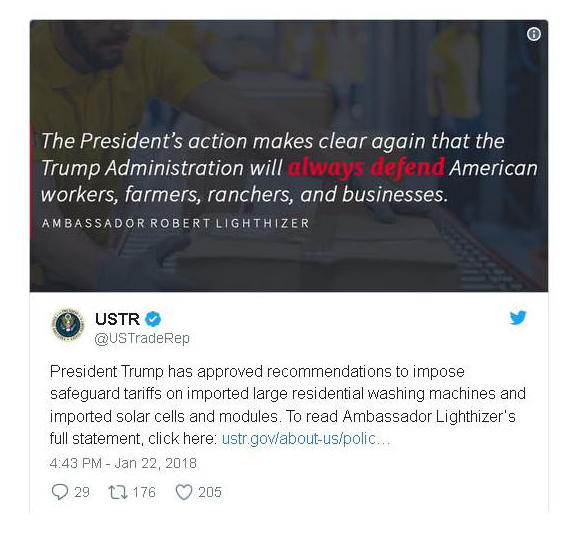
Washington, DC – U.S. Trade Representative Robert Lighthizer announced today that President Trump has approved recommendations to impose safeguard tariffs on imported large residential washing machines and imported solar cells and modules.

USTR made the recommendations to the President based on consultations with the interagency Trade Policy Committee (TPC) in response to findings by the independent, bipartisan U.S. International Trade Commission (ITC) that increased foreign imports of washers and solar cells and modules are a substantial cause of serious injury to domestic manufacturers.

“These cases were filed by American businesses and thoroughly litigated at the International Trade Commission over a period of several months,” said Ambassador Lighthizer. “The ITC found that U.S. producers had been seriously injured by imports and made several recommendations to the President. Upon receiving these recommendations, my staff and I conducted an exhaustive process which included opportunities to brief in person and through public comments, public hearings, and meetings with senior representatives.

Based on this information, the Trade Policy Committee developed recommendations, which the President has accepted. The President’s action makes clear again that the Trump Administration will always defend American workers, farmers, ranchers, and businesses in this regard.”

For imports of large residential washers, the President approved applying a safeguard tariff-rate quota for three years with the following terms (read more)

Suniva, SolarWorld and Whirlpool were helped by a 1974 trade law that lets companies seek trade protection if they can show damage from a rise in imports.  Prior administrations’ stopped using the law in the mid 1990’s, President Trump reconstituted the process in 2017 as part of his overall overall trade-plan.

Up to certain levels, imports of solar cells will be exempt from the tariff, while the first 1.2 million imported large washing machines will get a lower tariff, peaking at 20 percent.

Congress has no authority to change or veto Trump’s decision. Countries affected by the decision can appeal to the World Trade Organization.  The U.S. Chamber of Commerce and their purchased DC politicians are apoplectic:

Ben Sasse, R-Neb., said Republicans need to understand that tariffs are a tax on consumers. “Moms and dads shopping on a budget for a new washing machine will pay for this — not big companies,” Sasse said in a statement.