Full Transcript of ABC Bill Barr Interview Shows Most Content Not Included In Broadcast Interview…


Not exactly surprising, but late last night ABC released the transcript of the Bill Barr interview.  A review of the transcript compared to the broadcast shows there was significant interview material left on the editing floor.

Approximately two-thirds of the interview was never broadcast.  Additionally, major sections of answers were completely cut out (chopped up/edited) after the question(s) was/were asked.

Below is the full transcript of the interview (including parts not broadcast), and the full, raw, 25 minute video of the interview:

.

[Transcript] – ABC NEWS CHIEF JUSTICE CORRESPONDENT PIERRE THOMAS: General Barr, thank you for your time.

ATTORNEY GENERAL BILL BARR: Thank you.

THOMAS: This is the first time we’re hearing from you since the Roger Stone story erupted. At minimum, there appears to be an appearance problem. Trial prosecutors recommended 7 to 9 years on Monday evening. The president tweets at 1:48 AM Tuesday morning calling the recommendations – quote “horrible, unfair and a miscarriage of justice.”

Then word comes out from DOJ headquarters Tuesday morning that the recommendations are too severe and suggests a lesser sentence is more appropriate. Four of the trial attorneys resigned from the case. One of them quitting the Justice Department altogether.

What happened, sir, and what was your role?

BARR: Well, as you know, the Stone case was prosecuted while I was attorney general. And I supported it. I think it was established, he was convicted of obstructing Congress and witness tampering. And I thought that was a righteous prosecution. And I was happy that he was convicted.

The issue then became the sentencing. A new U.S. attorney had just started in Washington D.C. and the week before the filing, he engaged in conversations with senior staff here who raised some questions about the sentencing because he was concerned that the so called guidelines, the sentencing guideline formula, was indicating a sentence between 7 and 9 years.

Which, he felt and all of us immediately felt was very, very high and excessive in this case. And so he wanted to discuss that and over a number of days it became clear that the prosecution team wanted to recommend to the judge, and by the way, sentencing is a function for the judge and not the Department of Justice, we’re not the decision maker. But they wanted to advocate for a sentence that was, at the top, between 7 and 9 years.

And, in those discussions here at the department, you know, I came to the view as my colleagues did that I wouldn’t support affirmatively advocating what I thought was an excessive sentence.

So, what I wanted to do what to provide dis — defer to the discretion of the judge, let the judge make the determination.

THOMAS: You wanted to do that from the outset?

BARR: Yes. And then point out different features of the case that she should consider if she wanted to go below the 7 to 9 years. And I won’t get into the wires on that, but there were a lot of, I think, very legitimate arguments to be raised, there are points to be raised there. But at the end of the day, we deferred to her. Or, and that was what the approach was, I thought, we were going to take.

THOMAS: So the US attorney for the District of Columbia signed off on, his name is on the recommendation that went in there.

BARR: Yeah.

THOMAS: How did that happen?

BARR: On Monday, he came by to briefly chat with me and say that the team very much wanted to recommend the 7-9 year to the judge. And, but he thought that there was a way of satisfying everybody and providing more flexibility.

And there was a brief discussion of that. I was under the impression that what was going to happen was very much what I had suggested, which is deferring to the judge and then pointing out the various factors and circumstances. On Monday night, when I first saw the news reports, I said, “Gee, the news is spinning this. This is not what we were going to do.”
MORE: A timeline of the extraordinary turn of events in the Roger Stone case

THOMAS: So you were surprised?

BARR: I was very surprised. And once I confirmed that that’s actually what we filed, I said that night, to my staff, that we had to get ready cause we had to do something in the morning to amend that and clarify what our position was.

So the following morning — and by the way, I don’t look at tweets, I don’t read tweets unless they’re brought to my attention. So early the next morning I was you know, putting that in motion and directing that be done when someone walked in and told me that, about the president’s tweet.

That sort of illustrates how disruptive these tweets can be for the Department of Justice, because at that point, I had made a decision that I thought was fair and reasonable in this particular case and once the tweet occurred, the question is, Well, now what do I do? And do you go forward with what you think is the right decision or do you pull back because of the tweet? And that just sort of illustrates how disruptive these tweets can be.

THOMAS: So you’re saying you have a problem with the tweets?

BARR: Yes. Well, I have a problem with some of, some of the tweets. As I said at my confirmation hearing, I think the essential role of the Attorney General is to keep law enforcement, the criminal process sacrosanct to make sure there is no political interference in it. And I have done that and I will continue to do that.

And I’m happy to say that, in fact the president has never asked me to do anything in a criminal case. However, to have public statements and tweets made about the department, about our people in the department, our men and women here, about cases pending in the department, and about judges before whom we have cases, make it impossible for me to do my job and to assure the courts and the prosecutors in the department that we’re doing our work with integrity.

THOMAS: Mr. Barr, the president does not like to be told what to do. He may not like what you’re saying. Are you prepared for those ramifications?

BARR: Of course. As I, you know, said during my confirmation, I came in to serve as Attorney General. I am responsible for everything that happens in the department, but the thing I have most responsibility for are the issues that are brought to me for decision.

And I will make those decisions based on what I think is the right thing to do and I’m not going to be bullied or influenced by anybody. And I said, whether it’s Congress, newspaper editorial boards, or the president. I’m going to do what I think is right. And, you know, the, I think the — I cannot do my job here at the department with a constant background commentary that undercuts me.

THOMAS: Why does it make it so difficult for you to do your job and if he keeps doing it, what are you prepared to do?

BARR: Well you know I think—

THOMAS: Commenting specifically on criminal investigations?

BARR: Well again if some examples would be if you tweet something about, someone should be investigated for this or someone should go to jail and it turns out you are investigating them at that point, let’s say, this is a hypothetical, then what do you do? Because people might think that if you proceed with the investigation, it was prompted by the tweet. It’s the same kind of thing that happened here. So, and there are other examples where if you have a case before a judge to be attacking the judge, you know, it is not helpful or productive at all.

And also, you know, I think attacking- for people to attack people here in the department or in the FBI in general terms is unfair and, you know, I think I came back into government because I love the department and I believe strongly in it as an institution and I think we have great people here. And I can – and so, you know, it makes it difficult to be a leader here if —

THOMAS: How strongly do you feel about this?

BARR: Well I feel strongly about it.

THOMAS: So just to be clear, did you talk to the President at all about your decision regarding the recommendations?

BARR: The recommendations on this case? Never.

THOMAS: Anybody from the White House call you to try to influence you?

BARR: No. Nope. [crosstalk] have not discussed the Roger Stone case at the White House.

THOMAS: At all?

BARR: At all.

THOMAS: Lisa Murkowski, Senator from Alaska. Here’s what she said this week,“I think most people in America would look at that and say hmm that just doesn’t look right.” And then she goes on to say, “I don’t think the President needed to jump in the middle of this in the first place.” And Lindsey Graham, Chairman of the Senate Judiciary Committee, strong defender, supporter of the president, he defended his frustration with all that’s happened to him in Washington. He added this, “I don’t think the President should have tweeted about an ongoing criminal case.” So you share their position?

BARR: Yes. I do. [crosstalk] It makes it very hard. You know, it doesn’t affect the decision. It doesn’t affect my decision. As I said at the beginning during my hearing, I don’t pay attention to tweets. If the President has something to say, I expect that he will talk to me directly and call me. So I don’t pay attention to tweets and I – I’m not going to pay attention to directions and do something that I think is wrong.

I’m going to handle each case as I think the law requires and is fair, and even-handed. But I think Senator Murkowski is right that people who see these tweets can get a misimpression that they… that the work of the department is being influenced by it.

THOMAS: So when you heard him or you saw him say, “Congratulations to the Attorney General Bill Barr for taking charge of a case that was totally out of control and perhaps should not have been brought. Evidence now clearly shows that Mueller- the Mueller scam was improperly brought and tainted, even Bob Mueller lied to Congress.” He criticized the judge, as you mentioned earlier. How does that impact the department? The people that work here. And the impression of the American people?

BARR: Well I think the people who know me, know me here in the Department, know me in town and have worked with me, know that that stuff has no effect on what we do here. That we’ll make our decisions, as I say, based on the merits. But most people in the country don’t have that kind of exposure, and I think I can understand why people are concerned that it could influence the work of the department.

THOMAS: You’re telling the American public that had absolutely nothing to do with it?

BARR: Absolutely. And just, I, I’ve heard very few people actually suggest that 7 to 9 year sentence would be appropriate in this case. Very few people. Even the people who were criticizing me. It was very excessive. And I didn’t want my department to be behind that. Because I believe that each individual as unsavory as they may be, and I’m not a fan of Roger Stone, but he’s entitled to the particularized and careful application of the law to his case.

And as I say, I could not support the 7 to the 9 year- and I didn’t need anybody to tell me that 7 to 9 years was an excessive sentence. You think I need the president’s tweet to tell me that 7 to 9 years is excessive? That was the reaction of you know the senior staff here that, you know, there’s not really a comparable situation where that kind of sentence has been used.

THOMAS: And so, I guess I’m confused as to how that recommendation could get filed when you clearly were indicating that shouldn’t go down like that.

BARR: Yeah well, it’s, I’m afraid it’s one of those situations, I’m confused too. And I think it really was a situation of miscommunication. It was a very brief meeting, it was actually in between two meetings I had and the U.S. Attorney stuck his head in and described what he, how he thought he could reconcile things. And I thought that he was saying, was in accord with my view that we should not affirmatively recommend 7 to 9 years.

But we should allow the judge or say that we defer to the judge, you know, there appears to have been something lost in translation.

THOMAS: Do you feel like you still have confidence in U.S. Attorney Shea?

BARR: Yes I do. I mean I’ve known Tim Shea for a long time as you know he was with me here at the department last time I was Attorney General so that was many years ago. He has a great a great record so – and he was just- to be fair he had just entered into that office and you know I think we’ll establish better communications.

THOMAS: I just wanted to go back to the 4 prosecutors who resigned. Were you surprised that they stepped away from the case, including one who quit the department altogether?

BARR: Yeah. My understanding is one left the department but the other three did not resign from the department.

THOMAS: Just resigned from the case?

BARR: I, I thought — I was a little surprised because at the end of the day, what this was about was whether we — this was a sentencing decision that a judge was going to make — going to be making. It wasn’t, you know, the department wasn’t the decision maker.

And the difference of opinion was whether we should affirmatively advocate a 7 to 9 year sentence, or whether we should let the judge decide and explain why a lower sentence could be justified. And, I’m not, I’m not sure why that would prompt anyone to resign. On the other hand, again there may have been a communication problem because of the way the information leaked out.

THOMAS: Now, some people would say, look, they worked the case. They know the case best. They’re just wrong in your eyes?

BARR: No, this actually gets to a very important point about the Department, which is, you know, what other industry allows you know, life or death decisions to be made by the most junior level of the, of the business, so to speak. We at the department, we want people with a lot of energy and commitment. And so we express — we hope for a lot of, of that energy and commitment.

At the same time, when people are working on one case, and devoting a lot to it, they can sometimes lose perspective. And that’s exactly why we have a, a system of checks and balances within the department with multiple level of reviews that fan out with people with broader and broader responsibility. And most cases don’t come up to the attorney general, because people are doing a great job in the department.

And, a lot of the work doesn’t involve much controversy. But every once in a while, there are disputes or arguments over cases and those are the ones that come up. And the AG has to make the decision. So, some people say, you know, the AG intervening in a case.

That’s preposterous, we have an escalation system that tries to get the difficult issues that are, you know, people are arguing about, to get them up for resolution and it’s the attorney general’s responsibility to resolve it.

THOMAS: And you know, people have pride, though, and you could see how they would see as a public rebuke. You think that’s part of why they resigned in protest? From the case?

BARR: I don’t know why they resigned.

THOMAS: So you’ve not had a chance to talk to them?

BARR: No.

THOMAS: And do you expect any other resignations, are you getting any hint of any other resignations in regard to this case? People tied to the case?

BARR: I hope, I hope there are no more resignations. We, we like our prosecutors and hope they stay.
MORE: William Barr: Everything you need to know about Trump’s controversial attorney general

THOMAS: You’re known around town as someone who believes that the president vast authority, broad authority, to do the job, to execute the wills of the state. Does the president have the authority to just direct you to open an investigation and you have to do it? Can you help people at home understand? Can he do that?

BARR: Well I discuss this in detail in my confirmation hearings. I think in many areas such as- that don’t affect his personal interest-

THOMAS: Terrorism?

BARR: Terrorism or fraud by a bank or something like that where he’s concerned about something, he can certainly say I think someone should look into that. That’s perfectly appropriate. If he were to say, you know, go investigate somebody because – and you sense it’s because they’re a political opponent, then an attorney general shouldn’t carry that out, wouldn’t carry that out.

THOMAS: Democrats on Capitol Hill have said they believe that you were somewhat misleading in how you described the Mueller Report initially, before the full report came out. You said openly that you thought the president was spied on in the congressional hearing. You expressed skepticism about the launch of the origins of the Russia investigation. So they would say that you have maybe let the president feel like- that he can have the latitude to say those things. What would you say to them?

BARR: I would say that- that is not a valid conclusion, obviously the whole point of the Muller exercise was to determine if there was collusion. There wasn’t. And frankly I think you recognize, having looked at the material directly, that I didn’t mislead anyone about Mueller’s conclusions, but in terms of the Durham effort, which is to take a look at what happened that’s a legitimate area of investigation.

And you know starting a legitimate investigation as to what happened is- that’s the work of the Attorney General and Department of Justice. That- that’s not like a- you know, like a running commentary from someone on the outside about what we’re doing.

THOMAS: New York Times reported that John Bolton wrote in his book that after the president’s July 25th phone call with the Ukrainian president, he raised concerns about Guiliani and that he was pursuing the Ukraine with you. Is that true?

BARR: I don’t – I don’t recall that that was the exact quote. I’m not going to get into, into Bolton but, yeah, just not going to get into it.

THOMAS: Were you surprised when the president mentioned you on the — when you heard that he mentioned you on the July 25th call and he did so 5 times and kind of created the impression that you were working with Guiliani?

BARR: Yes.

THOMAS: Your reaction when you heard it?

BARR: I was a bit irritated by it. But, you know, the conversation jumped around, so, I’m not sure what he meant by some of what he was saying.

THOMAS: And this sounds like it’s in the same vein as creating the impression that you’re doing exactly what he wants you to do when he wants you to do. Is that what frustrated you?

BARR: Well, I think that it’s very clear, and I’ve always said this publicly and I think people know it, that what I am dealing with is the review of the 2016 election. That’s what I’m looking at. I’m not looking, you know, at other more general things about the Ukraine. And I think mixing them together created confusion in people’s minds.

THOMAS: And so now we have Guiliani, who’s gone to the Ukraine, come back, he’s presenting information and you told me earlier this week that he would go through the appropriate channels.

But he worked with two men to get this information who currently under indictment in the Southern District. Can you ensure- can you ensure that to the American public that the Justice Department is not going to be used as a weapon in a highly charged political season?

BARR: Absolutely. And as you know, Pierre, one of my passions is the feeling that we have to ensure that the Department of Justice is not used as a political football. And one of the things I’m distressed about is the increasing use of the criminal process to achieve political results. And I want to- I want to get away from that.

As you know, I put out a memo to make sure that any investigation that could have these kinds of political effects during an election year have to be approved at the very highest level of the FBI and the Department of Justice.

THOMAS: Do you think the Democrats will accept you as the messenger though?
MORE: Pelosi accuses Trump of abusing power by interfering in Roger Stone case

BARR: I don’t know. [crosstalk] They, many of them didn’t vote for me for confirmation.

THOMAS: Right. And they held you in contempt.

BARR: We live, unfortunately, you know, one of the things that makes it difficult is the hyper-partisan age we live in. That makes it very difficult.

THOMAS: You know, having known you and covered you for years, you’re not a person that responds a lot to criticism. But I am wondering, in this version of the job, you in the job, and when you hear people on Capitol Hill saying “Barr is acting more like the personal attorney to the President rather than the chief law enforcement officer,” how irritated does that make you and what do you say to those people?

BARR: Well, this goes back to the fact we are in a very polarized situation. And so in that kind of situation, I expect a lot of low blows, and there are a lot of low blows.

But I don’t respond to that, as you say. But I do think that in the current situation, as I’ve said, you know, the fact that the tweets are out there and correspond to things we’re doing at the department sort of give grist to the mill and that’s why I think it’s time to stop the tweeting about Department of Justice criminal cases.

THOMAS: How would you describe your relationship with the President in general terms. I know you don’t talk specifics, but in general terms, how is the relationship?

BARR: I think our relationship is good. I support his program, I think he’s doing great things for the country. I feel that, you know he’s faced a lot of resistance and he’s still able to accomplish a lot of good things. And we have a good working relationship.

THOMAS: You’re clearly setting some parameters for that relationship. Do you have any expectation of how he’ll react to some of the things you’ve said today?

BARR: Yeah. I hope he will react.

THOMAS: And respect it?

BARR: Yes.

THOMAS: I thank you for your time.

BARR: Thank you.

[END TRANSCRIPT]

Here’s the maximum amount of interview that was broadcast:

Advertisements

Nevada Poll: Breadline Bernie Holds Commanding Lead – Picks Up Coveted de Blasio Endorsement…


It looks like Bernie Sanders is going to win his third straight Democrat primary given the current polling from Nevada.   The Las Vegas Review Journal conducted a poll of likely caucus attendees (Tuesday through Thursday) shows Bernie Sanders with 25% of the vote.

(Source)

With the ‘Never Bernie’ vote split five ways, and with former New York City Mayor Michael Bloomberg not on the Nevada ballot, it looks like Bernie is going to win another primary contest.

The Club has been using establishment allies to take shots at Bernie, but the Antifa mob behind his socialist race are swarming and blasting anyone who targets their lightbringer of free stuff.   The Bernie-AOC wing have formed an impenetrable protective membrane around their candidate and most mainstream Democrats do not want to become their targets.  It’s a remarkable dynamic.

Accepting the foregone conclusion, today New York Mayor Bill de Blasio attempts to increase his progressive credentials by proclaiming his support for Bernie.

Daniel Marans

@danielmarans

In a statement, he makes the case for Bernie’s electability vis-a-vis Trump.

“Bernie is the candidate to take him on and take him down.”

View image on Twitter
752 people are talking about this
However, there are a few hitches…. Bernie’s socialized government takeover of healthcare is not sitting well with the Nevada unions.  This might foretell a problem in the future.  The union members do not want to lose their top-tier healthcare plans, and as a consequence they are withholding their endorsement:

NEVADA – Nevada’s culinary union, an influential force in the state’s upcoming caucuses, just fired a shot across the bow of Sen. Bernie Sanders’s presidential campaign. In flyers, emails, and text messages, the union warned its members that Sanders’s “Medicare for all” plan would “end Culinary Healthcare.”

The culinary union has good reason to oppose Sanders’s plan. It provides top-tier benefits to 130,000 workers and their families. “Medicare for all” would destroy these benefits and saddle union members with far worse coverage.

Unions across the country have negotiated hard to provide generous health coverage to their members. In 2018, three-quarters of union members had access to dental benefits, compared with just half of nonunion workers. Some unions have even negotiated premium-free health benefits.

Sanders’s “Medicare for all” proposal would invalidate union health plans and force all their members into the same government-run plan as every other person.

In Nevada, that would mean the end of the Culinary Health Fund, which provides some of the best coverage in the state. Benefits include access to a members-only clinic that provides 24/7 urgent care, along with dental, vision, and pediatric care. Union clinics like this tend to offer high-quality care and have helped members save hundreds of dollars a month. (read more)

Alexandria Ocasio-Cortez

@AOC

If this reporting is correct, then there needs to be accountability at the @DNC.

Even if the DNC’s access to the tool was “solely for security testing” as they claim, ProPublica found major hackable vulnerabilities almost immediately – which means they didn’t do their job. https://twitter.com/yashar/status/1228088667752714240 

Yashar Ali 🐘

@yashar

New: Documents reveal DNC was ‘intimately involved’ with Iowa caucus app @hunterw reports https://news.yahoo.com/shadow-inc-idp-contract-dnc-documents-224407455.html 

Alexandria Ocasio-Cortez

@AOC

Candidate preferences aside, the integrity of our primaries are incredibly serious. We cannot afford to be pointing fingers- we need to pinpoint solutions.

If the DNC was responsible for security and there were security failures, we need to address that.https://www.propublica.org/article/the-iowa-caucuses-app-had-another-problem-it-could-have-been-hacked 

The Iowa Caucuses App Had Another Problem: It Could Have Been Hacked — ProPublica

While there is no evidence hackers intercepted or tampered with the results, a security firm consulted by ProPublica found that the app lacks key safeguards.

propublica.org

1,610 people are talking about this

Army Announces They Will Not Investigate Lt. Col Alexander Vindman…


President Trump mentioned the likelihood the military would take a look at the conduct of Lt. Col Alexander Vindman in the wake of his leaking classified information to construct a fraudulent whistle-blower complaint with CIA ally Eric Ciaramella.

Today Army Secretary Ryan McCarthy said Vindman will not be investigated for his role in breaching national security protocol, fabricating claims and breaking chain of command.

WASHINGTON DC – The Army will not investigate Lt. Col. Alexander Vindman, the former National Security Council staffer who testified in the president’s impeachment investigation, the service’s top civilian said Friday.

Army Secretary Ryan McCarthy made the announcement at an event just days after President Donald Trump said he imagined the military would “take a look at” whether Vindman should face disciplinary action for the “horrible things” he told House investigators about the president’s phone call with Ukrainian President Volodymyr Zelensky last July. (link)

When we consider that Lt. Col. Vindman was carrying out what he believed to be his role; and when you overlay his military purpose; and when we accept Vindman was assisting CIA agent Eric Ciaramella in constructing his dossier to remove President Trump; and when we stand back and look at the aggregate interests involved; and when we consider there was ZERO push-back from the ranks of military leadership, specifically the Joint Chiefs of Staff; and when you accept Vindman was simply allowed to return to his post inside the White House – where he remains today; well, the alarming aspect increases in direct proportion to the definition of the word: “coup”.

Beyond the debate about the optics of the “coup“, within the testimony of Lt. Col Vindman, the NSC witness readily admits to understanding the officially established policy of the President of The United States (an agreement between President Trump and President Zelenskyy), and stunningly admits that two weeks later he was giving countermanding instructions to his Ukrainian counterpart to ignore President Trump’s policies.

The coup against President Donald Trump went from soft, to hard. Consider…

The testimony from Lt. Col. Vindman is available here. [SCRIBD pdf below]

Borrowing from Roscoe B Davis, here are some highlights:

Representative John Ratcliffe begins deconstructing Lt. Col Vindman, while his arrogant attorneys begin trying to interfere with the questioning.

This next section is very interesting, and very important.

Congressman John Ratcliffe begins questioning Vindman from the perspective of an Article 92 violation {READ IT}, coupled with an Article 88 violation {READ IT}. President Trump, is Lt. Col Vindman’s superior. President Trump sets the foreign policy.

Any commissioned officer who uses contemptuous words against the President, the Vice President, Congress, the Secretary of Defense, the Secretary of a military department, the Secretary of Homeland Security, or the Governor or legislature of any State, Commonwealth, or possession in which he is on duty or present shall be punished as a court-martial may direct. [Article 88, UCMJ]

Two weeks after President Trump has established an agreement with Ukraine President Zelenskyy, and established the policy direction therein, Lt. Col. Vindman is now giving contrary instructions to the Ukranian government. Vindman’s lawyer recognizes where the questioning is going and goes absolutely bananas:

Here’s the Full Transcript:

.

A reminder from the CIA “whistleblower” attorney. January 30th, 2017, ten days after President Trump’s inauguration: the “coup has started”

Chaff and Countermeasures – Senator Graham Asks AG Bill Barr for “Spygate” and “FISA” Witnesses…


Anyone who has followed DC for a while could see this one coming a mile away… including the synergy of self-interested timing.  Catherine Herridge of CBS reports on a ‘tick-tock’ letter from Senator Lindsey Graham to AG Bill Barr where Graham announces his request for witnesses.   The Graham list is an assembly of various DOJ/FBI officials who participated in Crossfire Hurricane and the fraudulent FISA application(s).

The timing of the letter, alluding to some possible hearing at some possible later date, follows a DC pattern. [Chaff and Countermeasures] In essence, cover for visible inaction; an attempt to convince people to put down the pitchforks.

A “Countermeasure” is a measure or action taken to counter or offset a preceding one.

Politically speaking, the deployment of countermeasures is a tactic used by professional politicians in Washington DC to counter incoming public inquiry and protect themselves from anger expressed by the electorate.

Weaponized government takes action and creates victims. Beyond the strategy – the countermeasures are politicians assigned a role to control the incoming righteous inquiry from voters who find out about the weaponized or corrupt governmental action.

1.) The electorate become aware of a political issue or action; often illegal.

2.) The electorate become angry.

3.) DC needs to protect itself.

4.) Countermeasures are assigned and deployed to delay, obfuscate and create the illusion of investigation of the illegal governmental action.

5.) Electorate watch.

6.) Investigation goes nowhere.

7.) Countermeasure deployment successful.

Repeat.

Recent and ongoing examples:

Lengthy Interview With Rep. Devin Nunes Covering Endless Trump Coup…


“Hashing it Out” is a Washington Examiner podcast hosted by Siraj Hashmi.  This week HPSCI ranking member Devin Nunes appears for a lengthy 45-minute discussion covering the never-ending coup against President Trump.

Representative Nunes discusses the counterintelligence investigation into the Trump campaign during the 2016 election, what he discovered through his own investigation, Objective Medusa, and how this all led to Trump’s impeachment and acquittal.

CPL Michael Avenatti Found Guilty On All Counts in Nike Extortion Case…


Creepy porn lawyer and former CNN political analyst, Michael Avenatti, has been found guilty on all three counts in the $25 million Nike Extortion case.

New York – Disgraced lawyer Michael Avenatti was convicted Friday by a jury of all three charges related to his efforts to extort up to $25 million from athletic apparel giant Nike.

[…] Avenatti was accused in the Nike case of trying to shake down the company by threatening to expose alleged evidence of bribing amateur basketball players and their families unless the company paid up. (link)

CPL still faces two more prosecutions: one in New York for defrauding client Stormy Daniels of $300k; and another in California for fraud, embezzlement, tax crimes and perjury.

Two-Tiered Justice – DOJ Informs Andrew McCabe He Will Not Be Prosecuted for Lying to FBI Investigators (3 Times, Under Oath)…


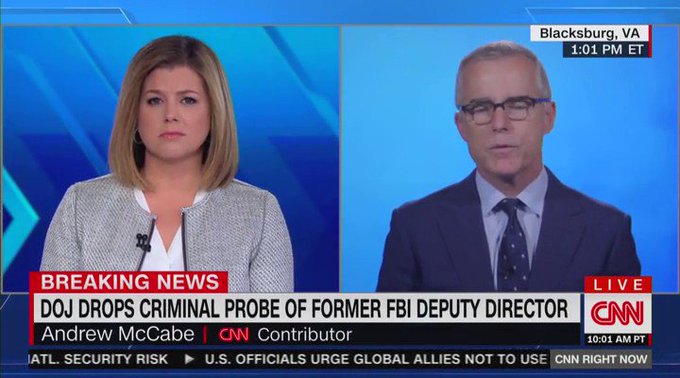
The Department of Justice has informed former FBI Deputy Director Andrew McCabe he will not face criminal prosecution for lying to FBI investigators.  The lawyers for Andrew McCabe shared the DOJ letter:

The DOJ inspector general had previously sent a criminal referral based on the OIG investigation of Mr. McCabe leaking to the media and then lying to FBI investigators four times, three times under oath in 2017, about his activity.  [OIG Report HERE]

During an immediate appearance on CNN the former FBI Deputy Director criticized the Department of Justice for putting his “family through this experience.”  McCabe said it was an “insult” and a “disgrace” for the DOJ to put him through this for two years.

Tom Elliott@tomselliott

Andrew McCabe: “As glad as I am that the DoJ and the DC attorney’s office finally decided to do the right thing today, it’s an absolute disgrace that they took 2 years and put my family through this experience for two years before they finally drew the obvious conclusion.”

Embedded video

711 people are talking about this

Lawyers for Mr. McCabe released the following statement:

As a reminder, this was the previous summary from an investigation carried out by the Office of Inspector General:

U.S. and U.K. Intelligence Agencies Worry About John Durham – Scrutiny of CIA Draws Media Apoplexy…


There was once a time, not that long ago, when the mainstream left was highly critical of the CIA, and scrutiny of dubious claims by U.S. intelligence was a common occurrence. Of course all of that changed when those same intelligence agencies were weaponized to target a political enemy that was also the enemy of the left, namely Donald Trump.

Now, in the era of modern political narratives, no intelligence claim against the Trump administration is too outlandish. Regardless of dubious sourcing, it’s all pushed as fact so long as the target of the claim is President Donald Trump.

As a result it is not a surprise how targeted weaponization became the cornerstone of the Russian narrative, and sketchy intelligence claims of Russian involvement in elections became the mortar that binds the bricks.  The end product is tenuous at best; and if anyone starts to scrutinize the instability of the construct they too become a target.

Last year U.S. Attorney John Durham and U.S. Attorney General Bill Barr were reported to be spending time on a narrowed focus looking carefully at CIA activity in the 2016 presidential election.  That CIA activity is directly related to the construction of the December 2016 Joint Analysis Report (JAR), and January 2017 Intelligence Community Assessment (ICA).  Both constructs are so critical to the Russia narrative that anyone who dare question the information becomes an immediate risk and target.

Using information from U.K. media, and looking closer at yesterday’s New York Times report about investigations of the CIA, in this outline we will explain where corrupt U.S. and U.K. interests merge; what specific action was taken, & why the mortar is crumbling.

2019 – “One British official with knowledge of Barr’s wish list presented to London commented that “it is like nothing we have come across before, they are basically asking, in quite robust terms, for help in doing a hatchet job on their own intelligence services””. (Link)

The U.K. Independent ran the above quote last year based on British intelligence officials who were concerned about scrutiny on their aligned activity with the U.S. CIA during the 2016 election.  More recently, yesterday the New York Times ran an article breathless with concern about DOJ inquiry and Attorney John Durham questioning the CIA directly.

2020 […]  The Justice Department has declined to talk about Mr. Durham’s work in meaningful detail, but he has been said to be interested in how the intelligence community came up with its analytical judgments — including its assessment that Russia was not merely sowing discord, but specifically sought to help Mr. Trump defeat Hillary Clinton in the 2016 election.

[…] The analysts could have been engaged in standard bureaucratic behavior like obeying the filtering process or hoarding sensitive information. Or perhaps they were trying to cover something up. The questions asked by Mr. Durham and his team suggest they are looking for any potential basis to support making the latter reading, officials said.

[…] Mr. Durham has interviewed F.B.I. officials and agents who worked on the bureau’s Russia investigation, called Crossfire Hurricane, and for the special counsel who took over the inquiry, Robert S. Mueller III. They have also interviewed C.I.A. analysts.

Mr. Durham and his team also interviewed around a half-dozen current and former officials and analysts at the National Security Agency, including its former director, the retired Adm. Michael S. Rogers, last summer and again last fall. The Intercept first reported the interviews of Admiral Rogers.

But Mr. Durham has not interviewed the former F.B.I. director James B. Comey, his onetime deputy Andrew G. McCabe or Mr. Brennan. Mr. Durham has requested Mr. Brennan’s emails, call logs and other documents from the C.I.A. to learn what he told other officials, including Mr. Comey, about his and the C.I.A.’s views of a notorious dossier of assertions about Russia and Trump associates.  (NYT Link)

It is important to remember how critical the Russian interference narrative is to the activity that took place in 2016.  If you take away the mortar, the building collapses. If the concrete evidence is not there to support the intelligence claims of 2016/2017, then all justification for the downstream “investigations” is lost.

Without the Russia narrative, those who weaponized intelligence for political surveillance are naked to the world.  The Russia narrative is essential for their justification of everything.  In a world with a functioning media the high importance of a key detail would mean even more scrutiny on that detail was warranted. Alas, in the world of orange-man-bad, the concept of a functioning media is as visible as a rotary phone.

The two-year investigation that generated the Weissmann/Mueller report contains claims that Russia hacked the DNC servers as the central element to the Russia interference narrative in the 2016 U.S. election.  This claim is perhaps the sketchiest.

It is also important to remember just how extensive the operations of the CIA were in 2016; because it is within the network of foreign and domestic operations where FBI Agent Peter Strzok is noted as a bridge between the CIA and FBI operations.

By now people are familiar with the construct of CIA operations involving Joseph Mifsud, the Maltese professor now generally admitted/identified as some kind of a western intelligence operative who was tasked to run an operation against Trump campaign official George Papadopoulos in both Italy (Rome) and London. {Go Deep}

In a similar fashion the CIA tasked U.S. intelligence asset Stefan Halper to target another Trump campaign official, Carter Page. Under the auspices of being a Cambridge Professor Stefan Halper also targeted General Michael Flynn. Additionally, using assistance from a female FBI agent under the false name Azra Turk, Mr. Halper also targeted Papadopoulos.

The initial operations to target Flynn, Papadopoulos and Page were all based overseas. This seemingly makes CIA exploitation of assets and targets much easier. However, there is an aspect to the domestic operation also bearing fingerprints of the CIA; only this time due to the restrictive laws on targets inside the U.S. the CIA aspect is less prominent. This is where FBI Agent Peter Strzok working for both agencies starts to become important.

In their text messages Strzok has a working relationship with what he called their “sister agency”, the CIA. Additionally, CIA Director Brennan has admitted Strzok helped write the January 2017 Intelligence Community Assessment (ICA) which outlines the Russia narrative.

Also late July “Electronic Communication” from the CIA to the FBI originating FBI operation “Crossfire Hurricane” was party authored from the CIA by Strzok.  The fast moving Strzok immediately used that EC, to initiate Crossfire Hurricane as authorized by his boss FBI Director of Counterintelligence Bill Priestap.  Then Strzok traveled to London to debrief intelligence officials there about the Australian Ambassador to the U.K, Alexander Downer and his contacts with George Papadopoulos.

Peter Strzok appears as a very eager, profoundly overzealous James Bond wannabe, who enjoyed a role acting as a bridge between the CIA and the FBI. The perfect type of FBI career agent for CIA Director John Brennan to utilize. [Strzok gets CIA service coin]

Fusion-GPS founder Glenn Simpson hired CIA Open Source analyst Nellie Ohr toward the end of 2015; at appropriately the same time as “FBI Contractors” were identified exploiting the NSA database and extracting information on a specific set of U.S. persons.

It was also Fusion-GPS founder Glenn Simpson who was domestically tasked with a Russian lobbyist named Natalia Veselnitskya. A little reported Russian Deputy Attorney General named Saak Albertovich Karapetyan was working double-agents for the CIA and Kremlin. Karapetyan was directing the foreign operations of Natalia Veselnitskaya, and Glenn Simpson was organizing her inside the U.S.

Glenn Simpson managed Veselnitskaya through the 2016 Trump Tower meeting with Donald Trump Jr. However, once the Fusion-GPS operation using Veselnitskaya started to unravel with public reporting… back in Russia Deputy AG Karapetyan unfortunately died in a helicopter crash.

Simultaneously timed in late 2015 through mid 2016, there was a domestic FBI operation using a young Russian named Maria Butina tasked to run up against republican presidential candidates. According to Patrick Byrne, Butina’s handler, it was FBI agent Peter Strzok who was giving Byrne the instructions on where to send her. {Go Deep}

Additionally, Christopher Steele was a British intelligence officer, hired by Fusion-GPS to assemble and launder fraudulent intelligence information within his dossier. And we cannot forget Oleg Deripaska, a Russian oligarch who was recruited by Asst. FBI Director Andrew McCabe to participate in running an operation against the Trump campaign and create the impression of Russian involvement. Deripaska refused to participate.

All of this context outlines the extent to which the CIA and FBI were openly involved in constructing a political operation that settled upon anyone in candidate Donald Trump’s orbit.  Much of this overlapping operation was seemingly directed by Peter Strzok operating with a foot in both agencies. [Strzok gets CIA service coin]

Thus we see the importance of the Russian Conspiracy-Interference Narrative.  Without that baseline all of the aforementioned operations have no justification.  Again, this Russia narrative is the critical mortar that binds the investigative and political surveillance bricks.

All of this engagement was admittedly controlled by U.S. intelligence; and all of this was intended to give a specific Russia impression. This predicate is presumably what John Durham is currently reviewing.

The key background point is to see how committed the CIA/FBI were to the narrative of Russia interfering with the 2016 election. The CIA, FBI, and by extension the DOJ, put a hell of a lot of work into it. Intelligence community work that Durham is now unraveling.

John Durham is looking at the construct of the Intelligence Community Assessment (ICA); and talking to CIA analysts who participated in the construct of the January 2017 report that bolstered the false appearance of Russian interference in the 2016 election. This is important because it ties in to the next part that involves Julian Assange and Wikileaks.

On April 11th, 2019, the Julian Assange indictment was unsealed in the EDVA.

From the indictment we discover it was under seal since March 6th, 2018:

(Link to pdf)

On Tuesday April 15th, 2019, more investigative material was released. Again, note the dates: Grand Jury, *December of 2017* This means FBI investigation prior to….

♦The FBI investigation took place prior to December 2017, it was coordinated through the Eastern District of Virginia (EDVA) where current FBI chief legal counsel Dana Boente was U.S. Attorney at the time, while also holding jobs in Main Justice.

♦The grand jury indictment was sealed from March of 2018 until after Mueller completed his investigation, April 2019.

Why did the DOJ wait?

What was the DOJ waiting for?

Here’s where it gets interesting….

The FBI submission to the Grand Jury in December of 2017 was four months after congressman Dana Rohrabacher talked to Julian Assange in August of 2017: “Assange told a U.S. congressman … he can prove the leaked Democratic Party documents … did not come from Russia.”

(August 2017, The Hill Via John Solomon) Julian Assange told a U.S. congressman on Tuesday he can prove the leaked Democratic Party documents he published during last year’s election did not come from Russia and promised additional helpful information about the leaks in the near future.

Rep. Dana Rohrabacher, a California Republican who is friendly to Russia and chairs an important House subcommittee on Eurasia policy, became the first American congressman to meet with Assange during a three-hour private gathering at the Ecuadorian Embassy in London, where the WikiLeaks founder has been holed up for years.

Rohrabacher recounted his conversation with Assange to The Hill.

“Our three-hour meeting covered a wide array of issues, including the WikiLeaks exposure of the DNC [Democratic National Committee] emails during last year’s presidential election,” Rohrabacher said, “Julian emphatically stated that the Russians were not involved in the hacking or disclosure of those emails.”

Pressed for more detail on the source of the documents, Rohrabacher said he had information to share privately with President Trump. (read more)

Knowing how much effort the CIA and FBI put into the Russia collusion-conspiracy narrative; and knowing how absolutely critical it was to justify all the surveillance that had taken place prior to the 2016 election; it would make sense for the FBI to take keen interest after this August 2017 meeting between Rohrabacher and Assange; and why the FBI would quickly gather specific evidence (related to Wikileaks and Bradley Manning) for a grand jury by December 2017.

Within three months of the grand jury the DOJ generated an indictment and sealed it in March 2018. The EDVA sat on the indictment while the Mueller probe was ongoing.

As soon as the Mueller probe ended, on April 11th, 2019, a coordinated effort between the U.K. and U.S. was executed; Julian Assange was forcibly arrested and removed from the Ecuadorian embassy in London, and the EDVA indictment was unsealed (link).

As a person who has researched this three year fiasco including: the ridiculously false 2016 Russian hacking and interference narrative; the “17 intelligence agencies”, Joint Analysis Report (JAR) needed for Obama’s anti-Russia narrative in December ’16; and then a month later the ridiculously political Intelligence Community Assessment (ICA) in January ’17; the timing against Julian Assange was far too coincidental.

It doesn’t take a deep researcher to see the aligned U.S/U.K motive to control Julian Assange because the Mueller report was dependent on Russia cybercrimes, and that narrative is contingent on the Russia DNC hack story which Julian Assange disputes.

The Weissmann/Mueller report contains claims that Russia hacked the DNC servers as the central evidence to the Russia interference narrative in the U.S. election. This claim is directly disputed by WikiLeaks and Julian Assange, as outlined during the Dana Rohrabacher interview, and by Julian Assange on-the-record statements.

Now Watch This Brief Interview:

.

The predicate for Crossfire Hurricane was Russia interfering in the 2016 election.

The predicate for the FISA warrant against U.S. Carter Page was a Russia investigation, that included the Steele Dossier as evidence, and the use therein was contingent on Russia interfering in the 2016 election.

The predicate for Robert Mueller’s investigation was specifically due to Russian interference in the 2016 election; and the possibility of Trump-Russia collusion.

All of these predicate claims are demonstrably false or wildly overstated using the most tenuous of stretched interpretations.   This is what John Durham is looking at.

The fulcrum for the media to push the Russia interference narrative is the Intelligence Community Assessment; and the primary factual evidence claimed within the ICA is that Russia hacked the DNC servers.  A claim that is only made possible by relying on forensic computer analysis from Crowdstrike, a DNC contractor.

When it comes to reviewing all of the predication aspects, the CIA holds a massive conflict of self-interest in upholding the Russian hacking claim.  Thus we see members of the CIA and intelligence apparatus within media stories outraged over being questioned.

Without the initiation by the CIA, the FBI also is exposed.  Thus the FBI holds a massive interest in maintaining the Russia hacking (Crowdstrike) claim.

Additionally, all of those foreign countries whose intelligence apparatus participated with John Brennan and Peter Strzok also have a vested self-interest in maintaining the Russia hacking and interference narrative.

Most worrisome, Julian Assange is the only person with direct knowledge of how Wikileaks gained custody of the DNC emails; and Assange has claimed he has evidence it was not from a hack – but rather from a leak by a source inside the DNC.

This Russian “hacking” claim is ultimately so important to the CIA, FBI, DOJ, ODNI and U.K intelligence apparatus; and right there is the most transparently obvious motive to shut Assange down as soon as U.S. and U.K. intelligence officials knew the Mueller report was going to be made public.

Biden Loses His Marbles!


Well. Joe’s marbles are not in New Hampshire…

Joe Biden is done. Stick a fork in him. Kaput!

It’s just a matter of time before sleepy, creepy Joe falls back asleep and dreams of running barefoot through Ukraine cash with Hunter by his side.

The piss-poor performance at the New Hampshire primary confirmed what everyone was thinking, but were afraid to say out loud, Joe Biden will NEVER be the nominee and NEVER be President.

We almost, and we mean ALMOST, feel sorry for Biden. Every time Joe ran for the nomination he lost. The Fake News wanted us to believe that he could beat Trump. After all, Biden was Barack Hussein Obama’s Vice President! It would be the third perfect term of Obama and the end of the anomaly called Trump.

They were wrong.

Again.

Biden came in 5th place in New Hampshire. In fact, he didn’t even show up on primary night, scurrying off to South Carolina before the results were final.

When reporters asked about the bloodbath in NH, all Biden could say was,

“I’m not giving up on New Hampshire! And don’t poke that in my face, okay buddy?”

It’s over Joe.

Who will drop out first? Biden or Warren?


StayTooned!

Tina

The 2020 Elections & the Coming Violence


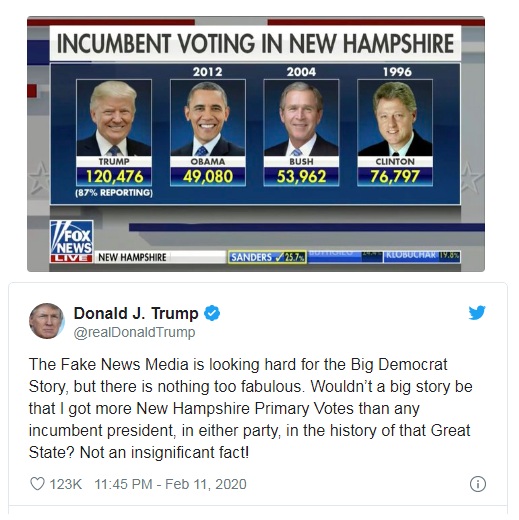
Democracy is dying and it just looks like we have to go into the crash and burn. President Trump won more votes than any incumbent ever in history in New Hampshire. His rallies attract more people than any other and in most cases, all others combined. The Democrats have adopted such a left-wing agenda that it is truly scaring the “silent majority” who most often are never represented in the polls. In the Democratic camp, Bernie supporters realize that the game is rigged.

There are fears emerging among Bernie supporters that his nomination will be stolen like the last time. They fear that party-bosses claim that they have rewritten the nomination rules after the nasty 2016 primary race to quell a backlash from Sanders’ supporters, that will not matter here in 2020 – watch! Last time, the influence of the “superdelegates” backed Hillary which was not represented by any democratic vote. That is how the party can ignore the primaries when they do not like the result. They are absolutely correct – they will never allow Bernie to represent the party in November.

Even Bloomberg is acting very left-wing and many see him with resentment. The common complaint is that he made all his money and now wants to oppress the small business owners with his insane environmental regulations. He thinks he can just buy the presidency and vows to outspend Trump. Hillary outspent Trump by 10:1 so 2016 showed that money was not the deciding factor. Bloomberg is a very dangerous guy for his decision on the stop-and-frisk illustrates that his claim that crime was just too high and he had to do something demonstrates he has no respect for constitutional rights. This is not a dictatorship and many see his Napoleon Complex a very dangerous. Bloomberg News will, of course, pitch him to the world just like CNN will oppose Trump regardless of who the Democratic candidate will be. My bet is on Hillary still – (OPINION).

The real problem to emerge is interesting. When Obama was elected, we did not hear Republicans claiming “he’s not my president!” Something has seriously changed. Historically, everyone who voted for the losing candidate simply moved on and that was the end of the contest. This time, the left is hell-bent on oppressing the right and this is not what civilization is supposed to be about. No matter who wins in 2020, either side will just not accept a loss. This will lead to violence this time far more than people realize.

This is just not going to end well and it is part of the collapse in confidence in the bond market and governments. CNN and the rest of the biased media are fueling this divide. They just do not care what they are doing to the nation. We are no longer a democracy or a viable civilization that benefitsLIBERTY. It is all about suppressing the opponent.

This is why the backlash is becoming evidence from both sides. If the winner is not respected as the president, then what is the purpose of even having a unified country? The United States becomes the Free-For-All of States. We have New York declaring it is a “sanctuary” state issuing IDs to illegal aliens who then do not pay taxes or are ineligible to vote legally? So they defend people who cannot even vote or pay taxes? Very strange thinking indeed