George C. Herring, emeritus professor of history at the University of Kentucky, lectures on “The First Indochina War, 1946-1954,” as part of the W&L Alumni College titled “Vietnam: A Retrospective.”
Watch Combat Approved series: https://rtd.rt.com/series/combat-appr… Imagine flying a plane so high that the world looks spherical and the sky is pitch-black. The Mikoyan Mig-31 fighter is the only jet plane in the world to make it possible to fly on the very edge of space. With an incredible speed of 3,000 km/h, the Soviet-designed interceptor is the world’s fastest serving aircraft, and it can fly twice as high as a commercial flight. Travelling at more than twice the speed of sound, the MiG-31 can touch the stratosphere and breach what’s known as the Armstrong limit. beyond which a pilot’s tears and saliva would boil without a pressure suit. Even at such incredible heights, the MiG-31 can still deal with its enemies. The fighter is armed with long and short-range missiles that can be launched against high-speed targets. At Khotilovo air base, RTD attempts to give viewers a first-hand experience of near-space travel aboard this unique aircraft by mounting cameras on the airframe and inside the cockpit. See what breaking the sound barrier looks like and why, despite being designed in the 1970s, the MiG-31remains at the top of its game and unrivalled to this day. SUBSCRIBE TO RTD Channel to get documentaries firsthand! http://bit.ly/1MgFbVy FOLLOW US RTD WEBSITE: https://RTD.rt.com/ RTD ON TWITTER: http://twitter.com/RT_DOC RTD ON FACEBOOK: http://www.facebook.com/RTDocumentary RTD ON DAILYMOTION http://www.dailymotion.com/rt_doc RTD ON INSTAGRAM https://www.instagram.com/rtd_documen… RTD LIVE https://rtd.rt.com/on-air/
2:55 – Basic physics of rocket engines 6:10 – Rocket engine cycles 20:30 – Rocket fuel comparison 30:40 – Raptor vs other rocket engines 44:05 – Summary Article version – https://everydayastronaut.com/?p=9823… SpaceX’s new raptor engine is a methane fueled full flow staged combustion cycle engine and its so hard to develop, no engine like this has ever flown before! Now this topic can be really intimidating so in order to bring the Raptor engine into context, we’re going to do an overview of a few common types of rocket engine cycles then compare the Raptor to a few other common rocket engines, like SpaceX’s current work horse, the Merlin, The Space Shuttle’s RS-25, the RD-180, Blue Origin’s BE-4 and the F-1 engine. And if that’s not enough, not only is SpaceX using a crazy engine cycle, they’re also going to be using Liquid Methane as their fuel, again something that no orbital rocket has ever used! So we’ll also go over the unique characteristics of liquid methane as a rocket fuel and see if we can figure out why SpaceX went with Methane for the Raptor engine. We’ll also break down and explain all the different engine cycle types so you know what the full flow staged combustion cycle is, how it works, and how it compares to the other cycles. So by the end of this video hopefully we’ll have the context to know why the raptor engine is special, how it compares to other rocket engines, why it’s using methane and hopefully find out if the Raptor engine will be the new king of rocket engines… ———————————————– Rocket engine renders by @MartianDays https://twitter.com/MartianDays HUGE thanks to my Moon Walker Patreon supporters! Blake Jacobs, Eli Burton, Jethro, Mac Malkawi, Neurostream, Ole Mathias Heggem Want to support what I do? Consider becoming a Patreon supporter for access to exclusive livestreams, our discord channel and subreddit! – http://patreon.com/everydayastronaut The best place for all your space merch needs! https://everydayastronaut.com/shop/ All music is original! Check out my album “Maximum Aerodynamic Pressure” anywhere you listen to music (Spotify, iTunes, Google Play, Amazon, etc) or click here for easy links – http://everydayastronaut.com/music I’m the cohost of an awesome podcast where we talk all about current technologies and how they shape our future! http://ourludicrousfuture.com or here on YouTube https://www.youtube.com/ourludicrousf…
For more information, go to http://worldcyclesinstitute.com/the-o… Ever heard of the numbers of nature? You really need to know about them because they’re in everything … plants, animals, the human body, artwork, our DNA, the stock market, the planets … you name it, nature’s numbers are there somewhere. The guy that discovered them 900 years ago is the man from Pisa. No, not your Pizza delivery guy … Pisa is a city in central Italy famous for the leaning tower and this man … Leonardo Fibonacci … nice Italian sounding name. These numbers of nature were so revolutionary, that they bear his name even today. It starts with a simple sequence of numbers … here’s how they work: You start with 0 and then 1 and then you simply add the last two number together to get the next … so 1, 2, 3, 5, 8, 11 and so on. Now when you divide any number by the one following it, you get what we refer to as the Golden Mean … .618. It’s also called phi. This is the number that’s in everything … It’s all through nature … it’s all through the stock markets … it’s in our DNA … it’s in music … and it been in architecture since before it was discovered. For example, the Parthenon… one of Greece’s most prized assets … if it’s not now owned by Germany …. It was built in the 4th century BC … many centuries before Fibonacci. And yet it seems to be proportioned closely to the golden mean. The lower portion is about 62% of the total height. The reciprocal is .382 and together, these two numbers occur over and over in artwork because we humans find the ratio pleasing. Something as simple as playing cards, for example. You can then take that “golden rectangle” to humans. It frames the face and positions the eyes, nose, and mouth. The belly button seems to generally divide the body into the golden section. You have 5 fingers, each one with 3 bones perfectly proportioned to the golden mean. You’ll find the golden mean in our DNA. You can see the numbers of nature at work in sunflower leaves. They arrange themselves in Fibonacci layers. There’s the Fibonacci spiral, evident in hurricanes … and sea shells. It goes on and on. In the stock market, when stocks are trending, the waves they form are in ratios of phi. You find it over and over again and many traders use it to trade quite profitably. So, the markets are not random, as so many think. They’re quite predictable. And where could these ratios in nature that we find everywhere on Earth originate Well, let’s look to the heavens. The planets are more or less separated in distance by the golden ratio. They actually follow more of a sine wave. But if you were to take the distances and average them, you’d find they come out to 1.618 … phi! We know that we’re affected by electromagnetic waves from the planets … we just don’t know exactly how we’re affected. But that’s a thought from another video. Is God a mathematician? Well, there’s certainly order to the universe and as we delve deeper and deeper into science, we’ll no doubt find more of the answers.
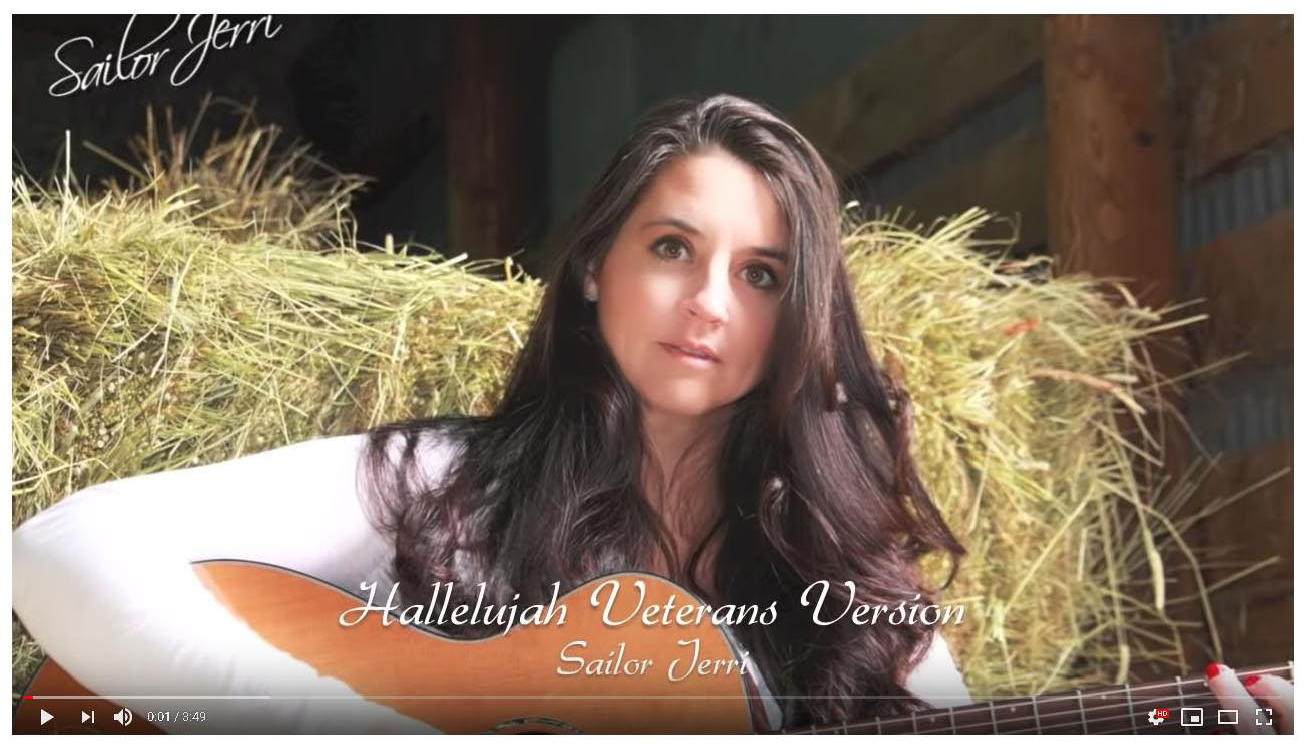
Sailor Jerri is a Navy Veteran from central Minnesota. While serving in the US Navy she worked as an Aviation Mechanic on F/A 18’s with the VFA 83 Rampagers. Jerri started playing guitar and singing for the long term care at the VA, and in veteran support groups. In April of 2017 she wrote and posted “Hallelujah Veterans Version” In just a year it was viewed over 125 million times, and downloaded in 22 countries. That was the beginning of her music career! She has been busy writing and in the Studio ever since. “No Rules In Sight” her new album, was released on April 13, 2018! It hit #14 on the country charts. It is available on the website, iTunes, and Google play. Jerri started her year in February 2019 when she took off for Las Vegas to begin her 2019 tour at Mandalay Bay. Already added to the schedule is over 16 states and 45 shows. Jerri filmed a music video for her original song “I’m Going Anyway” in her squadron’s hanger on Naval Air Station Oceana. It was released in September and has been watched over 210k times so far!
It’s rough. But I wanted it up My rewrite of Hallelujah “Veterans Version” Yes we are working on getting it recorded for everyone who has asked. Thank you for your support and for supporting the men and women in uniform. **yes the lyrics are protected under copy-write
I rewrote hallelujah for our Veterans. Every picture in this video was sent to me by the great members of our Armed Forces who have been supporting me from the beginning. Thank you so much for your service and your support.
The Second is also good:
Mitch Rossell – A Soldier’s Memoir (Official Music Video)
It’s rough. But I wanted it up My rewrite of Hallelujah “Veterans Version” Yes we are working on getting it recorded for everyone who has asked. Thank you for your support and for supporting the men and women in uniform. **yes the lyrics are protected under copy-write
I rewrote hallelujah for our Veterans. Every picture in this video was sent to me by the great members of our Armed Forces who have been supporting me from the beginning. Thank you so much for your service and your support.
Mitch Rossell – A Soldier’s Memoir (Official Music Video)
Today all across this great land we call America, we pause to remember those who have fallen. We give thanks for their final sacrifice, for their love of country, and we say prayers for them, for their families, for the country they serve. We fly flags to honor their service, to observe our own dedication to America. However, being the ever optimistic Americans we are, we have turned this day formerly known as Decoration Day into a nation wide party, a celebration of patriotism, family, summer’s promise, and just any old other thing we choose it to be, but in some places like our little town Memorial Day is still about the fallen servicemen and women who gave their lives for our country.
Tracking the origins of Memorial Day proves to be a somewhat difficult task. Some attribute it to former African slaves paying tribute to fallen Union soldiers. There is strong evidence that women of the South were decorating graves before the end of the Civil War. On May 30, 1868, flowers were placed on the graves of Union and Confederate soldiers at Arlington National Cemetery. By 1890 all the northern states were observing the day. The South would not observe the same date until after World War I, when it became more than an observance recognizing those fallen in the Civil War.
So, it took another war to unite Americans in remembrance of those fallen heroes. Stubborn aren’t we? Here in the South, I grew up visiting the cemetery on birthdays, holidays, and whenever my mother felt a need to connect with those gone from her – but never forgotten. Each visit to the cemetery (my mother never let us call it a graveyard) was a fascinating experience to me as a child.
Always walk around the plots, never step on one. Wander away as my mother knelt in the grass coaxed lovingly into growth in the red Georgia clay. Look first for relatives, those my mother spoke of, and those strange names I was unfamiliar with. Look for the little stone with the lamb on top – the resting place of my mother’s baby sister, Carole. Look for more lambs and little angels – they were dotted around the older section with alarming frequency, something I noticed even as a child. Take note of all the flowers.
It was a fine thing for a family to have many who remembered to honor their dead. I also very vividly remember the little American flags stuck in the ground on days such as Memorial Day and the Fourth of July. Not too long ago, I found a small cemetery with a mass grave of Confederate soldiers who mostly died of an outbreak, possibly flu, during the war. Those little flags had been put in the ground around the few individual markers. I wondered if they minded that 50 star flag, or if they were grateful to be remembered, honored, prayed over.
It was something I lived with as a child, this presence of the dead. I never thought much about it until recently. Here you literally cannot stray far outside your own yard without encountering some reminder of the war fought on this soil, and those fallen. As a child, many of our parents remembered grandparents who fought in the war. It is alive for us, and so has colored how we honor our dead, those who have fallen in battle, and those who in the words of many a fire and brimstone preacher, “The LORD has called home to be with HIM.” Believe me, no disrespect intended, just an indication of a little local flavor.
And so, I find myself wondering. Is this a southern thing? Is it an American thing? Or is it something common to all of us, this need to return to the place we left our loved ones for the final time on this earth? Is it a regional custom, tied deep in the roots we are so tangled in, or a need born with our souls? I think it must be the latter, with a twist of regional observances that may vary from place to place, but sooth the heart of those who wait here, on this side. Perhaps, after all is said and done, it meets our needs more than just paying respect to the dead. We wander there, among those peaceful plots, wondering, imagining, where are they? How is it there? When will my time come? Will I be with them again? Then, that most human of all questions. Who will honor me in my time, when I lay beneath the grass coaxed lovingly into growth in the red Georgia clay?
I hope you enjoyed the video of my hometown. I couldn’t be more proud to live in a place like this little town. Volunteers work for several weeks to place the poles and crosses. You can even get a list of names and locations so that families can locate the cross for their own loved one. We Remember, we honor, we celebrate. I sure hope we always will.
I have created this site to help people have fun in the kitchen. I write about enjoying life both in and out of my kitchen. Life is short! Make the most of it and enjoy!
This is a library of News Events not reported by the Main Stream Media documenting & connecting the dots on How the Obama Marxist Liberal agenda is destroying America




 Centinel2012