House Votes For Short-Term Funding Bill That Includes Border Security…


The House of Representatives voted tonight to include $5.7 billion for border security in a spending bill after President Trump warned them he would veto the spending bill without it.  Despite prior claims by Democrats the bill passed 217-185.

The bill now goes to the senate where Mitch McConnell, the GOP Decepticon caucus, and Chuck Schumer previously refused to consider border security.  If Schumer, McConnell and the Decepticons reject the bill it will likely lead to a partial government shutdown.

Treasury Secretary Steven Mnuchin Discusses Wall Street and Monetary Policy….


Treasury Secretary Steven Mnuchin discusses the strength of the U.S. economy, and the apparent disconnect between Main Street’s growth and Wall Street’s multinational risk exposure.  [Pro Tip: go back and read the dimensional shift]

Secretary Mnuchin (correctly) stays away from discussing the federal reserve and highlights the strength of Main Street.   CTH readers well understand what is driving this dynamic; and it will continue until 30-years of divergence is corrected, and parity achieved.

.

Traditional economic principles have revolved around the Macro and Micro with interventionist influences driven by GDP (Gross Domestic Product, or total economic output), interest rates, inflation rates and federally controlled monetary policy designed to steer the broad economic outcomes.

Additionally, in large measure, the various data points which underline Macro principles have been viewed as two dimensional. As the X-Axis goes thus, the Y-Axis responds accordingly… and so it goes…. and so it has historically gone.  This ain’t that.

Traditional monetary policy has centered upon a belief of cause and effect: (ex.1) If inflation grows, it can be reduced by rising interest rates. Or, (ex.2) as GDP shrinks, it too can be affected by decreases in interest rates to stimulate investment/production etc.

However, against the backdrop of economic Globalism -vs- economic Americanism, CTH is noting the two dimensional economic approach is no longer a relevant model. There is another economic dimension, a third dimension. An undiscovered depth or distance between the “X” and the “Y”.

I believe it is critical to understand this new dimension in order to understand Trump economic principles, and the subsequent “America-First” economy he’s building.

As the distance between the X and Y increases over time, the affect detaches – slowly and almost invisibly. I believe understanding this hidden distance perspective will reconcile many of the current economic contractions. I also predict this third dimension will soon be discovered and will be extremely consequential in the coming decade.

To understand the basic theory, allow me to introduce a visual image to assist comprehension. Think about the two economies, Wall Street (paper or false economy) and Main Street (real or traditional economy) as two parallel roads or tracks. Think of Wall Street as one train engine and Main Street as another. (continue reading)

Breaking: President Trump Announces James Mattis Retiring…


Oh snap, grab my belt, we’re going deep.

This move is not unexpected; especially for those who have followed the Trump Doctrine for the past two years. President Trump has announced reception of a notification from Defense Secretary James Mattis that he intends to retire.

The move makes sense on multiple levels.  President Trump has been executing a policy, a clear doctrine of sorts, where national security is achieved by leveraging U.S. economic power.  It is a fundamental shift in approach.

Initially, the traditional military interventionist approach couldn’t just be reversed or dispatched; and James Mattis was the bridge to a path forward.  Toward that end President Trump removed military constraints, allowed rules of engagement that were much stronger, and let Mattis work on confronting and stamping out terror threats.  In essence, an aggressive “let’s get this over with” approach.

However, that strong-arm military approach cannot continue indefinitely because it will never end.  War and intervention have a history of unnecessarily expanding, if not constrained.  The war machine turns into a military business.

President Trump wants U.S. troops brought home from all the “stupid wars”; and as a consequence the time for Defense Secretary Mattis was sure to come to an end.

The Trump Doctrine of using economics to achieve national security objectives is a fundamental paradigm shift, history provides no reference.

Just like the demanded restructuring of NATO, removing troops from Syria and likely Afghanistan will run counter to the interventionist policies of those who advocate for military deployments; and also the benefactors on the business end of the military industrial complex.

Yes, it’s time for a shift.

(Source Link)

Peace is the prize” ~ President Donald Trump

The nature of the Trump foreign policy doctrine, as it has become visible, is to hold manipulative influence accountable for regional impact(s), and simultaneously work to stop any corrupted influence from oppressing free expression of national values held by the subservient, dis-empowered, people within the nation being influenced.

There have been clear examples of this doctrine at work.  When President Trump first visited the Middle-East he confronted the international audience with a message about dealing with extremist influence agents. President Trump simply said: “drive them out.”

Toward that end, as Qatar was identified as a financier of extremist ideology, President Trump placed the goal of confrontation upon the Gulf Cooperation Council, not the U.S.

The U.S. role was clearly outlined as supporting the confrontation.  Saudi Arabia, Kuwait, Egypt, Bahrain and the United Arab Emirates needed to confront the toxic regional influence; the U.S. would support their objective.  That’s what happened.

Another example:  To confront the extremism creating the turmoil in Afghanistan, President Trump placed the burden of bringing the Taliban to the table of governance upon primary influence agent Pakistan.  Here again, with U.S. support.  Pakistan is the leading influence agent over the Taliban in Afghanistan; the Trump administration correctly established the responsibility and gives clear expectations for U.S. support.

If Pakistan doesn’t change their influence objective toward a more constructive alignment with a nationally representative Afghanistan government, it is Pakistan who will be held accountable.  Again, the correct and effective appropriation of responsibility upon the influence agent who can initiate the solution, Pakistan.

The process of accurate regional assignment of influence comes with disconcerting sunlight.  Often these influences are not discussed openly.  However, for President Trump the lack of honesty is only a crutch to continue enabling poor actors. This is a consistent theme throughout all of President Trump’s foreign policy engagements.

The European Union is a collective co-dependent enabler to the corrupt influences of Iran.  Therefore the assignment of responsibility to change the status is placed upon the EU.

The U.S. will fully support the EU effort, but as seen in the withdrawal from the Iran Deal, the U.S. will not enable growth of toxic behavior.  The U.S. stands with the people of Iran, but the U.S. will not support the enabling of Iranian oppression, terrorism and/or dangerous military expansion that will ultimately destabilize the region.  Trump holds the EU accountable for influencing change.   Again, we see the Trump Doctrine at work.

Perhaps the most obvious application of the Trump Doctrine is found in how the U.S. administration approached the challenging behavior of North Korea.   Rather than continuing a decades-long policy of ignoring the influence of China, President Trump directly assigned primary responsibility for a reset to Beijing.

China held, and holds, all influence upon North Korea and has long-treated the DPRK as a proxy province to do the bidding of Beijing’s communist old guard.  By directly confronting the influence agent, and admitting openly for the world to see (albeit with jaw-dropping tactical sanction diplomacy) President Trump positioned the U.S. to support a peace objective on the entire Korean peninsula and simultaneously forced China to openly display their closely-guarded influence.

While the Red Dragon -vs- Panda influence dynamic is still ongoing, the benefit of this new and strategic approach has brought the possibility of peace closer than ever in recent history.

No longer is it outlandish to think of North Korea joining with the rest of the world in achieving a better quality of life for its people.

Not only is President Trump openly sharing a willingness to engage in a new and dynamic future for North Korea, but his approach is removing the toxic influences that have held down the possibility for generations.  By leveraging China (through economics) to stop manipulating North Korea, President Trump is opening up a door of possibilities for the North Korean people. This is what I mean when I say Trump is providing North Korea with an opportunity to create an authentic version of itself.

What ultimately comes from the opportunity President Trump has constructed is entirely unknown.  However, the opportunity itself is stunning progress creating a reasonable pathway to prosperity for the North Korean people.   Chairman Kim Jong-un has the opportunity to be the most trans-formative leader within Asia in generations; but it is still only an ‘opportunity’.

Whether Kim Jong-un can embrace openness, free markets and prosperity is yet to be seen.  Freedom is a precariously scary endeavor because there’s always a danger loosening the grip on control can lead to fear, which can lead to even tighter more authoritarian, control.

The commonality in all of these foreign policy engagements is the strategic placement of responsibility upon the primary influence agent; and a clear understanding upon those nation(s) of influence, that all forward efforts must ultimately provide positive results for people impacted who lack the ability to create positive influence themselves.

One of the reasons President Trump is able to take this approach is specifically because he is beholden to no outside influence himself.  It is only from the position of complete independence that accurate assignments based on the underlying truth can be made.

A U.S. foreign policy that provides the opportunity for fully-realized national authenticity is a paradigm shift amid a world that has grown accustomed to corrupt globalists, bankers and financial elites who have established a business model by dictating terms to national leaders they control and influence.

When you take the influence of corporate/financial brokers out of foreign policy, all of a sudden those global influence peddlers are worthless. Absent of their ability to provide any benefit, nations no longer purchase these brokered services.

As soon as influence brokers are dispatched, national politicians become accountable to the voices of their citizens. When representing the voices of citizens becomes the primary political driver of national policy, the authentic image of the nation is allowed to surface.

In western, or what we would call ‘more democratized systems of government‘, the consequence of removing multinational corporate and financial influence peddlers presents two options for the governing authority occupying political office:

♦One option is to refuse to allow the authentic voice of a nationalist citizenry to rise.  Essentially to commit to a retention of the status quo; an elitist view; a globalist perspective.  This requires shifting to a more openly authoritarian system of government within both the economic and social spheres. Those who control the reigns of power refuse to acquiesce to a changed landscape.

♦The second option is to allow the authentic and organic rise of nationalism.  To accept the voices of the middle-class majority; to structure the economic and social landscape in a manner that allows the underlying identity to surface naturally.

Fortunately we are living in a time of great history, and we have two representative examples playing-out in real time.  •One example is the U.K. and voices of the British people who have voted to Brexit the European Union.  •The second example is Mexico, and the July 1st, 2018, election of Andres Manuel Lopez-Obrador (aka AMLO), a nationalist.

In the U.K. we see the government turning more authoritarian and distancing itself from the voices of the majority who chose to rebuke the collective association of the EU.  In recent decisions the government has taken a more harsh approach toward suppressing opposition, and as a consequence oppressing free speech and civil liberties.

This doesn’t come as a surprise to those who have followed the arc of history when the collective global elite are rejected.  Globalism can only thrive amid a class structure where the elites, though few in number, have more controlling power over the direction of government.  It is not accidental that the EU has appointed officials and unelected bureaucrats as the primary decision-making authority.

By its very nature the EU collective requires a central planning authority who can act independent of the underlying national voices.

As the Trump Doctrine clashes with the European global elite, the withdrawal of the U.S. financial underwriting creates a natural problem.  Subsidies are needed to retain multiculturalism.

If a national citizenry has to pay for the indulgent decisions of the influence class, a crisis becomes only a matter of time.

Wealth distribution requires a host.  Since the end of World War II the U.S. has been a bottomless treasury for EU subsidy.  The payments have been direct and indirect.  The indirect have been via U.S. military bases providing security, and also by U.S. trade policy permitting one-way tariff systems.   Both forms of indirect payment are now being reversed as part of the modern Trump Doctrine.

Similarly, in Mexico the Trump Doctrine also extends toward changed trade policies; this time via NAFTA.  The restructuring of NAFTA into the USMCA disfavors multinational corporations who have exploited structural loopholes that were designed into the original agreement.

With President Trump confronting the NAFTA fatal flaw, and absent of the ability of corporations to influence the direction of the administration, the trade deal ultimately presents the same outcome for Mexico as it does the EU – LESS DOLLARS.

However, in Mexico, the larger systems of government are not as strongly structured to withstand the withdrawal of billions of U.S. dollars.  The government of Mexico is not in the same position as the EU and cannot double-down on more oppressive controls.  Therefore the authentic voice of the Mexican people is likely to rise.

Andres Manuel Lopez Obrador (AMLO), is a nationalist but he is not a free-market capitalist.  AMLO is more akin to soft-socialist approach with a view that when the central governing authority is constrained, and operates in the best interests of its citizens, equity can be achieved.

The fabric of socialism runs naturally through the DNA strain of Mexico, and indeed much of South America.  This is one of the reasons why previous Mexican governments were so corrupt.  Multinational corporations always find it easier to exploit socialist minded government officials.

When bribery and graft are the natural way of business engagement, the multinationals will exploit every opportunity to maximize profit. Withdraw the benefit (loophole exploitation) to the financial systems, and the bribery and graft dries up quickly.  A bottom-up nationalist like AMLO, is the ultimate beneficiary.

The authentic-sense of the Mexican people, rises in the persona of Andres Manuel Lopez Obrador – who actually does personify the underlying nature of the classic Mexican class-struggle.

Thus we see two similar yet distinct outcomes of the Trump Doctrine. Within a highly structured U.K. parliamentary government the leadership becomes more authoritarian and rebukes the electorate; and in Mexico a less structured government becomes more nationalist, more prideful, and embraces the underlying nature of the electorate.

It is not accidental the historic nature of the U.K. is a monarchy (top down), and the historic nature of Mexico is populist (bottom up). Revolution not withstanding, both countries are now returning to their roots.

We are indeed living in historic times.

Enjoy this…  We are living inside history.

President Trump Participates in Farm Bill Signing – 3:30pm EST Livestream…


President Donald Trump will Participate in a Signing Ceremony for H.R. 2, the “Agriculture Improvement Act of 2018.  Anticipated start time 3:30pm EST:

President Trump leads the signing ceremony for the ‘Agriculture Improvement Act’ aimed at supporting farmers through threats of a trade war and increasingly frequent natural disasters. Additionally, President Trump is expected to make remarks on the ongoing showdown over government funding and border security kicked off by Trump and Democratic leadership in congress.

UPDATE: Video Added

WH Livestream Link – Fox News Livestream Link – PBS Livestream Link

Optimal Solution Confirmed – Kirstjen Nielsen Announces Asylum Seekers Will Be Retained in Mexico Pending Processing….


A few days ago many critics were concerned over an announced pledge of U.S. State Department funding ($4.8 billion) for security and economic development in Mexico. However, CTH noted the approach was likely not what it seemed.

Those who followed the USMCA construct closely noted that U.S. President Trump (through Jared Kushner) and Mexican President Lopez-Obrador (through Jesus Seade) were doing something much bigger than a trade agreement; they were structuring an entirely new U.S-Mexico economic alliance.

With increased investment in central America by the Chinese government; and with Venezuela in a state of vulnerability to becoming a proxy therein; and with Brazil taking a more nationalistic approach; a completely new partnership which focused heavily on domestic security and economics was taking shape between the U.S. and Mexico. Throughout 2017 and 2018 the U.S. media was oblivious to it.

Then, two days ago, the U.S. State Department made public the principles of an economic alliance between the United States and Mexico. [See Here] The outline should be familiar: Economic Security is National Security.

Today Department of Homeland Security chief Kirstjen Nielsen told lawmakers that migrants heading to the southwest border to seek asylum in the United States will have to wait in Mexico until their claims are processed, under an agreement between the two countries:

Secretary Nielsen is confirming exactly what we suspected.

Rather than fight internally for short-term solutions to long-term immigration problems, President Trump has gone directly to the heart of the issue. Invisible in the background, to all but those who follow closely, President Trump has been structuring a comprehensive  optimal solution to the border crisis; and he has been doing it for over a year.

Outline – […] Promoting Prosperity, Good Governance, and Security in Central America: The United States and Mexico will continue government cooperation and coordination to enhance security, governance, and economic prosperity in Central America, complementing the Northern Triangle countries’ Plan of the Alliance for Prosperity. The United States is committing a total of $5.8 billion in support of institutional reforms, development, and economic growth in the Northern Triangle from public and private sources. The United States and Mexico will also work with the U.S. and Mexican private sector and multilateral development banks to promote investment and economic development in the Northern Triangle. We will leverage the resources of U.S. and Mexican international development finance capabilities to better target investments in the region.

Cabinet-level Meeting and High Level Taskforce: The Governments of the United States and Mexico will convoke a cabinet-level meeting in late January 2019 to agree on a strategic framework for our cooperation in Central America to address root causes of migration. The United States and Mexico will establish a high-level taskforce to facilitate design and implementation of cooperation and monitor progress on advancing our common objectives.

Investment in Southern Mexico: The United States and Mexico will strengthen coordination with the private sector and development institutions to expand infrastructure and generate employment opportunities in southern Mexico. The government of Mexico has announced the largest development commitment in decades in southern Mexico to include $25 billion over 5 years. The United States, for its part, through the Overseas Private Investment Corporation, is focused on private and public investment in Mexico totaling 4.8 billion, to include committing $2 billion for suitable projects in southern Mexico. The United States will seek to leverage public and private investment in Mexico and is exploring options of further investment in dialogue with the government of Mexico.

Bilateral Business Summit: The United States and Mexico will convoke a business summit in the first quarter of 2019 with participation by a broad range of U.S., Mexican, and international private sector representatives to increase investment and business opportunities in Mexico with a special focus on southern Mexico and the Northern Triangle. (more)

As we have been sharing for quite some time, it was obvious there was an agreement of this sort long before the USMCA was finalized and made public.

As part of an agreement with President Lopez-Obrador, [insert Jared Kushner here] funds will be used to secure Mexico’s border effectively cutting-off the Central American migration flow before it can reach the Southern U.S.

This approach is entirely a Win/Win.  With China seeking to influence North America, a stronger economic alliance between the U.S. and Mexico can be a jaw-dropping game changer globally.  This joint approach is entirely in line with nationalist AMLO’s objectives for a larger and more stable economy within Mexico specifically by partnering with nationalist U.S. President Trump toward that common goal [See USMCA details].

If President Trump cannot get congress to secure the U.S. border, a problem that has become generational in scale, he can damn sure leverage and entice President Lopez-Obrador to do comprehensibly.   This approach is actually far more than just simply securing the border; this approach is a geopolitical alliance with ramifications as significant as President Trump’s Indo-pacific strategy (India, Japan, ASEAN).

This approach is as pragmatic as it is strategic. POTUS Trump is working on optimal solutions while encountering domestic political roadblocks.  This is exactly what President Trump does…. find solutions.

President Trump can sit around righteously fighting with the swamp over the security issues (historic political approach); or he can fight the swamp while simultaneously deploying a solution that mitigates the issue at its root cause (thinking outside the box).

What would a businessman president do?

President Andres Manuel Lopez-Obrador’s first visit to the White House will be epic.

President Trump Tells GOP Leaders He Will Not Sign Funding Bill Without Border Security….


Sticking to his prior statements about omnibus spending, President Donald Trump called republican leaders to the White House and informed them he will NOT sign a short-term resolution that does not provide funding for border security.

Speaker of the House Paul Ryan and Majority Leader Kevin McCarthy hold a quick presser following their visit with President Trump:

Donald J. Trump

@realDonaldTrump

67.2K people are talking about this

President Trump Delivers a Message on Syria…


President Trump delivers a deliberate message announcing the full U.S. military withdrawal from Syria.

.

Thank You, and Merry Christmas.

Two days ago, December 17th,  the move was signaled when Ambassador James Jeffrey, Secretary’s Special Representative for Syria Engagement, delivered a keynote address at the Atlantic Council’s “The Future of U.S. Policy in Syria” program:

.

PM of Israel

@IsraeliPM

541 people are talking about this

.

Advertisements

Poland Signs 20 Year Deal to Purchase U.S. Liquefied Natural Gas….


Economic security is national security… In July 2017 President Trump traveled to Polandto attend the Three Seas Initiative Summit, a gathering of countries bordering the Adriatic, Baltic and Black Sea (Poland, Austria, Croatia, Hungary, Czech Republic, Slovenia, Slovakia, Romania, Bulgaria, Lithuania, Estonia and Latvia).

The primary purpose of the visit was to discuss security initiatives including how to diminish Russian influence through a cooperative agreement over energy.  President Trump took the SME’s, and delivered a speech in Warsaw, Poland:

[…] “President Duda and I have just come from an incredibly successful meeting with the leaders participating in the Three Seas Initiative. To the citizens of this great region, America is eager to expand our partnership with you. We welcome stronger ties of trade and commerce as you grow your economies. And we are committed to securing your access to alternate sources of energy, so Poland and its neighbors are never again held hostage to a single supplier of energy.”

Well, today a massive multi-billion energy contract for the United States sale and Poland purchase of Liquefied Natural Gas (LNG) was announced.  While financial terms were not disclosed, the agreement is for the sale and purchase of approximately 2.7 billion cubic meters per year (after regasification) – enough natural gas to meet about 15 percent of Poland’s daily needs.  The contract is for 20 years of purchases.

SAN DIEGODec. 19, 2018 /PRNewswire/ — Port Arthur LNG, LLC, a subsidiary of Sempra Energy (NYSE: SRE), and the Polish Oil & Gas Company (PGNiG) today announced they have entered into a definitive 20-year sale-and-purchase agreement for liquefied natural gas (LNG) from the Port Arthur LNG liquefaction-export facility under development in Jefferson County, Texas.

Today’s announcement is an important milestone as Sempra Energy pursues its long-term goal of exporting 45 million tonnes per annum (Mtpa) of North American LNG.

“This agreement marks an important step toward Poland’s energy independence and security,” said U.S. Secretary of Energy Rick Perry. “As demonstrated with the launch of the Strategic Dialogue on Energy in Poland last month, the Trump Administration remains committed to increasing energy diversity, advancing energy security, strengthening national security, and creating a future of prosperity and opportunity in Poland and throughout the region.”

“This agreement with PGNiG represents an important expansion of our portfolio of contracts for LNG exports and major step forward in the development of our Port Arthur LNG project,” said Jeffrey W. Martin, chairman and CEO of Sempra Energy.  “Last month, we began the commissioning phase of our Cameron LNG liquefaction-export facility in Louisiana. This agreement, along with the great progress on Cameron LNG, continue to validate our growth strategy as we advance our vision to become North America’s premier energy infrastructure company.”  (read more)

When I read this announcement, the first picture that came to my mind was a meme CTH shared well over a year ago while watching Commerce Secretary Wilbur Ross in the audience at Trump’s Warsaw speech:

CTH has now achieved master level meme prediction skillz.

Rick Perry

@SecretaryPerry

This @ENERGY-led agreement marks an important step toward Poland’s energy independence and security. @POTUS remains committed to increasing energy diversity, strengthening national security, and creating a future of prosperity and opportunity in Poland. https://www.sempra.com/newsroom/press-releases/sempra-energy-subsidiary-and-polish-oil-gas-co-sign-definitive-agreement 

Sempra Energy Subsidiary And Polish Oil & Gas Co. Sign Definitive Agreement To Export U.S. LNG To…

SAN DIEGO, Dec. 19, 2018 /PRNewswire/ — Port Arthur LNG, LLC, a subsidiary of Sempra Energy (NYSE: SRE), and the Polish Oil & Gas Company (PGNiG) today announced they have entered into a definitive…

sempra.com

144 people are talking about this

View image on TwitterView image on Twitter

Robert Palladino

@StateDeputySPOX

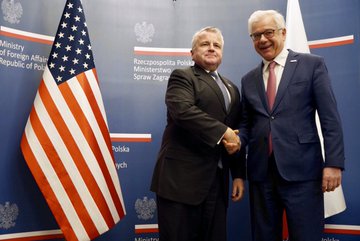
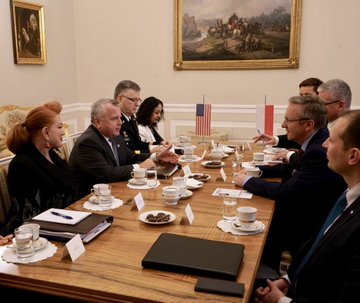
In , Deputy Secretary Sullivan reaffirmed the United States’ ironclad commitment to the @NATO Alliance, commended Poland’s commitment to spend 2.5% of GDP on defense by 2030 and celebrated the centennial of Poland’s reclaimed independence. https://go.usa.gov/xExAM 

175 people are talking about this


Conspicuous Timing – President Trump Punches Back at Senate Decepticons, Announces Withdrawal From Syria…


The White House says U.S. has started returning troops home from Syria as it transitions to next phase of campaign.  Additionally, all U.S. State Department personnel are being evacuated from Syria within 24 hours (link).

White House – “Five years ago, ISIS was a very powerful and dangerous force in the Middle East, and now the United States has defeated the territorial caliphate. These victories over ISIS in Syria do not signal the end of the Global Coalition or its campaign. We have started returning United States troops home as we transition to the next phase of this campaign. The United States and our allies stand ready to re-engage at all levels to defend American interests whenever necessary, and we will continue to work together to deny radical Islamist terrorists territory, funding, support, and any means of infiltrating our borders.”  (Link)

The UniParty Decepticons will not be pleased…


As expected the UniParty legislature in Washington DC; bought and paid for by lobbyists with specific intention to oppose President Trump; have constructed a short-term funding mechanism that kicks-the-can to February 2019.

Mitch McConnell announced on the Senate floor the stopgap funding mechanism, for departments and agencies not already funded for fiscal year 2019, would run through Feb. 8th, 2019.  The Big Club lobbyists control the UniParty.  President Trump pushes back by announcing a U.S. military withdrawal from Syria…

(Via Roll Call) […] “Later this morning I’ll introduce a continuing resolution that will ensure continuous funding for the federal government,” McConnell said. “Even if the face of a great need to secure the border and following good-faith efforts by the president’s team, our Democratic colleagues rejected an extremely reasonable offer yesterday.”

“It would have cleared the remaining appropriations bills which have received bipartisan support in committee and provided an additional $1 billion to tackle a variety of urgent border security priorities,” the majority leader added.

Senate Minority Leader Charles E. Schumer of New York said that while it was not ideal, the short-term bill would be acceptable.

“I’m glad the leader thinks the government should not shut down over the president’s demand for a wall. And Democrats will support this CR,” Schumer said after McConnell announced the plan.

House Minority Leader Nancy Pelosi of California said House Democrats would go along with it, as well. (more)

Advertisements