
If you re in the USA and you are promoting secession that is treason and if you are a Mexican and here illegally you are a subject to being tried as a saboteur and either jailed or sent home.
Tag Archives: Tans-fats
Hunt for Taxes: Safe-Deposit Boxes Under Attack

HSBC is altering its oversight of safe-deposit boxes in Hong Kong. Governments are targeting safe-deposit boxes to look for cash that is hiding from taxation. HSBC, a U.K. bank, is now moving against claimed financial crimes by altering conditions for safe-deposit boxes. This is becoming a global trend. Anything of value that is stored in a safe-deposit box is now considered money laundering. Governments want their taxes and all the laws are changing to ensure they get their money.
Who are “The People”?
Armstrong Economics Blog
Re-Posted Jun 3, 2016 by Martin Armstrong
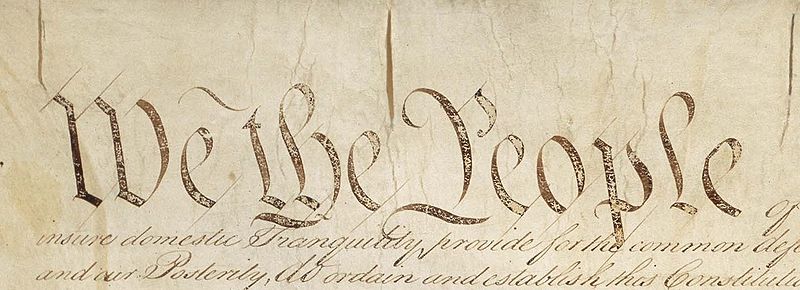
The familiar phrase “We the People” no longer means what it used to. The majority of Americans do not understand how the law is made and assume Congress proposes all legislation and therefore makes law. That is not the case. The president can refuse to enforce any law or impose it arbitrarily under the claim of discretion, and the Judiciary is responsible for altering law every day. Judges create the majority of laws to impress their particular brand of bias in a very undemocratic manner by using their interpretation of the words written by Congress in any Act or the Constitution. So all you need is a judge to twist the words around to make new law, which is why fights erupt over appointing Supreme Court justices who can become legal unelected dictators.
Money laundering was intended for the war on drugs. Today, hiding your money from the government, which includes placing cash in a safe deposit facility, is money laundering thanks to judicial law. Judges twist the same statutes around so that the words mean whatever they want it to mean. It is your burden to appeal and prove that the judge is wrong. Good luck. Cops protect cops, and so do judges.
On March 18, 2008, the Supreme Court heard the case of District of Columbia v. Heller (07-290), regarding the Second Amendment, which reads:
“A well-regulated militia, being necessary to the security of a free state, the right of the people to keep and bear arms, shall not be infringed.”
The ACLU argued in that the term “We the People” should have its definition changed to mean “We the State Militia.” Changing that definition can effectively prevent individuals from having the right to own a gun. The Constitution would become complete trash if the term was found to have different meanings, but lawyers have become wordsmiths and use this ability to create laws.

Supreme Court Cases
The Supreme Court overlooked this question of who “the people” are for 200 years (1789–1989). Since then, the Supreme Court has twice commented on the meaning of this phrase, but these two cases are in somewhat conflict with each other.
In United States v. Verdugo-Urquidez, the court said that “the people” refers to those “persons who are part of a national community,” or who have “substantial connections” to the United States. In delivering this interpretation, they were consistent with the problem that faced the question of jurisdiction at the founding of the nation.
If you were English and committed a crime in France, the French king could not punish you for you were the property or “subject” of the English king. He would send you back in chains to England with an explanation of what you did. Since the American Revolution was against the monarchy, why would they comply with international law and send someone back to England for a crime committed in America to be punished by a king they did not recognize? The American Constitution established territorial jurisdiction for the first time. So someone convicted of a crime would be punished in America for his crime in America. Now the problem became a question of rights under the Constitution. Did a foreign citizen have a right to a fair trial? The definition had to extend to any person tried in America regardless of their citizenship.
The touchstone in United States v. Verdugo-Urquidez was correct, constitutionally speaking, for it extended to one’s connection to this country in compliance with territorial jurisdiction. The court declared that this definition of “the people” applied consistently throughout the Bill of Rights and did not limit rights to citizens.
In U.S. v. Verdugo-Urquidez (494 U.S. 247, 288, 1990), Justice William J. Brennan Jr. argued: “The term ‘the people’ is better understood as a rhetorical counterpoint ‘to the government’ … that rights that were reserved to ‘the people’ were to protect all those subject to ‘the government.’ …” He continued: “The Bill of Rights did not purport to ‘create’ rights. Rather, they designed the Bill of Rights to prohibit our government from infringing rights and liberties presumed to be pre-existing.”
In United States v. Verdugo-Urquidez, the Supreme Court wrote: “The people protected by the Fourth Amendment, and by the First and Second Amendments, and to whom rights and powers are reserved in the Ninth and Tenth Amendments, refers to a class of persons who are part of a national community… The Fourth Amendment’s drafting history shows that its purpose was to protect the people of the United States against arbitrary action by their own government.”
However, in District of Columbia v. Heller, 554 U.S. 570 (2008), the court approvingly quoted Verdugo-Urquidez’s definition and similarly suggested that the term “the people” had a consistent meaning throughout the Constitution. This must be correct or the Constitution becomes chaotic. Yet, Heller also said that the term “refers to all members of the political community,” which actually changes the definition.
Heller’s interpretation contains a confusing three-part analysis: (1) it approved of Verdugo-Urquidez’s interpretation; (2) it substituted “members of the political community” for “persons who are part of a national community”; and (3) it suggested that “the people” means the same thing throughout the Constitution.
Heller’s analysis has created a conflict that has largely gone unnoticed but is already changing law. Heller could now be u as changing the meaning of “the people” throughout the Bill of Rights by limiting “the people” to “members of the political community,” which might be interpreted to mean, inter alia, “eligible voters.” This interpretation could have a profound consequence for individuals who have been denied the right to vote and non-American citizens. In this manner, the entire principle of territorial jurisdiction can be overturned.
Heller’s interpretation is already being applied. The Fifth Circuit previously held, “Once aliens become subject to liability under United States law, they also have the right to benefit from [Fourth Amendment] protection.” (United States v. Cortes, 588 F.2d 106, 110 (5th Cir. 1979) (citing United States v. Cadena, 585 F.2d 1252, 1262 (5th Cir. 1978))
In a recent case, US v Armando Portillo-Munoz, it was ruled that a ranch hand who lived and worked in the United States for more than 18 months, paid rent, and helped to support a family, but who committed the misdemeanor of illegally crossing the border — is not part of “the people.” Circuit Judge Dennis in his dissenting opinion warned, “The majority’s interpretation of the “the people” has far-reaching consequences.”
“We the People” no longer means what people have always assumed: “We the People.”
THE BATHROOM WARS
Published on May 22, 2016
In his latest Firewall, Bill looks into the fallacies involved in the latest product of the Progressive Synthetic Injustice machine.
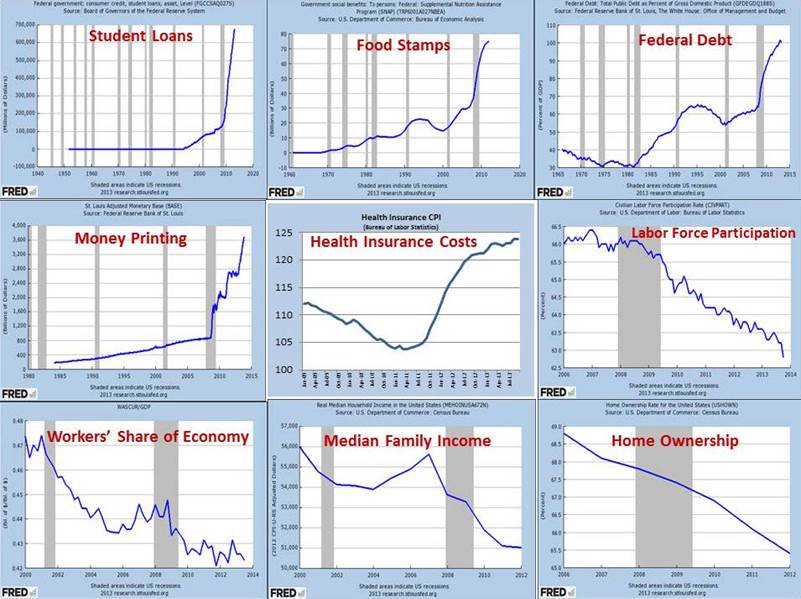
A Snapshot of what Obama has accomplished in 7 years and 3 months and there are still 9 months to go.
A friend sent me an email with this series of charts in it today and after looking at it I thought I would pass it on. There is no explanation needed the charts all speak for themselves.
ECM 2015.75: The Rock vs. Hard Place
Armstrong Economics Blog
Re-Posted May 21, 2016 by Martin Armstrong

QUESTION: Mr. Armstrong, with your 2015.75 turning point on the ECM, you said that was the peak in government and the following 4.3 years would turn down rather hard. You also said 2016 would be a strong rise in 3rd party activity and people are now talking even about Bernie running 3rd party. You said 2017 would be the year from political hell and it looks really crazy here in Europe and with Merkel gone, everything will change. Then you said the monetary system would change by 2020 but could come as early as 2018. You said interest rates would start to rise in 2016 as early as March and that would be the fuel behind the dollar and help create the Sovereign Debt Crisis. I understand this is not your opinion and I can now see how each is linked to create the trend. The Berlin conference was fantastic and really helped me understand how this all fits together. My question is simply this. Do you have any idea what the type of monetary system we are headed into? What survives? You said the IMF is trying to position itself for that role which you opposed. Any clue yet?
ANSWER: The Fed is between a rock and a hard place and is trying to be that little flower that sees the light. It has two choices: (1) deal with the pension crisis at home by raising rates to prevent defaults, or (2) keep rates low to save other governments in emerging markets who continue to borrow and are doomed anyhow. Then there is the question of whether the budget deficit in the USA will explode with rising rates.
The Fed has really lost control of the economy, but the mainstream still needs to figure this out. Our model goes nuts from 2018 into 2020. This is part of the peak in 2015.75. Of course, the general public does not see this yet. They should by next year and then the game will change.
 Governments will not go quietly into the light. They will rage at every possible moment. They are moving toward electronic money since their solution is to force everyone to pay whatever tax they demand. On January 1, 2017, G20 will begin sharing info on everyone. Compliance in business will cost tens of billions of dollars alone. Even companies who do not have foreign clients will have to confirm they do not.
Naturally, governments will act in the most stupid manner for they will not reform. Even if they grab everything, it would not be enough to save them. So be prepared. They will get very punitive. Expect crazy laws to benefit them like constitutional amendments. They will find whatever excuse to confiscate assets; mere suspicion will become proof and it will be your burden to prove innocence.
The old guard is near death. People like John McCain and Barbara Boxer, who was shouted down in California by Bernie supporters, are out the door. We are looking at new people coming to power — the changing of the guard. In this respect, Trump is part of the new and Hillary is the old world of corrupt politics. We are turning the corner. Those in government remain clueless.
What survives is always tangible assets be it land, industry, shares, or something of value like gold, silver, antiques, etc. Whatever currency we use is only a medium of exchange between tangible assets. Currency is not “money,” it never holds its value, and by no means is it a store of wealth. It is just a medium of exchange like a language. So whatever we end up with, which I believe will be some basket of currencies, will become the new medium of exchange through which everything else is measured.
National Poll – Trump Dominates With “Independent Voters”: Donald Trump 46%, Hillary Clinton 30%…
Now, with rest of the pack gone we will see that Hillary has to offer besides her female sex when Trump focuses on her.
#2 Election Night Results Thread – Kentucky (D) and Oregon (R and D) – #NeverHillary Surfaces…
If the Invincible Clinton machine with the full support of the media can barely beat Bernie she must we the worst democrat candidate ever.
WOW – DNC Chair Debbie Wasserman Schultz Launches Attack On Bernie Sanders Supporters (video)…
DWS is a flaming idiot attorney so why would anyone believe anything that she said.
Prosecutors have More Power than Judges
Armstrong Economics Blog
Re-Posted May 18, 2016 by Martin Armstrong

In a Washington DC Court of Appeals decision United States v. Fokker Services B.V., a Dutch aerospace firm accused of making more than 1,000 illegal shipments of parts and components to Iran and other sanctioned countries from 2005 to 2010, the Executive Branch was handed dictatorial powers last month. It held that Federal judges have no authority to “second-guess” the discretion of federal prosecutors to cut deals with companies under criminal investigation. This was a unanimous ruling handing unimaginable power to the Justice Department which claims discretion to obey the law. This is why Hillary can escape prosecution because the government can deny equal protection of the law to its citizens be prosecution some people and not others for the very same offense.
The U.S. Court of Appeals for the D.C. held that the Justice Department may engage in the often-controversial deals it uses to punish large companies without leaving the scar of a criminal conviction that might threaten their existence when it comes to things like a banking license. These deals are called “Deferred Prosecution Agreements” which allow companies to avoid criminal prosecution by paying a fine and submitting to certain conditions for a period of probation, after accepting responsibility for wrongdoing. Of course, who becomes the probation officer? Former US attorney’s such as Ashcroft who gets tens of millions of dollars in return for no criminal prosecution. Yes, NJ governor Chris Christie when he was a federal prosecutor, did such a deal where the company had to pay $52 million to John Ashcroft former US Attorney General to monitor a firm in New Jersey. These types of deals are rotten to the core and for the US Court of Appeals to rule judges have no power to object, is handing prosecutors the ultimate blackmail card of all time.
The “discretion” in legal terms has been transformed into exactly what it was not suppose to be. The Supreme Court explained back in 1824 in the landmark case:
Osborn v. Bank of the United States
22 U.S. 738 (1824)
“When they are said to exercise a discretion, it is a mere legal discretion, a discretion to be exercised in discerning the course prescribed by law; and, when that is discerned, it is the duty of the court to follow it. Judicial power is never exercised for the purpose of giving effect to the will of the judge, always for the purpose of giving effect to the will of the legislature; or, in other words, to the will of the law.”
id/22 US 866
When the President of the United States takes office, he takes his oath of office which has just become word they babble any more.
“Before he enter on the Execution of his Office, he shall take the following Oath or Affirmation: — “I do solemnly swear (or affirm) that I will faithfully execute the Office of President of the United States, and will to the best of my Ability, preserve, protect and defend the Constitution of the United States.”
ARTICLE II, SECTION 1, CLAUSE 8
Nowhere within this oath is there the word “discretion” to execute what laws he likes or against only people he dislikes. This decision effectively nullifies that oath entirely and declares to the entire world to see that there is no rule of law, for the President and everything within the executive branch has the discretion to enforce the laws created by Congress. That bluntly means that the people have absolutely no say whatsoever in government for they pretend to elect “representatives” who can legislate but the President need not listen. Here is Congressional powers defined in the Constitution “To make all Laws which shall be necessary”. None of this means anything if the President has the “discretion” to enforce what laws he agrees with. That is a dictatorship and tyranny.
Section. 8.
The Congress shall have Power To lay and collect Taxes, Duties, Imposts and Excises, to pay the Debts and provide for the common Defence and general Welfare of the United States; but all Duties, Imposts and Excises shall be uniform throughout the United States;
To borrow Money on the credit of the United States;
To regulate Commerce with foreign Nations, and among the several States, and with the Indian Tribes;
To establish an uniform Rule of Naturalization, and uniform Laws on the subject of Bankruptcies throughout the United States;
To coin Money, regulate the Value thereof, and of foreign Coin, and fix the Standard of Weights and Measures;
To provide for the Punishment of counterfeiting the Securities and current Coin of the United States;
To establish Post Offices and post Roads;
To promote the Progress of Science and useful Arts, by securing for limited Times to Authors and Inventors the exclusive Right to their respective Writings and Discoveries;
To constitute Tribunals inferior to the supreme Court;
To define and punish Piracies and Felonies committed on the high Seas, and Offences against the Law of Nations;
To declare War, grant Letters of Marque and Reprisal, and make Rules concerning Captures on Land and Water;
To raise and support Armies, but no Appropriation of Money to that Use shall be for a longer Term than two Years;
To provide and maintain a Navy;
To make Rules for the Government and Regulation of the land and naval Forces;
To provide for calling forth the Militia to execute the Laws of the Union, suppress Insurrections and repel Invasions;
To provide for organizing, arming, and disciplining, the Militia, and for governing such Part of them as may be employed in the Service of the United States, reserving to the States respectively, the Appointment of the Officers, and the Authority of training the Militia according to the discipline prescribed by Congress;
To exercise exclusive Legislation in all Cases whatsoever, over such District (not exceeding ten Miles square) as may, by Cession of particular States, and the Acceptance of Congress, become the Seat of the Government of the United States, and to exercise like Authority over all Places purchased by the Consent of the Legislature of the State in which the Same shall be, for the Erection of Forts, Magazines, Arsenals, dock-Yards, and other needful Buildings;—And
To make all Laws which shall be necessary and proper for carrying into Execution the foregoing Powers, and all other Powers vested by this Constitution in the Government of the United States, or in any Department or Officer thereof.
 Centinel2012