U.S. Trade Representative Robert Lighthizer is attending Round Six of the NAFTA talks in Canada while President Trump, Secretary of Commerce Wilbur Ross, and Secretary of Treasury Steven Mnuchin attend the Davos World Economic Forum and sit down for an interview with Maria Bartiromo. (Three Video Segments).
Tag Archives: US Supreme Court
President Trump Delivers Remarks To Group of Mayors…
Prior to President Trump delivering remarks to a group of mayors from around the country, Attorney General Jeff Sessions announced the possible subpoenas for officials amid Sanctuary Cities. In response, several Mayors boycotted the White House meeting.
The jurisdictions that received DOJ notification letters on Wednesday included: Chicago; Cook County, Ill; New York City; the state of California; Albany, N.Y.; Berkeley, Calif.; Bernalillo County, N.M.; Burlington, Vt.; the city and county of Denver, Colo.; Fremont, Calif.; Jackson, Miss.; King County, Wash.; Lawrence, Mass.; City of Los Angeles, Calif.; Louisville, Ky.; Monterey County, Calif.; Sacramento County, Calif.; the city and county of San Francisco; Sonoma County, Calif.; Watsonville, Calif.; West Palm Beach, Fla.; the state of Illinois and the state of Oregon.
All 23 of these jurisdictions were previously contacted by the Justice Department, which raised concerns about its laws, policies and practices.
.
[Transcript] 3:37 P.M. EST – THE PRESIDENT: Well, thank you very much. What a group. Some great friends, great mayors. Please sit down.
We have really hardworking, brilliant people in this room. I know so much about being a mayor.
We have a very good friend of mine, Dane Maxwell. Where’s Dane? Dane. Stand up, Dane. We’ve been together a long time, Dane, a long time. And thank you very much for being here. It’s a great place — that Mississippi is special. We had a good time on November 8th in Mississippi, right?
And Betsy Price. Betsy? Thank you, Betsy. Thank you for being here, very much. Really, two fantastic friends of mine for a long time.
Toni Harp. Where’s Toni? Toni? Toni? Uh oh, can’t be a sanctuary city person, I know. (Laughter.) That’s not possible, is it?
Well, I want to just say — I mean, we’ll start by saying that, as you know, the Department of Justice, today, has announced a critical legal step to hold accountable sanctuary cities that violate federal law and free criminal aliens back into our communities.
We can’t have that. Can’t have it. It would be very easy to go the other way, but we can’t have it. We want a safe country, and it’s getting safer all the time.
Sanctuary cities are the best friend of gangs and cartels, like MS-13. You know that. The result in the death rate around sanctuary cities — in and around — for innocent Americans is unacceptable. Take a look at what happened in San Francisco and Kate Steinle, and countless others.
My administration is committed to protecting innocent Americans and the mayors who choose to boycott this event have put the needs of criminal illegal immigrants over law-abiding Americans. But let me tell you, the vast majority of people showed up. Okay? The vast majority. Because the vast majority believe in safety for your city. (Applause.)
I want to thank all of you for being here. I’m thrilled to welcome dozens of mayors from across the country to the White House. And I’ve worked with so many of you, some in the private sector. Who knew I was going to be here? (Laughter.)
But it happened. Right, Kellyanne? My star, Kellyanne. Stand up, Kellyanne. She’s more famous than I am. (Applause.) Good. Thanks, Kellyanne. Great.
You bring safety, prosperity, and hope to our citizens. My administration will always support local government and listen to leaders who know their communities best. And you know your community best.
We believe in local government. We believe in empowering each and every one of you. Together, we are achieving absolutely incredible results.
We have created nearly 2.4 million jobs since the election. Nobody thought that was going to be happening, right? (Applause.)
The unemployment rate is at, now, an 18-year low. African American unemployment — I’m very proud of this. Remember, I used to say, “What do you have to lose?” And people said, “I don’t know if that’s a nice thing to say.” I said, “Of course it is. For 100 years, the Democratic mayors have done a terrible — I mean, they’ve done some bad work.” I said, “What did you have to lose?” African American unemployment is at its lowest rate ever recorded. (Applause.) That’s not bad.
Unemployment for women is at its lowest rate in 17 years, and that’s going to be a very new standard very soon. (Applause.)
And Hispanic American unemployment, like African American unemployment, is at the lowest rate ever recorded. That’s a long time. (Applause.)
And here’s the good news: it’s getting better. It’s going to get better. We’ve cut more regulations than any administration in history, by far. And we’ve been really doing the cutting for about 10 months, even though we’ve been here now for 12. We started a little bit late. Although, the first day we did some pretty big cutting, I will say.
And as you know, just before Christmas, we passed massive tax cuts and reform so that more businesses will come back to your cities and towns, and working families will finally get the pay raises that they’ve been waiting for many, many years, in some cases. (Applause.)
Our tax plan also creates opportunities — and some of you are taking advantage of that — to encourage investment in distressed communities, create more jobs, and bring Main Street booming back to life.
More than two million American workers have already received tax cut bonuses from their employers all because of our incredible tax cut bill. And I must tell you, this has worked far greater — because nobody thought in terms of the companies coming out and paying $1,000; and $2,000; and $2,500 per employee. They have hundreds of thousands of employees in some cases.
And the ones that aren’t getting it are getting it because they’re going, “What about us?” Now they’re at a point, they’re saying, “What about us?” We know that feeling. So it’s really turned out — nobody thought that.
As much as we thought — and as much as we had a lot of brilliant minds around that tax bill, nobody really thought in terms of would a company step up. And it started — AT&T started it. And then a couple of others picked it up very quickly — Comcast and some others, they picked it up. And then it became an avalanche.
And Kellyanne, we never used to talk about that because it wasn’t really in the realm of thinking. And it’s turned out to be, really, an avalanche. And it’s been a beautiful thing to watch. People are walking away with $1,000 and $2,000, and much more.
We’re also working to rebuild our crumbling infrastructure by stimulating a $1 trillion investment, and that will actually, probably, end up being about $1.7 trillion. (Applause.)
Oh, you like that? I can tell we have mayors in the room. That’s good. That’s good. Only mayors could be that excited. Only the mayors and the workers — it’s about jobs, right — could be that excited.
No, and we’ll probably be putting that in a week or two, right after the State of the Union Address. We’ll be talking about it a little bit in the State of the Union; we’ll put that in.
One of the other things, I have to say — Apple — a $350 billion investment. And I spoke to Tim Cook. And you probably you heard me on the trail — I’ll say, “I will not consider this job complete and great, in terms of economics and the economy, unless Apple someday starts building some plants in our country.” And what happened is they said, $350 billion.
And when I first heard it — Tim Cook and I spoke. But when I first heard it, I said, “I guess they mean $350 million” — because that’s a big plant. You know, $350 million, you can build a lot of plant. But they said, “No, sir, $350 billion.” And much of that comes from overseas. They’re going to bring it back because of the tax bill because we made it possible for them to bring it back. (Applause.)
And they’re investing a lot of money over and above that. So it’s $350 billion and thousands and thousands of new jobs. They’re going to build an incredible campus. It’s going to be something special.
But we worked with Congress to cut down the approval and permitting process so that it takes no longer than 2 years, instead of, on average, 10 to 12 to 17 years to build a simple road. (Applause.)
A road in a certain location — I won’t mention the state, although I happen to like the state very much — it’s been under approval 17 years. They’ve been planning it for 17 years, and it was a straight — nothing — road. Now it’s got lots of curves because we have to miss the nests and everything else. And curves aren’t good on roads. You know, roads are, like, straight. And it was, 17 years ago, going to cost virtually nothing, and it ends up being hundreds of millions of dollars. And it was recently completed, and everyone goes, “You have to be kidding.”
So we’re going to bring that 10-year process — that’s an average. I think it’s actually much higher than that. We’re going to bring that down to, we say, less than two years, but I’d like to be able to average about one year.
And you’ll let them know. If we don’t want a highway, if we don’t want something built, you’re going to let them know quickly. But at least they won’t be waiting 17 — because a lot of times, you’ll wait 17 years and you’ll get rejected. That’s even worse. If you’re the builder, that’s not good. You devoted a good part of your life to doing something and get rejected. That’s really unfair.
So you may get rejected, but you’re going to get rejected quickly, okay? That’s not bad. (Laughter.)
But mostly, you’re going to get — you saw what we did with the pipelines — 48,000 jobs, immediately. As soon as I came to the office, we approved it — 48,000 jobs.
We’re partnering with the state and local governments, like yours, to find the most innovative ways to rebuild our roads, bridges, waterways, and airports. Very important words: on time and under budget. Have you heard those words before? (Applause.) You don’t hear them too much in government, right?
And a lot of that is the bidding process, and you’ll take care of your bidding processes. But the bidding process is a very big factor in that. Some of the way they bid in cities and states — and, I can tell you, in our military — I mean, the process — it’s not even bidding, really. You give somebody a contract to steal, and we don’t want to do that.
We’re supporting our local police beyond what we’ve ever done. (Applause.) Great. And fire departments. We’re also getting you a lot of our excess military equipment; you know all about that. Previous administrations — but in particular, “-on” — the previous administration, “-on” — they didn’t like to do that, and someday they’ll explain why. But we had a lot of excess military equipment; we’re sending it to your police as they need it. And it’s made a tremendous difference.
We believe every child deserves to live in a safe home, attend a great school, and look forward to an amazing and very, very safe future. (Applause.) So you’re getting a lot of equipment.
And together — just in summing up — we are restoring pride in the American worker and faith in the American Dream. People are dreaming again. It’s been a tremendous thing. They’re especially dreaming when they open up their 401(k)s, and they see that they’re up 44 percent, okay? (Applause.) And they feel very brilliant about their investment strategy.
I told you the story, but I’ve said it numerous times — I like to tell it — about people, they come to me all the time and they say, “Thank you so much. I’m up 42 percent. I’m up 48 percent. I’m up 37 percent. And my wife or my husband thinks I’m totally genius as an investor.” (Laughter.) I said, “Don’t worry about it, just keep it.”
And I will say this, if the wrong person came into this office, you wouldn’t only be even and you wouldn’t be up — I think it’s now 42.5 percent, and the markets up again, but 42.5 percent since election — you would be down 30 to 40 percent.
And that’s what was happening. You take a look at your GDP then and take a look at what’s happened now. We’ll have three quarters in a row over 3[percent]. We had 3.2, and a lot of people thought it would take two or three years to get there. And we’re going to be hitting 4 soon, and then we’re going to be hitting 5’s. And you’re going to see a big difference. (Applause.)
And each point, remember this — so you go up, people say, “Oh, what’s the big deal between 2.5 and 3.5?” Well, I’ll tell you. You were below 2 — you had the slowest recovery in history. Slowest recovery in history. And if you take a look at the average, I think it was 1.7 or 1.8 for eight years. The one point means $2.5 trillion. Think of that. One point — $2.5 trillion — and it means 10 million jobs. Other than that, it’s not a big deal, okay? (Laughter.)
But it’s — literally, it’s $2.5 trillion to the country. We’ve gained in market value, in the stock market, $8 trillion since Election Day. I mean, that’s something that’s pretty amazing — $8 trillion. And set every record in doing it. Most days, where we had new records — you know, our stock market, I think, since election, it was 82 or 84 times where we set a new record for the stock market.
And it’s going to continue, folks, because we have a long way to go. We have, actually, a lot of regulation-cutting to do. And we want regulation. You know better than anybody we need regulation. But you don’t need 17 different approvals from 17 different agencies on the same subject. And we’re doing that, and it’s really been beautiful to watch.
But we actually have a long way to go, believe it or not, because we’ve gotten great credit for regulations. I think the regulations may be almost as important as the tax cuts. And I have some businesses that have called me and they say, “We love the tax cuts. We’re going to spend a lot of money. But, sir, we think the regulation-cutting that you’ve done might even be more important.” And I’m sure you’re seeing that too, or you’re seeing something like that.
So I want to thank you all for joining us in this great national effort. Thank you for your leadership — you truly are great leaders and important leaders — friendship and partnership. And together, we will usher in a very bold, new era of peace and prosperity.
We’re doing great. I’m going Davos right now to get people to invest in the United States. I’m going to say, “Come into the United States, you have plenty of money.” But I don’t think I have to go, because they’re coming — they’re coming at a very fast clip.
So it’s going to be an interesting time. But they’re coming back to this country. You saw that we have Chrysler leaving Mexico — we like Mexico — and coming into Michigan. We like that? Nobody has seen in a long time. (Applause.)
And we other major car companies. You saw Toyota and so many others; they’re coming back into the United States, and they’re building big plants. And that — all it means to me is money for our people, lower taxes. And what it really means is jobs.
So, people have not seen this in decades. And I think, in the end, they will never have seen anything like what’s happening with our country.
So, again, I would like to thank you all. You’re very, very important to the future of this country. You’ve done a fantastic job. So many friends and so many great people. And I know you very well. And thank you very much. And you guys have been fantastic, and I appreciate it very much.
Thank you. Thank you all. Have a good time. (Applause.)
Wilbur Ross Shreds Globalists at Davos: “We don’t intend to abrogate leadership, but leadership is different from being a sucker and being a patsy”…
Commerce Secretary Wilbur Ross at the World Economic Forum in Davos (President Trump departs the U.S. tonight to attend). The attendance by Secretary Ross provides an opportunity to further enforce the position of the Trump administration regarding free, fair and reciprocal trade deals.
Believe me, the economic globalist attendees were/are entirely freaking out. There’s a panel discussion video at the bottom which will highlight the tenuous position of the multinational corporations, banks and the economic interests of the globalists. Prior to the panel Secretary Ross gave an interview to CNBC. WATCH:
.
As mentioned Secretary Ross also outlined how the ‘America First’ economic policy and platform engages with the global community during a panel discussion at the World Economic Forum. Generally the attendees have been historic champions of multinational corporations and multinational financial interests, ie. fans of “economic globalization”.
Wilbur Ross conveys to the larger multinational interests an explanation of the high-level shift in U.S. trade policy, and reinforces the Trump Doctrine of economic nationalism.
Secretary Ross told the panel: “The Chinese for quite a little while have been superb at free-trade rhetoric and even more superb at highly protectionist behavior. Every time the U.S. does anything to deal with a problem, we are called protectionist.”
Ross brushed off some narrow-minded global criticism about the U.S. retreating from the world stage allowing China to increase its geopolitical footprint around trade leverage. After three decades of President Trump outlining his trade views, secretary Ross accurately said President Donald Trump has a forceful leadership style that some people don’t like.
… “We don’t intend to abrogate leadership, but leadership is different from being a sucker and being a patsy. We would like to be the leader in making the world trade system more fair and more equitable to all participants.” …
Secretary Ross also challenged the panelists, including World Trade Organization Director-General Roberto Azevedo and Cargill Inc. Chief Executive Officer David MacLennan, to name a nation that’s less protectionist than the U.S.
He got no responses.
Wolverine Ross then cited a study of more than 20 products that showed China had higher tariffs on all but two items on the list, and Europe all but four.
“Before we get into sticks and stones about free trade we ought to first talk about, is there really free trade or is it a unicorn in the garden,” said Ross. {{{ZING}}} Again, no response from the panel. Despite the tariffs Trump imposed this week on solar panels and washing machines, China is hoping for a “bumper year” for new trade deals, according to China’s own Commerce Ministry.
All trade and economic wonks can join me in watching the full panel discussion in this next video. If you have time, watch it all. Wilburine was pulling no punches, and he deconstructed the ridiculous arguments brilliantly. At 14:50 you can hear a pin drop in the room to Ross’s correcting the record. Again, around 17:30 Ross bears his teeth:
.
President Trump and USTR Lighthizer Levy Tariffs on China (Solar Cells) and South Korea (Samsung Washing Machines)…
President Trump and U.S. Trade Representative Robert Lighthizer followed through on the trade commission study from last year showing evidence of dumping in the U.S. market. Samsung anticipated this final outcome and is almost finished with their plans to manufacture washing machines in South Carolina.
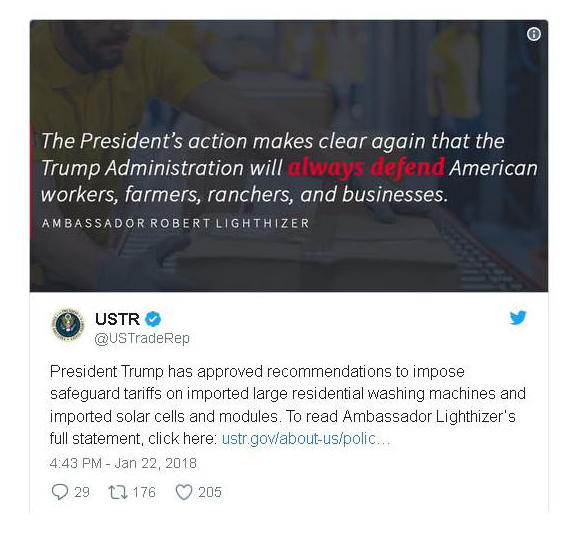
Washington, DC – U.S. Trade Representative Robert Lighthizer announced today that President Trump has approved recommendations to impose safeguard tariffs on imported large residential washing machines and imported solar cells and modules.
USTR made the recommendations to the President based on consultations with the interagency Trade Policy Committee (TPC) in response to findings by the independent, bipartisan U.S. International Trade Commission (ITC) that increased foreign imports of washers and solar cells and modules are a substantial cause of serious injury to domestic manufacturers.
“These cases were filed by American businesses and thoroughly litigated at the International Trade Commission over a period of several months,” said Ambassador Lighthizer. “The ITC found that U.S. producers had been seriously injured by imports and made several recommendations to the President. Upon receiving these recommendations, my staff and I conducted an exhaustive process which included opportunities to brief in person and through public comments, public hearings, and meetings with senior representatives.
Based on this information, the Trade Policy Committee developed recommendations, which the President has accepted. The President’s action makes clear again that the Trump Administration will always defend American workers, farmers, ranchers, and businesses in this regard.”
For imports of large residential washers, the President approved applying a safeguard tariff-rate quota for three years with the following terms (read more)
Suniva, SolarWorld and Whirlpool were helped by a 1974 trade law that lets companies seek trade protection if they can show damage from a rise in imports. Prior administrations’ stopped using the law in the mid 1990’s, President Trump reconstituted the process in 2017 as part of his overall overall trade-plan.
Up to certain levels, imports of solar cells will be exempt from the tariff, while the first 1.2 million imported large washing machines will get a lower tariff, peaking at 20 percent.
Congress has no authority to change or veto Trump’s decision. Countries affected by the decision can appeal to the World Trade Organization. The U.S. Chamber of Commerce and their purchased DC politicians are apoplectic:
Ben Sasse, R-Neb., said Republicans need to understand that tariffs are a tax on consumers. “Moms and dads shopping on a budget for a new washing machine will pay for this — not big companies,” Sasse said in a statement.
OMB Director Mick Mulvaney Press Briefing on Schumer-Shutdown
Education Secretary Betsy DeVos: Common Core is Dead at U.S. Department of Education…
U.S. Secretary of Education Betsy DeVos gave a far-ranging speech Tuesday in Washington at an American Enterprise Institute conference, “Bush-Obama School Reform: Lessons Learned.” Most media reporting outlines Mrs. DeVos presentation to state ‘the era of common core education is now dead“…
The full transcript of Secretary DeVos remarks is below:
[Transcript] “Thank you, Rick, for that kind introduction. Who would’ve thought that after we were last together on a panel in Grand Rapids a couple of years ago, I’d be here in this capacity today?
It’s an honor to be with all of you at an organization I have long appreciated.
AEI is now in its 80th year and in that near century, the Institute’s scholars have influenced and shaped the way Americans think about so many issues in the public square. AEI has been – and will continue to be – a treasured constant in this town of transition. And it should be noted that’s due in no small part to the leadership of Arthur Brooks, who brings a unique and compelling perspective. I’m grateful to call him a friend.
I’d like to especially thank Rick and Michael for putting this volume together and for hosting today’s important discussions. Both of you have contributed significantly to the policy debates in American education, and, importantly, you’ve put your distinct perspectives and experience to work with the goal of improving education for all. You both left the classroom out of frustration, and there are still far too many teachers who share that experience today.
My work over thirty years has revolved around time spent on the outside, looking in. Outside Washington. Outside the LBJ building. Outside “the system.” Some have questioned the presence of an outsider in the Department of Education, but, as it’s been said before, maybe what students need is someone who doesn’t yet know all the things you “can’t do.”
To a casual observer, a classroom today looks scarcely different than what one looked like when I entered the public policy debate thirty years ago. Worse, most classrooms today look remarkably similar to those of 1938 when AEI was founded. Take a look at this! These two operating rooms look starkly different, as does this general store and this website. But these two classrooms look almost identical.
The vast majority of learning environments have remained the same since the industrial revolution, because they were made in its image. Think of your own experience: sit down; don’t talk; eyes front. Wait for the bell. Walk to the next class. Repeat. Students were trained for the assembly line then, and they still are today.
Our societies and economies have moved beyond the industrial era. But the data tell us education hasn’t.
The most recent Program for International Student Assessment, or PISA, report, with which you are all familiar, has the U.S. ranked 23rd in reading, 25th in science and 40th in math. And, you know this too: it’s not for a lack of funding. The fact is the United States spends more per pupil than most other developed countries, many of which perform better than us in the same surveys.
I know that hard truth touches a nerve for everyone in this room. It does so for educators who try to help their students realize their potential. For employers who seek prepared employees. And, most importantly, for parents who only want the best for their children.
Of course there have been many attempts to change the status quo. We’ve seen valiant efforts to improve education from Republicans and Democrats, liberals, conservatives and everyone in between.
That’s because everyone is aiming for the same result.
Everyone wants students to be prepared and to lead successful lives.
We can’t say that sort of public harmony exists in other policy arenas. Not everyone agrees about the outcome or goal of tax policy or energy policy or immigration policy.
Our unity of purpose here presents an opportunity.
But while we’ve changed some aspects of education, the results we all work for and desire haven’t been achieved.
The bottom line is simple: federal education reform efforts have not worked as hoped.
That’s not a point I make lightly or joyfully. Yes, there have been some minor improvements in a few areas. But we’re far from where we need to be. We need to be honest with ourselves. The purpose of today’s conversation is to look at the past with 20/20 hindsight, examine what we have done and where it has – or hasn’t – led us.
First, let me be clear that I’m not here to impugn anyone’s motives. Every one of us wants better for students. We want better for our own children. We want better for our communities and our country. We won’t solve any problems through finger-pointing.
I also don’t intend to criticize the goals of previous administrations’ education initiatives. In the end, every administration has tried to improve education for students and grow the number who are learning valuable skills.
We should hope – no, we should commit – that we as a country will not rest until every single child has equal access to the quality education they deserve. Secretary Spellings was right to ask “whose child do you want to leave behind?”
But the question remains: why, after all the good intentions, the worthwhile goals, the wealth of expertise mustered, and the billions and billions of dollars spent, are students still unprepared?
With No Child Left Behind, the general consensus among federal policymakers was that greater accountability would lead to better schools. Highlighting America’s education woes had become an American pastime, and, they thought, surely if schools were forced to answer for their failures, students would ultimately be better off.
President Bush, the “compassionate conservative,” and Senator Kennedy, the “liberal lion,” both worked together on the law. It said that schools had to meet ambitious goals… or else. Lawmakers mandated that 100 percent of students attain proficiency by 2014. This approach would keep schools accountable and ultimately graduate more and better-educated students, they believed.
Turns out, it didn’t. Indeed, as has been detailed today, NCLB did little to spark higher scores. Universal proficiency, touted at the law’s passage, was not achieved. As states and districts scrambled to avoid the law’s sanctions and maintain their federal funding, some resorted to focusing specifically on math and reading at the expense of other subjects. Others simply inflated scores or lowered standards.
The trend line remains troubling today. According to the most recent National Assessment of Educational Progress data, two-thirds of American fourth graders still can’t read at the level they should. And since 2013, our 8th grade reading scores have declined.
Where the Bush administration emphasized NCLB’s stick, the Obama administration focused on carrots. They recognized that states would not be able to legitimately meet the NCLB’s strict standards. Secretary Duncan testified that 82 percent of the nation’s schools would likely fail to meet the law’s requirements — thus subjecting them to crippling sanctions.
The Obama administration dangled billions of dollars through the “Race to the Top” competition, and the grant-making process not so subtly encouraged states to adopt the Common Core State Standards. With a price tag of nearly four and a half billion dollars, it was billed as the “largest-ever federal investment in school reform.” Later, the Department would give states a waiver from NCLB’s requirements so long as they adopted the Obama administration’s preferred policies — essentially making law while Congress negotiated the reauthorization of ESEA.
Unsurprisingly, nearly every state accepted Common Core standards and applied for hundreds of millions of dollars in “Race to the Top” funds. But despite this change, the United States’ PISA performance did not improve in reading and science, and it dropped in math from 2012 to 2015.
Then, rightly, came the public backlash to federally imposed tests and the Common Core. I agree – and have always agreed – with President Trump on this: “Common Core is a disaster.” And at the U.S. Department of Education, Common Core is dead.
On a parallel track, the Obama administration’s School Improvement Grants sought to fix targeted schools by injecting them with cash. The total cost of that effort was seven billion dollars.
One year ago this week, the Department’s Institute of Education Sciences released a report on what came of all that spending. It said: “Overall, across all grades, we found that implementing any SIG-funded model had no significant impacts on math or reading test scores, high school graduation, or college enrollment.”
There we have it: billions of dollars directed at low-performing schools had no significant impact on student achievement.
These investments were meant to spark meaningful reforms. Schools were encouraged to significantly alter their teaching staffs, fire the principal or change the structure and model of the school. But most glossed over those recommendations. They simply took the federal money and ran the school the same old way.
So where does that leave us? We saw two presidents from different political parties and philosophies take two different approaches.
Federally mandated assessments. Federal money. Federal standards. All originated in Washington, and none solved the problem. Too many of America’s students are still unprepared.
Perhaps the lesson lies not in what made the approaches different, but in what made them the same: the federal government. Both approaches had the same Washington “experts” telling educators how to behave.
The lesson is in the false premise: that Washington knows what’s best for educators, parents and students.
Rick, you’ve rightly pointed out that the federal government is good at making states, districts, and schools do something, but it’s not good at making them do it well. Getting real results for students hinges on how that “something” is done.
That’s because when it comes to education – and any other issue in public life – those closest to the problem are always better able to solve it. Washington bureaucrats and self-styled education “experts” are about as far removed from students as you can get.
Yet under both Republican and Democratic administrations, Washington overextended itself time and time again.
Educators don’t need engineering from Washington. Parents don’t need prescriptions from Washington. Students don’t need standards from Washington.
Throughout both initiatives, the result was a further damaged classroom dynamic between teacher and student, as the focus shifted from comprehension to test-passing. This sadly has taken root, with the American Federation of Teachers recently finding that 60 percent of its teachers reported having moderate to no influence over the content and skills taught in their own classrooms.
Let that sink in. Most teachers feel they have little – if any — say in their own classrooms.
That statistic should shock even the most ardent sycophant of “the system.” It’s yet another reason why we should shift power over classrooms from Washington back to teachers who know their students well.
Federal mandates distort what education ought to be: a trusting relationship between teacher, parent and student.
Ideally, parent and teacher work together to help a child discover his or her potential and pursue his or her passions. When we seek to empower teachers, we must empower parents as well. Parents are too often powerless in deciding what’s best for their child. The state mandates where to send their child. It mandates what their child learns and how he or she learns it. In the same way, educators are constrained by state mandates. District mandates. Building mandates… all kinds of other mandates! Educators don’t need Washington mandating their teaching on top of everything else.
But during the years covered in your volume, the focus was the opposite: more federal government intrusion into relationships between teachers, parents and children.
The lessons of history should force us to admit that federal action has its limits.
The federal-first approach did not start with No Child Left Behind. The push for higher national standards was present in the Clinton administration’s “Goals 2000” initiative. Before that, we had President George H.W. Bush’s “America 2000,” also calling for higher national standards. These followed the Reagan administration’s “Nation at Risk” report, released in 1983.
That report gave dire warnings about the country’s track if education was not reformed. “If an unfriendly foreign power had attempted to impose on America the mediocre educational performance that exists today,” the report warned, “we might well have viewed it as an act of war.” That came after President Carter’s giant nod to union bosses: the establishment of the Department of Education, with the ironic charge to “prohibit federal control of education.”
The trend is evident. Politicians from both parties just can’t help themselves. They have talked about painting education in new colors and even broader strokes. But each time, reform has not fundamentally changed “the system.” Each attempt has really just been a new coat of paint on the same old wall.
When we try the same thing over and over again, yet expect different results, that’s not reform – that’s insanity.
We will not reach our goal of helping every child achieve his or her fullest potential until we truly change. Let me offer three ways we can move forward in that pursuit.
First, we need to recognize that the federal government’s appropriate role is not to be the nation’s school board. My role is not to be the national superintendent nor the country’s “choice chief” – regardless of what the union’s “Chicken Littles” may say! Federal investments in education, after all, are less than 10 percent of total K-12 expenditures, but the burdens created by federal regulations in education amount to a much, much larger percentage.
The Every Student Succeeds Act charted a path in a new direction. ESSA takes important steps to return power where it belongs by recognizing states – not Washington — should shape education policy around their own people. But state lawmakers should also resist the urge to centrally plan education. “Leave it to the states” may be a compelling campaign-season slogan, but state capitols aren’t exactly close to every family either. That’s why states should empower teachers and parents and provide the same flexibility ESSA allows states.
But let’s recognize that many states are now struggling with what comes next. State ESSA plans aren’t the finish line. Those words on paper mean very little if state and local leaders don’t seize the opportunity to truly transform education. They must move past a mindset of compliance and embrace individual empowerment.
Under ESSA, school leaders, educators and parents have the latitude and freedom to try new approaches to serve individual students.
My message to them is simple: do it!
Embrace the imperative to do something truly bold… to challenge the status quo… to break the mold.
One important way to start this process is to make sure that parents get the information they want and need about the performance of their children’s schools and teachers. ESSA encourages states to be transparent about how money is spent, down to the school-building level.
Some states have developed information that is truly useful for parents and teachers. Others have worked just as hard to obfuscate what is really going on at their schools. To empower parents, policymakers and teachers, we can’t let “the system” hide behind complexity to escape accountability.
We must always push for better.
ESSA is a good step in the right direction. But it’s just that – a step. We still find ourselves boxed in a “system,” one where we are in a constant battle to move the ball between the 40-yard lines of a football field. Nobody scores, and nobody wins. Students are left bored in the bleachers, and many leave, never to return.
So why don’t we consider whether we need a new playbook?
That brings me to point number two. And, to finish the analogy… let’s call a new play: empowering parents.
Parents have the greatest stake in the outcome of their child’s education. Accordingly, they should also have the power to make sure their child is getting the right education.
As Deven Carlson points out, there is little constituency in America for the top-down reforms that have been tried time and again. In order for any reform to truly work, it must attract and maintain the support of the people.
I have seen such support for parental empowerment. The more parents exercise it, the more they like it. This growing support is why states are responding to that demand one by one. It’s also why sycophants entrenched in and defending the status quo are terrified. They recoil from relinquishing power and control to teachers, parents and students.
Well, I’m not one bit afraid of losing power. Because I trust parents and teachers, and I believe in students.
Equal access to a quality education should be a right for every American and every parent should have the right to choose how their child is educated. Government exists to protect those rights, not usurp them.
So let’s face it: the opponents of parents could repeal every voucher law, close every charter school, and defund every choice program across the country.
But school choice still wouldn’t go away. There would still be school choices… for the affluent and the powerful.
Let’s empower the forgotten parents to decide where their children go to school. Let’s show some humility and trust all parents to know their kids’ needs better than we do.
Let’s trust teachers, too. Let’s encourage them to innovate, to create new options for students. Not just with public charter schools or magnet schools or private schools, but within the traditional “system” and with new approaches yet to be explored.
What we’ve been doing isn’t serving all kids well. Let’s unleash teachers to help solve the problem.
You know, I’ve never heard it claimed that giving parents more options is bad for mom and dad. Or for the child. What you hear is that it’s bad for “the system” – for the school building, the school system, the funding stream.
That argument speaks volumes about where Chicken Little’s priorities lie.
Our children deserve better than the 19th century assembly-line approach. They deserve learning environments that are agile, relevant, exciting. Every student deserves a customized, self-paced, and challenging life-long learning journey. Schools should be open to all students – no matter where they’re growing up or how much their parents make.
That means no more discrimination based upon zip code or socio-economic status. All means all.
It’s about educational freedom! Freedom from Washington mandates. Freedom from centralized control. Freedom from a one-size-fits-all mentality. Freedom from “the system.”
Choice in education is not when a student picks a different classroom in this building or that building, uses this voucher or that tax-credit scholarship. Choice in education is bigger than that. Those are just mechanisms.
It’s about freedom to learn. Freedom to learn differently. Freedom to explore. Freedom to fail, to learn from falling and to get back up and try again. It’s freedom to find the best way to learn and grow… to find the exciting and engaging combination that unlocks individual potential.
Which leads to my final point: if America’s students are to be prepared, we must rethink school.
What I propose is not another top-down, federal government policy that promises to be a silver bullet. No. We need a paradigm shift, a fundamental reorientation… a rethink.
“Rethink” means we question everything to ensure nothing limits a student from pursuing his or her passion, and achieving his or her potential. So each student is prepared at every turn for what comes next.
It’s past time to ask some of the questions that often get labeled as “non-negotiable” or just don’t get asked at all:
Why do we group students by age?
Why do schools close for the summer?
Why must the school day start with the rise of the sun?
Why are schools assigned by your address?
Why do students have to go to a school building in the first place?
Why is choice only available to those who can buy their way out? Or buy their way in?
Why can’t a student learn at his or her own pace?
Why isn’t technology more widely embraced in schools?
Why do we limit what a student can learn based upon the faculty and facilities available?
Why?
We must answer these questions. We must acknowledge what is and what is not working for students.
Now, I don’t have all the answers or policy prescriptions. No one person does. But people do know how to help their neighbors. People do know how they can help a dozen students here or 100 there. Because they know the students. They know their home lives. They know their communities. They know their parents. They know each other.
That means learning can, should, and will look different for each unique child. And we should celebrate that, not fear it!
I’m well aware that change — the unknown – can be scary. That talk of fundamentally rethinking our approach to education seems impossible, insurmountable.
But not changing is scarier. Stagnation creates risks of its own. The reality is…
we should be horrified of not changing.
Our children don’t fear their futures. Think of a newborn, born into hope — not fear. They begin life with a clean slate. With a fresh set of eyes to see things we don’t currently see. That’s how students begin their lifelong learning journeys… with unlimited potential… yet with limited time.
Their dreams, their hopes, their aspirations, their futures can’t wait, while another wave of lawmakers puts yet another coat of paint on the broken “system.” One year may not seem like much to an adult, but it’s much too long for the child who still can’t read “Goodnight Moon.”
We, the public, can’t wait either. Education is good for the public.
Everything else – our health, our economy, our continued security as a nation — depends on what we do today for the leaders of tomorrow. It follows, then, that any educator in any learning environment serves the public good. If the purpose of public education is to educate the public, then it should… not… matter what word comes before school.
What matters are the students the school serves. What matters are their futures. We’ve been entrusted with their futures not because we asked to be, but because it’s a duty to destiny – theirs… and ours. It all depends on what we do now.
When our grandchildren tell their children about this moment in history, let them say we were the ones who finally put students first.
Thank you, and I look forward to this conversation.
More Winning !!
Meanwhile… the fake news media are cats chasing Trump’s dancing laser pointer…
MAGAnomics – Stunning 2017 Holiday Season Sales Results Exceed All Forecasts, DOW Breaks 26,000…
MAGAnomics – The first round of economic results from 2017 holiday sales are coming in and the results are incredible. Total holiday sales from November and December increased 5.5% over the prior year, that’s a massive jump.
Keep in mind, two-thirds of GDP is attached to consumer spending. The spending jump to $692 billion will increase fourth quarter GDP growth when calculated.
(Via CNBC) Holiday sales jumped 5.5 percent compared with last year, marking the largest jump seen since the end of the Great Recession, the National Retail Federation said Friday.
Total sales for November and December were $691.9 billion, exceeding the industry trade group’s forecast of between $678.75 billion and $682 billion, which would have been an increase of between 3.6 and 4 percent.
“We knew going in that retailers were going to have a good holiday season but the results are even better than anything we could have hoped for,” NRF President and CEO Matthew Shay said.
Economists and advisors had expected robust spending across the board due to strong employment and consumer confidence. However, many questioned exactly where that increased spending would go.
Over the holidays, the strongest performers were building materials and supply stores (8.1 percent growth ), furniture (7.5 percent growth) and electronics (6.7 percent growth). Clothing/accessories and health/personal care clocked in weaker growth, up 2.7 percent and 2.2 percent, respectively. (read more)
Sarah Sanders White House Press Briefing – Wednesday January 17th (Video)…
Sarah Huckabee Sanders delivers the White House press briefing for Wednesday January 17th. Secretary Sanders is joined by a DOJ official to help show the connection between immigration policy and the evolving threat from terrorism.
Department of Justice, Asst. Attorney General Ed O’Callahan (part of the National Security Division), delivered remarks on the Departments of Justice and Homeland Security Release Data Release on Terrorism-Related Activity –SEE HERE-
.
U.S. Dept of Justice – Today, the Department of Justice (DOJ) and the Department of Homeland Security (DHS) released a report, revealing that three out of every four, or 402, individuals convicted of international terrorism-related charges in U.S. federal courts between September 11, 2001, and December 31, 2016 were foreign-born.
Over the same period, U.S. Immigration and Customs Enforcement removed approximately 1,716 aliens with national security concerns. Further, in 2017 alone DHS had 2,554 encounters with individuals on the terrorist watch list (also known as the FBI’s Terrorist Screening Database) traveling to the United States. (continue reading)
Stunningly Rude and Disrespectful Conduct by CNN’s Jim Acosta…
CNN Chief White House Correspondent Jim Acosta has a history of rude journalistic behavior and disrespect that has never before been allowed in the White House.
Today during an oval office meeting between President Trump and President Nursultan Nazarbayev of Kazakhstan the CNN journalist exhibited a level of disrespectful behavior that should lead to his White House press credentials being revoked permanently.
Project Veritas Outlines Risk of Weaponized Social Media…
There is more than a little connective tissue behind a series of Project Veritas undercover investigative reports on how Twitter surveillance data is utilized, and recent discoveries of how FBI contractors were weaponizing FISA surveillance data against political opposition.
In each example, private company or big government, surveillance data forms the basis for the weaponization. In an era when people don’t think twice before engaging on social media platforms, the Project Veritas series presents a warning worth sharing.
Part I HERE – Part II HERE – Part III is below:
(San Francisco) Project Veritas has released undercover footage of Twitter Engineers and employees admitting that Twitter employees view all of your private messages on their servers and analyze it to create a “virtual profile” of you which they sell to advertisers.
The footage features four current Twitter software engineers–Conrado Miranda, Clay Haynes, Pranay Singh, and Mihai Alexandru Florea. (more)