Is Obama Supporting the ISIS?


Some of this information is from the Council of Conservative Citizens

The US government once offered a reward of “up to $10 million” for the capture of al-Quida leader Abu Bakr al-Baghdadishortly after the 2003 invasion of Iraq. He was eventually captured in 2005 and interned at Camp Bucca, which was a detention facility maintained by the United States Military in the vicinity of Qasr, Iraq.

After Obama took office and started pulling all the troops out of Iraq he was released in 2009; as he was released, the man who would go on to head the powerful ISIS group issued a menacing warning to his former captors.

‘I’ll see you guys in New York,’ Abu Bakr al-Baghdadi reportedly told U.S. Army reservists from Long Island who had been guarding him at Camp Bucca near the Kuwaiti border.

Army Colonel Kenneth King, who was the commanding officer of the U.S. forces’ largest detention facility in Iraq in 2009 was one of the people who heard al-Baghdadi’s parting words, but he did not take them as a threat at the time.

Not that there is any known connection but trouble started in Libya in August 2009 and by October 2011 Gaddafi was dead and the revolution leaders were in power. As the situation in Libya wound down the Syrian civil war was starting up after protests began there on January 28, 2011.

Barack Obama and his minions have had their hands in all these situations and have been providing money and support to Sunni Jihadists in Syria, where Abu Bakr al-Baghdadi was based. This money and arms transfer was a major part of the Bengali situation as weapons were moved from Libya to Syria apparently through Turkey.

Therefore, many of the Sunni Jihadists now fighting with the ISIS have directly benefited from US money and arms.

Abu Bakr al-Baghdadi is also believed to be the mastermind behind a series of large scale jail breaks in Iraq that have freed about 2,000 Jihadists over the past year.

His present army stretches from The middle of northern Syria to northern and central Iraq. The core of his army is made up of former FSA Jihadists that received money and weapons from the USA, freed Iraqi veteran Jihadists, and Sunni militias that are now flocking to join him.

West Point Class of 2014


This was from a friend but not inconsistent with what I saw and know.

May 30, 2014

The West Point graduating class of 2014 “spoke” volumes as their commencement speaker, Barack Obama, used the speech NOT to laud them for their accomplishments and their sacrifice to serve in the U.S. Military, no, instead he chose to use that precious time to tell them how effective his foreign policy has been, how the military role in foreign policy going forward (paraphrasing) “ain’t what it used to be” and is no longer a leading line of defense. At times he stumbled over the words on the teleprompter to the point of embarrassment but he didn’t seem to be in the least bothered by it.

To top off his narcissistic ramblings in which he claimed successes in Syria and Ukraine for God’s Sake and bragged about ending the war in Iraq (and as every cadet sitting there knew, his actions of pulling all troops on a date certain, handed Iraq right back to Al Qaeda linked terrorist groups as if the sacrifices our military made was of no consequence and stood for nothing). Believe me, every one of those intelligent, well informed cadets knew the sacrifice this president flushed down the toilet and for what; political gain.

As if that wasn’t bad enough, he then lectured the cadets that they must focus on the progressive social policy of GLOBAL WARMING! He told them they must be prepared to help the government enforce the legislation. The looks on the cadets’ faces said it all!!! I could read their minds. “Since when has ANY of our military been used to enforce social policy? How ‘bout NEVER! And for good reason, Mr. president, that kind of use of the military only happens under DICTATORS, you ass. We studied long and hard to learn how to lead troops to defend our country from enemies both foreign and domestic, not enforce domestic and social policy at a president’s whim!”

The cadets, as is the custom, were prompted to applaud at designated intervals throughout the speech. At first, the majority of the cadets clapped on cue (out of respect for the office I would imagine) but there was no enthusiasm in it. Not even at the beginning. As the speech progressed, fewer and fewer cadets clapped. Many chose to stare at the ground. By the end there were only five or six clapping when prompted. Did the president seem to notice the cadets’ silent protest? Oh hell no. He was so enthralled by the sound of his own voice he stood there and beamed like the cat that swallowed the canary.

Here’s the topper; as the president handed out the diplomas to the West Point cadets; each one very accomplished, intelligent and dedicated to serving their country, their Commander-in-Chief BOPPED AROUND on the stage CHEWING GUM!!!!!!!!!!!!!!!!!! Disrespectful? Yeah, I’d say. He is clueless six years in to his presidency. There again, the expressions on the cadets faces told it all. Contrasts don’t get much more stark than that.

Journalist That Exposed Bowe Bergdahl as a Traitor and Deserter Murdered in Possible ‘..FBI Assassination Cover-up..’


Sergeant Bowe Bergdahl


The Sergeant Bowe Bergdahl situation is very simply now that he is back.

If Sergeant Bowe Bergdahl left his unit as his fellow troops state than the military has no choice but to charge him under the terms of desertion listed in the UCMJ Article 85 Desertion (2) quits his unit, organization, or place of duty with intent to avoid hazardous duty or to shirk important service as specified in the Army Regulation 27-10 dated 3 October 2011 Chapter 5 Procedures for Courts-Marshal.

If this is not done than it will create a very serious morale and command problems that could have a devastating effect on the performance of the US Military. In the military every soldier must depend on every other soldier to be there and perform his or her duty. If a soldier is allowed to walk away from any situation for any reason than the entire command structure of the military is jeopardized.

The minimum result of this mandatory Courts-Marshal, in my opinion, would be a dishonorable discharge with forfeiture of all pay and reduction in rank to private E-1 and no veterans benefits. However the maximum penalty as proscribed in Article 85 is ….

Article 85 – Desertion. This is the most serious of the absentee offenses. If the member deserts during time of war: Death or such other punishment (such as life in prison) as a court-martial may direct.

The following link will give you a good synopsis of what happened.

http://www.realclearpolitics.com/articles/2014/06/04/exclusive_the_story_you_havent_yet_heard_about_bowe_bergdahls_desertion_122856.html

A Military Prospective on Politics from those that have served


This is a repost from Special Operations Speaks a private source of information from former military NCO’s and Officers that served in the elite units of the US military. We are the ones that were the boots on the ground and we (especially the higher ranking) know better than anyone in Washington what is going on. The only exceptions are the very few that are there and have served. This repost is from.

Dennis B, Haney – Lt Col, USAF (Ret) Wild Weasel #1023
SOS Operations Coordinator
Special Operations Speaks
www.SpecialOperationsSpeaks.com

This past weekend, the Obama Administration treated us to a Rose Garden event unparalleled in its arrogance and symbolic malevolence toward all that America represents.  As the co-opted and simpering American press watched, the President exploited the distraught parents of Sergeant Bowe Bergdahl, and hailed Bergdahl’s release from the clutches of the jihadists who held him for five years in exchange for the unleashing of five notoriously dedicated terrorists, all fat and sassy straight out of Gitmo, upon the world scene.

But what America really witnessed on Saturday was President Obama’s continuing deliberate and traitorous dismantling of three of our four fundamental elements of National power: Diplomacy, Information and the Military. The fourth element is the Economy, and if we try, we could likely make a case for that as well.

The tortured decision-making that led to the release of five prime enemies, who were each made fit and combat-ready, compliments of the U.S. taxpayers, flies in the face of logic and of the U.S. National interest. Yet it follows a long pattern of policies favoring militant Islam over United States and world safety.

The Muslim Brotherhood long ago infiltrated our Nation’s capital, coming to settle in key Executive Branch advisory and appointed positions.   The Muslim Brotherhood, whose operatives now influence so many policy-level decision-makers across this Administration, in fact are the ideological soul mates of the jihadis who captured Bergdahl. The Obama administration used Qatar, a Taliban supporter and home-away-from-home for Yousef al-Qaradawi, the senior jurist of the Muslim Brotherhood, as a go-between to negotiate with the Taliban and Haqqanis. The Brotherhood influence was never more evident than in the Rose Garden act of prime time symbolic surrender, and very likely helped shape the terms of the GITMO detainee release.  That same influence was also at work in the days leading up to and during the Benghazi massacre, when four Americans were sacrificed to the jihad and to the overarching demands of the 2012 Presidential campaign.   Jihad is alive and well in Washington, D.C.

The Saturday Rose Garden drama was a National tragedy; a clinic in strategic psychological operations. It was an Islamist demonstration of the level of control they exercise over the governance of the United States, through this President and his key advisors.

Special Operations Speaks condemns the dismantling of our Military while upgrading the militant forces of the jihadists.

We condemn the media for its culpability in the active dis-informing and demoralizing of the American people.

We condemn the deliberate dismantling of American diplomatic image, credibility, and its hard-won standing as a bona fide champion for good around the world for the past century.

We urge our flag officers, in uniform and retired, to step up to the plate and be counted just as many of their warrior privates have done in these past days as they witness the daily dismantling of the Republic that has granted them the special trust and confidence of the American People.

Special Operations Speaks votes No Confidence in this administration and in its destructive policies.

A Short History of U.S. Special Forces


The Green Beret’s

The following short history is mostly paraphrased from information in the book written by Shelby Stanton the “Green Berets at War” especially from the foreword to the book that was written by George C. Morton a retired U.S. Army Colonel. Colonel Morton was also the first commander of the U.S. Army Special Forces Vietnam (Provisional). His forward is by no means a complete history of Special Forces but it does give a very good overview of beginning of this elite unit.

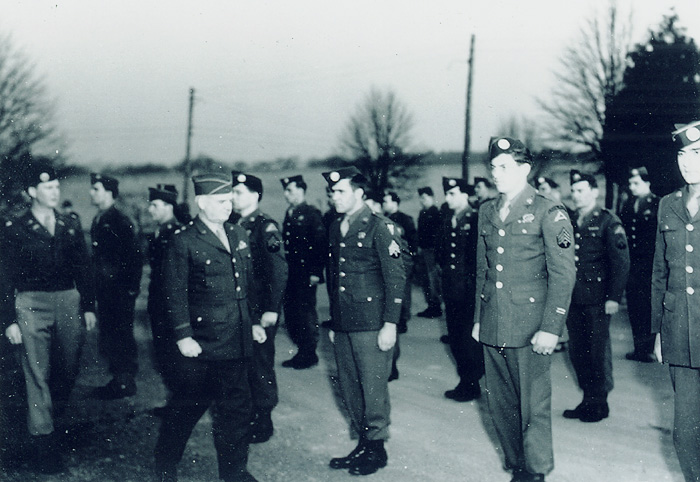
The story starts at the end of World War II when General William J. “Wild Bill” Donovan’s Office of Strategic Services (OSS) was demobilized by Harry S. Truman with Executive Order on Sept. 20, 1945 (mainly the result of J Edgar Hoover’s dislike of Donovan’s unconventional methods) and the Office of Strategic Services was no more. The following picture is of Donovan’s review of OSS troopers prior to deployment.

“We were not afraid to make mistakes because we were not afraid to try things that had not been tried before.” “You can’t succeed without taking chances.”

– Maj. Gen. William J. Donovan, OSS founder

Sf-Donovan

When the OSS was disbanded the United States lost its capability to conduct unconventional warfare and the vast experiences gained by the American personnel involved with the World War II resistance movements worldwide was irretrievably lost. Unfortunately for America, this occurred at the same time that communist expansionism was being manifested throughout the newly emerging and Third World countries of Asia, Latin America, Africa and the Middle East in support of so-called national wars of liberation. Without a capability to support resistance movements in those affected countries and regions, opposition eventually withered and those nations fell under the firm grip of either the Soviet Union or the People’s Republic of China. The resultant was that most of Eastern European as well as most of mainland Asia, fell under communist control by the late 40’s.

Note: This was the period when the “Domino Theory” was developed. This theory basically stated that countries would fall to communist expansion one after the other (geographically) much as domino’s fall after the first one is pushed down. Under this scenario the Communists would use the boarders of adjacent countries to infiltrate into their neighbors spreading unrest. This theory also assumed that there was a “monolithic” communism. Many years later it would be seen that both these assumptions were false and that there were other factors that were in play. In my opinion it was the significant wealth difference of the have countries verses the have not countries. This combined with the illusion of sometime for nothing promised by the Communists gave those in third world counties something to get peoples hopes up over. In actuality Karl Marx stated that industrial nations would be the first to fall to communism not the backward countries that did. In any case, the traditional Communist system collapsed in the early 1990 and no longer presents much of a challenge to other economic systems.

Two years later with the passage of the National Security Act in 1947 the Truman administration corrected the problem created when the OSS was disbanded with the creation of a new clandestine agency to replace the defunct Office of Strategic Services, the Central Intelligence Agency, using a plan created by Donovan. Most of its early members of the CIA were OSS alumni. This act also set the stage for the creation of the US Special Forces a few years later but we lost two critical years in the fight against the Communists.

The American strategy developed in the 1950’s and 1960’s to block further communist expansion relied on containment backed up by the three strategic nuclear deterrents (One, Air Force B-52’s; Two, the strategic land based missiles (ICBM’s) and Three, the navy’s; nuclear ballistic submarines and aircraft carriers.) These elements were called “The Triad”. This policy resulted in a proliferation of collective or bilateral defense treaty organizations, which all involved large numbers of U.S. and allied conventional units supported by an arsenal of nuclear weapons. Although formidable these forces were totally unsuitable for the grassroots wars of liberation, which cropped up throughout the third world during this period.

The Greek Civil War and the Hukbalahap Guerrilla War in the Philippines shortly after the end of World War II both further highlighted the necessity for a national defense policy aimed at countering communist expansionism using an alternative to massive conventional intervention or atomic annihilation. Such a requirement also received impetus during the Korean War, when bands of South Korean irregulars were formed behind the lines in North Korea and conducted successful sabotage, ambush and intelligence collection operations, as well as establishing escape and evasion nets for the rescue of downed American pilots in the famous MIG Alley.

As a result, on June 20, 1952, the first contingent of volunteers assembled on Smoke Bomb Hill at Fort Bragg, North Carolina, to be organized into the 10th Special Forces Group under the auspices of the Army Chief of Psychological Warfare. The formation of this first SF unit was the direct result of the efforts of Colonel Aaron Bank an OSS veteran who is now considered to be the father of Special Forces. I meet him in 1994 at the Cleveland SF convention and again at the fiftieth anniversary of the formation of Special Forces at Ft. Bragg in 2002. The following picture of him that I took with Roy Benavidez a Vietnam era SF Metal of Honor recipient on June 24, 1994.

SF Col A Bank

These volunteers were trained for infiltration deep into enemy territory by land, sea or air to conduct unconventional warfare: guerrilla warfare, sabotage, and escape and evasion. Although this original contingent included a smattering of former OSS men and individuals who had served with other guerrilla and resistance groups in World War II, the majority had no previous unconventional warfare experience. They were, however, outstanding paratrooper (airborne) qualified officers and non-commissioned officers (NCOs) who were dedicated and highly motivated individuals.

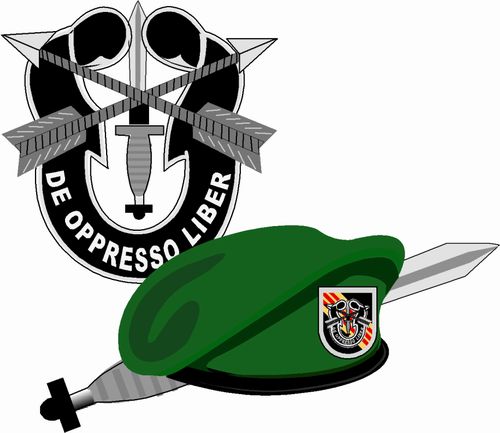
These professionals brought with them their skills in operations, intelligence, demolitions, communications, light and heavy weapons, and medicine. They were capable of operating independently as small teams for extended periods in hostile territory with minimal support. They were taught to organize, train, and equip guerrilla forces; conduct sabotage operations, support resistance movements and to evade, and if necessary, escape from enemy forces. These elite troopers adopted the insignia of the Trojan Horse as their symbol, and De Oppresso Liber (To Liberate from Oppression) as their motto. The Green Beret was originally designated in 1953 by Special Forces Major Herbert Brucker, a veteran of the OSS. Later that year, 1st Lt. Roger Pezelle adopted it as the unofficial head-gear for his A-team, Operational Detachment FA-32. They wore it whenever they went to the field for prolonged exercises. Soon it spread throughout all of Special Forces, although the Army refused to authorize its official use.

sf-crest and beret

In November of 1953, the 10th Special Forces Group, which had completed over a year of training at Fort Bragg, deployed to Bad Tolz in Germany. There the group prepared to support resistance movements and organize guerrilla forces in the Soviet-dominated Eastern European satellite countries and, if indicated, throughout Africa and the Middle East. On the departure of the 10th SFG for Germany, the 77th Special Forces Group was activated at Fort Bragg with some members of the deploying 10th SFG and new troopers mostly acquired from the 82nd airborne also stationed at Ft Bragg. In 1957 the 1st Special Forces Group was activated on Okinawa to support unconventional warfare missions in the Far East. By 1961, Special Forces teams from both the 77th and the 1st SFG’s were operational in Korea, Taiwan, the Philippines, Vietnam, Laos, Thailand, and other nations, primarily as mobile training teams for their indigenous counterparts.

By the time John F. Kennedy became President of the United States on January 20, 1961, the communist supported national wars of liberation conducted along the periphery of the Soviet Union and Red China, as well as in Africa, the Middle East, Latin America, and Southeast Asia had assumed major proportions. President Kennedy embarrassed by the abortive Bay of Pigs operation in Cuba (which was an unsuccessful attempt at preventing the establishment of a communist regime in the Western hemisphere) and confronted by imminent communist insurgency in Laos and South Vietnam sought an alternative to committing regular U.S. forces in these areas. Later that year, October 12, 1961 during a visit to the U.S. Army Special Warfare Center at Fort Bragg, President Kennedy found his answer.

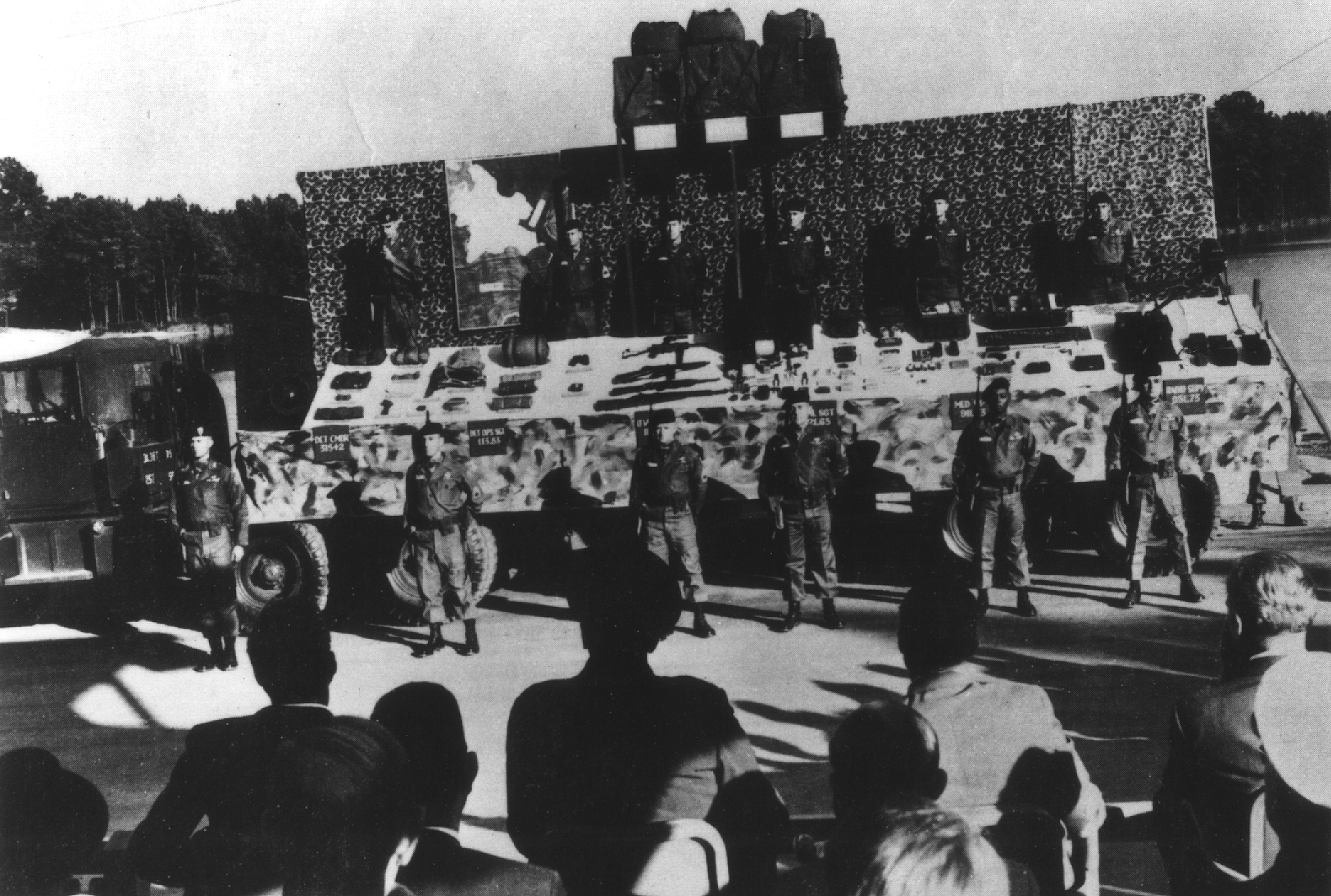
While there Kennedy met and had discussions with Brigadier General William P. Yarborough (the Commander of the Special Warfare Center). General Yarborough was young and dynamic and, more importantly, a highly articulate advocate of unconventional warfare and counterinsurgency operations. While there Kennedy observed the capabilities of the Special Forces troops and knew this was what he was looking for. One of my friends, Ernie Tasseff, in the Cleveland Chapter of the Special Forces Association was a member of that team; he was the 2nd SF trooper from the left on the ground in the picture below and I understood him to be in the first 50 Special Forces troopers pictured. President Kennedy (first on left bottom of picture) thought that he could expand these forces and then commit them to fight communist inspired insurgencies anywhere in the world.
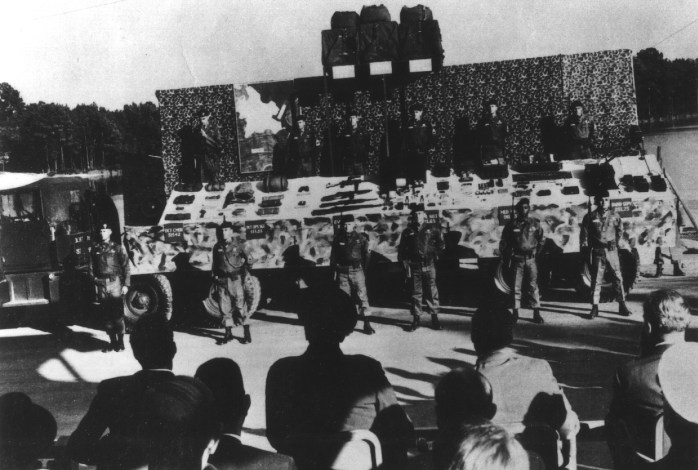
Sf-demo

Upon his return to Washington, President Kennedy instructed the Secretary of Defense to improve America’s paramilitary and unconventional warfare capabilities. Kennedy also advised him that the United States needed a greater ability to combat communist guerrilla forces, insurgency, and subversion. Kennedy then authorized the Green Beret as the official headgear for Special Forces, describing it as a symbol of excellence, a mark of distinction, and a badge of courage (prior to this the U.S. Army did not condone it’s use). Counterinsurgency became a buzzword in Washington, and the Army Special Forces became predestined to fight in a protracted war in Vietnam that no one in Washington could foresee at the time. In an April 11, 1962, White House memorandum for the United States Army, President Kennedy showed his continued support for the Special Forces, calling the Green Beret… “a symbol of excellence, a badge of courage, a mark of distinction in the fight for freedom.”

Sf-jfk

The Army Special Forces lost its champion and foremost advocate of counterinsurgency and unconventional warfare on November 22, 1963, when President Kennedy was assassinated in Dallas, Texas. However, by this time, many of his directions had already been implemented. In addition to the 10th SFG in Germany, the 1st SFG in Okinawa, and the 77th (later designated the 7th) SFG at Fort Bragg, the 8th SFG had been activated in Panama, the 5th SFG was already sending personnel to Vietnam, and the 3d and the 6th SFGs were activated at Fort Bragg with African and Middle Eastern areas of assignment. The United States had finally regained its capacity to conduct unconventional warfare and counterinsurgency operations.

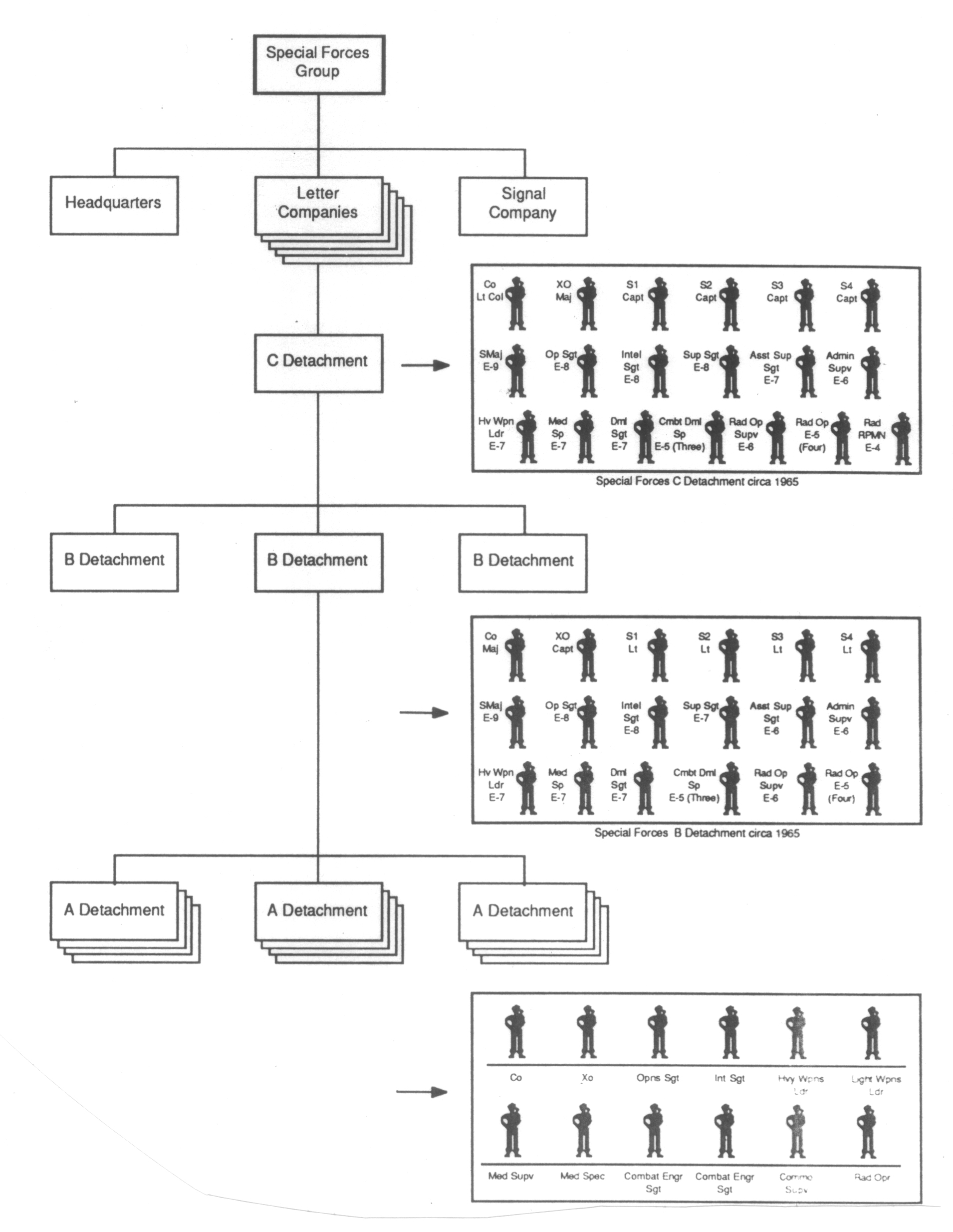
Next is the structure for an A team as it existed in the 60s. The current structure of Special Forces is totally different from that period, as is its mission. The core mission, at least prior to the Vietnam conflict, was to have a unit with the capability to infiltrate behind enemy lines, recruit local people, train them into a fighting guerrilla force, and then to conduct military operations as required. To accomplish this require men skilled in the arts or war as well as teaching and training. Since they were to operate behind enemy lines they also needed to be independent thinkers, resourceful and self-motivated. This combination of skills was not required in any other unit in the military then or now and that is what made “Green Berets” unique.
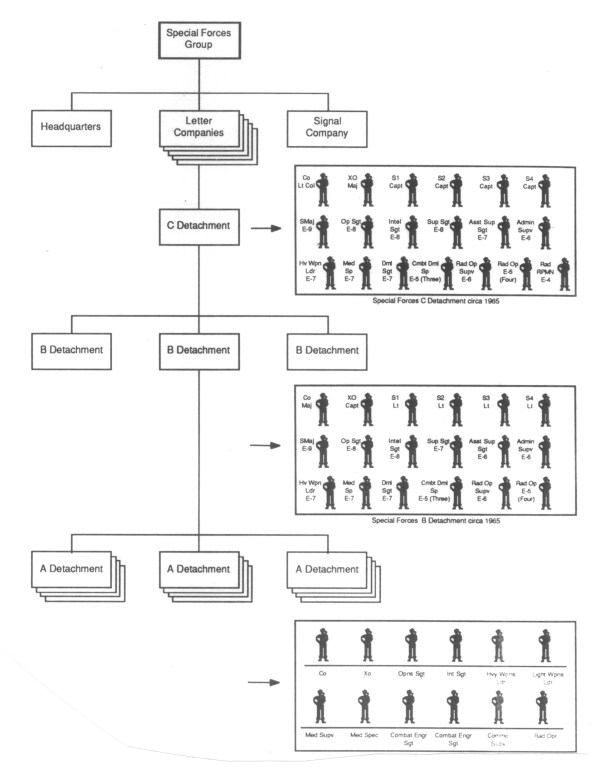
Sf-org

Shortly after Kennedy’s assassination the Special Warfare Center was renamed the John F. Kennedy Center for Special Warfare (in his honor) and all Special Forces troopers feel a special relationship to the young dynamic President who saw the worth of their elite unit. Six years after President Kennedy was assassinated I was a young lieutenant at Ft Brag in the 7th Special Forces group undergoing culture and language training prior to deployment to Vietnam. The Vietnam buildup was in full force and when that happens promotions come quicker than they should and I felt bad that I didn’t have the military experiences that many of the others had. But I did bring other factors to the game as I was very good at improvising and I was skilled in almost all of the trades. The only reason I bring this up is that I had a very unique opportunity to meet one the biggest supporters of the military and Special Forces, John Wayne.

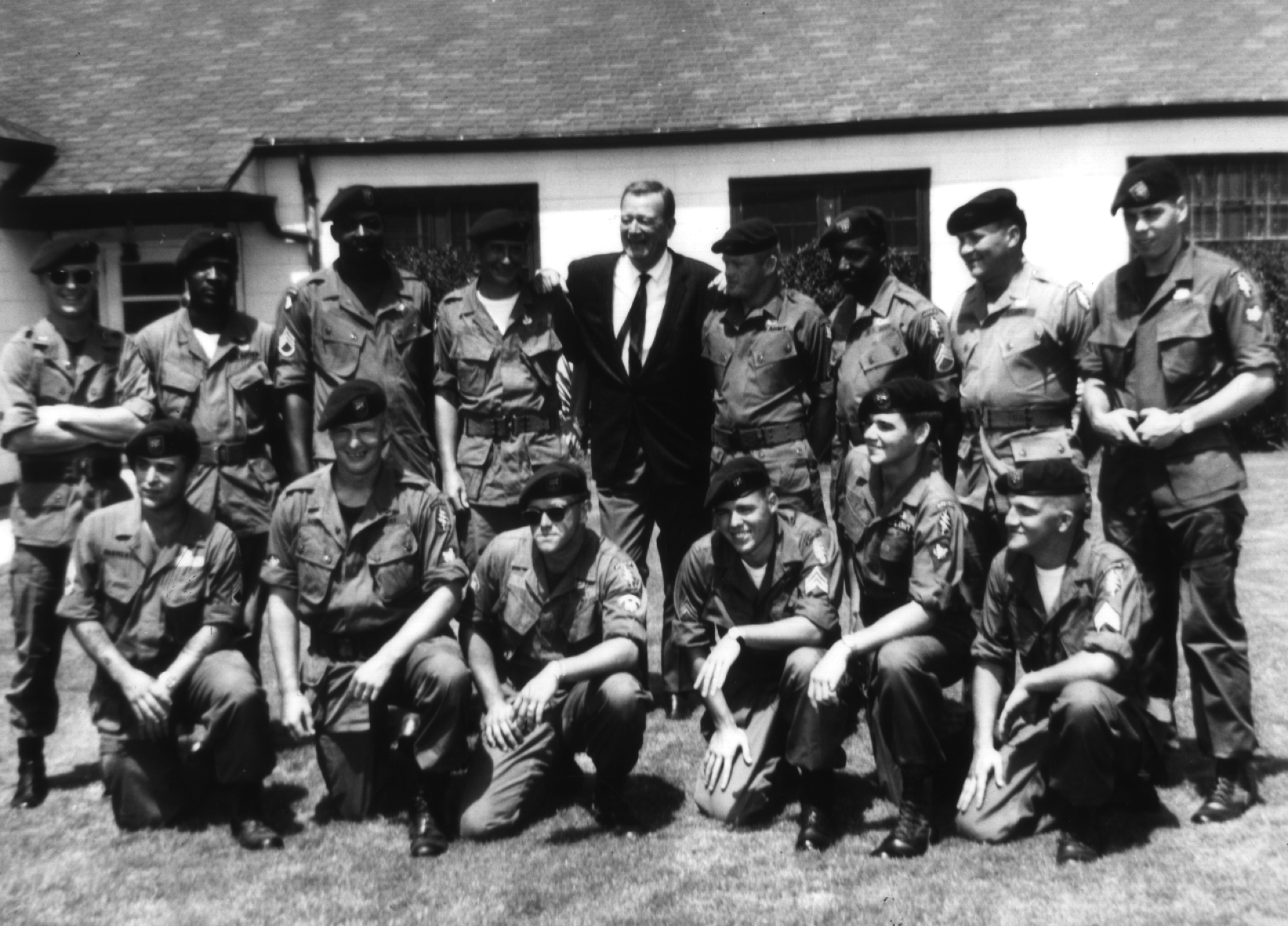
During the summer of 1967 the movie the Green Beret staring John Wayne was being filmed and the 7th Special Forces group (Abn) was tasked with providing the support for the movie. Several of my friends ended up in the support detail with me and I took a team to Pensacola Florida to do a night insertion combat air jump for the movie. We were to jump from a C-47 (DC-3) but since it was a night jump we were to wear strobe lights (I know it makes no sense) during the mission planning briefing John Wayne had a picture taken with my team which I missed.

Sf-wayne

There is one other entertainer that deserves special mention and that is of Martha Raye or as she was known to the guys in Special Forces Colonel Maggie, who was also a trained RN before going into the entertainment field. “Maggie” was known to be in places with the troops that even the brass would not go without protection. She is one of the very few who got down in the trenches with the troops and she had a special liking for those that wore the Green Beret.

Sf  - Maggie

During 1967 she was in Vietnam on tour and she went to a small Special Forces camp with a clarinet player, but while they were there the NVA attacked the camp. Mortar rounds and small arms fire were incoming and it appeared that there was a full-scale assault on the base camp Early in the firefight the camp medic was hit, and so with her being a nurse, she took over and began to assist with the treatment of the wounded who were coming into the aid station.

The camp was in great danger for several hours of being overrun and the military was trying to dispatch helicopters to the camp, but a combination of very bad weather and heavy fighting made that task a very dangerous mission for any crews that would be coming in to get the wounded, or to pull her out to a safer place. All this time, she was subjecting herself to the dangers of flying shrapnel and incoming automatic rifle rounds. She tended to the task that she was trained for – treating the wounded. She was said to have remained calm and fully active in doing her work – even with all the action taking place just outside the aid station. She kept focused on treating the wounded and did not seek shelter or safety for herself. She spent hours putting her skills as a nurse, to use treating patients and even assisting with surgery. She was in the operating room for 13 hours; she then went through the aid station talking with the wounded and making sure that they were okay. It was said that she worked without sleep or rest, until all the wounded were either treated, or evacuated out on a Dustoff. She did not leave that camp until she was satisfied that all wounded were taken care of.

On a more personal note I was wounded at Special Forces CIDG camp Bu Dop (A-341) in earlt December 1967 along with two other SF troopers and MEDEVACed out of country first to Japan and then Ft Sam in Texas where I was for four months getting put back together. While I was there Colonel Maggie heard I was there and called me to wish me a speedy recovery. The other two SF troopers had already died or I’m sure she would have talked to them as well.

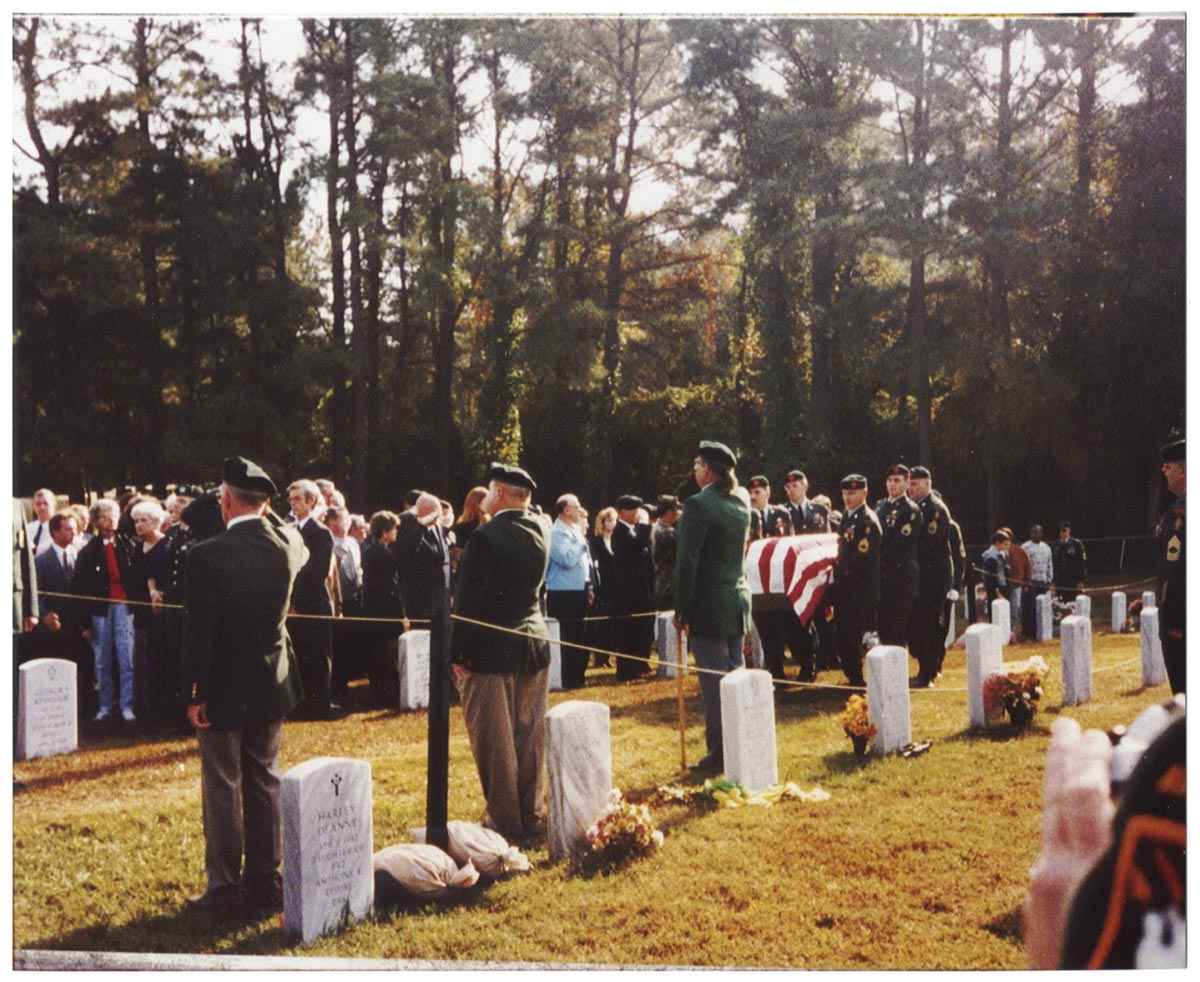
For these and other services “Colonel Maggie,” Martha Raye, was an a very special honorary member of the Special Forces. She had received her prized Green Beret and the title of Lieutenant Colonel from President Lyndon B. Johnson, himself. Known as “Colonel Maggie of the Boondocks” by her many military friends, Martha Raye (born Margaret Teresa Yvonne Reed on August 27, 1916) died October 19, 1994. Raye is buried in the military cemetery at Fort Bragg, North Carolina.

SF MAGGIE Funeral


What to do with the Russians?


But the real worry is what about the Chinese?

This president came into office just over 5 years ago with the “Stated” goal of making a “Fundamental” change to America.  Whether the American’s believed him or not he was going to do just that!  Progressives’ like Obama and his appointed minions believe that America is the problem in the world and that our large military scares everyone and that is why they do not like us. I would not agree with this proposition one bit, but but my opinion is irrelevant I’m not in politics either here nor there. However, that doesn’t mean I cannot understand what is going on in the world for I have studied the subject of global politics from both the military and civilian perspectives.

To the rest of the world what has Obama done? Well a partial listing follows: First a world apology tour for “us” being so bad; then he cancels the anti missile agreement with Poland, then he cancels the US manned space program, he does not negotiate a status of forces agreement in Iraq; he does nothing with the green movement in Iran; he begins to cancel DOD advanced weapons programs soon after assuming office; he encourages the Arab spring; he ignores Iran’s nuclear program for all practical purposes; he gives the impression that he does not like Israel; he proposes major reductions in US nuclear weapons; he announces that all American troops will be out of Afghanistan in 2014; he does nothing In Syria or prior to that in Georgia; he was AWOL after the Benghazi terrorist attack, he has his EPA continue to make regulation that start to close down major sections of the U.S. economy; then he announces that the U.S. military will be significantly reduced and more military programs are to be eliminated.

Foreign leaders with real world experience see a U.S. president with no experience dismantling the US military as fast as he can. They will obviously take advantage of this as real leaders always do.  So it’s no surprise that Putin is doing what he is doing which is to attempt to reestablish the old U.S.S.R. as there will be no military action against him; since the EC has no military and is dependent on Russian e.g. Putin, for their natural gas so there really is nothing that they can do other than complain.

The real issue is not Russia reassembling its empire but what will China do?  The logical thing for them is to see how the world acts or doesn’t act to the absorption of at minimum the eastern Ukraine into Russia.  If Putin gets away with this and its hard to see how he will not given the box that Obama has put himself in, unfortunately along with the rest of the country, they will likely make a similar move in their sphere of influence with those disputed islands with Japan or maybe even a much bigger target Taiwan.

The American Eagle has clipped wings and can no longer fly.

Image

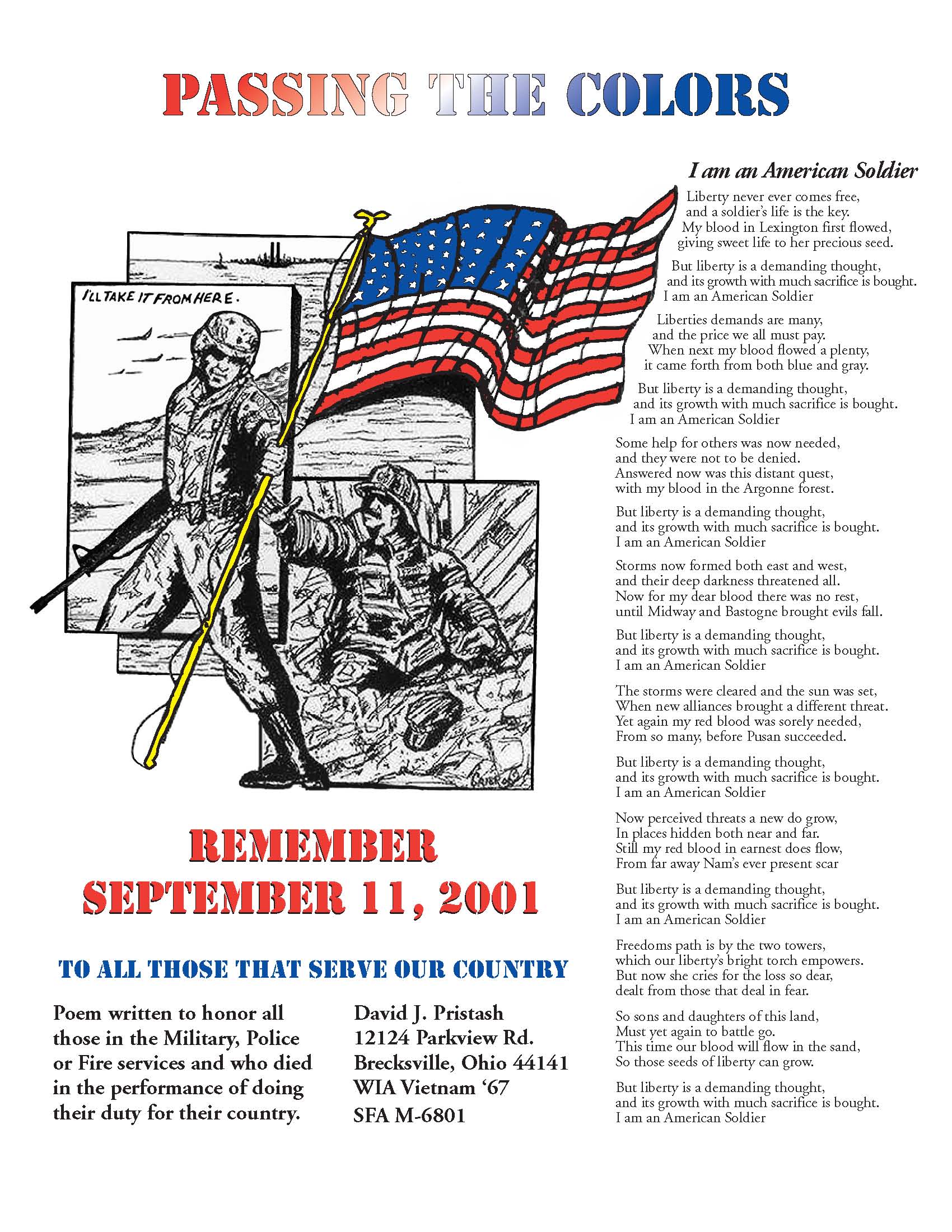
Tribute to those that Serve!


PassingtheColors

Book Review, Vietnam Labyrinth


An almost unbelievable story

This is possibly the best book on the Vietnam War that I have ever read. Vietnam Labyrinth Allis, Enemies, & Why the U.S. Lost the War is a story about the personal journey of Tran Ngoc Chau starting in 1943 as a teenager in the National Salvation Youth group resisting Japanese occupation until his escape from Vietnam as a boat person 36 years later eventually making it to America in the fall of 1979. Chau and his brother are intertwined in the war, the politics and the intrigue during the entire saga of the Vietnam War from the end of the French colonial days until the North Vietnamese communists takeover the south in 1975. It’s hard to envision how one person could have been involved in both side of this conflict at such high levels and lived to tell about it.

The book was published in 2012 by Texas Tech University Press and is the work of Tran Ngoc Chau and Ken Fermoyle with a forward by Daniel Ellsberg of the Pentagon Papers fame. It is well documented and researched and an excellent historical narrative besides being a very interesting story of someone that could have made a big difference to the eventual outcome of the conflict if only others had listened.

The Asian portion of WW II starts with the invasion of China in 1937 by Japan, although they had taken Manchuria in 1931 and by 1940 they were in control of most if not all of the former French Indo China and that is where the story starts.  Ho Chi Min having been previously introduced to communism in France and later China used the Japanese occupation of Vietnam as an excuse to start a resistance movement and help the allies against the Japanese. The OSS helped Ho and as the Japanese were defeated Ho though he could get the allies to keep the French from recouping Vietnam and the rest of Indochina.  Ho using many aliases hides his true intentions very well to gain his objective of a United Communist Vietnam.

By the end of WW II Chau and his brother were both in the Viet Minh, Chau thought he was fighting for the freedom of his people while Ho kept his communist goals secret. Ho was also able to eliminate most of his rivals such that as the French came back in after the German defeat and hired the remaining Japanese to help them reestablish that control the battle for the country had begun.

The first 8 chapters are about Chau’s rise through the ranks of the Viet Minh fighting the French from a foot soldier to a leader in the movement.  In 1949 he is faced with a major decision as his superiors want him to join the Communist party, Chau a very principled man and having seen some of the atrocities that the Communists were doing elected to leave the movement instead and he ending up back home in 1950 where he decided after talking with his farther to side with the other side, the French supported Vietnamese, becoming an officer in the South Vietnamese army. By 1955 the French are gone the country is divided into North and South and the American replace them; and Chau begins another life change that lasts until chapter 16 in 1963 with the coup that brought the military to power.

From Chapter 16 until till the end of Chapter 24 Chau rises in the military developing many powerful friends especially in the CIA. His prior experiences with the Viet Minh gave him a perspective not many had and it’s unfortunate that those above him did not listen to him more for his ideas could have worked and resulted in a very different outcome.  By the end of Chapter 24 Chau is a respected member of the National assembly and the 1968 Tea offensive by Hanoi has been beaten back. All though this period Chau’s brother Tran Ngoc Hien, now high up in the Communist leadership have kept in tough (with the permission of the U.S. CIA) both trying to convince the other to switch sides and passing proposed for ending the war to each other.

In Chapter 25 in mid 1969 Chau is arrested after his brother Hien is Captured and tried.  He spends the next 5 years in prison or confinement but just before the collapse of the South Vietnamese in 1975 he is released. But his trials and tribulations are not finished and shortly after the Communists take over Chau was arrested as an enemy of the state and placed in a re-education camp. Chapter 27 the last is how he resisted the indoctrination and managed to get out of the country with his family in 1978 as one of the boat people. The Chapter ends in October 1979 as he boards a plane for the U.S. after his American friends find him and get him authorization to come to America.

This book is an amazing story of personal courage, integrity and survival.  I recommend this book as a must ready to understand the Vietnam War from the prospective of a Vietnamese who had fought on both sides and been imprisoned by both sides a truly unique set of experiences.

Book Review, Vietnam the Complete Story of the Australian War


A small force but they did their part

Bruce Davies with Gary McKay, (both served in Vietnam) jointly wrote a very comprehensive historical narrative of Vietnam spanning not only the entire Australian active involvement in Vietnam (1962 to 1972) but also containing a historical background of the Vietnamese people going back to before the time of Christ. The book was first published in 2012 by Allen & Unwin in Australia.

The authors did an outstanding job of documentation in putting this 689 page historical narrative together. The scope ranges from declassified documents in both Australia and the US as well as from those now available from the North to personal recollections from those that were there from both sides. After the historical background the book begins in the period just after WW II (the French Indochina war) through the American Indochina war to the collapse of the South Vietnamese Government to the boat people and eventually to the Vietnamese move away from Communism in the 90’s.  Having served in Vietnam myself I’ve had an interest in the history of that conflict and I have read a fair number of books on the subject. This is one of the better books and a must read for any serious student of that conflict.

The quandary of the Australian politicians and their military was twofold; one Australia was a small country with only 12 million people at the time and so they could not field a large force in Vietnam. Also because of the dominating presence of the US Military they were basically dragged along with little effect on policy or strategy; two although much maligned today the domino theory was very, very real to them and they had major concerns over what would happen if the communists got the entire Vietnamese country and possibly Laos and Cambodia. They had a difficult task balancing all these factors as well as the building resistance to the war itself.

The book is written as a description of the various military actions the Australians were involved in from the early 60’s through the withdrawal of their forces in 1972.  The availability of documentation, from all sources that were involved, makes for very interesting reading from the highest levels of the various governments to squad and platoon leaders in firefights. Toward the end of the book they also describe the fall of the Republic of South Vietnam to the communist North in 1975.  They also do a decent job in describing the aftermath of the war and the dispersion of the South Vietnamese, both forced and voluntary, out of the country.

In 1959 as the story of the Australian involvement in Vietnam gets started there are only 49,217 soldiers in entire Australian military. During the period that Australians were in Vietnam they had 521 killed and another 3,129 wounded out of the almost 60,000 that eventually served there. At the peak of the Australian involvement there were about 8,500 in country. Compared to the American involvement of 536,000 in country at the peak with 58,200 Killed and 303,644 wounded it would seem the Australian part was small but they did an outstanding job with what they had in their area of responsibility.

In summary the authors did an outstanding job of melding the after action reports from the Americans the South Vietnamese the North Vietnamese and the Australians military units and in many cases of the same battles.  I will not get into describing the details of the various battles described in this book; but I will say that you should read this work if you were there or if you have an interest in that conflict.