Scientific Survey Shows Voters Widely Accept Misinformation Spread By the Media


Re-Posted from Just Facts By James D. Agresti

January 2, 2020

NBC News reporter and political director Chuck Todd recently railed against “misinformation” and singled out President Trump and “the right” for having an “incentive structure” to spread it. Todd, who according to NBC, “is responsible for all aspects of the network’s political coverage,” also stated that Republicans criticize the media for “sport” and “the loudest chanters of fake news” are “the ones who, under a lie detector, would probably take our word over any word they’ve heard from the other side on whether something was poisonous or not.”

Speaking directly to those unsupported claims, a scientific survey commissioned by Just Facts shows that many people are indeed misinformed—but contrary to Todd—this is a bipartisan affair. In fact, the survey found that the most commonly believed misinformation accords with left-leaning narratives spread by the press, and Democrat voters are more likely to accept these falsehoods than Trump voters. Furthermore, sizable portions of Trump voters have swallowed some of these media-promoted liberal fictions, as well as some conservative ones.

The findings are from a nationally representative annual survey commissioned by Just Facts, a non-profit research and educational institute. The survey was conducted by Triton Polling & Research, an academic research firm that used sound methodologies to assess U.S. residents who regularly vote.

While most polls measure public opinion, this unique one measures voters’ knowledge of major issues facing the nation—such as education, taxes, healthcare, national debt, pollution, government spending, Social Security, global warming, energy, and hunger. Every year, the poll includes a new question about a prevalent, controversial issue. This year, it is about poverty.

Results for All Voters

For each question, voters were offered a selection of two or more answers, one of which was true. Voters also had the opportunity to say they were unsure.

On average, voters gave the correct answer 39% of the time, gave an incorrect answer 54% of the time, and said they were unsure 6% of the time. A majority of voters gave the correct answer to only 5 of the 24 questions.

The highest levels of misinformation were found on questions relating to child hunger, tax burdens, poverty, landfills, health insurance copayments, and two elements of Social Security finances. For these 7 questions, 75% or more of voters provided an incorrect answer.

Among 8 of the 10 questions in which the electorate was most deluded, the wrong answers they gave accorded with progressive storylines propagated by the media. Moreover, these answers were often far removed from reality, not just slightly mistaken.

For example, 79% of voters think that the middle class pays a greater portion of their income in federal taxes than the top 1%. Yet, the Congressional Budget Office, the U.S. Treasury, and the Tax Policy Center have all documented that households in the top 1% pay an average federal tax rate that is about 2.5 times higher than that of the middle class. More specifically, the latest Congressional Budget Office data on federal taxes shows that on average in 2016:

  • middle-income households paid $10,100 in taxes on income of $75,900, or a tax rate of 13%.
  • the top 1% of households paid $595,900 in taxes on income of $1,789,800, or a tax rate of 33%.

Nevertheless, media outlets commonly report the opposite based on deceptive studies that exclude large portions of people’s taxes and/or incomes. A remarkable 93% of Democrat voters have accepted this canard, as well as 65% of Trump voters.

Results by Age, Gender, and Politics

The survey also recorded voters’ ages, genders, and who they planned to vote for in the upcoming presidential election (Donald Trump, the eventual Democrat nominee, or a third-party candidate). This allows the survey to pinpoint segments of society that are most and least informed about specific issues.

The results show deep partisan and demographic divides, with different groups being more or less knowledgeable depending upon the questions. In total, the rates at which voters gave the correct answers varied from a high of 46% for Trump voters to a low of 32% for Democrat voters, with others falling in between as follows

  • 46% for Trump voters
  • 43% for males
  • 41% for 35 to 64 year olds
  • 38% for 65+ year olds
  • 37% for 18 to 34 year olds
  • 36% for females
  • 32% for Democrat voters

The sample sizes of unsure and third-party voters were too small to produce meaningful data.

The questions, answers, full survey results and methodologies are below.

Education

Question 1: Relative to other nations, how do you believe U.S. fourth graders rank in terms of their reading and math ability? Are they in the bottom 50% or in the top 50%?

Correct Answer: Top 50%. In international tests administered to students in dozens of nations, U.S. fourth graders rank in the top 30% of nations for reading and for math. Confusion about this issue may stem from the fact that the relative performance of U.S. students declines over time, and by the age of 15, they drop to the bottom 50% in reading and to the bottom 20% in math. This suggests that the problems of the U.S. education system may occur in the later years, not the early years, as many have claimed.

Correct answer given by 47% of all voters, 46% of Democrat voters, 48% of Trump voters, 46% of males, 48% of females, 53% of 18 to 34 year olds, 49% of 35 to 64 year olds, and 42% of 65+ year olds.

Question 2: On average across the United States, how much do you think public schools spend per year to educate each classroom of students? Less or more than $150,000 per classroom per year?

Correct Answer: More than $150,000. The average cost to educate a classroom of public school students is about $332,000 per year. In contrast to a drumbeat of media stories decrying education funding cuts, Department of Education data shows that the average inflation-adjusted spending per public school student has risen by more than three times since 1960.

Correct answer given by 36% of all voters, 26% of Democrat voters, 45% of Trump voters, 46% of males, 28% of females, 25% of 18 to 34 year olds, 40% of 35 to 64 year olds, and 33% of 65+ year olds.

Question 3: In your mind, what portion of 17- to 24-year-olds in the U.S. are unqualified for military service because of poor physical fitness, weak educational skills, illegal drug usage, medical conditions, or criminal records?

Correct Answer: More than half. According to various agencies within the Department of Defense, two-thirds to three-quarters of all 17- to 24-year-olds are unqualified for military service because of poor physical fitness, weak educational skills, illegal drug usage, medical conditions, or criminal records.

Correct answer given by 43% of all voters, 37% of Democrat voters, 51% of Trump voters, 44% of males, 42% of females, 40% of 18 to 34 year olds, 46% of 35 to 64 year olds, and 41% of 65+ year olds.

Question 4: When conventional public schools are subject to school choice programs that allow students to leave for private or charter schools, do you think the children who remain in the public schools academically decline?

Correct Answer: No. At least 21 high-quality studies have been performed on the academic outcomes of students who remain in public schools that are subject to school choice programs. All but one of the studies found neutral-to-positive results, and none found negative results. This is consistent with the theory that school choice stimulates competition that helps public schools to improve.

Correct answer given by 46% of all voters, 40% of Democrat voters, 51% of Trump voters, 49% of males, 43% of females, 53% of 18 to 34 year olds, 47% of 35 to 64 year olds, and 43% of 65+ year olds.

Taxes

Question 5: The average U.S. household spends about $30,000 per year on food, housing, and clothing combined. If we broke down all combined federal, state, and local taxes to a per household cost, do you think this would amount to more or less than an average of $30,000 per household per year?

Correct Answer: More than $30,000. In 2018, federal, state and local governments collected a combined total of $5.1 trillion in taxes or an average of $40,000 for every household in the U.S.

Correct answer given by 43% of all voters, 36% of Democrat voters, 47% of Trump voters, 42% of males, 44% of females, 51% of 18 to 34 year olds, 46% of 35 to 64 year olds, and 38% of 65+ year olds.

Question 6: On average, who would you say pays a greater portion of their income in federal taxes: The middle class or the upper 1% of income earners?

Correct Answer: The upper 1%. The Congressional Budget Office, the U.S. Treasury, and the Tax Policy Center have all documented that households in the top 1% of income pay an average effective federal tax rate of about 33%, while middle-income households pay about 13%. These tax rates account for nearly all income and federal taxes. Claims to the contrary—often voiced by politicians and the media—are based on misleading calculations that exclude large portions of people’s taxes and/or incomes.

Correct answer given by 18% of all voters, 6% of Democrat voters, 30% of Trump voters, 21% of males, 15% of females, 11% of 18 to 34 year olds, 19% of 35 to 64 year olds, and 19% of 65+ year olds.

Spending

Question 7: Now, changing the subject from taxes to spending, suppose we broke down all government spending to a per household cost—do you think the combined spending of federal, state and local governments amounts to more or less than $40,000 per household per year?

Correct Answer: More than $40,000. In 2018, federal, state and local governments spent a combined total of $6.9 trillion, or an average of about $54,000 for every household in the United States. For reference, the average U.S. household spends about $45,000 per year on food, housing, clothing, transportation, and healthcare combined.

Correct answer given by 48% of all voters, 44% of Democrat voters, 53% of Trump voters, 53% of males, 43% of females, 53% of 18 to 34 year olds, 52% of 35 to 64 year olds, and 43% of 65+ year olds.

Question 8: Do you think the federal government spends more money on social programs, such as Medicare, education, and food stamps—or does the federal government spend more money on national defense, such as the Army, Navy, and missile defense?

Correct Answer: Social programs. In 2018, 62% of federal spending was for social programs, and 18% was for national defense. In 1960, the opposite was true, and 53% of federal spending was for national defense, while 21% was for social programs. Reporters sometimes mislead the public about the composition of federal spending by using a subset of spendingthat omits the vast majority of social programs.

Correct answer given by 36% of all voters, 14% of Democrat voters, 59% of Trump voters, 40% of males, 33% of females, 23% of 18 to 34 year olds, 36% of 35 to 64 year olds, and 41% of 65+ year olds.

National Debt

Question 9: What about federal government debt? The average U.S. household owes about $122,000 in consumer debt, such as mortgages and credit cards. Thinking about all federal government debt broken down to a per household basis, do you think the average federal debt per U.S. household amounts to more or less than the average consumer debt per U.S. household?

Correct Answer: More than $122,000. Federal debt is now $23.1 trillion or about $180,000 for every household in the United States. Such levels of debt can have far-reaching negative effects on wages, living standards, and government and personal financial security.

Correct answer given by 77% of all voters, 76% of Democrat voters, 81% of Trump voters, 75% of males, 80% of females, 84% of 18 to 34 year olds, 79% of 35 to 64 year olds, and 75% of 65+ year olds.

Question 10: From the time that the Great Recession ended in 2009, which do you think has grown at a faster rate, the U.S. economy or the national debt?

Correct Answer: The national debt. From the time that the Great Recession ended in June 2009, the national debt has grown by 100%, while the U.S. economy has grown by 49%.

Correct answer given by 77% of all voters, 89% of Democrat voters, 65% of Trump voters, 71% of males, 82% of females, 76% of 18 to 34 year olds, 77% of 35 to 64 year olds, and 77% of 65+ year olds.

During Obama’s presidency, the party split on this question was reversed, and 88% of Republican voters and 73% of Democrat voters answered correctly.

Global Warming

Question 11: Would you say the earth has become measurably warmer since the 1980s?

Correct Answer: Yes. According to both satellitemeasured data and groundlevel thermometers, the earth’s average temperature has increased by about 0.7 to 0.9 degrees Fahrenheit since the 1980s. This increase is greater than the range of measurement uncertainty. Providing a sense of scale for this change, a temperature analysis of a glacier in Greenland found that it was about 22ºF colder during the last ice age than it is now.

Correct answer given by 62% of all voters, 94% of Democrat voters, 29% of Trump voters, 57% of males, 67% of females, 83% of 18 to 34 year olds, 57% of 35 to 64 year olds, and 64% of 65+ year olds.

Question 12: Again, thinking about the whole planet, do you think the number and intensity of hurricanes and tropical storms have generally increased since the 1980s?

Correct Answer: No. Comprehensive global data shows that the number and intensity of cyclones and hurricanes has been roughly level since the 1980s. This data was originally published in the journal Geophysical Research Letters in 2011 and updated this year. Likewise, the Intergovernmental Panel on Climate Change has reported: “There is low confidence in any observed long-term (i.e., 40 years or more) increases in tropical cyclone activity (i.e., intensity, frequency, duration), after accounting for past changes in observing capabilities.” Regional data that extends back for more than century shows the same. Nonetheless, media outlets have spread false claims to the contrary by cherry-picking anecdotes and reporting computer model predictions instead of hard facts.

Correct answer given by 32% of all voters, 4% of Democrat voters, 59% of Trump voters, 40% of males, 25% of females, 19% of 18 to 34 year olds, 36% of 35 to 64 year olds, and 30% of 65+ year olds.

Pollution

Question 13: Now, just thinking about the United States, in your opinion, is the air generally more polluted than it was in the 1980s?

Correct Answer: No. EPA data shows that ambient levels of all criteria air pollutants have declined significantly since the 1980s. Criteria air pollutions are those that are deemed by the administrator of the EPA to be widespread and to “cause or contribute to air pollution which may reasonably be anticipated to endanger public health or welfare….” Likewise, combined emissions of hazardous air pollutants have declined by about 50% since the 1990s. Lower pollution levels can improve human health and reduce problems like learning deficits and behavioral disorders.

Correct answer given by 56% of all voters, 44% of Democrat voters, 67% of Trump voters, 67% of males, 46% of females, 47% of 18 to 34 year olds, 63% of 35 to 64 year olds, and 49% of 65+ year olds.

Question 14: If the U.S. stopped recycling and buried all of its municipal trash for the next 100 years in a single landfill that was 30 feet high, how much of the nation’s land area would you think this landfill would cover? Less than 1%, 1% to less than 5%, or more than 5%?

Correct Answer: Less than 1%. At the current U.S. population growth rate and the current per-person trash production rate, the landfill would cover 0.06% of the nation’s land area. More realistically, the actual area in use will be an order of magnitude smaller, because:

  • the U.S. recycles, burns, or composts 48% of its trash.
  • landfills can be more than 200 feet high.
  • after 30 to 50 years, landfills are often covered and used for purposes such as parks, golf courses, ski slopes, and airfields.

Despite these facts, media outlets have been reporting for more than 30 years that the U.S. is “nearly out of space” to dispose of trash. NBC News recently published a series of videos called Wasteland that claims U.S. landfills are “set to reach max capacity by 2030” and “scientists are racing against time to find new ways to hack them for the future.” The video presents no source or evidence to support these statements.

Correct answer given by 7% of all voters, 8% of Democrat voters, 9% of Trump voters, 12% of males, 3% of females, 6% of 18 to 34 year olds, 8% of 35 to 64 year olds, and 6% of 65+ year olds.

Energy

Question 15: Without government subsidies, which of these technologies do you think is the least expensive method for generating electricity? Wind turbines, solar panels, or natural gas power plants?

Correct Answer: Natural gas power plants. Determining the costs of electricity-generating technologies is complex, but data from the U.S. Energy Information Administration shows that natural gas is considerably less expensive than wind, and wind is considerably less expensive than solar. Affordable energy has many important benefits, and for poorer people, it can mean the difference between life and death.

Correct answer given by 40% of all voters, 23% of Democrat voters, 57% of Trump voters, 53% of males, 29% of females, 25% of 18 to 34 year olds, 43% of 35 to 64 year olds, and 41% of 65+ year olds.

Question 16: Without government subsidies, which of these fuels do you believe is least expensive for powering automobiles? Gasoline, ethanol, or biodiesel?

Correct Answer: Gasoline. Data from the U.S. Department of Energy and U.S. Energy Information Administration show that in 2017, the unsubsidized cost of ethanol was 32% more than gasoline, and the unsubsidized cost of biodiesel was 119% more than gasoline.

Correct answer given by 46% of all voters, 35% of Democrat voters, 55% of Trump voters, 56% of males, 37% of females, 30% of 18 to 34 year olds, 48% of 35 to 64 year olds, and 49% of 65+ year olds.

Question 17: Worldwide, which of these technologies generates the most electricity? Solar panels, natural gas power plants, coal power plants, or nuclear power plants?

Correct Answer: Coal power plants. Due to the low cost and widespread availability of coal, coal power plants generate about 35% of the world’s electricity, as compared to 23% for natural gas, 11% for nuclear, and 4% for solar.

Correct answer given by 40% of all voters, 34% of Democrat voters, 43% of Trump voters, 55% of males, 26% of females, 36% of 18 to 34 year olds, 42% of 35 to 64 year olds, and 36% of 65+ year olds.

Hunger

Question 18: On an average day, what portion of U.S. households with children do you believe will have at least one child who experiences hunger? Less than 1%, 1% to 10%, or more than 10%?

Correct Answer: Less than 1%. Per the latest data from the USDA, 0.14% or less than one out of every 700 U.S. households with children have any child who experiences hunger on an average day. This includes children who are hungry due to poverty, not those who skip meals because they are late for school, don’t feel like eating, or are trying to lose weight.

Media stories claiming that child hunger is much more prevalent often falsely equate USDA data on “food insecurity” with “hunger.” Yet, the USDA explicitly states that “low food security” means “reports of reduced quality, variety, or desirability of diet” but “little or no indication of reduced food intake.” Prior to 2006, the USDA’s label for such households reflected this reality and was called “food insecurity without hunger.”

Correct answer given by 12% of all voters, 2% of Democrat voters, 22% of Trump voters, 15% of males, 9% of females, 3% of 18 to 34 year olds, 12% of 35 to 64 year olds, and 13% of 65+ year olds.

Social Security

Question 19: Do you think Social Security’s financial problems stem from politicians looting the program and spending the money on other programs?

Correct Answer: No. By law, all Social Security taxes and revenues can be used only for the Social Security program, and the federal government has never failed to abide by this law. What some call “looting” is actually a legal requirement (established in the original Social Security of 1935) that all of the program’s surpluses be loaned to the federal government. The government is required to pay back this money with interest, and it has been doing this since 2010.

Contrary to the notion that politicians have looted Social Security, they have actually added money to the program by repeatedly raising its payroll tax rate, increasing its inflation-adjusted taxable maximum, and injecting other taxes to its income stream. This has placed progressively higher Social Security tax burdens on successive generations of American workers. Yet, the program is still facing insolvency, mainly because the ratio of workers paying taxes to people receiving benefits has fallen by three times since 1955 and is projected to fall further.

Correct answer given by 20% of all voters, 28% of Democrat voters, 13% of Trump voters, 25% of males, 15% of females, 24% of 18 to 34 year olds, 23% of 35 to 64 year olds, and 15% of 65+ year olds.

Question 20: Some policymakers are proposing that individuals be allowed to save and invest some of their Social Security taxes in personal accounts instead of paying these taxes to the Social Security program. In your view, do you think such proposals generally improve or harm the finances of the Social Security program?

Correct Answer: Improve. As shown by analyses conducted by the chief actuary of the Social Security Administration and a bipartisan presidential commission, proposals to give Social Security an element of personal ownership generally strengthen the program’s finances. Although some tax revenues that would have gone to the program instead go to people’s personal retirement accounts, these tax revenues are more than offset by the savings of not paying these individuals full benefits. Media outlets like NBC and the New York Times have misleadingly portrayed personal ownership proposals in a negative light.

Correct answer given by 22% of all voters, 11% of Democrat voters, 33% of Trump voters, 28% of males, 17% of females, 31% of 18 to 34 year olds, 20% of 35 to 64 year olds, and 23% of 65+ year olds.

Health Care

Question 21: In 1960, governments paid for 24% of all healthcare costs in the U.S. Do you think governments now pay a greater portion or a lesser portion of all healthcare costs in the U.S.?

Correct Answer: A greater portion. In 2017, governments paid for 49% of all healthcare expenses in the United States.

Correct answer given by 57% of all voters, 42% of Democrat voters, 70% of Trump voters, 62% of males, 52% of females, 46% of 18 to 34 year olds, 57% of 35 to 64 year olds, and 59% of 65+ year olds.

Question 22: When health insurance copayments are high, people tend to spend less on healthcare. Do you think that this reduced spending typically has a negative impact on their health?

Correct Answer: No. Multiple studies have shown that when copayments are high, people generally spend less money on their healthcare without negatively impacting their health. This is because when people directly pay for more of their healthcare bills, they are more likely to be responsible consumers and use only those services that actually benefit their health. An exception to this rule is the poorest 6% of the population, who do experience negative effects when copayments are increased.

Correct answer given by 13% of all voters, 4% of Democrat voters, 22% of Trump voters, 18% of males, 9% of females, 14% of 18 to 34 year olds, 14% of 35 to 64 year olds, and 12% of 65+ year olds.

Question 23: In 2010, Congress passed and President Obama signed the Affordable Care Act, also known as “Obamacare.” This law uses price controls to save money in the Medicare program. Do you think these price controls will worsen Medicare patients’ access to care?

Correct Answer: Yes. As explained by Medicare’s actuaries, the price controls in the Affordable Care Act will cut Medicare prices for many medical services over the next three generations to “less than half of their level under the prior law.” The actuaries have been clear that this will likely cause “withdrawal of providers from the Medicare market” and “severe problems with beneficiary access to care.”

Correct answer given by 50% of all voters, 17% of Democrat voters, 80% of Trump voters, 53% of males, 46% of females, 38% of 18 to 34 year olds, 52% of 35 to 64 year olds, and 49% of 65+ year olds.

Poverty

Question 24: Including government benefits and private charity, how much worth of goods and services do the poorest 20% of U.S. households consume on average each year? Less than $20,000, $20,000 to $40,000, or more than $40,000?

Correct Answer:

According to the latest government data, the poorest 20% of U.S. households consumed an average of $57,049 of goods and services per household in 2010. The much-lower poverty statistics often cited by the media exclude about 80% of the material resources of the poor because they:

  • don’t account for “noncash benefits, such as food stamps, health benefits, subsidized housing,” and other forms of welfare.
  • are based on government household surveys, and low-income households substantially underreport their cash and noncash income on such surveys.

Correct answer given by 13% of all voters, 6% of Democrat voters, 20% of Trump voters, 13% of males, 14% of females, 15% of 18 to 34 year olds, 16% of 35 to 64 year olds, and 9% of 65+ year olds.

Methodology and Full Results

The survey was conducted by Triton Polling & Research, an academic research firm that serves scholars, corporations, and political campaigns. The responses were obtained through live telephone surveys of 700 likely voters across the U.S. during December 2–11, 2019. This sample size is large enough to accurately represent the U.S. population. Likely voters are people who say they vote “every time there is an opportunity” or in “most” elections.

The margin of sampling error for the total pool of respondents is ±4% with at least 95% confidence. The margins of error for the subsets are 6% for Democrat voters, 6% for Trump voters, 5% for males, 5% for females, 12% for 18 to 34 year olds, 5% for 35 to 64 year olds, and 6% for 65+ year olds.

The survey results presented in this article are slightly weighted to match the ages and genders of likely voters. The political parties and geographic locations of the survey respondents almost precisely match the population of likely voters. Thus, there is no need for weighting based upon these variables. The complete weighted and unweighted results are available here:

DOJ Drops Rosenstein and Mueller’s Nonsense Case Against Russian Company Concord LLC…


Almost everyone who researched the substance behind Rod Rosenstein and Robert Mueller’s heavily promoted Russian indictments knew the underlying claims were centered on the thinnest of evidence.

A few Facebook memes were used to accuse Russian company Concord LLC of violating FARA and FEC election laws.

In July,2018, Robert Mueller asked a federal judge in Washington for an order that would protect the handover of voluminous evidence to lawyers for Concord Management and Consulting LLC, one of three companies and 13 Russian nationals charged in a February 2018 indictment. They are accused of producing propaganda, posing as U.S. activists and posting political content on social media as so-called trolls to encourage strife in the U.S.

Indeed, to an incurious media, a Russian catering company posting Facebook memes might sound like a good justification for a vast Russian election interference prosecution; however, when Concord & the accused Russians show up in court and request to see the evidence against them, well, the prosecutors might just have a problem.  It’s that problem that dogged the Mueller prosecution since 2018.   Today, predictably and finally, the DOJ dropped the nonsense case (full pdf below):

Here’s the Full Filing:

.

The prosecution was always just a farce.  The ridiculous Russian indictments were only created to give some sense of validity to a premise that did not exist; and to allow the Robert Mueller investigation to continue operating when there was never a valid justification for doing so.

This was perhaps the biggest shell game operation, with a non-existent pea, using the DOJ and FBI to give the impression that something nefarious had happened; when factually the ‘Russian Conspiracy Narrative’ was all just one big hoax upon the American people.

The purpose of Robert Mueller was to create something, find anything, that would lead to their political allies being able to remove a sitting president.  Deputy AG Rod Rosenstein participated in that hoax for those intents….

This purposeful fraud has yet to be addressed.

Techno Fog@Techno_Fog

Wow.

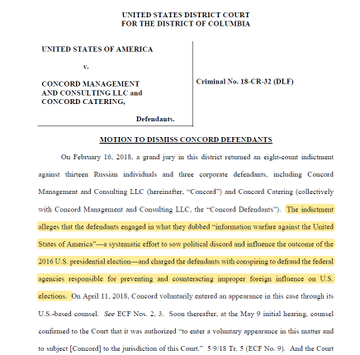
The DOJ moves to dismiss the charges against the Russian Company (Concord) who conducted the alleged “information warfare against the US”

The troll case will be dismissed w/ prejudice.

How embarrassing for Team Mueller.

View image on TwitterView image on Twitter

Techno Fog@Techno_Fog

You can read the full Motion here:https://www.scribd.com/document/451950605/US-v-Concord 

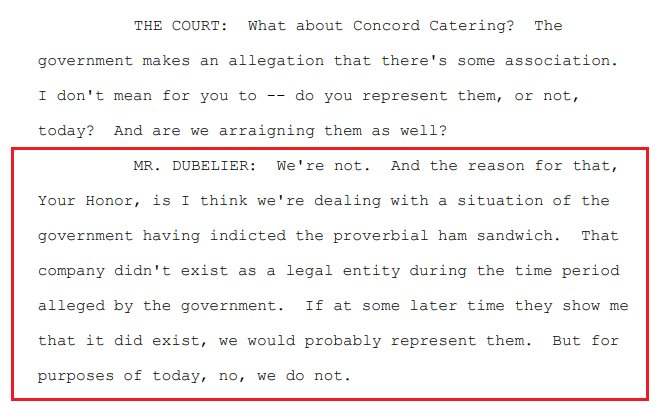
This case has been quite entertaining. Concord attorney Eric Dubelier has, at time, run circles around Special Counsel and DOJ lawyers.

Starting with his claim that the DOJ “indicted the proverbial ham sandwich.”

View image on Twitter
861 people are talking about this

Techno Fog@Techno_Fog

Because it’s quarantine time, here are Dubelier’s greatest hits in the Concord case.

In which Dubelier calls Special Counsel Jeannie Rhee a liar.

View image on TwitterView image on Twitter

Techno Fog@Techno_Fog

Concord lawyer Dubelier returns the Concord summons to Special Counsel Rhee because it doesn’t comply with the Federal Rules.

Dubelier: I find it disturbing that “you are already behaving in a manner that is inconsistent with the practices of the DOJ”

View image on TwitterView image on Twitter
555 people are talking about this

Techno Fog@Techno_Fog

Sidebar: the Concord case was EXCEEDINGLY dangerous because the DOJ twisted the law to fit these defendants.

The alleged illegal activities: Concord interfered with the FEC’s ability to determine whether “statutes were violated.”

View image on Twitter

Techno Fog@Techno_Fog

Anyway, what was some of the illegal activity?

Bad memes posted by fake Facebook user “Bertha Malone”

View image on TwitterView image on Twitter
464 people are talking about this

Techno Fog@Techno_Fog

Concord lawyer Dubelier never let up.

From a 10/2018 hearing: “The real Department of Justice” never would have brought this case.

View image on Twitter

Techno Fog@Techno_Fog

Mocking Mueller’s legal theories (partially via Tweetie Bird):

“‘Give a man enough rope and he will hang himself,’ the Special Counsel just did so.”

View image on Twitter
837 people are talking about this

Amid Ongoing Fight FISA Will Lapse – McConnell Hopes to Assemble Vote Next Week, But Trump May Veto…


The House Rules Committee previously released the text of proposed changes to FISA (full pdf).  The “deal” is intended to reauthorize the FISA “business records provision”, the “roving wiretap” provision, the “lone wolf” provision, and the more controversial bulk metadata provisions [Call Detail Records (CDR)], all parts of the Patriot Act.  However, key Senators and President Trump say not enough being done to change it.

The current FISA authorities expire on March 15th; it looks like they will lapse as Mitch McConnell tries to regroup for a possible vote next week.  McConnell was forced to delay consideration past the expiration date after Senators Mike Lee (R), Rand Paul (R) and  Ron Wyden  (D) said they would object.

WASHINGTON DC – President Trump told Sen. Mike Lee (R-Utah) on Thursday that he does not support a House-passed surveillance bill— raising fresh questions about the fate of the legislation.

A spokesman for Lee confirmed the conversation and that the president told the Utah Republican that he does not support the House legislation. Officials speaking for the White House did not immediately respond to a request for comment.

Lee and Sen. Rand Paul (R-Ky.) have been working to kill the House bill, including urging Trump to veto it if it reaches his desk, over concerns that it does not go far enough to reform the court associated with the Freedom Intelligence Surveillance Act (FISA). (read more)

The House legislation, negotiated by House Speaker Nancy Pelosi and Republican leader Kevin McCarthy, supports the requests of AG Bill Barr and would renew several provisions the FBI claims vital to fighting terrorism.

The House legislation updates the three expiring surveillance provisions, including one that permits the FBI to obtain secret court orders to collect “business records” on subjects in national security investigations. The main purpose of this section is researching Foreign Agent Registration Act (FARA) violations. Using the FISA process for anyone suspected of FARA violations is a bucket of deep state horse-poo. It’s essentially an excuse for surveillance of anyone in DC.

Another provision, known as the “roving wiretap” provision, permits surveillance on subjects even after they’ve changed phones. So long as the subjects are “foreign” that’s no big deal. However, if the account owner of the phone is an American…. well, you can see the problem. Again, more sketchy stuff from the DOJ.

The third provision “lone wolf” allows agents to monitor subjects who don’t have ties to international terrorism organizations. This is where any American can be suspected, accused, and with no oversight have secret surveillance authorized by the secret court. The surveillance is retroactive; meaning the warrant allows the DOJ/FBI to find evidence to support the application for the warrant.  Sketchy.

I find myself in alignment with Rand Paul who says the laws should be changed so that *ONLY* foreigners can be targeted by FISA, and for all investigative issues involving Americans the DOJ/FBI should be forced to go to a traditional Title-3 Court to ask for a search warrant or surveillance. This approach is a more reasonable assurance for Fourth Amendment protection.

(Via Associated Press) […] Republicans had been aggressively seeking changes to the law since the Justice Department’s investigation into Trump’s campaign and Russia, while many Democrats already had concerns about government surveillance.

At the behest of those Republicans, the House compromise takes aim at some of the missteps the Justice Department has acknowledged making during the Russia investigation. Applications under the Foreign Intelligence Surveillance Act to eavesdrop on a former Trump campaign aide were riddled with omissions and missteps, according to an inspector general report.

The measure would require that officers responsible for FISA applications certify that the department has been advised of any information that could undercut or contradict the premise of the surveillance. In the Russia investigation, some of the information the FBI omitted from its applications cut against the idea that former Trump adviser Carter Page was a Russian agent, the watchdog found.

Page has denied that and was never charged with wrongdoing.

The bill also would institute criminal penalties and other sanctions for making false statements to the secretive Foreign Intelligence Surveillance Court, which issues warrants to the FBI to eavesdrop on people it has probable cause to believe are agents of a foreign power. It would require the attorney general to approve in writing of an investigation if the target of the surveillance is a federal candidate or official.

Attorney General William Barr was involved in the negotiations with the White House and Congress, and he said Wednesday that he supports the bill.

“It is of the utmost important that the Department’s attorneys and investigators always work in a manner consistent with the highest professional standards, and this overall package will help ensure the integrity of the FISA process and protect against future abuses going forward,” Barr said.

But Barr’s support does not guarantee that Trump is on board. The president kept Congress guessing with a Thursday tweet that did not indicate how he would act. (more)

.

FISA Deal – House Rules Committee Releases Text of FISA Agreement….


The House Rules Committee is releasing text of proposed changes to FISA (full pdf below).  The “deal” is intended to reauthorize the FISA “business records provision”, the “roving wiretap” provision, the “lone wolf” provision, and the more controversial bulk metadata provisions [Call Detail Records (CDR)], all parts of the Patriot Act.

.

(House Rules Link pdf)

Tom Fitton: Reform Isn’t Going To Fix FISA Problems Without Accountability for Prior Abuse…


In November of 2019 buried deep in the congressional budget Continuing Resolution (CR) was a short-term extension to reauthorize the FISA “business records provision”, the “roving wiretap” provision, the “lone wolf” provision, and the more controversial bulk metadata provisions [Call Detail Records (CDR)], all parts of the Patriot Act.  As a result of the FISA CR inclusion the terminal deadline was pushed to March 15, 2020.

Something has to happen this week ~

AG Bill Barr traveled to Capitol Hill today for meetings with House and Senate leadership.  However, Tom Fitton is correct in this interview.  Nothing currently being called “reform” is going to address abuse when those who abused the system are not held accountable.

Black Swan!


“Only thing we have to fear is fear itself”  FDR 1933

As I write this the Dow futures are down 1,200 points. Oil is down over 20 percent. Gold is way up—no wait, it’s going sideways and silver back down under $17. So much for safe havens. Precious metals are also considered commodities and are now treated as such. Everything is getting punished and many bubbles will get popped.

The coronavirus is the trigger that is causing the crash. It’s a crash that should have happened in 2008. Instead the banks were bailed out and even rewarded for their criminality with taxpayer-paid bonuses. Lower rates and never-ending QEs caused the stock market to skyrocket to outrageous highs. It seemed like it would only go up and the party would never end.

Now the party’s over. Debt is turning out the lights. There’s a huge amount of debt everywhere in the system. Everyone got way too greedy and overextended including the ChiComs. Some conspiracy theorists are saying they released the virus intentionally to do away with a few hundred surplus workers. Their economy was due to crash and they know the virus is a good distraction from that.

In America we have a $23, soon to be $24 trillion national debt. It’s so much that most ignore it as something meaningless. A billion is a number that’s difficult enough to comprehend. A billion minutes ago, Jesus walked the Earth. Every two hours, the US Government spends $1 billion. It’s all debt money, and the interest must be paid back to the Federal Reserve’s private central bankers. Maybe this crash will open eyes and we can finally jettison the vile system of money that has plagued hard-working US citizens for over 100 years. Our corrupt banking system also allows fractional reserve lending, which means more debt. Corrupt politicians have given the ’too big to fail’ big banks permission to become casinos and now they’ve run up over a quadrillion in derivative bets.

The average consumer is nearly maxed out on credit cards and paying the robber baron bankers an outrageous interest rate. The bankers create that ‘unsecured’ debt money out of thin air.

It’s all a con game. It’s all fake. Still, as Ayn Rand once said, “We can ignore reality, but we cannot ignore the consequences of ignoring reality.

We should have faced those consequences long ago. Hold on—we’re in for a rough ride that will be difficult to ignore.

—Ben Garrison

DOJ Political Surveillance – From the IRS in 2011 to the FISA Court in 2016…


An assembly of government reports and public records now indicates a political exploitation of the NSA database, for weaponized intelligence surveillance of politicians, began mid 2012.  After an initial attempt to exploit IRS records, the legal tool used to access the NSA database was the Foreign Intelligence Surveillance Act, or FISA.

With research files on the ’15, ’16 and ’17 political surveillance program; including information from the Mueller report and information from the IG Horowitz report; in combination with the Obama-era DOJ “secret research project” (their words, not mine); we are able to overlay the Obama-era domestic IC operations & gain a full understanding of how political surveillance was conducted over a period of four to six years.

The FISA-702 database extraction process, and utilization of the protections within the smaller intelligence community, became the primary process only after a previous DOJ effort ran into trouble. The established record from the 99-page FISC opinion rendered by Presiding Judge Rosemary Collyer on April 26, 2017, helps explain the details.

I would strongly urge everyone to read the FISC report (full pdf below) because Judge Collyer outlines how the DOJ, which includes the FBI, had an “institutional lack of candor” in responses to the FISA court.  Very specifically, the court outlined how the Obama administration was continually lying to the court about both their activity, and the rate of fourth amendment violations for illegal searches and seizures of U.S. persons’ private information. These violations continued for multiple years throughout Obama’s terms.

Unfortunately, due to intelligence terminology Judge Collyer’s brief and ruling is not an easy read for anyone unfamiliar with the FISA processes outlined. The complexity also helps the media avoid discussing, and as a result most Americans have no idea the scale and scope of the issues. So we’ll try to break down the language.

.

For the sake of brevity and common understanding CTH will highlight the most pertinent segments showing just how systemic and troublesome the unlawful electronic surveillance was.

Early in 2016 NSA Director Admiral Mike Rogers was alerted of a significant uptick in FISA-702(17) “About” queries using the FBI/NSA database that holds all metadata records on every form of electronic communication.

The NSA compliance officer alerted Admiral Mike Rogers who then initiated a full compliance audit on/around March 9th, 2016, for the period of November 1st, 2015, through May 1st, 2016.

While the audit was ongoing, due to the severity of the results that were identified, Admiral Mike Rogers stopped anyone from using the 702(17) “about query” option, and went to the extraordinary step of blocking all FBI contractor access to the database on April 18, 2016(keep these dates in mind).

Here are some significant segments:

The key takeaway from these first paragraphs is how the search query results were exported from the NSA database to users who were not authorized to see the material. The FBI contractors were conducting searches and then removing, or ‘exporting’, the results. Later on, the FBI said all of the exported material was deleted.

Searching the highly classified NSA database is essentially a function of filling out search boxes to identify the user-initiated search parameter and get a return on the search result.

FISA-702(16) is a search of the system returning a U.S. person (“702”); and the “16” is a check box to initiate a search based on “To and From“. Example, if you put in a date and a phone number and check “16” as the search parameter the user will get the returns on everything “To and From” that identified phone number for the specific date. Calls, texts, contacts etc. Including results for the inbound and outbound contacts.

FISA-702(17) is a search of the system returning a U.S. person (702); and the “17” is a check box to initiate a search based on everything “About” the search qualifier. Example, if you put a date and a phone number and check “17” as the search parameter the user will get the returns of everything about that phone. Calls, texts, contacts, geolocation (or gps results), account information, user, service provider etc. As a result, 702(17) can actually be used to locate where the phone (and user) was located on a specific date or sequentially over a specific period of time which is simply a matter of changing the date parameters.

And that’s just from a phone number.

Search an ip address “about” and read all data into that server; put in an email address and gain everything about that account. Or use the electronic address of a GPS enabled vehicle (about) and you can withdraw more electronic data and monitor in real time. Search a credit card number and get everything about the account including what was purchased, where, when, etc. Search a bank account number, get everything about transactions and electronic records etc. Just about anything and everything can be electronically searched; everything has an electronic ‘identifier’.

The search parameter is only limited by the originating field filled out. Names, places, numbers, addresses, etc. By using the “About” parameter there may be thousands or millions of returns. Imagine if you put “@realdonaldtrump” into the search parameter? You could extract all following accounts who interacted on Twitter, or Facebook etc. You are only limited by your imagination and the scale of the electronic connectivity.

As you can see below, on March 9th, 2016, internal auditors noted the FBI was sharing “raw FISA information, including but not limited to Section 702-acquired information”.

In plain English the raw search returns were being shared with unknown entities without any attempt to “minimize” or redact the results. The person(s) attached to the results were named and obvious. There was no effort to hide their identity or protect their 4th amendment rights of privacy:

But what’s the scale here? This is where the story really lies.

Read this next excerpt carefully.

The operators were searching “U.S Persons”. The review of November 1, 2015, to May 1, 2016, showed “eighty-five percent of those queries” were unlawful or “non compliant”.

85% !! “representing [redacted number]”.

We can tell from the space of the redaction the number of searches were between 1,000 and 9,999 [five digits]. If we take the middle number of 5,000 – that means 4,250 unlawful searches out of 5,000.

The [five digit] amount (more than 1,000, less than 10,000), and 85% error rate, was captured in a six month period, November 2015 to April 2016.

Also notice this very important quote:

…”many of these non-compliant queries involved the use of the same identifiers over different date ranges.”…

This tells us the system users were searching the same phone number, email address, electronic “identifier”, or people, repeatedly over different dates.

Specific people were being tracked/monitored.

Additionally, notice the last quote: “while the government reports it is unable to provide a reliable estimate of” these non lawful searches “since 2012, there is no apparent reason to believe the November 2015 [to] April 2016 coincided with an unusually high error rate”.

That means the 85% rate of unlawful FISA-702(16)(17) database abuse has likely been happening since 2012.

2012 is an important date in this database abuse because a network of specific interests is assembled that also shows up in 2016/2017:

  • Who was 2012 FBI Director? Robert Mueller.  The same Mueller selected by the FBI group to become special prosecutor in 2017.
  • Who was Robert Mueller’ chief-of-staff? Aaron Zebley.  The same Aaron Zelbley, who became one of the lead lawyers on the Mueller special counsel.
  • Who was 2012 2012 CIA Director? John Brennan.
  • Who was the 2012 ODNI? James Clapper.
  • Remember, the NSA is inside the Pentagon (Defense Dept) command structure. Who was Defense Secretary? Ash Carter.

Now it becomes important to remember in 2016:

  • Who wanted NSA Director Mike Rogers fired? Brennan, Clapper and Carter.
  • And finally, who wrote and signed-off-on the January 2017 Intelligence Community Assessment and then lied about the use of the Steele Dossier? John Brennan, James Clapper

Tens of thousands of searches over four years (since 2012), and 85% of them are illegal. The results were extracted for?…. (I believe this is all political opposition use; and I’ll explain why momentarily.)

OK, that’s the stunning scale; but who was involved?

Private contractors with access to “raw FISA information that went well beyond what was necessary to respond to FBI’s requests“:

And as noted, the contractor access was finally halted on April 18th, 2016.

[Coincidentally (or not), the wife of Fusion-GPS founder Glenn Simpson, Mary Jacoby, goes to the White House the next day on April 19th, 2016.]

None of this is conspiracy theory.

All of this is laid out inside this 99-page opinion from FISC Presiding Judge Rosemary Collyer who also noted that none of this FISA abuse was accidental in a footnote on page 87: “deliberate decisionmaking“:

This specific footnote, if declassified, would be key. Note the phrase: “([redacted] access to FBI systems was the subject of an interagency memorandum of understanding entered into [redacted])”, this sentence has the potential to expose an internal decision; withheld from congress and the FISA court by the Obama administration; that outlines a process for access and distribution of surveillance data.

Note also: “no notice of this practice was given to the FISC until 2016“, that is important.

Important summary of this aspect: •The FISA court identified and quantified tens-of-thousands of search queries of the NSA/FBI database using the FISA-702(16)(17) system dating back to around 2012.  •The NSA database was repeatedly used by persons with contractor access who unlawfully searched and extracted the raw results without redacting the information and shared it with an unknown number of entities. •The same people had multiple searches performed against their private information from November of 2015 to May of 2016, the exact time of the Republican presidential primary.

The outlined process certainly points toward a political spying and surveillance operation; and we are not the only one to think that’s what this system is being used for.

Back in 2017 when House Intelligence Committee Chairman Devin Nunes was working to reauthorize the FISA legislation, Nunes wrote a letter to ODNI Dan Coats about this specific issue:

SIDEBAR: To solve the issue, well, actually attempt to ensure it never happened again, NSA Director Admiral Mike Rogers eventually took away the “About” query option permanently in 2017. NSA Director Rogers said the abuse was so inherent there was no way to stop it except to remove the process completely. [SEE HERE] Additionally, the NSA database operates as a function of the Pentagon, so the Trump administration went one step further. On his last day as NSA Director Admiral Mike Rogers -together with ODNI Dan Coats- put U.S. cyber-command, the database steward, fully into the U.S. military as a full combatant command. [SEE HERE] Unfortunately it didn’t work as shown by the 2018 FISC opinion rendered by FISC Judge James Boasberg [SEE HERE]

There is little doubt the FISA-702(16)(17) database system was used by Obama-era officials, from 2012 through April 2016, as a way to spy on their political opposition.

Quite simply there is no other intellectually honest explanation for the scale and volume of database abuse that was taking place; and keep in mind these searches were all ruled to be unlawful. Searches for repeated persons over a period time that were not authorized.

When we reconcile what was taking place and who was involved, then the actions of the exact same principle participants take on a jaw-dropping amount of clarity.

All of the action taken by CIA Director Brennan, FBI Director Comey, ODNI Clapper and Defense Secretary Ashton Carter make sense. Including their effort to get NSA Director Mike Rogers fired.

Everything after March 9th, 2016, had a dual purpose: (1) done to cover up the weaponization of the FISA database. [Explained Here] Spygate, Russia-Gate, the Steele Dossier, and even the 2017 Intelligence Community Assessment (drawn from the dossier and signed by the above) were needed to create a cover-story and protect themselves from discovery of this four year weaponization, political surveillance and unlawful spying. Even the appointment of Robert Mueller as special counsel makes sense; he was FBI Director when this began. (2) They needed to keep surveillance ongoing.

The beginning decision to use FISA(702) as a domestic surveillance and political spy mechanism appears to have started in/around 2012. Perhaps sometime shortly before the 2012 presidential election and before John Brennan left the White House and moved to CIA. However, there was an earlier version of data assembly that preceded this effort.

Political spying 1.0 was actually the weaponization of the IRS. This is where the term “Secret Research Project” originated as a description from the Obama team. It involved the U.S. Department of Justice under Eric Holder and the FBI under Robert Mueller. It never made sense why Eric Holder requested over 1 million tax records via CD ROM, until overlaying the timeline of the FISA abuse:

The IRS sent the FBI “21 disks constituting a 1.1 million page database of information from 501(c)(4) tax exempt organizations, to the Federal Bureau of Investigation.” The transaction occurred in October 2010 (link)

Why disks? Why send a stack of DISKS to the DOJ and FBI when there’s a pre-existing financial crimes unit within the IRS. All of the evidence within this sketchy operation came directly to the surface in early spring 2012.

The IRS scandal was never really about the IRS, it was always about the DOJ asking the IRS for the database of information. That is why it was transparently a conflict when the same DOJ was tasked with investigating the DOJ/IRS scandal. Additionally, Obama sent his chief-of-staff Jack Lew to become Treasury Secretary; effectively placing an ally to oversee/cover-up any issues. As Treasury Secretary Lew did just that.

Lesson Learned – It would appear the Obama administration learned a lesson from attempting political opposition research through the IRS database. The timeline reflects a few months after realizing the “Secret Research Project” was now worthless (June 2012), they focused more deliberately on a smaller network within the intelligence apparatus; and through “contractors” they began weaponizing the FBI/NSA database. If our hunch is correct, that is what will be visible in footnote #69:

How this all comes together in 2019/2020

Fusion GPS was not hired in April 2016 to just research Donald Trump. As shown in the evidence provided by the FISC, the intelligence community was already doing surveillance and spy operations. The Obama administration already knew everything about the Trump campaign, and were monitoring everything by exploiting the FISA database.

However, after the NSA alerts in/around March 9th, 2016, and particularly after the April 18th shutdown of contractor access, the Obama intelligence community needed Fusion GPS to create a legal albeit ex post facto justification for the pre-existing surveillance and spy operations. Fusion GPS gave them that justification in the Steele Dossier.

That’s why the FBI small group, which later transitioned into the Mueller team, were so strongly committed to and defending the formation of the Steele Dossier and its dubious content.

The Steele Dossier, an outcome of the Fusion contract, contains two purposes: (1) the cover-story and justification for the pre-existing surveillance operation (protect Obama); and (2) facilitate the FBI counterintelligence operation against the Trump campaign (assist Clinton).  That became more important after the election when the same players needed to get a special counsel. An insurance policy would be needed.

The Steele Dossier becomes the investigative virus the FBI wanted inside the system. To get the virus into official status, they used the FISA application as the delivery method and injected it into U.S. person Carter Page; a former Trump campaign advisor. The FBI already knew Carter Page; essentially Carter Page was irrelevant, what they needed was the FISA warrant and the Dossier in the system {Go Deep}.

Fusion GPS was not only hired to research Trump, the intelligence community was already doing surveillance and spy operations. The intelligence community needed Fusion GPS to give them a plausible justification for already existing surveillance and spy operations.

Fusion-GPS gave them the justification they needed for a FISA warrant with the Steele Dossier. Ultimately that’s why the Steele Dossier is so important; without it, the DOJ and FBI would be naked with their FISA-702 abuse as outlined by John Ratcliffe.

.

“Mistakes were made”, is the ridiculous excuse.  The FBI knew all along the Steele Dossier was garbage, but they were dependent on using it… Their willful blindness was by design; they needed the dossier to get to the Mueller phase:

Devin Nunes Discusses The Fraud Behind The Chris Steele Dossier…


HPSCI Ranking Member Devin Nunes discusses the fraudulent narrative that surrounds the Steele Dossier, and the credibility of Christopher Steele, against the backdrop of recent lawsuits by himself and the Trump administration against U.S. media.

Good News – Doug Collins Says Clean FISA Reauthorization Doesn’t Have Votes – Only Five Days Remain…


In November of 2019 buried deep in the congressional budget Continuing Resolution (CR) was a short-term extension to reauthorize the FISA “business records provision”, the “roving wiretap” provision, the “lone wolf” provision, and the more controversial bulk metadata provisions [Call Detail Records (CDR)], all parts of the Patriot Act.  As a result of the FISA CR inclusion the terminal deadline was pushed to March 15, 2020.

Something has to happen this week

The Senate is scheduled to recess March 13, 2020.  Additionally, the DOJ/FBI response to the FISA court order (due February 5th) has still not been made public.  If congress is going to reauthorize the controversial FISA provisions, they now have only *FIVE* days; and the good news today is Doug Collins confirming the House does not have enough votes to support a “clean reauthorization.” Hopefully, that means FISA is going to change.

.

According to Senator Rand Paul, President Trump is committed to seeing that FISA is not reauthorized without “significant” reform. Senator Paul has proposed to significantly change the FISA process by forcing the DOJ, FBI and Intelligence Community to apply for search and surveillance warrants to Title-3 courts in order to access any NSA database containing private information of American citizens.

Prior to the December 9, 2019, inspector general report on FISA abuse, FISA Court judges Rosemary Collyer (declassified 2017) and James Boasberg (declassified 2019) both identified issues with the NSA bulk database collection program being exploited for unauthorized reasons.  Americans were under surveillance as part of the political process.

For the past several years no corrective action taken by the intelligence community has improved the abuses outlined by the FISA court; the surveillance has only worsened.

Also keep in mind the deadline for the DOJ to respond to the FISA court about the abusive intelligence practices identified in the Horowitz report was February 5th, more than four weeks ago. The responses from the DOJ and FBI have not been made public.

FISA Court Order – FISA Court Notice of Extension.

The DOJ is trying to get the FISA reauthorization before the FISC declassifies the corrective action outlined from the prior court order. The pending DOJ response will include information about the “sequestering” of evidence gathered as a result of the now admitted fraudulent and misrepresented information within the FISA applications.

The U.S. constitution’s fourth amendment is being violated by the continued abuse of bulk metadata collection, particularly when private contractors and government officials illegally access the system. The 2016 FISA review (Judge Collyer partly declassified in 2017) and the 2018 FISA review (Judge Boasberg partly declassified in 2019) both show ongoing and systematic wrongdoing despite all prior corrective action and promises.

Declassification of existing FISA records would reveal the November 2015 through April 2016 FISA-702 search query abuse as outlined in the April 2017 court opinion written by FISC Presiding Judge Rosemary Collyer.  Who exactly are these private sector FBI contractors behind the 85% fraudulent search queries?  This was a weaponized surveillance and domestic political spying operation. [The trail was laid down in specific detail by Judge Collyer – SEE HERE]

WATCH VIDEO:

.

The FISA “business records provision”, the “roving wiretap” provision, the “lone wolf” provision, and the more controversial bulk metadata provisions [Call Detail Records (CDR)], again all parts of the Patriot Act, must not be reauthorized without a full public vetting of the abuses that have taken place for the past several years.

The position being put forth by Rand Paul is exactly correct.  Change the law so that FISA can only be used against foreign actors, and force the DOJ or intelligence apparatus to go to a normal Title-3 court for a search/surveillance warrant against any American.

Attorney General Bill Barr Responds to Federal Judge Who Questioned His Credibility…


Yesterday Federal Judge Reggie Walton questioned the credibility and truthfulness of Attorney General Bill Barr.  [SEE HERE]  Today AG Barr responded:

(Source Link)