Nothing says stupid quite like telling the people who pay your paycheck to get lost; yet that’s exactly what Tennessee Titan football player Delanie Walker just did.
TENNESSEE – Tennessee Titans tight end Delanie Walker said fans upset by team demonstrations during the national anthem can stay home.
“And the fans that don’t want to come to the game? I mean. OK. Bye,” he told the Tennessean. “If you feel that’s something – we’re disrespecting you, don’t come to the game.”
Walker, who is in the middle of a 2-year $13.3 million contract with the Nashville-based team, said the demonstrations are not intended to be an affront to the military.
“That’s not what it’s all about,” he said. “I’ve been in the USO. I support the troops.” “It’s about equal rights. That’s all everyone is trying to show… that we all care about each other,” Walker said.
Coach Mike Mularkey told the paper that he thought it was a team-wide decision to remain in the locker room last week. But, Jessie James Decker, the country singer and wife of wide receiver Eric Decker, said her husband was not told about the plan. (link)
The Weaponized Administrative State is Protecting Itself
A report from Reuters highlights the DOJ and FBI refusing to hand over documents related to the Steele Dossier on candidate Donald Trump, and the FBI (Via James Comey) involvement in assembling the content therein. However, the lede is buried in paragraph four of the article.
WASHINGTON (Reuters) – The U.S. Justice Department and the FBI are resisting demands from a Republican lawmaker to hand over documents about a former British spy’s dossier on purported Russian support for Donald Trump’s 2016 election campaign, because the FBI has its own open criminal investigation, officials said.
The U.S. House of Representatives Intelligence Committee issued subpoenas in August seeking “any and all documents” about both agencies’ dealings with former MI6 officer Christopher Steele, according to a letter seen by Reuters from committee chairman Devin Nunes, a Trump supporter.
Steele compiled the so-called Trump dossier, which Trump was told by FBI director James Comey contained salacious material about the businessman-turned president. Trump and his associates have said the dossier’s contents were false.
Law enforcement and congressional officials said that the Justice Department and the FBI were reluctant to comply with the demand for documents as the FBI had its own probe, under the supervision of Special Counsel Robert Mueller, into U.S. allegations of Russian meddling in the 2016 campaign to tilt the November election in Trump’s favor. (read more)
This is genuinely much more alarming that might initially appear on first review. In essence the FBI is protecting itself from inquiry into unlawful conduct of the FBI.
People often talk about ‘conflict of interest’ in matters of personal or organizational conduct when the investigative apparatus itself is a participating entity into the originating issue. However, the FBI refusing to allow investigative oversight into actions taken by the FBI takes ‘conflicted interest’ concerns into stratospheric levels.
If the issue was simply a one-time request by the FBI to delay inquiry it might not hold the same level of consequence it does right now.
But when you combine this intentional action by Robert Mueller to block oversight into the potentially illegal action of a rogue agency with the previous actions within the DOJ as they relate to the IRS targeting, well, what you get is a stunning picture of a weaponized FBI apparatus attempting to avoid accountability.
A reminder on the IRS and FBI collusion, and the refusal of the DOJ to prosecute the IRS officials engaged in illegal targeting:
(Washington, DC) – Judicial Watch President Tom Fitton made the following statement regarding the Department of Justice’s decision not to bring charges against Lois Lerner, former director of the Exempt Organizations Unit of the IRS, whose own emails place her at the heart of the politicization of the IRS for the targeting of conservative groups:
I have zero confidence that the Justice Department did an adequate review of the IRS scandal. In fact, we’re still fighting the Justice Department and the IRS for records about this very scandal. Today’s decision comes as no surprise considering that the FBI collaborated with the IRS and is unlikely to investigate or prosecute itself. President Trump should order a complete review of the whole issue. Meanwhile, we await accountability for IRS Commissioner Koskinen, who still serves and should be drummed out of office.
Judicial Watch released 294 pages of FBI “302” documents revealing top Washington IRS officials, including Lois Lerner and Holly Paz, knew the agency was specifically targeting “Tea Party” and other conservative organizations two full years before disclosing it to Congress and the public. An FBI 302 document contains detailed narratives of FBI agent investigations. The Obama Justice Department and FBI investigations into the Obama IRS scandal resulted in no criminal charges.
The FBI 302 documents confirm the Treasury Inspector General for Tax Administration (TIGTA) 2013 report that said, “Senior IRS officials knew that agents were targeting conservative groups for special scrutiny as early as 2011.” Lerner did not reveal the targeting until May 2013, in response to a planted question at an American Bar Association conference. The new documents reveal that then-acting IRS Commissioner Steven Miller actually wrote Lerner’s response: “They used names like Tea Party or Patriots and they selected cases simply because the applications had those names in the title. That was wrong, that was absolutely incorrect, insensitive, and inappropriate.” (read more)
In October 2015 the DOJ announced it was dropping the investigation into the IRS, Lois Lerner, and the unlawful sharing of taxpayer data in the IRS targeting investigation surrounding True The Vote et al.
In essence, not only did the DOJ drop an investigation into the IRS – it also dropped an investigation into itself. The DOJ, via FBI, was part of the entire IRS targeting enterprise. Yeah, there’s a massive conflict there.
CTH stumbled onto the DOJ trail of evidence back in June 2014 when we reviewed one of very few disclosures given by Lois Lerner’s attorney William Taylor III. In a moment of clarity, which was not caught by the interviewer, William Taylor responded to questioning by stating that his client, Lois Lerner, was merely responding to a request from the Department of Justice, when she sent confidential tax files to the DOJ.
Taylor said Lerner didn’t know and sent them because Justice requested the documents: “She [understood] the donor information on Schedule B had been removed. In some cases, we later learned, it may not have been.” (link)
Lois Lerner sent the DOJ 1.1 million pages of 501(c)(4) tax filing data. Including a very specific set of “33 Schedule B attachment files”. The Schedule B’s were specific to Large Conservative 501(c)(4) groups operating and organized to oppose the agenda of President Obama.
The Schedule B’s include the donor lists of specific people and sub-groups attached to the 501(c)(4).
In essence the donor group or names of every person who supported the larger conservative group. These would have been “the opponents” President Obama outlined in the controversial “citizens united” Supreme Court decision.
For obvious reasons it is illegal to distribute that taxpayer data. It is primarily illegal because such information could be used to create a list of people in opposition to the executive branch; that is exactly what happened.
Lois Lerner sent the data to the DOJ just before 2010 mid-terms. The DOJ hid the connection for three years and did not admit the submission until 2013 when congress was about to find out through one of their IRS subpoenas.
The DOJ then claimed it was some form of miscommunication, merely a mistake. The DOJ claimed they did not expect to get the Schedule B information, and therefore never noticed it until the House investigation began.
However, Lois Lerner’s attorney, William Taylor, is clearly refuting such deniability. He said it was not a mistake, it was his client, Lois Lerner, fulfilling a specific request.
Hence, it became obvious, the House Oversight Committee was actually investigating only ONE aspect of the overall scheme. The larger scheme is actually within the investigating body, the DOJ itself, and where they came up with the idea.
Which brings us back to the conflict of interest issue: How can the DOJ conduct an investigation into unlawful aspects of the IRS targeting of specific 501(c)(4) groups, when the DOJ was the initiating body for the illegality they were seeking to investigate?
See the problem?
There’s a pattern here.
Today in their intentional refusal of the FBI/DOJ to release records of their involvement with the “Steele Dossier”, Robert Mueller is following a pattern of FBI and DOJ action to hide the unlawful behavior of FBI and DOJ leadership.
And Attorney General Jeff Sessions is doing what?…
**Authors Note** The writer of this article is a healthy person of stable psychological disposition with no intent, propensity or disposition toward self-harm; nor does the author participate in dangerous or generally at risk behaviors. All scheduled vehicle maintenance is up to date, nothing is askew, and there are no surrounding environmental dangers which would -in the customary function of life- present any extraordinary risk to the author.
Well, well, well…. According to a breakingState Department release T-Rex will be headed to Beijing the day after tomorrow (Thursday) through Sunday. Yup, everything proceeding swimmingly. A very predictable plan, for an intensely smart geopolitical strategy. Walking in a Winner Wonderland !
STATE DEPT – U.S. Secretary of State Rex Tillerson will travel to Beijing September 28 – October 1 to meet with senior Chinese leaders. Secretary Tillerson will discuss a range of issues, including the President’s planned travel to the region, the denuclearization of the Korean Peninsula, and trade and investment. Secretary Tillerson’s visit to China reaffirms the Administration’s commitment to further broaden and enhance U.S. economic and security interests in the Asia-Pacific region.
China doesn’t want to own the DPRK outcome. They want plausible deniability in any confrontation. However, N-Korea is a de-facto economic province of China under the guiding control and authority of communist Beijing.
In order to create the outcome where China accepts ownership of the DPRK, and leads negotiations therein, there has to be a value for Beijing, a carrot, toward the larger international community. Considering the decades-long Chinese obfuscation of that role and responsibility, Trump needs to keep narrowing the diplomatic space until China has no options. That’s where the magnanimous panda strategy comes into play.
Trump will never use the U.S. military to solve this regional issue.
The “Trump Doctrine” national security strategy is based on economics and diplomacy.
President Trump’s words and rhetoric against Kim Jong-un, and the response from Jong-un in kind toward President Trump, creates the foundation of a need for magnanimous panda to step in.
This year Beijing is holding it’s communist party national referendum, the Communist Party Congress, mid October. This ‘Old Guard’ meeting happens every five years.
Beijing (AsiaNews) – The Central Committee’s Political Bureau (Politburo) yesterday chose 18 October for the opening of the 19th Chinese Communist Party Congress.
The 200-strong Central Committee is expected to ratify the date when it meets for its last plenum on 11 October.
“[The congress] will formulate an action plan and set out major policy direction that will meet the demands of the era,” the Politburo said in a statement.
The congress, which is held every five years, is expected to re-elect Xi Jinping as party general secretary for a second five-year term. Xi is likely to get his own political philosophy included in the party’s constitution, placing him on a par with Mao Zedong, Deng Xiaoping, and others. (read more)
It is widely anticipated that Xi Jinping will gain more control and power over the affairs of China on economics and domestic policy.
Remember, it would be against Trump’s interests if the entire global and geopolitical community understood what was happening, as he attempts to create an outcome where China takes responsibility for North Korea.
So the question becomes, how will we know when President Trump has won in the economic and national security challenge? Well, first let’s look at the geopolitical landscape and the known and identified calendar to view the goal timeline:
♦We know President Trump is planning to attend an ASEAN meeting in November.
♦We also know that President Trump is planning to visit China later this year. Most likely that trip will be part of the ASEAN engagement.
So it makes sense that President Trump would like to conclude the outline of the economic diplomacy by the time of the ASEAN and China visit – such that: A.) President Trump can outline the agreement and stroke the panda’s ego on his turf; and B.) President Xi Jinping can announce his magnanimous victory on behalf of great Panda’s incredible achievement in providing great security to the world.
::::smiling:::::
Yup.
Meanwhile, just prior to the ASEAN/China meetup, President Trump’s secret weapon, Ivanka, who happens to be the most beloved American in China, is deployed to India to capture the world’s attention with Narendra Modi hugs.
President Modi is the “Trump Card” in the geopolitical economic gamesmanship. China is currently at odds with India’s rise to economic power; Ballywood is very hot in the U.S. right now; and a warm Modi – Trump economic relationship is a foil against China’s heavy-handed extortion of their economic partners.
Whoopsie sounds like the makings of a fork in China’s One Road/One Belt plan.
Strategery.
::::still smiling::::
So, if this strategy works, and there’s every indication everything is falling into place, we can safely predict that sometime in late fall, most likely before the ASEAN visit timeline in November, President Trump and Secretary of State Rex Tillerson will be engaged in a new round of Six Party Talks, initiated by request of the increasingly boxed-in China.
China will structure the DPRK talking points to set up the meetings. This is a part of how China is allowed to save face, against a backdrop of Trump/Mnuchin economic pressure, and sets up the magnanimous Panda narrative.
The six party talks will be essentially a Marshall Plan of sorts for North Korea.
Japan, South Korea, The United States, China, Russia and North Korea will enter into a set of negotiations publicly sold as engaging in diplomacy and reducing tension. That tension is what President Trump is currently stimulating to keep the pressure on Beijing ahead of the Communist Congress.
With success, President Trump (or T-Rex) will sit on the patio complimenting Xi Jinping (or deputy), and Russian, Japanese and South Korean emissaries.
Meanwhile, well behind the scenes, in the conference room, Secretary Wilbur Ross, USTR Robert Lighthizer and U.S. Treasury Secretary Steven Mnuchin will play the role of Willy Wonka handing out the golden economic tickets to representatives who all line up with their requests for terms of economic discussion.
President Trump’s golf partner Shinzo Abe will already have his ticket, but he’ll play along. South Korea and partnered ASEAN nations will also see a benefit. The only real negotiations will be between the U.S. Russia and China. Russia will be negotiating for higher regional energy prices to get their GDP growing again (affluence) and increase their geopolitical influence; While China will be negotiating to retain as much of the $350 billion trade surplus as possible, and retain their one-road/one-belt viability.
The end result will be Kim Jong-un giving up his nuclear ambitions for good; China accepts responsibility to denuclearize under carefully negotiated terms, and against the backdrop of economic punishment for duplicity, and publicly Big Panda promises to the world to be the magnanimous insurance policy therein.
Everything between now and that outcome is optically chaff and countermeasures.
♦SHORT TERM – When the denuclearization terms are finalized; only then will President Trump outline the broad parameters of a U.S./China trade relationship based on new renegotiated trade policies. The mood of that stage within the strategy will be based on the cooperative behavior of China in the next 60 days.
♦MEDIUM TERM – Also, when Trump gets to that latter stage, China will be facing a different global economic landscape because President Trump and India’s Prime-Minister Modi have already formulated the outlines of a joint economic partnership.
♦LONG TERM – Economic leverage against communist China to remove the larger geopolitical threat they represent to the U.S. (and the international community) is gained by positioning India as a replacement for U.S. trade/commerce, and ASEAN partners as continental benefactors, with favorable access to the U.S. market, within bi-lateral trade deals.
Readers will note this bi-lateral strategic approach, in economic depth and breadth, also significantly reduces the internal economic benefits of the Trans-Pacific Partnership (TPP) amid partner nations.
That diluted regional trade outcome is not accidental.
The Dallas Cowboys, together with team owner Jerry Jones, take a collective knee at the start of the Monday Night Football game to display their unity with… well, something probably. Stick a fork in the financial future of the NFL, it’s done; finished.
The only thing that was saving the NFL from full organizational collapse was the advent of Fantasy Football Leagues and the subsequent betting and fan-based league play therein.
Never underestimate the inability of any business organization to inoculate itself with idiot resistant policies once they enter the arena of identity politics. It has always been thus:
.
There is something profoundly hilarious in the face of team owner Jerry Jones looking so smug, as if he’s figured out how to navigate this insufferable financial minefield. He didn’t. Now watch the slow-motion financial implosion… that smugly look will change quickly as he watches his organizational bank account drain. Which is faster than the knee he promised to never take. By Thanksgiving; you’ll see. Bigly.
I’m sorry, but I just can’t stop laughing. Play stupid games, win stupid prizes.
Against the backdrop of a revised set of administration rules on visa issuance and restricted nationalities; and considering the previously argued ‘Trump travel ban’ guidelines expired Sunday; the Supreme Court has cancelled their hearing of arguments in opposition to the former travel restrictions and visa guidance.
(Via Associated Press) – 1:40 p.m. – The Supreme Court has canceled arguments set for Oct. 10 in the dispute over President Donald Trump’s travel ban, after Trump rolled out a new policy Sunday.
The unsigned order from the justices Monday asks both sides to weigh in by Oct. 5 about what to do with the case.
The court had been ready to hear argument about the legality of a 90-day ban on travelers from six mostly Muslim countries and a 120-day ban on refugees from around the world.
The ban expired Sunday and was replaced by a new policy that affects eight counties and has no expiration date. Those countries are Chad, Iran, Libya, North Korea, Somalia, Syria, Venezuela and Yemen. Chad, North Korea and Venezuela were not covered by the earlier ban. (link)
In addition both Chad and Venezuela are pushing back against Homeland Security guidance that led to their inclusion on the revised travel restrictions:
♦Chad’s government says it learned “with astonishment” of the decision by the U.S. government that its country is on a list whose nationals will be prohibited from entering the United States.
A government statement Monday said the government expresses its incomprehension about the “official reasons for this decision; which contrasts with Chad’s constant efforts and commitments in the fight against terrorism at regional and global levels.”
Chad’s government called for a better appreciation of the situation and for Trump to reconsider the decision which it says “undermines the image of Chad and the good relations between the two countries.” (LINK)
♦Venezuelan President Nicolas Maduro (nee-koh-LAHS’ mah-DOO’-roh) says the Trump administration’s decision to include Venezuelan officials on a travel ban is a form of “political and psychological terrorism.”
His foreign ministry issued a statement Monday saying that the travel restrictions violate the values of the United Nations charter and international law and are part of a continuing effort by the U.S. to oust Maduro from power.
The ministry said it is considering “all necessary measures” to defend Venezuela’s sovereignty and national interest. (LINK)
Puerto Rico has been devastated by Hurricane Maria. CTH can confirm there is almost no communication with the majority of those impacted by the devastating impact of Hurricane Maria. Local officials are using satellite phones to gain residents the ability to contact their friends and family in the U.S. mainland. Critical infrastructure has been severely compromised. Cell phone service is sporadic to non-existent.
Adding to and amplifying the problem was a general dependency on government assistance, by a large portion of the population, for basic needs prior to the storm. The comfort of dependency has now worsened the desperation of the people on the island.
(Via Fox News) A humanitarian crisis grew Saturday in Puerto Rico as towns were left without fresh water, fuel, power or phone service following Hurricane Maria’s devastating passage across the island.
A group of anxious mayors arrived in the capital to meet with Gov. Ricardo Rossello to present a long list of items they urgently need. The north coastal town of Manati had run out of fuel and fresh water, Mayor Jose Sanchez Gonzalez said.
“Hysteria is starting to spread. The hospital is about to collapse. It’s at capacity,” he said, crying. “We need someone to help us immediately.”
The death toll from Maria in Puerto Rico was at least 10, including two police officers who drowned in floodwaters in the western town of Aguada. That number was expected to climb as officials from remote towns continued to check in with officials in San Juan.
Authorities in the town of Vega Alta on the north coast said they had been unable to reach an entire neighborhood called Fatima, and were particularly worried about residents of a nursing home.
“I need to get there today,” Mayor Oscar Santiago told The Associated Press. “Not tomorrow, today.”
Rossello said Maria would clearly cost more than the last major storm to wallop the island, Hurricane George in September 1998. “This is without a doubt the biggest catastrophe in modern history for Puerto Rico,” he said.
A dam upstream of the towns of Quebradillas and Isabela in northwest Puerto Rico was cracked but had not burst by Saturday afternoon as the water continued to pour out of rain-swollen Lake Guajataca. Federal officials said Friday that 70,000 people, the number who live in the surrounding area, would have to be evacuated. But Javier Jimenez, mayor of the nearby town of San Sebastian, said he believed the number was far smaller.
Secretary of Public Affairs Ramon Rosario said about 300 families were in harm’s way.
The governor said there is “significant damage” to the dam and authorities believe it could give way at any moment. “We don’t know how long it’s going to hold. The integrity of the structure has been compromised in a significant way,” Rossello said. (read more)
.
The U.S. military is the tip of the spear in attempting to get aid and supplies to the residents in coordination with FEMA and emergency officials. CTH had numerous conversations today with teams trying to get as much into the island as possible.
The leadership of the 26th Marine Expeditionary Unit (MEU) and Expeditionary Strike Group 2, met with key leaders with Federal Emergency Management Agency (FEMA) and the Puerto Rico National Guard to plan and coordinate for Hurricane Maria response efforts in Puerto Rico. The Department of Defense (DoD) is supporting FEMA, the lead federal agency, in helping those affected by Hurricane Maria to minimize suffering and is one component of the overall whole-of-government response effort. (U.S. Marine Corps video by Cpl. Adam D. Edwards)
Round three of NAFTA begins this weekend in Canada. According to a leaked possible itinerary obtained by Reuters the auto-sector “rules of origin” will be discussed on Tuesday or Wednesday.
The auto sector rules of origin have been exploited by China to send auto manufacturing parts into Mexico, including massive electronic components, where they are assembled and shipped into the U.S. under NAFTA. This trade maneuver is an exploitation, a back-door per se’, of the NAFTA agreement by China which Secretary Ross and USTR Robert Lighthizer are committed to stopping.
Secretary Wilbur Ross explains in this recent CNBC interview. WATCH:
The United States leading diplomat, Secretary of State Rex Tillerson, makes the historic case for peaceful denuclearization to the U.N. Security Council.
.
[Transcript] SECRETARY TILLERSON: Well, good afternoon. And I appreciate the opportunity to address the Security Council again, and I thank this month’s – this month’s chair, Ethiopia.
Members of the Security Council talk often of threats to global security.
The focus of today’s Security Council meeting is an issue of worldwide implications: nuclear proliferation.
At a time when stabbings, crudely constructed bombs, and trucks driven into crowds of innocent men, women, and children are often our enemies’ weapons of choice to attack us, it is easy to become complacent and see the threat of nuclear attacks as a relic of the Cold War.
The threat of a nuclear attack remains a grim reality. Those who would trigger such a horrific scenario pose a unique threat to the security of peace-loving nations.
The challenge for each of us is, “How can we decrease the threat posed by nuclear weapons, not just to our own people, but people the world over?”
Today I want to put four points forward:
The first is to highlight the positive trajectories of nations that have voluntarily relinquished nuclear weapons.
The second is to emphasize the moral burden of possessing nuclear weapons, and the enormous responsibility that accompanies stewardship of such devastating weapons, as well as the technologies and nuclear materials that go into them.
The third is to make clear acquiring nuclear weapons capability does not provide security, prestige, or other benefits – but instead represents a path to isolation and intense security scrutiny from the global community, as those responsible nuclear powers will check such uncertain, unpredictable threats.
And lastly, all nations, but most particularly the current nuclear powers, must recommit to sound nuclear security practices and robust and effective non-proliferation efforts in order to keep nuclear weapons and associated materials and technology out of the hands of irresponsible nations, terrorists, and non-state actors.
There are historical precedents of nations abandoning their nuclear weapons programs and arsenals out of self-interest. Belarus, Kazakhstan, South Africa, and Ukraine all weighed the risk and responsibility of nuclear weapons and made the decision to eliminate their nuclear programs or give up their nuclear weapons.
As the apartheid regime in South Africa ended, the country’s leaders eliminated its nuclear weapons and joined the Non-Proliferation Treaty as a non-weapon state. After the dissolution of the Soviet Union, Belarus, Kazakhstan, and Ukraine willingly gave up the nuclear weaponry that the Soviet collapse bequeathed to their territories. And, over the years, several other countries were willing to abandon clandestine nuclear weapons development efforts when reassured by the United States and others that their relationships with us and the global community enabled them to meet their national security needs without such tools.
The Republic of Kazakhstan is a particularly illustrative example of the wisdom of relinquishing nuclear weapons.
In partnership with the United States, and aided by the Cooperative Threat Reduction Act spearheaded by U.S. Senators Sam Nunn and Richard Lugar, Kazakhstan opted to remove from its territory former Soviet weapons and related nuclear technologies, and joined the Non-Proliferation Treaty as a non-weapons state.
This courageous decision by the leaders of Kazakhstan greatly reduced the prospect of nuclear weapons, components of nuclear weapons, or nuclear materials and dual-use technologies from falling into the wrong hands. Nuclear weapons introduced complexity into relations with other countries, and they introduced the risk of miscalculation, accident, or escalation.
Kazakhstan’s actions represented a key step in that country becoming part of the community of nations. As a result of letting go of nuclear weapons, the world does not look on Kazakhstan as a potential nuclear aggressor or a rogue state. It did not make enemies of its nuclear neighbors, Russia or China.
Today Kazakhstan has overwhelmingly been at peace with its neighbors, and its trade relations are robust. This year, it hosted World Expo 2017, an event in Astana, which showcased the sources of future energy and investment opportunities in Kazakhstan to attendees from around the world. This is a modern nation making a substantial contribution to regional and international peace and prosperity. Kazakhstan has only benefitted from its early decision.
In my previous career, I met President Nazarbayev on many occasions and had the opportunity to ask him about this decision. He is more at peace with his choice than ever. He once remarked to me, “It was the best thing I ever did for our young country.”
Ukraine made a similar courageous choice. Even after Russia’s incursion – incursion into its territory in Crimea and east Ukraine, a violation of Moscow’s commitments under the Budapest Memorandum – Ukraine’s leaders reaffirmed yet again the wisdom of their decision to remove nuclear weapons. Their friends and allies quickly came to their aid in response to this violation of their sovereignty with a strong, unified set of sanctions on Russia and are steadfastly committed to ending this conflict through full implementation of the Minsk accords.
By rejecting the power of nuclear weapons, both of these two proud nations are in a better place than they would have been otherwise. They reduced the danger of nuclear conflict and helped reduce the chances of such capabilities falling into the hands of irresponsible third parties.
As the only nation on Earth to have used nuclear weapons in warfare, the United States bears a heavy responsibility to exercise proper stewardship of nuclear weapons and to lead in working with other nations to reduce global nuclear dangers.
It is a blessing, and perhaps in many ways a miracle, that nuclear weapons have never been used again. All the peoples of the world pray that they will never be. Experience is a hard but wise teacher and has taught everyone the grim moral responsibility that accompanies nuclear weapons.
The United States is reliant upon nuclear deterrence today not only for the purposes of safeguarding our own security interest but also those of our allies who otherwise might feel the need to acquire such weapons themselves. Such deterrence and such relationships have contributed to the absence of war between the great powers since 1945 and indeed to the fact that nuclear weapons themselves have never been used again.
We’re all fortunate that John F. Kennedy and Nikita Khrushchev, when they stood on the brink of a nuclear holocaust during the Cold War, came to a common understanding of the fearful and awesome power of nuclear weapons. As potential human extinction loomed over the Cuban Missile Crisis, the dominant emotion was fear. Nuclear weapons brought the most powerful men in the world no comfort, but it did make clear the need to minimize the risk of ever repeating this near-miss of a catastrophe by permitting nuclear capabilities to spread further.
Just this week, the world learned of the passing of a little-known but important figure in the history of the Cold War. His name was Stanislav Petrov, and he is sometimes referred to as “the man who saved the world.” In 1983, Petrov was a Soviet military officer on duty at a nuclear early warning center when his computers detected a barrage of incoming American nuclear missiles. He said, “I had all the data to suggest” it was true. He said, “If I had sent my report up the chain of command, nobody would have said a word against it.” He said, “All I had to do was to reach for the phone to raise the direct line to our top commanders, but I couldn’t move. I felt like I was sitting on a frying pan.”
Petrov had a hunch that the computer had made an error, and fortunately he was right about a false alarm. Instead of notifying his commanders to prepare an immediate nuclear counterattack, he instead called army headquarters and reported a system malfunction. This episode illustrates just how high the risk factor is with nuclear weapons, especially when decisions to use them are entrusted or could be entrusted to sometimes unreliable technologies or fallible human judgment. Countries who want nuclear weapons must ask themselves: Am I prepared to deal with this type of scenario in my own country?
The history of the Cuban Missile Crisis and the Soviet early warning malfunction illustrate how challenging it can be even for the most experienced and most sophisticated nuclear possessors to control nuclear dangers.
Rogue regimes fail to appreciate the responsibilities inherent to nuclear weapons. They wish to develop or expand their holdings of nuclear weapons in what they claim to be a search for security, but in fact they desire to use such tools to intimidate and coerce their neighbors and destabilize their regions. Such acquisitions risk creating an escalating spiral of regional or global instability and conflict, not just as a direct result of their own proliferation, but by prompting other nations to undertake their own nuclear weapons programs in response. In such circumstances, nuclear weapons are not instruments of mutual deterrence and strategic stability, but instead are tools of destabilization.
Rogue regimes may have persuaded themselves that they pursue nuclear weapons to establish and enhance their security and prestige, but, in fact, nuclear weapons are more likely to undermine both. There’s a very good reason why almost every country in the world has joined the Non-Proliferation Treaty: All parties can know that they will not in the future face the threat of nuclear catastrophe from any new direction.
If would-be proliferators seek security or to improve their standing in the world or to enhance the prosperity of their citizens and their people’s hope for a brighter future, proliferation will not provide these things. There are much better, proven ways for nations to establish and enhance their standing, such as deepening their trade integration with the rest of the world, adhering to international standards and agreements, and participating in humanitarian activities.
The Korean Peninsula serves as a stark example of these differing paths. While North Korea has shunned the international community and let its people starve while it relentlessly pursues nuclear weapons, South Korea has opted not to pursue nuclear weapons and is fully engaged with the international community. As a result, South Korea has grown into one of the world’s great economic powers, with a GDP over 100 times that of its neighbor to the north.
By contrast, though North Korea may assume that nuclear weapons will ensure the survival of its regime, in truth, nuclear weapons are clearly only leading to greater isolation, ignominy, and deprivation. Continued threats against us – against us, the U.S., and now, the entire global community, will not create safety for the regime, but will rather stiffen our collective resolve and our commitment to deterring North Korean aggression.
North Korea is a case study in why nations must work to preserve and strengthen global nonproliferation norms. As we look to the future, the international community’s record of enforcing compliance with nonproliferation obligations and commitments is not what we need it to be.
It is partly for lack of such accountability that we find ourselves in the situation we are in with North Korea at the moment. Though it joined the Non-Proliferation Treaty in the mid-1980s, North Korea never came into full compliance with the treaty, and cheated on every subsequent arrangement designed to remedy that noncompliance and rein in the nuclear threat it now presents.
There are also lessons here for Iran, which was on its own pathway to develop nuclear weapons – in violation of its Non-Proliferation Treaty and nuclear safeguards obligations and multiple, legally binding UN Security Council resolutions. Iran seems keen to preserve for itself the option to resume such work in the future, even while sponsoring international terrorism, developing missile systems capabilities of delivering nuclear weapons, and destabilizing its neighbors in a dangerous quest of regional hegemony.
The collective responsibilities of meeting such proliferation challenges will require more from all of us. As President Trump said in his speech on Tuesday, “If we are to embrace the opportunities of the future and overcome the present dangers together, there can be no substitute for strong, sovereign, and independent nations.” As strong, sovereign, and independent nations, we must work together, bilaterally, regionally, and globally, to stem the tide of proliferation. Sovereign states acting in unison will produce a global good.
We especially urge Russia to examine how it can better support global nonproliferation efforts. As the world’s two most powerful nuclear states, Russia and the United States share the greatest responsibility for upholding nonproliferation norms and stopping the further spread of nuclear weapons.
We have cooperated well before: the United States and the Soviet Union worked together closely in drafting most of the text that became the Non-Proliferation Treaty, which helped keep proliferation under control through the Cold War. Washington and Moscow did this, moreover, notwithstanding their own Cold War rivalry and the many problems in their bilateral relationship. In the post-Cold War era, Russia worked hard to improve accountability for its nuclear stockpile dispersed across the former Soviet Union, and we engaged closely in cooperative efforts – through the Nunn-Lugar program – to reduce the risk of weapons or material falling into the hands of proliferators or terrorists.
Unfortunately, in recent years, Russia has often acted in ways that weaken global norms and undercut efforts to hold nations accountable. Examples include violating its own obligations under the Intermediate-Range Nuclear Forces Treaty, flouting the security assurances it made at the end of the Cold War, impeding efforts to build on the legacy of past international efforts on nuclear security, and seeking to weaken the International Atomic Energy Agency’s independence in investigating clandestine nuclear programs.
If Russia wants to restore its role as a credible actor in resolving the situation with North Korea, it can prove its good intentions by upholding its commitments to established international efforts on nuclear security and arms control.
Cooperation from China is also essential if the international community is to bring North Korean nuclear and missile threats under control and prevent a catastrophe spiraling of instability and conflict on the Korean Peninsula.
If China truly desires to denuclearize the Korean Peninsula, to promote stability, and to avoid conflict in that sensitive region, right on its own border, now is the time to work with the rest of us, the rest of the international community, to put the kind of pressure on North Korea that can change its strategic calculation before it’s too late.
And lastly, we must be fully aware that there are non-state actors who will never conform to international norms governing nuclear weapons.
Their grand-scale terror attacks, beheadings, crucifixions, burnings, rapes, torture, acts of enslavement expose ISIS, al-Qaida, and other groups as those who seek to find glory through death and destruction.
Their eagerness to commit atrocity makes clear that, if given the chance, they would commit death and destruction on an even larger scale. And there is no scale larger than a nuclear attack on one of the world’s cities.
Many jihadist groups aspire to detonate a nuclear device in the heart of a booming metropolis. Their mission is to kill our people and send the world into a downward spiral. We must never allow this.
We must continue to work to secure nuclear technologies, blueprints, and materials at their sources and disrupt proliferation networks.
We must deepen information sharing between intelligence agencies in order to identify actors and identify when nuclear materials have been or may be diverted from legitimate uses.
And we must revive the practice of creating alternative career and job opportunities for nuclear experts, so they do not sell their skills on the black market.
But ultimately, the best means to halt jihadists in their quest for nuclear weapons is to destroy them long before they can reach their goal.
Whether on the battlefield, in the streets, or online, terrorism must be given no quarter.
We must remain ever vigilant against the spread of ISIS and other Islamist groups in new locations, whether in Africa, Asia, Europe, or elsewhere.
One of the great successes of the campaign of the Coalition to Defeat ISIS in Iraq and Syria has been uprooting ISIS from formerly safe havens in which they could freely mastermind attacks against targets the world over. These efforts must continue.
As a body committed to security, we must treat nuclear proliferation with the seriousness it deserves.
For those of us on the Security Council, counteracting nuclear threats begins with full enforcement of the UN Security Council resolutions all member-states are bound to implement. To make sure all nations are able to play their part, we must continue to work for full and effective implementation of UN Security Council Resolution 1540.
But signing treaties and passing resolutions is not enough. Stopping nuclear proliferation also entails exercising other levers of power, whether diplomatic, economic, digital, moral, or, if necessary, military.
Ultimately, we each have a sovereign responsibility to ensure that we keep the world safe from nuclear warfare, the aftermath of which will transgress all borders.
The United States will continue to halt – to work to halt the proliferation of nuclear weapons. We ask all peace-loving nations to join us in this mission.
Afghanistan President Ashraf Ghani delivered remarks today at the U.N. discussing the difference between U.S. President Donald Trump’s current strategy and the failed policy of former President Obama.
Two key differences underline the optimism of Ghani: #1) President Trump listened to what the region needed for stability; and #2) The Trump Doctrine of appropriately placing responsibility on Pakistan due to their enabling conduct with the extremist Taliban.
(Reuters) – Afghan President Ashraf Ghani said on Wednesday that U.S. President Donald Trump’s strategy to win the war in Afghanistan will work where his predecessor’s failed because the Afghan army is stronger and Trump wants a regional approach and a harder line with Pakistan.
Ghani also said that former President Barack Obama “did not have a partner in Afghanistan,” implicitly criticizing former Afghan President Hamid Karzai, who frequently disdained U.S. policy and the U.S.-led international military force.
“President Trump is not just an individual (but) a team of partners in Afghanistan,” Ghani told the Asia Society in New York, where he is attending the U.N. General Assembly. “The Trump administration’s strategy has the uniqueness of immense consultations with us.”
At the same time, Ghani said, Obama’s decision to maintain some U.S. forces in Afghanistan “ensured our survival” despite advances by Taliban insurgents.
U.S. Defense Secretary Jim Mattis said on Monday that more than 3,000 additional U.S. troops are being deployed to Afghanistan under the new strategy announced last month. The number of U.S. forces would rise to more than 14,000, compared to a high of more than 100,000 under Obama.
While providing few details, Trump pledged stepped-up operations against the Taliban and an open-ended commitment of U.S. military advisers, trainers and counter-terrorism units.
He also vowed to take a tougher line to end what U.S. officials say is Pakistan providing refuge and other support to the Taliban and other extremist groups. Pakistan denies the charge.
Asked how Trump’s strategy differs from Obama‘s, Ghani said Trump’s plan takes “a regional approach” to security and a harder line with Pakistan while providing a new opening for peace talks.
“The message to Pakistan to engage and become a responsible stakeholder in the region and in the fight against terrorism has never been clearer,” Ghani said. “What I am offering the Pakistan government, the Pakistan security apparatus, is the invitation to a comprehensive dialogue.”
“If Pakistan does not take this opportunity, I think they will pay a high price,” he said, without elaborating. (read more)
Thank you for everything that you do. Concerning the post, The Long-Term Cycle of Monetary Crisis, you describe the corruption of power that leads to monetary crisis and the subsequent reform: the thread that repeats throughout history.
I was wondering if you could contrast this with the periods of history where there is a renaissance/age of enlightenment, and the common tread there (is it the people revolting, which is the only way that corruption of power is defeated?).
Many Thanks Again,
Danny
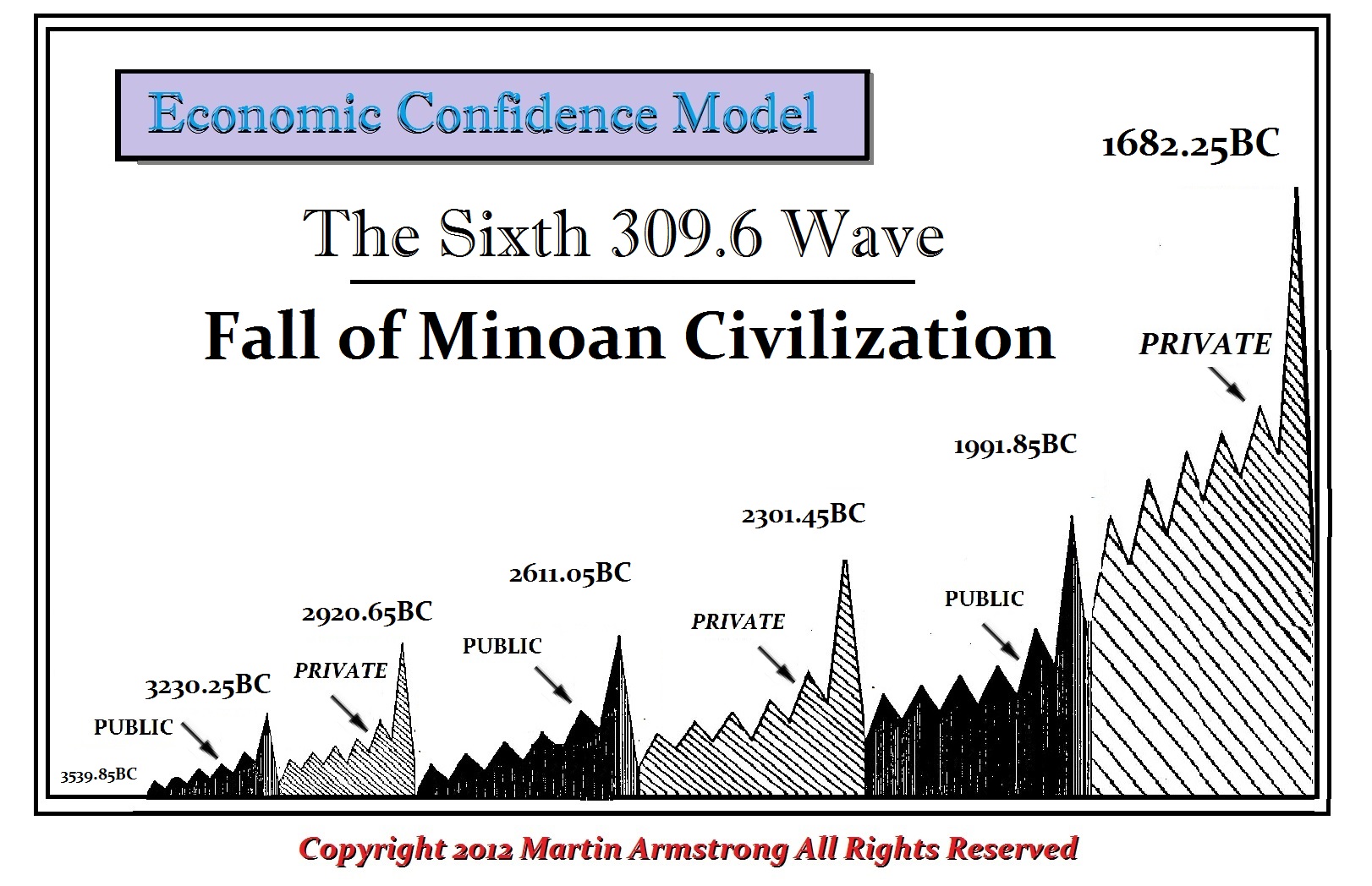
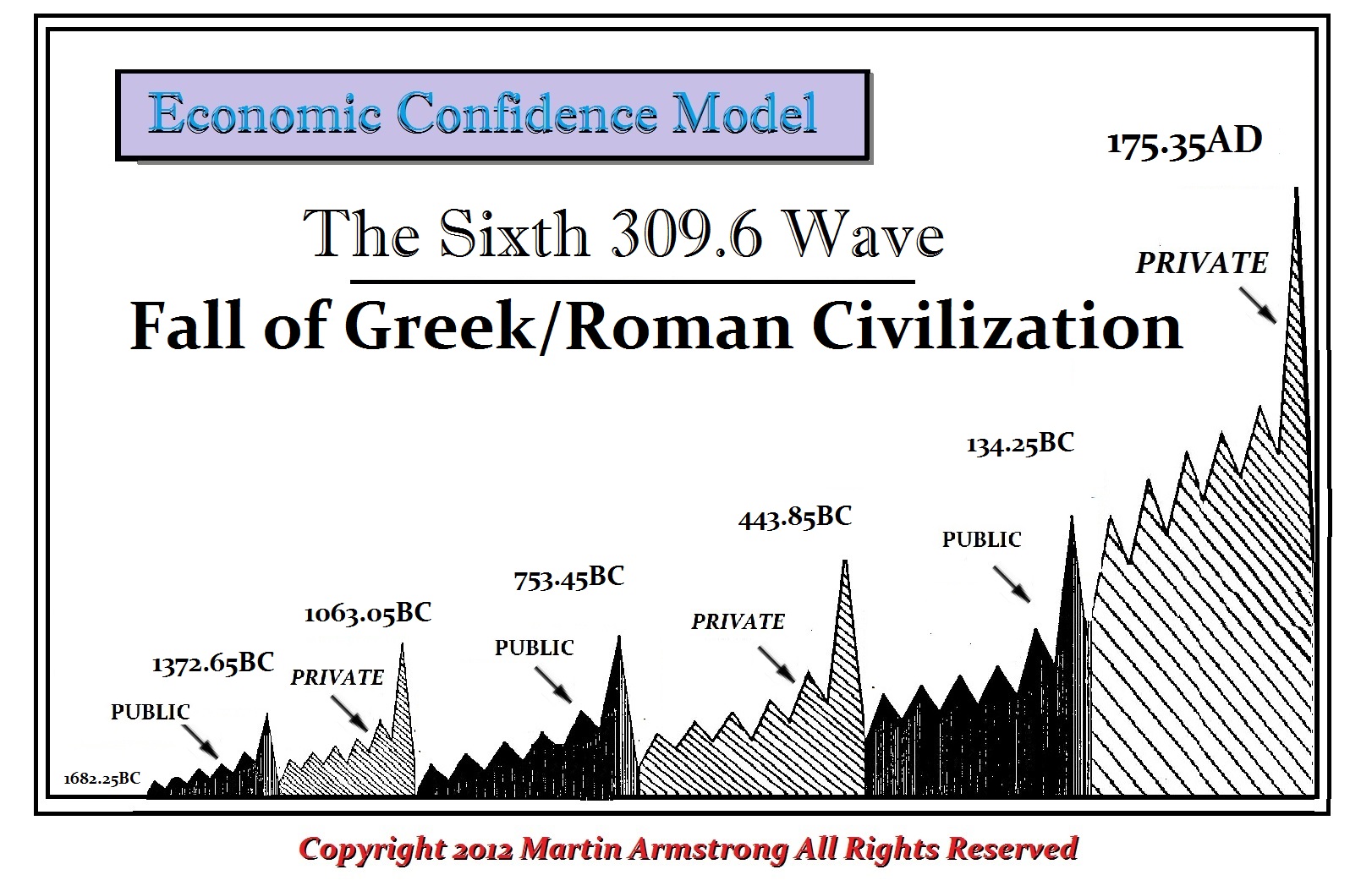
ANSWER: Oh yes. This is part of the Cycle of Civilization but now you are at the 309+ year level where major change begins to appear. The big one comes on the Sixth Wave of the 309.6 Year level. This is the only reason I do what I do. I have written many times that when this wave peaks in 2032, when we come to a crossroads. We either regress contracting into authoritarianism, then break-up into a fragmented feudal type system of local tribes basically, or we can perhaps crash and burn, but then see the light and we make a major technological leap forward.
Even at each 51.6 year wave culmination there is a major structural reset. It is my HOPE that if we reach a level of understanding how and why things work, then we have a shot and perhaps pushing back and we can make do what Neil Armstrong said upon landing on the moon: “That’s one small step for man, one giant leap for mankind.“
This is the third set of the Sixth Wave. This is why I say if it was just me, I am ready- Beam Me Up Scotty. I have my posterity to think about. So I am trying to do what I can. I bumped into cycles in the middle of the night. They found me. I never approached this as a theory to go out and prove. Most major discoveries in science have been by accident.
The Renaissance really began when Constantinople fell to the Turks. Then the scholars fled to the West bringing the known with them in 1453. Note the year. They began schools and started to teach people all the knowledge they had forgotten. There were some who were starting to reintroduce mathematics like Fibonacci (c. 1175 – c. 1250) during the 13th century. But it was the schools that opened following the fall of Constantinople that brought educate back to Europe. Hence, Columbus was exposed to that knowledge and he realized the Earth was round. He set sail in 1492.
The full Age of Enlightenment truly began with the confrontation that cycles existed. It all began with the discovery in 1772 of a frozen intact woolly rhinoceros . Then intact woolly-mammoth followed in Siberia. Suddenly people were stunned. This meant that you could be frozen with food still in you mouth. This inspired tremendous investigation into gravity to the cyclical nature of comets.
The Dark Age is the fragmentation of society reverting back to where we see nations breaking up unto regions and then all the way back to city states. The Renaissance is typically inspired by the rediscovery of lost knowledge. This is really an extensive subject. I have written a book on this entire topic documenting everything from math and science to political rise and fall. I am hiring more editors to try to get out several books that have been backlogged for way too long.
I have created this site to help people have fun in the kitchen. I write about enjoying life both in and out of my kitchen. Life is short! Make the most of it and enjoy!
This is a library of News Events not reported by the Main Stream Media documenting & connecting the dots on How the Obama Marxist Liberal agenda is destroying America

 TENNESSEE – Tennessee Titans tight end Delanie Walker said fans upset by team demonstrations during the national anthem can stay home.


 QUESTION: Hi Martin,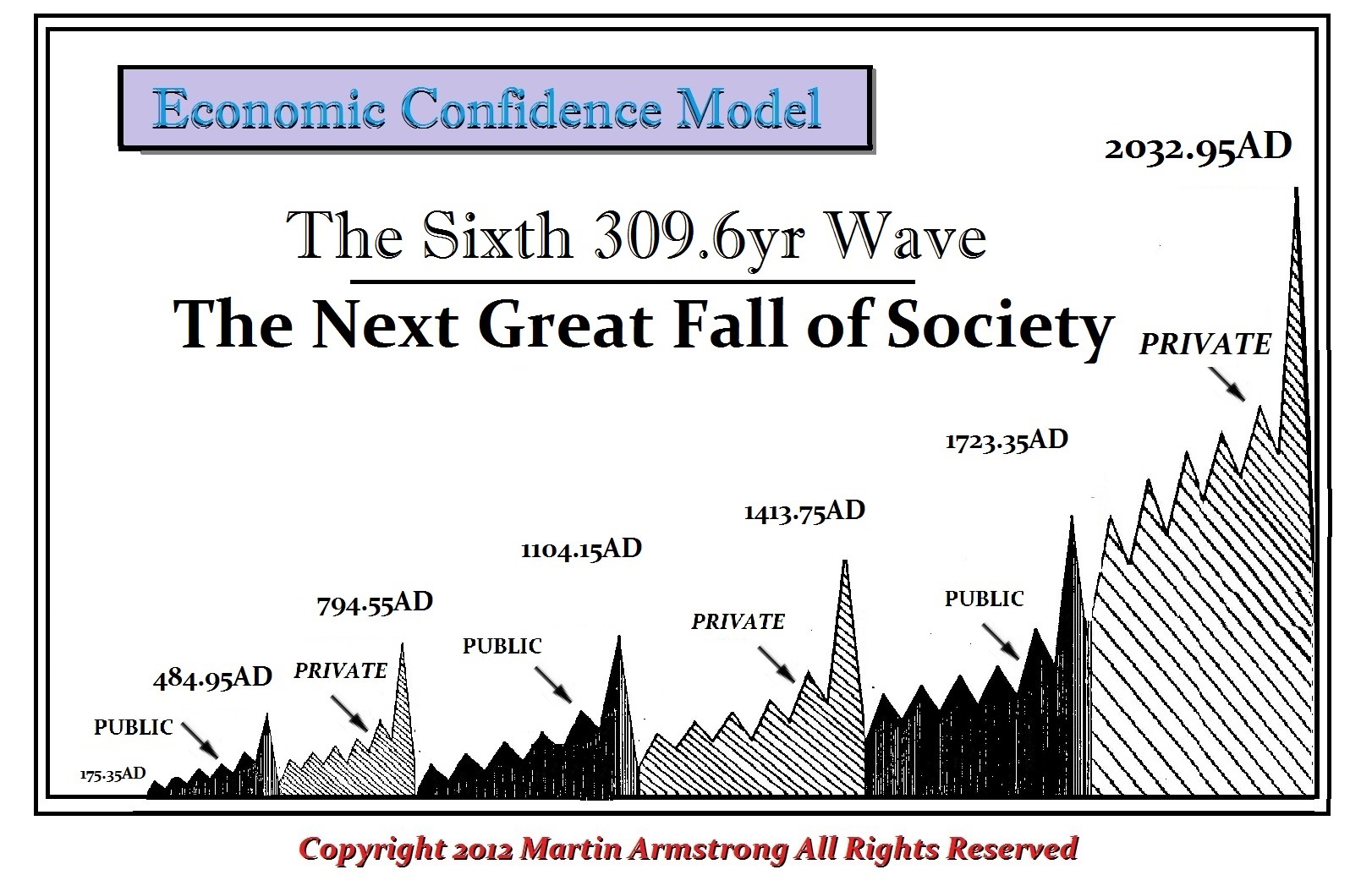




 Centinel2012