Today, President Donald J. Trump and First Lady Melania Trump attended a Wreath Laying Ceremony at the Korean War Veterans Memorial in Washington, DC, to commemorate the 70th anniversary of the outbreak of the Korean War and remember the brave American soldiers who selflessly sacrificed their lives in the fight for peace.
Attending with the President and First Lady was Secretary David Bernhardt, Department of the Interior; Secretary Robert Wilkie, Department of Veteran Affairs; and Ambassador Lee Soo Hyuck, Ambassador of the Republic of Korea to the United States
.
Korean War Veteran Participants Included:
MG Omar Jones, Commanding General, Joint Force Headquarters-National Capital Region
Hwang Hye Kyung, Spouse of Ambassador Lee Soo Hyuck Gerald Merna, United States Marine Corps: 1st Marine Division – Chosin Reservoir, Army: 2nd Division, 38 Infantry Regiment
Joseph Ade, United States Marine Corps: 1st Marines, 1st Battalion Hill 812 Bravo Company
Arthur Cooke, United States Marine Corps: 1st Marine, 2nd Battalion – Chosin Reservoir
Thaddeus Gembczynski, United States Marine Corps: 1st Battalion, 5th Marines – Chosin Reservoir
William Tapley, United States Army: Counterintelligence, First Cavalry Division – Chosin Reservoir
George Patton, Jr., United States Army: 25th Infantry Division
John Coleman, United States Army: 25th Field ArtilleryBattalion, 40th Infantry Division
Carlyle Agrelius, United States Marine Corps: 1st Marines, 2nd Battalion – Chosin Reservoir Campaign
Huck Wiley, United States Marine Corps: 1st Marines, 2nd Battalion Weapons Company
Ronnie Fukuoka, United States Marine Corps: 1st Marines, Radioman
Ben Chism, United States Army: 92nd Field Artillery Division, 9th Army
President Trump, who was presented with numerous awards from Black organizations as a supporter of equality for all before the Democrat establishment and the Democrats who identify as journalists decided to accuse him of racism, works tirelessly to empower America’s forgotten communities.
According to President Trump on September 10, 2019, “We’re lifting up forgotten communities, creating exciting new opportunities, and helping every American find their path to the American Dream.”
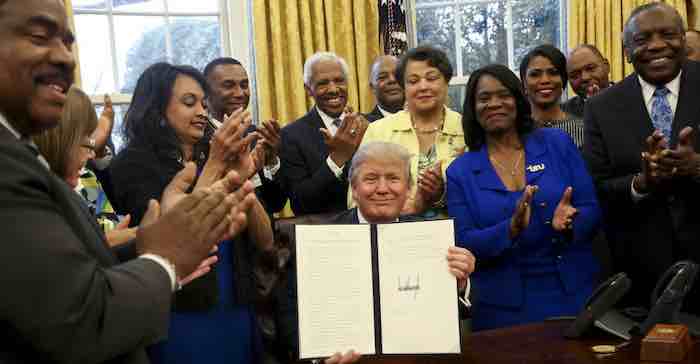
A statement from the Trump White House staked out a basic tenet of President Trump’s stance regarding the importance of education in building for success in the African American community. “For over 180 years, America’s Historically Black Colleges and Universities (HBCUs) have made extraordinary contributions to our country, helping bring the American Dream to millions of African-American students and many others.”
Addressing the 2019 National HBCU Week Conference, President Donald J. Trump said: “Together, we will ensure that HBCUs continue to thrive and prosper and flourish for the countless generations to come,” as he pledged to keep building on his Adminifst,ration’s work in support of these important institutions.
He pointed out the long and illustrious history of HBCUs in America saying, “For more than 180 years, HBCUs have strengthened our country and called our country to greatness. Your institutions have been pillars of excellence in higher education and the engines of advancement for African American citizens. It’s been incredible the job they’ve done.”
And President Trump has put legs to this vocal support. In his budgets he has spent more than any other president on HBCUs. In 2018, Trump appropriated more than three hundred and sixty million dollars—thirty-two million more than Obama.
And while it is easy to say that you are supportive of a cause actions speak louder than words. Here are some of the actions President Trump has taken to help build a better future for Americans:
PRIORITIZING EDUCATION: President Donald J. Trump has made supporting Historically Black Colleges and Universities (HBCUs) a priority of his Administration.
Barely a month after taking office, President Trump signed an Executive Order to move the Federal HBCU initiative back to the White House – making sure it is a key priority.
President Trump directed agencies across his Administration to develop plans to enhance their support for HBCUs.
President Trump has signed legislation increasing Federal funding for HBCUs.
The President signed legislation that added more than $100 million for scholarships, research, and centers of excellence at HBCU land grant institutions.
The Administration relaunched the HBCU Capital Finance Board to make millions of dollars available to support HBCUs’ long-term growth and improvement.
The Administration has announced that any restrictions on those funds going to institutions with a religious mission is unconstitutional.
The Administration is rethinking college by reducing regulatory burdens, promoting innovation, strengthening accountability, and respecting the unique mission of each school.
LIFTING UP COMMUNITIES: President Trump is ensuring that no citizen is forgotten, and no community is ignored.
President Trump’s America First agenda is spurring investment and revitalization in our country’s most underserved communities.
President Trump signed legislation creating Opportunity Zones, a game-changing vehicle to spur new capital investment in America’s economically distressed communities.
Nearly 9,000 communities in all 50 States, the District of Columbia, and 5 Territories have been designated as Opportunity Zones.
Opportunity Zones are projected to attract $100 billion in private investments to the American communities that need these investments most.
President Trump created a White House Opportunity and Revitalization Council to help ensure we are lifting these communities.
Since its creation, the Council has taken action to deliver additional Federal support to Opportunity Zones.
Median income for African American-headed households rose by 2.6 percent between 2017 and 2018.
The poverty rates for African Americans and Hispanic Americans each reached new series lows in 2018.
Nearly 2.5 million have been lifted out of poverty in the first two years of the Administration.
INVESTING IN OUR WORKFORCE: President Trump is promoting workforce development to ensure all Americans share in our historic economic revival.
President Trump is supporting American workers to ensure all Americans can benefit from today’s thriving economy.
More than 350 companies have signed President Trump’s “Pledge to America’s Workers,” offering more than 13 million employment, education, and training opportunities.
President Trump’s National Council for the American Worker is developing strategies for training and retraining workers for the jobs of today and tomorrow.
Last year, the President signed legislation reauthorizing nearly $1.3 billion in funding for career and technical education, benefitting millions of Americans.
The President’s pro-growth policies are generating millions of new jobs – creating more and more opportunities for American workers.
More than 6.3 million new jobs have been created since President Trump’s election and job openings continue to far exceed the number of job seekers.
CREATING A FAIRER JUSTICE SYSTEM: President Trump’s criminal justice reforms are keeping our communities safe and giving Americans a second chance to succeed.
President Trump is ensuring that former prisoners can find jobs and build meaningful lives after rejoining their communities.
The President signed the groundbreaking First Step Act, enacting historic reforms to make our criminal justice system fairer for all and to help prepare prisoners to successfully rejoin society.
These reforms helped to remedy unfair sentencing provisions that disproportionately hurt African Americans.
This historic legislation promotes prisoner participation in vocational training, educational coursework, or faith-based programs.
These reforms help keep all Americans safe by giving former prisoners the chance to find purpose and contribute to our economy, rather than returning to crime.
President Trump is promoting second chance hiring to offer prisoners an opportunity to achieve the American dream.
Departments and agencies across the Government are enacting initiatives to promote second chance hiring opportunities.
Evangelist Alveda King, the niece of Dr. Martin Luther King Jr., is not helping Democrats with their accusations that President Donald Trump is a racist. In fact, she has quite the opposite to say. She tweeted, “I am the Niece of Dr. Martin Luther King Jr. Listen to my words, President Trump is not a racist!! He is one of the best presidents America has ever seen! I fully support him!”
Speaking to Fox News about the president King said, “I’ve had the experience of going head-to-head with genuine racists. Back in the 20th century, I was a youth organizer … and a racist is a person who really does believe that their race, their category of humanity is superior or different.”
She went on to call out Joe Biden and other Democrats for not being honest about Trump denouncing white supremacy, which King acknowledged the president has done several times.
She also said, “One thing really is getting to me and I’d like for you to look into this, the race-baiters who want to stir up fear and hate make us think we’re different when we’re one blood and one human race. President Trump says, ‘we all bleed the same,’ he’s really clear on that, he has done so much for all Americans, including African Americans.”
And there you have it. Some people for partisan reasons want to say that President Trump is a racist. However, if we look at what was said about him before he decided to run for president and had the audacity to win, if we listen to Black leaders such as Alveda King, or if we take time to actually look at his actions we learn that the opposite is true.
President Trump and President Duda of Poland hold a press availability in the oval office prior to a bilateral meeting. [Video and Transcript Below]
.
[Transcript] – PRESIDENT TRUMP: Thank you very much. It’s an honor to have President Duda, a friend. We’ve had many discussions, and we work very well with Poland. I don’t think we’ve ever been closer to Poland than we are right now. And we’re going to have a very important meeting on economic development, military, and other things. And that’ll start in about 10 minutes.
We’re going to meet for a little while here, and then we’re going into the Cabinet Room. We then will go outside, and we’re going to see you all, or most of you, out in the Rose Garden, where we’ll take some questions and make statements. And it’s an honor to have you here, Mr. President.
PRESIDENT DUDA: Thank you very much, Mr. President. It’s a privilege and honor to be here with you in the White House as the first president of state after the lockdown, at the end of the coronavirus —
PRESIDENT TRUMP: It’s true.
PRESIDENT DUDA: — epidemic. So thank you very much.
And I hope this meeting will be the next step in our relations, and I hope that we will build together a stronger alliance between Poland and the United States of America. I’m very glad to be here.
PRESIDENT TRUMP: Very good. It’s great to have you.
Okay, thank you very much, everybody. Thank you.
Q Mr. President, why did President Duda get the honor of meeting with you after so many months?
PRESIDENT TRUMP: Great respect for Poland.
Q How does it feel to have the first foreign leader since the shutdown? And now is a good time to have the first foreign leader since all the shutdowns?
PRESIDENT TRUMP: Well, I think it’s a great honor. And, frankly, Poland is a country we have a tremendous relationship with, and I have a very good personal relationship with the President. So this is the first after COVID, after the start of the plague, as I call it. And it’s an honor to have you here.
Okay. Thank you very much, everybody.
And I’m very happy about General Flynn. He was treated horribly. He was treated very, very horribly by a group of very bad people, and I think you’ll see things are going to start to come out.
But what happened to General Flynn should never happen again in our country. He was persecuted, and many other people were persecuted. They spied on a campaign, and they should never spy on a campaign, to put it mildly. It never happened before in the history of our country. The Obama administration spied on a campaign. This is just the first one.
He’s been exonerated, and I want to congratulate him. He’s been through a lot. He’s been through a lot. He had great courage, great fortitude. But they spied on a campaign. There’s never been anything like that happen. If that were the other way around, people would be in jail for 50 years already.
President Trump and President Andrzej Duda of the Republic of Poland are scheduled to hold a joint press conference today following their bilateral meetings. Both leaders have a warm personal friendship. Anticipated start time 3:30pm ET.
Earlier today President Trump commemorated the 200th mile of border wall being built along the U.S-Mexico border. [Video and Transcript]
.
[Transcript] – Q Can I ask question on the wall: How’s it looking?
THE PRESIDENT: I think it’s great. It’s great. It’s going to be — it’s really foolproof. It’s solid steel. It’s rebar and concrete inside the steel. So we have a very heavy concrete inside the steel. And inside the concrete, we have rebar. So you have everything you could have. It’s what they wanted, and that’s what we did.
Any questions?
Q Mr. President, with all the problems that we’re facing right now, why are you determined to end DACA at this time — with unemployment, with COVID?
THE PRESIDENT: Well, we’re looking at it. We’ll work it out with DACA. I think good things are happening with DACA. They resubmit, but we’ll work it out. And the Democrats have been playing with DACA for years, and they haven’t done anything. I’ll get it done. I’ll get it done. And we’ll — good things will happen for DACA recipients, and pretty soon.
Q Is there a message for DREAMers?
THE PRESIDENT: So, we’re going to — yeah. The message is: Put your chin up. Good things are going to happen. You’ll watch. Okay?
Q Why was the suspension on green cards necessary?
THE PRESIDENT: You have to talk up.
Q Suspension on green cards: Why was it necessary?
THE PRESIDENT: So we want to give jobs to Americans right now. Right now we want jobs going to Americans.
Any other questions? Okay. Thank you all very much.
Earlier today President Trump attended a border security briefing in Arizona during an event to thank border enforcement and review the border wall. [Video and Transcript]
.
[Transcript] – THE PRESIDENT: Well, thank you very much. Great to be here. Beautiful runway. A little warmer than I’m used to, but that’s okay, Doug, right? We have a — I was just given a beautiful picture of the wall. That’s before and after. And that’s quite a difference: one area you walk over, you drive over, you do whatever you want, and other one you say, “Well, I guess we don’t get in.” Here’s another one — just given. That’s great. That’s a different section. Pretty amazing.
They’ve done a great job; we’re up to 212 — more than that now, about 220 — but over 212 miles, and we’ll be very close to 500 miles by the end of the year. And that’s the area that we wanted.
So it’s great and thank you all for being here. Thank you very much. And I’m thrilled to be in Yuma, Arizona. They’ve treated me very nicely in Arizona. So we’re very happy about that, Mr. Governor. Right? To commemorate the completion of more than 200 miles of powerful border wall.
We’re on pace to complete 450 miles by the end of the year, and 500 miles, almost immediately thereafter. We may even have the 500 miles by the end of the year. We’re doing a real job. The Army Corps of Engineers, I want to thank them. They’ve been incredible.
This is the most powerful and comprehensive border wall structure anywhere in the world. It’s got technology that nobody would even believe, between sensors and cameras and everything else.
With us today are Acting Secretary of Homeland Security Chad Wolf, who has done a fantastic job. Thank you, Chad. Commissioner Mark Morgan. Mark, thank you very much. Lieutenant General Todd Semonite, who’s doing a fantastic job at the Army Corps. We have interesting construction talk, don’t we?
LIEUTENANT GENERAL SEMONITE: Yes, sir.
THE PRESIDENT: Really great stuff.
President of the National Border Patrol Council, Brandon Judd. Hello, Brandon. What are you doing sitting back there? I’ve never seen that before. You’re always up here with me. You’re getting low key lately, huh? That’s confidence. That means he’s got a lot of confidence. That’s great. And thank you for everything, Brandon. Say hello to everybody. Great job you do. Appreciate it.
He was a supporter of mine before I ran. He said, “I hope that guy runs.” Right? So I appreciate it very much. We won’t forget it either.
And several other very dedicated and heroic members of law enforcement. I met just a few of them back there and they gave me a beautiful replica of the wall, a little shorter version, but that’s okay. And we want to thank everybody.
We’re also joined by some of my very good friends and people I have great respect for you. You have a great governor in this state. And he’s been a great friend for the state, but he’s been a great friend to our nation and does a — just a great job: Doug Ducey. Thank you very much, Doug.
GOVERNOR DUCEY: Thank you, Mr. President.
THE PRESIDENT: Appreciate it.
GOVERNOR DUCEY: Thank you.
THE PRESIDENT: Talk to you in a little while. Appreciate it.
Senator Martha McSally, who I hear is doing very well. We need you in Washington. Will you please win?
SENATOR MCSALLY: Yes, sir. (Inaudible.)
THE PRESIDENT: Because we need you. The alternative that’s running against you is not the person that we want, where he’s got — he’s got things that we don’t want. So we want you to win this race. It’s very important. And we appreciate all the help that you’ve given us, especially on the border wall. We appreciate it, Martha. Thank you very much.
Representative Debbie Lesko has become a tremendous friend of mine and supporter. And with the impeachment hoax, she was right up front. And it was good for you. You became very famous. I became more famous and you became very, very famous. Right?
REPRESENTATIVE LESKO: Well, you helped me. Thank you.
THE PRESIDENT: Well, it certainly didn’t hurt. She was one of the really great advocates, who’s terrific. We appreciate it, Debbie. Thank you.
Yuma Mayor Douglas Nicholls. And thank you, Douglas, very much for being here.
MAYOR NICHOLLS: Thank you. Welcome back to Yuma.
THE PRESIDENT: Thank you very much, Doug. It’s really an honor.
And Yuma Police Chief, Susan Smith. Thank you, Susan, very much for being here.
So my administration has done more than any administration in history to secure our southern border. Our border has never been more secure. I think Doug can tell you that. Anybody at this table can tell you that. It’s never even been close.
The numbers now, including not only the wall — the wall has helped a lot, where we have that 200 miles — 212 and now 220 — it’s really, essentially, almost, I guess 99.6 or something like that. Maybe somebody can get an extraordinarily long ladder, but once you get up there, it gets very high. And it’s just about unclimbable. So it’s — it’s really great. That’s made a big difference, but we have other things that we’ve done.
During the past two months, we’ve seen the lowest number of illegal border crossings in many years. Illegal immigration is down 84 percent from this time last year. Illegal crossings from Central America are down 97 percent.
Now, the news — I won’t say “fake news”; I want to be nice today. So the news will say “97 percent,” Doug. “That’s not very good.” But 97 percent, I would say, sounds pretty good.
GOVERNOR DUCEY: A-plus.
THE PRESIDENT: You sure it’s 97 right?
ACTING COMMISSIONER MORGAN: Yes, sir.
THE PRESIDENT: Ninety-seven. That’s a pretty good —
ACTING COMMISSIONER MORGAN: Yes, sir.
THE PRESIDENT: That’s a pretty good number you’re doing. Ninety-seven percent down. Nearly 450,000 pounds of drugs have been seized this year, and 2,337 criminal aliens have been apprehended. We’ve stopped asylum fraud, ended catch and release.
If you look at so many of the different crimes that come through the border, they’re stopped. We’ve implemented groundbreaking agreements with Mexico. I want to thank the President of Mexico. He’s really a great guy. I think he’ll be coming into Washington pretty soon, to the White House.
But they have a total of — what’s the number today, would you say? Soldiers? What would you say?
ACTING COMMISSIONER MORGAN: Over 20,000, sir.
THE PRESIDENT: Yeah. Over 20. So we’ve had 27,000, 28,000, 25,000 Mexican soldiers are on our border making sure people aren’t coming across.
So I want to also say that we’ve made a lot of progress with Guatemala, El Salvador, and Honduras. And now, when somebody comes over, whether it’s MS-13 or anybody else, we bring them back and they take them gladly. In the previous administration, they didn’t take them at all. They wouldn’t take them. They said, “You keep them.”
Using our emergency public health authorities, we prevented a coronavirus catastrophe on the southern border, shutting down human smuggling and swiftly returning the crossers — we call them “crossers.” They cross now, and we bring them right back. In the old days, it would take years to get them back. They wouldn’t get them back. Other administrations, like the previous administration, essentially didn’t bring them back.
Without these public health measures, the southern border would be a global epicenter of the viral transmission. And if you look at some of the towns on the other side of the wall — as an example, in California, we have a certain area that is heavily infected on the Mexico side. And if we didn’t have a border wall there, it would be a — it would be really a catastrophic situation.
So I just want to thank everyone. The Biden people — and he’s controlled totally by the radical left, as you understand. He’s not controlling it; they’re controlling him. They want open borders. They want criminal sanctuaries. They want everything that doesn’t work. I don’t even think it works politically, frankly, at this point. People see what happened.
You’ll take a look at what’s happening in Seattle, or take a look — Minnesota is such a great, great state, but you look at Minneapolis and you see what happened there. Until we sent in — we sent in the National Guard. We said, “You got to do it.” As soon as they were there, boom, it shut down. All the problems they had shut down. You didn’t hear about them anymore. And many other places.
Last night in Washington, we heard they were going to take down the statue — Washington, D.C. — the statue of Andrew Jackson. A beautiful statue in Lafayette Park. And Mark Meadows is here. He heard about it. I heard about it. We sent people there. And law enforcement did an incredible job. They ran into that place. And we were minutes away. That was a sneak attack.
And now we’ve enacted an act, a very specific statue and monument act that puts people in jail for 10 years if they do anything to even try to deface one of our monuments or statues. So we have numerous people in prison right now; others are going there. And we’re going to look at that from a standpoint of retroactivity. We can go back and look at some of the damage they’ve done.
But largely, it’s state damage, because the states have been very weak — extremely weak in protecting their heritage and protecting their culture. So the states are going to have to take care of themselves, but we’re with — we’re there to help. If they want, we’ll gladly help.
But the federal statues, monuments, buildings, various things that we have, including if you look at the Jefferson Memorial, the Lincoln Memorial. They want to take down George Washington. How about that one? That’s a new one. We heard that the other day — George Washington. I don’t think we’ll let that happen, Doug, right? I don’t think we’re going to let that happen. But George Washington and so many others. They — I really don’t even think, frankly, they know who they’re taking down. I think they just want to do things for bad purposes.
So — and these aren’t protestors. These are agitators and others. So we’ve taken a very strong stance. And it won’t be happening federally. If it does, they’re going to pay a very big price and they know that. It won’t be happening with the federal statues and monuments.
So with that, I’d like to just introduce Chad Wolf to say a few words about the border — the job we’ve done on general security, not just the southern border. The southern border has been a primary focus, as everyone knows, because tremendous amounts of drugs and other things come down. Human trafficking, we have that down to the lowest number we’ve had in many years. And again, being helped a lot by the length of our wall, which is going to be complete very soon.
So, Chad, say a few words, please.
ACTING SECRETARY WOLF: Well, thank you, Mr. President. And we’re here today as a testament to your leadership and determination to secure our nation’s borders. In recent weeks, as you’ve mentioned, our country has witnessed an all-out attack against our law enforcement. Thankfully, you have not stood idly by. Instead, you’re supporting the brave law enforcement officers who sacrifice so much for all of us every day. And nowhere is that support as important as it is here at the southwest border.
Border security is homeland security. The first priority of any nation is to ensure the sovereignty by protecting the integrity of its borders.
Mr. President, you have disregarded the ineffective conventional wisdom put forth by folks in D.C. and have instead listened to your operators. And they have been very clear: They want an effective and lasting border wall system. And you’ve been — you’ve responded by making available over $15 billion to fund this critical capability. And so your support of the men and women of DHS and CBP are — is beyond comparison.
Others, such as General Semonite and Commissioner Morgan will talk to you about the attributes of the wall, but let me just focus on a few key issues that you also brought up that goes into securing our borders — not only the border wall system, but we are also closing loopholes that have served as magnets over the last three years, enticing migrants to take a very dangerous journey north to the U.S. and enter our country illegally.
We have entered into a number of game-changing agreements with our Northern Triangle partners to stem the flow of illegal migrants as well.
We’ve demanded — you specifically have demanded Mexico step up their efforts, and we’re seeing more and more migrants being turned around at Mexico’s southern border before they reach our own.
We’re also addressing abuse, as you mentioned, of the asylum system, clamping down on the use of frivolous asylum claims to illegally obtain work authorization here in the U.S.
And we’re also disrupting and dismantling dangerous cartels by leveraging the unique capabilities of the United States Coast Guard as well as the United States Navy. And we’re attacking these criminals where they’re most vulnerable, and that’s at the sea.
And perhaps, most importantly, you took decisive action to restrict travel to the U.S. during COVID-19. And you’ve taken recent action to put American workers first as we reopen the economy.
So, Mr. President, I want to thank you once again for your support of the men and women of DHS, also for your support of law enforcement across the country, but particularly here along the southwest border.
We look forward to continuing our work on the border wall system and making the border even more secure.
THE PRESIDENT: Thank you very much. You know, when we first came, there was a thing called the “caravan.” And you’d have caravans, you’d have these massive amounts of people coming up, and they’d be coming from sometimes Honduras or Guatemala, El Salvador, other countries. They’d come through those countries sometimes, but thousands and thousands of people. I guess the largest one we saw was maybe 15,000. That’s a lot of people.
ACTING SECRETARY WOLF: It’s large.
THE PRESIDENT: And very dangerous for those people too. Things that happened on that journey up were brutal, and it was a long journey. But we don’t have that anymore because they know they can’t get through. And when they know they can’t get through, they don’t want to go through that.
So, you know, we’ve told other countries, “You can’t do that. You can’t have caravans.” And they listened to us, so it was a big — it’s a big difference right now. Tremendous difference.
Mark, please.
ACTING COMMISSIONER MORGAN: Yes, sir. So a couple things. First, I want to echo what the Secretary said, sir. I want to say, as Commissioner of CBP, thank you. Thank you from early on. You listened where others before you have not. I think Brandon Judd could testify to that. Early on — right, Brandon? — he was engaging you. And you engaged the experts who are on the frontlines every day, risking their lives for this country. And you asked them, “What do you need?” And one of the things they said is, “We need an effective border wall system.” And, Mr. President, you have delivered that.
And to echo what the Secretary said too, we also concur that border security is national security. It’s just commonsense. We have to know who and what is coming through our borders and to our borders, and we have to be able to defend that.
With every new mile of new wall system, the operational capacity of CBP, specifically Border Patrol, is increased. Our ability to enforce the rule of law has increased. Our ability to maintain integrity in the immigration system has increased. Our ability to improve border security has increased. And our ability to shape and drive the behavior of the cartels has also increased. Our ability to impede, deny, and stop the vast threats that we have have increased because of your leadership and providing us the tools, like the wall system.
And I think this is also important, and we — we’ve talked about this before: It’s not just a wall. I keep saying “wall system” on purpose, because what you have delivered is something that has not been delivered before. It’s not just a bunch of steel in the ground. It’s that plus access roads, technology, other attributes that really makes it an effective wall system and gives us a capability that we have not had before.
And that’s why I stay true to the fact when I’m asked — the 220 miles of wall system we have in right now are 220 new miles of wall system that gives us an enhanced capability that we never had.
Stopping drugs at the border, that’s what we should do. That helps reduce the tens of thousands of American citizens that have died every year at the hands of the cartels smuggling drugs across this border.
Stopping human smuggling at the border prevents and reduces the ability of women and children to be lost, abandoned, and further exploited by the cartels.
Stopping criminals and gangs at the border reduces violent crime in every city in this country.
Stopping infectious disease, like COVID-19, at the border has saved countless lives, and that is due to your leadership.
And that’s why we say all the time that every town, city, and state is a border town, border city, border state. Everything that touches our border touches every city, town, and state in this country, and that’s why we have said and we will continue to say borders matter; the wall matters.
And I want to end by saying a special thanks also to General Todd Semonite. It’s been an incredible relationship that we’ve had. His “wall team,” as we call it, and CBP’s wall team, we’ve worked together for the past few years and making this happen. And I am 100 percent convinced that we will reach that 450 miles by the end of the calendar year.
THE PRESIDENT: That’s great. Yes, I think we’ll do that. Todd, go ahead, please.
LIEUTENANT GENERAL SEMONITE: Well, sir, first of all, thanks for having us in. And the Corps of Engineers is exceptionally honored to work on one of these largest infrastructure projects in our country. And the Commissioner talked about the team. I mean, it goes to Secretary Wolf, all the CBP agents — phenomenal people. We couldn’t do this alone. And it’s just a very noble calling to be able to put this in place.
Just to be able to talk to you a little bit: Again, this is a four-state program, about $15 billion, 49 different projects that are being done right now. And I’m just going to give you a quick couple of numbers here.
There are 220 miles that are complete. They’re done. We’re doing about a mile a day right now. Under contract right now being built, put in the ground, steel and concrete: 384 miles. And then we’ve got another 129 miles that are actually — we’re working through real estate, we’re working through the design, and we continue to get all that in. So that would be somewhere over 700 miles that’s already under work and being done.
That’s a hundred and — there’s 144,000 panels that are being put in the ground. These are 8 feet wide, 30 or 18 feet high — already in place, in concrete. So it’s a pretty massive system.
Today, we’re actually looking at what we call the “Yuma primary.” This is 26 miles, cost about $267 million, 51,000 cubic yards of concrete, about 36,000 tons of steel. And, sir, what we’ve got in this particular project is about 17,000 panels. So a lot going on there.
And I just want to end by looking at the elected officials of Arizona, and it goes to the other states as well. CBP, the Corps of Engineers, we’re absolutely committed to do this where it is as — environmentally, less impact as possible. We want to put as many jobs as we can into the local community.
We want to continue to make sure that we are doing — going overboard on COVID compliance. And, right now, our contractors have some of the most stringent measures in America before — to make sure, before they ever walk on the workspace, they’re being as safe as they absolutely can. And if there’s anything else that we need to do to be able to make sure we’re working very, very close with your constituents, we are committed to do that.
So, sir, we’re honored to be here and we got a lot of great things going on.
THE PRESIDENT: Great job. Thank you very much, Todd.
Brandon, could I ask you to say a few words? Because you were the ones that said — you told me, “We need a wall. You got to get the wall.”
MR. JUDD: Well, first, President, actions speak much louder than words. You’re the only President in my 20-year — 23-year career that has actually come down to the border multiple times to look at and assess what actually needs to be done.
Your agents — I normally call them my agents, but they are your agents — your agents appreciate the fact that you’ve gone above and beyond well — more than any other President in the history of my career.
Your agents want two things: They want border security, which is security for the entire United States, and they want economic security for their family, for their friends, and for their loved ones. You built the strongest economy in my lifetime. We trust that you’re going to continue to build that economy.
Pandemic hit. Nobody saw it coming. Nobody could have predicted it. You will build that economy, and we trust that you will build that economy. You’ve done more to secure the border. We are at historic lows. And you’ve done it twice, not just once. None of your predecessors were able to do that.
You’ve talked with the men and women of the Border Patrol. You’ve invited me to the Oval Office on multiple occasions to consult with what the boots on the ground want. They have consistently told you: Walls in strategic locations work. It allows us to dictate where traffic goes. It allows us to be a lot more effective.
You, not your predecessors, have done that. You built the economy. You have provided border security. And you continue to do it, and we continue to look forward to working with you. Thank you.
THE PRESIDENT: Thank you, Brandon, very much. It was very interesting because Brandon was telling me, right at the beginning, we needed the wall, and what kind of wall we need, and you have to have a vision through the wall. If you don’t have the vision through — and then we met, and you all agreed.
But we met with your people. We had various design competitions for — I said, “If we’re going to build it, let’s build it right.” And we had design competitions. The wall that was hardest to get over, the wall that was impossible to climb or certainly very, very hard — and this was the hardest. And we built the top of the line.
But you were really a great help. Thank you, Brandon, very much.
So a man that’s been so much — has just done a great job for the area and very — is so into security of this state, of this great state of Arizona — and I just think he’s really a fantastic guy, the governor. Could you say a few words, please, Doug?
GOVERNOR DUCEY: Sure, (inaudible). One, welcome back to Arizona, Mr. President. It’s good to have you here and, I want to say, to be down on the border.
For years, Arizonans have heard empty talk about the border, and this is the first administration that has taken action. So I want to say how grateful I am for the partnership with Homeland Security; how your Border Patrol, your Customs and Border Protection, and ICE have all been helpful. The Army Corps of Engineers — not only what they’re doing on the wall, but what they’re doing for a potential surge capacity around COVID-19, I think, shows the best of what’s possible when there’s a partnership between the federal government and the state government. And it’s been your leadership that has allowed there to be real action.
And in 2014, when I was first elected, there were large areas of Arizona’s border that were wide open and unprotected. And on this 220-mile stretch, now there is border security, which is national security, and that will stop drug cartels, human traffickers, and child sex traffickers.
And your top folks have partnered with the Border Strike Force in Arizona. And as a result, we’ve kept dangerous drugs and this poison out of our schools and neighborhoods, as well as protecting people who are not being trafficked over the border.
So, I’m grateful, and I know there’s more to do because the border is longer than 220 miles, and I look forward to working with you in the coming years to complete the job.
THE PRESIDENT: We’ll have it mostly complete by the end of the year, and there may be a little — we may add a little, and then we may find spots where we want to add. But we’ll have everything we wanted pretty much by the end of the year. That’s great, Doug. Thank you. Great job you’re doing.
And, Martha, you’re there, and you’ve been such a help, and I appreciate it. And I know how you feel about border security, maybe better than anybody —
SENATOR MCSALLY: Yes, sir.
THE PRESIDENT: — but I just want to thank you for your help. Please say a few words.
SENATOR MCSALLY: Absolutely. Mr. President, welcome back to Arizona. It was an honor to fly with you on Air Force One and bring you back for this commemoration.
I feel like we were just here recently for the 100th mile, and so it just shows with the partnership that’s been talked about here how quickly you’ve been able to enact this border wall system to give the agents everything that they need in order to secure our border.
And I know our mayor knows the impact of that on this community, and the sector chief here. Border Security is national security. It’s also health security. I think people have realized now, in this pandemic, that borders matter, and they matter for the safety and security of the state and the whole nation.
And the drugs that have been flowing through easily that are impacting and killing loved ones around America — it has to stop, and this border wall system is a huge part of stopping the cartel activity; stopping that poison from coming across; and giving these agents everything they need, as we support law enforcement for everything they do in order to keep us safe at the federal and at the local level.
So thanks for your leadership and your partnership on this. Welcome back to Arizona.
THE PRESIDENT: Thank you very much. Thanks, Martha. Great job. Appreciate it.
Debbie, go ahead. Come on.
REPRESENTATIVE LESKO: Well —
THE PRESIDENT: Let’s see if you can do it again. (Laughter.)
REPRESENTATIVE LESKO: You know, I’m — I’m on the ground, I’m on Judiciary Committee and Homeland Security committees, so I see firsthand how many of my Democratic colleagues really want to prioritize illegal immigrants over U.S. citizens and they really do want open borders.
I mean, I don’t understand it, but they do. And so there’s such a clear difference between you and your future opponent in this issue and Democrats as whole.
I mean, I sat in Judiciary Committee when Chairman Jerry Nadler said that the Border Patrol officers were guilty of child abuse. And I think they said to Mr. Morgan that he was guilty of negligent homicide. I mean, the insanity of what they’re saying and the difference is so clear between what the Democrats want for the future of our nation and what you are doing to make us safe and make our country safe, and I want to thank you for that.
THE PRESIDENT: Well, I think one of the all-time classics — and I’m sure you all remember it well — was they had a picture of a cage, in the New York Times and other places, and it was a cage for children. And they said President Trump built it and how horrible it was. And they still talk about it, even though they know it’s not true.
And somebody wrote in, “No, no, that cage was built in 2014 by President Obama.”
REPRESENTATIVE LESKO: That’s right.
THE PRESIDENT: I guess you could say Biden, but I don’t think Biden knew too much about it, frankly. He still doesn’t. But it was built by President Obama.
And Mark called, who was around this business for a long time. He said, “That wasn’t built by President Trump; that was built by President Obama in 2014.” They gave me an exact date. Actually, they gave me the date it was constructed, meaning a series of cages. And I’ve, sort of, never forgotten it.
And they still say that. You know, they still take — take that same picture. That’s why they get called the “fake news,” and it’s too bad because they ought to straighten it out. It would be so good for our country.
But, no, that was built in 2014, and I never forgot it. Somehow, I never forgot it.
Anyway, Mr. Mayor, would you like to say something?
MAYOR NICHOLLS: Thank you very much, Mr. President, and thanks again for coming back to Yuma. But thank you, more importantly, for last year when you helped us through a big surge of the Central American families. The folks with DHS really stepped up and addressed the very specific concern we had.
Now, if you fast-forwarded that situation to today and those families were coming through with COVID, that would be 5,200 people coming through my community, potentially with COVID. So, the wall — it’s simple math: The wall prevents people from coming, that prevents the number of exposures we can have to COVID. So, from local perspective, that helps our community.
But the men and women of DHS that live here — they’re our residents, they’re our friends, they’re our family members, and it’s a very personal and very poignant fact for us to have those kind of protections in place.
So, thank you very much.
THE PRESIDENT: Well, you have to see San Diego. So, on the other side of San Diego is a tremendously big problem with COVID and other things. And they wanted that wall so badly — you know, you don’t hear this about California. They wanted that wall. They were calling. Everybody was call- — I won’t even tell. I won’t embarrass them by saying who called. But people that didn’t want the wall outside wanted the wall.
And I built the wall, and it worked 100 percent. You know what I’m talking about. And then, I see one of the politicians two weeks later. “They should take down the wall.” By the way, it worked so well. But he was saying, “They should’ve taken down the wall.” But now they don’t even say that, because now it stopped COVID; it stopped everything. It stopped the whole deal. And you’ve had it, and you see the experience. And we’re going to take a good look at a big chunk that we have right in your backyard, right here.
And I know it’s made a big difference for Yuma, and that’s great. You’ve done a fantastic job. Thank you very much.
Chief, would you like to say something?
CHIEF SMITH: Yes, sir. Welcome, Mr. President, to Yuma. And I really first want to thank you very much for your support of law enforcement, local and federal. It’s much needed right now, and it’s appreciated.
I can tell you: I worked on the road back in the early 2000s, and I understand firsthand the calls for service related to undocumented immigrants and how high those calls for service were. And then, after the border enhancement security measures were put into place, I can tell you that we saw a marked decline in many of those calls — those crimes associated with undocumented immigrants, such as load vehicles coming across with drugs and humans, human trafficking, stolen vehicles, and other crimes related. So it’s very much appreciated, and it has helped with the security in Yuma County.
One thing I want you to take away is that Yuma County is a very unique community in that all of the law enforcement work very collaboratively together, from our federal, state, and local partners. So I hope you get that takeaway when you leave here.
THE PRESIDENT: Thank you very much. Appreciate it. I look forward to seeing it.
Please.
DIRECTOR CARROLL: Thank you, Mr. President. As your principal drug advisor, when we first told you about China and fentanyl coming in from over there, you took decisive action and you held China accountable. We explained about South America and drugs coming up through the Caribbean, and you had Secretary Esper do a surge out at sea to prevent the boats from bringing the drugs into our country. And as we’re talking about today, when we talked about the southwest border, you already knew it, but you knew to took action, and you did it. And you are now taking a tough stance here at the southwest border.
We talked about treatment, and we talked about the need to make sure that people get help. You committed more funds than any other President in history. You also talked about the importance of preventing kids from going down this path — on prevention. You committed more funds than any other President in history.
And you did everything with one purpose in mind, and that is to save more American lives. And you have done it. For 30 years, drug deaths were going up. Last year, prior to COVID, first time in three decades, the number of Americans dying from a drug overdose went down, and that’s because of all the action you have taken on treatment, prevention, and stopping drugs from coming into our country and killing our children.
It’s been a great honor to be able to work for you in this capacity and see your passion for saving American lives.
THE PRESIDENT: That was really nice. I appreciate that very much. We are working very hard on it. So I appreciate it. You’re doing a great job, too.
DIRECTOR CARROLL: Thank you, Mr. President.
THE PRESIDENT: Thank you.
Please.
DEPUTY CHIEF LUNDRUM: Mr. President, thank you for visiting Yuma Sector Border Patrol. The agents here, the men and women of this sector, have put in tireless days the past several years in the recent surge across the southwest border. Here in this sector, even though — even though Yuma is a small sector — the second smallest sector on the southwest border; less than 800 agents here in this sector — even though that is the case, we were the third-busiest sector on the southwest border.
And what that looked like here is: In 2017, we had over 12,000 apprehensions, which was more than a 100 percent increase. One year later, in 2018, we had 26,000. Again, another 100 percent increase. One year after that — last year, 2019, over 68,000 apprehensions here.
And it takes a while for the government — for leadership represented here today, for the members, the elected officials here today — it takes a while for those resources to flow in. And the agents, we — we know they’re coming. We believe they’re coming, but now we know it. We see it on the ground. We see what flew in here over the past year to help us out when we were in dire straits in this sector.
We did not have the capacity we needed, facilities-wise. We did not have the resources we needed. But the agents really fought through that — drove through that, and they did what was right. Because every single person that was coming over here — even though, yes, they broke the law, they still had to be taken care of while they were in our custody. We still had to step up and get that part done.
And to do that, we leveraged state officials. We leveraged the local community. You know, we leveraged NGOs in the area to help us.
But now — you know, thank you for your leadership, because now those resources have arrived. And now, in this sector, we’re receiving 110 miles of new wall system. And out there, right now, today, is more than 60 miles already built, already completed, and that 60 miles makes a huge difference.
Every single mile of new wall system that is put in and every single mile, both — both illegal entries in that particular area, drug smuggling in that particular area, border crime in that particular area has decreased in every single mile that new wall system gets put in.
And I thank you for the leadership. I thank everybody at the table today for leadership around the room, in order to take on this particular effort and help Yuma Sector Border Patrol in doing what we need to do to help secure the United States.
So thank you very much, Mr. President.
THE PRESIDENT: Thank you very much. Those are incredible numbers.
And I just want to say: This was one of the most difficult things I’ve ever had to do because we had to raise, you know, large amounts of money. As you were saying, this was one of the biggest projects you’ve ever worked on.
LIEUTENANT GENERAL SEMONITE: Yes, sir.
THE PRESIDENT: It’s a tremendous — you know, you hear it’s a wall, but it’s a wall that’s very big and very long and very powerful. And the Democrats didn’t want to do it. They just didn’t want to do it, Doug, no matter what. It didn’t matter. And these are people that voted in favor of it 10 years ago, but they never got it built because they didn’t know how to build it — because building it is tough, too. But I do that, and we know how to build.
But they tried to block it. They did everything in their power to block it. And it’s very interesting because, in the end, it sort of just went through and the military helped us and we’re getting it built regardless. But they don’t like bringing it up and it’s never mentioned anymore; the wall is never mentioned anymore.
The reason it’s not mentioned: It’s not that we won the battle. It’s that it’s such a compelling thing to have done. Because you see the numbers, and where that wall is going, as you’re saying, it’s like — it’s like magic. You don’t have to do — it saves tremendous manpower and womanpower. It saves tremendous human resources and saves lives.
But they want open borders and they don’t want walls. And they fought harder than anybody I’ve ever seen. And in the end, they quit. They gave up. The reason they gave up: Because, politically, it’s unacceptable to say — especially with this new disease coming in, the pandemic. The new disease coming in, a gift from China. Especially when that happened, and they say, “How can we be putting this…” So they don’t want to talk about the wall anymore. They opposed it. They were strongly opposed to it.
And it was interesting because — you said about the wall — they’d say, “No, no, we don’t need a wall. We can have airplanes flying above. We can have pic- — people taking pictures. We can have drones.” They wanted drones. I say, “What are you going to do? Take pictures of everyone flowing across?” They didn’t want to say. They said, “No, no. Walls — that’s old technology.” No, walls are the greatest technology. They work.
I said — I sort of came up with this; I’m sure somebody did, before — I said there’s two things — because everything changes in the world. They change fast. Change is so fast. You do a computer, and it’s obsolete in two weeks. But two things that have never changed: a wall and a wheel. We’re going to always have wheels, and we’re going to always have walls. And we have the best security wall ever built. And we’ll have it a completed very soon.
And the way you said that was very nice. I appreciated the big difference that it’s made. It’s — it’s really great. Thank you very much. Thank you.
So we’re going to the wall now. And we’re going to see a piece of the wall. We’re not going to be able to cover 500 miles of view, but we’ll be able to cover about 10 yards. But we’ll see a piece of a long — of a long wall that we’re building. And you’ll see — you’ll see what we’re talking about.
We’ll see you over there. Thank you, media. Thank you.
This evening President Trump will be delivering a speech to young Americans at the Turning Point Action Convention in Phoenix, AZ. Anticipated start time 6:30pm ET.
The venue is Dream City Church in Phoenix, and the “Students for Trump” crowd of more than 3,000 mostly young attendees are expected to attend.
Jumpin’ ju-ju bones… New home sales jumped a whopping 16.6% in May, blowing past the estimates of a 2.9% rise. The May increase in sales is nearly 13 percent higher than the same month one year ago.
Home sales are a key indicator of economic health because purchases of homes requires (1) income, a stable job; and (2) an optimistic financial outlook from the buyer.
Sales of new single-family homes jumped 16.6% in May from April, to a seasonally adjusted annualized pace of 676,000, the Census Bureau reported Tuesday. The median economist estimate was for 640,000, according to Bloomberg data.
In addition to a larger-than-expected monthly surge, May sales were nearly 13% higher than a year ago. As the US economy reopens, people are flocking back to the housing market in droves — the rosy sales are a rebound from three months of declines ending in April. (LINK)
In the economic balancing act toward China Larry Kudlow represents the good cop, Peter Navarro represents the bad cop and President Trump navigates the market responses. Neither person is factually in conflict with the other; the nuance is in the expression and each person has a role to play. Sometimes teeth, sometimes not. It depends on need.
Last night trade advisor Peter Navarro noted the U.S. position with China and trade is still in a state of serious conflict. This is accurate, and a more confrontational posture has been expressed by President Trump. Today Larry Kudlow moderates the Navarro position to lessen the Wall St. concern over a looming decoupling. It’s all a dance.
The need for nuance becomes clear as we watch Stuart Varney pushing the Wall Street concern angle on behalf of U.S. multinationals. The administration does not want to spook the stock market while they deal with a China confrontation. WATCH:
.
Kudlow represents the panda mask. Navarro represents the eagles claw. President Trump advances or retracts each position as he controls the market response. The objective is a slow, steady, smiling decoupling that doesn’t unnerve anyone… but the direction is always toward the decoupling.
President Trump is delivering the proverbial economic death by a thousand paper cuts.
Because China sees their strategic panda mask approach being used against their own interests; and because Beijing now sees their economy contracting due to the long-term strategy being deployed by President Trump; China is getting a little more desperate:
BEIJING/HONG KONG (Reuters) – The Chinese government’s top diplomat Wang Yi on Tuesday proposed a “fast track” arrangement for the movement of people and goods with India and Russia.
Ministers from China, Russia and India should together discuss trade, energy, transport, education and health, Wang said in a statement on the foreign ministry’s website. (link)
President Trump smiling while slowly and methodically cutting down the economy of China and simultaneously holding them to account for prior purchase agreements. This relentless approach has to be making Beijing quite angry.
The Chinese saying: “if you plant your trees in another man’s orchard don’t be surprised when you pay for your own apples”, is very appropriate for these times. However, China has always been the one charging…. they did not expect to be the one paying.
Chopper pressers are the best pressers. Earlier today President Trump stopped to deliver remarks to the assembled press pool and answer questions. The President is heading to Arizona for events at/near the border. [Video and Transcript Below]
.
[Transcript] – THE PRESIDENT: Hello, everybody. So we’re going to Arizona. We’re celebrating. We have over 200 miles of wall built. It’s been incredible. Our numbers on the border, as you know, are at just about a record-breaking low. People are not being able to cross the border. The wall is up, because we have more than 200 — we have about 212 miles up of wall. So that’s good.
And we’re going to be doing a number of other things. We’re going to be making a speech to young people in Arizona, and we’ll be meeting with some of the Arizona officials to talk about their border and how strong it’s become. It’s become very strong.
Last night, we stopped an attack on a great monument — the monument of Andrew Jackson in Lafayette Park. And I just want to thank law enforcement. They did a great job. We were working very closely with the White House Secret Service and some of our executives. It was really — they did a great job. They stopped it cold.
Numerous people are in jail and going to jail today. People are already there, but we’re looking at long-term sentences under the act. We have a very specific monuments act. And we are looking at long-term jail sentences for these vandals and these hoodlums and these anarchists and agitators, and call them whatever you want. Some people don’t like that language, but that’s what they are. They’re bad people. They don’t love our country, and they’re not taking down our monuments. I just want to make that clear.
And other than that, go ahead.
Q Mr. President, do you have executive order coming regarding the monuments? What will it accomplish?
THE PRESIDENT: I will have an executive order very shortly. And all it’s really going to do is reinforce what’s already there, but in a more uniform way. Okay?
I want to also say this: If the state governments — because you see them all over — in Seattle, they’re very weak, and in Minnesota, they might need help. If they need help, the federal government is willing to help them. If these hoodlums come around — these are not protestors, by the way; these are — these are anarchists and other things. If these hoodlums come around, and if the states can’t handle it, we are ready, willing, and able to help as we did in Minnesota, where we stopped — after four days, they finally called, and we did a great job with the National Guard.
Q Mr. President, are you planning to make any — are you planning to make any changes at your campaign after the Oklahoma rally?
THE PRESIDENT: Yeah, Hogan Gidley — not for that reason, because as you probably have heard, Fox had the highest ratings on a Saturday night in the history of Fox. So that’s the ultimate poll, I guess. But the ratings on Saturday night, for Fox, were the highest ratings in the history of Fox News, which is, I guess, it’s a long history. So that was the number one Saturday night in history.
We actually had a nice crowd, and — despite all of the warnings and everything else that other networks were trying to do; despite the fact that we had some pretty bad people waiting there, waiting — they shouldn’t have been. Maybe some of the same people I just talked about.
We had a nice crowd. But we had the highest ratings in the history of Fox on Saturday night. And online, I heard the record was unbelievable. I heard the numbers were unbelievable. I think you probably know that. What were the numbers online? Do you know?
Q I don’t know, sir.
THE PRESIDENT: Well you should know because you should report it.
Q Mr. President, at that rally, when you said you asked your people to slow down testing, were you just kidding or do you have a plan to slow down testing?
THE PRESIDENT: I don’t kid. Let me just tell you — let me make it clear: We have got the greatest testing program anywhere in the world. We test better than anybody in the world. Our tests are the best in the world, and we have the most of them.
By having more tests, we find more cases. We did 25-plus — 25 million tests. Think of that: 25 million. If you look at other countries, they did 1 million, 2 million, 3 million. Big countries. We did 25 million. Way more by double, triple, quadruple any other country. Therefore, with tests, we’re going to have more cases. By having more cases, it sounds bad, but actually what it is, is we’re finding people. Many of those people aren’t sick or very little. You know, they may be young people.
But what’s happened is, because of all of the cases that we find, we have a very low mortality rate, just about the best in the world. So that’s the advantage to the testing, along with other things. But just remember this: The reason we have more cases than other countries is because our testing is so much. Other countries —
Q So do you want to slow it down?
THE PRESIDENT: Other countries — listen: Other countries do very little testing by comparison. So we’re going to do, this year, right now — up until yesterday, I think they told me, we’re over 25 million tests. Other countries are at 2 million, 3 million.
Here’s what I say: Testing is a double-edged sword. In one way, it tells you you have cases. In another way, you find out where the cases are and you do a good job. We are doing a great job. We have never been credited for it. We’re doing the best testing job anywhere in the world. We’re doing the best ventilator job anywhere in the world. We’re now supplying ventilators to the entire world. Nobody else has done that. Nobody else — people don’t — countries don’t have ventilators. They call the United States. We’ve done a great job. We have not been given credit for it.
The other thing: The Tulsa rally was incredible. Despite all of the horrible, ominous warnings that you people put out over a period of two weeks, the crowd was wonderful. It was a great — they were warriors. It was a great crowd. But many of them stayed home and watched television, and what happened is Fox, on Saturday night, had the biggest ratings in the history of Fox television.
I have created this site to help people have fun in the kitchen. I write about enjoying life both in and out of my kitchen. Life is short! Make the most of it and enjoy!
This is a library of News Events not reported by the Main Stream Media documenting & connecting the dots on How the Obama Marxist Liberal agenda is destroying America




 Centinel2012