
Then a similar case was discovered. An award winning contributor to Sueddeutsche Zeitung Magazine, Dirk Gieselmann, had invented a main protagonist in a story he wrote. The SZ stated the forgery had taken place, but revealed few details, while suggesting the case was not as severe as that of Relotius.
One way or another, do two known recent cases of fictitious journalism in Germany make the problem systemic?
But what about the infamous fake news? And alternative facts? Those have been around for a while. Is that something totally different from making up plots and characters as in the above mentioned cases?
Even though it was Donald Trump who was credited with creating the fake-news brand, it was largely applied to his own statements, as well as various stories, posts and tweets coming out of Russia, on its behalf, in favour of its perceived friends, and against its perceived enemies.
Yet, has the fake news era really started with Trump and his collusion with Russia, that never actually was? While some call the Trump era “post-truth”, how should we refer to the times when, for example, a Labour prime minister was lying blatantly to justify a war that was to kill tens of thousands of innocent civilians? Or what was the director of National Intelligence in the administration of a progressive predecessor of President Trump doing as he denied NSA were spying on Americans? He was lying, as it became obvious from Edward Snowden’s revelations a little later, but it was a lie before the post-truth era kicked off “officially”.
I had to do my fair share of pondering on the fake news issue while dealing with the story of Sergei Magnitsky and William Browder. I started investigating the story well before the Trump era, but the consequences of my findings revealed in a film played out fully in the context of the new ideological war between Russia and the West.
In the course of the preparations for a new film I am to shoot this year, I wrote to Frederik Obermaier, a Munich based journalist known for the investigation of the famous Panama Papers leak. Obermaier won a Pulitzer Prize for his work on the Panama Papers, as part of an ICIJ (International Consortium of Investigative Journalists) team. Mr Obermaier was one of the authors of the article “The Cellist and the dead Lawyer” (in the English version: “The Magnitsky Case“) published by Suedeutsche on 27 April 2016.
My new film deals, inter alia, with the ways money is laundered, and I wanted to interview Mr Obermeier, who, along with his ICIJ colleagues, has become an authority on the subject. The article Mr Obermeier co-wrote was of a particular interest to me as it appeared to have traced the money stolen in the fraud associated with the name of Sergei Magnitsky. ICIJ has recently reminded its subscribers of the great investigative article by the German colleagues, published exactly three years ago.
The article seems to have established a connection between the Magnitsky Affair (which my previous film was about) and a friend of Vladimir Putin, Sergei Roldugin. My forthcoming film is in many ways a sequel to the film about the fraud at the centre of the Magnitsky Case.
While studying Frederik Obermaier’s article and its sources I realised that it was full of mistakes. I made a list of the most obvious ones and emailed it to Mr Obermaier on the 23 October 2018. Having not heard back I sent another email on 21 November attaching an updated list of mistakes complete with explanations and links to documents disproving the majority of the claims in the article. The first time round I asked Mr Obermaier for an interview, but then I suggested we discuss the matter off the record. Anyone can make mistakes, but the ability to admit them is as important as the talent for authoring good stories, in my humble opinion. I got no response from Frederik Obermaier whatsoever.
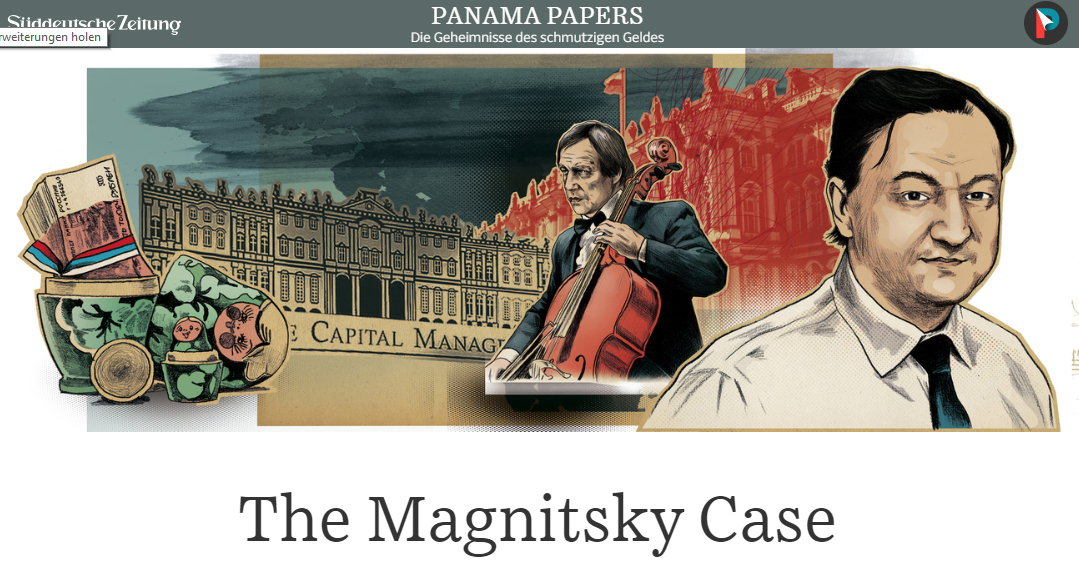
Browder is wanted by Russia for tax evasion. He claims that the Russian criminal charges are politically motivated. Yet, the tax evasion (as well as a number of related crimes) Browder is being accused of happened in 2001, the criminal probe into it starting in 2004. It is well known, and easily evidenced, that Browder was an outspoken supporter of Putin and his government until at least 2005.
Putin understood that the country would never succeed with seven oligarchs at the helm — particularly since their interests were so counter to those of the nation. He has set clear limits to the oligarchs’ power and their meddling in the affairs of state. While there may be some things about Putin that we disagree with, we should give him the benefit of the doubt in this area and fully support him in his task of taking back control of the country from the oligarchs.
To divert attention from the the proven 2001-2004 tax evasion case, as well as the suspicion that he may have been involved in the 230 million dollar tax rebate, Browder invented a figure of the crusading anti-corruption lawyer, whistleblower, Sergei Magnitsky. Magnitsky existed of course, but he was Browder’s accountant, not a lawyer, and he never blew whistle on anything.
Tragically, Magnitsky died while in pre-trial detention. Browder claims he was beaten to death by eight “riot guards”. Browder presents no evidence for that, apart from selective quotations from Russian documents. Studied in full those documents, as well as an American report commissioned by Browder himself, make no mention of a murder, let alone a murder by beating. The author of the Parliamentary Assembly of the Council of Europe report on Magnitsky, Andreas Gross told me on camera that Magnitsky had not been murdered but died of the “lack of care”.
The investigative journalists at Sueddeutsche Zeitung claim to have traced money flows from the Magnitsky affair, but appear unwilling to recognise that they had uncritically embraced the affair’s interpretation by someone with a vested interest in it.
It is also highly ironic that the journalists, writing about Browder’s Russian business, chose to ignore that Browder himself used off-shore schemes extensively, with the help of his Russian staff that included Magnitsky. Companies controlled by Browder have also appeared in Panama papers, e.g Berkeley Advisors and Starcliff.
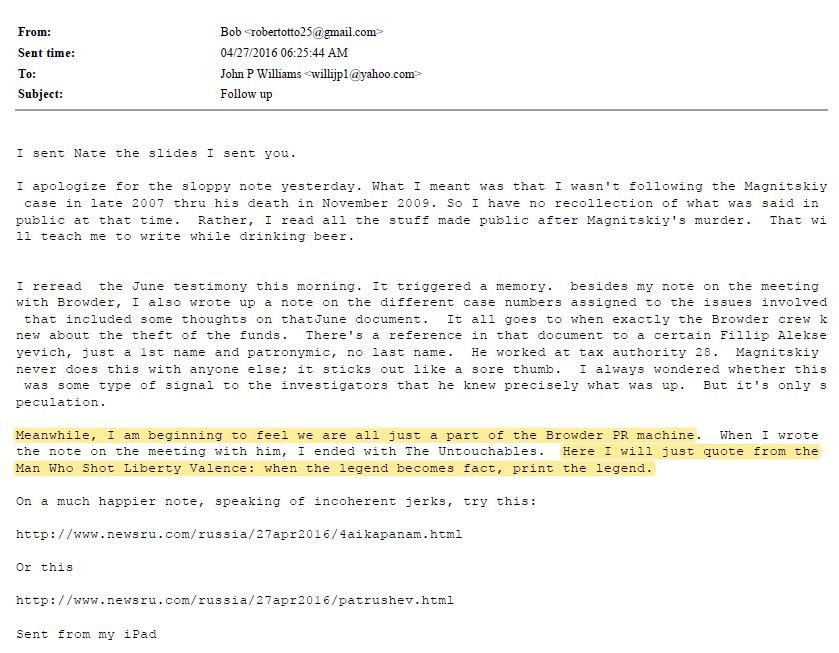
In the spring of 2016 my film was secretly, and possibly illegally, seen by U.S. government officials before its premiere at the European parliament was stopped on the 27th of April, and the ARTE transmission cancelled on the 3rd of May. One of those officials was Robert Otto, a top intelligence officer at the State Department who wrote in one of many e-mails that were later leaked online. “I am beginning to feel we are all just part of the Browder P.R. machine.” – Mr Otto wrote.
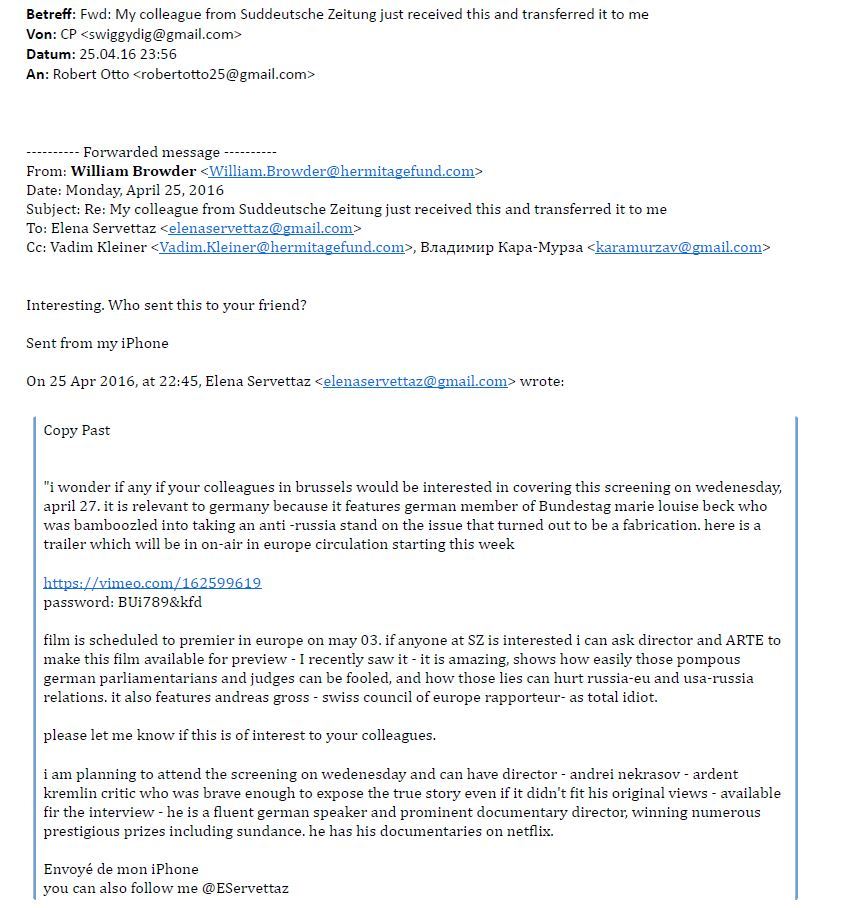
I was not contacted by the SZ, either before the cancelled European Parliament screening or thereafter.
On 13 June 2018 Telepolis organised a screening of my film in Munich, with a following discussion. Frederik Obermaier and Tim Neshitov, who had written about the Magntisky case for the SZ were invited. No-one turned up, nor replied to the invitation.
The “money tracing” SZ/Panama Papers used trying to connect the Magnitsky fraud to Sergei Roldugin, was in its main part presented in the U.S. case against Prevezon Holdings Ltd (2013-2017). After almost five years of trying to prove that Prevezon received and laundered money from the Magnitsky fraud, the American government decided to avoid the litigation and to settle the case with no guilt admitted by Prevezon.
Prevezon lawyers questioned Browder as a witness under oath. It was Browder (as he himself admitted) who had personally handed Preet Bharara, then the U.S. attorney for the Southern District of New York, the version of the Magnitsky story that I disprove in my film. William Felix Browder was the source of the whole sprawling, costly case. And it’s his Magnitsky story that was essentially disproved in a court of law.
Yet the mainstream media, including the Sueddeutsche Zeitung, had no interest in taking another look at their articles which had faithfully re-transmitted Browder’s false story. And a stony, arrogant silence was all I got trying politely and tactfully to point out serious mistakes.
Panama papers became a brand name for the press standing up to corruption and wrongful secrecy of those in the position of power, whether financial or political. It would be paradoxical and particularly regrettable if a journalist, a colleague, would use a power he has acquired through a reputation for openness and association with mainstream German and international investigative networks, to obfuscate legitimate questions and documented objections.
A.: Well, we reviewed his documentation, we reviewed some of his statements and verified some of his statements via the internet.
Q.: What did he tell you?
A.: Well, he told us the story of Sergei Magnitsky.
Q.: What public source documents did he refer you to?
A.: He referred me on his website, he referred me to a Russian language newspaper.
Q.: What else?
A.: And the documents that he provided.
Q.: What documents did he provide?
A.: Copies of the bank records, copies of wire transactions
Q.: Did you get in touch with the banks to see if they were accurate?
A.: No, I did not.
Q.: And you obtained flow charts; is that correct?
A.: That’s correct.
Q.: And those were also from Hermitage that you obtained them?
A.: Correct.
Q.: So every transfer here is based on copies that are not authenticated, of records that are incomplete, based on an accounting assumption. Is that right?
A.: That would be correct.
 Centinel2012