The Washington Postrevealed that the person leaking information from the Pentagon is not a high-level official. There was no collective effort to access the classified information, and the motive of the leak may surprise you. The leak was first posted on a Discord channel called Thug Shaker Central, led by a man in his 20s who allegedly lives on a military base. A user called Wow_mao spoke with the Post through Discord to say he used his platform for humor and began creating videos as a teen. “I can sort of understand how sharing big private military secrets could be a funny thing to do among your internet friends, but come on. Take care of yourself and stay away from doing stuff like this,” the anonymous user posted on YouTube.
A group of teens and young adults were able to access sensitive information—for fun. They did not need skilled hackers or top intel to access military records, showing how inept our national security has become. Discord is a social media platform that is largely unregulated. It is one of the last platforms where users can speak freely without censorship.
The Post discussed how a few users on social media were able to make the files a global sensation and cause international turmoil. Snowden reached out to countless reporters to reveal his message. WikiLeaks also put forth a campaign to draw attention to thousands of classified documents relating to America’s involvement in Iraq. This time around it only took a few kids on a social platform that is not regulated by the government. I expect Congress to now go after Discord as they did with TikTok. “It’s just a bunch of guys from the internet. How would they know about understanding military war documents?” Wow_mao said. “Many people were like: ‘That’s hilarious. Why are they here?’ And then they moved on with their lives.”
Posted originally on the conservative tree house on October 23, 2022 | Sundance |
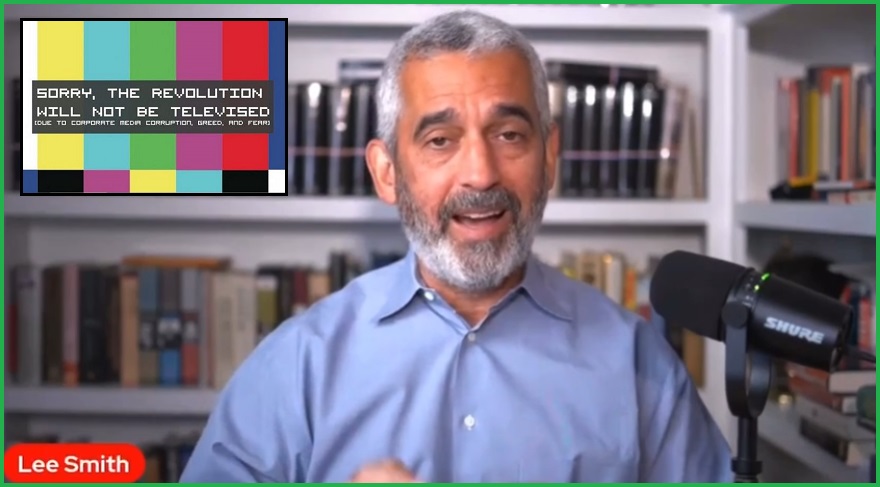
Lee Smith makes an important point in this brief podcast excerpt. {Direct Rumble Link Here} We have outlined his point on these pages for several years.
Essentially, the point Lee Smith drives home is how the U.S. Corporate Media, and the Big Tech monopolies, are the front force of the new national security and intelligence state. It is a relationship that extends far beyond the customary leanings of media, and now covers a full synergistic relationship. WATCH:
“We’re all familiar with the fact that the press has historically leaned to the left. That’s not what we’re looking at now. We’re looking at something very, very different. We’re looking at the press as being a part of the intelligence community. They are the ones who is putting these operations out there.”
.
The New York Times and Politico are the public relations firms for Main Justice, the DOJ and FBI. The Washington Post handles the needs of the Intelligence Community (IC) and the Central Intelligence Agency. Meanwhile CNN is managed by the needs of the U.S. State Dept. These direct relationships have been discussed here for several years.
Posted originally on the conservative tree house on September 9, 2022 | Sundance
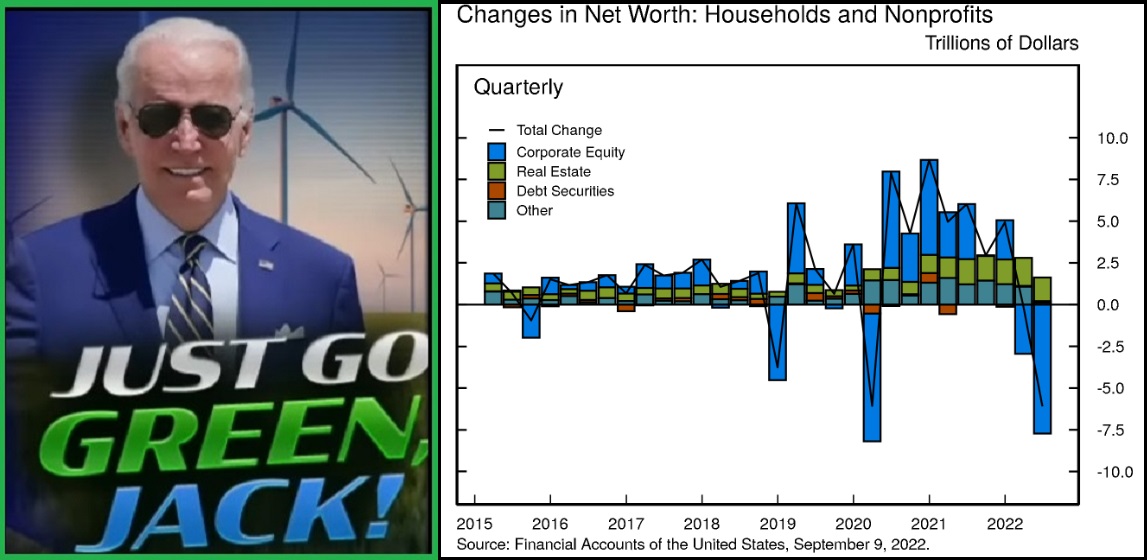
The U.S. Federal Reserve has published the second quarter 2022 balance sheet of U.S. total household wealth [DATA HERE].
In the second quarter (April, May, June) 2022, the total U.S. household wealth dropped $6.1 trillion, despite a calculated increase in home value of $1.5 trillion. The majority of the loss is connected to a drop in Corporate Equity (stock market) and household investment in the stock market.
FED “The net worth of households and nonprofit organizations declined $6.1 trillion to $143.8 trillion in the second quarter. The value of stocks on the household balance sheet declined by $7.7 trillion, while the value of real estate increased by $1.5 trillion.” Keep in mind this is backward looking data, and after a period of decelerating rates of growth, the overall real estate market is now in a period of decline as calculated for the most recent month of July [DATA].
The equity position of homeowners is now considerably less than the equity position when the feds calculated the second quarter household wealth (two months ago). Part of the issue goes back to what we have been discussing with inflation and specifically energy driven increases in fuel and electricity.
Inflation sucks money out of the economy, making people less wealthy. Energy inflation sucks money exponentially faster out of each household, potentially making the already working-class poor, much poorer.
The higher prices paid for housing, food, fuel and energy do not contribute to anything, the increased costs are just sucked out of the consumers’ pockets without generating any additional value. It just costs more to live, and that reduces wealth. Consider this the cost of going green.
Joe Biden and his economic team are introducing phrases like “a growth recession,” to explain a dynamic where earned wages are replaced by government subsidy. You can no longer afford food, energy, housing etc, so the government steps in as the provider of subsidy based on income level to supplement the gap between wages and the new costs of products and services within the Biden created “green” economy.
However, in the bigger of big pictures, the government does not create wealth. Wealth is created outside government by private activity. Government income via taxation is lowered when the economic activity of the private sector drops.
There is currently a massive lag in recording dropped economic activity that is going to surface very soon. The rate of energy price increase has been so large, so fast, the ability of producers to transfer the cost creates an economic lag.
Total product costs (except imports) are rising faster than finished good prices to consumers. At the same time, consumer demand for goods has dropped dramatically due to the speed and rate of increased energy costs. As a combined result, the equity market will likely continue to decline as each earnings report comes in lower than prior expectation.
Now, looking at wealth over time, what happens to the economic model of Biden when current housing value ($41.2 trillion) simply drops back to 2020 levels ($33.0 trillion a conservative real estate market correction)?
Continued higher prices to consumers, less money to government, less economic activity and lower household equity. That’s trouble, big trouble.
Wave #3 of food inflation starts hitting hard next month as the increased costs at the field start to transfer through the supply chain from harvest to the fork.
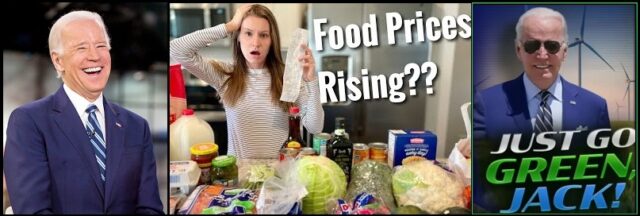
WASHINGTON DC – […] The sour mood appears to stem from record food, energy and housing prices. Positive views of the grocery industry dropped 14 percentage points from last year, the biggest drop in the survey. The real estate industry dipped 9 points, the second-largest decline.
Just 22 percent of respondents reported having a positive view of the oil and gas industry, down from 28 percent last year. Twenty-nine percent reported having a positive view of electric and gas utilities, down from 36 percent last year.
Grocery prices rose a stunning 13.1 percent over the last 12 months ending in July, the largest annual increase in more than four decades, according to Labor Department data.
Housing affordability has fallen to its lowest level since the Great Recession, according to the National Association of Home Builders, with rents and home prices at record levels.
Gas prices reached an all-time high in June before falling slightly in recent months, while energy bills are also soaring amid huge demand for natural gas. (read more)
Meanwhile Biden’s economic team is bragging that Main Street is in better shape?
“The President’s first two years in office have been two of the most productive in American history, and as the Blueprint explains, these accomplishments are all part of one economic vision.” (more)
Posted originally on the conservative tree house on August 23, 2022 | sundance
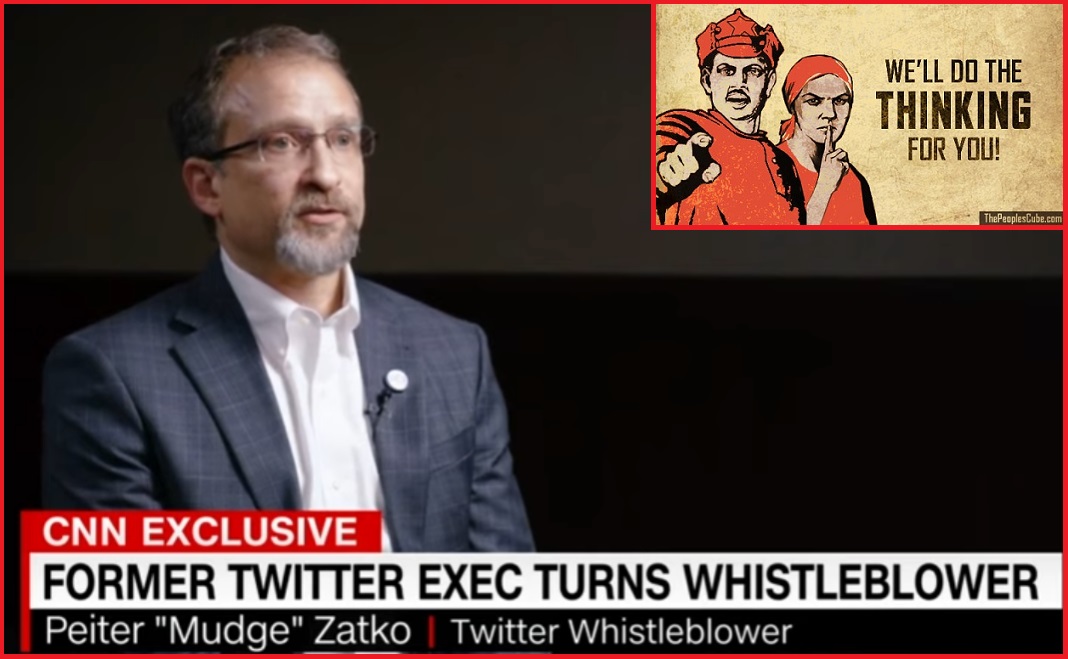
The background story behind Jack’s Magic Coffee Shop takes an interesting twist today, as a whistleblower deep inside the Twitter technology side of the platform begins to outline what CNN calls, “a threat to its own users’ personal information, to company shareholders, to national security, and to democracy.”
This discussion is where it becomes critical to remember the nature of stakeholders in media.
CNN is the national media firm protecting the interests of the U.S. State Dept. The Washington Post is the national media firm protecting the interests of the U.S. intelligence apparatus. The latest Twitter whistleblower information originates in,.. wait for it… “an explosive whistleblower disclosure obtained exclusively by CNN and The Washington Post.”
The whistleblower is a former technology expert who came from within the research farm of DARPA, the Defense Advanced Research Projects Agency. Peiter “Mudge” Zatko, is a well-known cybersecurity expert who left government work, entered the public world, and eventually became the head of Twitter security, reporting directly to the CEO.
Peiter “Mudge” Zatko is now saying the background technology of Twitter is vulnerable to manipulation. I’m not going to go into the granules of what Mudge is outlining, instead I prefer to focus on the bigger picture, a scenario we have been outlining for quite a while that could, emphasize *could*, become very explosive, especially considering the legal challenges between the social media platform and Elon Musk.
The nub of the bigger story is essentially that the database of Twitter, and likely other social media platforms, is integrated with the U.S. intelligence system. The database of Twitter is not necessarily vulnerable to hacking by outside entities, although that is the framework used by media reporting this whistleblower issue.
The bigger risk to the surveillance state is discovery that Twitter and the U.S. intelligence community are in a public-private partnership. The Dept of Homeland Security has access by design, not flaw. How the stakeholder media are reporting on the issue shows the nature of the risk, (emphasis mine):
[…] The scathing disclosure, which totals around 200 pages, including supporting exhibits — was sent last month to a number of US government agencies and congressional committees, including the Securities and Exchange Commission, the Federal Trade Commission and the Department of Justice. The existence and details of the disclosure have not previously been reported. CNN obtained a copy of the disclosure from a senior Democratic aide on Capitol Hill. The SEC, DOJ and FTC declined to comment; the Senate Intelligence Committee, which received a copy of the report, is taking the disclosure seriously and is setting a meeting to discuss the allegations, according to Rachel Cohen, a committee spokesperson. (link)
How would it damage the U.S. government if previous claims about the Chinese government having access to all user data on TikTok, are shown to be exactly identical to the U.S. government having access to all user data on Twitter?
Let that question settle in for a few moments, because that is exactly what I have been alleging since, well, 2011, when the U.S. State Dept first collaborated with Twitter in a joint public-private partnership to use the platform as a communication tool exploiting the Arab Spring uprising in Egypt, Libya and beyond.
The issue of Jack’s Magic Coffee Shop is an issue of financial viability. The business model of Twitter just doesn’t exist as a free social media discussion platform while running the ultra-expensive data processing system needed for millions of simultaneous users. A global chat that requires exponential database responses as an outcome of simultaneous users is just ridiculously expensive. {Go Deep} However, if the computing system and massive database were being subsidized by the U.S. government, then the viability of the ‘free coffee‘ business model makes sense.
“Cloud computing is one of the core components of the strategy to help the IC discover, access and share critical information in an era of seemingly infinite data.” … “A test scenario described by GAO in its June 2013 bid protest opinion suggests the CIA sought to compare how the solutions presented by IBM and Amazon Web Services (AWS) could crunch massive data sets, commonly referred to as big data.” … “Solutions had to provide a “hosting environment for applications which process vast amounts of information in parallel on large clusters (thousands of nodes) of commodity hardware” using a platform called MapReduce. Through MapReduce, clusters were provisioned for computation and segmentation. Test runs assumed clusters were large enough to process 100 terabytes of raw input data. AWS’ solution received superior marks from CIA procurement officials”… (MORE)
♦ Legal Stuff – The issue of American citizen privacy and U.S. constitutional limits against the government listening in on communication is functionally obsolescent. The Foreign Intelligence Surveillance Act (FISA) prohibits communication intercepts on U.S. citizens without a valid search warrant. However, if a U.S. citizen is engaged in a conversation with a foreign person, all privacy restrictions are essentially gone. [Insert example of Michael Flynn taking to Russian Ambassador Sergey Kislyak here]
Your phone calls can be intercepted by the government from the foreign side of the call. The govt can freely monitor the calls that involve foreign actors. The only rule is that your privacy must be maintained. If the foreign actor is in communication with a U.S. citizen, the U.S. citizen must be “minimized” or not identified in any intercept.
However, what happens when the phone call is on a community line that is connected, and visible, to the entire world? That’s the benefit of social media monitoring from a surveillance perspective. It is from that opaque and unresolved archaic legal perspective that surveillance authority of social media platforms, by the U.S. intelligence community, exists. Now you see why the SSCI is taking an interest in the Twitter whistleblower, classic risk mitigation.
Hopefully, you can also see why the 200-page whistleblower document was leaked, by a Democrat staffer, to the Washington Post and CNN.
CNN defends the equity interests of the U.S. State Dept., and WaPo defend the Intelligence Community (CIA, DHS, etc).
Within the narrative as constructed you will note, “Zatko further alleges that Twitter’s leadership has misled its own board and government regulators about its security vulnerabilities, including some that could allegedly open the door to foreign spying or manipulation, hacking and disinformation campaigns.”
If the relationship between Twitter and the U.S. intelligence community is a public-private partnership, why would Twitter want to shut down the portals given to the Dept of Homeland Security?
Answer, they wouldn’t… Ergo the response from Twitter to the whistleblower complaint is (emphasis mine), “What we’ve seen so far is a false narrative about Twitter and our privacy and data security practices that is riddled with inconsistencies and inaccuracies and lacks important context.”
Put another way, the “lacks important context” is the nature of the security risk, which is structural to the relationship between the intelligence community and the platform. See how that works?
The integration between Twitter and the United States Intelligence Community has been hiding in plain sight:
July 26, 2021,(Reuters) – A counterterrorism organization formed by some of the biggest U.S. tech companies including Facebook (FB.O) and Microsoft (MSFT.O) is significantly expanding the types of extremist content shared between firms in a key database, aiming to crack down on material from white supremacists and far-right militias, the group told Reuters.
Until now, the Global Internet Forum to Counter Terrorism’s (GIFCT) database has focused on videos and images from terrorist groups on a United Nations list and so has largely consisted of content from Islamist extremist organizations such as Islamic State, al Qaeda and the Taliban.
Over the next few months, the group will add attacker manifestos – often shared by sympathizers after white supremacist violence – and other publications and links flagged by U.N. initiative Tech Against Terrorism. It will use lists from intelligence-sharing group Five Eyes, adding URLs and PDFs from more groups, including the Proud Boys, the Three Percenters and neo-Nazis.
The firms, which include Twitter (TWTR.N) and Alphabet Inc’s (GOOGL.O) YouTube, share “hashes,” unique numerical representations of original pieces of content that have been removed from their services. Other platforms use these to identify the same content on their own sites in order to review or remove it. (more)
A shared hashing protocol is a form of data system integration. The databases of the identified social media platforms are integrated with the U.S. intelligence system.
So, what is the angle here? Peiter/CNN’s objective is to support Musk‘s part of the legal argument. That support helps Elon Musk exit from Twitter deal. That exit allows Twitter/IC to return to surveillance operations and intel gathering with exposure risk removed. That’s Peiter’s objective.
I shall leave on a happy note, which highlights the nature of the risk:
After this article was initially published, Alex Spiro, an attorney for Musk, told CNN, “We have already issued a subpoena for Mr. Zatko, and we found his exit and that of other key employees curious in light of what we have been finding.” (LINK)
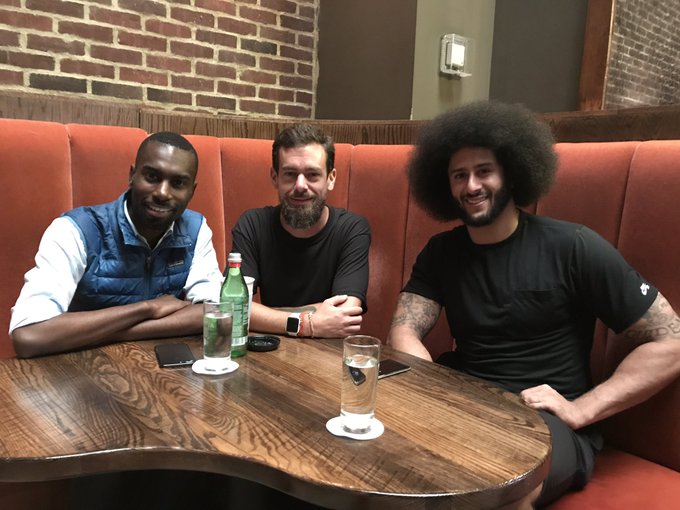
Hello, fellas…
.
Now, for the pantomime, and to showcase the need for extreme control by the narrative engineers. Notice how the directors of the CNN segment use alternative actors to shape the context of what Mr. Peiter “Mudge” Zatko is saying. This is classic intelligence community media tradecraft.
Notice what is expressly attributed to Mudge in his own words, versus what is implied toward Mudge from alternative voices and faces that appear. Once you see the strings on the marionettes, you can never return to that moment in the performance when you did not see them. WATCH:
I have created this site to help people have fun in the kitchen. I write about enjoying life both in and out of my kitchen. Life is short! Make the most of it and enjoy!
This is a library of News Events not reported by the Main Stream Media documenting & connecting the dots on How the Obama Marxist Liberal agenda is destroying America





 Centinel2012