After Promoting Avenatti Accusers NBC Tries Walking Quietly Toward the Exits…


Senate Judiciary Chairman Chuck Grassley sent a criminal referral to the DOJ today surrounding Creepy Porn Lawyer Michael Avenatti and claims from the accusers he brought forth.   Hours later,…. all of a sudden NBC, the primary advocacy media for Avenatti and his accusers, starts publicly questioning the details of their interactions?

In a late-evening publication of NBC News Investigations, journalists Kate Snow and Anna Schecter outline the contradictions between Creepy Porn Lawyer and two female accusers Avenatti put them in contact with.

In a transparent effort to retain credibility, the face of NBC, Chuck Todd, now claims Avenatti “mislead” the NBC reporters. It needs to be emphasized here that none of these contradictions were discussed by NBC during the controversy around the Kavanaugh confirmation.  They kept quiet about it when it mattered.

NBC […] In the second statement, the unidentified woman said she witnessed Kavanaugh “spike” the punch at high school parties in order to sexually take advantage of girls. But less than 48 hours before Avenatti released her sworn statement on Twitter, the same woman told NBC News a different story.

When asked in the phone interview if she ever witnessed Kavanaugh act inappropriately towards girls, the woman replied, “no.” She did describe a culture of heavy drinking in high school that she took part in, and said Kavanaugh and his friend Mark Judge were part of that group.

[…]  According to the second woman’s declaration that Avenatti provided to the Senate Judiciary Committee, she said: “During the years 1981-82, I witnessed firsthand Brett Kavanaugh, together with others, ‘spike’ the ‘punch’ at house parties I attended with Quaaludes and/or grain alcohol. I understood this was being done for the purpose of making girls more likely to engage in sexual acts and less likely to say ‘No.’”

[…]  But reached by phone independently from Avenatti on Oct. 3, the woman said she only “skimmed” the declaration. After reviewing the statement, she wrote in a text on Oct. 4 to NBC News: “It is incorrect that I saw Brett spike the punch. I didn’t see anyone spike the punch…I was very clear with Michael Avenatti from day one.”  (read more)

2018 Midterm Election – Ground Reports and Open Discussion…


In the past several election cycles CTH has posted these type of open discussion threads to see and share the perspectives of ground reports from your state, city and neighborhood.  ‘Ground Reports’ are a valuable resource to gauge the non-quantifiable elements around elections; they are often quite insightful.

Many states are currently in the process of early voting.  If you have a ground report you would like to share, please use the comment section below to provide your perspective.

Additionally, there are often obscure events that can help identify voting trends and possibilities; so don’t limit your review to traditional perspectives. Sentiments and senses are also very useful.  What do you sense? What is going on in/around your town and location?  Good or bad; positive or negative; what do you see happening?

An example that might help in looking “outside the box” per se’, was in the Alabama special election between Doug Jones and Roy Moore. We suspected in October 2017 that Roy Moore would lose the special election in December.

What led to that unfortunately accurate conclusion was not just a review of the candidate; and predictable democrat opposition attacks that came in November; but also a review of obscure events on the horizon. One of those events was the opening of the Jackson, Mississippi, Civil Rights museum next door to Alabama on the exact eve of the special election vote.

Two months before the December 2017 election, CTH could see a structured event pattern developing where tens of thousands of people antithetical to Roy Moore would be assembled only a few miles away from Alabama voting booths on the eve of the vote.  The Jackson grand opening was December 9th and 10th. The Alabama election was December 12th. CTH anticipated the convenient Alabama scheduling was not coincidental; it appeared to be done by political design.  So don’t limit your view to current events… look forward; sometimes it helps.

Reports: Megyn Kelly Fired by NBC…


Apparently NBC has found their excuse to rid themselves of the $69 million dollar mistake known as Megyn Kelly following her comments about “blackface” to an aghast audience. Reports are now confirming the caucasian version of  Omarosa has been dispatched from the network.

Rupert’s Princess became famous for working with Chris Wallace, Bret Baier and Fox Political Vice President Bill Sammon during the August 6th, 2015, Presidential Primary on a scripted plan to attack front-runner candidate Donald Trump… [CTH saw it coming on July 30th, and fired up the warning flare – We were correct] Her career as the Caucasian Omarosa was all downhill from there.

New York – Megyn Kelly’s 9 a.m. Today show hour has been canceled, multiple sources confirm to PEOPLE.

The news comes just 48 hours after she received immense backlash for her controversial remarks about blackface earlier this week.

“They’re contacting the staff and reassigning everyone today. Everyone’s being told that they still have a home here, but it won’t be on Megyn’s show,” one source says. “They haven’t made an official announcement about the show, but everyone knows what it means when they’re being moved somewhere else. The show is clearly over.”

Two additional sources insist that Kelly has not been fired from NBC completely (and she herself has not been told the network’s final decision), but her 9 a.m. show “is most likely over.”

Kelly did not appear live on air Thursday morning after NBC announced the rest of this week’s broadcasts have been replaced with pre-taped episodes.  (read more)

(Never Forget)

Chris Wallace, Bret Baier, Bill Sammon (circled) and Megyn Kelly prepping the August 2015, debate strategy.

Mexican Trucking Company, With U.S. License, Identified Moving Central American Caravan…


An interesting video was captured a few days ago showing a Mexican trucking company named EXPRESS SAN JAVIER, assisting in moving Central American invasion force to the U.S. border.

What is additionally interesting is the Mexican company holds a Department of Transportation (DOT) license for operations inside the U.S. DOT License #1202728

(click image to enlarge – SAFER database link here)

It is not an American trucking company, it is part of a fleet of ten vehicles owned by the company in Mexico.  However, there’s a good question about whether the U.S. Department of Transportation could revoke the U.S. DOT License of the company that is aiding the caravan to violate U.S. immigration law.

THE SILK ROAD EXHIBIT


NOTES ON THE SILK ROAD EXHIBIT

By Tabitha Korol August 2014

“Traveling the Silk Road,” at the Cleveland Museum of Natural History, appears to be a small section of a larger, global exhibition, “1001 Inventions,” which, accompanied by an award-winning film, professes to be a revelation of a thousand years of scientific and cultural achievements by the Muslim world, with a nod to some contributing faiths and cultures. However, these faiths and cultures were victims of Muslim jihadists who, following in Mohammed’s footsteps, invaded the “infidel” world for more than 1400 years, enslaving, slaughtering, and plundering. Their greatest achievement was their ability to expropriate every creative, innovative, groundbreaking device of Islam’s victims and, defying all logic, fraudulently claim each as their own.

The Silk Road exhibit is a betrayal of its name and deception to the tourists, individuals, schoolteachers and students. Some of the visitors are of those cultures whose contributions were formidable, but were given scant recognition or complete disregard, thereby denying them the knowledge and sense of pride to be had upon learning that their heritage contributed to the growth of civilization along the early trade routes. This Islamic presentation allowed about 20 percent to China.

Islam’s growth in both religious adherents and these “achievements” emanated from their invasions into foreign lands, enforcing their will under penalty of death, and booty acquired from the invaded and enslaved cultures (the worst, the black African trade, was excluded). Slavery, including sexual slavery, is justified in the Qur’an and practiced in many countries, to this day.

Islam is socialism, and socialism is antithetical to creativity. Islam is based on envious hatred of what is noble, the aspirations and outstanding creative individuality in all fields of human endeavor. Muslims are enraged that a small Israel could smash the rocket launchers and their terror tunnels of Gaza, for example. They resent and hate human excellence, yet they take ownership of the ingenuity of others out of envy and deceit to entice.

The museum exhibit is just such an example of Muslims’ adopting achievements of others for their own acclaim, because they have produced nothing of value in 1400 years of existence. The majority of the Islamic world is illiterate, violent combatants who commit atrocities beyond the Western imagination – although we are beginning to learn of what these people are truly capable.

DEFINING THE SILK ROAD

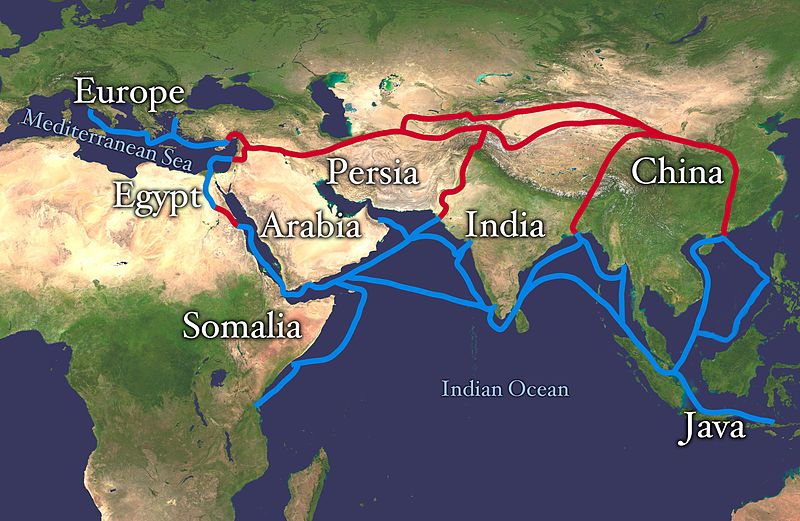
The Routes Network ofChang’on-Cianshan Corridor, Eurasia

Silk 01

A vertical screen hangs at the entrance:

Silk 01a

WHAT WASN’T SAID:

1. That this was an Islamic exhibit.

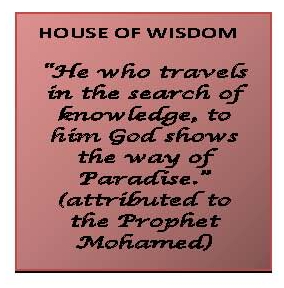
2. that Islam provides a martyr’s way to Paradise, which includes destruction, slavery, suicide and genocide, and looting.

3. That Islamic countries lead the world in illiteracy.

FACTS:

1. The most prominent reward promised Islamic Martyrs are the 72 Dark-Eyed Virgins in Paradise. A Palestinian religious leader explained, “…the purpose of authentic Islam is to fill Muslims with desire for Paradise” – the anticipation and love of death. He [Muhammad] said (in a Hadith, Islamic tradition): “[There is] a palace of pearls in Paradise and in it seventy courts of ruby… And in each court [there are] seventy houses of green emerald stone. In every house, seventy beds. On every bed, seventy mattresses of every color and on every mattress a woman.” (Hadith)

2. Sahih al-Bukhari HadithHadith 1.35 Narrated by Abu Huraira The Prophet said, “The person who participates in (Holy battles) in Allah’s cause and nothing compels him to do so except belief in Allah and His Apostles, will be recompensed by Allah either with a reward, or booty (if he survives) or will be admitted to Paradise (if he is killed in the battle as a martyr).” http://www.inthenameofallah.org/Shaheed%20OR%20Martyr.html

EXHIBIT SIGN:

Silk 02

HISTORIC BACKGROUND:

Ancient Chinese guarded the silk production secret for centuries. Ottoman Turks and Persians fought over it; English and French competed to restrict its markets, but every culture was touched by silk. It was found aboard medieval Viking ships sailing out of Constantinople, as kerchiefs from India and as silk bandanas brought by pirates and worn by American cowboys. Damask silk of Damascus, Syria, was actually from China. Martha Washington wore a dress of Virginia silk to George’s inauguration, and Native Americans learned silk embroidery to decorate traditional apparel.

WHAT WASN’T SAID:

1. That the Persian and Babylonian Jews pioneered the intercontinental trade and the Silk Road.

2. It is likely that “Arab traders” is an all-encompassing term to include all the people, religions and cultures that existed in the Middle East, that the Muslims captured and made their own. In fact, the Arab ethnic groups included Lebanese, Syrians, Emiratis, Qataris, Saudis, Bahrainis, Kuwaitis, Iraqis, Omanis, Jordanians, Yemenis, Sudanese, and Egyptians. These were not all Arab, in fact; neither were they of the same original religion; the exhibit is misleading.

FACTS:

1. Intercontinental trade was pioneered by Persian Jews who forged the “Silk Route” to the heart of China in the fifth century BCE. Augustus, first Roman emperor, is said to have commissioned “the first travel guide” from Isidore of Charax (a Greco-Roman geographer of the 1st century BC and 1st century AD). Centuries later, while the Europeans were still deep in the Dark Ages, Persian Radhanite scholar/travelers (medieval Jewish merchants who traded between the Christian and Islamic worlds, 500-1000 AD) pioneered land and sea trade routes to the Far East. “These merchants speak Arabic, Persian, Roman, Frankish, Spanish, and Slavonic,” wrote Ibn Khurdadhih in the ninth century CE, “They travel from East to West and from West to East by land as well as by sea.” They also spoke Hebrew and Aramaic.

2. The Silk Route was pioneered by Babylonian Jews in the fifth century BCE. The Kaifeng, China synagogue complex was erected in 1163 to serve a community of three thousand worshipers, and to accommodate Jewish trader-travelers who came across Asia with their caravans.


Silk Road #2, Spices


Cinnamon, Cassia (the bark from which cinnamon is made), jade, camphor, and many other Chinese products were greatly in demand in the West. The earliest reference in any literature to the oriental products, cinnamon and cassia, occurs in Exodus 30:23: Moses is instructed to take “principal spices, of pure myrrh five hundred shekels, and of sweet cinnamon (kinamon besem) half so much.” In 30:24 he is likewise instructed to take “of cassia (kiddah) five hundred shekels.”]

1. Herodotus (485-425 BCE) stated that Kinnamomon (Greek) came from Canaan (3.111); the word in Exodus for cassia, kiddah, appears in Greek as Kitto. Another Biblical word, kes’iah (Psalms 45.9), became the Greek 2 The transcription of Aramaic words into the Greek language identifies the merchants who first brought these spices in the 5th c. BCE from the Orient to the Mediterranean.

2. Linen fabrics (Byssus) were as marketable in China as silk fabrics were in the west. One of the earliest centers of industrial weaving of fine linen fabrics was the city of Beth She’an. The Bible informs us that Beth She’an (“Scythopolis” by the Greeks), was a Canaanite town that fell to the forces of David. By the 3rd c. BCE, the Jews of Beth She’an achieved world fame as producers of fine fabrics. The Jerusalem Talmud refers to “the fine linen vestments which come from Beth She’an.”

3. Beth She’an is described as a city that supplies textiles to the world in the Latin Descriptus Orbis, 4th The superiority of the textiles and clothes made by Jews in Beth She’an was affirmed by Roman Emperor Diocletian, in 296 CE. The edict listed Judaic glassware (by Jews of Judah) and vitri Alessandrini (by Jews of Alexandria). Hadrian also asserted that Jews were the glassmakers of Alexandria.

4. Rabbi Chiyya bar Abba, a famous sage is named in the Bible, was involved with trading goods of glassware, flax, and linen along the Silk Route into China.

5. The tradition of travel and trade expanded into a world-girdling network of Jewish trade under the Rhadanites. Ibn Khurdadhibih, an Arab chronicler of the ninth century, wrote that “these merchants speak Arabic, Persian, Roman, Frankish, Spanish and Slavonic. They travel from East to West, and from West to East by land as well as by sea.” They also spoke Hebrew and Aramaic. The routes radiated out from the Jewish centers of population in the agricultural and industrial heart of Babylonia to Europe, North Africa, India, and China.

Silk Road #3, Merchants


EXHIBIT SIGN:

Silk 03

WHAT WASN’T SAID:

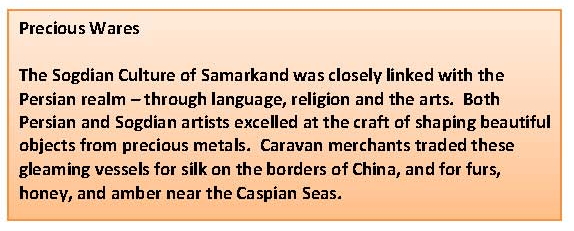
1. That Sogdians were mainly Zoroastrian (a religion that exists today), yet linked to suggest they are Muslim craftsmen.

2. That Jews who worked at creating merchandise in Samarkand and produced much of the “beautiful objects” described in the exhibit sign, remain unidentified; the Aramaic alphabet may be a means of identification.

FACTS:

1. Sogdians were an ancient civilization of an Iranian people whose religion was Zoroastrianism. Although many converted to Islam, they may number up to 2.6 million today. Not politically aligned, Sogdiana’s various territories centered around Samarkand. They wrote in a variety of scripts derived from the Aramaic alphabet.

2. Most merchants tended to trade goods in a central oasis, and Sogdians established a trading network across the 1500 miles from Sogdiana to China, until they became the all-encompassing name for all merchants to trade with China’s Han Dynasty, into the 10th Their language became a lingua franca of trade; they taught their children to read at age 5. Sogdians worked as farmers, carpetweavers, glassmakers, and woodcarvers.

EXHIBIT SIGN:

Silk 04

WHAT WASN’T SAID:

1. That the Sogdian designation for merchants of Samarkand remains The exhibits’ focus is promoting Islam.

2. That skill may have been needed to handle animals and people, named in a questionable order, unless the people are women and children who had been abducted into slavery.

FACTS:

1. The Silk Road exhibit is a tribute to the Islamic culture, with all negative characteristics whitewashed, removed, and replaced with positive traits usurped from the cultures conquered. Islam was and continues to be a culture of acquisition, subjugation, and genocide, responsible for the killing of 270 million people over 1400 years, to this day.

2. The countries involved in the Silk Route include China, Persian Empire, Greece (particularly maritime trade routes), and mainland Europeans. By religion, they were Jews, Zoroastrians, Buddhists, Romans, Grecians, Hindus, Pharoahans, Christian sects and Muslims.

3. Dating back about three millennia, the Jewish community in Iran is the oldest in Asia. Freed from slavery by Persia’s Emperor Cyrus in 539 BCE, they became an integral part of the Persian Empire. They travelled widely in Persian-dominated Afghanistan, the Caucasus and Caspian through Central Asia, and traded with displaced Turgik tribes, and Khazars (glassworks factories, c. 7th and 8th centuries). Persian Jews were merchants in Uzbekistan, Central Asian Silk Road in Bukhara and Samarkand, where major trading posts were established.

EXHIBIT SIGN:

Silk 05

WHAT WASN’T SAID:

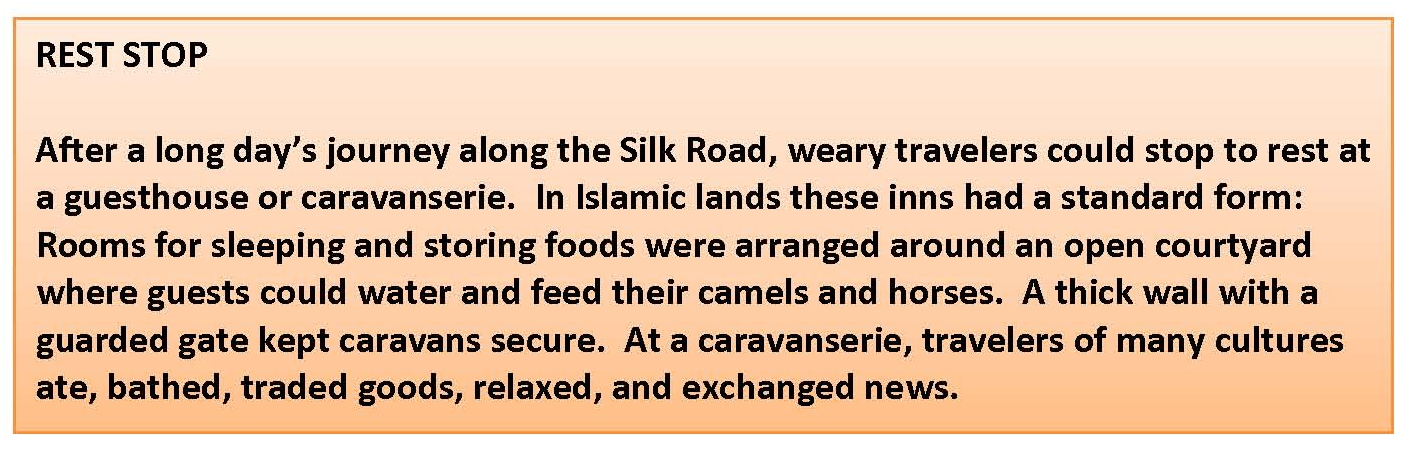
1. Some inns provided sex workers to the Silk Road merchants; one Sogdian-language contract shows at least one Chinese bought a Sogdian girl in 639 AD. Earlier 7th century documents point to massive volume in the sex-slave trade, with some recorded marriages. One record shows a Sogdian merchant sold an 11-year-old girl for 40 bolts of silk.

2. That there was a flourishing slave trade. As a youth, Mohammed accompanied his uncle on the caravan expeditions, dealing in human slavery and trading the items looted from the conquered peoples.

3.The many cultures of travelers and slavers remain unidentified, although their grotesqueries are known and continue unabated.


Silk Road #4, Glass and Pottery


EXHIBIT SIGN:

Silk 06

WHAT WASN’T SAID:

1. That glass making originated with the Jewish people, a secret maintained for the next 3,000 years.

2. That it had been considered an Egyptian discovery until an archaeological expedition unearthed the truth, and acknowledged in 1983.

FACTS:

1. The art of glassmaking was born in Akkadia, the Biblical locale in Mesopotamia, home of Terach, father of Abraham, ~2400 B.C.E. It was a Semitic, and then Jewish, art for the next three millennia. Unique among the arts, glassmaking was invented only once in all of human history and its spread was parallel and coincident with the dispersal of the Jews.

2. Manufactured glass was discovered by Dr. R. H. Hall on an archaeological expedition near the ancient city of Eridu, close to Abraham’s purported birthplace of Ur, in the winter of 1918-19. “Only one object of great interest has been found,” reported the astounded Hall, “… In the rubbish beneath the pavement was found a lump of opaque blue vitreous paste which I recognized as true glass… the most ancient piece of glass known.” The object’s date was fixed at between 2047-2038 B.C.E. Later, Akkadian glass, more than two centuries older, was found from buildings and cemeteries of the ancient city of Ur itself.

3. Museums and texts on glassmaking history had always cited Egypt as the birthplace. However, glassmaking depends on thick forests for fuel, requiring several tons of wood to produce just one kilogram of glass, and Egypt had no forests. Further, glass is liquefied silicate stone (quartz), and only a reverberatory furnace (absent from ancient Egypt technology) could achieve and maintain the necessary temperatures of 1200 degrees Celsius. Further, glassware couldn’t suddenly appear in 1500 BCE in 18th Dynasty tombs without a trace of hundreds of years of necessary development. Finally, there is no word for “glass” in Egyptian language (scribes used the Akkadian term) and there was no cobalt, the coloring for the glass, available in Egypt.

4. In 1983, Donald B. Harden, author of the catalogue of the British Museum’s collection of Greek and Roman Glass, finally removed all doubt, admitting, “During my two years at Ann Arbor and the next winter season on the excavating staff in Egypt, I naturally became too Egypto-oriented.”

5. Once manufactured, glass is easily melted and reformed into glassware. Delicate glassware was not transportable, but beads or amulets were. A Canaanite merchant vessel was found off the Turkish coast at the turn of the 14th century, with tons of cargo of glass ingots and eye-beads (beads overlaid with concentric rings of colored glass).   Glass was produced in Israel and Judah, and transported by Canaanites, whom Greeks called Phoenicians – “purple,” from the purple-stained hands and clothes of those who made purple dye.

6. Egyptians and Greeks made advances in glassmaking; Romans brought glass into everyday life by making it transparent at a lower temperature. They manufactured in bulk and transported throughout the Roman Empire via their vast trading infrastructure. The Roman love of glass evolved into the glass window, providing protection from the elements while delivering light. They developed the mirror at a lower cost, increasing effectiveness and longevity.

7. Roman innovation developed into glassblowing to produce delicate creative shapes, and into clear drinking vessels, for color, transparency and wine clarity.

EXHIBIT SIGN:

Silk 07

FACTS:

1.  The first evidence of this significant historical milestone was recovered from the 5th century BCE grave at Lo-yang. Glass beads to wear in the next world were among the artifacts buried with the deceased. The Chinese had no knowledge of glassmaking at that time.

2.  The beads were typical of eye beads made in Israel – overlaid with concentric rings of colored glass – and distributed around the Mediterranean by Canaanite seafarers (Phoenicians)

3.  Late BCE eye-beads found in Europe and the near East paralleled those found in China. The technique and composition of eye beads traded across Eurasia validates their common Near-Eastern origin.

Silk 08

4.  Persian Jews were merchants in Uzbekistan, the Central Asian Silk Road in Bukhara and Samarkand (areas mentioned in exhibit, improperly credited), where major trading posts were established. Evidence of thriving Jewish settlements was found along the Eastern Silk Road, into Kaifeng, China (which included synagogues and Hebrew documents). For the next thousand years, Jewish glassware and linens were the principal goods exchanged for the silk and spices of China and India.

5.  Arabs traded with a variety of merchants and are known for taking proprietorship of the items produced by the peoples they conquered: Africans, Greeks, Jews; Jews traded with Persians, Georgians, Uzbeks, Chinese; Chinese traded with Indonesians, Thais, Sri Lankans. Bloodlines merged; cultural practices and foods were integrated, all blending to form the Great Silk Road.

EXHIBIT SIGNS:
Silk 09

Silk 10

FACTS:

1. Pottery originated during the Neolithic Ceramic objects like the Gravettian culture Venus of Dolní Věstonice figurine discovered in the Czech Republic date back to 29,000–25,000 BC, and pottery vessels discovered in Jiangxi, China date back to 20,000 BP (before present). Early Neolithic pottery has also been found in Jomon Japan (10,500 BC), the Russian Far East (14,000 BC), Sub-Saharan Africa and South America.

2. Pottery was in use in ancient India, including areas now forming Pakistan and northwest India, during the Mehrgarh Period II (5,500-4,800 BC) and Merhgarh Period III (4,800-3,500 BC), known as the ceramic Neolithic and chalcolithic. Pottery, including items known as the ed-Dur vessels, originated in regions of the Saraswati River / Indus River and were found in a number of sites in the Indus Civilization.

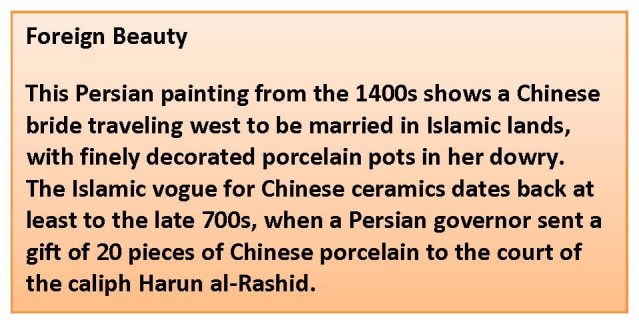
3. Early Islamic pottery followed the forms of the regions which the Muslims conquered. Eventually, however, there was cross-fertilization between the regions. One major emphasis in ceramic development in the Muslim world was the use of tile and decorative tilework.

Silk 11

WHAT WASN’T SAID:

1. That Muslims were neither the first nor the only merchants to travel the seas.

2. That the Mediterranean Jews were responsible for opening up these trade routes.

FACTS:

1. Mediterranean Jews were entrepreneurs who controlled much of the trade in the region and developed the economies of those nations, which included Alexandria’s shipping; Syria’s markets; Beirut’s silk-production industry and textile dyeing; and the glass factories, with bead shapes and colorations that are traced to Near Eastern Jewish glass designs.

2. Persian/Jewish traders pioneered the route from the Near East to Kaifeng, then capital of Imperial China, 1700 years before Marco Polo set out on his journey from Venice to China.

3. Interestingly, a saying attributed to Marco Polo is: “The militant Muslim is the person who beheads the infidel, while the moderate Muslim holds the feet of the victim.”

Along another Silk Road

1.The Chinese systems (Buddhism and Confucianism) fused with Korea and Japan, creating a Golden Age, which included the construction of pagodas and temples.

2. Products of the Silk Road were found at a Buddhist Temple site in Korea: bronze iron scissors, glass Buddha beads, terra cotta figures, jade ornaments, bronze buckles, images and bells, pottery, metalworking. The Middle Kingdom (Korea) became proficient at making iron blades and tools, 500 – 400 BCE.

3. Japanese had imports from Silla of perfume, medicine, cosmetics, fabric-dyeing materials, metallic goods, musical instruments, carpets, measuring tool; silk came to Japan in 306 CE. Buddhism became Japan’s state religion in 372 CE.

4. Korea’s Koryu Dynasty (935-1392) had the world’s first metal-printing technology before Gutenberg; the world’s oldest printed book, the Jikji; the world’s oldest surviving complete transcription of the Buddhist cantons; the world-famous Celadon pottery; and development of Buddhism throughout the peninsula.


Silk Road #5, The Learned


EXHIBIT SIGN:

Silk 12

WHAT WASN’T SAID:

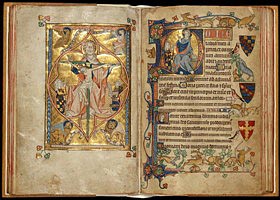
1. That Chinese calligraphy was also considered beautiful, as were Hebrew and Western Calligraphy. At right, is an illuminated manuscript, decorated with gold and silver. The earliest surviving substantive illuminated manuscripts are from AD 400 – 600, preceding the appearance of Islam. These were initially produced in Italy and in the Eastern Roman Empire, the majority of them being of a religious nature.

Silk 13

2. That they did not treat equally or fairly the qualities of other cultures, using “smeared” for ink application, and “magnificent, graceful, beautiful, flowing,” for Islamic writing; that Islam produced “stunning” discoveries, adjectives not applied to other cultures.

3. That if Islamic scholars led in all the sciences, why Islam is so backward now; that if they produced so many books, why they trail behind the western countries now.

4. That Islam has always taken on the cultures of the people through which it passed and looted, and kept the enslaved illiterate.

FACTS:

1. Islam’s practice of conquest was part of the directives of Mohammed; acquiring slaves and booty encouraged. Therefore, the spoils of war made it practically unnecessary to strive for values of the western world. When masters have workers, they no longer need to learn or be productive; hence the population is devalued and creativity and production suffer dramatically.

2. As seen in the Koran and other Islamic scriptures, Muslims were barbarian, slaughtering wherever they went in whatever cultures they met, and the same exists today. Therefore, how is it possible that they can claim a lofty culture in the middle (the Golden Age, for example)? And if this were actually so, what caused the changes from barbarian to civilized and the subsequent reversal.

EXHIBIT SIGN:

Silk 14

WHAT WASN’T SAID:

Once conquest was made, survivors of the slaughter were converted to Islam. Therefore, it might be prudent to question the original identity of those who owned and ran the paper manufacturers/mills, again in Samarkand, where we know that a large Jewish population existed.

FACTS:

1. The world’s oldest paper book is Chinese, AD 256; with the oldest printed book (using woodblock printing) from China’s Han dynasty (202 BC-AD), although discoveries suggest paper was used more than 10 years before, in 8 BC. After the Muslim defeat of the Chinese in the Battle of Talas in 751 (today Kyrgyzstan), the invention spread to the Middle East.; the first paper mill was founded in Samarkand.

2. The use of water-powered pulp mills for preparing the pulp material used in papermaking dates back to 8th Samarkand, The Muslims introduced the use of trip hammers (human- or animal-powered) in the production of paper, replacing the traditional Chinese mortar and pestle method. By the 9th century, Arabs were using paper regularly for their Qur’an; Arabs made books lighter, although vellum was preferred for the Qur’an. By the 12th century in Marrakech in Morocco, a street was named Kutubiyyin or booksellers, which contained more than 100 bookshops. (Ketubim means “writings” in Hebrew)   Chinese later employed the trip-hammer.

3. Since the First Crusade in 1096, paper manufacturing in Damascus had been interrupted by wars. Egypt continued with the thicker paper, while Iran produced the thinner papers. Papermaking was diffused across the Islamic world, from where it was diffused further west into Europe. Paper manufacture was introduced to India in the 13th century by Arab merchants, where it almost wholly replaced traditional writing materials.

4. In America, archaeological evidence indicates that a similar bark-paper writing material, amatl, was used by the Mayans no later than the 5th century AD. It was in widespread use among Mesoamerican cultures until the Spanish conquest. Paper making as more common to the European practice spread to the American continent first in Mexico by 1575 and then in Philadelphia by 1690.

EXHIBIT SIGN:

Silk 15

WHAT WASN’T SAID:

1. What happened to all these students of learning where now exists an illiterate, death-cult society.

2. That the Qur’an encourages violence, death, and plundering. Therefore, if the Arabs indeed studied this way, what caused the drastic deterioration of their culture.

3. If the conquered people, the People of the Book (dhimmis), were permitted access to the libraries.

FACTS:

1. An important reason for Judaic survival is that manual labor was never reviled In Judaism, but traditionally respected. Labor leads to artisanship and to literacy for a fulfilled life. Therefore, Jews were also prominent among the craftsmen and technicians at the junctures of civilization where industry, technology, and commerce flourished. The market for Judaic artisanship was universal. Art is inherent to artisanship. The former soars in the world of the imagination, and the latter produces the practical things that enhance the environment and prosperity. Through the written word, the reverence of learning, artisanship, and the subjective arts of imagery, Jews became quintessentially a creative people and creativity was their salvation.

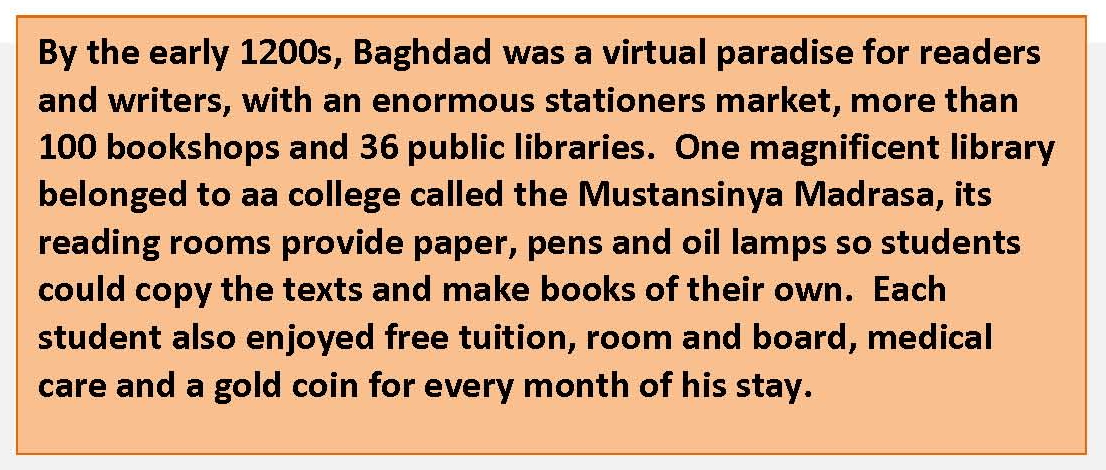
2. Unlike the Torah, the Qur’an does not encourage reading and artisanship. The Qur’an exhorts violence, looting, enslavement and murder. Enslavement encourages sloth in the master.   We can wonder what happened to the virtual paradise in Baghdad when writers and readers were not rewarded for industry. Why and how did this magnificence die, so that the various illiteracy rates reach as low as 15.2%.

EXHIBIT SIGN:

Silk 16

WHAT WASN’T SAID:

1. That writing was invented in Sumeria, the fertile crescent of Iraq; 3500 BCE.

2. That other cultures produced beautiful writing, also considered art forms.

FACTS:

1. With the introduction of Christianity, came magnificent illuminated manuscripts (manu – hand; script – written), made mainly by monks and nuns in monastic scriptorium. A scribe did the calligraphy (Greek: kali – beautiful; graphia – writing); an illuminator decorated the book; a bookbinder sewed the pages into book format, made the leather binding with gold and precious colors. The Tres Riches Heures and The Book of Kells are two examples of famous exquisite manuscripts that have survived to this day.

2. Of existing examples of historical ketubot (marriage contracts) from Jewish communities around the world, the vast majority fall into the category of floral and ornamental. Jewish ketubah artists drew on the natural world for inspiration, avoiding graven images, and were as diverse as the countries where produced – florals of Italy, Morocco, India and Afghanistan. Others are of historical design, formal, or stylized, folk or contemporary art.

3. Chinese calligraphy is considered an art form, widely practiced and revered in Asia – Korea, Taiwan, Vietnam, China, and Japan. The characters can be traced to 4000 BC, and are closely related to ink and wash paintings. They are distinguishable from other cultural arts because they emphasize motion. Calligraphy has led to the development of many forms of art in china, including seal carving, ornate paperweights, and inkstones. In Imperial China, the graphs on old steles, dating back to 200 BC, are still accessible.

EXHIBIT SIGN:

Silk 17

WHAT WASN’T SAID:

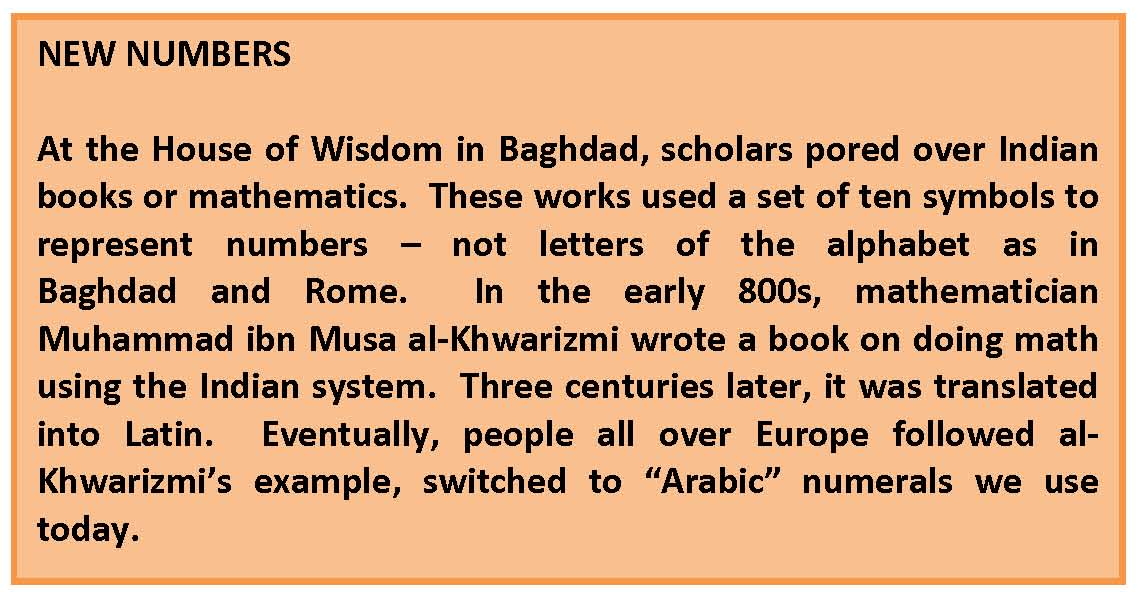
The books were Indian; the symbols were Indian; and the Islamic mathematician wrote the book using Indian symbols, yet the numerals are called “Arabic,” another example of undeserved credit and historic revisionism.

EXHIBIT SIGN:

Silk 18

WHAT WASN’T SAID:

1. That the term “scholars” is used only for Muslims, and presented as an isolated phenomenon, unknown to other cultures.

2. That the intent is to usurp the inventions and creativity from other cultures and subtly present them as Islamic.

3. In a show of multiculturalism, there were several one-minute slides, questions and answers on a screen. One slide asked about the music of Matisyahu, “An American singer,” who identifies himself as an orthodox Jew and sings a combination of Hebrew and reggae. The “correct answer” was given only as reggae.

FACTS:

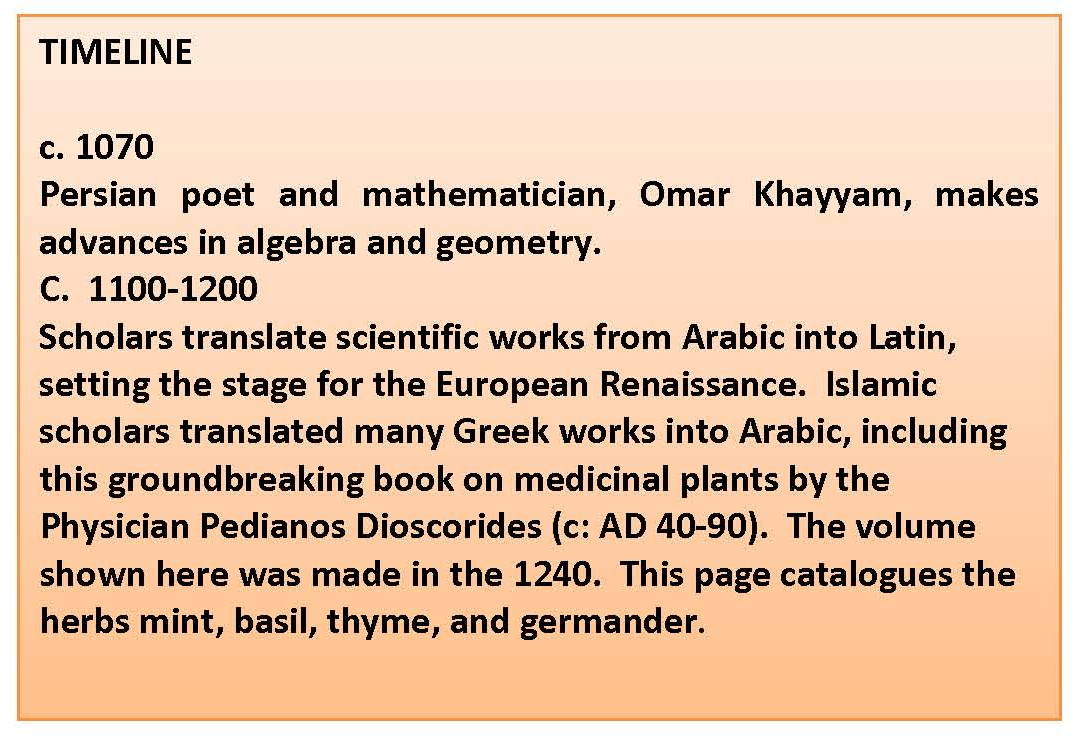
1. Muslims translated Greek works into Arabic, but the exhibit implies that they, not the Greeks, are to be credited with the scientific achievements. Arabs introduced the Indian numeric system as Arabic numerals.

2. Several references to China’s accomplishments were shown as hinged on products from around the world, insinuating that China could not have progressed without the aid of Arabs.


Silk Road #6, Inventions


EXHIBIT SIGNS:

Silk 19

Silk 20

WHAT WASN’T SAID:

That they may have originated in Cairo, Egypt, but also in Babylon, India, China, with the probability of China as early as 4000 BCE, none of which had Islamic scholars or craftsmen.

FACTS:

1. The huge planetary clock-type models, driven by water and considered the forerunners of today’s mechanical clocks, originated during the 1th century and were discovered in China, the Middle East and in North America.

2. A water clock or clepsydra (Greek κλέπτειν kleptein, ‘to steal’; ὕδωρ hydor, ‘water’) is any timepiece in which time is measured by the regulated flow of liquid into (inflow type) or out from (outflow type) a vessel where the amount is then measured. These and the sundials are likely to be the oldest time-measuring instruments, with the only exceptions being the vertical gnomon and the day-counting tally stick. 

3. Their precise origin may never be known, but the bowl-shaped outflow (simplest form) is known to have existed in Babylon and in Egypt around the 16th century BC. Other regions of the world, India and China, also have early evidence of water clocks, dates less certain. Some authors claim that water clocks appeared in China as early as 4000 BC. Therefore, it should be suggested that the inventor could be Chinese, Babylonian, Egyptian, or Indian, but not Islamic.

4. The Greeks and Romans advanced water clock designs to include the inflow clepsydra with an early feedback system, gearing, and escapement mechanism, which were connected to fanciful automata and resulted in improved accuracy. Further advances were made in Byzantium, Syria, and Mesopotamia, where increasingly accurate water clocks incorporated complex segmental and epicyclic gearing, water wheels, and programmability, advances that eventually made their way to Europe. Independently, the Chinese also developed gears escapement mechanism, and water wheels, and passed them on to Korea and Japan.

5. Some water clock designs were developed independently and some knowledge was transferred through the spread of trade. These early water clocks were calibrated with a sundial replaced by the ore accurate pendulum clocks in 17th-c. Europe.