European Parliament Accelerates DIGITAL EURO


Posted originally on Mar 6, 2026 by Martin Armstrong |  

The European Parliament has now thrown its support behind the creation of a digital euro, marking a significant political step toward introducing a central bank digital currency across the eurozone. While the project has been under development for several years at the European Central Bank, this vote signals that lawmakers are increasingly prepared to move the concept from theory toward reality.

Members of Parliament approved amendments endorsing a digital euro that would function both online and offline, effectively aligning with the European Central Bank’s vision for a publicly issued digital form of money. The vote passed with a strong majority, signaling broad political backing for the idea that Europe should create a digital currency controlled by its own monetary institutions rather than relying entirely on private payment networks.

The move reflects growing concern within Europe about the structure of global payment systems. A large portion of digital transactions within the European Union currently run through networks such as Visa and Mastercard, companies headquartered outside the EU. European policymakers have become increasingly uncomfortable with this dependency, arguing that payment infrastructure is no longer just a technical system but a strategic asset tied to economic sovereignty.

euro digital electric
Image

Officials have openly framed the digital euro as a way to regain control over the “rails” of Europe’s payment system. If payments are moving steadily away from cash and toward electronic platforms, central banks want to ensure that sovereign currency continues to play a role in that environment rather than being displaced by private payment systems or foreign financial networks.

Under current proposals, the digital euro would complement cash rather than replace it immediately. Citizens would access the currency through digital wallets provided by banks or financial institutions, allowing them to send and receive payments electronically using money issued directly by the central bank. Supporters argue this would preserve public access to central bank money in an economy where physical cash is used less frequently.

Yet the broader implications extend beyond convenience. A digital currency issued by a central bank changes the architecture of the financial system itself. For the first time, individuals could potentially hold digital money backed directly by the central bank rather than commercial bank deposits. That raises complex questions about the relationship between central banks, commercial banks, and the public.

The project remains in its legislative and technical stages. EU governments agreed on a negotiating framework in late 2025, and the European Parliament’s vote now signals that lawmakers are prepared to move forward with the next phase of legislation. If the regulatory framework is finalized in the coming years, the European Central Bank hopes to begin pilot testing around 2027, with a potential public rollout later in the decade.

Europe Is Building a Digital Identity System for 450 Million People


Posted originally on Mar 5, 2026 by Martin Armstrong

The European Union is quietly constructing what may become one of the most sweeping digital identity systems ever attempted. Under new legislation, every EU member state must provide citizens with a government-approved “European Digital Identity Wallet” by 2026. This system will allow people to store official documents, verify identity, access government services, sign legal contracts, and potentially interact with financial institutions through a single digital platform. It is being marketed as a modernization effort designed to make life easier for citizens navigating an increasingly digital economy.

Supporters claim the digital wallet will simply replace physical paperwork. Instead of carrying passports, driver’s licenses, or other credentials, individuals will be able to verify their identity online with a government-issued digital key. The European Commission argues that this will streamline bureaucracy and allow citizens to interact with both public and private services more efficiently across all 27 member states.

digital_wallet_300_clr_34539

Yet the implications extend far beyond administrative convenience. Once identity becomes centralized within a digital framework controlled or approved by government authorities, participation in everyday life increasingly depends on that system. Access to banking, employment verification, healthcare services, travel documentation, and legal contracts can all be integrated into the same identity infrastructure. What begins as a convenience quickly becomes a gateway through which access to modern society is managed.

Governments have always maintained population registries in one form or another. What makes digital identity systems fundamentally different is the speed and scale at which they operate. When identification becomes digitized and interconnected across borders, the ability to monitor economic and social activity expands dramatically. Identity verification can occur instantly, records can be updated in real time, and information can be shared between institutions with unprecedented efficiency.

This development becomes even more significant when viewed alongside other technological initiatives currently underway in Europe. The European Central Bank continues to explore the creation of a digital euro, a central bank digital currency that would exist entirely within electronic financial systems. If digital identity platforms and digital currency systems eventually intersect, financial activity and identity verification could become closely linked within the same infrastructure.

Proponents emphasize security and convenience, but critics argue that centralized identity systems create vulnerabilities of their own. Large databases containing personal information become attractive targets for cyberattacks. More importantly, the consolidation of identity into a single digital framework gives authorities significant influence over how individuals interact with economic systems. Access to services, verification processes, and regulatory compliance can all be mediated through the digital identity network.

Europe’s digital identity wallet represents a major step toward integrating identification, financial systems, and digital services across an entire continent. Whether it ultimately functions as a tool of convenience or evolves into something far more intrusive will depend on how these systems are governed and how widely they are integrated into everyday life. What is clear is that the infrastructure for a new form of digital administration is being built now, and its long-term implications will extend well beyond simplifying paperwork.

Physical Bank Branches Disappearing – Relationship Banking is Dead


Posted originally on Jan 30, 2026 by Martin Armstrong |  

bankteller

Physical bank branches are disappearing along with relationship banking. The Office of the Comptroller of the Currency (OCC) files state that the US lost a net total of 339 bank branches in December 2025. The S&P Global and Federal Reserve found that the US has been losing, on average, 1,600 bank branches per year.

Santander announced that it would be shuttering 44 branches in Q1 2026, noting a move toward digital banking. TD Bank plans to close 51 branches across 13 states as it aims to cut 10% of its brick-and-mortar locations. JPMorgan Chase announced 66 branch closures in late 2025. US Bank, Wells Fargo, PNC, Bank of America, Citizens Bank, Flagstar, and every other major banking chain are moving away from physical banking as people favor online convenience, and the government favors online monitoring.

Digital banking will continue to grow. Branches will continue to close. But do not confuse a trend with a solution. Convenience is being sold as innovation, yet what is really happening is the consolidation of financial power and the reduction of public access points.

Relationship banking was built on human judgment. Transactional banking is built on algorithmic approval. This is something I have warned about for years.

Under relationship banking, they lent you money but monitored your business and ability to repay. This imposed some rational constraints. Under the new transactional banking model, the New York bankers sought to repeal Glass-Steagall, and they have transformed into brokers, packaged loans, and resold them. They no longer cared about the borrower, for the motive is how they can sell it.

Under relationship banking, your local banker knew who you were. They understood your business, your family, your reputation, and your history in the community. Loans were not always granted because a formula said yes. They were granted because character and long-term trust mattered. The system was decentralized in practice, even when imperfect. Now you are reduced to a data profile.

A banker could vouch for a person based on their relationship and push through loan approval. With transactional banking, a model can reject the loan, and that’s the end of the discussion. One is local, and the other is centralized.

As governments move toward tighter financial surveillance, digital currencies, and automated reporting, relationship banking becomes an obstacle. It introduces flexibility into a system that regulators want to be rigid.

Pentagon Lines the Pockets of Warmongers


Posted originally on Oct 3, 2025 by Martin Armstrong |  

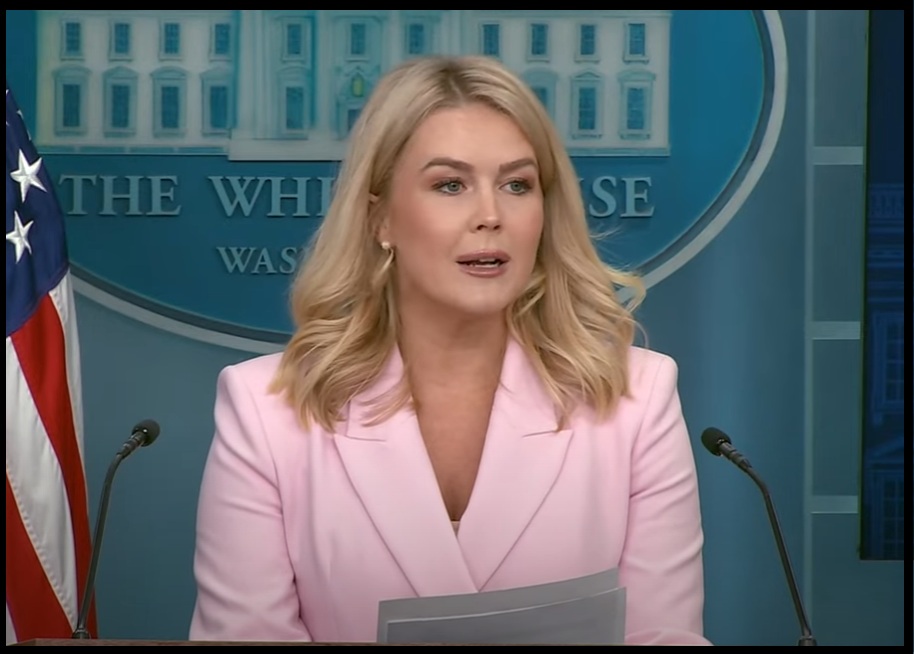
Press Secretary Karoline Leavitt Briefing – 1:00pm ET Livestream


Posted originally on CTH on October 3, 2025 | Sundance 

White House Press Secretary Karoline Leavitt delivers a press briefing today at 1:00pm ET.  Livestream Links Below.

RSBN Livestream Link – Forbes Livestream Link – AP Livestream Link

.

.

.

Shutdown Day #3 – Trump’s Challenge


Posted originally on CTH on October 3, 2025 | Sundance

The professionally Republican wing of the GOPe want this shutdown ended just as much as the professionally Democrat wing. The UniParty cannot allow Trump/Vought this much power. Republicans cannot allow Trump this much power.

The Moonbat leftists are not the biggest problem, they never have been. They are ideologues, mostly. Insufferable, stupid, violent at times, but easy to spot.

Remember, Democrats quest for power; Republicans quest for money. Always underline this because it’s really important.

The Moonbat leftists seek power, seek control of your life, and they are open in their insufferably stupid arguments to get there. When they start to lose, they turn violent. This is their history.

That said, they are not the most dangerous.

The professional Republicans are more dangerous, because their priority is money. As a result, their approaches, goals, objectives and arguments can be purchased.

Republicans have no interests, goals or objectives, nor allegiances, that supersede their primary objective – getting money, and growing their wealth.

Democrats will come at you with a knife, a gun or a baseball bat. You can see them. The professional Republican guy standing beside you, however, is willing to take a payment to shoot you in the ear when you don’t see it coming.

This is also why it seems like Democrats stick together, and Republicans split. Democrats are chasing a common goal, a collective goal – power. Republicans are chasing a commonality, yes, but an individual goal – money, their wealth.

Donors contribute to the Democrat agenda because their interest is to benefit from power. Republicans modify their agenda to benefit donors, because their goal is money.

Democrats stay on task, power. Republicans are flexible, money.

You enter a war against Leftists with extreme danger. However, the danger is not the war in front of you, it’s the army beside you waiting to get a payment from the enemy in front of you.

Out of a group of 1,000 Democrats, 900+ will join in to defend a weakened Moonbat leftist (see Kimmel).

Out of a group of 1,000 Republicans, you will find, maybe, 5 willing to cover your back regardless of how much bribery is put in front of them.

Remember this, understand this and the reality of who presents the most danger to us is accurately framed.

Republicans do not simply snatch defeat from the jaws of victory; they sell defeat to the highest bidder!

In our lifetime we have watched this unfold.

There were Democrats with the same outlook as Republicans; they were known as “blue dog” democrats. The Blue Dogs were willing to compromise power, to sell power, in return for financial payment.

Traditional ‘Blue Dogs’ were names like Hillary and Bill Clinton; their prism was the assembly of money. However, this group faced the introduction of hardline ideological believers – the communists or Marxists represented by Barack Obama.

Obama Inc. battled Clinton Inc. to determine the future of the Democrats. The ideologues won, and the democrat Blue Dogs in their tribe, those willing to concede ideology for money, were purged from their ranks. Modern Democrats, post Obama takeover, are now pure ideologues.

By any means necessary” is the operational objective of modern leftists. This is why government under Obama flipped the switch so openly and began weaponizing power. Purging govt agencies and replacing the staff with ideologues. Crushing opposition, by brute force and targeting.

Simultaneously, in the smaller Republican ranks, there was a small group who wanted to face down the same battle inside the Republican Party. The original Tea Party represented this group. A smaller assembly trying to put ideology, freedom and liberty at the forefront of the Republican objective.

Unlike the leftist effort, the Tea Party effort inside the Republican Party failed. Republican leadership crushed the liberty rebellion, and went back to business taking money from the ideological Marxists who now ruled the centers of power.

People, who didn’t quite understand what was taking place, stood and watched, frustrated, at the dynamic of Republicans who conceded every battle to the left.

What the abused GOP viewers didn’t understand was the core of the issue; Democrats want power, Republicans want money.

Each time the Republicans could win on a policy issue, they sold the loss to Democrats. Battered conservatives grew more frustrated and more frustrated.

Now we enter the era of MAGA, represented by billionaire Donald J. Trump, who, like Obama before him, began the fight inside the Republican Party.

The Tea Party rebellion quickly reengaged Trump and formed MAGA; the ideological fight inside the Republican party, liberty over money, was on again.

MAGA represents opposition to the leftist ideological advancement. But the Republican assembly will not concede. In a way their resistance makes sense.

If liberty and freedom become the priority, the advancement of personal wealth becomes more difficult. Simultaneously, if retention and assembly of wealth is the priority, liberty and freedom ideologues become impediments. Again, MAGA within Republicanism must be crushed when money is the priority.

This internal Republican battle has been unfolding in various reference points for almost a decade now, while the internal Democrat battle was long ago decided.

The root issue within the Republican apparatus still surrounds the greatest evil. ‘The love of money is the root of all evil.’

This conflict has not yet been fully decided, yet admittedly -and thankfully- MAGA has made some significant gains. The Republican Party now has a lower income demographic and a more ideological working class base.

However, don’t be fooled. The top tier of the Republican apparatus is mostly unchanged; albeit, they are facing more entrenched ideological opposition from the awakened MAGA forces. The top tier will still sell out the base, still compromise for personal profit, and still take payment for policy.

This brings us to where we are today.

Inside the MAGA assembly, we are trying to identify which Republican leaders have shifted to the MAGA/liberty viewpoint, and which Republican leaders are playing the long game while retaining their DNA level objective – get money.

Each day on these pages, and many others, the ‘trust’ factor is raised; this is completely understandable.  We have a strong muscle memory for betrayal, and we all bear the scars to remind us.  It is fitting and proper that these conversations take place.

After all, it’s interesting to watch professional Republicans discuss how agencies like the DOJ and FBI have lost the institutional trust of the American people due to corruption, while simultaneously those same Republicans never note trust loss within the Republican Party as a result of their willful blindness to it.


WATCH: Leftist NGOs Aiding And Abetting Illegal Aliens Outside Courthouse in Portland, Oregon


Posted originally on Rumble on By Bannon’s War Room on: October, 01, 2025

WADE MILLER: Russ Vought Is Uniquely Capable Of Taking A Scalpel To Thousands Of Bloated, Woke, Weaponized Government Programs While Minimizing The Impact On The American People


Posted originally on Rumble on By Bannon’s War Room on: October, 01, 2025

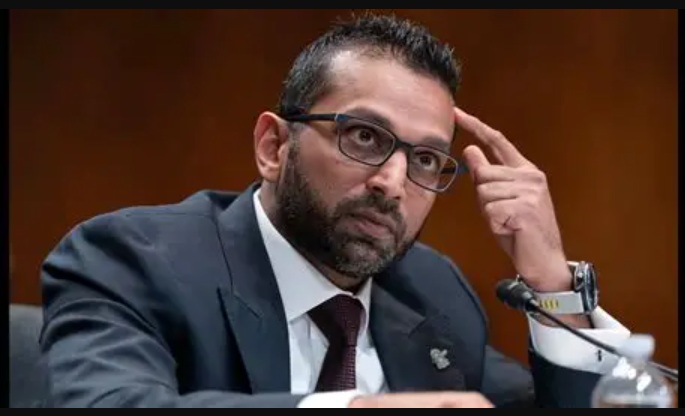
FBI Director Kash Patel Says Agents in J6 Crowd Were Dispatched to Quell Riot Underway


Posted originally on CTH on September 28, 2025 | Sundance

FBI Director Kash Patel once again rises to defend the integrity of the institution he leads.

While Tweeting a link to a Fox News story quoting him, the FBI director says, “274 FBI agents were thrown into crowd control on Jan 6 against FBI standards. That failure was on corrupt leadership. Thanks to agents stepping up, the truth is coming out. Transparency. Justice. Accountability.”

Which begs the questions: 274 FBI plainclothes agents were going to do what, exactly?… How did the FBI know to have 274 agents “on hand” prepared to intervene?  And where exactly is “on hand” located?

(VIA FOX NEWS) – The FBI responded on Saturday to a report that 274 plainclothes agents were at the U.S. Capitol riot on Jan. 6, 2021, clarifying the role of bureau personnel while still blasting former Director Christopher Wray.

While the agents were on hand, they were sent in after the riot had begun to try to control the unruly crowd, officials told Fox News Digital. That is not the proper role of FBI agents, and Wray was not forthcoming about what happened when he testified numerous times on Capitol Hill, Director Kash Patel said.

“Agents were sent into a crowd control mission after the riot was declared by Metro Police – something that goes against FBI standards,” Patel told Fox News Digital. “This was the failure of a corrupt leadership that lied to Congress and to the American people about what really happened.”

He added, “Thanks to agents coming forward, we are now uncovering the truth. We are fully committed to transparency, and justice and accountability continues with this FBI.” 

There’s no indication any FBI agents were involved in any events related to Trump’s speech on the morning of Jan. 6 at the Ellipse, an FBI official told Fox News Digital, adding that Wray should have disclosed that agents were there when he was asked by congressional leaders. (read more)

Suspicious Cat remains, well, suspicious…

UPDATE: DOJ Investigator Ed Martin Begins Questioning FBI Agent Bill Aldenberg’s Conflict in Alex Jones Lawsuit


Posted originally on CTH on September 24, 2025 | Sundance 

UPDATE: According to CNN“in a new letter addressed to attorney Christopher Mattei on Wednesday, Martin withdrew his initial letter entirely. In a brief note, according to a person familiar with the letter, Martin wrote that there is no investigation of Aldenberg and “because of this, I hereby withdraw my request for information from you or your former client.” {SOURCE}

As noted in the original outline below, it wasn’t particularly smart for Alex Jones to post the letter on his Twitter account.  Without much doubt the Ed Martin retraction was due to this knuckleheaded move.

— Original Outline Below —

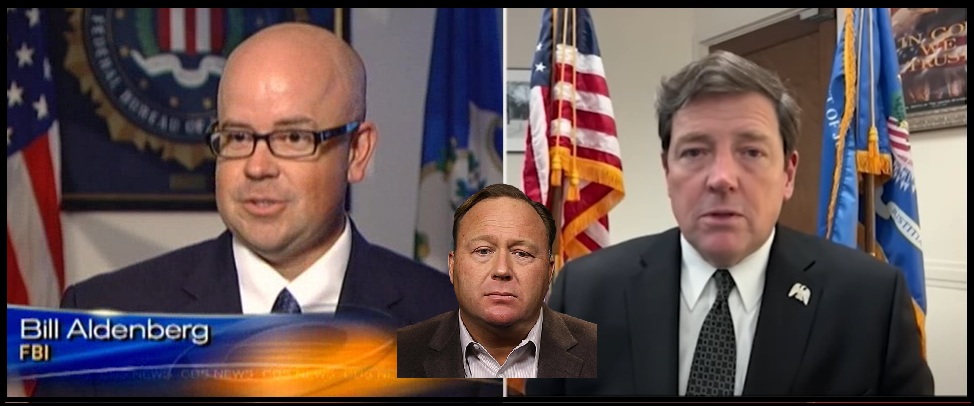
William “Bill” Aldenberg was the lead investigator for John Durham in 2020.  Bill Aldenberg was also a plaintiff in the case against Alex Jones in the Sandy Hook Elementary School shooting 2012, lawsuit and civil trial 2022.

According to a U.S. News and World Report article, “Aldenberg was among the law enforcement officers who responded to the school and found the dead children. That then led to years of abuse from people who believed the shooting was a hoax, he has said. His share of the judgment totaled around $120 million.”

Bill Aldenberg was the first witness in the 2022 case against InfoWars.  Alex Jones and InfoWars lost the lawsuit and were punished by a $1.4 billion damage award to the plaintiffs. InfoWars filed bankruptcy and the arguments over liquidation of assets is underway in Texas.

Here’s where things get weird.  We know the FBI was conducting an operation called “Arctic Frost,” essentially the targeting of Donald Trump and key figures who aligned with Trump in the aftermath of the 2020 election. {Citation}

It is widely suspected, the massive amount of evidence captured in the Arctic Frost operation, was eventually fed to the January 6th Committee for use in their expanded investigation.  That evidence then underpinned the case against President Trump that was being assembled by Jack Smith. {Go Deep}

Essentially, operation Arctic Frost was the evidence gathering operation, then the J6 Committee and special counsel Jack Smith used the FBI evidence to frame their cases.  [Readers will note, this process is similar to the FBI “Crossfire Hurricane” operation, which fed evidence to special counsel Robert Mueller, to frame their cases.]

Back to FBI Investigative Agent William Aldenberg, who was lead for John Durham.

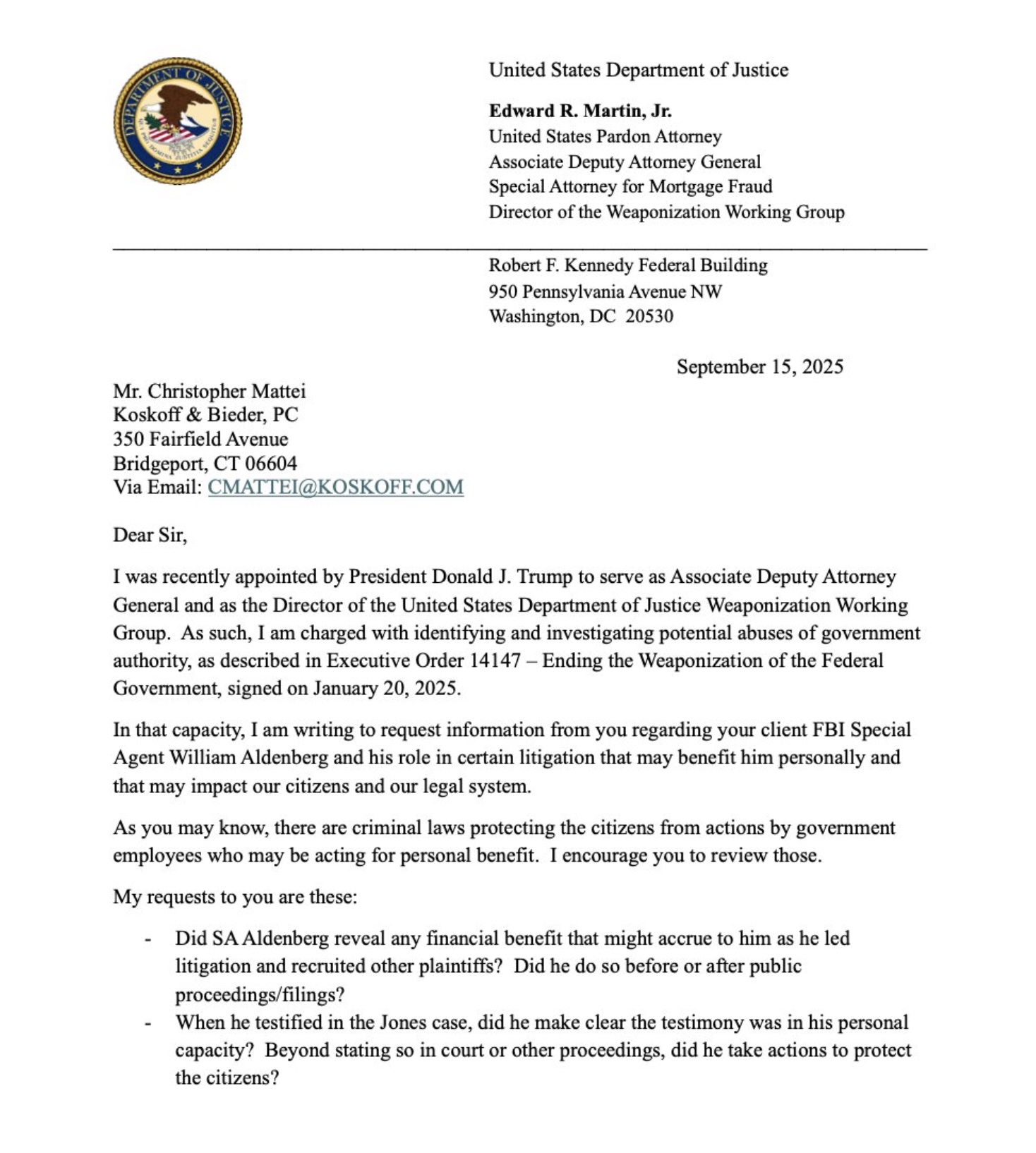
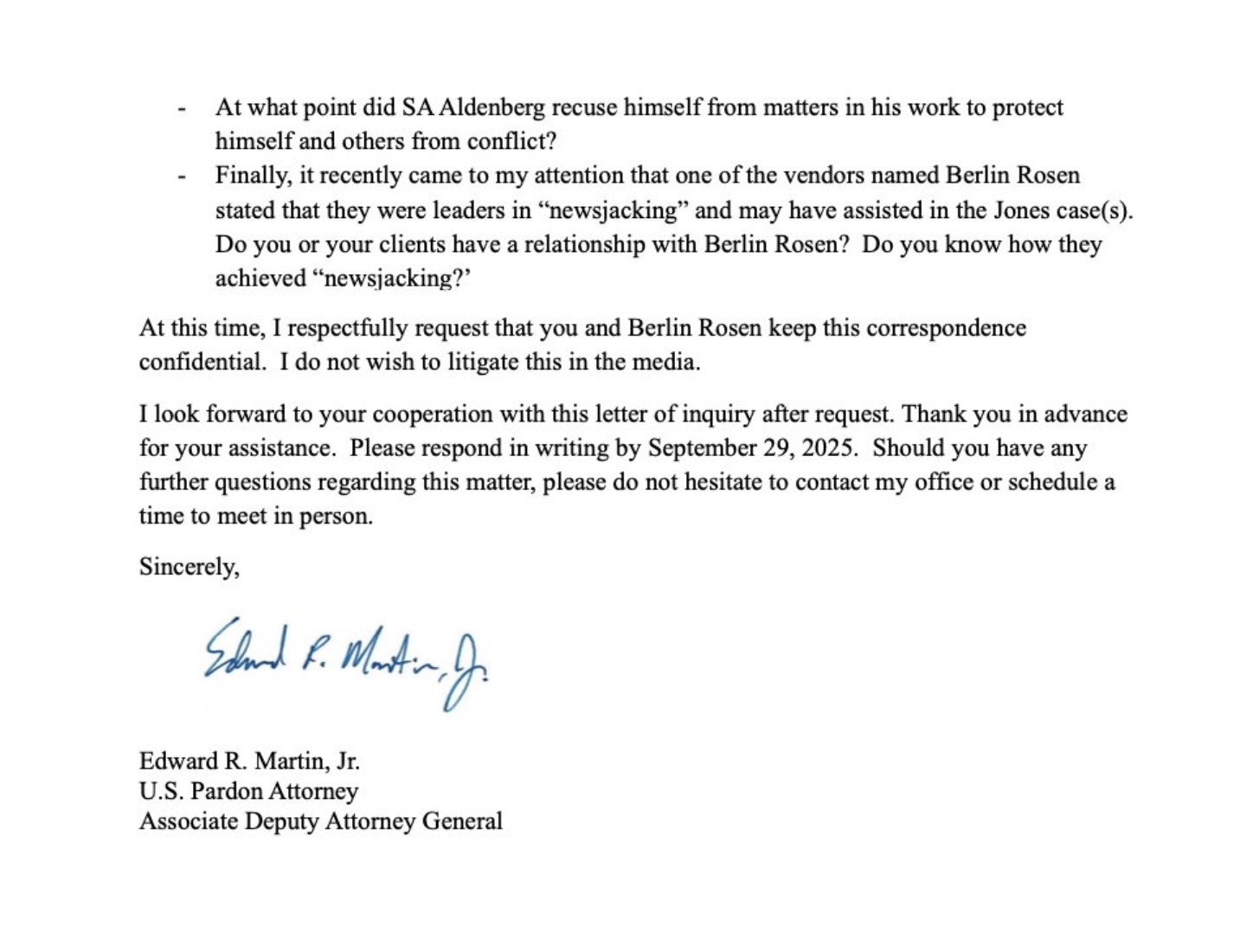
DOJ attorney Ed Martin is looking at the connective tissue around all of the FBI targeting operations.  He now asks the lawyers for William Aldenberg about details of their client’s involvement in the case against Alex Jones.

[SOURCE]

Alex Jones posted a copy of the letter on his Twitter [X] feed, along with a picture of him and Ed Martin.  A rather knuckleheaded move by Jones considering how Ed Martin says in the letter he would prefer not to litigate the issue in the media.  Then again, wisdom and sound judgement have never been Jones’ strong points.

Really, it’s a convoluted mess making the serious issues around Arctic Frost get lost in the weeds.  Then again, perhaps that is a feature not a flaw.  Many people, CTH included, view Alex Jones through the prism of compromise ever since the $1.4 billion sword of Damocles was established over his head.

(USN&WR) – […] Ed Martin Jr., who leads the Justice Department’s “weaponization working group,” asked in the letter whether retired agent William Aldenberg received any financial benefits from helping to organize the lawsuit, in which he was a plaintiff along with victims’ family members.

Aldenberg, like the parents and other relatives of the 20 children and six educators killed in the 2012 school shooting in Newtown, Connecticut, has been the subject of false conspiracy theories spread by Jones on his “Infowars” broadcasts.

Aldenberg was among the law enforcement officers who responded to the school and found the dead children. That then led to years of abuse from people who believed the shooting was a hoax, he has said. His share of the judgment totaled around $120 million.

In a Sept. 15 letter to Christopher Mattei, a lawyer who represents Sandy Hook families, Martin suggested he was scrutinizing Aldenberg’s role in the lawsuit.

Mattei responded to the letter in a text message to The Associated Press.

“Thanks to the courage of the Sandy Hook families, Infowars will soon be finished,” he said, referring to the families’ efforts in court to liquidate Jones’ assets to help pay the judgment. “In his last gasps, Jones is once again harassing them, only now with the corrupt complicity of at least one DOJ official. It’s as disgusting as it is pathetic, and we will not stand for it.” (more)