Posted originally on the CTH on October 1, 2024 | Sundance
In the past 36 hours information to understand the context of devastation in Western North Carolina/East Tennessee has started to slowly come out. Today, we hope more families are able to contact their loved ones, as the number of missing persons continues to rise.
As communication lines start to open up, consider this thread an open discussion link for any information about the isolated impact zone. If you are in the region, let us know how you are doing. Tens-of-thousands remain trapped and isolated.
Thousands of rescue and recovery workers are now arriving just outside the area as officials attempt to patch together a way for relief efforts to reach impacted communities. Most mountain roads and bridges have failed or become severely compromised. Stay safe. Our entire CTH community is united in prayer and support.
Below is a solid representation of status for multiple families.
One Story: “My parents are ok but completely trapped. Yesterday, I hiked up to check on them. Brain spew coming; I’m still processing it all and was just locked in on go-mode yesterday.
Still not having heard from my parents in 48 hours, I was drowning in worry. My parents live in an absolute gem of the NC mountains — the Little Switzerland, Spruce Pine, Burnsville area — halfway between Asheville and Boone. Under normal circumstances, it’s pleasantly very isolated.
Little did I know that up there, Helene has demolished roads, homes and utility networks. **This area is completely cut off from resources in every direction.** I tried multiple routes to drive up but had to settle on parking in Marion at the base of a closed road (Hwys 221/226) and hiking 11 miles and 2,200 feet to find my parents thankfully ok but surrounded by devastation. I have never been so relieved to see anyone ok.
Crews weren’t even close yesterday. I can’t tell you how many failing roads and deep mudslides I had to cross, how many fallen trees I had to take off my backpack for and navigate through. While hiking up 226A, I met multiple people trapped by devastation in both directions of the highway.
In this part of the mountains with steep terrain rolling off the Blue Ridge Parkway, not only did water rise, it RAGED to tear up roads, earth and homes. Then, the winds (I’m certain tornados in some places) have brought down up to half the tree canopy.
I’m still processing it all. I’ve never seen anything like it. Power is a couple weeks out. I cannot fathom how long it will take DOT to repair the curvy roads that hug steep mountainsides with the most amazing views. Most of all, I want my parents to have the same basic needs they always provided me — food, water, shelter (house is mostly ok) and the ability to explore! But they can’t even leave their home right now. The steep part of their gravel road has braided channels only 18″ wide but up to 5′ deep from rushing water.
It’s just a waiting game now. If you are or you have family in the mountains, I feel for you. Know that crews are chipping away.”
A small portion video from Lake Lure to Asheville:
Posted originally on the CTH on September 30, 2024 | Sundance
Perhaps anticipating that a political administration will drag heels and deflect funds, according to press secretary Karolin Leavitt, President Trump has authorized a GoFundMe campaign to assist victims of Hurricane Helene.
GoFundMe – “President Donald J. Trump has launched this GoFundMe campaign as an official response for MAGA supporters to offer their financial assistance to their fellow Americans impacted by Hurricane Helene. With so many across the Southeastern U.S. facing challenges after the storm, President Trump is on the ground in communities to see the aftermath firsthand. All donations will be directed to help those most affected by Hurricane Helene. Any level of generosity will go a long way for your fellow Americans who are suffering.”
Posted originally on the CTH on September 30, 2024 | Sundance
Likely unknown to most readers, tens-of-thousands of Florida residents have homes and cabins in Western North Carolina (WNC). It is an inside joke in the region about the number of Florida tags on cars there. This is a smart move in principle and in politics by Florida Governor Ron DeSantis.
Giving an update from Steinhatchee, Florida, Governor Ron DeSantis was asked about communication from Joe Biden. Governor DeSantis pointed out that he has not spoken with Biden; however, he would recommend that all available FEMA and Federal recovery efforts be directed immediately to the Western North Carolina region.
DeSantis accurately describes and contrasts the unique challenges faced by people living in the WNC area. WATCH:
.
This is one of those situations where good policy is good politics.
Posted originally on the CTH on September 30, 2024 | Sundance
It is day #4 in the generally unexpected worst effect impact zone from Hurricane Helene. The area west of Black Mountain, North Carolina, through the eastern portion of Tennessee is facing a major crisis that continues to unfold.
After three days of almost no communication from the region outside what the private sector and social media could put together, North Carolina governor Roy Cooper finally said, “the catastrophic devastation to western North Carolina is like nothing we have ever seen.” Damage to roads, bridges, highways and all infrastructure in the impact zone is extreme. Many areas remain cut-off as the roads and bridges have been destroyed.
Helene’s impacts are severe in parts of Florida, Georgia, South Carolina and Virginia. However, the Eastern TN/Western Carolina region took the hardest hit as the massive flooding has destroyed towns and literally cut-off the primary access roads and interstates needed to get into the region.
Boone, North Carolina is near many of the worst hit communities and also the headquarters of Franklin Graham’s group Samaritan’s Purse. The orange shirts that show up in almost all areas of severe national disasters. Samaritan’s Purse does a phenomenal job of assistance and staged recovery, and this disaster unfolded right in their back yard.
Multiple private sector groups and individuals have rushed to assist as the state and federal government seem incapable of responding due to the region facing a communication blackout. In addition to the loss of power, cell towers, phone lines, fiber optic cable lines, and satellite receivers in the area have been destroyed. As a result, it took a long time for groups to realize the significance of the problem.
While aide is needed throughout many areas in the southeast U.S, the red circled impact zone is in the worst shape because access to get vitally needed resources, supplies and aid to them is very limited. Several communities remain completely cut-off and are accessible only by helicopter.
I-40 eastbound out of Tennessee is closed as the roads have washed out. I-26 is closed in key areas due to bridge collapses. The North Carolina Dept. of Transportation continues to say, “all roads in Western NC should be considered closed,” even the big ones. Rural, small mountain paths and a few state roads are the only way to get assistance into the area. Thankfully, as we enter day #4, people now realize the scale of the problem.
Folks, we just finished dropping off another shipment of material in Buncombe County. Thanks to your donations, their warehouse is no longer empty.
Western North Carolina is in dire need of supplies and assistance. We are doing everything in our power, but we still need your… pic.twitter.com/HLTy7JJtyh
Folks, there's no way to surgarcoat it. The situation in Western North Carolina is becoming more dire by the hour. Residents are still without power and do not readily have access to food and water. I am urging Governor Roy Cooper to send in more help immediately. We need to… pic.twitter.com/vG0bdrZ9wa
This shows the terminus of all the flash floods and debris flows from the Chimney Rock, NC area. This debris is basically the town of Chimney Rock pic.twitter.com/kfLCqUdUgz
𝐅𝐫𝐨𝐦 𝐏𝐚𝐦𝐥𝐢𝐜𝐨 𝐂𝐨𝐮𝐧𝐭𝐲 𝐄𝐦𝐞𝐫𝐠𝐞𝐧𝐜𝐲 𝐌𝐚𝐧𝐚𝐠𝐞𝐦𝐞𝐧𝐭 (𝐖𝐍𝐂): Our team is good and healthy. We cut our way into 𝐋𝐚𝐤𝐞 𝐋𝐮𝐫𝐞 𝐚𝐧𝐝 𝐂𝐡𝐢𝐦𝐧𝐞𝐲 𝐑𝐨𝐜𝐤 this morning. The damage is unimaginable. 3 of our Rescue Swimmers were able to swim across… pic.twitter.com/gKfdCjbfls
There are TONS of Americans doing exceptional work to help their fellow Americans despite the fact that virtually all levels of government above the municipal level are doing absolutely nothing 🦅#flood#flooding#Americans#governmentpic.twitter.com/fq0goo47CW
This is an unfolding crisis of unfathomable proportions. It’s not just the problem of destruction, and in some cases entire towns gone, but also a problem of reaching them to help. A few videos for context below.
CTH coordinated communication resources into the area two days ago to join up with Franklin Graham’s group. People have asked for advice on donations. This is a hard question for this crisis because the big industrial type of relief efforts doesn’t seem to be effective yet. The best on-the-ground support is coming from ordinary people, Youtubers, podcasters, storm chasers and small independent groups; just plain boots on the ground folks responding to what is happening. Many links exist in the comment section on prior posts on this effort. God love em’.
For a large organizational support, I would suggest Samaritans Purse. They will stay around long after the media stops caring.
This next video is a great example of what relief workers literally face when trying to reach people.
Entire roads in North Carolina are washed out and people are without a way to get out of their driveways, no power, little to no communication, AND OUR FEDERAL GOVERNMENT IS DOING NOTHING. OUR MEDIA IS BARELY ACKNOWLEDGING THIS DISASTER. Our country is like a ship lost at sea… pic.twitter.com/CtF78W3sUJ
…”Greetings Treepers, Just evacuated out of area North of Asheville. Up in Va now. Glad to have some creature comforts and my family and friends are all ok. Here’s what I saw happening:
We have had zero communication for 48 hours. We includes citizens, fire dept, 911, rescue, police, troopers, emts,etc. Zero cell phone or land lines. Apparently viper is the only communication and only one channel was available. I’m not sure what has led to this issue but it the single biggest failure so far. This was confirmed at local fire dept. Finally had intermittent cell service around 11am today
Power is slowly coming on. Local Duke and French Broad co op guys were crushing it. They were heroes. Easy areas are coming online. Hard hit areas where trees or floods took out infrastructure are going to take some time. Duke guys I saw today were first organized crew helping
Water is going to be the huge issue. If you have a well and power you’ll be ok; if you are on municipal services it’s going to be a long haul. So many water infrastructure systems wiped out. It’s great to have electricity, it’s impossible to thrive without clean water. This is a slow rolling disaster getting ready to rear its ugly head and unfortunately the mainstream media won’t cover it because the footage won’t be sensational.
Food wise some stocked up a whole lot of people didn’t. Same with gas. Here’s where it is going to start getting crazy. There’s only one sufficient highway into the Asheville area, I 26w. I didn’t see much rolling into town as we drove out. Unless the Calvary is massing somewhere, there is nowhere near the sufficient resources coming into that area. I hope I’m wrong but it’s setting up a situation where people are going to move into desperation soon.
Glad to reply to any other questions. Local am radio really helped. After about 36 hours they were the lifeline for many of us. My family and I are amateur preppers. We would have done fine with our resources if we had stayed. I was amazed at how many were WAY under prepared. Really sad. Hope to head back in a few days. I’ll post an update if a service is available. (link)
Posted originally on the CTH on September 29, 2024 | Sundance
The ‘unreal’ part, is to watch North Carolina Governor Roy Cooper read from a teleprompter –ON DAY THREE– about the devastation in Western North Carolina that is only just now starting to surface in mainstream media reporting. I’m trying not to be political within this crisis, but seriously here folks, this is incompetency on steroids. A Friggin’ Teleprompter?
Governor Cooper outlines ‘what he knows’ about a situation that has been increasingly getting out of control over the past 48 hours. Ordinary patriots have done more to save lives than any representative of Cooper’s state government. Watch closely, listen as Cooper positions himself amid proactive excuses and justifications for the unfolding catastrophe.
Governor Cooper is trying to avoid the political damage now for himself and for Joe Biden; it’s obvious. Remember, this is DAY #3 WATCH:
.
On the upside, now the political continuum has swung, and the risk variable has shifted. As a consequence, aid will start pouring into Western North Carolina as the politicos attempt to create the optics of magnanimous competency.
They are suddenly super worried about Asheville. Can’t have the leftists in the deep blue, getting full awake to the incompetence of leftism. However, help will also start to flow further west too. That’s cool. At least, people are finally going to get help.
Posted originally on the CTH on September 29, 2024 | Sundance
I am certainly no expert on North Carolina politics, but what I can tell you after watching this interview is that North Carolina Governor Roy Cooper is completely incapable of dealing with the catastrophic crisis unfolding right now in WESTERN NORTH CAROLINA.
Far-east Tennessee and Western North Carolina are cut-off from the rest of the world. Not only have the main artery roads, interstates and bridges been wiped out, but also communication lines, fiber optic cables, transmission towers, cell towers, the works have been destroyed.
If you remember the communication blackout, and subsequent slow rolling information stream that took four days to surface in the aftermath of Hurricane Katrina (2005), you will have reference for why it is taking the nation so long to realize what is happening in Western NC.
The video below is exactly what you do not want to see in this situation.
Last night Governor Roy Cooper delivered a shocking “exclusive interview” with WLOS News 13. What makes the interview “shocking” is not just what Cooper says, but the manner in which he says it. This guy is in a bubble without any concept of what is happening on the ground. This interview represents everything you NEVER WANT TO SEE, in a state of emergency. WATCH:
First, Governor Roy Cooper is isolated and alone. There are no state emergency officials next to him. He is not in an emergency response posture; nor is he in a coordination center with the officials that matter. 15 minutes of time during a period of extreme crisis is a lot of time to waste. This should be a press conference with every state emergency official, from every responding agency, surrounding him to offer specifics on what they are doing.
Next, listen carefully to what Governor Cooper is saying. You will hear the words “learning”, “coordinating”, “facilitating”, “attempting to understand” etc., intertwined in the responses.
Governor Cooper has no idea what to do and he is deferring response to the private sector, who are stuck inside the crisis region. The scale of the crisis is too large for the private sector to handle right now. People are trapped and literally exposed to deadly situations during these 15 minutes of nothing.
Western North Carolina is in a state of crisis. People are trapped. Entire small towns and communities are isolated by lost roads and bridges. Many people can only be reached by helicopter. Communication in the region is almost impossible. The outside world has no way to understand just how bad things are in specific areas because those areas are cut-off from all transit and communication.
Now is not the time for politics. This issue is about competency.
Now is a time for action. This is day #3, and as each day passes the desperation gets worse. Remember, the standard rule of thumb from all emergency officials is for everyone to be self-sufficient for 3 days. After those 3 days, responses and resources should be well positioned.
When day #4 comes and there is still no adequate response, you get a Katrina outcome; desperation starts to manifest in social breakdown.
The people of North Carolina are good, self-sufficient and resourceful people who will help each other and their neighbor. No, they are not Katrina dependency minded. These are bootstrapped, solid people who know how to survive. However, there are also many people in the region in less fortunate situations; older, perhaps more vulnerable, perhaps less prepared, and currently cut off from the world.
Governor Cooper needs to get there himself.
Tennessee farmland and the devastation hard working farmers must face.
Pray for the farmers. They work so hard as it is and many can't afford flood insurance and virtually none have hurricane insurance. #Helene took their livelihood. pic.twitter.com/Dfd8tj0486
Was able to talk to my husband in Asheville for the first time in over 24 hours today. He sent me this video of the River Arts District near our home. I’m so devastated. I’m so worried about the friends and colleagues who are missing. I’m so heartbroken for my city and all of WNC pic.twitter.com/1kCVvI2BP4
Posted originally on the CTH on September 28, 2024 | Sundance
In the area of Eastern Tennessee and Western North Carolina, things are really bad in the aftermath of Hurricane Helene winds and rain. The massive flooding in the entire SE region has created multiple crisis points in NC, TN, GA, SC, AL and Virginia.
In Western North Carolina, eastbound Interstate 40 is gone. I-40 washed away by massive amounts of water through Pigeon River, near the Tennessee state line. {STORY HERE} Initially, state officials denied the collapse because it was impossible for anyone from the state to get to the area to confirm it. They later said, “oh, shit- it’s real”… and now admit it will take a long time for repairs.
In northern East Tennessee the Interstate 26 bridge has collapsed near Erwin. I-26 is closed eastbound at mile marker 37 and closed westbound at mile marker 43. {STORY HERE} Again, this is another closure that is likely to take a long time for repairs.
The region where Tennesse and North Carolina come together at the base of the Appalachian Mountain range has been severely damaged. Transit into the area will be impeded for a substantial amount of time. Rivers and streams throughout the area are far beyond their capacity and only now starting to recede.
I know we have a lot of Treepers in this area. Check in if you are in any of the affected areas and let us know your condition. There is going to be a significant amount of time delay in getting resources moved into the area to assist, and the national MSM do not seem to be recognizing the issues.
UNICOI COUNTY, Tenn. (WJHL) — Several state routes and an area of Interstate 26 in Northeast Tennessee are closed on Friday due to downed trees and flooding, according to the Tennessee Department of Transportation (TDOT).
TDOT spokesperson Mark Nagi said I-26 is closed both ways around Exit 40. The interstate is closed eastbound at mile marker 37 and closed westbound at mile marker 43.
Approximately 12,000 vehicles per day use the I-26 bridges located at mile marker 39.6, according to Nagi. (read more)
NEWPORT, Tenn. (WSMV/WBIR) – Interstate 40 Eastbound is closed to all traffic at Mile Marker 432 in Cocke County due to catastrophic flooding in Tennessee and North Carolina, according to the Tennessee Department of Transportation.
Part of I-40 going into North Carolina has washed away.
“This is a serious and life threating situation. DO NOT TRAVEL TO NORTH CAROLINA,” NWS Morristown said in a tweet.
Spokesman Mark Nagi shared several videos of the Pigeon River flooding onto I-40 in Cocke County. (read more)
ATLANTA, Sept 28 (Reuters) – Authorities across a wide swath of the southeastern United States faced the daunting task on Saturday of cleaning up from Hurricane Helene, one of the most powerful to hit the country, as the death toll continued to rise.
At least 43 deaths were reported by late on Friday, and officials feared still more bodies would be discovered across several states.
Helene, downgraded late on Friday to a post-tropical cyclone, continued to produce heavy rains across several states, sparking life-threatening flooding that threatened to create dam failures that could inundate entire towns.
Police and firefighters carried out thousands of water rescues throughout the affected states on Friday.
More than 50 people were rescued from the roof of a hospital in Unicoi County, Tennessee, about 120 miles (200 km) northeast of Knoxville, state officials said, after floodwaters swamped the rural community.
Rising waters from the Nolichucky River prevented ambulances and emergency vehicles from evacuating patients and others there, the Unicoi County Emergency Management Agency said on social media. Emergency crews in boats and helicopters were conducting rescues. (read more)
Everyone check in and let us know that all is ok, if not – whether you need help.
Posted originally on the CTH on September 27, 2024 | Sundance
Flooding and high water continue being a serious problem as former Hurricane Helene dumps massive amounts of rain.
Fast moving Helene made landfall about 10 miles west-southwest of Perry, Florida, at 11:10 pm last evening. Helene came ashore as a Cat-4 storm with over 120 mph sustained winds. Seven fatalities have been reported. Following the storm surge, impacts are now being felt across the Southeast and into portions of the mid-Atlantic as the storm pushes farther inland and weakens.
The greatest ongoing threat from Helene’s activity continues to be flash flooding as torrential rain falls throughout the southeast, impacting rivers and pushing streams onto roads and into communities, sometimes trapping residents.
According to Fox News Weather, “The flash flood threat stretches from the Southeast into the mid-Atlantic, where multiple Flash Flood Emergencies were issued early Friday morning, including the first-ever Flash Flood Emergency issued for Atlanta.
At least seven other Flash Flood Emergencies were also issued in western North Carolina from Asheville to the Charlotte area.
According to a post on X from Haywood County Emergency Services, residents in portions of Waynesville, North Carolina, are being told to evacuate because of the potentially deadly situation that’s unfolding. (more)
Treepers in the affected areas, please use this thread to update your personal condition. Also, all long time Treepers understand you can reach out via email if you need assistance, and we will do our earnest best to assist and/or connect you with resources.
1,500 search and rescue responders are active right now just in Florida. If you are in an impact zone, do not go looking around, be careful. There is a great video below, a press conference from moments ago, that contains excellent information for those in the impact zone. Please watch it.
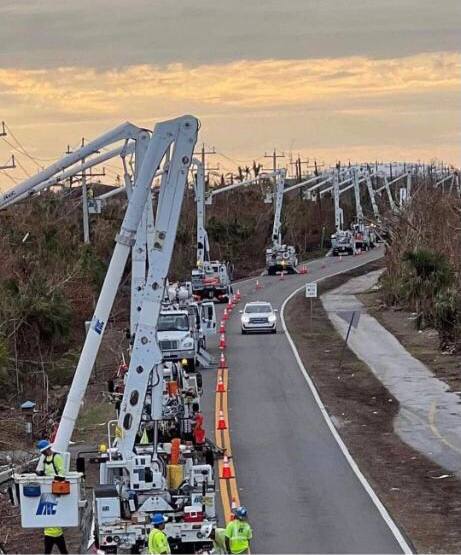
Due to the speed of the storm, there are convoys coming to construct a pre-planned electricity grid recovery process.
Convoys from every city, town and state from the east-coast to the mid-west. A glorious melding of dirty fingernails all arriving for the meet-up. Depending on your proximity to the bigger picture objectives at hand, you will cherish their arrival.
But first, there will be an assessment. The convoys will stage at pre-determined locations using radios for communication. Most cell phone services will likely be knocked out.
Recovery teams will begin a street-by-street review; everything needs to be evaluated prior to thinking about beginning to rebuild a grid. Your patience within this process is needed; heck, it ain’t like you’ve got a choice in the matter…. so just stay positive.
Meanwhile, you might walk outside and find yourself a stranger in your neighborhood. It will all be cattywampus.
Trees gone, signs gone, crap everywhere, if you don’t need to travel, DON’T.
I mean CRAP e.v.e.r.y.w.h.e.r.e.
Stay away from powerlines.
Try to stay within your immediate neighborhood for the first 36-48 hours. Keep the roadways and main arteries clear for recovery workers, power companies and fuel trucks.
Be entirely prepared to be lost in your own neighborhood and town for days, weeks, and even months. Unknown to you – your subconscious mind is like a human GPS mapping system. When that raging Helene takes away the subconscious landmarks, I guarantee you – you are gonna get lost, make wrong turns, miss the exit etc.
It’s kinda funny and weird at the same time.
Your brain is wired to turn left at the big oak next to the Church, and the road to your house is likely two streets past the 7-11 or Circle-k. You don’t even notice that’s how you travel around town; that’s just your brain working – it is what it is.
Well, now the big oak is gone; so too is the Circle-K and 7-11 signs. Like I said, everything is cattywampus. Your brain-memory will need to reboot and rewire. In the interim, you’re going to get lost… don’t get frustrated.
No street signs. Likely no stop signs. No traffic lights.
Remember, when it is safe to drive, every single intersection must be treated like a four-way stop…. and YOU ARE GOING TO HAVE TO PAY ATTENTION. Even the major intersections.
You’ll need to override your brain tendency to use memory in transit. You’ll need to pay close attention and watch for those who are not paying close attention. Travel sparingly, it’s just safer.
Check on your-self first, then your neighbors. It doesn’t matter if you’ve never said a word to the guy in the blue house before. It isn’t normalville now. Break out of your box and check on the blue house down the street too. In the aftermath, there’s no class structure. Without power, the big fancy house on the corner with a pool is just a bigger mess. Everyone is equally a mess.
The first responders in your neighborhood are YOU.
You, the wife, your family, Mrs. Wilson next door; Joe down the street; Bob’s twin boys and the gal with the red car are all in this together. If you don’t ordinarily cotton to toxic masculinity, you will worship it in the aftermath of a hurricane. Git-r-done lives there.
Don’t stand around griping with a 40′ tree blocking the main road to your neighborhood. Figure out who’s got chainsaws, who knows how to correctly use them, and set about safely clearing the road. If every neighborhood starts clearing their own roadways, the recovery crews can then move in for the details.
Stage one focuses on major arteries… then secondary… then neighborhood etc. It’s a process. Oh, and don’t get mad if your fancy mailbox is ploughed over by a focused front-end loader who is on a priority mission to clear a path. Just deal with it. Those same front-end loaders will also be removing feet of sand from coastal roads. Don’t go sightseeing… stay in your neighborhood.
For the first 36-48 hours, please try to stay close to home, in your neighborhood. Another reason to stay close to home is the sketchy people who can sometimes surface, looters etc. Staying close to home and having contact with your neighbors is just reasonable and safer.
Phase-1 recovery is necessarily, well, scruffy…. we’re just moving and managing the mess; not trying to clean it up yet. It’ll be ok. There are going to be roofing nails everywhere, and you will likely get multiple flat tires in the weeks after the hurricane.
After this storm half of the people living near the Big Bend are going to fit into two categories, two types of people: (1) those with a new roof; or (2) those with a blue roof (tarp).
Keep a joyous heart filled with thankfulness; and if you can’t muster it, then just pretend. Don’t be a jerk. You will be surrounded by jerks…. elevate yourself. If you need to do a few minutes of cussing, take a walk. Keep your wits about you and stay calm.
Now, when the recovery teams arrive…. If you are on the road and there’s a convoy of utility trucks on the road, pull over. Treat power trucks and tanker trucks like ambulances and emergency vehicles. Pull over, give them a clear road and let them pass.
When everyone gets to work, if you see a lineman, pole-digger or crew say thanks. Just simple “thanks”. Wave at them and give them a thumb-up. No need to get unnecessarily familiar, a simple: “thank you for your help” will suffice. You know, ordinary people skills.
Many of these smaller crews will be sleeping in cots, or in their trucks while they are working never-ending shifts. Some will be staging at evacuation shelters, likely schools and such. The need to shelter people and recovery crews might also delay the re-opening of schools.
Once you eventually start getting power back, if you see a crew in a restaurant, same thing applies… “thanks guys”.
Same goes for the tanker truckers. The convenience stores with gas pumps are part of the priority network. Those will get power before other locales without power. Fuel outlets are a priority. Fuel is the lifeblood of recovery. Hospitals, first responders, emergency facilities, fuel outlets, then comes commercial and residential.
Remember, this is important – YOU are the first responder for your neighborhood. Don’t quit. Recovery is a process. Depending on the scale of the impact zone, the process can take days, weeks and even months.
Take care of your family first; then friends and neighborhood, and generally make a conscious decision to be a part of any needed solution.
Pray together and be strong together. It might sound goofy to some, but don’t be bashful about being openly thankful in prayer.
It will be ok.
It might be a massive pain in the a**, but in the end, it’ll be ok.
Governor Ron DeSantis has some great information and advice in this press conference this morning.
Posted originally on Sep 26, 2024 By Martin Armstrong
| Thank you for all the emails about the storm and whether I will be alright. Don’t worry. Biden will never let me die. I pay enough taxes to keep Zelensky’s pockets full. Without my taxes, Zelensky might not be able to repair his place in Miami, or Russia might actually win. I don’t know why the IRS is playing the middleman. We should just be sending our checks to Kiev directly. And, I never dated a girl named Helene, so I don’t fear any retribution.
I took this at 7:30 AM. There was still a little blue-sky.
This one is from 12:45. I will post another before the sun goes down.
The last time, I evacuated and went to Orlando so I could be in the middle of it. Then the FAKE News, all of them, only show the worse possible places. I finally asked a boy who came to work in the hotel if the interstate was clear. He said he had no problem driving to work. I left expecting some flooding, and there was nothing. I got home, and the power never went out. The one before that, CNN said we would have a 10ft wall of water. It turned out to be 6 inches. FAKE news has engulfed everything.
Posted originally on the CTH on September 26, 2024 | Sundance
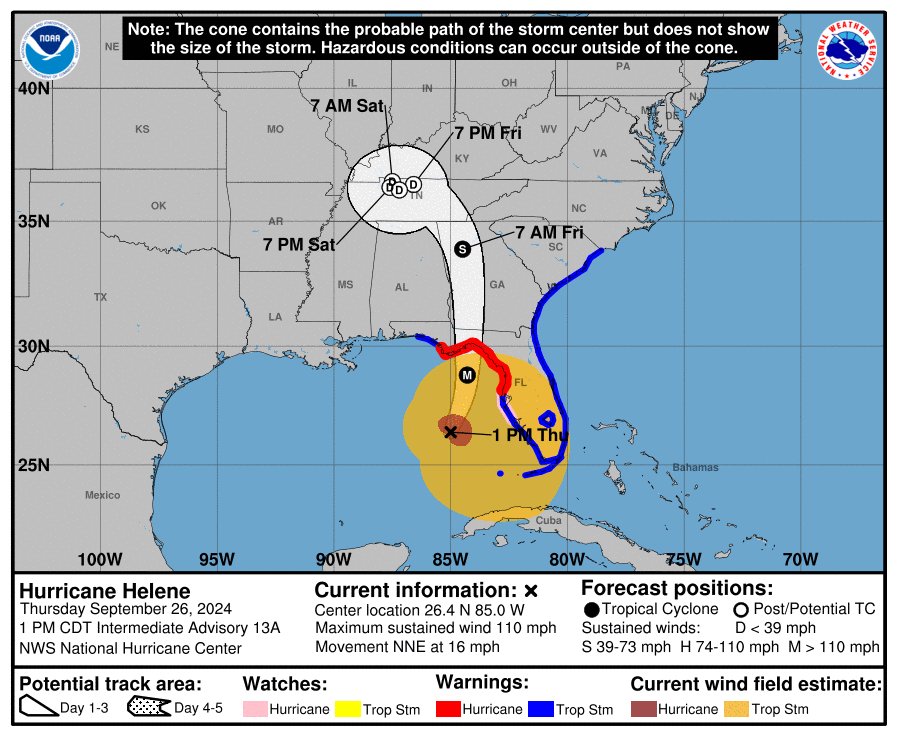
Hurricane Helene is following the forecast track. SW Florida is feeling the impact of the first storm surge. Tropical storm force winds are being felt throughout Florida. All interests in the Big Bend area should heed local officials’ warnings and instructions. Focus on the local emergency management advice.
For those who are in the path of the storm, there comes a time when all options are removed, and you enter the “Hunkering Down” phase. You’re just about there now. Hurricane force winds extend 60 miles from center.
At 100 PM CDT (1800 UTC), the center of Hurricane Helene was located near latitude 26.4 North, longitude 85.0 West. Helene is moving toward the north-northeast near 16 mph (26 km/h). A significant increase in forward speed is expected during the next 24 hours. On the forecast track, Helene will make landfall in the Florida Big Bend region this evening. After landfall, Helene is expected to turn northwestward and slow down over the Tennessee Valley on Friday and Saturday.
Maximum sustained winds have increased to near 110 mph (175 km/h) with higher gusts. Additional strengthening is forecast, and Helene is expected to be a major hurricane when it reaches the Florida Big Bend coast this evening. Weakening is expected after landfall, but Helene’s fast forward speed will allow strong, damaging winds, especially in gusts, to penetrate well inland across the southeastern United States, including over the higher terrain of the southern Appalachians.
Helene is a very large hurricane. Hurricane-force winds extend outward up to 60 miles (95 km) from the center and tropical-storm-force winds extend outward up to 345 miles (555 km). (link)
As many long-time readers will know, we do have a little bit more than average experience dealing with the aftermath of hurricanes. I ain’t no expert in the before part; you need to heed the local, very local, professionals who will guide you through any preparation, and neighborhood specific guidelines, for your immediate area.
However, when it comes to the “duration part” and the ‘after part’, well, as a long-time CERT recovery member, and survivor of multiple direct hits, perhaps I can guide you through the expectation and you might find some value. Consider this little word salad a buffet, absorb what might be of value pass over anything else.
A category-4 storm can and will erase structures, buildings and landscape. Hurricane Helene is similar to Hurricane Charley which impacted the SW coast of Florida in 2004, only larger. The coastal topography will likely change in the 60-mile-wide area of immediate impact.
Total infrastructure failure should be anticipated, and it will take weeks for restoration. The coastal communities are the most vulnerable; however, the inland impact of the storm will continue unimpeded until the eyewall crosses onto land.
That means communities inland for 50 miles will likely see consistent 100+ MPH winds for several hours. That scale of sustained wind energy will snap power poles and reinforced concrete.
As the backside of the storm then reverses the energy direction, any already compromised structures will not withstand the additional pressure. In many cases -particularly those who go through the eyewall- the backside of the storm is worse than the front. If you are inland, prepare yourself for a long duration of extensive wind damage followed by an extended power outage.
For those who are in the path of the storm, there comes a time when all options are removed, and you enter the “Hunkering Down” phase. You’re just about there now. Fortunately, just like Charley, this particular hurricane Helene will move fast and that might mitigate some of the coastal storm surge (only one part of one tidal cycle). However, in totality from impact through recovery this is going to be a long-duration event.
When the sustained winds reach around 45mph today the power will begin to shut down. However, do not be alarmed, this actually makes things a heck of a lot safer in the aftermath; and much easier and safer during the rebuild. Do not expect the power to be turned back on until it is safe.
Hurricanes can be frightening; downright scary. There’s nothing quite like going through a few to reset your outlook on just how Mother Nature can deliver a cleansing cycle to an entire geographic region. The sounds are scary. Try to stay calm despite the nervousness. Telephone and power poles, yes, even the concrete ones, can, and likely will, snap like toothpicks. Trees will bend and break; the sounds are dramatic.
There’s a specific sound when you are inside a hurricane that you can never forget. It isn’t a howl, it’s a roar. It is very unique sound in depth and weight. Yes, within a hurricane wind has weight, it’s the pressure of it.
Stay clear of windows and doors, and within an interior room of the house or apartment if possible. That scary roar sounds like it won’t ever quit…. it will… eventually; but at the time you are hunkering down, it doesn’t seem like it will ever end.
A hurricane wind is a constant and pure rage of wind that doesn’t ebb and flow like normal wind and storms. Hurricane wind is heavy, it starts, builds and stays; sometimes for hours. Relentless, it just won’t let up. And then, depending on Helene’s irrelevant opinion toward your insignificant presence, it will stop. Judging by the forward speed the hurricane force wind will likely last around 2 hours before it stops.
Then silence. No birds. No frogs. No crickets. No sound.
Nature goes mute. It’s weird.
We have no idea how much ambient noise is around us, until it stops.
Due to the speed of the storm, there will be convoys coming to construct a pre-planned electricity grid recovery process even before the sun rises tomorrow. Convoys from every city, town and state from the east-coast to the mid-west. A glorious melding of dirty fingernails all arriving for the meet-up. Depending on your proximity to the bigger picture objectives at hand, you will cherish their arrival.
But first, there will be an assessment. The convoys will stage at pre-determined locations using radios for communication. Most cell phone services will likely be knocked out. Recovery teams will begin a street-by-street review; everything needs to be evaluated prior to thinking about beginning to rebuild a grid. Your patience within this process is needed; heck, it ain’t like you’ve got a choice in the matter…. so just stay positive.
Meanwhile, you might walk outside and find yourself a stranger in your neighborhood. It will all be cattywampus.
Trees gone, signs gone, crap everywhere, if you don’t need to travel, DON’T.
I mean CRAP e.v.e.r.y.w.h.e.r.e.
Stay away from powerlines.
Try to stay within your immediate neighborhood for the first 36-48 hours. Keep the roadways and main arteries clear for recovery workers, power companies and fuel trucks.
Be entirely prepared to be lost in your own neighborhood and town for days, weeks, and even months. Unknown to you – your subconscious mind is like a human GPS mapping system. When that raging Helene takes away the subconscious landmarks, I guarantee you – you are gonna get lost, make wrong turns, miss the exit etc.
It’s kinda funny and weird at the same time.
Your brain is wired to turn left at the big oak next to the Church, and the road to your house is likely two streets past the 7-11 or Circle-k. You don’t even notice that’s how you travel around town; that’s just your brain working – it is what it is.
Well, now the big oak is gone; so too is the Circle-K and 7-11 signs. Like I said, everything is cattywampus. Your brain-memory will need to reboot and rewire. In the interim, you’re gonna get lost… don’t get frustrated.
No street signs. Likely no stop signs. No traffic lights.
Remember, when it is safe to drive, every single intersection must be treated like a four-way stop…. and YOU ARE GOING TO HAVE TO PAY ATTENTION. Even the major intersections.
You’ll need to override your brain tendency to use memory in transit. You’ll need to pay close attention and watch for those who ain’t paying close attention. Travel sparingly, it’s just safer.
Check on your-self first, then your neighbors. It don’t matter if you’ve never said a word to the guy in the blue house before. It ain’t normalville now. Break out of your box and check on the blue house down the street too. In the aftermath, there’s no class structure. Without power, the big fancy house on the corner with a pool is just a bigger mess. Everyone is equally a mess.
The first responders in your neighborhood are YOU.
You, the wife, your family, Mrs. Wilson next door; Joe down the street; Bob’s twin boys and the gal with the red car are all in this together. If you don’t ordinarily cotton to toxic masculinity you will worship it in the aftermath of a hurricane. Git-r-done lives there.
Don’t stand around griping with a 40′ tree blocking the main road to your neighborhood. Figure out who’s got chainsaws, who knows how to correctly use them, and set about safely clearing the road. If every neighborhood starts clearing their own roadways, the recovery crews can then move in for the details.
Stage one focuses on major arteries… then secondary… then neighborhood etc. It’s a process. Oh, and don’t get mad if your fancy mailbox is ploughed-over by a focused front end loader who is on a priority mission to clear a path. Just deal with it. Those same front-end loaders will also be removing feet of sand from coastal roads. Don’t go sightseeing… stay in your neighborhood.
For the first 36-48 hours, please try to stay close to home, in your neighborhood. Another reason to stay close to home is the sketchy people who can sometimes surface, looters etc. Staying close to home and having contact with your neighbors is just reasonable and safer.
Phase-1 recovery is necessarily, well, scruffy…. we’re just moving and managing the mess; not trying to clean it up yet. It’ll be ok. There are going to be roofing nails everywhere, and you will likely get multiple flat tires in the weeks after the hurricane.
After this storm half of the people living near the Big Bend are going to fit into two categories, two types of people: (1) those with a new roof; or (2) those with a blue roof (tarp).
Keep a joyous heart filled with thankfulness; and if you can’t muster it, then just pretend. Don’t be a jerk. You will be surrounded by jerks…. elevate yourself. If you need to do a few minutes of cussing, take a walk. Keep your wits about you and stay calm.
Now, when the recovery teams arrive…. If you are on the road and there’s a convoy of utility trucks on the road, pull over. Treat power trucks and tanker trucks like ambulances and emergency vehicles. Pull over, give them a clear road and let them pass.
When everyone gets to work, if you see a line-man, pole-digger or crew say thanks. Just simple “thanks”. Wave at them and give them a thumbs-up. No need to get unnecessarily familiar, a simple: “thank you for your help” will suffice. You know, ordinary people skills.
Many of these smaller crews will be sleeping in cots, or in their trucks while they are working never-ending shifts. Some will be staging at evacuation shelters, likely schools and such. The need to shelter people and recovery crews might also delay the re-opening of schools.
Once you eventually start getting power back, if you see a crew in a restaurant, same thing applies… “thanks guys”.
Same goes for the tanker truckers. The convenience stores with gas pumps are part of the priority network. Those will get power before other locales without power. Fuel outlets are a priority. Fuel is the lifeblood of recovery. Hospitals, first responders, emergency facilities, fuel outlets, then comes commercial and residential.
Remember, this is important – YOU are the first responder for your neighborhood. Don’t quit. Recovery is a process. Depending on the scale of the impact zone, the process can take days, weeks and even months.
Take care of your family first; then friends and neighborhood, and generally make a conscious decision to be a part of any needed solution.
Pray together and be strong together. It might sound goofy to some, but don’t be bashful about being openly thankful in prayer.
It will be ok.
It might be a massive pain in the a**, but in the end, it’ll be ok.
√ Andrew √ Jeanne √ Frances √ Ivan √ Charley √ Irma √ Ian
I have created this site to help people have fun in the kitchen. I write about enjoying life both in and out of my kitchen. Life is short! Make the most of it and enjoy!
This is a library of News Events not reported by the Main Stream Media documenting & connecting the dots on How the Obama Marxist Liberal agenda is destroying America





 Centinel2012