Posted originally on the conservative tree house on June 27, 2021 | Sundance | 97 Comments
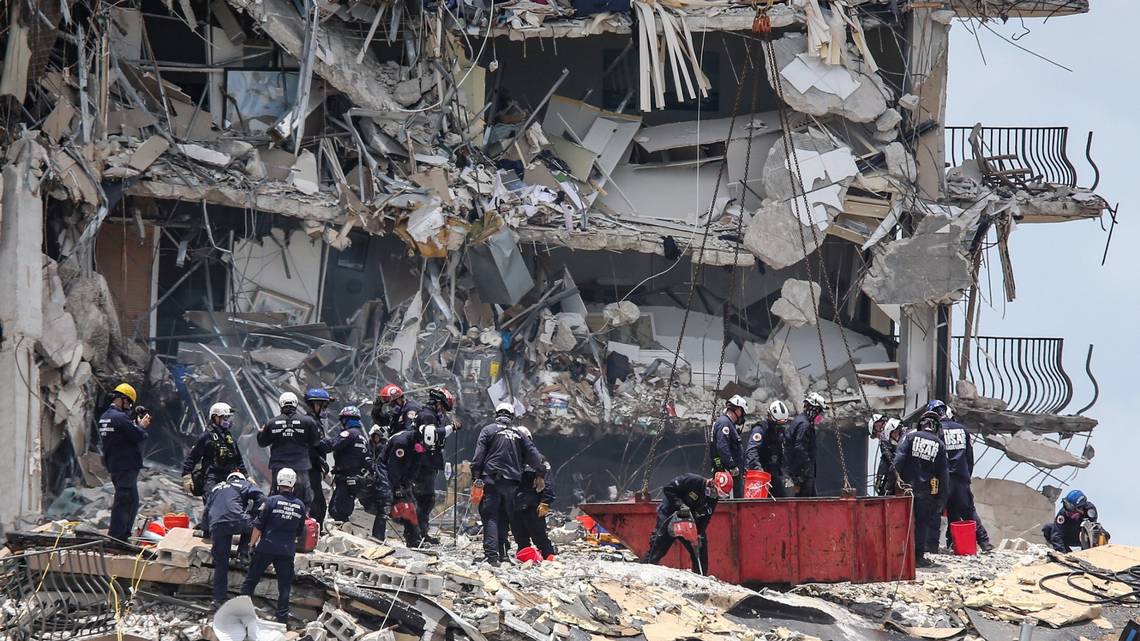
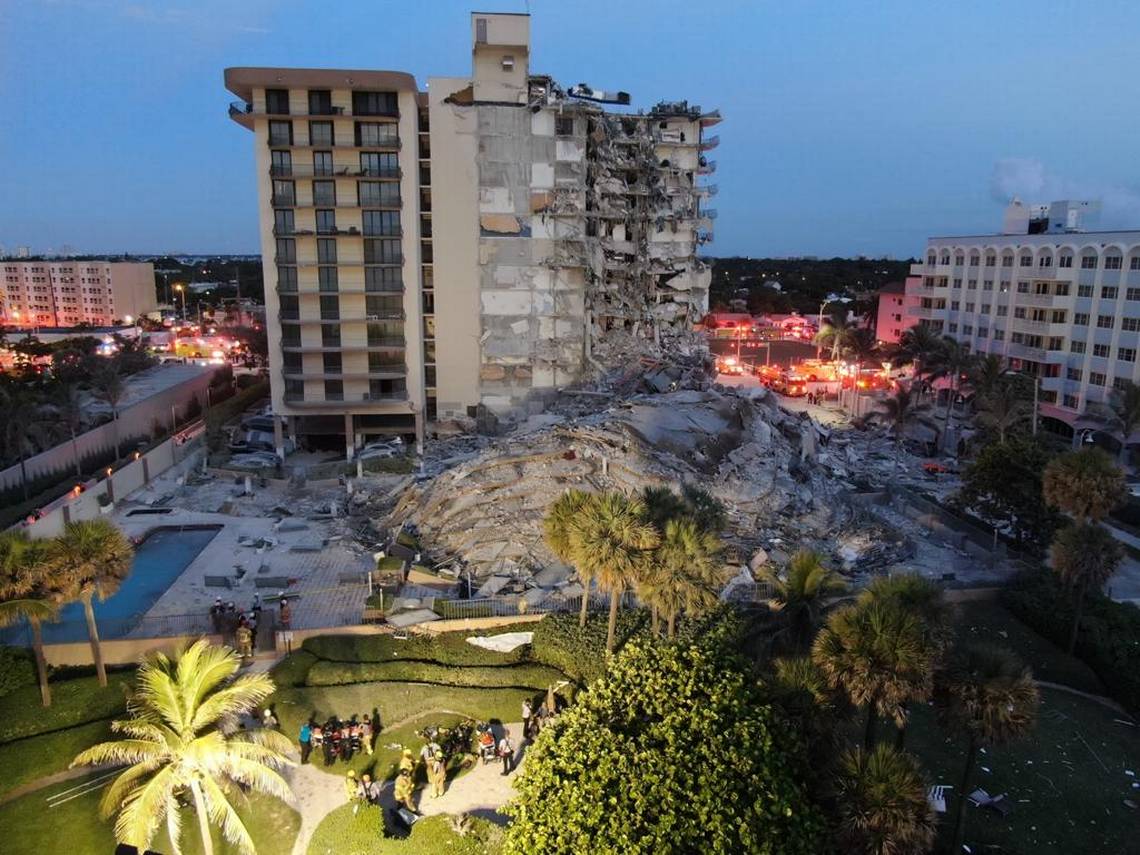
The tragic mission is still called “search and rescue” as more heavy equipment is brought in on the fourth day of rescue efforts. In the past day four more bodies “and additional human remains” have been recovered from the ruble of the collapsed 12 story condo building in Surfside Florida.
Hopes are diminishing for the 156 people still missing. Specific prayers this Sunday for the families of those lost and for the safety of the rescue workers who are in very perilous surroundings.
Miami Dade – Rescuers have recovered another four bodies in the wreckage of the Champlain Towers South condominium collapse, bringing the total to nine dead and 156 still missing since the Surfside building collapsed early Thursday.
The latest victims were discovered along with “additional human remains” in a 135-foot long trench dug into the rubble to add rescue and recover teams — the newest tactic in the round-the-clock excavation of an unstable, sometimes shifting mountain of debris.
“We are making every effort to identify those others that have been recovered,” Miami-Dade Mayor Daniella Levine Cava said in a Sunday morning press conference. (read more)
Posted originally on the conservative tree house on June 25, 2021 | Sundance | 68 Comments
Heartbreak north of Miami-Dade as the number of missing persons in the Surfside condo collapse rises to 159 people. Search and rescue efforts continued throughout the night and morning as rescue workers enter their 36th hour of operations. The work is dangerous as the remaining elements of the building are very unstable.
MIAMI-DADE The arduous and heartbreaking task of recovering the bodies of victims at the site of the collapse of the Champlain Towers South condo in Surfside began overnight and continued into a somber Friday morning in an unfolding tragedy that is feared to be the worst building failure in Florida history.
Miami-Dade Mayor Daniella Levine Cava said Friday morning that the number of people who are unaccounted for in Thursday’s building collapse increased to 159 — dramatically higher than the 99 reported earlier. The official death toll rose to four, as three more people were found in the rubble.
She said 120 people are now accounted for but stressed that all the numbers are “fluid” because some residents may not have been in the building when it collapsed.
[…] While the cause of the 12-story oceanfront condo tower’s collapse remains unknown, Levine Cava and other county officials confirmed that there was no sinkhole under the building.
State Chief Financial Officer Jimmy Patronis, who also serves as the state fire marshal, said on CNN early Friday morning the rescue mission would continue into the day, with search-and-rescue teams from Naples and Orlando coming to relieve Miami-Dade searchers who had been working their way through the rubble for more than 24 hours. (read more)
While the cause of the collapse is unknown the fact the building was located near the coast in South Florida; was built with an underground parking garage, and previous reports of the building slowly shifting/sinking point to structural instability and potential design flaws from the 40 year-old construction. Not to be too blunt, but put a barstool on a beach and sit on it…. that’s the stability element many structural engineers in S-FL are discussing.
Regardless of cause this is a horrific event and our thoughts and prayers go out to the victims and their families. The rescue workers are also facing peril as the elements of the remaining building that did not collapse are tenuous at best. We pray for the safety of those trying around the clock to rescue and recover the lost.
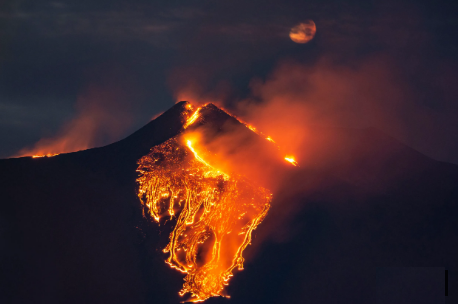
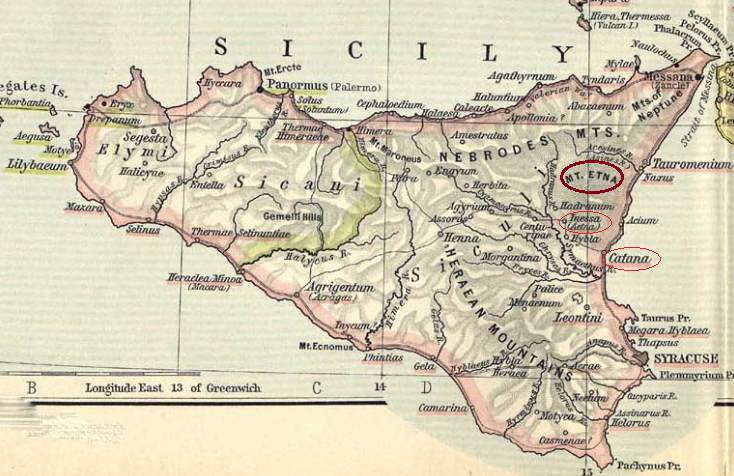
The lava flows from the Mt. Etna volcano, near Catania in Sicily, Italy, Feb. 23, 2021, are providing spectacular images. The explosion, which began just before midnight on Monday night, sent a plume of ash that rose for several kilometers from the top of Etna, as reported by The National Institute of Geophysics and Volcanology, Etneo Observatory.
The earliest historical writer to mention an eruption of Mount Etna is Thucydides. In the course of his history of the Peloponnesian War, he records that there had been three eruptions of the volcano since the Greeks had settled in Sicily. He says the first occurred in the spring of 425BC when “a fire-flood issued from Aetna as on former occasions and destroyed the territory of Catania”; the preceding one took place fifty years before, which is doubtless the one described by Pindar and Aeschylus and mentioned in the “Marmor Parium”15 as happening in 479BC. He makes no mention of the date of the third one. These are the earliest historical records of the volcano, which therefore do not antedate the fifth century BC. After 400BC several eruptions are recorded in Graeco-Roman writers. Of these, the chief ones are the following: 396 BC, when a great lava stream reached the sea on the northeastern base of the volcano in which Catania was destroyed. Interestingly, perhaps just before Julius Caesar (100-44BC) crossed the Rubicon in 49BC, Vergil mentions as one of the signs of the gods’ displeasure at Caesar’s untimely death was an eruption of Mt Aetna.
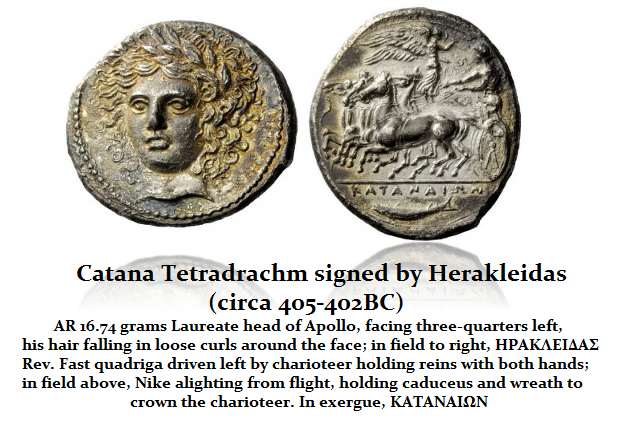
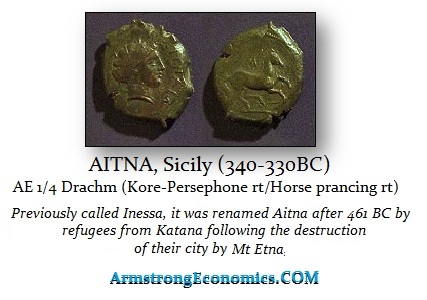
Following the destruction of Catana by Mt Etna, the refugees fled to Inessa, a small suburb. They renamed that city Aitna and began to strike coinage in the name of their new city.
Hurricane Delta posed a particularly dangerous threat to Louisiana as much of the exact same area was previously hit by Hurricane Laura just six weeks ago. With massive amounts of debris from Laura still in the cleanup process Hurricane Delta was poised to deliver a troubling double-whammy. However, that said, first responders and state officials are saying there were no fatalities from Delta – Prayers Answered.
[Via ABC] Hurricane Delta, now a tropical depression, made landfall near Creole, Louisiana, on Friday evening, with nearly 11 million people in the storm’s path. More than 600,000 power outages were reported across Texas, Louisiana and Mississippi early Saturday afternoon as the storm’s remnants moved further inland.
Delta is now expected to move across western and northern Mississippi before heading into the Tennessee Valley tonight and Sunday. (more)
Material stuff can be replaced, people cannot. Now the incredible heroes from across the United States will move in to begin restoring power. Massive numbers of power crews are working to rebuild the grid; tens of thousands of tons of debris being removed. [Much of what is now called “debris” represents the cherished belongings of thousands of lives.]
Now it’s time to try and restore some sense of normalcy for those who have been impacted, and commit to a long-term rebuilding process. Stay strong. Thousands have staged. Help is on the way…
“It was quite a night,” Lake Charles resident Don Dixon said as he cleaned up branches and assessed his home in the Louisiana city. Dixon worried as the rain poured and the wind howled, but the damage was not as bad as he had feared.
“All in all, we got punched in the face, but we’re getting back up,” Dixon said.
Anther resident, Caleb Cormier, drove around all morning, and said most of the damage he’d seen was debris on the roads and one downed electrical line.
“It really is nowhere near the amount of damage that Hurricane Laura did, and I’m very grateful for that,” Cormier said as he cleared up tree branches and garbage from the street so it wouldn’t be a hazard for passing cars.
Still, damage reached far inland, with trees shorn of leaves and falling onto streets in Louisiana’s capital of Baton Rouge. Widespread power outages were also reported. LINK
A glorious melding of dirty fingernails all arriving for the recovery meet-up. Depending on your proximity to the bigger picture objectives at hand, you will cherish their arrival.
Recovery teams will begin a street-by-street review; everything needs to be evaluated prior to thinking about beginning to rebuild a grid. Your patience within this process is needed; heck, it ain’t like you’ve got a choice in the matter…. so just stay positive.
Meanwhile, you might walk outside and find yourself a stranger in your neighborhood.
It will all be cattywampus.
Trees gone, signs gone, crap everywhere, if you don’t need to travel, DON’T.
I mean CRAP e.v.e.r.y.w.h.e.r.e.
Stay away from power-lines.
Try to stay within your immediate neighborhood for the first 36-48 hours. Keep the roadways and main arteries clear for recovery workers, power companies and fuel trucks.
Remember, when it is safe to drive, every single intersection must be treated like a four-way stop…. and YOU ARE GOING TO HAVE TO PAY ATTENTION. Even the major intersections.
You’ll need to override your brain tendency to use memory in transit. You’ll need to pay close attention and watch for those who ain’t paying close attention. Travel sparingly, it’s just safer.
Stage one recovery focuses on major arteries… then secondary… then neighborhood etc. It’s a process. Oh, and don’t get mad if your fancy mailbox is ploughed-over by a focused front end loader who is on a priority mission to clear a path. Just deal with it. Those same front-end loaders will also be removing feet of sand from coastal roads. Don’t go sightseeing… stay in your neighborhood.
For the first 36-48 hours, please try to stay close to home, in your neighborhood. Another reason to stay close to home is the sketchy people who can sometimes surface, looters etc. Staying close to home and having contact with your neighbors is just reasonable and safer.
Phase-1 recovery is necessarily, well, scruffy…. we’re just moving and managing the mess; not trying to clean it up yet. It’ll be ok. There are going to be roofing nails everywhere, and you will likely get multiple flat tires in the weeks after the hurricane.
If you are on the road and there’s a convoy of utility trucks on the road, pull over. Treat power trucks and tanker trucks like ambulances and emergency vehicles. Pull over, give them a clear road and let them pass.
When everyone gets to work, if you see a line-man, pole-digger or crew say thanks. Just simple “thanks”. Wave at them and give them a thumbs-up. No need to get unnecessarily familiar, a simple: “thank you for your help” will suffice. You know, ordinary people skills.
Many of these smaller crews will be sleeping in cots, or in their trucks while they are working never-ending shifts. Some will be staging at evacuation shelters, likely schools and such. Once you eventually start getting power back, if you see a crew in a restaurant, same thing applies… “thanks guys”.
Same goes for the tanker truckers. The convenience stores with gas pumps are part of the priority network. Those will get power before other locales without power. Fuel outlets are a priority. Fuel is the lifeblood of recovery. Hospitals, first responders, emergency facilities, fuel outlets, then comes commercial and residential.
Pray together and be strong together. It might sound goofy to some, but don’t be bashful about being openly thankful in prayer.
It will be ok.
It might be a massive pain in the a**, but in the end, it’ll be ok.
The U.S. Geological Survey said the quake’s magnitude was 7.7, while Mexico’s seismological institute put its strength at 7.1. Quakes of such size can be devastating. Historically, when strong earthquakes hit this region, we tend to see smaller quakes hit in the New York City area. Meanwhile, the Indonesia volcano Mount Merapi’s is also starting to erupt and that has been the area where the volcanic activity has been large enough in history to create volcanic winters. In Europe, crops are already behind season in many areas because of a very cold May/June.
Many people have been writing in asking what does Socrates have to say on the earthquake that shook Puerto Rico. This was the first people have really felt since 1917. While such earthquakes may appear to be rare events, there is a general 19.29-year cycle on earthquakes in that general region of the Caribbean. Here is the data of just major earthquakes in the Caribbean.
Year
Location
Magnitude
1692
Jamaica
7.5
1751
Port-au-Prince
8
59
1770
Port-au-Prince
7.5
19
1787
Boricua
8
17
1842
Cap-Haïtien
8.1
55
1843
Guadeloupe
8.5
1
1907
Kingston
6.5
64
1918
San Fermín
7.1
11
1946
Dominican Republic
8.1
28
1974
Lesser Antilles
6.9
28
1984
San Pedro Basin
6.7
10
2003
Dominican Republic
6.4
19
2004
Les Saintes
6.3
1
2007
Martinique
7.4
3
2010
Haiti
7
3
2018
Haiti
5.9
8
2020
Puerto Rico Basin
6.5
2
There is a general cycle of 19.29 years which was due 2019.71. This is a cycle based on the entire region and it reflects an average, not a specific location. Nonetheless, we should see a noticeable increase in earthquake events in the region.
What you will notice is that the last column on the right which is the number of years between events. Note that since the 2004 event, the frequency has changed. This is what I have been warning about which ties into the fraud being carried out about Climate Change groups of Greenpeace and Al Gore.
There was a solar maximum in 2000. In 2006 NASA initially expected a solar maximum in 2010 or 2011, and thought that it could be the strongest since 1958. However, the solar maximum was not declared to have occurred until 2014, and even then was ranked among the weakest on record.
Even since the peak in 2000, the profile of volcanoes and earthquakes on a global scale have increased. This is what takes place during solar minimum phases because the energy waves coming from the sun change. It is believed that the types of waves emitted from the sun penetrate the earth and may be causing greater activity in volcanoes and earthquakes. This correlates also with the ECM during the historical rise and fall of civilizations.
This is all a backdrop to what Socrates is warning about a return of inflation and global cooling due to solar minimum which will result in also food shortages. So the climate change conspiracy groups may get their wish – reduction in population, but from global cooling
While traveling aboard Air-Force-One, President Trump held a briefing with officials on the aftermath of Hurricane Dorian, and allowed the traveling press pool to participate. [Video and Transcript Below]
.
[Transcript] THE PRESIDENT: So we were going to take a helicopter to Emerald Isle in North Carolina, which was hit very, very hard. Atlantic Beach was hit very hard. Certain areas were really hit. The Governor is with me. Roy, thank you very much for being here.
GOVERNOR COOPER: Sure, Mr. President.
THE PRESIDENT: The Governor was standing in the rain for a long time, along with a lot of talented people that have really helped us a lot. Lindsey, I’m glad you’re here with us, and we appreciate it very much. And Kevin is here someplace.
ACTING SECRETARY MCALEENAN: I’m behind you.
THE PRESIDENT: Where’s — hello, Kevin. Thank you. Thank you for being here.
We have a big rally tonight for Dan Bishop. I was going to go from Emerald Isle right back into the rally, but now we’ll be very early for our rally. That’s the one thing. But it was, I guess, Roy, they say very dangerous flying conditions. I said, “Let’s do it anyway.” They said, “Sir, we’d rather not.” So, I said, “Okay, I’ll take your word for it.” The greatest pilots in the world.
We will be spending a little time. We’re going to be given a presentation as to what’s happening in North Carolina and a little bit about a couple of the other places. I just spoke to Governor Henry McMaster, and they’re in great shape in South Carolina. They’ve done a really good job.
Roy, maybe I could ask you to say a few words —
GOVERNOR COOPER: Yes, sir.
THE PRESIDENT: — and what you need from the federal government.
GOVERNOR COOPER: Yes, sir. First, Mr. President, thank you for coming to North Carolina. We’ve enjoyed our working relationship probably too much. With FEMA, we’re glad to have Mr. Gaynor here with us. And, of course, we’ve had the FEMA team embedded with us at our Emergency Operations Center in Raleigh.
This is the third hurricane that has crossed the coast of North Carolina in less than three years. So this is something that we take very seriously. The widespread damage of Dorian did not approach the damage that we had from Florence and Matthew, but it was still significant in some parts.
We’ve had three deaths in North Carolina related to the storm. Two of them were people who fell off ladders while they were trying to get their house boarded up for the storm. And the other death happened post-storm, with a chainsaw accident with cleanup. We still have about 3,500 people without power, but we had a couple of hundred thousand at one point.
THE PRESIDENT: Right. They’ve done a great job.
GOVERNOR COOPER: One of the hard-hit areas is Ocracoke Island, which they said it’s the worst that they had ever seen. I talked to a man who had a house built in the 1870s, and they had never seen it that bad.
The power is still out there. We’re providing food, resources, working with all of our federal and local partners to provide help there.
The place that you were going to go, Emerald Isle, as the storm approached, it had an EF2 tornado hit an RV park. I toured it on Saturday. The damage was significant. Many homes absolutely destroyed. We had issued an evacuation order, and therefore, most of the people were gone. The few people who were there survived and are lucky that they are alive. And they — I’m sure they appreciated the fact that you had planned to go and see. And I know we have local government officials here who were ready.
We have a nuclear power plant at Brunswick which had to be powered down as the storm him. Today it’s powered back up, and we think everything is okay with that. We still have about 20 road closures. We don’t have anything approaching the last two storms, but we still have some there. We’ve got 125 National Guard activated now, down from 577.
What we would request, Mr. President, is an expedited disaster declaration for both debris removal and for emergency protective measures. And we’ve got joint preliminary damage assessments going on right now with state, FEMA, local, trying to determine the extent of the damage.
And the other thing that I’d like to mention is that Hurricane Florence hit this state badly, and you were here for that, but —
THE PRESIDENT: That’s right.
GOVERNOR COOPER: — less than a year ago. And we have a number of people who were — are not in their homes yet that were affected by Dorian. So any help that you can give us with HUD publishing the Federal Register for the CDBG-DR money for Hurricane Florence —
THE PRESIDENT: Right. We will do that.
GOVERNOR COOPER: — we would appreciate. We’ve had a good relationship with Secretary Carson, but there’s a couple of things that would be helpful, I think, long term with CDBG-DR money, which would, one, be a universal application for all disaster survivors that would work with FEMA, would work with SBA, that would work with HUD. I think that would slim things down and make it a lot easier.
THE PRESIDENT: We’ll look into that.
GOVERNOR COOPER: And also, maybe codifying the CDBG-DR money instead of the Federal Register. And I know there’s legislation in both the House and the Senate for that.
I have with me my Secretary of Public Safety Erik Hooks, who is behind you there. We’re grateful for his work and our local partners we have here too, Mr. President.
THE PRESIDENT: Good. We’ll you’ve done a great job. Thank you very much, Roy.
GOVERNOR COOPER: Thank you, sir.
THE PRESIDENT: Erik, would you like to say something?
MR. HOOKS: Yes, sir, Mr. President. From my aspect, I’d like to emphasize the partnerships that we have all throughout the Department of Homeland of Security, the Coast Guard, FEMA. They’re always at the table. And they’re at the table when things are relatively peaceful.
So when a tragedy in our all-hazards approach hits us, we’re ready and we’re partnered, and those relationships are strong.
THE PRESIDENT: Thank you very much.
GOVERNOR COOPER: Mr. President, if I could add one more thing. The Admiral is here and we were in communication throughout the storm. But the Coast Guard did amazing work, both during Florence and during Dorian. They helped us rescue a man from Ocracoke Island and helped to bring him off, and worked closely with our National Guard. We’re grateful for our Coast Guard and our relationship with them.
THE PRESIDENT: They’ve been so incredible. I’ve always said, for the last three or four years, there’s no brand that has gone up more than the United States Coast Guard. In Texas, they saved thousands and thousands of lives. They’ve done a job like I’ve never seen. Then you went to Florida. Then you went to Puerto Rico. Then you went back here. And the job you’ve done in the Bahamas has been incredible. So please extend my wishes to everybody, Admiral.
Would you like to say something?
ADMIRAL SMITH: No — Mr. President and Governor Cooper, I just — the Coast Guard was just glad to be part of the team. We have a great relationship with the state, with our federal partners, local partners, and we were happy to be part of the team.
As you know, as this storm came up, we flowed in resources —
THE PRESIDENT: Yeah.
ADMIRAL SMITH: — and were ready to respond. And then the focus was providing response when needed, and then opening the ports as quickly as possible. We did that, and I think it went about as well could be expected, sir.
THE PRESIDENT: You’ve done a fantastic job. How are the new Coast Guard cutters?
ADMIRAL SMITH: They’re doing great, sir. We had to flow them out of the region, but we flowed them back in. And they were the first to get offshore to provide response.
THE PRESIDENT: But they’re great. They’re both great.
THE PRESIDENT: We got them. We got them. They were getting very old. Now you have brand new beauties, right?
ADMIRAL SMITH: Yes, sir, Mr. President.
THE PRESIDENT: That’s very good.
ADMIRAL SMITH: We’re in good shape, sir.
THE PRESIDENT: Kevin, would you guys like to say something?
ACTING SECRETARY MCALEENAN: Absolutely. Thank you, Mr. President. As you know, we’re here in support of our state partners. And Governor Cooper and his team, Commissioner Hook, have been outstanding throughout the effort.
I’d like Administrator — Acting Administrator Pete Gaynor to give you a little bit of sense of the preparations that we had in place in the initial response, and, of course, we’re doing the joint naval assessments now.
THE PRESIDENT: Good. Pete?
ACTING ADMINISTRATOR GAYNOR: Yes, sir. As soon as we realized that Dorian bypassed U.S. Virgin Islands and Puerto Rico and was not going to touch land again, (inaudible) and the NRCC, the National Response Coordination Center, which you visited the other day, was big storm, big response. And we had staff, material, equipment from Miami to Fort A.P. Hill, Virginia, making sure that we could provide all the governors, to include Governor Cooper, whatever they needed from not only FEMA but from the federal family.
And, again, it takes partnerships to make it all happen. And when it works well, it’s a great thing to see. So I thank everyone here that is part of the federal team.
THE PRESIDENT: And I have to say, Ron DeSantis and Brian Kemp and — Henry has been fantastic in South Carolina. Henry McMaster and yourself. The governors have really done a fantastic job. They’ve worked. Whether it’s Republican, Democrat, doesn’t matter. In this case, we’re talking about one that’s on the other side, and the relationship was perfect, right? We have a really good relationship.
And we’re working to get it all together. I want to say that FEMA, first responders, law enforcement has been incredible. Really on the ball. And they were ready in Puerto Rico. Everybody thought it was going to hit Puerto Rico, and we were all set. And, fortunately, it missed Puerto Rico. What it did to the Bahamas is incredible. And the government of the Bahamas has asked us to help. And we have a lot of assets over there, right now, trying to help. That’s really a life-saving mission, when you get right down to it. But the Coast Guard and FEMA and all of you have done a fantastic job.
Would you like to say anything in front of the camera?
ACTING SECRETARY MCALEENAN: No, sir.
THE PRESIDENT: Okay. Lindsey Graham, please?
SENATOR GRAHAM: Well, I want to thank you for calling Henry. To my friends in North Carolina, I used to be a reservist at Seymour Johnson. You all have been hit really hard. And, unfortunately, our delegations in South Carolina and North Carolina are getting pretty good at turning the funds around. And Kevin and Nancy work well together.
So we got to fund the government entirely by the end of the month. But I promise you, we’ll do everything we can to get the money flowing. And being your neighbor, I’m really sorry. I know it’s been really hard up here.
So, thank you, Mr. President.
THE PRESIDENT: Well, thanks. You’ve done a great job. Thank you, Lindsey, very much.
And, Leader, what do you think? You’re working, I know, with the Democrats, and we’re getting things approved rapidly. How’s it going?
HOUSE MINORITY LEADER MCCARTHY: Yeah. I think it’s working well. The only thing, I do want to credit and thank all of you for how well everybody has worked together. The coordination, knowing how this storm would change course, the modeling continuing to go, and just the preparation. I know you saved a lot of lives by the preparation you do.
Our responsibility, Lindsey and others, is making sure the resources are there. And there was — as we talked to FEMA ahead of time, there was enough money. And if there’s more needed, we’ll continue to work towards it.
THE PRESIDENT: Thank you very much, Kevin. And, Admiral, thank you for keeping me in touch. He was with me all the way. No matter where I went, the Admiral was right there. And you let us know. And we were able to do a lot of good by being there. So, thank you.
Would you have anything to say, Admiral?
ADMIRAL SCHULTZ: Just, with regard to the Bahamas — because much of the attention has shifted there now, Mr. President — USAID, the Agency for International Development, their Office of Foreign Disaster Assistance, has been the coordinating lead working directly with the government of the Bahamas, responding to their request for the most acute humanitarian needs of the Bahamian people.
And as you’ve talked about, it’s a very concentrated area of the Bahamas that was affected. The rest of the Bahamas, almost the size of the state of California, is unaffected and open for business. So, Bahamians are helping Bahamians, evacuating people to other sections of the Bahamas that have not been affected. And not only the United States, but foreign governments and non-governmental organizations are all also there in force, providing the humanitarian aid that’s needed.
THE PRESIDENT: So, people are unaware of the fact, for the most part, that the Bahamas is a much bigger place than people would understand, than most people would understand. So you’re actually moving large numbers of people into safer areas and areas that weren’t affected in the Bahamas by the hurricane.
ADMIRAL SCHULTZ: Right, sir. The government of the Bahamas is actually doing that, assisted by others, moving people from the most affected islands, generally the Abaco island which was really damaged —
THE PRESIDENT: Right.
ADMIRAL SCHULTZ: — toward Nassau, which is an area of the Bahamas that was relatively undamaged that has the resources to help those folks out.
THE PRESIDENT: That’s great. They’ve really done a great job. Thank you very much.
So, we have now people standing on line, trying to get into the arena. And I will tell you that they are soaking wet, because Roy and everybody just walked under the plane, and you folks were wet. It is bad weather out there. But we have a tremendous crowd, and we’re going to be there in a little while. We’re going over a little bit earlier than anticipated.
So, I hope you’re going to be able to join us, and we’ll have some fun. It’s going to be a good rally.
Yes.
SENATOR GRAHAM: Mr. President, I forgot to mention one thing. The budget agreement that you helped negotiate with the House and the Senate — no agreement is perfect, but if we had not done the budget deal, we’d go back into sequestration. You would not be having new ships.
THE PRESIDENT: It’s true.
SENATOR GRAHAM: The biggest winners were the DHS and the military as a whole. So in times like this, I appreciate what you did on the budget because sequestration would have been devastating.
THE PRESIDENT: And I think it’s really important to say, Mexico has passed it, Canada has passed it. The USMCA is vital for our country, the economics of our country. You have two countries that have gone through the process fully. And we’re waiting for an approval from the House. I think the Senate will approve it rapidly. So we hope they can get that moving. It’s a great thing for us.
The farmers — even the unions are really liking it a lot. And we’re going to make certain little changes. But Bob Lighthizer is dealing with Nancy Pelosi. I think they’re getting along very well. Steve Mnuchin is involved. And hopefully they can get a vote on that very quickly — the USMCA. Very important. Thank you.
Okay. Thank you, folks. Thank you all very much. Thank you.
Steve Harrigan reports from Abaco Island in the Bahamas as search and rescue efforts continue. The scale of the devastation is incredible; everything is gone, and worse yet the topography has changed removing the ability of deep water ports to be used in/around most of the northern Bahama islands. The anticipated death toll is expected to be dramatic. [Disturbing Content]
.
The duration of Hurricane Dorian has changed the underwater topography making access to the Island communities even more difficult, if not impossible. The Bahamian National Emergency Management Agency and the Royal Bahamian Defense Force have warned all ocean vessels to stay clear of the Northern Bahama islands.
The equipment needed, and the fuel to make the equipment operational, is not able to reach the Islands because the underwater topography has changed. Deep water channels and port routes need to be remapped. Most previous ports in/around the Northern Bahamas are no longer feasible for use. What used to be deep water is now shallow water.
Air crews from the U.S. Coast Guard and U.S. Military are working under the authority granted by the Bahamian National Emergency Management Agency and the Royal Bahamian Defense Force to reach as many island residents as possible. However, the mass delivery of tonnage is severely limited by the inability to open the airports and use fixed wing carriers.
Large ships cannot port, and hovercrafts are needed to avoid the issues with topography changes. All coastal maps are essentially useless around Abacos and Grand Bahama Island. Near shore navigation is currently impossible for large vessels.
This recovery effort is going to be complex and long duration.
Coast Guard crews have rescued 205 people in the Bahamas since Hurricane Dorian began.
The Coast Guard is conducting air operations based out of Andros Island, Bahamas. Seven MH-60 Jayhawk helicopters and five MH-65 Dolphin helicopters are conducting search and rescue missions, area assessments and providing logistical support.
Port Condition Zulu is in effect for the Port of Savannah and Brunswick, Georgia.
Port Condition Zulu is in effect for the Port of Charleston, South Carolina.
Eight Coast Guard cutters are staged near the Bahamas ready to engage in Hurricane Dorian response efforts.
For their safety, the Coast Guard advises mariners to not attempt voyages into the Northern Bahamas until further notice due to the devastating effects of Hurricane Dorian.
The Government of the Bahamas is currently assessing its northern ports and harbors to determine if they are safe to enter. There is a high risk of debris in the water, sunken vessels, and destroyed or missing aids to navigation and pier facilities. There is also a risk of chemical spills and changes to the topography/hydrology in ports and marinas from the prolonged winds and storm surge of the Category 5 hurricane.
The Coast Guard is supporting the Bahamian National Emergency Management Agency and the Royal Bahamian Defense Force, who are leading search and rescue efforts in the Bahamas.
If you are in a life-threatening situation and need assistance, call 911 or 919 in the Bahamas, or call the Bahamian National Emergency Management Agency at 242-325-9983 or the Bahamian Emergency Operations Center at 242-362-3895 or 242-362-3896.
During Port Condition Zulu, no vessels may enter or transit within ports without permission of the COTP. All vessel movements are prohibited, and all ship-to-shore operations must cease. (link)
Hurricane Dorian has begun moving north, finally starting to lessen the impact on Grand Bahama Island. The strongest winds have diminished to 110 mph, but the wind field has expanded and now covers 60 miles from center. The storm surge along the U.S. Southeast is anticipated to be very significant through all tide cycles.
At 500 PM EDT (2100 UTC), the center of Hurricane Dorian was located near latitude 27.7 North, longitude 78.7 West. Dorian is moving toward the northwest near 6 mph (9 km/h), and a slightly faster motion toward the northwest or north-northwest is expected tonight. A turn toward the north is forecast by Wednesday evening, followed by a turn toward the north-northeast Thursday morning.
On this track, the core of Hurricane Dorian will move dangerously close to the Florida east coast and the Georgia coast tonight through Wednesday night. The center of Dorian is forecast to move near or over the coast of South Carolina and North Carolina Thursday through Friday morning.
Maximum sustained winds are near 110 mph (175 km/h) with higher gusts. Dorian is expected to remain a powerful hurricane during the next couple of days.
Dorian has become a larger hurricane. Hurricane-force winds extend outward up to 60 miles (95 km) from the center and tropical-storm-force winds extend outward up to 175 miles (280 km). (more)
If you are near the southeastern coast of the United States please pay attention to the instructions from local officials. If you are in the mid-Atlantic region, your preparation should be rushed to completion. Anyone asked to evacuate please follow the advice your local officials. No-one likes to leave their home; but safety must be the number one priority.
In the next several days recovery crews will begin reaching Grand Bahama Island. Our thoughts and prayers are with those residents who survived two days of sustained hurricane ferocity; and our appreciation for those who now head into the aftermath as they attempt to rescue and recover.
It’s impossible to find words to describe what the people in Grand Bahama island must be going through. More than 24 hours inside a 90-mile wide buzzsaw of sustained cat-5/cat-4 winds, stationary over a populated island, is beyond comprehension.
Two, perhaps three, complete tide cycles; plus 20 feet of storm surge, plus the catastrophic wind must be completely overwhelming the land mass of the island… A topography changing event. We pray for those who still have hours left amid this storm.
At 500 PM EDT (2100 UTC), the eye of Hurricane Dorian was located near latitude 26.8 North, longitude 78.4 West. Dorian has become nearly stationary this afternoon. A slow westward to west-northwestward motion is expected to resume overnight and continue into early Tuesday. A turn toward the northwest is forecast by late Tuesday, with a northeastward motion forecast to begin by Wednesday night.
On this track, the core of extremely dangerous Hurricane Dorian will continue to pound Grand Bahama Island into Tuesday morning. The hurricane will then move dangerously close to the Florida east coast late Tuesday through Wednesday evening and then move dangerously close to the Georgia and South Carolina coasts on Wednesday night and Thursday.
An Air Force Reserve Hurricane Hunter aircraft has found that maximum sustained winds are near 145 mph (230 km/h) with higher gusts. Dorian is a category 4 hurricane on the Saffir-Simpson Hurricane Wind Scale. Although gradual weakening is forecast,
Dorian is expected to remain a powerful hurricane during the next couple of days.
Hurricane-force winds extend outward up to 45 miles (75 km) from the center and tropical-storm-force winds extend outward up to 150 miles (240 km). (more)
I have created this site to help people have fun in the kitchen. I write about enjoying life both in and out of my kitchen. Life is short! Make the most of it and enjoy!
This is a library of News Events not reported by the Main Stream Media documenting & connecting the dots on How the Obama Marxist Liberal agenda is destroying America







 Centinel2012