“A Watershed Month” – November Sees Greatest “Asset Rotation” Since 2013


Tyler Durden's picture

The final November fund flow numbers are in, and as BofA’s Michael Hartnett puts it, November, it was a “watershed” month for fund flows with the largest 5-week
bond outflows in three and a half years at $10 billion…

… the largest 3-week precious metals outflows
in 3.5 years…

… and the largest 5-week equity inflows since October 2013 at $34.5 billion.

Focusing on just the last week, the “Trumpflation rotation” out of bonds and into stocks continued, with $4.4 billion in bond outflows, $0.6 billion precious metals outflows vs $1.2 billion in  equity
inflows according to Bank of America, which writes that investor flows have stabilized following violent post-US election flows; In fact, a mini revulsion may already be forming with the first TIPS outflows in 6 months, first EM equity inflows in 5 weeks, first HY bond inflows in 5 weeks and first utilities inflows in 5 weeks.

Some further observations from Hartnett who notes that while November was “Fast & Furious” there was no Euphoria: despite the strongest 4-week equity inflows in 2 years, a sharp drop in FMS cash to 5.0% and a big US equity rally, our sentiment signals have actually shifted in a more contrarian bullish direction in recent weeks. In fact, our BofAML Bull & Bear Indicator has fallen to 3.0, the lowest reading in 4 months, on the back of big redemptions from high-beta EM equity funds, EM debt funds & HY bond funds.

Broken down by asset class shows that the trend of flows out of active managed funds and into ETFs continued:

  • Equities: small $1.2bn inflows (note $6.3bn ETF inflows vs $5.2bn outflows from mutual funds)
  • Bonds: $4.4bn outflows (5 straight weeks = longest streak in 14 months)
  • Precious metals: $0.6bn outflows (3 straight weeks)

Looking only at Equity Flows:

  • Europe: $2.0bn outflows (largest in 11 weeks)
  • US: $4.4bn inflows (4 straight weeks)
  • EM: ekes out first inflows in 5 weeks (albeit small $0.1bn)
  • Japan: small $0.1bn inflows
  • By sector: 10 straight weeks of financials inflows ($0.6bn); 4 straight weeks of REITs outflows ($0.1bn)

And then fixed income, which saw 5 straight weeks of outflows from muni bond funds ($1.6bn)

  • 4 straight weeks of outflows from IG bond funds ($2.4bn)
  • 4 straight weeks of outflows from EM debt funds (albeit small $0.1bn)
  • 3 straight weeks of outflows from govt bond funds ($0.7bn)
  • First TIPS outflows in 25 weeks ($0.3bn)
  • First HY bond inflows in 5 weeks ($0.6bn)
  • Inflows to bank loan funds in 20 of past 22 weeks ($0.6bn)

However, it may all go just as fast as it came: according to Bloomberg, U.S. global-focused ETFs saw a net $742.5m of capital outflows on Dec. 1 – the funds have shrunk a net $1.5b in the past five days. Investors have put a net $23.3b into the funds in 2016. Should the risk-off sentiment persist, more outflows are likely.

Americans Not In The Labor Force Soar To Record 95.1 Million: Jump By 446,000 In One Month


Tyler Durden's picture

So much for that much anticipated rebound in the participation rate.

After it had managed to post a modest increase in the early part of the year, hitting the highest level in one year in March at 63%, the disenchantment with working has returned, and the labor force participation rate had flatlined for the next few month, ultimately dropping in November to 62.7%, just shy of its 35 year low of 62.4% hit last October. This can be seen in the surge of Americans who are no longer in the labor force, who spiked by 446,000 in November, hitting an all time high of 95.1 million.

As a result of this the US labor force shrank by 226,000 to 159,486K, down from 159,712K a month ago, and helped the unemployment rate tumble to 4.6%, the lowest level since August 2007.

Adding the number of unemployed workers to the people not in the labor force, there are now over 102.5 million Americans who are either unemployment or no longer looking for work.

Payrolls Rise 178K As Unemployment Rate Tumbles To 4.6% But Average Hourly Earnings Worst Since 2014


Tyler Durden's picture

While the headline November payrolls print came in almost on top of expectations at 178K, vs consensus of 180K there were two big surprises in today’s report, one being the unemployment rate which plunged from 4.9% to 4.6%, well below the 4.9% expected, but the biggest negative surprise was that the Average hourly earnings in November dropped by 0.1%, far below last month’s 0.4% rise, and below the 0.2% expected with the annual increase growing by a far more modest 2.5% than the 2.8% expected.

The change in total nonfarm payroll employment for September was revised up from +191,000 to +208,000, but the change for October was revised down from +161,000 to +142,000. With these revisions, employment gains in September and October combined were 2,000 less than previously reported. Over the past 3 months, job gains have averaged 176,000 per month.

One red flag in the report was the 4,000 drop in manufacturing workers, worse than the -3,000 expected, and following last month’s -5,000 print. Also of note, workers unable to work due to bad weather according to the BLS were 19K in Nov. The historical average for Nov. is 72k employees cannot work due to poor weather conditions.  Another 113k workers who usually work full-time could only work part-time due to the weather last month.


The reason for the steep drop in the unemployment rate is that while the number of employed rose from 151,925K to 152,085K, coupled with a decline in the number of unemployed by 387K, the number of people not in the labor force soared to 95.055 million, a new all time high, which in turn pressured the labor force participation rate to 62.7%, the lowest since June and just shy of the 30 year low.

But as noted above, the biggest surprise was the negative print in the average hourly earnings which declined by 0.1%, the first negative print in 2016 and the wrst print since 2014.

More details from the report:

 Total nonfarm payroll employment rose by 178,000 in November. Thus far in 2016, employment growth has averaged 180,000 per month, compared with an average monthly increase of 229,000 in 2015. In November, employment gains occurred in professional and business services and in health care.

Employment in professional and business services rose by 63,000 in November and has risen by 571,000 over the year. Over the month, accounting and bookkeeping services added 18,000 jobs. Employment continued to trend up in administrative and support services (+36,000), computer systems design and related services (+5,000), and management and technical consulting services (+4,000).

Health care employment rose by 28,000 in November. Within the industry, employment growth occurred in ambulatory health care services (+22,000). Over the past 12 months, health  care has added 407,000 jobs.

Employment in construction continued on its recent upward trend in November (+19,000), with a gain in residential specialty trade contractors (+15,000). Over the past 3 months, construction has added 59,000 jobs, largely in residential construction.

Employment in other major industries, including mining, manufacturing, wholesale trade, retail trade, transportation and warehousing, information, financial activities, leisure and hospitality, and government, changed little over the month.

The average workweek for all employees on private nonfarm payrolls was unchanged at 34.4 hours in November. In manufacturing, the workweek declined by 0.2 hour to 40.6 hours, while overtime was unchanged at 3.3 hours. The average workweek for production and nonsupervisory employees on private nonfarm payrolls was unchanged at 33.6 hours.

In November, average hourly earnings for all employees on private nonfarm payrolls  declined by 3 cents to $25.89, following an 11-cent increase in October. Over the year, average hourly earnings have risen by 2.5 percent. Average hourly earnings of private-sector production and nonsupervisory employees edged up by 2 cents to $21.73 in November.

JFK Assassination – Unintended Victim?


jfk-assassination

There is another side to the JFK assassination that does not actually negate some of the conspiracies that surround CIA or military involvement. It may actually expose that Oswald was the patsy who was out to kill John Connally, not JFK. Nevertheless, the events are still clouded by bureaucrats.

After Lee Harvey Oswald delivered those fatal shots in Dallas, a Secret Service officer named Mike Howard was dispatched to Oswald’s apartment. Agent Howard found a little green address book. In this book on page 17, under the heading, “I WILL KILL,” Oswald listed four men: James Hosty, an FBI agent; Edwin Walker, a right-wing general; and Vice President Richard Nixon. However, at the very top of that list was the governor of Texas, John Connally, where Oswald drew a dagger with blood drops dripping downward. Oswald motive was that he had written to Connally asking for help and got the typical bureaucratic reply letter.

Agent Howard turned that book over to the FBI investigating the case. Only later did he find out that someone tore that very page out of the book. Why? Was JFK assassinated by government agents and they needed Oswald for the patsy? Oswald’s wife, Marina, in her testimony to the Warren Commission, named Connally, and not Kennedy, as her husband’s target. Marina has also testified before the U.S. House Select Committee on Assassinations in 1978, repeating this same story about Connally. Oswald was obsessed with Connally, but testimony showed that he admired JFK’s important initiatives like the president’s efforts at detente with Russia. So the plot becomes interesting when one asks, “Why was that page torn out of the little green book?”

Bleeding Borders Must Stop!


The invasion from the south must be stopped and sealing the border with the US military is a viable option.

Populist-Nationalist Tide Rolls On


If all the old progressives get thrown out maybe there is hope!

Trump Effect – Mexico’s Central Bank Chief Resigns…


Media reports of Agustin Carstens resignation as chief of Mexico’s central bank have left MSM pundits and even business analysts scratching their heads. It appears no-one has any idea why Car…

Source: Trump Effect – Mexico’s Central Bank Chief Resigns…

trump-standing-in-gap41122111211

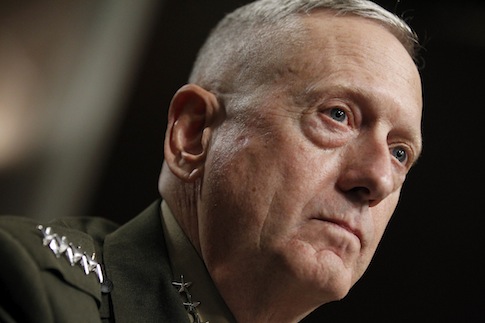
Trump Confirms Retired Marine General “Mad-Dog” Mattis Will Be America’s Next Secretary Of Defense


Tyler Durden's picture

Update: Speaking during an Ohio “thank you” rally, Donald Trump just confirmed that James “Mad Dog” Mattis will be America’s next Secretary of Defense.

*  *  *

President-elect Donald Trump has chosen 66-year-old retired Marine General James N. “Mad-Dog” Mattis to be secretary of defense, according to The Washington Post.

An announcement is likely by early next week, according to the people familiar with the decision. Mattis declined to comment. Spokespersons for Trump’s transition team did not respond to requests for comment.

 Mattis, 66, retired as the chief of U.S. Central Command in spring 2013 after serving more than four decades in the Marine Corps. He is known as one of the most influential military leaders of his generation, serving as a strategic thinker while occasionally drawing rebukes for his aggressive talk. Since retiring, he has served as a consultant and as a visiting fellow with the Hoover Institution, a think tank at Stanford University.

Mattis has also gotten cheers from veterans and Trump supporters online, in the form of celebratory memes dubbing him the Patron Saint of Chaos (Chaos was Mattis’s call-sign in Iraq and Afghanistan), praising his lethal “double knife hands,” and saying that he “Puts the Laughter in Manslaughter.”

Mattis gets the nod ahead of a notable group who were up for the top role..

  • * David Petraeus, former CIA director and retired Army general
  • * Tom Cotton, Republican U.S. senator from Arkansas
  • * Jon Kyl, former Republican U.S. senator from Arizona
  • * Duncan Hunter, Republican U.S. representative from California and early Trump supporter, member of the House Armed Services Committee
  • * Jim Talent, former Republican U.S. senator from Missouri who was on the Senate Armed Services Committee
  • * Rick Perry, former Republican Texas governor
  • * Stephen Hadley, former national security adviser under President George W. Bush

His bio – as one would expect – is impressive…(apart from the Theranos aspect) (via The Intercept)

Mattis is exactly what Trump is not, a soldier-scholar who knows something of the wider world.

Now 66 years old, Mattis was born in Walla Walla, Washington. His lifelong bachelordom is the source of one of his many nicknames: “warrior-monk.” He served in every major U.S. Middle Eastern conflict from the first Iraq War on. In 2001, as a one-star general, he led 4,000 Marines in a search for Osama bin Laden near the Afghanistan/Pakistan border. In 2004, as a two-star, he led a Marine division into the second battle for Fallujah. He went on to lead combatant commands at the Pentagon and NATO, culminating in two years as the head of Central Command under President Barack Obama, reportedly leaving after disagreeing with Obama’s policy on Iran.

Shortly before his departure, Mattis appears to have weighed in with the Pentagon on behalf of Theranos, Elizabeth Holmes’s troubled biotech firm. He later joined the company’s board. Should Trump nominate Mattis, emails between Mattis and Holmesare likely to come up during his Senate confirmation hearing.

Professor Richard Kohn, a military historian at the University of North Carolina, called Mattis “loyal and discreet. He doesn’t talk out of school. He seeks out top people, and people like working for him.” Trump, Kohn continued, “is going to be advised by a National Security Advisor [Flynn] with some deep flaws. I think that having a legendary and respected retired general in charge of Defense makes a great deal of sense.”

“I think he would be an outstanding candidate,” Michèle Flournoy, widely believed to be Hillary Clinton’s frontrunner for secretary of defense, told NPR. In 2010, Seth Moulton, a decorated Marine captain who served in Iraq, praised Mattis as one of the “leaders who can speak the truth, who aren’t just constrained by the politics of the moment.” Moulton is now a Democratic congressman representing the Sixth District of Massachusetts.

Mattis has also gotten cheers from veterans and Trump supporters online, in the form of celebratory memes dubbing him the Patron Saint of Chaos (Chaos was Mattis’s call-sign in Iraq and Afghanistan), praising his lethal “double knife hands,” and saying that he “Puts the Laughter in Manslaughter.”

Indeed, Mattis is famous for speaking bluntly when it comes to describing the military’s primary function — killing the enemy — and for whistling about his work. He has lived down an eleven-year-old gaffe where he described killing as “a lot of fun, … a hell of a hoot,” but has never backed off from the stance that the military’s core function is not peacekeeping or humanitarian missions but war-fighting. He is widely credited with popularizing the motto of the 1st Marine Division — “No Better Friend, No Worse Enemy” — and turning it into a basic tenet of counterinsurgency doctrine. His letter to the division on the eve of the 2003 invasion is a cool-headed exhortation to “close with those forces that choose to fight, and destroy them.”

William Treseder, a former Marine who now advises startups, said that Mattis is skilled at injecting a fighting spirit into mundane jobs. “The enemy should quiver in fear every time you sign a contract,” was Mattis’s advice to a fellow soldier working in procurement, Treseder said

While Mattis briefly flirted with his own 2016 presidential run, he chose not to leap into politics with the gusto of Flynn or retired Gen. John Allen, both of whom delivered fire-breathing speeches at this year’s major-party conventions. Adm. Mike Mullen, the former chair of the Joint Chiefs of Staff, criticized both Flynn and Allen at a panel discussion last week for injecting politics into the military.

“Too many times when you see retired military individuals … take a very strong political stance, that sends the wrong message to America,” Mullen said. “It sends the wrong message back inside our military. Because it teaches our young ones that it’s okay. And it’s not okay; … it’s a fundamental principal of the United States of America that the military has got to stay apolitical.”

Keeping the military out of politics and under civilian control is one reason that the 1947 National Security Act requires that officers be out of military service for ten years before assuming the mantle of secretary of defense. In 2008, Congress lowered the waiting period to seven years. Congress granted a waiver to Gen. George Marshall, President Truman’s third secretary of defense, in 1950. Mattis would need his own congressional waiver to serve under Trump.

If Mattis and Trump still have disagreements to smooth over, the treatment of Gold Star families, whose children have died fighting for the U.S., would likely be one of them. During the campaign, Trump suffered a blistering attack from the family of Army Capt. Khizr Khan. He chose to push back, suggesting that Khan’s mother was not allowed to speak at the Democratic National Convention. He also appeared to draw an equivalence between his own struggles in business and the sacrifice made by the Khan family.

“I’ve made a lot of sacrifices,” Trump said in an interview with ABC News. “I work very, very hard.”

Trump’s words may have served to aggravate a trend that Mattis pointed out in an anthology he recently co-edited about the military-civilian relationship in the U.S., which describes the “atrophying” of empathy for Gold Star families. “What had been a more common experience of loss in previous wars now tends to be an isolating experience for families,” Mattis wrote, with his co-editor.

Should Mattis join the cabinet of such an unusual commander-in-chief, one of his challenges will be to balance the roles of servant and tutor.

Finally, here are 16 quotes (via FreeBeacon) to get a better feel for “mad-dog”…

1. “I don’t lose any sleep at night over the potential for failure. I cannot even spell the word.”

(San Diego Union Tribune)

James Mattis

AP

2. “The first time you blow someone away is not an insignificant event. That said, there are some assholes in the world that just need to be shot.”

(Business Insider)

3. “I come in peace. I didn’t bring artillery. But I’m pleading with you, with tears in my eyes: If you fuck with me, I’ll kill you all.”

(San Diego Union Tribune)

4. “Find the enemy that wants to end this experiment (in American democracy) and kill every one of them until they’re so sick of the killing that they leave us and our freedoms intact.”

(San Diego Union Tribune)

Flickr

Flickr

5. “Marines don’t know how to spell the word defeat.”

(Business Insider)

6. “Be polite, be professional, but have a plan to kill everybody you meet.”

(San Diego Union Tribune)

7. “The most important six inches on the battlefield is between your ears.”

(San Diego Union Tribune)

8. “You are part of the world’s most feared and trusted force. Engage your brain before you engage your weapon.”

(Mattis’ Letter To 1st Marine Division)

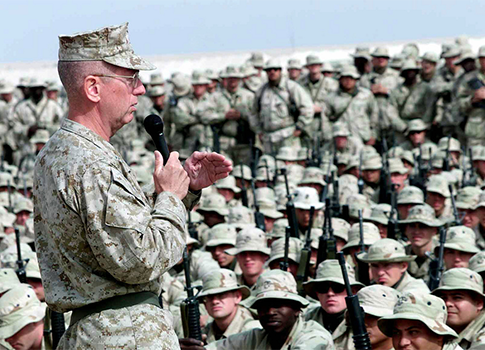
Mattis in 2006 / Flickr

Gen. Mattis in 2006 / Flickr

9. “There are hunters and there are victims. By your discipline, cunning, obedience and alertness, you will decide if you are a hunter or a victim.”

(Business Insider)

10. “No war is over until the enemy says it’s over. We may think it over, we may declare it over, but in fact, the enemy gets a vote.”

(Defense News)

11. “There is nothing better than getting shot at and missed. It’s really great.”

(San Diego Union Tribune)

12. “You cannot allow any of your people to avoid the brutal facts. If they start living in a dream world, it’s going to be bad.”

(San Diego Union Tribune)

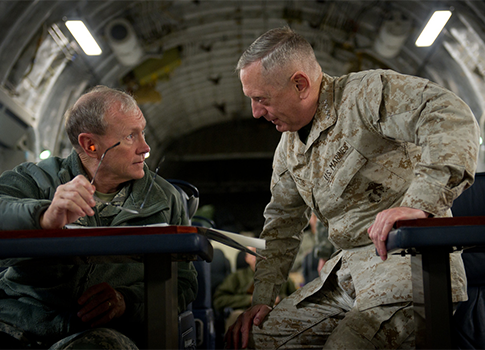
Gen. Mattis and Gen. Dempsey / Flickr

Gen. Mattis and Gen. Dempsey / Flickr

13. “You go into Afghanistan, you got guys who slap women around for five years because they didn’t wear a veil. You know, guys like that ain’t got no manhood left anyway. So it’s a hell of a lot of fun to shoot them. Actually it’s quite fun to fight them, you know. It’s a hell of a hoot. It’s fun to shoot some people. I’ll be right up there with you. I like brawling.”

(CNN)

14. “I’m going to plead with you, do not cross us. Because if you do, the survivors will write about what we do here for 10,000 years.”

(San Diego Union Tribune)

15. “Demonstrate to the world there is ‘No Better Friend, No Worse Enemy’ than a U.S. Marine.”

(Mattis’ Letter To 1st Marine Division)

16. “Fight with a happy heart and strong spirit”

(Mattis’ Letter To 1st Marine Division)

Yahoo’s Advice To Trump: Educate Children In Media Literacy To Combat Fake News


Tyler Durden's picture

Submitted by Joseph Jankowski via PlanetFreeWeill.com,

Writing for Yahoo News, National Political Columnist Matt Bai provides a suggestion to combat the so-called “fake news” epidemic that has become a major talking point of the mainstream media since Donald Trump’s victory in the presidential election. According to Bai, we should be “teaching our kids how to consume” information in an age where the internet has provided a press to anyone with a computer and a router.

Within his article, titled “The real problem behind fake news“, Bai calls fake news a “searing hot topic these days” and mentions the infamous WaPo article which cites a shadowy, anonymous organization known as PropOrNot (Propaganda or Not) that smears many legitimate conservative and libertarian news sources like Zero Hedge, Infowars, Breitbart, World Net Daily and The Ron Paul Institute as Russian propaganda.

That WaPo article highlighted what was the second blacklist of websites to make its rounds in the mainstream press last month. The first list was put together by a nobody liberal professor from Merrimack College (let me tell you how worthy of circulation that is).

Bai writes:

The emergence of “fake news” is a searing hot topic these days, as you’ve probably heard — a new, truth-free media to go with our new, truth-free politics. The Washington Post reports that a lot of these phony stories, some of which probably influenced the election in at least a tangential way, originate with Russian “bots” programmed to confuse American readers. (Payback, I guess, for all those years when Voice of America did the same thing.)

Under enormous pressure, Facebook and Google have now promised to do a better job of curating the content that populates their sites. Which is all very comforting, if you really want software engineers assuming the role of civic arbiter that has traditionally fallen to journalists. I don’t.

And the problem with cracking down on social media sites is that it’s a little like the war on drugs. You can try to stamp out the supply of garbage news, but the Web is a vast place, and as long as someone can make money off misinformation, it will always find a crack through which to seep.

Aside from citing the WaPo hit piece on basically all effective news outlets outside the MSM realm, Bai is being reasonable. Most will agree, it is better not to have Facebook and Google taking on the role of civic arbiter and information gatekeeper. And the promoting of a crackdown on social media could lead to the very slippery slope of censorship.

The Yahoo News journalist goes on to writes:

No, the long-term solution here is about stemming the demand. The answer doesn’t lie in hectoring tech companies into policing content, but rather in teaching our kids how to consume it.

Bai says that “navigating the news media isn’t intuitive anymore” and compares it to flying a plane rather than driving a car.

“A Big Bang at the genesis of the Internet age” has fractured the entire (Media) industry and its audience into a million pieces,” he says.

“The proliferation of social media and the rise of mindless aggregation” is also causing this problem of “fake news” reaching the masses, Bia writes.

My kids will spend months of their young lives studying the Revolution and the Civil War and the advent of mass production, which is fine. In grade school, they spend some part of every year revisiting the social movements of the ’60s, which is noble and important.

But what’s called “media literacy” in the education world — the ability to consume torrents of information with some level of competence and sophistication — is still an outlier in social studies curricula, despite having been discussed now for decades. Even when it’s taught, it’s crammed into a high school unit, by which time today’s grade-schoolers will have been surfing YouTube for half their lives.

It seems like a great idea, teach kids how to objectively analyze the media. But, if we are to take the mainstream media’s labeling of “fake news” seriously, we will find ourselves telling our children that only big networks like CNN and MSNBC are trustworthy sources.

The real problem with the entire fake news narrative is that “fake news”, by PropOrNot’s definition, is really not a problem at all.

The mainstream media is telling everyone that since Google’s algorithm made a mistake by linking to a false news report, individuals now must surrender their ability to look at things objectively and only trust the big news networks.

Just look at PropOrNot.com’s blacklist, it is full of alternative news sites that now have large enough audiences to bang heads with the corporate controlled press. And considering that the trust in the mainline news is equal to that of trust in congress, this can only be seen as a way to discredit the grassroots news organizations that are threatening the old media’s reign.

The labeling of fake news should be left up the internet user who might stumble across some wrong information or even some disinformation.

It would be foolish to allow the mainstream press, an unknown organization that hides its identity and a leftist professor that teaches feminist media studies, to provide what is real and what is not.

I would also not be too enthusiastic on the public school system, that runs off federal funding, embracing the rise of alternative voices in media that are usually critical of government (the way it is suppose to be).

Matt Bai ends his piece for Yahoo with a very laughable thought.

Here’s a radical thought: If President Trump is looking for a bold and useful education initiative that might serve the incidental purpose of redeeming what’s left of his soul, media literacy would be a pretty good place to start. Getting behind a nationwide push in K-through-12 classrooms could be an important and unifying priority for the incoming education secretary, Betsy DeVos.

Willingly or not, Trump has done more than anyone else to expose the problem. The least he can do is begin to address it.

HA!

You mean the Donald Trump that absolutely ridiculed the mainstream media during a meeting last month over their blatant bias coverage of the election and misrepresentations?

Hate to break it to you Matt, but if Trump were to do that many of the websites on the PropOrNot list cited by WaPo would be presented as “real news” to our children. CNN and ABC would be identified as the establishment government lapdogs that they are.

I hope Trump takes your advice.

Trump Warns US Companies There Will Be “Consequences” For Outsourcing Jobs


Tyler Durden's picture

Emboldened by his “victory” with Carrier Corp, which agreed to keep 1,100 workers in the US instead of outsourcing them to Mexico in exchange for $7 million in tax incentives over 10 years, as part of his victory tour in Indiana, Donald Trump on Thursday warned that U.S. companies will face “consequences” for outsourcing jobs overseas.

“Companies are not going to leave the United States any more without consequences. Not going to happen,” the President-elect said on a visit to a Carrier Corp plant in Indianapolis cited by Reuters.


U.S. President-Elect Donald Trump speaks at event at Carrier HVAC plant in
Indianapolis, Indiana.

Trump, did not elaborate just what the consequences would be but during the election campaign he frequently threatened U.S. firms that his administration would put a 35% import tariff on goods made by American manufacturers who moved jobs offshore. As part of his “Make America Great Again” campaign, Trump has made keeping jobs in the US one of the main aspirations of his election campaign and frequently slammed Carrier for planning to move production to Mexico as he appealed to blue-collar voters in the Midwest.

Trump said his negotiation with Carrier would serve as a model for how he would approach other U.S. businesses that are tempted to move jobs overseas to save money – which likely means providing further tax concessions in exchange for keeping workers in the US.

In laying out the “carrot”, Trump also pledged to create a healthy environment for business via lower taxes and fewer regulation: “I just want to let all of the other companies know that we’re going to do great things for business. There’s no reason for them to leave any more,” Trump said.

Should the carrot fail however, there is a “stick” and Trump warned that If that approach did not work, there would be penalties.


U.S. President-elect Donald Trump and Vice-President Elect Mike Pence tour the

Carrier factory in Indianapolis

The Carrier deal marked a quick, and high profile win for Trump, who has spent most of his time since the Nov. 8 election in New York building his team ahead of the handover of power from President Barack Obama.

Arriving early in the afternoon, Trump toured the plant in Indianapolis and shook hands with workers on an assembly line. Some workers yelled out “Thank you Mr. Trump” and “Thanks Donald” as he greeted them. Carrier confirmed that Indiana agreed to give the company $7 million in tax incentives. A source briefed on the matter said the tax incentives are over 10 years and the company has agreed to invest $16 million in the state, which is run by Governor Mike Pence, Trump’s vice president-elect.


Donald Trump greets a worker as he tours a Carrier factory with Greg Hayes,
CEO of United
Technologies in Indianapolis, Indiana, U.S., December 1, 2016.

Trump’s victory however was not without blemishes: Carrier still plans to move 600 jobs from the plant to Mexico, the Wall Street Journal said. Reuters reported earlier this week Carrier also still intends to close a factory in Huntington, Indiana, that employs 700 people making controls for heating, cooling and refrigeration and move the jobs to Mexico by 2018.

* * *

And while Trump was enjoying the first stop of his victory parade, he was slammed by Bernie Sanders who, in a WaPo op-ed, warned that the Carrier deal is incomplete and leaves the incoming Trump administration open to threats from companies, echoing a concern we noted last night.

Sanders’ concerns were actually quite valid, by highlighting the shift in the negotiating calculus between corporations and the new administration. In the very worst case, Sanders is right that companies will now feel empowered – with a vivid case study – to demand concessions in order to keep jobs in the US.

“Trump has endangered the jobs of workers who were previously safe in the United States. Why? Because he has signaled to every corporation in America that they can threaten to offshore jobs in exchange for business-friendly tax benefits and incentives,” Sanders wrote in a Washington Post opinion piece on Thursday. He is not wrong. Sanders also noted that Trump had originally said he would save 2,100 jobs that Carrier planned to move to Mexico.

“Let’s be clear: It is not good enough to save some of these jobs,” Sanders said although it was unclear what his alternative – if any – would be to keep jobs in the US.

Sanders wasn’t the only one to slam the Trump deal. Moments ago, Reuters reported that according to a senior Mexican state official, Trump’s intervention to stop jobs at a plant in Indiana going to Mexico “is typical of what happens in countries that Americans call “banana” republics.”

Trump’s deal with Carrier created an “uncomfortable” situation for the company, and went beyond politicians’ remit, Fernando Turner, economy minister for Nuevo Leon, said in an interview. “It’s not our job. It’s up to companies to take their own decisions, not politicians; that’s what’s done in Latin American countries that they call banana (republics) in the United States,” he said, laughing.

“It’s not something that was done up until now in the United States. But anyway, things change.”

Turner also said that Mexico had not been a winner from NAFTA. The trade deal had both failed to lift Mexican economic growth and had cost the country millions of jobs, he argued. In that case, we can only add, since both the US and Mexico are against NAFTA it should probably be scrapped immediately.

“(Trump) is sending a message to (U.S.) workers, to unions that they don’t need to change, that everything is fine, that Mexico is the problem. But the problem is not Mexico,” Turner added. “They’re barking up the wrong tree.”

Still, Turner said Trump was “intelligent” and his ambition to grow the U.S. economy would benefit Mexico if it came off. “Trade between Mexico and the United States did not begin with NAFTA,” he said.

* * *

While it remains to be seen how Trump will deal with Mexico – whose ambassador to the US Carlos Manuel Sada Solana told the Arizona Republic that “we have said time and again Mexico is not paying for the wall” – Trump may have to to resolve other domestic issues first: despite Trump’s deal, employers elsewhere in Indiana are laying many more thousands of workers because of foreign competition. If Trump is indeed serious about them facing “consequences”, we may soon find out just what these will be.