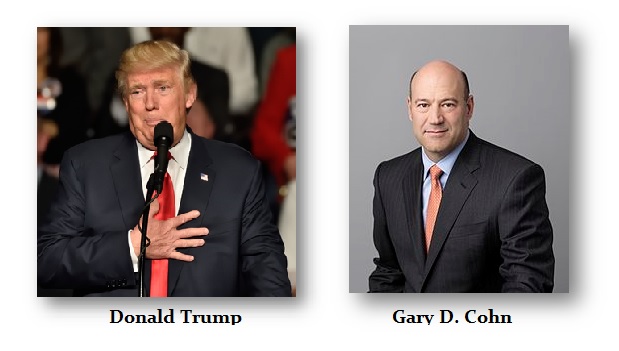
Gary Cohn Resigns from Trump Administration – Good Riddance!


The drop in the market yesterday was widely attributed to Gary Cohn resigning from the Trump Administration over his tariff policy. That must be a real shock because it Gary Cohn has resigned as White House chief economic advisor. Cohn’s planned departure comes on the heels of a decision by President Donald Trump to impose stiff tariffs on steel and aluminum imports. However, Cohn resigning has something implied behind the curtain.
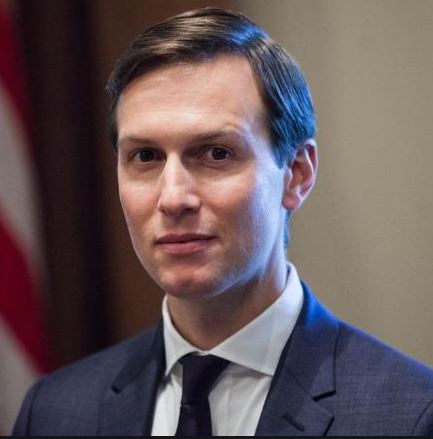
Cohn was brought in by Trump’s son-in-law and close adviser, Jared Kushner. Kushner lost access to the most valued U.S. intelligence report, the President’s Daily Brief, as the White House imposes greater discipline on access to secrets. The link between Kushner and Goldman Sachs has also been a questionable agenda behind the curtain. Cohn would NOT leave the Trump Administration simply over the tariffs on steel and aluminum. Goldman Sachs would not yield personal access to such a minor issue when Cohn personally manipulated the debt of Greece to enter the Eurozone. My sources are not so convinced about the noble position of Cohn.

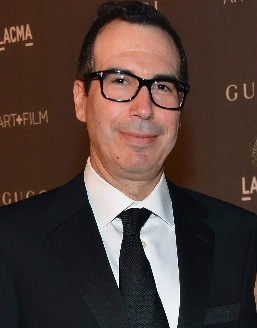
Goldman Sachs, I believe, placed two other people in strategic positions – Steven Mnuchin running the Treasury who has testified his agenda is to restore Glass Steagall, which would allow Goldman Sachs to revert to an Investment Banking house and kick out the other banks from the industry – particularly J.P.Morgan and Citibank.

Steven Mnuchin previously worked for Goldman Sachs but he left them in 2002. There has long been the rumor that once you work for Goldman Sachs, you remain as an alumnus and you still need to call them on something like this position.
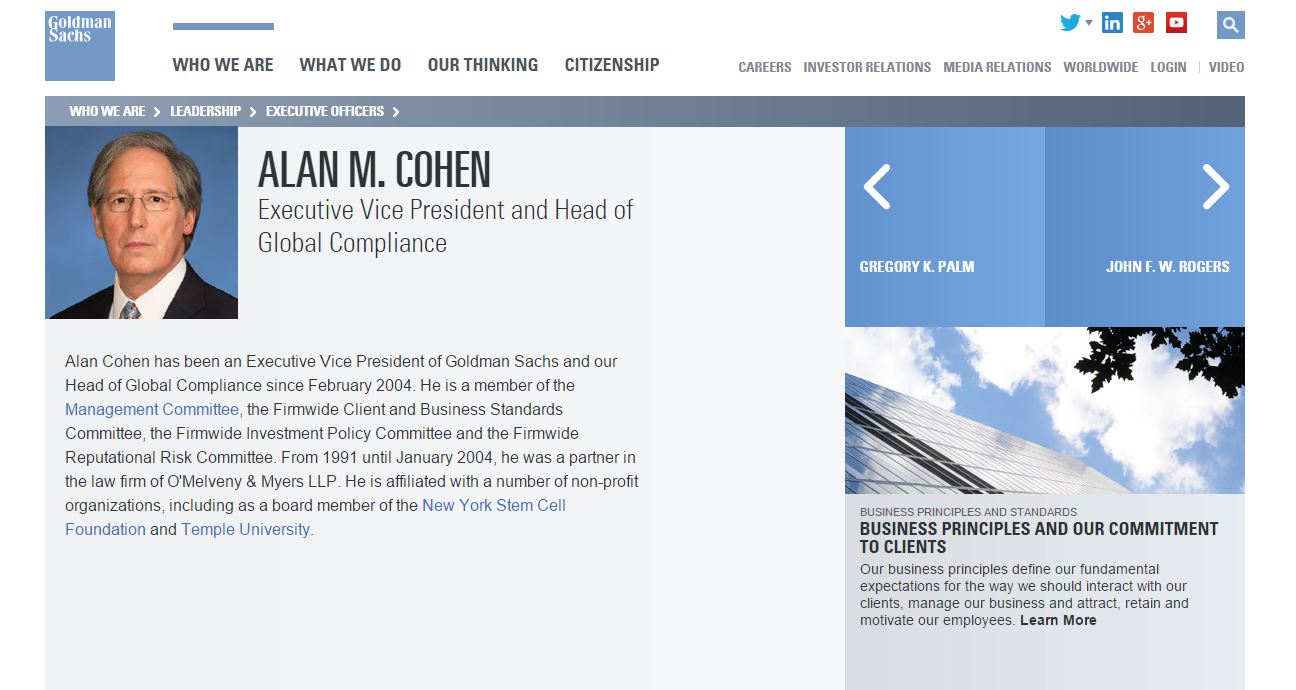
 

The third less known person I believe was a plant from Goldman Sachs is Alan Cohen who took the number two position in the SEC. Alan Cohen spent 13 years as head of compliance and a board member of Goldman Sachs. He joined the Securities and Exchange Commission as a senior policy adviser to Chairman Jay Clayton. Cohen will deal with two of the biggest issues confronting Wall Street: Brexit and new European rules that will upend banks’ research businesses.

Goldman Sachs, I believe, had placed strategic people within the Trump Administration that formed a Tripartite control over economic policy with tremendous influence that would shape the future for the firm. I believe this was an incredible strategic play to take over the Trump Administration and steer the USA into a bargaining chip for the firm in the Eurozone to fight legislation that would restrict Goldman in Europe. There is no way that Gary Cohn would depart over the simple tariff issue. There was FAR MORE at stake here than meets the eye.

These highly paid people do not walk away from million dollar salaries and bonuses to work for peanuts in government that everyone knows will be for just a brief stint. There are other considerations in play here and only a fool would think that Gary Cohn left for just a magnanimous level of principle. Trust me, if I died suddenly, my bet it would be at the direction of the New York club.

BREAKING: Jeff Sessions Already Has “Outside DC” Justice Official Investigating Judiciary Committee Concerns…


Judicial analyst and Fox News host, Shannon Bream, has an exclusive interview airing tonight on Fox News.  Jake Gibson is a Fox News producer and just tweeted this:

It would appear Attorney General Jeff Sessions already has a DOJ prosecutor looking into the issues uncovered by the House Judiciary Committee Chairman Bob Goodlatte.

You might note, as we previously outlined, Chairman Bob Goodlatte -as a specific outcome of his oversight role-  is the congressional leader working closest with DOJ Inspector General Michael Horowitz.   I shall resist the urge….

“Investigative Journalism and the Obama Administration” – Sharyl Attkisson


Sharyl Attkisson Former CBS Investigative Journalist Author, “Stonewalled: My Fight for Truth Against the Forces of Obstruction, Intimidation, and Harassment in Obama’s Washington”


“Political Corruption: Can the Swamp Be Drained?” – Kimberley Strassel


This lecture was given as part of the April 2018 National Leadership Seminar, “What is American Greatness?”

Why Is China So Afraid of the Letter N?


China is cracking down on internet users by… banning the letter N? The Right Angle team takes on the absurdity of totalitarian regimes.

Secretary Wilbur Ross Outlines MAGAnomic Phase-2 Trade ‘Reciprocity’…


Commerce Secretary Wilbur Ross talks about the importance of trade “reciprocity”.  As Wilburine outlines phase-2 MAGAnomics is only just beginning the reciprocity discussion.

Additionally, Secretary Ross talks about the issues with Chinese steel trans-shipment and the reason for Steel and Aluminum tariffs to be global in order to address China’s use of proxy nation states to continue dumping.   In this interview Ross begins to outline the fine points behind the pending 2018 trade negotiations. It is going to take a lot of repeated effort to awaken the larger U.S. electorate to the issues.

Why ship directly to the U.S., or manufacturer inside the U.S., when you could just assemble in Mexico and Canada and use NAFTA to bring your products to the ultimate goal, the massive U.S. market?

From the POTUS Trump position, NAFTA always came down to two options:

Option #1 – renegotiate the NAFTA trade agreement to eliminate the loopholes.  That would require Canada and Mexico to agree to very specific rules put into the agreement by the U.S. that would remove the ability of third-party nations to exploit the current trade loophole. Essentially the U.S. rules would be structured around removing any profit motive with regard to building in Canada or Mexico and shipping into the U.S.

Canada and Mexico would have to agree to those rules; the goal of the rules would be to stop third-party nations from exploiting NAFTA.  The problem in this option is the exploitation of NAFTA currently benefits Canada and Mexico.  It is against their interests to remove it.  Knowing it was against their interests President Trump never thought it was likely Canada or Mexico would ever agree.  But he was willing to explore and find out.

Option #2 – Exit NAFTA.  And subsequently deal with Canada and Mexico individually with structured trade agreements about their imports.  Canada and Mexico could do as they please, but each U.S. bi-lateral trade agreement would be written with language removing the aforementioned cost-benefit-analysis to third-party countries (same as in option #1.)

All nuanced trade-sector issues put aside, the larger issue is always how third-party nations will seek to gain access to the U.S. market through Canada and Mexico.  [It is the NAFTA exploitation loophole which has severely damaged the U.S. manufacturing base.]

The U.S. has to look upstream, deep into the trade agreements made by Mexico and Canada with third-parties, because it is possible for other nations to skirt direct trade with the U.S. and move their products through Canada and Mexico into the U.S.

Additionally, with Canada now joining TPP it has become impossible for the U.S. to remain in NAFTA and simultaneously conduct trade negotiations with TPP nations.

EXAMPLE: If the U.S. remained in NAFTA all TPP nations would engage in trade discussion knowing there was a Canadian and/or Mexican option to gain access to the U.S. market.  Therefore, despite the size of our market, we could never negotiate a better trade agreement than the deal existing between Canada, Mexico and their TPP partner nations.

President Trump, Commerce Secretary Wilbur Ross, Trade Adviser Peter Navarro and U.S. Trade Representative Robert Lighthizer well understand this structural problem.  ONLY Trump, Ross, Mnuchin, Navarro and Lighthizer are willing to confront this problem.  If Trump had lost the 2016 election, Clinton would have joined the multinationals and U.S. workers would have suffered greatly.

Lastly, the issue of Canada and Mexico making trade agreements with other nations (especially China), while brokering/leveraging their NAFTA position with the U.S. as a strategic part of those agreements, is a serious issue that cannot adequately be resolved while the U.S. remains connected to NAFTA.

At the conclusion of Round #6, this was the direct issue at the heart of a very frustrated U.S.T.R. Lighthizer’s strongly worded response to Canada:

[…]  In another proposal, Canada reserved the right to treat the United States and Mexico even worse than other countries if they enter into future agreements. Those other countries may, in fact, even include China, if there is an agreement between China and [Canada]. This proposal, I think if the United States had made it, would be dubbed a “poison pill.” We did not make it, though. Obviously, this is unacceptable to us, and my guess is it is to the Mexican side also. (read full remarks)

Timing Reveals What Media Ignore…


*ahem* As if on cue…

(tweet link)

DEEP-DIVE FULL BACKSTORY

The Eagle, The Panda and The Red Dragon

AG Jeff Sessions Announces Lawsuits Against California Over Interference With Immigration Enforcement…


Attorney General Jeff Sessions and the U.S. Department of Justice is filing an injunction to block enforcement of three California immigration laws, each enacted within the past year.

Summary of California Laws Being Challenged:

(Encapsulated from Fox News coverage)  ♦ One law offers additional worker protections against federal immigration enforcement actions. Senior Justice Department officials have said it’s prevented companies from voluntarily cooperating with Immigration and Customs Enforcement (ICE) officials.

Employers are mandated under the law to demand ICE agents present a warrant or subpoena before entering certain areas of the premises, or when accessing some employee records. Some companies have complained they’ve felt torn between trying to comply with seemingly contradictory state and federal statutes, since penalties for non-compliance can be steep from both entities.

♦ The second law also known as “the sanctuary state bill” protects immigrants without legal residency by limiting state and municipal cooperation with the feds, including what information can be shared about illegal-immigrant inmates.

♦ A third law gives state officials the power to monitor and inspect immigrant detention facilities either run directly by, or contracted through, the U.S. Department of Homeland Security.

Treasury Secretary Steven Mnuchin Interview With Maria Bartiromo…


Maria Bartiromo interviews Treasury Secretary Mnuchin to discuss Gary Cohn’s departure from President Trump’s National Economic Council (NEC).  {Deep Dive Here}  Secretary Mnuchin talks about the larger MAGAnomic objectives, and the transition of the administration into ‘policy phase-2’ with all attention now focused on Main Street.

Great Interview:

.

♦Economic Patriotism – ‘America First’:
√ Unleash energy development. Drive down energy costs. Lower cost-of-living.
√ Eliminate regulatory stranglehold. Unleash free market entrepreneurial expansion.
√ Lower corporate tax burden. Position business investment ‘best bet’ domestically.
√ Generate investment expansion. Create: jobs, jobs, jobs.
√ Generate higher labor demand. Jobs, Jobs, Jobs = Higher wages, wages, wages.
√ Lower middle-class tax burden. Combine higher wages with lower taxes. 2x benefits.
==> WE ARE HERE <==
• Structure trade deals to benefit workers/companies inside the U.S.
• Leverage access to U.S. market as incitement for domestic investment.
• Economic Growth + Domestic Manufacturing Expansion =  GDP increases.
• Increased overall tax revenues from expanding economy stabilizes debt and entitlements.

2018 Media Study: First Two Months 91% Network Media Trump Coverage Negative…


MRC News has just released a study of ABC, CBS and NBC broadcast news coverage for the first two months of 2018.  The results are almost identical to the results from 2017, and highlight the extreme media bias against a republican president.

(Via NewsBusters) So far, 2018 looks an awful lot like 2017 — at least when it comes to the broadcast networks’ hostile approach to Donald Trump. A Media Research Center analysis of the ABC, CBS and NBC evening newscasts in January and February found ten times more negative comments about the President than positive statements, and found the ongoing Russia investigation once again swamped all other topics.

For this study, MRC analysts looked at all 505 evening news stories that mentioned President Trump or his administration in January and February. Out of 851 total minutes of airtime devoted to the administration, the networks spent almost one-fourth of it (204 minutes, or 24%) on the Russia investigation, eclipsing other major topics such as the economy, immigration reform, and even the gun debate. (read more)