Posted originally on Oct 7, 2024 By Martin Armstrong
Thank you for all the concern. The last one was not a direct hit—it was just tidal flooding—so I could sleep through the night, as did my dogs and even my neighbor. This one is a direct hit involving wind, rain, and tidal surge. I am evacuating for this one and moving inland. I am moving to a hotel. Hopefully, I will still have internet most of the time.
Posted originally on the CTH October 7, 2024 | Sundance
lorida Governor Ron DeSantis just finished giving an update on preparations ahead of Hurricane Milton. Replay Video Below. There are multiple mandatory evacuations taking place along the western coast of Florida.
Milton came on the scene on Saturday as a tropical storm. Early Monday morning, Milton kicked off a rapid intensification starting as a Category 2 storm. By noon, the storm had strengthened to a large Category 5 hurricane, the National Hurricane Center said. Florida state preparations are ongoing.
Posted originally on the CTH October 7, 2024 | Sundance
Hurricane Milton has intensified in the Eastern Gulf and is expected to gain strength over the next 24 hours. On the positive side, most predictions have rapid deintensification in their models in the final 12 hours before landfall. However, there are major variables still to be understood.
Overall, all interests on the west coast of Florida should use the next two days to complete preparation. Today and tomorrow look like the best opportunity to secure property and prepare for a landfall event sometime late Wednesday/Thursday morning. The exact area of impact remains unknown.
(NHC) – […] An eastward to east-southeastward motion is forecast through tonight, followed by a turn toward the east and northeast on Tuesday and Wednesday. On the forecast track, Milton is forecast to move near or just north of the Yucatan Peninsula today and Tuesday, then cross the eastern Gulf of Mexico and approach the west coast of the Florida Peninsula by Wednesday.
Maximum sustained winds are now near 100 mph (155 km/h) with higher gusts. Milton is forecast to intensify rapidly and become a major hurricane later today. (read more)
Today is the day for all of us to prepare.
Due to this path, the area north of the impact eyewall will see winds offshore. The area directly south of the impact eyewall will see winds directly onshore. Preparations are always critical within the cone area; however, preparations for a west to east storm are even more critical. A few miles and a little wobble can make all the difference in the storm surge.
For those in the cone of uncertainty, remember, planning and proactive measures taken now can significantly reduce stress in the days ahead. Plan when to make the best decision on any evacuation (if needed) consider Tuesday the decision timeframe. As a general rule: take cover from wind – but evacuate away from water.
The coastal area directly below Tampa/St Pete (Sarasota, Venice, Port Charlotte, Punta Gorda, Cape Coral, Matlacha, Pine Island, Bokeelia, Sanibel Island, Captiva Island, Fort Myers, Fort Myers Beach, Bonita Springs, Naples, Marco Island, and Ten-Thousand-Islands) should be on high alert and paying very close attention.
Again, the difference between Milton being above or below your location will make a lot of difference.
If Milton, traveling West to East, hits below you the hurricane force winds will initially be blowing offshore, pulling water out (tidal variables notwithstanding). If Milton hits above you, the hurricane force winds will initially be blowing onshore, pushing water in. When considering threat variables, the specifics of intensity and eyewall size will play a big role in determining impact scope, storm surge and subsequent damage.
It is very important to pay attention to your local officials and emergency management teams. Each area is very different, and each community can feel a totally different impact depending on topographical, geographical and regional distinctions. Listen to state officials, pay attention to the National Hurricane experts, but the best suggestion is to focus your attention on the advice of local EMS officials.
DAY TWO (Monday) Get Storm Update Assemble and Purchase Hurricane Supplies Contact Insurance Company – Updates Secure Important Papers. Strengthen and Secure Your Home Make Evacuation Decision for your Family.
DAY THREE (Tuesday) Get Storm Update Re-Evaluate your Supplies based on storm update Finish last minute preparation Assist Your Neighbors If Needed – Evacuate Your Family
Communication is important. Update your contact list. Stay in touch with family and friends, let them know your plans. Select a single point of contact for communication from you that all others can then contact for updates if needed. Today/tomorrow are good days to organize your important papers, insurance forms, personal papers and place them in one ‘ready-to-go’ location.
You can see the importance of this communication plan, from the recent results of the emergency in Western North Carolina. Tell your family who your primary contact person is, then tell that contact person what you EXACTLY plan to do. That contact person then becomes the information hub for you that relays information to your family and friends.
Evaluate your personal hurricane and storm supplies; update and replace anything you might have used. Assess, modify and/or update any possible evacuation plans based on your location, and/or any changes to your family status.
Check your shutters and window coverings; test your generator; re-organize and familiarize yourself with all of your supplies and hardware. Check batteries in portable tools; locate tools you might need; walk your property to consider what you may need to do based on the storm’s path. All decisions are yours. You are in control.
Consider travel plans based on roads and traffic density. Being proactive now helps to keep any future stress level low. You are in control. If you have pets, additional plans may be needed. Look over the National Hurricane Center resources for planning assistance. [SEE HERE]
You can always tell those people who have been through direct hurricane impacts by how they parked their cars. I now include this information in all hurricane prep because it makes such a difference. If you lose your Florida garage door you will more than likely lose your roof. That’s just the reality of having a massive opening in your structure to 100 – 150 mph winds that will lift the trusses.
If you have two vehicles, put one vehicle inside the garage with the front bumper against the door to help stop the flex (do this carefully). Put the other vehicle outside blocking the garage door facing down the driveway or facing parallel to the garage. The goal is to use the aero dynamics of the car to push the wind away from the door and provide protection.
Purchase a cheap car cover to protect the outside vehicle and/or use old blankets (cable ties, bungee cords) to stop the outside vehicle from getting sandblasted and destroyed. Place double folded corrugated cardboard in front of the radiator to protect it from storm debris.
Additionally, if you live in a flood zone, or if you are concerned about storm surge, the day before impact take your #1 car to the nearest airport or hotel with a parking garage and park in the upper levels. Take an uber back home if you don’t have a friend or partner to help you. This way you know you will have one workable vehicle, just in case.
♦ Another lesson from Ian, if you drive an electric vehicle and sustain saltwater intrusion (of any level) your car is not safe. Saltwater makes the vehicle batteries extremely dangerous, and they could spark or catch fire. Multiple homes survived Hurricane Ian only to have the electric car catch fire in the garage and burn the house to the ground. Hurricane rain is wind-driven Gulf saltwater. The fire department was begging people to put their EVs outside and not to plug them in. Dozens of EVS also erupted in flames while driving down the streets after the storm.
♦ Hardening your home is a matter of careful thought and physical work. However, every opening into your structure must be protected, leaving yourself with one small exit opportunity just in case. Hopefully you have a bolted door with no glass windows you can use as an emergency exit. If not, select a small window and leave only enough room uncovered for you to get out in case of emergency or structural collapse.
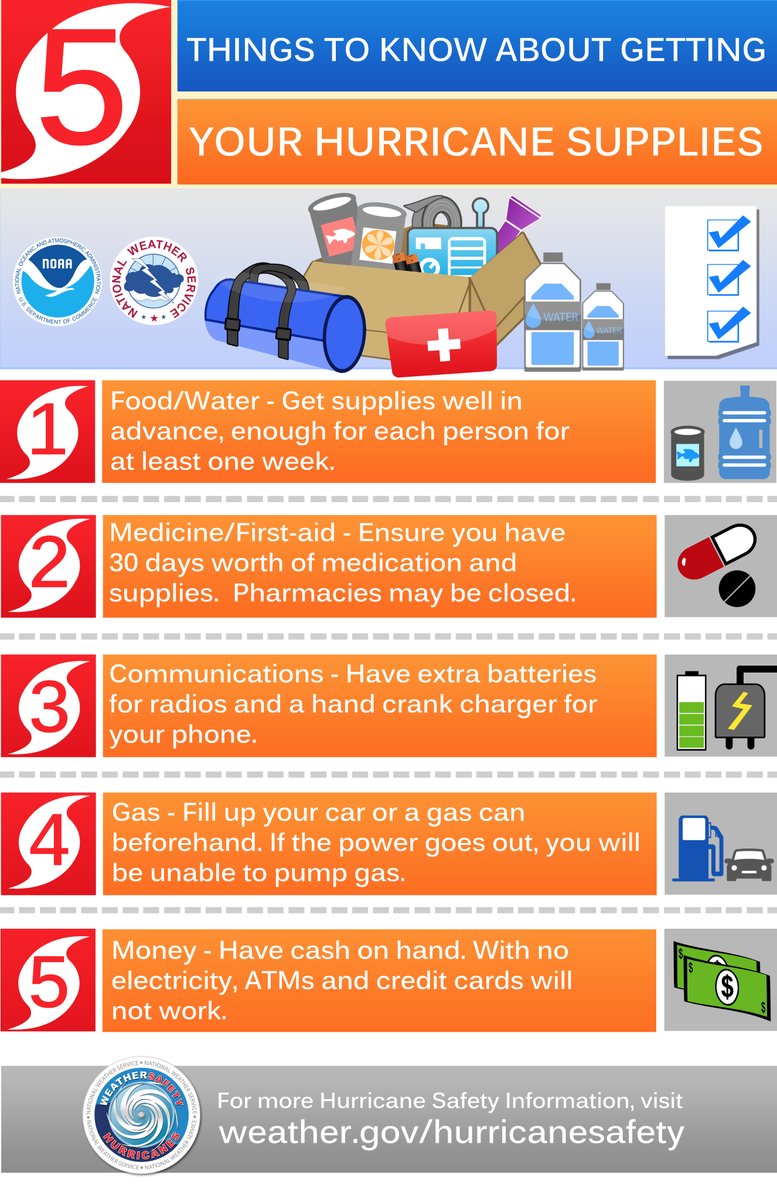
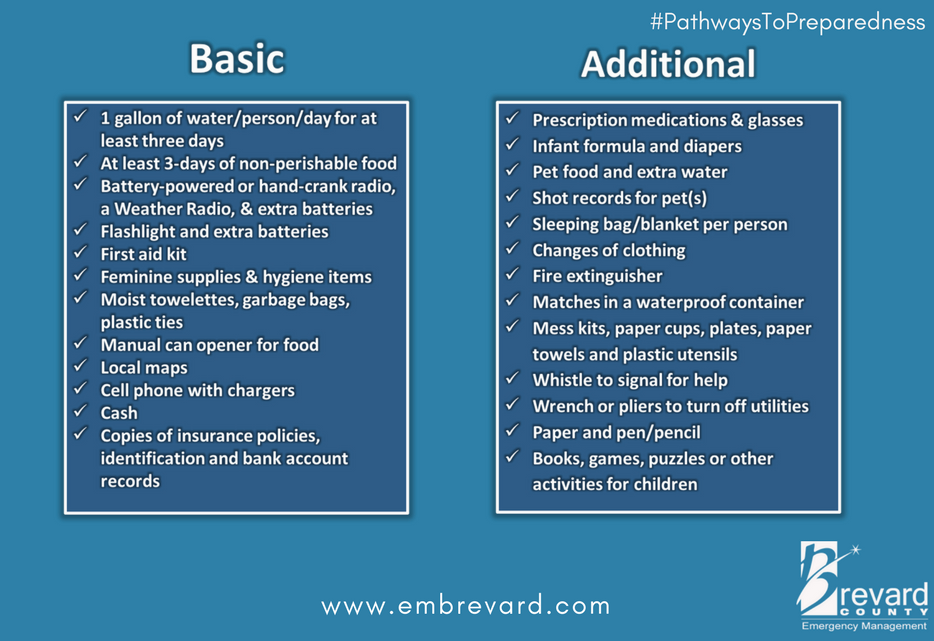
Beyond the ordinary supplies like drinking water, batteries, flashlights, battery or hand-crank radio, generators, gasoline, etc. Evaluate the scale of what you have against the likelihood of weeks without power or water. A few pro tips below:
♦ Put three 30-gallon trash cans in the shower and fill them with water before the storm. This will give you 90 gallons of water for cooking and personal hygiene. You will also need water to manually flush your toilets. Bottled water is great for drinking, hydrating and toothbrushing, but you will need much more potable water if the municipal supply is compromised or broken.
♦ A standard 6,500-to-8,500-watt generator will run for approximately 8 hours on five gallons of gasoline. Do not run it all the time. Turn it on, chill the fridge, make coffee, use the microwave or charge stuff, then turn it off. Do this in 4-hour shifts and the fridge will be ok and your gasoline will last longer. Gasoline is a scarce and rare commodity in the aftermath of a hurricane. Gas stations don’t work without power. Check the oil in the generator every few days. Also, have a can of quick start or butane available in case the generator starts acting up.
♦ Extension cords. If you are purchasing them buy at least one 100 to 150′ extension cord with a triple ponytail. This way you can use one cord into a central location to charge up your electronic devices. Establish a central recharging station for phones, pads, laptops, and rechargeable stuff.
♦ Purchase a box of “contractor garbage bags” and just keep them in the garage. These are large, thick, industrial trash bags that fit 40-gallon drums. They can be used for trash, or even cut open for tarps in the aftermath of a storm. These thick mil contractor bags have multiple uses following a hurricane.
♦ Do all of your laundry before the hurricane hits. You will likely not have the ability again for a few weeks.
♦ Cook a week’s worth of meals in advance of the hurricane. Store in fridge so you can microwave for a meal. Eating a constant diet of sandwiches gets old after the first week. Dinty Moore canned beef stew and or Chef-boy-ardee raviolis can make a nice break…. anything, except another sandwich.
♦ Have bleach for use in disinfecting stuff before and after a hurricane. Also have antibiotics and antiseptics for use. Hygiene and not getting simple infections after a hurricane is critical and often forgotten. Again, this is where the extra potable water becomes important. Simple cuts and scrapes become big deals when clean potable water is not regularly available. Keep your scrapes and abrasions clean and use antiseptic creams immediately.
♦ Do not forget sunscreen and treatments to relieve muscle aches and pains. Hurricane recovery involves physical effort. You will be sore and/or exposed to the elements. Remember, it’s all about self-sufficiency because the normal services are not available. A well-equipped first aid kit is a must have.
♦ Buy a small camping stove. Nothing big or expensive, just something you can cook on outside in case of emergency. It will be a luxury when you are 2+ weeks without power and all the stores and restaurants are closed for miles.
♦ Those small flashlights that you can strap around your head that take a few AAA batteries? Yup, GOLD. Those types of handsfree flashlights are lifesavers inside and outside when you need to see your way around. Nighttime is especially dark without electricity in the entire town. Doing stuff like filling a generator with gasoline in the middle of the night is much easier with one of those head strap flashlights. Strongly advise getting a few, they’re inexpensive too.
♦ Cash. You will need it. Without power anything you may need to purchase will require cash, especially gasoline. Additionally, anyone you hire to help or support your immediate efforts will need to be paid. Cash is critical. How much, depends on your individual situation, but your cash burn rate could go into the thousands in the first few days. Also keep in mind, you may or may not be able to work and without internet access even getting funds into place could be challenging.
♦ Hardware. A box of self-tapping sheet metal screws (short and long) is important, along with a box or two of various wood screws or Tyvex screws. A battery drill or screw gun is another necessity. Check all of this stuff during hurricane prep.
What you do before the hurricane hits is going to determine where you are in the recovery phase.
Additionally, and this should be emphasized and discussed within your family, if you cannot be self-sufficient in the aftermath – for any reason, then you should evacuate.
Self-sufficiency in this context requires being able to cope for up to several weeks:
(1) potentially without power; (2) potentially without potable running water (3) potentially without internet service; (4) potentially without communication outside the region; and (5) with limited municipal and private sector assistance.
If you decide you cannot deal with these outcomes, you should evacuate.
Posted originally on the CTH October 6, 2024 | Sundance
As we enter Day #10, Samaritan’s Purse President Franklin Graham appeared on Fox News this morning to discuss the scope of the crisis in Western North Carolina.
According to Graham, the two most pressing needs are (1) volunteers and (2) hope. Volunteers are needed to just grunt out the work of trying to clear homes, clear trees, get access to some of the most rural and isolated areas; and then provide HOPE to the people who have been devastated and lost everything.
As outlined, the Starlink communication system is being deployed to the churches as a rally point for the communities in the rural areas. If they can get communication lines opened up at the same place fellowship can provide support, then two major issues can be tackled long-term for the residents in the most impacted areas. WATCH:
.
Both Eastern Tennessee and Western North Carolina are suffering from the flood damage. In places of highest elevation, the Blue Ridge Parkway is reported to look desolate, every leaf removed from the entire tree line by hurricane force gales. The valley areas are in various states of destruction caused by flooding; however, communication is starting to increase. There are still a large number of missing people, and many estimate the death toll will climb.
Posted originally on the CTHOctober 6, 2024 | Sundance
As anticipated, Tropical Storm Milton is now Hurricane Milton with top winds of 80 mph. In the past 24 hrs., Milton slowed down a bit, wobbled a little south, and gained strength about a half-day earlier than predicted. The probability cone shifted a little south and the center consensus is now just south of Tampa in the Sarasota area.
As mentioned last night, this storm is going to be unique in contrast of condition between the areas immediately North and South of the storm. There are far too many variables for any accurate assessment at the moment; however, all interests should pay close attention. As a result of the slowing, the prudent evacuation timeline has moved from Tuesday morning to Tuesday afternoon.
(NHC) – At 100 PM CDT (1800 UTC), the center of Hurricane Milton was located by an Air Force Reserve Hurricane Hunter aircraft near latitude 22.5 North, longitude 94.0 West. Milton is moving toward the east near 6 mph (9 km/h), and this general motion is expected today. An eastward to east-northeastward motion is forecast on Monday, followed by a faster northeastward motion on Tuesday and Wednesday.
On the forecast track, Milton is forecast to move north of the Yucatan Peninsula and to move across the Gulf of Mexico and approach the west coast of the Florida Peninsula by midweek.
Maximum sustained winds have increased to near 80 mph (130 km/h) with higher gusts. Milton is forecast to rapidly intensify during the next couple of days and become a major hurricane on Monday. Hurricane-force winds extend outward up to 20 miles (30 km) from the center and tropical-storm-force winds extend outward up to 80 miles (130 km) from the center. (link)
Posted originally on the CTH October 5, 2024 | Sundance
Unfortunately, as the Northwest coastal area of Florida continues to recover from Hurricane Helene, the National Hurricane Center is now warning of a tropical storm in the western gulf, heading East, that is likely to become Hurricane Milton.
There are many variables present within the models for the track of TS Milton as it develops and strengthens into a hurricane. This storm will be a little unique in modern forecast as it is traveling from west to east. Storms that travel this way create a very different set of variables in the cone of uncertainty.
Due to this path, the area north of the impact eyewall will see winds offshore. The area directly south of the impact eyewall will see winds directly onshore. Preparations are always critical within the cone area; however, preparations for a west to east storm are even more critical. A few miles and a little wobble can make all the difference in the storm surge.
Currently the cone of possibility extends from Ten Thousand Islands (South of Naples, FL) all the way to the Big Bend in the Peninsula of Florida. The center is Tampa Bay. The entire west coast of Florida is in the cone of uncertainty.
(NHC) – At 400 PM CDT (2100 UTC), the center of Tropical Storm Milton was located near latitude 22.7 North, longitude 95.5 West. Milton is moving toward the north-northeast near 3 mph (6 km/h). A slow east-northeastward motion is expected to begin tonight. A slightly faster eastward to east-northeastward motion is forecast by Monday and Tuesday.
On the forecast track, Milton is forecast to remain over the southwestern Gulf of Mexico through Sunday night, then move across the south-central Gulf of Mexico on Monday and Tuesday, and approach the west coast of the Florida Peninsula by midweek.
Maximum sustained winds are near 40 mph (65 km/h) with higher gusts. Steady to rapid strengthening is forecast during the next few days. Milton is forecast to become a hurricane Sunday night, and it could become a major hurricane while it moves across the central and eastern Gulf of Mexico. Tropical-storm-force winds extend outward up to 35 miles (55 km) from the center. (more)
The largest variables for Milton are size, intensity and impact zone. Unfortunately, these are significant variables; however, everyone should prepare for the worst scenario and then adjust with additional information as it is provided over the next two days. Do not get complacent with this one.
For those in the cone of uncertainty, remember, planning and proactive measures taken now can significantly reduce stress in the days ahead. Plan when to make the best decision on any evacuation (if needed) consider Tuesday the decision timeframe. As a general rule: take cover from wind – but evacuate away from water.
When the forecast narrows, the area directly SOUTH of the eyewall holds the greatest risk. However, stay calm. You are in control right now. You can make preparations right now. Currently, the centerline is Tampa Bay/St Pete.
The coastal area directly below Tampa/St Pete (Sarasota, Venice, Port Charlotte, Punta Gorda, Cape Coral, Matlacha, Pine Island, Bokeelia, Sanibel Island, Captiva Island, Fort Myers, Fort Myers Beach, Bonita Springs, Naples, Marco Island, and Ten-Thousand-Islands) should be on high alert and paying very close attention.
Again, the difference between Milton being above or below your location will make a lot of difference.
If Milton, traveling West to East, hits below you the hurricane force winds will initially be blowing offshore, pulling water out (tidal variables notwithstanding). If Milton hits above you, the hurricane force winds will initially be blowing onshore, pushing water in. When considering threat variables, the specifics of intensity and eyewall size will play a big role in determining impact scope, storm surge and subsequent damage.
It is very important to pay attention to your local officials and emergency management teams. Each area is very different, and each community can feel a totally different impact depending on topographical, geographical and regional distinctions. Listen to state officials, pay attention to the National Hurricane experts, but the best suggestion is to focus your attention on the advice of local EMS officials.
♦ I am repeating prior advice along with a note about the BUZZSAW part that always gets the most attention.
During a hurricane, even if you experience significant impacts, the odds of being in the eyewall part of the hurricane itself is very low. The eyewall gets all of the attention: windspeed, intensity, Cat status, etc. However, the eyewall is not the total of a hurricane, the eyewall is a very limited area and the most dangerous.
During Hurricane Ian the old axiom remained mostly true, “hunker down from wind, but run from water.”
Now, I say “mostly true“, because to be brutally honest -due to the unique nature of Ian- if you are going to be inside that buzzsaw area (the eyewall) for 8 hours, hunkering down is really not a safe option. Fortunately, Ian was a rare system in terms of its slow-moving nature, even after hitting land. Most hurricane impact events are less than 3 hours in duration. Ian, eight to nine hours, was dangerously unique.
To give scale to the size of the buzzsaw, again we are talking about the most dangerous part of any hurricane – the eyewall itself, this next image shows a comparison between the eyewall of Hurricane Charley in 2004 and the eyewall of Hurricane Ian in 2022.
That is the eye of Charley overlaid inside the eye of Ian in almost the same location. You can see how much bigger the buzzsaw was for Ian as opposed to Charley.
Both Hurricane Charley (’04) and Hurricane Ian (’22) came ashore in generally the same place. Charley made official landfall at Upper Captiva Island and Ian at Bokeelia. The distance between both landfall locations is only about 4 miles as the crow flies.
Both storms were Cat-4 landfall events. However, Charley was much smaller, had a smaller buzzsaw and moved very quickly around 20 mph. Ian was big, had a much bigger buzzsaw and moved very slowly around 5mph.
The duration of Charley was around 2 to 3 hrs. The duration of Ian was around 8 to 9 hrs. Ian was bigger and just moved slower. Inside this distinction you discover why, despite their almost identical regional proximity, the damage from Ian was much more severe. Topography was changed.
If there is a possibility you will be hit by the eyewall section; you should evacuate – period!
DAY ONE (Sunday) Determine Your Risk Make a Written Plan Develop and Evacuation Plan Inventory hurricane/storm supplies.
DAY TWO (Monday) Get Storm Update Assemble and Purchase Hurricane Supplies Contact Insurance Company – Updates Secure Important Papers. Strengthen and Secure Your Home Make Evacuation Decision for your Family.
DAY THREE (Tuesday) Get Storm Update Re-Evaluate your Supplies based on storm update Finish last minute preparation Assist Your Neighbors If Needed – Evacuate Your Family
Communication is important. Update your contact list. Stay in touch with family and friends, let them know your plans. Select a single point of contact for communication from you that all others can then contact for updates if needed. Today/tomorrow are good days to organize your important papers, insurance forms, personal papers and place them in one ‘ready-to-go’ location.
You can see the importance of this communication plan, from the recent results of the emergency in Western North Carolina. Tell your family who your primary contact person is, then tell that contact person what you EXACTLY plan to do. That contact person then becomes the information hub for you that relays information to your family and friends.
Evaluate your personal hurricane and storm supplies; update and replace anything you might have used. Assess, modify and/or update any possible evacuation plans based on your location, and/or any changes to your family status.
Check your shutters and window coverings; test your generator; re-organize and familiarize yourself with all of your supplies and hardware. Check batteries in portable tools; locate tools you might need; walk your property to consider what you may need to do based on the storm’s path. All decisions are yours. You are in control.
Consider travel plans based on roads and traffic density. Being proactive now helps to keep any future stress level low. You are in control. If you have pets, additional plans may be needed.
One possible proactive measure is to make a list of hotels further inland that you would consider evacuating to. Make that list today and follow updates of the storms’ progress.
Depending on information tomorrow (Sun/Mon) you might call in advance and make a reservation; you can always cancel if not needed. It is better to have a secondary evacuation place established in advance. Being proactive reduces stress. Even if you wait until much later to cancel, it is better to pay a cancellation fee (usually one night charge) than to not have a plan on where to go. Trust me, it’s worth it. Protect your family. Make the list of possibilities today, make the booking decision in the next 24 to 36 hours.
Look over the National Hurricane Center resources for planning assistance. [SEE HERE]
Stuff People Do not Talk About….
The ‘context’ of Ian in 2022 was shared previously {Go Deep}. What follows below are things to consider if you are prepping for a hurricane impact and/or deciding whether to stay in your home or evacuate. Standard hurricane preparations should always be followed. You need at least three days of food, water and supplies. Protect your family, secure your property and belongings, and prepare for the aftermath.
What you do before the hurricane hits is going to determine where you are in the recovery phase.
Additionally, and this should be emphasized and discussed within your family, if you cannot be self-sufficient in the aftermath – for any reason, then you should evacuate.
Self-sufficiency in this context requires being able to cope for up to several weeks:
(1) potentially without power; (2) potentially without potable running water (3) potentially without internet service; (4) potentially without communication outside the region; and (5) with limited municipal and private sector assistance. If you decide you cannot deal with these outcomes, you should evacuate.
Additionally, as a family or individual, you should also honestly evaluate:
(1) your physical abilities; (2) your emotional and psychological ability to withstand extreme pressures; and (3) your comfort in losing daily routines, familiar schedules and often overlooked things you might take for granted.
Post hurricane recovery is fraught with stress, frustration and unforeseeable challenges.
I saw a video presented by a structural engineer who was sharing his experience with Hurricane Ian. I am going to use his video for a few references because even with professional credentials, some of the common mistakes people make are highlighted in his experience. Keep in mind his video is taken about 30 miles inland from where the majority impact area (coastal region) is located.
The video below was shot from the soft side (western side) of the storm, and if we were to scale the difference between his experience and a person who was located in/around Fort Myers Beach, Sanibel, Pine Island or Cape Coral, he would be around a “5” on a ten-point impact scale.
Meaning the severity of conditions 30 miles southeast of him was twice as severe as his inland experience.
Key Points – At the 21: 35 moment (prompted), notice how his #2 vehicle is parked outside. Also, at the 22:00 minute moment, notice what he is describing and showing with his garage door and how his #1 vehicle (a pickup truck) is positioned inside the garage. WATCH:
.
♦ This is exactly what I was talking about in hurricane preparation when discussing the garage door. If that videographer was located 30 miles southeast, and/or his house was positioned facing West, instead of North, his garage door would have failed. If you lose the garage door, YOU COULD LOSE YOUR ROOF.
You can always tell those people who have been through direct hurricane impacts by how they parked their cars. I now include this information in all hurricane prep because it makes such a difference. If you lose your Florida garage door you will more than likely lose your roof. That’s just the reality of having a massive opening in your structure to 100 – 150 mph winds that will lift the trusses.
If you have two vehicles, put one vehicle inside the garage with the front bumper against the door to help stop the flex (do this carefully). Put the other vehicle outside blocking the garage door facing down the driveway or facing parallel to the garage. The goal is to use the aero dynamics of the car to push the wind away from the door and provide protection.
Purchase a cheap car cover to protect the outside vehicle and/or use old blankets (cable ties, bungee cords) to stop the outside vehicle from getting sandblasted and destroyed. Place double folded corrugated cardboard in front of the radiator to protect it from storm debris.
Additionally, if you live in a flood zone, or if you are concerned about storm surge, the day before impact take your #1 car to the nearest airport or hotel with a parking garage and park in the upper levels. Take an uber back home if you don’t have a friend or partner to help you. This way you know you will have one workable vehicle, just in case.
♦ Another lesson from Ian, if you drive an electric vehicle and sustain saltwater intrusion (of any level) your car is not safe. Saltwater makes the vehicle batteries extremely dangerous, and they could spark or catch fire. Multiple homes survived Hurricane Ian only to have the electric car catch fire in the garage and burn the house to the ground. Hurricane rain is wind-driven Gulf saltwater. The fire department was begging people to put their EVs outside and not to plug them in. Dozens of EVS also erupted in flames while driving down the streets after the storm.
Back to the video above…
♦ Notice at 24:30 of the video this professional structural engineer is standing and physically supporting his glass patio doors, with his wife, trying to keep them from breaking in due to wind and pressure changes. DO NOT DO THIS ! That is beyond dangerous. Any small item of debris (even a small twig or branch) could hit that window and shatter it, turning flying glass into instant flying blades.
Instead, put 3/4-inch plywood or steel bolted hurricane shutters over all your windows and doors. Period. This is not an option. My steel bolted hurricane shutters were hit with debris so hard – whatever it was, physically dented the steel. Every window and door need to be covered and protected, especially glass patio doors (even if tempered). Do not think you can stand there and protect glass doors. It’s beyond dangerous.
♦ Hardening your home is a matter of careful thought and physical work. However, every opening into your structure must be protected, leaving yourself with one small exit opportunity just in case. Hopefully you have a bolted door with no glass windows you can use as an emergency exit. If not, select a small window and leave only enough room uncovered for you to get out in case of emergency or structural collapse.
Beyond the ordinary supplies like drinking water, batteries, flashlights, battery or hand-crank radio, generators, gasoline, etc. Evaluate the scale of what you have against the likelihood of weeks without power or water. A few pro tips below:
♦ Put three 30-gallon trash cans in the shower and fill them with water before the storm. This will give you 90 gallons of water for cooking and personal hygiene. You will also need water to manually flush your toilets. Bottled water is great for drinking, hydrating and toothbrushing, but you will need much more potable water if the municipal supply is compromised or broken.
♦ A standard 6,500-to-8,500-watt generator will run for approximately 8 hours on five gallons of gasoline. Do not run it all the time. Turn it on, chill the fridge, make coffee, use the microwave or charge stuff, then turn it off. Do this in 4-hour shifts and the fridge will be ok and your gasoline will last longer. Gasoline is a scarce and rare commodity in the aftermath of a hurricane. Gas stations don’t work without power. Check the oil in the generator every few days. Also, have a can of quick start or butane available in case the generator starts acting up.
♦ Extension cords. If you are purchasing them buy at least one 100 to 150′ extension cord with a triple ponytail. This way you can use one cord into a central location to charge up your electronic devices. Establish a central recharging station for phones, pads, laptops, and rechargeable stuff.
♦ Purchase a box of “contractor garbage bags” and just keep them in the garage. These are large, thick, industrial trash bags that fit 40-gallon drums. They can be used for trash, or even cut open for tarps in the aftermath of a storm. These thick mil contractor bags have multiple uses following a hurricane.
♦ Do all of your laundry before the hurricane hits. You will likely not have the ability again for a few weeks.
♦ Cook a week’s worth of meals in advance of the hurricane. Store in fridge so you can microwave for a meal. Eating a constant diet of sandwiches gets old after the first week. Dinty Moore canned beef stew and or Chef-boy-ardee raviolis can make a nice break…. anything, except another sandwich.
♦ Have bleach for use in disinfecting stuff before and after a hurricane. Also have antibiotics and antiseptics for use. Hygiene and not getting simple infections after a hurricane is critical and often forgotten. Again, this is where the extra potable water becomes important. Simple cuts and scrapes become big deals when clean potable water is not regularly available. Keep your scrapes and abrasions clean and use antiseptic creams immediately.
♦ Do not forget sunscreen and treatments to relieve muscle aches and pains. Hurricane recovery involves physical effort. You will be sore and/or exposed to the elements. Remember, it’s all about self-sufficiency because the normal services are not available. A well-equipped first aid kit is a must have.
♦ Buy a small camping stove. Nothing big or expensive, just something you can cook on outside in case of emergency. It will be a luxury when you are 2+ weeks without power and all the stores and restaurants are closed for miles.
♦ Those small flashlights that you can strap around your head that take a few AAA batteries? Yup, GOLD. Those types of handsfree flashlights are lifesavers inside and outside when you need to see your way around. Nighttime is especially dark without electricity in the entire town. Doing stuff like filling a generator with gasoline in the middle of the night is much easier with one of those head strap flashlights. Strongly advise getting a few, they’re inexpensive too.
♦ Cash. You will need it. Without power anything you may need to purchase will require cash, especially gasoline. Additionally, anyone you hire to help or support your immediate efforts will need to be paid. Cash is critical. How much, depends on your individual situation, but your cash burn rate could go into the thousands in the first few days. Also keep in mind, you may or may not be able to work and without internet access even getting funds into place could be challenging.
♦ Hardware. A box of self-tapping sheet metal screws (short and long) is important, along with a box or two of various wood screws or Tyvex screws. A battery drill or screw gun is another necessity. Check all of this stuff during hurricane prep.
Depending on proximity, this can be a fury of nature; a battle where the odds are against you, that you may or may not be aware you are contemplating when you are choosing to stay or evacuate. It’s not the hurricane per se’, it’s that much smaller killer buzzsaw – the eyewall- that you are rolling the dice, never to see.
When it comes to the eyewall, the truest measure of the “cone of uncertainty“, the difference between scared out of your mind and almost certain death, is literally a matter of a few miles; and there ain’t no changing your mind once it starts.
If you have doubts, fears or worries, trust your instincts. Lockdown, clean up outside, bring inside all the patio furniture or throw it into the pool, and just evacuate.
Posted originally on Oct 4, 2024 By Martin Armstrong
Let me explain something about the government. Elon Muck is outraged that FEMA has blocked humanitarian efforts in the wake of widespread devastation in North Carolina. Elon Musk has had a go at FEMA because their actions are outrageous, and people will die because of it.
Government employees have (1) myopic vision since they have no long-term vision, and (2) those in government cannot see Beyond What is Right In Front of Them, which is not a government attribute.
When those in the legislature write a law, they never look to see if it has any potential side effects. Then those in the Executive branch who enforce laws have no comprehension whatsoever of what they are decreeing, for to them, it is only a question of power. In this case, how dare Elon Musk try to save people? Who does he think he is? This is FEMA’s job, so stay out of it. When the legislature investigates why people died because of this decision, nobody will be fired or imprisoned. So, there is no incentive to do your job, and there is certainly no possible common sense.
DEATH TOLL IS MORE THAN THEY ARE REPORTING
Multiple reports from eyewitnesses indicate that the situation has become bleak. I can tell you that they would not allow anyone to go south from Madiera, Florida, for several days, where the land is lower. Contractors I know were shaken and said they were sending in refrigerator trucks to collect the bodies. I was told by one who was in that region of St. Pete Beach that there were bodies in the street. It appears that they are trying to hide the incompetence of the government, and perhaps the reason they are blocking Musk is because the people there are already dead, and they do not want this news out before the election.
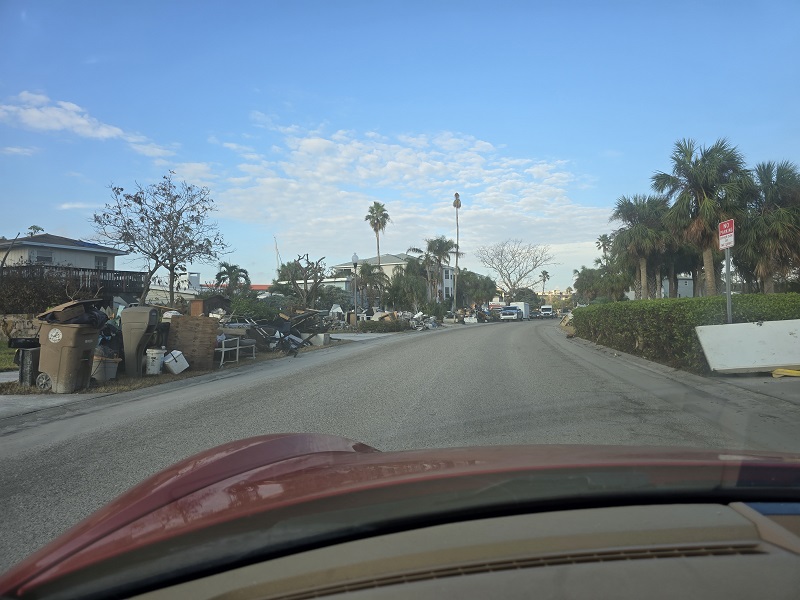
Here is a photo of a typical street in Madiera. Every house has whatever furniture it had out on the street. As I said, Pinellais County has closed the dump because there is no room. They will probably take this stuff to a garage, sell it to someone else, turn their back, and dump it in the ocean.
Posted originally on the CTH on October 3, 2024 | Sundance
I want to start the Day seven conversation with something I am very familiar with. This is the phase when shock, turns to frustration, turns to a sense of being simply overwhelmed. This is the phase when critical fellowship is THE MOST important aspect to recovery operations.
As the adrenalin subsides, there will likely be a great deal of despondency, as people succumb to dark imaginings, get angry psychologically, and with empty reserves of hope begin to express thoughts on the anger side of their mental ledger.
Try not to focus on the whispers that want you to look at the impossible horizon. Instead, with a heart of God filled fortitude, force your gaze at the 2 feet around you and work that problem… then the next two feet… then the next two feet, etc. etc.
If you are a relief worker, GIVE GRACE, and an ear, to every voice that is shouting despair. Let them cry through the apex of their desperation, until they can pause to encounter your shoulder. Then GIVE HOPE. At the core, this is what makes Samaritans Purse so effective. They live this creed as they elevate much more than just crushed stuff. Day #7 is a day to remember the focus on soul food and the nutrition of fellowship.
Just keep going. Sometimes the knights in shining armor appear wearing jeans, overalls and boots. It doesn’t take an emergency beacon to activate them, just a need… and they come. Purposefully, without condition, ready to move, activate and respond.
Look and see them. This is the army that matters, the Christian America we know well.
See and embrace the people who represent what makes our nation unique. The usually invisible, salty, mostly scruffy and beautifully comfortable about it, yet critical network of Americans that keep it all operating. God, how I cherish them so.
At the core of our American purpose is a decency and unity. Critics don’t like to talk about it, but Americans are fundamentally good. When something seems impossible, for blue-collar Americans ‘impossible‘ is just another starting point, if you get out of the way. Don’t lose sight of that.
No other nation on earth was ever conceived on the principle of allowing people to manifest their own destiny, while keeping government out of their lives. The vision, the premise and the purpose, was to allow you the freedom to determine your place in life; and even, at any time, change that determination and strike off in an entirely new direction.
Our labor and aspirations would not be pre-determined by caste, tier, creed or social status; but rather by our personal vision for our own future. The right of self-determination. This is what is in our DNA. This is what other nations do not understand. We are Americans.
Almost exactly two years ago, to the day, THIS HAPPENED:
Ms. Veronica is a lady of impeccable generosity, identified not simply by the hospitality and greeting, but also by the few moments of grace deserved and afforded in polite request to make herself more ‘presentable‘ for unexpected company.
Upon return, Ms. Veronica immediately became Vera, a woman, widow, great grandma and neighbor who may not have enough, but she’d give a stranger half – and they would never know.
This is a powerful woman filled with a message. “Hurricane Ian did not create victims,” she immediately captured my full and undivided attention. She continued, “I am not a victim.”
“There are dead people, and there are survivors.”
Long pause. The depth of her eyes, intense.
I am wise enough to notice moments when my prior opinion of self, strength and fortitude are immediately being redefined. I am also smart enough to stay silent.
“Our loving God does not create victims, and apparently he is not finished using me.” Veronica’s eyes now alight. “In this moment I am filled with rejoicing,” she said, “because I know there is a purpose I have yet to fulfill.” From me, more smart silence. “How incredible is it for me at 90 to realize there’s more use, more purpose, and more time,” she concluded.
Then, just as casual as one might order a familiar coffee on any ordinary Tuesday, Vera asked…. “How is it I can help you boys?“…
All the Mr. and Mrs. Veronica’s are not victims; none of us are. God doesn’t create victims – people do.
How stark is the reality of hearing, “there are dead people, and there are survivors.”
If you are not in the former, none of us are, then we should rejoice and realize we have purpose yet unfulfilled.
I share that story again because I know the mountains of North Carolina and Eastern Tennessee are filled with the strength that Vera represents.
If you are alive in the impacted region, you are a selected as a survivor and you have a purpose yet to fulfill. Remember that!
Consider the strength and wisdom that follows in this interview. Three members of a North Carolina family, including a 7-year-old boy, died in the disastrous flooding from Helene. Now, the survivors share their story of immense grief and comforting faith.
…”this is a backfire for the devil.”
.
In Day #7 of any recovery effort, fellowship and prayer are the fuel that matters. As the grieving survivor, daughter and mother so accurately and eloquently noted, “this is a backfire for the devil.”
Rebuke evil when manifest. Focus on your purpose!
♦ Turning toward another issue, inasmuch as the devil must be rebuked, any voice that amplifies the dark imagining and attempts to diminish the importance of fellowship must be rejected.
Appalachia is strong stock. Eastern Tennessee and Western North Carolina is the home region for some of the strongest faith-filled people in our nation. However, there are some very small people in positions of assumed power that do not understand the nature of this region; they too must be rejected:
🚨 Drone pilots: Do not fly your drone near or around rescue and recovery efforts for Hurricane Helene.
Interfering with emergency response operations impacts search and rescue operations on the ground. For more information on temporary flight restrictions follow: @FAADroneZonepic.twitter.com/muxHefL1sH
— U.S. Department of Transportation (@USDOT) October 2, 2024
The voices of a corrupt and malevolent government obviously do not want people to: (A) see the lack of FEMA response; (B) get immediate assistance from ordinary Americans; (C) feel the empowerment of community and fellowship that unites the nation.
This is a BIG painful PICTURE to accept; however, I must repeat:
We are in an abusive relationship with government. The abusers need isolation to retain control, power and dominance over their victims. Fellowship and community break the stranglehold of abuse.
Dear Lord, You say in Isaiah 40:31, “But those who hope in the Lord will renew their strength. They will soar on wings like eagles; they will run and not grow weary; they will walk and not be faint.”
Today we turn to You as our strength. Help us to fill our hearts with fuel so that we may be a source of Your true hope for all. We ask Your will to renew and restore us.
When we feel we are near our end, when we are weary, tired, or heavily burdened, give us firm reliance in You. Strengthen our bodies and our spirit in the way that only You can provide. We thank You for the ways You give us all we need each day.
Clear our eyes and souls. Give us the vision to see Your perspective in all things.
In our time of despair, we turn to You. When these moments feel hard or taxing, seed our minds with the reminder that You are beside us. ~ Amen
I have created this site to help people have fun in the kitchen. I write about enjoying life both in and out of my kitchen. Life is short! Make the most of it and enjoy!
This is a library of News Events not reported by the Main Stream Media documenting & connecting the dots on How the Obama Marxist Liberal agenda is destroying America









 Centinel2012