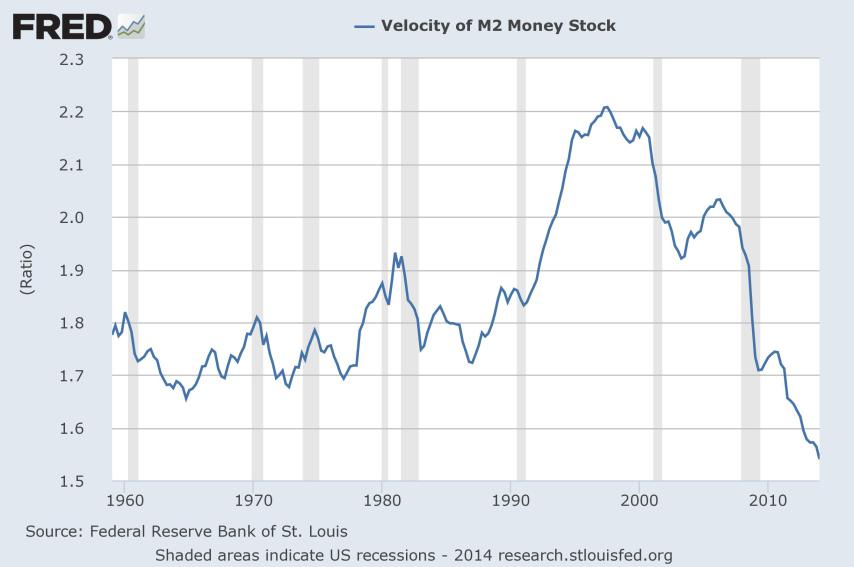
Visualizing the Vanishing Money Velocity Vortex


Re-Posted from ZERHEDGE Submitted by Bruno de Landevoisin on 08/23/2014 11:52 -0400

Cloud-Seeding

by Bruno de Landevoisin @ StealthFlation


Having recklesly impaired the original clean source of healthy naturally effervescent American spring water abundantly spouting up from the bedrock below, the misguided monetary authorities have dangerously attempted to artificially inseminate the clouds above, in the hopes of drenching the parched U.S. soil with torrential rain, so as to generate their much heralded and forever promised green shoots.  Regrettably for us all, when these artificially seeded clouds eventually do burst, they will produce nothing but the toxic inflationary rains of StealthFlation.

Under the imposition of StealthFlation, the Velocity of Money lies dormant while increasing Inflationary risks build below the surface.

U8FPYODQV-07c8Pqydglq2KqxewYCMRH6B-qiuP7yyqaU8bAsbFPxjG8wO4XJ8hl-vybBluBR0OhQkSg3z1zaSxvNJoZImOEyRk6oy2UO-P9cMw48mXs2oV_hi084QFhvg

The inflationary risks are deliberately concealed and remain latent due to the synthetic suppression of determinant free capital marlet forces. However, the grossly excessive supply of money has definitively been created, and it will debase the currency via inflation, it’s just a matter of time.

When an economy is healthy, there is much buying and selling and money tends to move around quite swiftly.  Unfortunately, the U.S. economy is manifesting the precise opposite of that these days.  In fact, the velocity of M1 & M2 has fallen to near all-time record lows.  This is a very serious sign that the underlying economy has entered a period of extreme stagnation.

In its infinite wisdom, the Federal Reserve has been attempting to counter this economic standstill by absolutely flooding the financial system with new money.  As it always does, this has created monumental financial and fixed asset bubbles, however, it has not addressed what is fundamentally and structurally wrong with our economy.  On a very basic level, the amount of real economic activity that we are witnessing is not anywhere near where it should be, and the anemic flow of money through our economy is proof certain of the ongoing dilemma.

XwyAPcqFpR7cjjt-Dw-JC2GE-_lrrx1sAHYysZR1f7AB_paX7YVKHa73sbhxoeA3ho5MtSrLyVJSayk8oY5OTrRUF0j1KGrreTn4TUVhSYHtvEBg4iBVahYTLMliZheA1Q

Clearly the transmission mechanism between the relentless synthetic origination of fresh money by the monetary miracle men and the velocity at which that new money is circulating in the real underlying economy on the ground is completely disconnected, FUBAR. Why is this?  Well, it’s really not that difficult to comprehend.

First of all, much of the supposed economic activity generated today is not being driven from the the bottom up by the healthy deployment of excess savings naturally created from genuine self-sustaining productive economic activity at the fundamental level, but rather in an unnatural fashion, force fed from the top down via the easy street ZIRP/QE induced debt financing incessantly being encouraged by our misguided megalomaniac monetary authorities.

Perhaps even more malignant, the largest capital market of them all, namely the U.S. bond market has been put down by the Fed’s activist zero bound anesthesiologist.  Thus, the utterly comatose American treasury market is no longer facilitating the natural growth of traditional savings income streams generated via secure interest bearing accounts and prudential savings products throughout the financial system’s depository structure. In short, the healthy income flows constructively generated from legitimate savings produced from genuine economic activity, namely people going to work every day, has been effectively terminated by these wizards of wanton monetary policy at the wayward central bank.

Let’s face it, if the major pension funds can’t generate 5-6% per year holding conservative debt instruments in order to meet their massive obligations, they are up a creek without a paddle. They require substantive returns in order to remain solvent. The Fed understands this all too well, they are most concerned on that score, and so should you be.

Having thoroughly shut down the sound, well established and effectives channels of capital formation, which have consistently engendered bona fide and constructive growth over the years through the virtuous avenues of productive savings, the foolish authorities have left themselves utterly hamstrung with only one risky road to travel down. Indeed, now that they have totally cracked the transmission on our fiscally busted and broken down American bus, they have become 100% reliant on the equity market to drive their top fuel funds into the U.S. economy via the wealth effect.  Pedal to the metal at 2,000 SPX mph.  Make no mistake my friends, we are on a crash course from hell, and we will hit the wall.

A Primer on Race by Thomas Sowell


Thomas Sowell is an eminent economics with a first class mind and he knows his subject better than another economics alive today, especially Paul Krugman.

MARSHALL SWING ON WILD DIVERGENCE OF GOLD & SILVER CHARTS: SOMETHING IS ABOUT TO HAPPEN!


One thing is for sure just before a crash things get a little crazy!

30-yr Treasury Yield: “The Economy Is Collapsing”


More good news — just can’t get too much of this stuff!

When there is a transition from one major currency to another its accompanied by social disruption!


World Reserve Currencies: What Happened During Previous Periods of Transition?

Re-Posted from Economics Reason Submitted by Chris Ferreira, 11 August 2014.

The decline of the US dollar hegemony is ever so clear today and this article aims to provide the reader with what exactly happened during past periods of reserve currency transitions. Historically, when a reserve currency transitioned over to a new one, it marked a pivotal change for the world. The economic paradigm shifted and the rules of the game changed. This time will be no different when the US dollar loses its status as the reserve currency!

The transition process of the world reserve currency brings much uncertainty

Throughout history, a transition of the reserve currencies has always brought about turmoil and uncertainty in financial markets. One country’s decline, and the subsequent rise of another, marks a radical transformation for the world, especially as market demand shifts. The country that dominates global commerce during any given period is usually marked with the status of having the reserve currency. Spain and Portugal dominated the 15th and 16th centuries, the Netherlands the 17th century, France and Britain the 18th and 19th centuries, and the US dominated the 20th century.

Throughout the Age of Exploration, Portugal created a dominant global empire. Traditional trade routes to Asia were no longer feasible due to the growth of the Ottoman Empire and their 1453 capture of Constantinople, and so the need for alternative trade routes emerged. Thanks to advances in navigational technology as well as other auspicious circumstances, the Portuguese, and soon the Spanish, were to reach Africa, Asia, and the New World. Consequently, the Portuguese and later the Spanish currencies became the primary currencies used in global trade at that time. The Portuguese, throughout their travels and discoveries, established military outposts along the coasts of Africa, India, Malaysia, Japan, and China (Macau), etc.; when they became over-extended, the empire eventually declined due to attacks and competition from other countries (mainly the Dutch, British and French). Portugal and Spain then merged together to create the Iberian union; however, it collapsed through wars and revolutions by the mid-17th century.

It was then the turn of the Dutch, whose rise to global power was largely aided by the creation of the first multinational corporation in the world, the Dutch East India Company (VOC). The Dutch defeated Portugal and Spain in global economic importance and positioned themselves to profit from European demand for spices. By 1669, the VOC was the richest private company that the world had ever seen, with over 150 merchant ships, 40 warships, 50,000 employees, a private army of 10,000 soldiers, and a dividend payment of 40% on the original investment to shareholders. Later, with the event of the Anglo-Dutch War, the spice trade was temporarily ceased and this caused a spike in prices for spices. At that point, other countries were enticed to start their own spice trading companies, namely the French and English (French East India Company and English East India Company). The saturation of the spice market and the costly Anglo-Dutch wars destroyed the Dutch East India Company and their currency (the “Guilder”) as a global currency.

VOC-dutch-india
VOC-dutch-india

France achieved European political dominance under Louis XIV, and although the legacy of the ‘Roi Soleil’ was great. it is not to be forgotten that he left his heirs in a whirlwind of social strife and extreme debt caused principally by war and an unfair tax base. While the French debt was being allowed to reach staggering amounts, the British, meanwhile, were engaging in an Industrial Revolution that would set Britain apart, creating, in effect, an empire “where the sun never set.” The 1789 French Revolution was essentially a response to a financial crisis that had become debilitating. After a decade of internecine bloodshed and civil war, the French found a new leader under the young general, Napoleon Bonaparte. The Napoleonic Wars of 1803-1815 raged for over a decade, extending French influence over much of Europe (and inspiring a revolution in Haiti). At the height of Napoleon in 1812, the French Empire maintained an extensive military presence in Germany, Italy, Spain, and Poland. It was this Napoleonic empire, however short-lived. that was to rock Europe so profoundly that upon Napoleon’s defeat, the powers of Europe came together to establish a peace at the 1815 Congress of Vienna that would re-balance power for the rest of the 19th century.

Following the defeat of Napoleonic France in 1815, England enjoyed almost a century of global dominance in trade.

By 1922 the British Empire held power over circa 458 million people (one-fifth of the world’s population) and about a quarter of the total land area at the time. By the Second World War, the British Empire was virtually bankrupt. The US provided funding to Britain at the time as they were now the largest creditor nation in the world. However, it was only after the Bretton Woods Conference 1945 that the US dollar officially became the world’s reserve currency.

Each country that rose to ultimate global dominance of commerce declined due to an over-saturation point. Fast-forward to today, and there is a remarkably similar situation for the US. The US has 900 military bases in 130 countries and spent over $640 billion in 2013 on military alone. This figure dwarfs all other military spending combined BY ALL OTHER COUNTRIES. The US is no longer the largest creditor nation in the world, but rather the largest debtor nation in the history of the world. China is now the largest creditor nation. Will the 21th century belong to China and the Yuan?

Today the US dominates the land, sea and air with their overbearing military reach in 130 countries. However, the landscape for war is once again changing. Alternative versions of the traditional warfare are emerging, such as economic/cyber war. By enforcing trade sanctions on a country and manipulating market prices, powerful countries can exert force without even having to step into another country. In other words, the stock market and future’s market have become a tool for the elite. They can drop the price of oil to bankrupt a particular country or sell their national debt on the market to wipe out their currency and create hyper inflation. These measures are much quicker/efficient for government and the elite to employ than the traditional methods of war we have seen in the last century. Although the US dominates the traditional sense of war, they do not have the same type of defense mechanisms in the financial market. As I pointed out in a previous, How the US Dollar Can Collapse, there are virtually an unlimited number of ways the US can be attacked today.
The Typical Duration of a World Reserve Currency

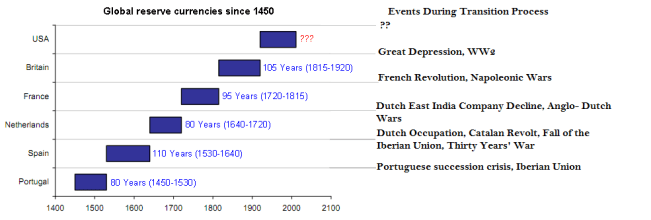
The reserve currency transition is a cycle that has typically lasted in history somewhere between 80 to 110 years. Officially, the US dollar has been the reserve currency for 68 years. However, the US dollar was used in trade much before, since the 1920′s in fact. That would put the US dollar closer to 90+ years as the reserve currency. These cycles of about 100 years (one century) is very common in history: the ancients called it a saeculum which represented four seasons (spring, summer, fall and winter). As with all cycles, there was a period of growth, saturation, peak, and decline which represented these seasons. An excellent book on economic cycles, with a focus on the current cycle in which we find ourselves, is The Fourth Turning by William Strauss and Neil Howe. It is a must-read. Here is a quote from Strauss’s book:

“An appreciation for history is never more important than at times when a secular winter is forecast. In the fourth turning, we can expect to encounter personal and public choices akin to the hardest ever faced by an ancestral generation. We would do well to learn from their experiences, viewed through the prism of cyclical time. This will not come easily. It will require us to lend a new seasonal interpretation to our revered American Dream. And it will require us to admit that our faith in linear progress has often amounted to a Faustian bargain with our children. Faust always ups the ante, and every bet is double or nothing. Through much of the Third Turning, we have managed to postpone the reckoning. But history warns that we can’t defer it beyond the next blend in time.”

The table below shows the transition of each reserve currencies (every 100 years or so) and the events that were carried out during each transition. Every transition was a period of great suffering marked by economic hardships, revolutions, and wars.
global-reserve-currencies2
The transition of one World Reserve Currency is a cycle that stems from social behavior

Esteemed British economic historian Arnold Toynbee (1852-1883), in his work Study of History, also identified an “alternating rhythm” of a cycle of war and peace that has occurred in Europe at roughly one-century intervals since the Renaissance. In addition to Europe, Toynbee also identified similar cycles in Chinese and Hellenistic history that averaged 95 years. He linked this to the gradual decay of the “living memory of a previous war,” whereby the descendents of war veterans, for whom their only knowledge of war was through stories, history books, and hearsay, would eventually come into power and resume the belligerent behavior pattern of their forefathers.

The most recent global crisis period was marked by WW1, the Great Depression, and WW2; from the start (1914) to the finish (1945) we find a period that ranges from 100 (1914-2014) to 69 (1945-2014) years ago. This suggests that we may be entering into a new global crisis with the same cyclical thinking.

Global crises wreak havoc on all levels of existence, not to the mention the great cost to human lives. If we are to learn from history, however, it seems as though we might have to nevertheless brace ourselves for yet another one in the near future, as it marks the end of one saeculum and the start of a new economic paradigm aligned more positively with proper balances of trade, debt, and policies.

The US is trying to postpone the crisis by printing money, however this is creating currency wars with nearly all major central banks in the world. As history has shown us time and again, causing this delay through money printing will only aggravate the problem, not only not preventing the inevitable, but indeed making the transition more painful and costly.

Economic Reason

Progressive Bigots


Very good analysis!

PA Pundits - International's avatarPA Pundits International

20130613_TomMcLaughlin_at_CPAC_2010By Tom McLaughlin ~

20140613_obamadumbblanklooksmug_lWhile I can’t understand everything that’s happening in the world, I pay attention and try to at least form working hypotheses to explain things. Hypotheses, by definition, are subject to modification as evidence accumulates. At no time should evidence be ignored. It should always be held up against ideas to see if it fits our basic understandings. If it doesn’t, we have to re-shape them – our understandings, not the conflicting evidence.

If you insist you’re right about your view even when a preponderance of evidence points in another direction, you’re a bigot – a word habitually misunderstood. Bigot, according to the World English Dictionary, means “a person who is intolerant of any ideas other than his or her own…” If we look around us with clear eyes, who would best fit that definition? Those who continue saying and doing the same things in the face…

View original post 689 more words

Macro Analytics – TAR PIT That is FINANCIAL REPRESSION w/ John Rubino


This is a good economics analysis of the situation, a bit technical but good thought on what might be happening right now.

The Future That Doesn’t Work


Progressive-ism doesn’t work as it is only Communism light

Re-Posted from a POWERLINE Blog post on August 9, 2014 by Steven Hayward

Scratch a Progressive, and they’ll tell you that their ideal for what America should look like is the “social democracies” of enlightened Europe.  That’s why we need higher minimum wage laws, pro-union mandates, and other regulations on the job market.  (One new idea in The New Yorker this week is a three-day work week.)  Meanwhile, younger Americans are finding it harder than ever to get started in today’s economy, and surveys show a larger number of Americans than even the late 1970s now think future generations will not be as prosperous as previous generations.

I hope everyone catches up with the story in today’s Wall Street Journal about conditions for young workers in Spain and Italy—and especially the reasons why:

In Europe, Job Protections for Older Generation Are Barriers for Younger Workers

. . .  In Europe’s weaker economies, people in their 20s and 30s often have little hope of achieving the careers, wealth and economic security enjoyed by their parents. In places like Spain and Italy, the employment rate has tumbled for people under 40 since 2008, even as it has stayed relatively steady or grown for their parents’ generation.

Their predicament is exposing a painful truth: The towering cost of labor protections that have provided a comfortable life for Europe’s baby boomers is now keeping their children from breaking in.

The older generation benefited from decades of rock-solid job protection, union-guaranteed salary increases and the promise of a comfortable retirement. All this has allowed them to weather Europe’s longest postwar crisis reasonably well.

By contrast, many younger Europeans can hope for little more than poorly paid, short-term contracts that often open a lifelong earnings gap they may never close. Employers in many countries are reluctant to hire on permanent contracts because of rigid labor rules and sky-high payroll taxes that go to funding the huge pension bill of their parents.

16 million Americans have dropped out of the labor force in the last 10 years


And with fewer (percentage wise) people working others have to work harder to make up the difference!

The debate is work for you stuff or get free stuff from the government nt


Charles Koch: How to Get Our Economy Moving Again

If there is anyone in the world who knows how to create wealth and generate good, high-paying jobs, it is Charles Koch. In USA Today, Koch sets out a basic prescription for how to improve our economy, accompanied by some eye-popping statistics:

Like most Americans, I am deeply concerned about our weak economic recovery and its effects on millions of families. Opportunity, especially for the young and disadvantaged, is declining. High underemployment has become our new norm. …

Too many businesses focus on getting subsidies and mandates from government rather than creating value for customers. According to George Mason University’s Mercatus Center, such favors cost us more than $11,000 per person in lost GDP every year, a $3.6 trillion economic hit.

That is astonishing. Everyone knows (unless he is a liberal economist like Paul Krugman) that cronyism promotes inefficiency. But the magnitude of the problem is stunning: if the Mercatus Center analysis is correct, cronyism is deflating the economy by around 21%! Imagine if every American got a 21% raise: that is only a small part of what free market economic policies could accomplish, if they were not blocked by the Democratic Party. Then, of course, we have the problem of excessive government regulation:

Federal rules cost America an estimated $1.86 trillion per year, calculated the Competitive Enterprise Institute. At Koch Industries, we’ve seen how punitive permitting for large projects creates years of delay, increasing uncertainty and cost. Sometimes projects are canceled and jobs with them. Meanwhile, 30% of U.S. employees need government licenses to work. We need a system that rewards those who create real value, not impedes them.

The main thing standing between you and a higher income, assuming you own an alarm clock, is the government. More:

[W]e should eliminate the artificial cost of hiring. Government policies such as Obamacare have given businesses a powerful incentive to hire two part-time people to do one full-time job. This trend was reflected in June’s employment data, which included the loss of half a million full-time jobs. In 2007, 4.4 million Americans worked part-time jobs because they could not find full-time work. That number now stands at 7.5 million, up 275,000 in June.

The Obama administration hailed the June employment data as a triumph, even though the number of full-time jobs declined by a half million. They want you and your children to accept a “new normal” in which part-time employment as a barista is a reasonable expectation for a college graduate.

Government likes for its citizens to be lazy, incompetent and dependent. That’s bad for the citizens, but good for the government:

Finally, we need greater incentives to work. Costly programs, such as paying able-bodied people not to work, are addictive disincentives. By undermining people’s will to work, our government has created a culture of dependency and hopelessness.

Government control over the economy, promotion of dependence and cronyism have been tried. They have failed. It is time for something different:

Our government’s decades-long, top-down approach to job creation has failed. Its policies have made our problems worse, leaving tens of millions chronically un- or underemployed, millions of whom have given up ever finding meaningful work. In doing so, our government has not only thwarted real job creation, it also has reduced the supply and quality of goods and services that make people’s lives better and undermined the culture required to sustain a free society.

When it comes to creating opportunities for all, we can do much better. It’s time to let people seek opportunities that best suit their talents, for businesses to forsake cronyism and for government to get out of the way.

A friend who knows Charles Koch well describes him as a genius. I can believe it: creating tens of billions of dollars in wealth and tens of thousands of productive, high-paying jobs probably does require a touch of genius. But when it comes to politics and the economy, what Charles Koch has to say is just common sense.