
Armstrong Economics Blog/Ancient History
Re-Posted Oct 20, 2018 by Martin Armstrong
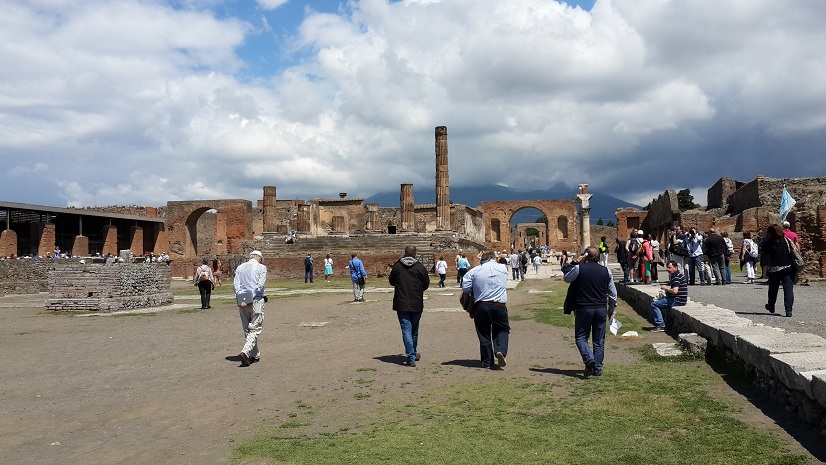
I have previously written how the academics have REFUSED to revise history even when the evidence has been right in their face. I have previously written that the date for the eruption of Vesuvius could not possibly historically correct based upon a single coin that was discovered in the dig. My position based upon a single coin has now at last been confirmed by writing on a wall recently discovered. This time, they have NO CHOICE!!!!
Coins have often called into question recorded history. The date of the destruction of Pompei near Naples has been a classic example of how the academic community has defended old interpretations and refuse to revise previous assumptions. The history books have written in stone that Vesuvius erupted burying Pompeii definitively on August 24th, 79 AD as the date carved in stone. This date has been interpreted from a letter to the historian Tacitus some 25 years following the event. This was his old friend Pliny the Younger who provided an eye-witness account of the eruption. He states that the eruption took place on Nonum Kal September (the ninth day before the Kalends of September), which has been calculated as being August 24th. However, Tacitus was translated during the 16th Century which remains questionable on many points. The ancient historian Cassius Dio directly states that the disaster took place “towards the end of the harvesting season” which would be in October, not August.
The excavation of Pompeii revealed that the stores were selling fruit that would not have been seasonal for August. There were amphoras filled with wine after the harvest which had been sealed and ready for transportation and sale. Many of the people discovered were wearing warm clothing. That has been dismissed as they just wanted to cover themselves for maintaining a wrong interpretation for decades. But during excavations of Pompeii’s “House of the Gold Bracelet” in 1974, 180 silver and 40 gold coins were discovered with the bodies of a group of victims. The coins were buried with the people attesting to their link with the eruption. The coins were never cataloged until 2006. There was one coin that confirmed that the date for the eruption of Pompeii was incorrect and that the account of Cassio Dio was closer to fact than Tacitus.

Titus (79-81AD) was emperor at the time of the eruption and he was remembered for the relief efforts. Titus’ administration was marked not by military or political conflicts, but by disasters. His first disaster was the eruption of Vesuvius. The eruption destroyed the cities and resort communities around the Bay of Naples in addition to Pompeii and Herculaneum which were buried under many feet of stone, ash, and lava. Titus appointed two ex-consuls to organize and coordinate the relief effort. He personally donated large amounts of money for the relief effort and he even personally toured the region the following year like presidents do today after such disasters (human nature never changes).
A single silver denarius was discovered among the 180 silver coins in 1974. When it was cataloged, it overturned history and has ever since been buried again in the Naples Museum rather than rewrite the history books. Titus’ father Vespasian (69-79AD) died on June 24th, 79 AD. Therefore, any coin of Titus as emperor would have to have the very first recording of his power “IMP VIIII” or 8th Imperator, which was a title that meant ‘leader of the army’ to the Romans. The award was generally given at this point in history for a particularly important victory that was celebrated. In some cases, these subsequent awards, denoted by a numeral following IMP, which also allows dating of coins to a very short period.
The coin discovered in Pompeii had the legend “IMP XV,” which was granted to Titus for the war in Britannia where he sent Gnaeus Julius Agricola who pushed further into Caledonia and managed to establish several forts there as recorded by Tacitus (Agricola 22). Therefore, Titus received this title of Imperator for the fifteenth time for this event, according to Cassius Dio (Roman History LXVI.20). This took place we know in September 79 AD about 3 months after becoming emperor following his father’s death. Obviously, if any coin was discovered in the ruins of Pompeii with “IMP XV” in its legend, then this provides absolute proof that the date for Vesuvius of August 24th, 79 AD cannot be correct as I previously wrote.

Archeologists in Pompeii have discovered a remarkable inscription written in charcoal which has survived the catastrophy confirming that the eruption of Mt Vesuvius indeed took place in October 79AD as confirmed by the coin discovered and ignored. The charcoal writing, discovered on the wall of a villa during a new phase of excavations, adds weight to a theory that the volcano destroyed the town in October 79AD rather than August of that year in line with Cassio Dio and the denarius of Titus. The Italian authorities said the new discovery “rewrites the history” of Pompeii proving that the August 24th date was WRONG! The inscription reads, in Latin, XVI K NOV – the 16th day before the first day of November in the Roman calendar, in other words, October 17th. The inscription may have been written by a builder or architect who was working on the restoration of a villa a few days before the eruption, possibly as a way of recording the work he had done. Remarkably, it survived the catastrophic eruption of Vesuvius now confirming October 24th.
Archeologists recently discovered that a worker had inscribed the date of “the 16th day before the calends of November”, meaning October 17, on a house at Pompeii. “Today, with much humility, perhaps we will rewrite the history books because we date the eruption to the second half of October,” said Italy’s Minister of Culture Alberto Bonisoli. At last, the single silver denarius discovered, and which has been ignored for so long, has been finally vindicated. The coins won!!!



 Centinel2012