The leadership of the DOJ and the FBI are intertwined in the 2016 election operation to support candidate Hillary Clinton and defeat candidate Donald Trump. However, most of the investigative discussions center around the FBI side of the equation. There’s a good reason for that.
The FBI side of the conspiracy is pretty straight forward. FBI Director James Comey, FBI Asst. Director Andrew McCabe, FBI Chief Legal Counsel James Baker, FBI Counterintelligence Head Bill Priestap, and FBI Counterintelligence Agent Peter Strzok all played a participatory role in the Trump Operation.
The 2016 FBI counterintelligence operation was surveillance on the Trump Campaign and was thinly disguised under the fraudulent auspices of a FISA warrant, sold as a defense of U.S. democracy from Russia, which permitted the wiretaps and surveillance etc.
Two DOJ people (central to the FBI) relayed and acted as facilitators between the FBI side and the DOJ side: DOJ Deputy Bruce Ohr and FBI/DOJ lawyer Lisa Page. Outlines of their collaborative efforts, and the trails they left behind, have filled the headlines recently.
On the Department of Justice side of the operation, specifically the DOJ leadership involvement, things are less clearly outlined. Again, there’s a reason for that.
The DOJ involvement surrounds legal arguments, processing of FISA applications, and use of the legal system to support the FBI with actionable legal framing (against Trump) mostly after their candidate, Hillary Clinton, was defeated.
In essence, in a bastardized manipulation of Law and Order, the FBI created disorder and the DOJ weaponized that manufactured disorder to launch a legal attack against their ideological political opposition, President-elect Donald Trump. Unlawfulness and Disorder.
However, to best understand the DOJ side, it’s helpful to look at a specific time, September and October 2016. That’s when the second FISA application was presented to the Foreign Intelligence Surveillance Court (FISC), using the information from the FBI counterintelligence operation (Steele Dossier etc.) as the basis for that application.
As of this writing the FBI and DOJ are refusing to answer foundational questions about that second FISA application and the subsequent FISA warrant that was used as a justification for the Wiretaps and Surveillance that began on the Trump Campaign.
The dates here seem intentionally cloudy because, according to James Comey testimony, the FBI counterintelligence operation began in July 2016, around the same time the Steele Dossier was given to the FBI and simultaneous to the first FISA application being denied.
The second FISA application was approved in/around October 2016. All current media outlines overlook the obvious question of whether the wiretaps and surveillance began in July 2016 without a warrant.
Given the nature of the illegality involved with the entire effort it would be naive to think the FBI waited until October for wiretaps to become legal when their own admissions state they began the operation in July, three months prior.
The story of October 2016 has more interesting aspects. But first, we must gain a greater understanding of the division within the DOJ that was involved.
♦The National Security Division (NSD) inside the DOJ was where all of the collaboration appears to have taken place. The NSD is a sub-division within the DOJ similar to the Counterintelligence Division within the FBI.
Using the National Security Division (NSD) inside the DOJ presents a specifically useful angle for the purposes of hiding duplicitous, unethical and unlawful conduct. Why? Well, here’s where the mirrored entry starts and also where it gets interesting.
(click image to enlarge)
Responding to a 2015 request by the DOJ Office of Inspector General, Deputy Attorney General Sally Yates told the internal watchdog they cannot investigate the National Security Division.
That’s right, there is essentially no oversight on any activity happening inside the NSD.
In 2015 the OIG requested oversight and it was Sally Yates who responded with a lengthy 58 page legal explanation saying, essentially, ‘nope – not allowed.’ (PDF HERE) All of the DOJ is subject to oversight, except the NSD.
The Department of Justice’s own Inspector General (currently Michael Horowitz who opened a January 2017 investigation into the 2016 politicization of the FBI and DOJ) is not allowed to investigate anything that happens within the NSD branch of the Department of Justice.
See the ‘useful arrangement‘?
Yeah, Funny that.
So it might not be so coincidental the players used on the DOJ side of “Operation Trump” all seem to come from within the National Security Division.
I digress, but remember, I said pay attention to the September/October 2016 time-frame.
DOJ Deputy Attorney Bruce Ohr was “demoted” in the summer of 2017 after the Inspector General discovered unreported 2016 contacts between Ohr and Russian Dossier author Christopher Steele, as well as contact with Fusion GPS founder Glenn Simpson, in October 2016. [Also remember Bruce’s wife, Nellie Ohr, was hired by Fusion GPS in April 2016 to start the research that ultimately ended with the sketchy dossier.]
Also in October 2016, right around the time the DOJ lawyers formatted the FBI information (Steele Dossier etc.) for the FISA Application, the head of the NSD, Asst. Attorney General John P Carlin, left his job.
It would have specifically been John Carlin’s responsibility to ensure a valid legal basis for the FISA application submitted to the Foreign Intelligence Surveillance Court.
Remember also, the July 2016 application was denied, a rarity. Therefore, if the second application used ‘sketchy’ enhancements – for the matter of accountability it no longer mattered because Asst. Attorney General John Carlin was headed to the exits.
Summary of October 2016 so far: ♦Bruce Ohr is meeting with Christopher Steele and Glenn Simpson and not telling his bosses. ♦The DOJ National Security Division submits FISA application for FBI use (likely using dossier). ♦The Head of DOJ National Security Division, John Carlin, quits.
Wait, it gets better.
I’m not making this up.
Immediately after the second FISA warrant is approved,… in the period where John Carlin has given his notice of intent to leave, but not yet left… Inside those specific two weeks,… On September 26th, 2016, the National Security Division of the DOJ tells the Foreign Intelligence Surveillance Court (FISC) they have been breaking the law; and the NSD specifically informs the court they have been using FISA applications to spy on their domestic political opposition.
However, we don’t discover this September 26th 2016 DOJ admission until May 2017. That’s when the FISA court decision on the self-reporting was released to the public, declassified and we find the details outlined within the court ruling.
The NSD admits the details how, under President Obama, the Eric Holder and Loretta Lynch Department of Justice used FISA applications to spy on political opponents, unmasked conversations to discover content, and also disclosed this has been happening for SIX YEARS prior to the beginning of the July 2016 joint FBI/DOJ “Trump Operation”.
Now, SERIOUSLY, does anyone doubt what the October 2016 FISA warrant was about?
You can read the 99-page FISA court ruling above –LINK HERE– and you can watch the explanation of 99-page FISC ruling above as shared by Judicial Watch below:
.
Recapping September/October 2016: ♦Bruce Ohr and Peter Strzok are secretly meeting with Christopher Steele (Dossier) and Glenn Simpson (Fusion GPS). ♦The NSD is submitting a second FISA application to spy on candidate Trump. ♦The Justice Department National Security Division head announces his intention to leave the NSD. ♦And the DOJ-NSD inform the FISA Court they have weaponized prior FISA warrants for political operations.
Now, retain your blood pressure and watch National Security Division, Deputy Asst. Attorney General, Office of Intelligence, Stuart Evans testify to congress on June 27th 2017:
Additionally, if I’m going to drag you into the rabbit hole where the corruptocrats speak in riddles – you might want to help me guess an answer this question:
@00:26 Who is: “I took a senior member of the National Security Division”?
.
The date Sally Yates is describing is January 26th, 2017 – when she went to see White House Counsel Don McGhan to discuss Mike Flynn’s January 24th ambush interview with FBI agent Peter Strzok.
My hunch is the “senior member of the National Security Division” was Mary McCord.
I seem to vaguely remember something from WikiLeaks emails about four political women who would ensure Hillary Clinton’s victory…
♦Release #2 outlined the depth of FBI Agent Strzok and FBI Attorney Page’s specific history in the 2016 investigation into Hillary Clinton to include the changing of the wording [“grossly negligent” to “extremely careless”] of the probe outcome delivered by FBI Director James Comey.
♦Release #3 was the information about DOJ Deputy Bruce Ohr being in contact with Fusion GPS at the same time as the FISA application was submitted and granted by the FISA court; which authorized surveillance and wiretapping of candidate Donald Trump; that release also attached Bruce Ohr and Agent Strzok directly to the Steele Dossier.
♦Release #4 was information that Deputy Bruce Ohr’s wife, Nellie Ohr, was an actual contract employee of Fusion GPS, and was hired by F-GPS specifically to work on opposition research against candidate Donald Trump. Both Bruce Ohr and Nellie Ohr are attached to the origin of the Christopher Steele Russian Dossier.
♦Release #5 was the specific communication between FBI Agent Strzok and FBI Attorney Page. The 10,000 text messages that included evidence of them both meeting with Asst. FBI Director Andrew McCabe to discuss the “insurance policy” against candidate Donald Trump in August of 2016.
Judicial Watch Director of Investigations Chris Farrell appears on Lou Dobbs show to discuss President Trump’s Twitter response toward the FBI and Deputy FBI Director Andrew McCabe’s plan to retire. Farrell outlines several things within this interview that CTH has been tracking on background.
.
First, there is a possibility the person Farrell describes at 02:50 might be John P. Carlin, the former head of the Justice Department’s National Security Division who left in October 2016, right after the controversial FISA warrant was issued.
John Carlin landed a job with law firm Morrison & Foerster leading their global risk and crisis management practice.
CNBC Video of John Carlin discussing President Trump and the Mueller investigation from mid-June 2017 is available HERE.
♦Second, while CTH understands the concern Farrell carries surrounding the final IG outcome, there’s no substantive reason to assign an intent of dilution toward his efforts, yet.
However, that said, the concern that Chris Farrell describes surrounding DOJ Inspector General Michael Horowitz explains why oversight Judiciary Chairman Bob Goodlatte has requested production of the IG investigative documentation from the OIG; which is due on/around Jan 15th, 2018.
Regardless of the structure within the finished report from Horowitz, Chairman Goodlatte appears positioning his committee investigators to review the evidence and likely launch a Special Prosecutor criminal probe based on the current investigative evidence; a reported 1.2 million pages of investigative documentation so far.
Catching up. If you watched the prior two updates from Brett McGurk you’ll note he does an exceptional job explaining how the administration is coordinating with multiple partners to defeat ISIS. The Trump administration plan was labeled the “D-ISIS” strategy.
Special Presidential Envoy for the Global Coalition to Defeat ISIS Brett McGurk provides an update on D-ISIS Campaign, at the Department of State on December 21, 2017.
.
(Transcript) MR MCGURK: Yeah. Sum up the campaign against ISIS over the past – over the past year and where we are, and kind of a little bit on where we’re going. And we’ll have more to say about that in the coming year, particularly over the coming weeks.
I think it’s worth recalling ISIS used to be controlling basically a state, 100,000 square kilometers, the size of the UK; planning and plotting and carrying out major terrorist attacks against our partner homelands; inspiring attacks here in the homeland; responsible for the violent murder and – violent murder of American citizens James Foley, Steve Sotloff, Peter Abdul-Rahman, as well as the death of Kayla Mueller; committing acts of genocide against the Yezidis as they swept into Iraq, and other minority groups; displacing Christians from their – from their ancient homelands; and destroying our common heritage. We’ve really never seen anything like it, 40,000 foreign fighters from 110 countries around the world pouring into this so-called phony caliphate.
So in January, when the new administration came in, when President Trump came in and Secretary Tillerson came in, we faced real critical challenges in terms of major plotting attacks against us and against our partner homelands coming from Syria and Iraq. And they were aspiring to kind of major, 9/11-type attacks. That’s what they really aspire to do. And so long as they had these safe havens and sanctuaries, particularly cities, a city like Raqqa, and at the time they still controlled half of Mosul, it was really hard to root them out.
So really, three key decisions were made right off the bat as soon as President Trump came into office. Number one, he issued a directive within, I think, his third day for all of us to really look to accelerate the overall defeat of ISIS. He delegated authorities immediately to Secretary Mattis and our commanders in the field. When Secretary Tillerson came in, he made clear to all of us that if everything’s a priority, nothing’s a priority, and our priority is the defeat of ISIS. One of his first major events here at the State Department was gathering almost 70 countries here at the State Department from our global coalition; it’s now one of the largest coalitions of its kind ever assembled in history, with 74 members. And we all gathered here in March really to map out the next phase of the campaign over what is now the last 10 months, particularly Mosul and Raqqa.
The Secretary also made the decision very early on to deploy a small team of experts from the State Department into Syria to work with our military partners as we got into the campaign in Tabqa and Raqqa, which I’ll talk about. We established task forces here at the State Department and the Department of Defense to coordinate the interagency in a way that had not been coordinated before. And we developed an overall global campaign plan called the Defeat ISIS Strategic Plan, which has been approved by the President. So prioritize the defeat of ISIS. If everything’s important, nothing’s important. And accelerate the campaign. And I’ll bring you into the campaign and describe kind of how this has gone over the last year.
Second, when he looked at the situation in Syria, decided we have to set conditions for a political settlement in Syria by de-escalating the overall conflict. This is a conflict that killed 400,000 people, displaced 11 million people, and obviously the situation – we had to look to ways to bring it under control. We had tried things like national ceasefires; they hadn’t worked. So we really – we really took a new approach.
Looked at different parts of the country. Tried to establish de-escalation zones, ceasefire areas, and really pragmatic, pretty hard-nosed diplomacy with the Russians. And looked at Syria in terms of phases. Number one, you have to defeat the physical caliphate of ISIS; so long as you have a caliphate in the middle of Syria, it’s really hard to get a realistic, meaningful political process underway. And you had to overall de-escalate the overall conflict to move ahead on the political process based in Geneva under UN Security Council Resolution 2254. I’ll talk a little bit about that.
Finally, holding Assad accountable for his chemical weapons use and proliferation. I think the April 6 strike ordered by the President – we actually happened to be in some negotiations with the Russians while all this was going on – had a pretty dramatic effect, I think, on the overall situation, our ability to exert some leverage on the overall situation in Syria. So those three key decisions, I think, have made a difference and have helped us speed some things up. I think I have a map. Okay.
So let me just kind of brief on this map. It’s the current situation, and just a situation – if you can all see it. Everything in green on this map, everything in green used to be controlled by ISIS, so over 100,000 square kilometers.
Everything in light green was controlled by – I’m sorry – everything in light green – everything in dark green, the dark green, was controlled by ISIS in January of this year. Everything in light green and dark green has been taken away from ISIS; it’s about 98 percent of their former caliphate. And significantly, 50 percent of all the territory that ISIS has lost, they have lost in the last 11 months, since January.
So 50 percent of all the territorial losses against ISIS have come in the last 11 months over the course of 2017. Seven point seven million people used to be living under ISIS are no longer living under ISIS, and 5 million of those people were liberated over the course of this past year. So when we came into office, there was still about 5 million people under ISIS; they are no longer under ISIS.
Returnees – we’ve talked about this in the past. The pace picked up. In Iraq we have returned 2.7 million Iraqis back to their homes. Again, that is a historically unprecedented rate of returns in a conflict like this – 1.4 million of those returnees in this past year. In Syria, for the first time – the Syria situation still remains totally unacceptable.
All the violence and the loss of life is attributable to Bashar al-Assad and his regime. But in Syria, for this – this year, for the first time, we did see significant returns, about 715,000 according to UN data, actually returning to their homes; 50,000 from outside Syria. And I think the focus on de-escalation had a contribution to that.
So based upon all that, I can kind of bring you into the – what we did over the last year and how this really came together. So there’s a number one on the map, which – oh, I guess this doesn’t work with the TV.
There’s a number one – there’s a number one on the map at Tabqa, which I can point to right here.
Tabqa – the battle of Tabqa began on March 21st, but what’s significant about it is kind of how it began. And I happened to be in Syria right around this time, and the force we’re working with, the Syrian Democratic Forces, identified an opportunity, but they had to launch almost immediately. They said, if we can launch within days to hop over a body of water about 10 kilometers and catch ISIS by surprise, they thought that they could seize Tabqa, the Tabqa dam, and the Tabqa airport.
So our commanders, having the delegated authority, wasted no time, put this operation together. It launched on March 21st, ended on May 11th. And I visited Tabqa shortly after the battle, and it wasn’t just the battle; it was the first time we also had State Department personnel working together to kind of help facilitate the humanitarian and stabilization aftermath of the conflict. So they worked to clear landmines, get humanitarian aid into the city. And the population before the war in Tabqa was 70,000; the population today, about 110,000 since ISIS has left. And without Tabqa, had Tabqa not been seized, Raqqa would not have been able to be taken because Tabqa really kind of helped close the noose on Raqqa. So that delegation of authorities made a specific, immediate difference in that very significant battle.
Second was Raqqa. So shortly after the Tabqa battle concluded in May, we looked at, again, all the options for Raqqa. You’ve reported on this, many of you. We looked at every possible way to do Raqqa.
A couple options were presented to the President, and really the option that he determined was the most viable option was the option to use our partner force, the Syrian Democratic Forces. And a couple reasons for that: the other option would have required really tens of thousands of American troops on the ground, and that’s a model that we do not want to return to. So the battle of Raqqa began on June 6, D-Day as it’s known, but it began on June 6, and it concluded about five months later.
Very, very difficult street-by-street fighting. I was in Raqqa about three weeks ago and you could see the aftermath of this battle. Our force that we work with, the Syrian Democratic Forces, about 400 were killed in the battle, about 700 wounded. No Americans were lost in this battle. We did lose one coalition special forces operator from our – one of our coalition partners.
Displacement. In the battle of Raqqa, in the province, about 264,000 people were displaced, and in the early phase of the battle, you could actually see the displacement. We actually really had to catch up. But having our team of experts on the ground, we immediately flooded resources into Syria and were able to manage the humanitarian displaced population from Raqqa fairly well. About 34,000 now have returned.
One reason why it’ll take a while to get people back into their homes of Raqqa is that ISIS has – basically, every single standing structure in Raqqa has an IED in it. We’re finding that as our teams that we have – we’ve trained about 125 Syrians now together with experts to really clear the streets of these areas that have been cleared, and it takes a lot of time. We’re finding an IED in almost every freestanding structure.
So ISIS, as they lose territory, kind of salt the earth to make sure that life cannot return. We do believe the outlying neighborhoods of Raqqa, which are fairly well intact, we will see significant returns to the center of the city. Having seen it with my own eyes, it is fairly well destroyed. I think it’ll be a very long time before people are able to return there.
We are in the business, as we’ve said before, of stabilizing these areas, clearing landmines, humanitarian – basic water, basic health, electricity. We are not engaged in nation-building exercises and long-term reconstruction.
Let me point to number three. This is right here.
And this is where you can see the red on the map, and that is where ISIS still has some small safe havens. I point to it because there is still very significant fighting going on. And I just want to emphasize this point: This isn’t over. The fact that we’ve made a lot of progress this year, nobody who works on these problems would tell you that we’re popping champagne corks or anything. This is not over. This has a long way to go.
Even on the ground in Syria, there’s probably some months of operations left in this area. Heavy fighting is ongoing; 31 airstrikes, coalition airstrikes in the last week alone. And we killed three very, very senior ISIS leaders right in that area in the last week, and we’re capturing, actually, as we speak, a number of fighters trying to flee.
Last week, a significant milestone: The Iraqi Security Forces and the Syrian Democratic Forces linked up at the border, just kind of tightening the noose on ISIS. And this area also has been critical in terms of deconflicting operations with the Russians, something we’ve talked about throughout the year. We’ve kind of drawn some lines on the map with the Russians about where their forces would be, where we would be.
This is a professional military-to-military engagement focused on deconfliction. We’re not coordinating operations but making sure we don’t have any accidents. That’s extremely tense from time to time, but overall that has gone quite well and accelerated the pace of operations. So the engagement with the Russians has actually, I think, contributed to the demise of ISIS at least in the caliphate.
I’m going to go down to the – just southeast Syria. I’ll start moving a little faster. But right here is a garrison called al-Tanf. We have a small U.S. military presence there. We’re working with the local force. There are still ISIS in the area. There was an operation – we actually engaged with a column, our military personnel, with our partner force just last week in a very heavy engagement.
But another reason why our presence is important there is there is an IDP camp right on the Jordanian border. About 40,000 people are there, and we want to get aid to that camp. We want to get aid to that camp from the Syrian side, and we’re working – we’re pushing, particularly through the Russians, to come up with a common plan to get aid to that camp. And we have called on the Russians to be cooperative in that effort, and we were pleased that earlier this week the UN Security Council resolution renewed resolutions known as 2165 that authorizes cross-border assistance into Syria. That was quite an important development as we manage the humanitarian situation in Syria.
So that’s Tanf. We are present at Tanf, and we’re going to be present at Tanf to make sure ISIS cannot return and also to manage this difficult humanitarian situation. We will also remain present in the other areas of Syria to make sure that ISIS cannot return and to make sure that we can help with the stabilization effort so people can return to their homes.
The final point on Syria is in the southwest. It’s number five.
I point to that because this is the southwest – it’s a de-escalation zone that we negotiated with Jordan and with Russia earlier this year. I think I described it as a painstaking negotiation over many months. That was very true, and it was finalized on July 7th in a meeting between President Trump and President Putin. I think it’s been – it’s not without problems, but it has been a – one of the most successful ceasefires to date. I think we’ve saved a significant number of lives, returning Syrians to their homes.
We’re monitoring the ceasefire every day in Amman. About a thousand Syrians are now returning every month, according to UN data, from Jordan, the first time we’ve seen that trend – that’s something positive, we want to keep it moving – and about a thousand every week displaced from Syria returning to their homes in this area. So total, about 5,000 a month.
We worked to re – kind of strengthen the ceasefire earlier this year – or just last month when we finalized what’s called a memorandum of principles, greater definition to the ceasefire. Key principle: The existing arrangements in these areas can remain in place, so opposition structures remain in place pending a long-term political settlement to the civil war through the Geneva process; and also a commitment, very importantly, to remove foreign forces from sensitive areas of this zone. And what that means are Iranian-backed forces, Iranian-backed militias should not be in this area. That’s something that the Russians have signed onto. And also, we need to remove foreign jihadi-like presence from this area, and there remains a persistent ISIS cell, which is the red blotch just on the corner of the map.
And President Trump and President Putin in Da Nang issued a very important joint statement which memorialized that memorandum of principles in the southwest and also the steps going forward on the political process.
Let me jump quickly to Iraq. I’ll go very quickly. Mosul.
When we came in in January, east Mosul was liberated on January 26th. The battle of west Mosul had not even begun, and we knew that would be an enormously daunting task. We have trained a total of 123,000 members of the Iraqi Security Forces. The battle of Mosul, the cooperation between the Iraqi Security Forces and the Peshmerga, was something that was historic, something we still want to build upon even as there’s tension between Baghdad and Erbil, and something that carried over into the battle of west Mosul.
The battle of west Mosul began on February 19th and concluded on July 10th. It really consumed the first half of this year. It was the main focus of Secretary Tillerson’s gathering so many members of our coalition here in March, where we raised about $2.2 billion, and a lot of that money went immediately into the campaign of Mosul. What’s remarkable about the Mosul campaign is that of a million displaced from Mosul, the worst-case scenario that we had planned for, nearly every single Moslawi that was displaced received humanitarian assistance and aid.
So even with a million displaced, we did not have a massive humanitarian crisis because of the planning that went into this, and that meeting in March was quite significant. In Mosul today we have about 500 stabilization projects are ongoing, and we are still working very closely with our coalition to make sure that we have adequate resources for that.
Finally on the map I want to just talk about two developments here in the bottom. This is the Arar border crossing with Saudi Arabia.
I point to the border crossing, but what’s really significant there is that President Trump and the Secretary very early on, within the first weeks, identified an opportunity to really open – reformalize an opening of ties between Iraq and Saudi Arabia.
The Secretary had an important conversation with Foreign Minister Jubeir. Foreign Minister Jubeir visited Baghdad on February 25th, the first visit of a Saudi foreign minister in 30 years, and from there, chipping away, we really kind of really opened up this relationship.
Speaking personally as – I’ve worked in three administrations; I remember President Bush going a number of times directly to King Abdullah to really encourage this, the argument being that we want to re-anchor Iraq in the Arab world, diversify its regional relationships. Very important, something the Iraqis want; we think it’s in our national security interest. And finally, this broke open.
I visited the – I visited that border crossing in August when it opened and it was quite a remarkable scene. And then on October 22nd, Secretary Tillerson met in Riyadh with King Salman and Prime Minister Abadi to formally launch the Iraqi-Saudi Coordinating Committee. We now have, for the first time in 30 years, direct flights moving between Saudi Arabia and Iraq, two border openings, and this continues to move forward. So that was a real significant breakthrough that we saw this year.
I’d just point finally to the other border crossing, the Turaibil border crossing with Jordan. That’s a multi-billion-dollar-a-year commerce route, and we’ve also worked very hard to open that because our ally Jordan is really first and foremost in our minds when we manage this very difficult situation.
Looking forward a little bit into next year, Kuwait will host a very – two very important conferences in February, one together with the World Bank and the EU on a reconstruction event for Iraq to help reconstruct some of these areas; and secondly, our coalition will gather, similar to the event we had here in March, in Kuwait in the February time frame.
Finally, when it comes to ISIS, we’re not just focused on the physical space of the caliphate, though that was the calling card; it was what held the organization together. We are also, as you know – talked about this a number of times from this podium – foreign fighters, counterfinance, countermessaging is a constant, 24/7 effort from here.
On foreign fighters, it – really an incredible effort, global effort, from all members of our coalition. And working with one of our newest members of the coalition, INTERPOL, we now have from 60 countries about 40,000 names in a database of known ISIS-affiliated fighters who try – have tried to travel or did travel to Iraq and Syria. And the UN Security Council today, we believe, will pass a very important resolution, really strengthening the Resolution 2178 that passed a few years ago. And our colleagues here, Nathan Sales and the CT bureau, doing a terrific job on that. So we hope to have more news on that later in the day.
Counter-finance – we’ve completely decimated ISIS finances by targeting their oil and gas reserves, and they really have no ability to raise significant revenue from what used to be their state-like holdings in Iraq and Syria. But they do still find ways to move money around, and Sigal Mandelker and our colleagues at the Treasury Department working constantly to identify these networks, sanction them, and root them out.
In counter-messaging, just a remarkable improvement from what we used to see, and I give the private sector here tremendous credit – Twitter, Facebook, YouTube. Very difficult to start a Twitter account now with an ISIS-affiliated message. You’re taken down really almost instantaneously; almost a million accounts have been taken down. And we’re working closely in the region with Saudi Arabia, UAE, all of our partners, and in East Asia with Malaysia and others to counter ISIS’s ideology.
So ISIS will be around for a while, so this is a – we have a long way to go. But we did make some progress this year, and I wanted to kind of bring you into it a little bit, decisions we made early and then how they played out. And with that, I’m happy to take some questions.
MS NAUERT: Matt, do you want to start?
♦QUESTION: I’m just curious. It sounds to me – well, it doesn’t sound to me – you said it – that changes from the policy of the previous administration are responsible for this success. You were in charge of implementing the policy of the previous administration. Why if – why – was it doomed to fail? And why did you – why did the previous administration continue to do what it was doing when you mention these three or four changes to it that seem to have brought success?
MR MCGURK: Yeah, thanks, Matt. I think I’d answer it this way. I think this isn’t a – it’s not a political statement. It’s the fact that we had to do a lot to get the foundation for our campaign set. A transition in wartime from one party to another – you look historically, it can always be a difficult endeavor. I actually give great credit – think an untold story – the transition actually on these issues was very smooth. The transition team here at State did a great job and we met regularly with the transition team and said look, there’s about three or four key decisions that, if they’re made early – and we did say at the time we think we can actually defeat the physical caliphate – we actually moved faster than we thought – but three or four key decisions.
Some of them were decisions that the former administration didn’t want to take at the end of their time in office so passed forward. But I will just say it takes – it takes focus and attention and prioritization from the top, and that’s what we got on day one from the President, and when the Secretary came in, and from Secretary Mattis. And those decisions were made. The delegations made a difference. The decision on Raqqa – we looked at the entire – we looked at all options. And the decision the President made in May was quite significant and —
♦QUESTION: Are you saying the previous administration, there wasn’t that involvement, that it wasn’t that big a priority for the senior members of the last administration?
MR MCGURK: That’s certainly not what I’m saying. What I’m saying is that decisions that were made early in the new administration to accelerate the campaign – these are big decisions; it’s not something you just go and make. But they were made early and they had a major impact. And I think the – I think it speaks for itself.
QUESTION: Thanks.
MS NAUERT: Next question. Nick.
♦QUESTION: Brett, could you just – I just have a couple of numerical questions and then one sort of bigger question. The first is do you have a current tally for the number of civilian deaths as a result of coalition airstrikes against ISIS in Iraq and Syria?
MR MCGURK: So as you know, we study this quite carefully. I’d really defer you to the – our CJTF colleagues who study this quite carefully. I can’t give you a number here. But let me give you an example on Raqqa. So I’ve read some reports that in Raqqa, at the end of the day, like thousands of ISIS fighters escaped. So I was just in Raqqa, and here’s what ISIS was doing in the final days of that battle. Down to about two neighborhoods, probably about 300 ISIS fighters left. Whenever they would go outside to move from one fighting position for another, they would take a child with them or a bunch of civilians with them, basically using them as human shields. That’s how they fought in Mosul. That’s how they fought in Raqqa. That’s how they fought in al-Qaim. That’s how they fought throughout the campaign.
So this is extremely, extremely difficult. Our Syrian partner forces and Iraqi forces, and particularly the Iraqis, took a number of casualties and Iraqi soldiers died because in Mosul in particular the humanitarian priority was put at the top of the campaign plan. So a number of times we did not do an airstrike, did not do certain military activities, because of the risk to civilians.
In Raqqa, these two neighborhoods saturated with remaining civilians and a limited number of ISIS fighters – it’s when local tribes from the area came and said we have to actually evacuate all of these civilians. And so that local deal was made. We think about 4,000 civilians – and we track this extremely closely – and a very small number, a very small number of foreign fighters, about 300 total, ISIS fighters. But the truth of the matter, these guys are using – they came to Syria and Iraq and they purport to be representing the Sunni population, then they use the Sunni population as human shields.
So I’m sorry I can’t give you a specific figure, but I just wanted to kind of – I’ve been in some of the centers – in Syria I was in one during the Raqqa battle – of how these decisions are being made. And it is extremely difficult when you confront an enemy like this.
♦QUESTION: Just two quick follow-ups. One is you talked about geographically reducing ISIS control. Do you have numbers of fighters who remain, who were able to flee? And then second, the Pentagon today accused Russia of intentionally violating the deconfliction agreements with the U.S., particularly with air forces. Do you have any comment on that?
MR MCGURK: So with deconfliction, I’d have to defer to DOD. There was an incident on December 13th that – again, whether it was accidental, whether it was intentional, don’t know. There have been direct, very high-level senior engagements between our military colleagues and theirs, and we have not had a significant incident like that since, so the deconfliction line overall has held. We had some – in June – look, in June we shot down a Syrian plane just south of Tabqa when they crossed the line that we had agreed upon. So this is serious. This is really, really serious business. But for the most part, the deconfliction lines have held.
In terms of overall fighters, we think there’s about – I hate to put numbers on it, but in some of these areas where they still are, about 3,000 or so. That’s kind of our assessment. In terms of an exodus of ISIS fighters from Syria and Iraq, it’s our best estimate – and all we can do is give our best estimate from our Intelligence Community – but think that there has not been a significant exodus of foreign fighters from Iraq.
QUESTION: (Off-mike.)
MR MCGURK: I hate to – I have it in my head, I just hate to even say. So I’d defer to some of my colleagues on that.
MS NAUERT: Dave Clark from AFP.
♦QUESTION: Hi. Thanks very much for doing this. Beyond the red areas marked on that map, there are lots of other areas in the world – Libya, West Africa, the Philippines, Afghanistan – where groups that have raised the ISIS banner have sprung up. Are these groups in tight communication? Is it a movement? Is it –is there that command and control, or is this just an inspirational kind of branding exercise from local insurgents? And will the campaign continue until you’ve ridded the whole world of people with the ISIS flag?
MR MCGURK: So look, it’s a great question. And it used to be a very well-connected organization being run out of Raqqa, with direct communication to Boko Haram, which then part of it split and became ISIS in Nigeria; direct communication to Libya, direct communication to Sinai, direct communication to Afghanistan. We’ve pretty much severed a lot of that, particularly from Syria. But look, ISIS became a brand, and a lot of pre-existing terrorist groups – you’ve seen this in the Sinai, for example – start to raise the flag of ISIS, mainly to recruit foreign fighters and other things.
But make no doubt that the defeat ISIS strategic plan that I mentioned is not an Iraq-Syria plan, it’s a global campaign plan. So we use different tools in different parts of the world. But certainly in Mindanao and in Philippines, when they popped up and tried to establish themselves, we worked very closely with Australia, with members of the coalition, with the Philippine armed forces, to root them out.
So this is going to go on for some time. And the main priority number one is protecting our homeland; but second, make sure that they cannot have sanctuary to recruit and attract foreign fighters.
♦QUESTION: Now just let me do a follow-up on that. So the Russians are saying that ISIS is defeated in Syria; you’re saying there’s still some 3,000 or so there. Does that reflect different understanding of the intelligence, or is that a political thing and they want to have an excuse to kick you out of Syria now – job’s done, leave us and Assad alone?
MR MCGURK: Well, as I said, look, we’re advancing our own national security interests in Syria. We’re going to stay in Syria to make sure there’s an enduring defeat of ISIS, to make sure we can stabilize these areas. That’s very clear. No, ISIS is not – is not totally defeated in Syria. As I mentioned, I think I gave you the number of airstrikes we’ve done in the last week alone, so that’s very clear.
And another key statistic: Every coalition-enabled – meaning our coalition – enabled operation against ISIS, ISIS has never been able to come back and reclaim a territory that we helped liberate. Frankly, the Russians can’t say that. In Palmyra they did the kind of concert. They got a lot of attention. Then ISIS actually came back and retook Palmyra. We’re having some problems on the south side of the river, in which Syrian armed forces claim to have liberated these areas and we see ISIS trying to come back. It’s not happening in the areas that we helped liberate because we do a lot of extensive planning for what comes afterwards.
So bottom line, to answer your question, no. ISIS is not totally finished in Syria. We still have a lot of work to do.
MS NAUERT: Nick from Fox News.
♦QUESTION: This is somewhat related. But do you see indications that the Russians are now eager to get out of Syria? And do you think – and maybe this is premature, but if so, do you think that could fast-track the Geneva process?
MR MCGURK: So we have agreed with the Russians that the only way – the only way – to bring an end to this conflict is through Geneva, through 2254. We’ve also made clear as a coalition that there will be no international reconstruction assistance for regime-controlled areas of Syria absent that political process really moving ahead in a credible way that can ultimately lead to a political transition. We also happen to believe that the end point of that political process, which is UN-sponsored parliamentary and presidential elections, so it’s all Syrians vote – that means the entire diaspora votes. The 5 million people who were displaced from Syria can vote and the Russians have now signed up to that. We believe that if you get to that point – and that’ll take some time – that Bashar al-Assad will no longer be in power in Damascus. The Russians might have a different view.
I’ve seen the announcement that they – okay, ISIS has wrapped up and they’re going to withdraw from Syria, but that really remains to be seen. I think they will retain a fairly significant presence. And again, we will engage with them where our interests align and we will make very clear to them where our interests don’t align. So when it comes to Syria, you have to have some engagement with the Russians. There’s a military-to-military deconfliction channel. And on the diplomatic side, we’re engaged with them regularly.
MS NAUERT: Just a couple more questions. (Inaudible). Thanks, (inaudible).
♦QUESTION: I’m curious about the relationship between the U.S. and the YPG because obviously, that’s a major sticking point here, and I think a few weeks ago, Jonathan Cohen said that the relationship was temporary and tactical. We’ve seen Trump tell Erdogan that there are going to be adjustments made to that relationship. So can you give us – shine some light as to what those adjustments are going to be going forward?
MR MCGURK: So after the battle of Raqqa – so Raqqa, again, such an intense urban, like, assault – that’s why it required a presidential decision because we had to give some equipment – and it’s limited, extremely limited – all of which was very transparent to our NATO ally, Turkey – but that decision had to be made if we were going to do Raqqa, and it was. Now that that major phase of operations is over, there will be adjustments in the level of military support.
We will continue to remain in Syria and to work with local hold forces. The Raqqa internal security force is a force that we’re training to make sure that we can hold the ground and continue to work with the Syrian Democratic Forces. But as the years goes on, there will be adjustments to the type of support, just given the way the campaign is proceeding. I think that’s very natural. That was always part of the plan. That was what we briefed to the Turks before Raqqa and that’s what we’ve told them now. So that’ll kind of continue throughout the year.
But as we remain in Syria, we’ll continue to work with local actors. We want local people to be in charge of their areas and we will retain our policy of full transparency with Turkey.
MS NAUERT: Okay. And the last question, Robbie from Foreign Policy.
♦QUESTION: Yeah. I was wondering if you could give your thoughts on the peace process Russia is attempting to open up in Sochi. How will that impact the negotiations in Geneva? Is there any conditions in which the U.S. would support those talks?
MR MCGURK: So it kind of remains to be seen. We’ve heard Sochi was going to happen last month, then it was going to happen this month, now it might happen in January, now it might happen in February. We’ve engaged with the Russians on this about exactly what they have in mind and they have said that Sochi would be kind of a gathering of Syrian figures, and then what happens in Sochi would feed directly into Geneva. If that’s the case, that’s something that might actually support the Geneva process. What we would not support and what would have absolutely no legitimacy would be a parallel process that’s parallel entirely to Geneva.
Geneva is the locus of where the political settlement has to be struck. That’s not only U.S. policy; that’s now something the Russians have very clearly signed up to in the Da Nang statement. So I would just have to say it really remains to be seen.
We also have, I have to say, some real skepticism of anything in which the Iranians are a guarantor of a process. So the Astana process, for example, in which the Iranians play a guarantor role for de-escalation zones – one reason we’ve not participated in Astana, we observe, is because that just kind of lacks credibility. So we’ll continue to remain engaged with the Russians and we want to settle the Syrian civil war through a constitutional reform process leading to UN-supervised elections in Geneva. And that is the key to unlocking reconstruction assistance in Syria writ large. So we’ve been very consistent with the Russians on this. In Da Nang, they signed up to the overall roadmap, and so we’ll have to see. This will be a key focus here over the coming year.
Final point, just to sum up. When we looked at the situation in January, it was hard to see how you could have a really credible political process until you remove the physical caliphate and you bring the overall levels of violence down. And that’s why over 2017, we were so focused on defeating the caliphate and de-escalating the overall civil war. And that sets the conditions now for a more meaningful political process in Geneva. Staffan de Mistura was just here yesterday. We met with him about the next steps. And this will be a very intense focus of ours over the course of the next year, so we look forward to briefing you on that. Okay.
To put a fine point on the anticipatory fireworks for mid-January, let us remind ourselves of what can be anticipated when everyone gets back to DC from the holiday break.
Following a week of growing pressure and sunlight, last week Asst. FBI Director Andrew “Andy” McCabe used The Washington Post -the PR transmission media of the Deep State Intelligence Community- to announce his career saving terms. Essentially McCabe presented the deal that he would leave office in March, in exchange for no returning fire.
President Trump, immediately spotting the intent of the public resignation announcement, responded by saying on Twitter: “NO DEAL“.
On January 15th, 2018, the Department of Justice Office of Inspector General Michael Horowitz will deliver approximately 1.2 million pages of documentation and evidence gathered in the year-long investigation into the politicization of the DOJ and FBI, by senior leadership and upper-level career leadership lawyers and bureaucrats.
IG Horowitz, having utilized the OIG’s vast 500+ investigative agents, is giving that preliminary evidence -in advance of pending full report- to the congressional committee in charge of DOJ/FBI oversight: House Judiciary Chairman Bob Goodlatte. –OUTLINED HERE–
So by mid-January the House Judiciary Committee will have massive investigative documentation surrounding Andrew McCabe, James Comey, Loretta Lynch, Sally Yates, and all of the top-tier team members around them for all of their principle activity throughout the past few years; with emphasis on 2016.
Put another way, Andrew McCabe, is going to be in FULL SUNLIGHT on or around January 15th, 2018, for any misconduct.
That explains the transparent reason for McCabe offering terms. However, the content of that year-long investigation is also the transparent reason for President Trump refusing McCabe’s terms.
In addition to McCabe, and depending on how well they have covered their political tracks, James Comey, Loretta Lynch, Sally Yates, and all of the top officials -lawyers mostly- within the FBI and DOJ will be part of that investigative release.
Depending on IG release content, there will also be downstream officials who will have likely taken action, or positioned themselves with prior public releases of intelligence information (ie. narratives), containing historic support toward the actions taken by those top-tier FBI and DOJ officials.
Those downstream Deep State positions include CIA John Brennan, DNI James Clapper, and all of the officials contained in known communication therein:
In addition to Horowitz, and generally overlooked by media, there has been another internal FBI and DOJ task force quietly gathering information over the Intelligence Community, including those qualified to receive “classified intelligence” within congress, since July/August 2016.
There’s no doubt the “Leak Task Force” has been monitoring all of the committee actions and releases by people they are suspecting of leaks. There’s a solid argument to be made that several leaks that led to false media reporting were actually part of task-force sting operations intended to expose those leakers.
Thankfully, no-one was paying much attention to either the IG investigation or the leak task-force until recently. The MSM completely overlooked their existence until early December reports on FBI conduct indicated the IG had not only collected information, but the investigative discoveries actually led to damage-control reactions by the DOJ and FBI.
Examples of damage-control include reassignments of: FBI counterintelligence agent Peter Strzok; FBI/DOJ lawyer, Lisa Page; DOJ Deputy Attorney, Bruce Ohr; and FBI Chief Legal Counsel James Baker.
These moves, especially the reassignment of FBI’s top lawyer James Baker, indicate the severity of the information gathered by the Inspector General. These are not insignificant personnel shifts. They indicate a much bigger issue is within the IG investigation that currently visible. Hence, current reactions from former officials begin to make sense.
♦Release #2 outlined the depth of FBI Agent Strzok and FBI Attorney Page’s specific history in the 2016 investigation into Hillary Clinton to include the changing of the wording [“grossly negligent” to “extremely careless”] of the probe outcome delivered by FBI Director James Comey.
♦Release #3 was the information about DOJ Deputy Bruce Ohr being in contact with Fusion GPS at the same time as the FISA application was submitted and granted by the FISA court; which authorized surveillance and wiretapping of candidate Donald Trump; that release also attached Bruce Ohr and Agent Strzok directly to the Steele Dossier.
♦Release #4 was information that Deputy Bruce Ohr’s wife, Nellie Ohr, was an actual contract employee of Fusion GPS, and was hired by F-GPS specifically to work on opposition research against candidate Donald Trump. Both Bruce Ohr and Nellie Ohr are attached to the origin of the Christopher Steele Russian Dossier.
♦Release #5 was the specific communication between FBI Agent Strzok and FBI Attorney Page. The 10,000 text messages that included evidence of them both meeting with Asst. FBI Director Andrew McCabe to discuss the “insurance policy” against candidate Donald Trump in August of 2016.
Inspector General Michael Horowitz Revenge Motive – Outlined Here
A quarter billion here, a quarter billion there, and pretty soon we’re talking about Bigly money. LOL While T-Rex is achieving State Department spending reductions of 30%, Nikki Haley joins the ‘walking in a winner wonderland” party…
(USUN) Today, the United Nations agreed on a budget for the 2018-2019 fiscal year. Among a host of other successes, the United States negotiated a reduction of over $285 million off the 2016-2017 final budget. In addition to these significant cost savings, we reduced the UN’s bloated management and support functions, bolstered support for key U.S. priorities throughout the world, and instilled more discipline and accountability throughout the UN system.
“The inefficiency and overspending of the United Nations are well known. We will no longer let the generosity of the American people be taken advantage of or remain unchecked. This historic reduction in spending – in addition to many other moves toward a more efficient and accountable UN – is a big step in the right direction. While we are pleased with the results of this year’s budget negotiations, you can be sure we’ll continue to look at ways to increase the UN’s efficiency while protecting our interests,” said Ambassador Haley. (link)
PART I – As the year winds down there will be lots of reviews of all things political. Lists of shifts and outlined accomplishments will be compiled to either show the advances or declines depending on tribal affiliation of the pundit.
However, not many people ever ask the questions behind the “why”. Why is there so much opposition to President Trump?
In the larger analysis, Donald Trump and the Make America Great Again (MAGA) proposition is a daily reminder that citizen inspired government can eliminate the decades-long notion of politics as a profession.
There are hundreds-of-thousands of people within the institutional system known as politics. Each member carving out a specialty and selling their expertise as necessary within the opaque organization known as government. From city council, through state legislature and into federal representation, the primary selling point of each participating member is to declare their operational skill within the institution.
Heck, the professional political enterprise is so accepted as ordinary you can even go to college and earn a degree in how to be a politician. Why?
Boil down government to it’s most basic of institutional objectives and the entire premise is about operating common systems to the benefit of the aggregate assembly. The only thing that changes is the scale of the assembled constituency, local, state or federal.
In the private sector success or failure is measured on competence in achieving the objective, usually financial growth.
In the public sector success or failure is measured in how effectively the individual retains the perception that governance is necessary.
When businessman Donald Trump arrived in Washington DC he represented a wrecking ball to a decades-long Potemkin village that only politicians can govern.
As a direct consequence, if Trump succeeds in solving problems or making things better he’s essentially embarrassing an entire profession; and fundamentally changing the dynamic.
Now, if your core purpose, and evaluation by your peers of success, was to convince people that only a specifically trained group of people could govern effectively, and along comes Trump and does it better than… well, see the problem?
If a team of little people showed up to the winter Olympics and easily won the bobsled competition because their physical stature meant they could remove half the weight of the sled; well, the next winter Olympic year the entire field of bobsled teams would be midgets…
…Then what happens to the ‘regular-sized‘ career bobsled professionals?
Never has their been a more brutally obvious intention on display, than with President Trump’s cabinet selections. Toward the end goal of MAGA, President-Elect Trump assembled his cabinet; these would be the subject matter experts to whom he assigns specific responsibilities.
Now, unlike most ‘politicians’, the filter of cabinet selection qualification did not include political repayment for campaign support rendered. Indeed, all previous political presidencies used cabinet positions to repay political favors; generally, it has always been thus. However, for POTUS Trump the intensely mapped-out MAGA objective is the primary filter. He was looking for results oriented ‘doer’s’ not politicians.
Within this cabinet, the level of competency and skill is stunning.
President Trump hired the most traveled business executive on the planet to be the COO of the administration. He actually hired the Chief Executive of the largest private business in the world, a man running a multi-billion company with over 74,000 employees around the globe, to be the Secretary of State.
Knowing how energy development would be one of the pillars to the larger use of American economic leverage to ensure maximum use of economic leverage to gain geopolitical national security objectives, President-elect Trump hired Rex Tillerson away from Exxon Mobil. Secretary Tillerson has been beyond consequential and effective in the year he’s running the State department.
With economics as the backbone to MAGA, President-elect Trump hires a the biggest apex predator, a contract killer amid the multinational business world, to be our Secretary of Commerce. Billionaire Wilbur Ross is the guy all international financial people knew as the man they could contract to turn corporate coal into diamonds.
Secretary of Commerce Wilbur Ross is as comfortable dancing through the fine print of international trade contracts like Fred Astaire gliding in a Viennese Waltz. The man can make a billion from the contract text covered by the rim of his glasses while sipping tea. If contracts were quarks, Wilbur Ross would be the maestro of particles.
Businessman Donald Trump faced hired contract killer Wilbur Ross once; only once. More than two decades before he hired him to be MAGA’s primary trade contract negotiator.
An odd duck within the international fiance world, who expanded his capital toward learning the machinations of Hollywood production, was considered a rain-main of sorts by those who tried to figure out his mental algorithms for currency exchange.
The guy looked like Clark Kent and used statistical analysis -to run mental algorithms through the prism of common sense- like no-one had ever seen. That guy is Steven Mnuchin, and President Trump took Wall Street’s mild-mannered rain-man to be our Treasury Secretary.
Rain-Man Mnuchin scared the left-coast elites so much Hollywood made a move about their perception of him but they never credited the origin of the screenplay. They titled the film simply “The Accountant“, and if you saw Ben Affleck character play out the role, you’ll immediately notice the parallel to Treasury Secretary Mnuchin (sans all the killing people with guns part). The Accountant’s brother? Yeah, that’s Gary Cohn right there.
Knowing China was the dominant threat to MAGA on the trade front the filter for USTR consideration would be depth of knowledge, scale of understanding the Chinese psyche, and willingness to confront an opponent that will never come to equitable terms.
That’s exactly why Robert Lighthizer is our combat wolverine United States Trade Representative.
Trump hired an eagle-scout, Navy SEAL, outdoors-man to be Secretary of the Interior, Ryan Zinke; a life-long Georgia farmer to be Secretary of Agriculture, Sonny Perdue. The list of exceptional qualifications goes on, but hopefully you see the larger picture.
The Trump Administration is a strategic assembly of the most inherently competent people every put together within a U.S. cabinet. And yes, I do mean so much more so than even President Ronald Reagan was able to assemble.
All prior presidencies needed to balance politics with the assignment. Political debts owed, to whom, what party, for what reason, etc. all of this was part-and-parcel of the prism of cabinet nominee selection. But not Donald Trump.
For this administration there is one objective: Make America Great Again. That’s the nucleus, the core, the central goal that radiates outward into the concentric circles of the cabinet and aggregate Trump administration.
That central objective, in combination with the competency currently in place to accomplish that mission, is why Donald J Trump is considered an existential threat to the system.
We have been told for well over a year now that Candidate Hillary did no wrong and Candidate Trump was a puppet of Putin. The Justice Department and the FBI and the Congress and the Executive branch of our government have now been looking at this issue with a Special Counsel, the US Justice department, a Justice Department IG, The US House of Representatives, The US Senate, the White house, all the US Intelligence Agency’s and virtually the entire national media, Hollywood, and a good portion of the blogs, Facebook, Twitter and the rest of the social media all in an attempt to find some crime on someone for doing something. So what we have are two sides dug into trench warfare and where no matter which side wins we have constitutional crises!
This has got to stop it serves no purpose and worse if there was some minor or processes crimes that were found here and we ended up with more hearings and criminal charges and trials this could go on for years and would prove nothing but it will destroy all faith in our form of government.
If I were Trump this is what I would do …
I would go on national television and address this major problem directly after the first of the year. I’ll just give bullet points in what I’m proposing here but professionals could properly dress it up.
The core problem i.e. The generational change in American Society, politics and the Deep State
Globalism and One World Government, verses American sovereignty
This Current witch hunt that we have gotten into is very bad and it has the potential to do great harm to the country
Therefore I am going to do the following
I am going to ask the Special counsel and all the various committees to finish their investigations in 30 day. And present a final report of their findings. This has been going on long enough.
If they have not done so by that time or if at that time there is nothing substantial than I will do the following to end this so we can move on.
I will grant pardons to all the various campaign staff and political appointees of any party that were involved directly or indirectly in any way in the current situation in following groups
The Trump Campaign
The Hillary Campaign
The FBI
The Justice Department
The Obama Administration
The Trump Administration
We need to stop this process and get on with what the people in this country what us to do, which is fix the problems in our country so the citizens can get back to living this life’s without all this drama
COMMENT: Mr. Armstrong; I watched the Forecaster on TV here in Scandinavia. It seems that anyone who is an opponent is criminally charged no matter what the field.
FA
ANSWER: You are absolutely correct. This tactic has been used actually throughout recorded history. Just read the struggles between the oligarchy and the democracy movement in Greece. They charged Pericles with crimes as well to overthrow the democratic process in Athens.
Pericles may have been technically the head of state, but he and his friends were never immune from political attack much like Trump today. The democratic movement in Athens was not equivalent to absolute rule. Pericles and two of his closest associates, Phidias and his companion, Aspasia, faced a series of personal and judicial attacks just before the eruption of the Peloponnesian War. It has suggested that because they were trying to pursue him in a judicial trial that he encouraged the Peloponnesian War as a diversion.
Opponents will ALWAYS use the legal process to try to stop an adversary. This is the standard operating procedure. The French are looking to criminally charge LePen to take her out of the political game. This is a standard operational procedure of always criminalizing anyone who is a threat to the powers that be. Germany is going after the former head of the AfD, Frauke Petry, to eliminate her from politics. The EU was behind the coup to criminally charge Prime Minister Berlusconi to bar him from politics because he wanted to take Italy out of the Euro.
Former Alabama governor Don Siegelman was sent to prison on political corruption charges, that was bogus and was directed by Karl Rove in the White House to stop him from possibly running for president.
This is the way it is always done. Any reform of government should PREVENT government from criminally prosecuting anyone. Any prosecution should require the signature of a private person under threat of imprisonment if the charges are false. A real Grand Jury should indict someone and not the Justice Department.
While many people make it sound like the end of the world is approaching with the Federal Communications Commission (FCC) vote to repeal the Obama-era power grab to regulate the internet, the reality is not much is likely to change. The FCC repealed the Obama act in a 3-2 vote, but what is not being explained is they have simply restored the way everything existed before 2015. Obama administration sought to regulate internet service providers (ISPs) which were previously covered under the Telecommunications Act of 1934.
The actual meaning and scope of “net neutrality” have been confused over the past two years primarily because people and experts use the term completely differently from the political activists, which the media tend to quote. From a reality check, “net neutrality” means consumers should be able to access the legal content they want using the legal applications and devices they want. To express that as plain as possible, Verizon’s network should not block data going to and from an AT&T customer’s computer. Nobody is going to change anything, at least for now.
Obama administration imposed a kill switch by executive order back in 2012. It’s also worth noting that the US President has, since the Communications Act of 1934, the power to “suspend or amend… the rules and regulations applicable” at any time as national security. That means he has the power to even shut down the press. Obama added the power to kill the internet.
Obama’s net neutrality rule simply prohibited a possible practice called “paid prioritization.” In other words, an ISP could demand a fee to carry high-speed content from Netflix. While the theory sounds good, if Verizon charged and Comcast did not, competition would come into play. The only way to do that would be for the Justice Department to turn a blind eye as they have done in the airline industry. They all agree to charge you to change a ticket and keep all your money if you can’t make a flight and then sell the seat to someone else turning the value of one seat into two. They all keep the same policies and that violates the Anti Trust Act, but politicians protect the airlines and bankers.
Things are getting increasingly interesting and simultaneously obvious. Thursday night the Washington Post reported that FBI Director Christopher Wray had relieved FBI Chief Legal Counsel, James Baker, of his responsibilities within the department.
Attorney James Baker accompanied FBI Asst. Director “Andy” McCabe to the Tuesday congressional hearing with the House Intelligence Community. Curiously, in addition to other lines of inquiry, during the questioning McCabe was asked about whether James Baker was authorized to speak to the media about the Steele Dossier and the underlying ‘counterintelligence’ operation. Asst. Director McCabe responded that Baker would not be authorized to take such action.
Following the HPSCI hearing, republican committee leadership announced their plan to subpoena James Baker for further questioning. [Keep in mind Baker was there.] Two days later, at the Thursday Judiciary and Oversight Committee hearings, James Baker did not accompany Andrew McCabe. Hours later, James Baker is removed from his responsibilities as legal counsel within the FBI. Cause: ‘unknown‘.
Back in July, 2017, it was reported that James Baker was under a criminal investigation for leaking classified information from within the FBI, although the details of the leak content were unknown. Politico today reports that James Baker has been identified as the likely source that released information about the Fusion-GPS/Christopher Steele “Russian Conspiracy Dossier” to David Corn of Mother Jones in October of 2016:
(Via Politico) House Republicans are investigating contact between the FBI’s top lawyer and a Mother Jones reporter in the weeks before the left-leaning outlet broke the first news story about the existence of a disputed dossier alleging ties between President Donald Trump and the Kremlin, according to two congressional GOP sources who described documents linking the two men.
The GOP sources said the documents — made available recently to lawmakers by the Department of Justice — revealed that James Baker, the FBI’s general counsel, communicated with Mother Jones reporter David Corn in the weeks leading up to the November 2016 election. Corn was the first to report the existence of the dossier on Oct. 31 and that it was compiled by a former high-level western spy.
[…] Corn’s story indicated direct contact with Steele: “[A] former senior intelligence officer for a Western country who specialized in Russian counterintelligence tells Mother Jones that in recent months he provided the bureau with memos, based on his recent interactions with Russian sources, contending the Russian government has for years tried to co-opt and assist Trump — and that the FBI requested more information from him,” he reported.
Corn then added that a “senior U.S. government official not involved in this case but familiar with the former spy,” told him that the agent “has been a credible source with a proven record of providing reliable, sensitive, and important information to the U.S. government.”
The news of Baker’s reassignment came just days after congressional Republicans began asking questions about his contacts with media. (read more)
A couple of interesting points to remember here.
♦Less than a week after the July 2017 report of the investigation of James Baker, Attorney General Jeff Sessions and Director of National Intelligence Dan Coats instructed Asst. DOJ AG Rod Rosenstein to create a new special unit inside the FBI and DOJ to target intelligence leaks.
04:30 …”The FBI has created a new counterintelligence unit to manage these [leak] cases”…
08:17 …”these National Security breaches do not just originate from within the Intelligence Community. They come from a wide range of sources within the government, including the Congress.”…
.
Two days later, Sunday August 6th, Deputy Attorney General Rod Rosenstein reiterated he was going to follow through on the investigative demand of AG Sessions and DNI Coats and again referenced a “new counterintelligence division within the FBI”.
00:50 …“we’re responding appropriately. We’re going to devote more resources, re-evaluate our procedures and make sure we investigate every one of those leaks in an appropriate way.”…
1:07 “We have seen a surge in referrals (of leaks). We’ve seen an increase in the number of leaks. And we’re going to respond appropriately and try to establish an effective deterrent. Criminal prosecution isn’t the only way to prevent leaks but it’s an important part of the solution.”…
1:43 “That significant increase has necessitated an increase in resources. And so we have re-prioritized our cases within the National Security Division, we’re providing appropriate supervision at a high level, we’ve created a new unit within the FBI to focus on those leaks, and we’re going to devote whatever resources are necessary to get them under control.”…
.
♦All indications are that James Baker was/is part of the FBI/DOJ “small group”, the co-conspirators behind the 2016 plan to assist Hillary Clinton with her email investigation. James Baker was one of the participants in the wording of the highly dubious exoneration script read by FBI Director James Comey:
Following the successful operation to cover for Hillary Clinton in the email investigation. The FBI/DOJ “small group” moved on to create the 2016 FBI counterintelligence operation known as the “Trump Project”.
The “Trump Project” was a thinly veiled political spying operation monitoring and wiretapping candidate Donald Trump with the use of weaponized FBI and DOJ FISA warrants.
April 2016: •Mary Jacoby, wife of Fusion GPS founder Glenn Simpson, visits the White House. •The Clinton Campaign and DNC then hire Fusion GPS to conduct ‘Opposition Research’, with a Russian emphasis. •Fusion GPS then hires Nellie Ohr who specializes in Russian-centric counterintelligence. •Nellie Ohr then contacts MI6 agent Christopher Steele to write a Russian Dossier. A month later, May 2016: Nellie Ohr’s husband inside the DOJ, Bruce Ohr, is then working with FBI counterintelligence head Peter Strzok. •The same month Strozk and the “small group” are crafting the exoneration letter. •By June 2016: Peter Strzok, Bruce Ohr and DOJ Attorney Lisa Page then apply for the first FISA warrant. •In July 2016 the official counterintelligence operation “The Trump Project” begins.
However, in the aftermath of the election they didn’t expect to lose, the “small group” behind the politicized operations shifted their efforts toward creating the Special Counsel Mueller Investigation, many of them remain there today.
James Baker is a key. As a known friend and confidant of both James Comey, Andrew McCabe and Robert Mueller, Baker would have been one of the primary FBI investigative and legal resources used to guide and assist the Special Counsel with who to place on his team. The goal of the “small group” was/is to shield their prior activity from sunlight.
As time has progressed, and the plot details have become evident, it is increasingly clear the entire purpose of creating Special Counsel Robert Mueller’s probe was not to investigate some nefarious Russian election interference; but rather with a Trump victory the same people who weaponized the FBI and DOJ to conduct the “Trump Project” needed control. The “small group” needed a shield or firewall to protect them from sunlight. The Mueller probe is that shield.
Those who are seeking answers to the most critical questions are now running into the officials within the scheme using the Mueller probe as a defensive shield so they do not have to answer investigative questions from congress. This motive is now the primary purpose and benefit of the Mueller probe.
With hindsight it is now clear why the Democrats, the intelligence operatives, and their media allies were so adamant a Special Counsel probe be initiated. They planned to use Mueller’s investigation as a shield all along.
This purpose is why those behind the Obama administration, the “small group” plot, the network of co-conspirators and their allies in the media, are demanding the Mueller probe remain untouched.
♦Release #2 outlined the depth of FBI Agent Strzok and FBI Attorney Page’s specific history in the 2016 investigation into Hillary Clinton to include the changing of the wording [“grossly negligent” to “extremely careless”] of the probe outcome delivered by FBI Director James Comey.
♦Release #3 was the information about DOJ Deputy Bruce Ohr being in contact with Fusion GPS at the same time as the FISA application was submitted and granted by the FISA court; which authorized surveillance and wiretapping of candidate Donald Trump; that release also attached Bruce Ohr and Agent Strzok directly to the Steele Dossier.
♦Release #4 was information that Deputy Bruce Ohr’s wife, Nellie Ohr, was an actual contract employee of Fusion GPS, and was hired by F-GPS specifically to work on opposition research against candidate Donald Trump. Both Bruce Ohr and Nellie Ohr are attached to the origin of the Christopher Steele Russian Dossier.
♦Release #5 was the specific communication between FBI Agent Strzok and FBI Attorney Page. The 10,000 text messages that included evidence of them both meeting with Asst. FBI Director Andrew McCabe to discuss the “insurance policy” against candidate Donald Trump in August of 2016.
Those seeking to expose the conspiracy include: Inspector General Michael Horowitz (OIG), Attorney General Jeff Sessions (DOJ), FBI Director Christopher Wray.
I have created this site to help people have fun in the kitchen. I write about enjoying life both in and out of my kitchen. Life is short! Make the most of it and enjoy!
This is a library of News Events not reported by the Main Stream Media documenting & connecting the dots on How the Obama Marxist Liberal agenda is destroying America


 (click image to enlarge)

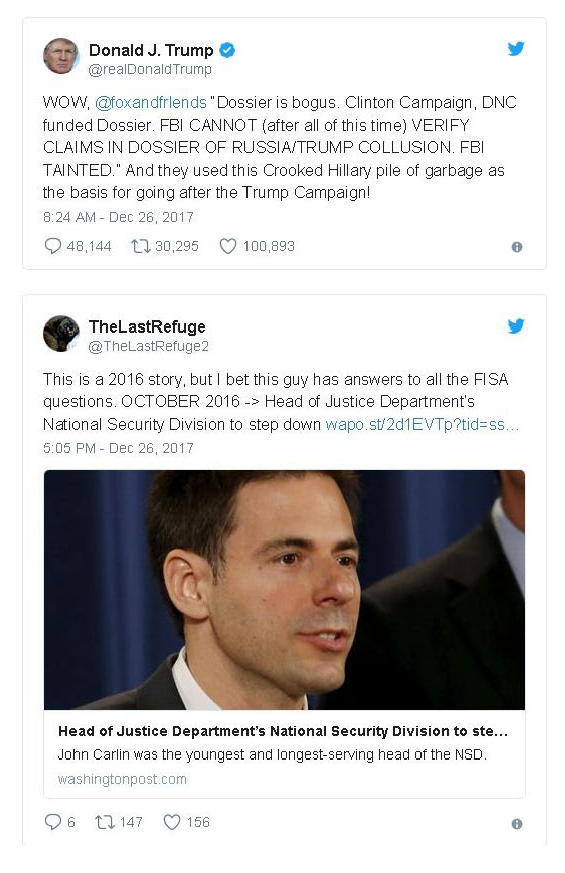



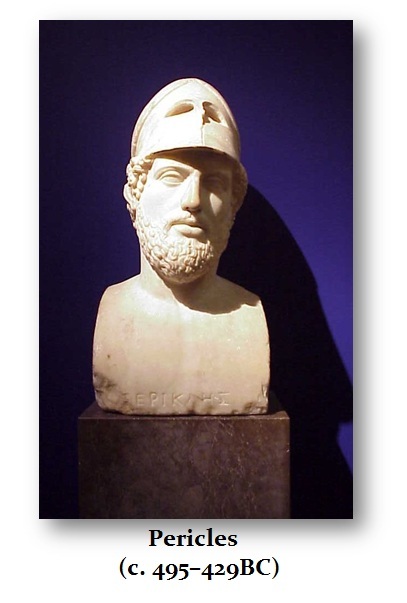



 Centinel2012